air condition AUDI S6 2015 User Guide
[x] Cancel search | Manufacturer: AUDI, Model Year: 2015, Model line: S6, Model: AUDI S6 2015Pages: 314, PDF Size: 77.57 MB
Page 173 of 314
M N
0 <.J 'SI: ,...., \!) 1.1"1 ,...., 1.1"1 ,....,
Child Safety
Important things to know
Introduction
The rear seat is generally the safest place in a
collision.
The physical principles of what happens when
your ve hicle is in a crash app ly also to chi ldren
~ page 13 7, What happens to occupants not
wearing safety belts?.
But unlike adu lts and
teenagers, the ir muscles and bones are not
fu lly developed . In many respects children are
at greater risk of serious injury in crashes than
ad ults.
Because children's bod ies a re not f ully deve l
oped, they require restraint systems especial l y designed for their size, weight, and body
structure. Many co untries and all states of the
United States and provinces of Canada have
laws requ iring the use of approved ch ild re
straint systems for infants and small chi ldren .
In a fronta l crash at a speed of 20 -35 mph
(30-56 km/h) the forces acting on a 13-po und
(6 kg) infa nt w ill be more than 20 t imes the
weight of the child . T his means the weight of
the child would suddenly be more than
260 pounds ( 120 kg). Under these conditions,
on ly an appropr ia t e chi ld restraint properly
used can reduce the risk of ser ious injury.
Ch ild restra ints, like adult safety belts, must
be used properly to be effective. Used improp
erly, they can increase the risk of ser ious in
jury in an accident.
Consult the ch ild safety seat manufacture r's
instr uctions in order to be sure the seat is
right fo r you r ch ild's size ~
page 175, Impor
tant safety instructions for using child safety
seats.
Please be sure to read and heed all of
the impo rtant informat ion and WARNINGS
about ch ild safety, Advanced A irbags, and the
i nstallation of child rest raints in this chapter .
There is a lot you need to know about the Ad
vanced A irbags in your vehicle and how t hey
wo rk when infants and children in child re-
Child Sa fet y 1 71
stra ints are on the front passenge r seat . Be
ca use of the large amount of impo rtant infor
mation, we cannot repeat it a ll here . We urge
you to read the detailed information in t his
owner 's man ua l about a irbags and the Ad
vanced Airbag System in your vehicle and the
very important information about transport
ing children on the front passenge r seat .
Please be sure to heed the WARN INGS -they
are ex tremely importa nt for yo ur safety and
the safety o f you r passengers, especially in
f ants and small chi ldren .
.A, WARNING
-Accident statistics have shown that c hil
dren a re generally safer in the rear seat
area than in the front seating position.
Always restrain any child age 12 and un der in the rea r.
- All vehicle occupants and especially chil
dren must be restrai ned p roperly when
eve r riding in a vehicle . An unr est rained
or improperly restrained chi ld could be
in ju red by str iking the interio r or by be
ing ejected from the vehicle during a
sudden maneuve r or impac t. An un re
straine d or improper ly restrai ned ch ild is
also at greater risk of injury o r death
through contact with an inflating airbag.
- A suitable ch ild restraint properly insta l
led and used at one of the rear seat ing
positions p rov ides the highest degree of
protection for infants and small children
in most accident situations.
A WARNING
Ch ildren on the front seat of any car even
with Advanced Airbags ca n be ser iously in
ju red or even kil led when an a irbag in
fla tes. A child in a rearwar d-fac ing ch ild
safety seat installed on t he front passen
ge r seat will be ser iously injure d and ca n
be killed i f the front airbag inflates .
- T he infla ting air bag will h it the ch ild
safety sea t or i nfan t carrie r wi th great
force an d will smash the child safe ty seat
an d child against the bac krest , center
armrest, or door .
•
•
Page 199 of 314
-If the brake booster is not working, the
brake pedal must be pressed considera
bly harder to make up for the lack of
booster assistance.
Electromechanical
power assist, dynamic
steering
The electromechanical power assist helps the
driver when steering .
Power steering adapts electronically based on
the vehicle speed.
Indicator lights and messages
• Steering defective! Stop the vehicle
If this indicator light turns on and stays on
and this message appears, the power steering
may have failed.
Do
not continue driving. See your authorized
Audi dealer or other qualified repair facility
for assistance .
'y. ij Steering: System fault You can continue
driving
If the indicator light turns on and the mes
sage appears, the steering may be more diffi
cult to move or more sensitive than usual. The
steering wheel may also be at an angle when
driving straight .
Drive slow ly to your authorized Audi dealer or
qualified workshop to have the malfunction
corrected.
' :r- ij Dynamic steering: Initializing
If this d river message appears and the indica
tor light is flashing on the instrument panel,
dynamic steering* is being reinitialized. After
starting the engine, the steering whee l w ill
move slightly. Re-initialization might be nec
essary if the steering wheel was moved hard
to the left and right while the vehicle was not
ev1 moving . The display goes out as soon as initi-
"' 8 alization is complete .
'SI: ,...., \!) 1.1"1 ,...., 1.1"1 ,....,
Intelligent technology 197
Drive slowly to your authorized Audi dea ler or
qualified workshop to have the ma lfunction
corrected.
_& WARNING
Have the dynamic steering* system mal
function repa ired as soon as possible by an
authorized Audi dealer or qualified work
shop -risk of acc ident!
(D Tips
If the . or (;r, ij ind icator light only stays
on for a short time, you may continue driv ing .
- The dynamic steering* stability systems
are not available in the event of a system
malfunction.
- For additional information on dynamic
steering*, refer to¢
page 100.
Driving with your
quattro
Applies to veh icles: w it h all -w hee l drive
-
With all-wheel drive, all four wheels are driv
en.
General information
With all-wheel drive, power is distr ibuted to
all four wheels. This happens automatically
depending on your driving style and the road
cond it ions at the time. See also
Qpage 193.
A center differential distributes the driving
power variably to the front and rear axle.
It
works together with selective wheel torque
control, wh ich activates when driving through
curves ¢
page 194. With the sport differen
tia l*, power distribution to the rear wheels is
variable and can be adjusted with drive se lect
¢ page 100.
The all-whee l drive concept is des igned for
high engine power. Your vehicle is exception
ally powerful and has excellent driving charac
teristics both under normal driving conditions
and on snow and ice. Always read and follow
safety precautions ¢
&- .,._
•
•
Page 230 of 314
228 Check ing and filling
- Always dispose of used engine oil proper
l y . Do not dump it on garden soi l, wood
ed areas, into open streams or down
sewage dra ins.
- Recycle used engine oil by taking it to a
used engine oil collection facility in your
area, or contact a service station.
Engine cooling system
Coolant
The engine coolant performs two functions: it
keeps the engine from overheating and it pro tects the engine from freezing in the winter.
The cooling system is sealed and generally re
qu ires little attention.
The cooling system has been filled at the fac
tory with a permanent coolant which does not need to be changed. The coolant consists of a
mixture of spec ially conditioned water and the
manufacturer's glycol-based coolant addi-
tive G13 antifreeze with ant icorros ion addi
tives (50% for USA models; 60% for Canadian
models). This mixture both assures the neces
sary frost protection and protects metal com
ponents in the engine's coo ling system from
corrosion and scaling . It also raises the boil
ing point of the coolant.
Do not reduce the concentration of the coo l
ant in the summer by adding plain water.
The
p ropo rtion of coolant add itive must be at
l e a st 50 % but not mo re th an 60 %
to ma in
tain antifreeze protection and cooling efficien
cy . If the coolant frost protect ion is too low,
the coo lant cou ld freeze and damage the veh i
cle heating and eng ine cool ing system.
For year-round driving, antifreeze is added at
the facto ry for temperatures down to:
- -31°F(-35°C)USA
- -40 °F ( -40 °C) Canada.
If you m ust add coo lant, use a m ix tu re of wa
ter and coo lant addit ive . M ixing the coolant
additive with disti lled water is recommended .
A WARNING
Before you check anything in the engine
compartment, always read and heed all
WARNINGS~ &.
in Working in the engine
compartment on page
222 .
(D Note
-Before winter sets in, have the coolant
checked to see if the coolant additive in
your vehicle is sufficient to meet the cli mate conditions. This is especia lly impor
tant if you live in a reg ion where t he win
t er is ex treme ly cold. If necessary, in
crease the p roportion of coo lant add it ive
to 60% .
- When adding coolant addi tive to yo ur
c ooling sys tem, remembe r:
- We recommend us ing on ly coolant ad
d itive G12++ or G13 (check the label)
for your vehicle . This coolant additive is
ava ilable at autho rized Aud i dea le rs.
Other types of antifree ze ca n sign ifi
ca ntly reduce co rros io n protec tion. The
res ulting corrosion c an cause a loss of
coolant and serious engine damage.
- Do not add any type of r ad iator le ak seal
ant to yo ur vehicle 's engine coolant .
Adding radiator repair flu id may adverse
ly affect the function and performance of
your cooling system and cou ld resu lt in
damage not covered by your New Vehicle Limited Warranty.
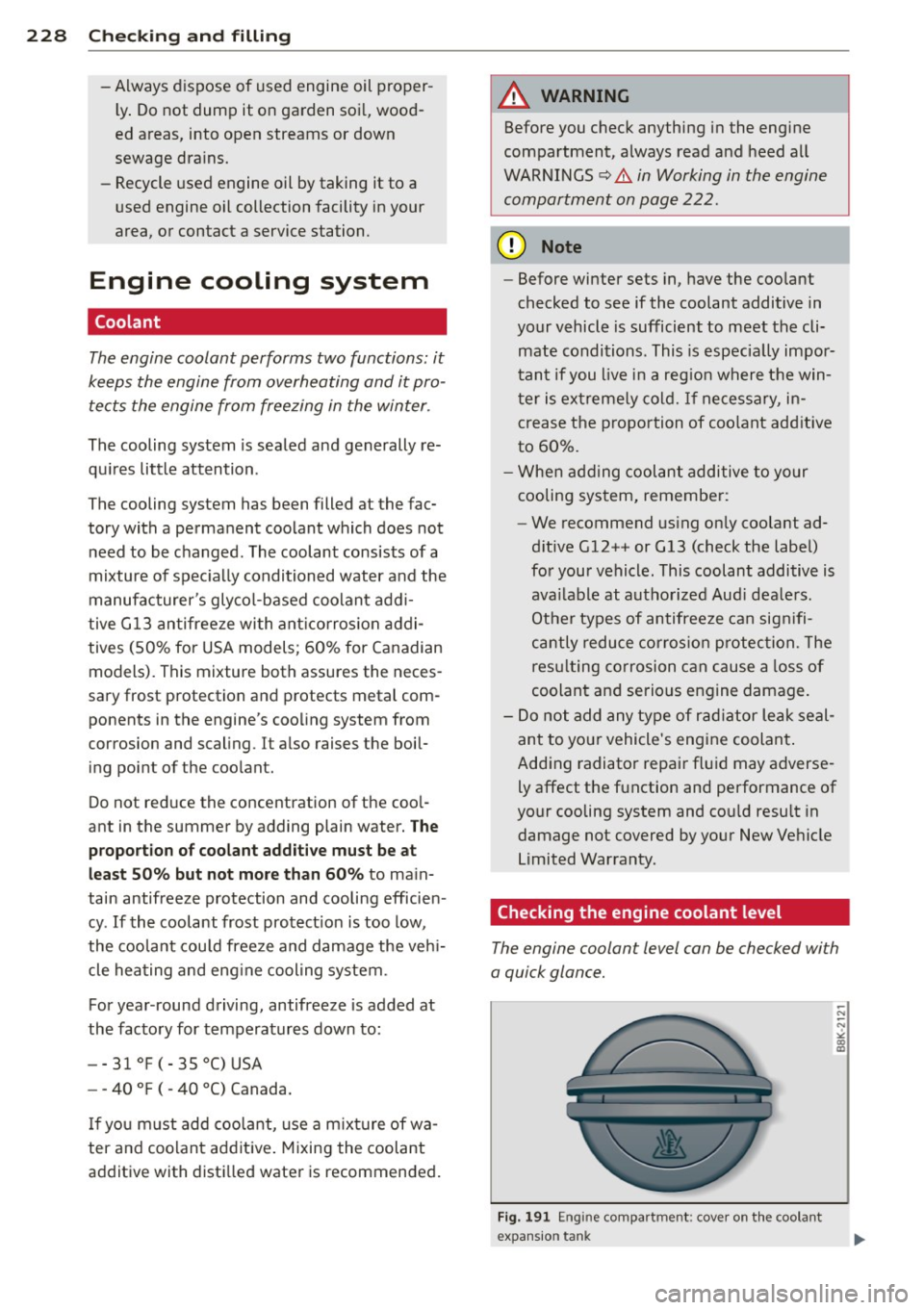
Checking the engine coolant level
-
The engine coolant level can be checked with
a quick glance.
F ig. 1 91 Engi ne compartment: cover on the coola nt
expansio n tank
Page 234 of 314
232 Checking and filling
@ For the sake of the environment
Because of the problem of proper disposal
of brake fluid as we ll as the special tools
required and the necessary expertise, we recommend that you have the brake fluid
changed by your author ized Audi dealer.
Battery
General information
Under normal operating conditions, the bat
tery in your Audi does not need any mainte
nance. With
high outside temperatures or
long daily drives we recommend that you have
the electro lyte level checked by a service fa
cility . The electrolyte level should also be
checked each time the battery is charged
¢ page 234.
Have the battery checked when you take your
vehicle in for service . You are well adv ised to
replace a battery that is older than 5 years .
With certain types of airbag deployment, the battery is disconnected from the vehicle elec
tr ical system for safety reasons¢
& in Re
pair, care and disposal of the airbags on
page 161.
Disconnecting the battery terminals
Some vehicle functions (power window regu
lators, for example) are lost if the battery ter
minals are disconnected. These functions have
to be relearned after the battery terminals are
connected again. To prevent this , the battery
should only be disconnected from the vehicle
e lectrica l system when absolutely necessary
for repairs.
Vehicles not driven for long periods
If you do not drive your vehicle over a period
of severa l days or weeks, electrical compo
nents are gradually cut back or switched off.
This reduces energy consumption and main
tains starting capabi lity over a longer period
¢page 198. Some of the convenience func
tions may not operate, such as the interior
lights or power seat adjustment. The conven- ience
functions will be available again when
you switch on the ignition and start the en gine.
Winter operation
During the winter months, battery capac ity
tends to decrease as temperatures drop. This
is because more power is a lso consumed whi le
starting, and the headlights, rear window de
fogger, etc., are used more often.
Avoid unnecessary power consumption, par
ticu larly in city traffic or when traveling only
short distances. Let your authorized Audi
deale r check the capacity of the vehicle bat
tery before winter sets in¢
page 234 . A well
charged battery will no t only prevent star ting
problems when the weather is cold, but will
also last longer .
@ Tips
If your vehicle is left standing for several
weeks at extremely low temperatures, the
vehicle battery shou ld be removed and
stored where it w ill not freeze. This will
prevent it from be ing damaged and having
to be replaced .
Working on the battery
Be especially careful when working on or near
the battery.
The battery is located in the luggage compart
ment under the floor . Before you check any
thing in the luggage compartment,
read and
heed all WARNINGS
¢ .&, .
Always heed the safety warnings , when work
ing on the vehicle battery or the vehicle elec
t rical system to prevent injury.
The following WARNINGS are very
important when working on the battery:
Always heed the following WARNING SYM-
BOLS and safety precautions when working
on the battery.
®
Always wear eye protection.
Page 242 of 314
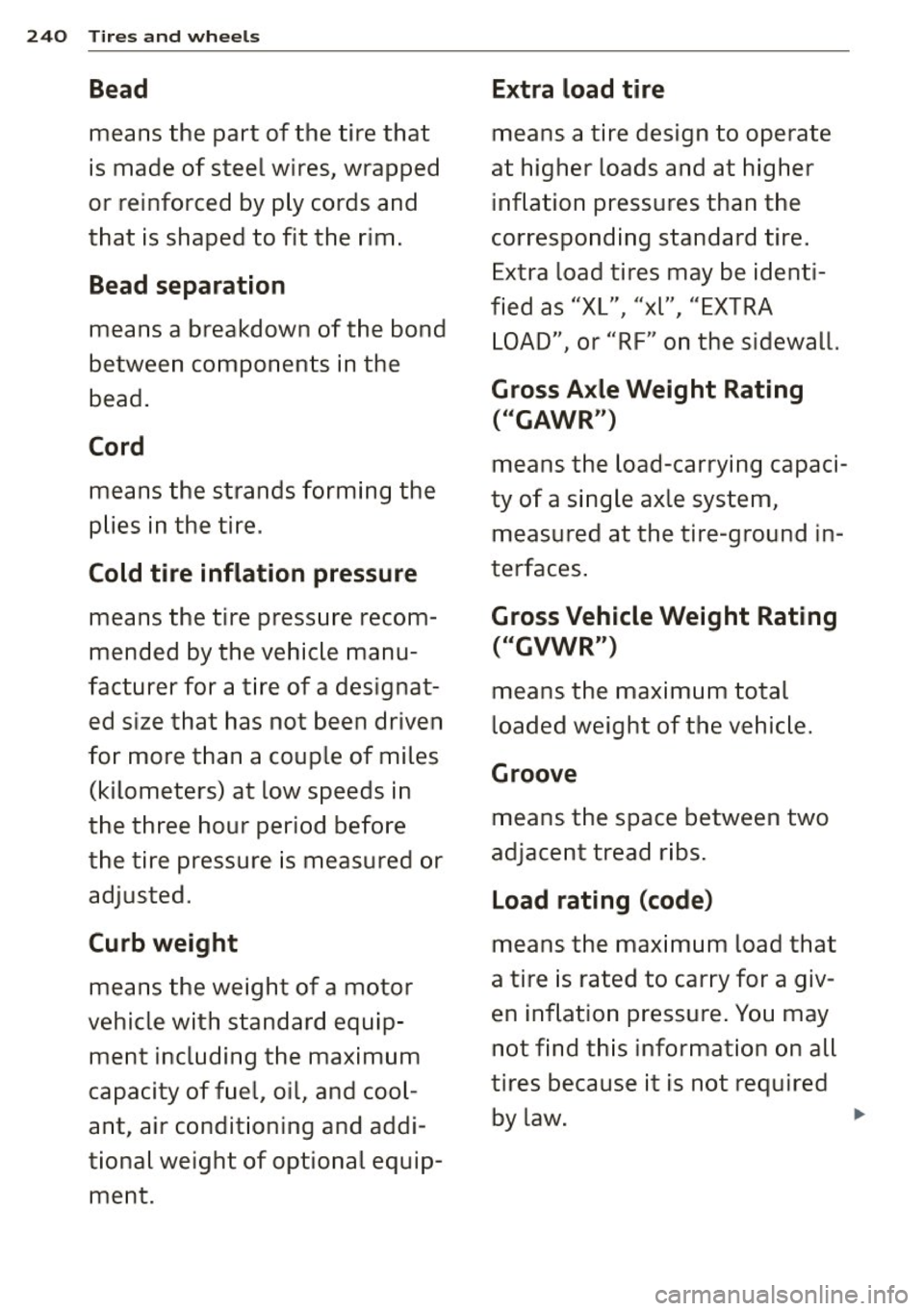
240 Tires and whee ls
Be ad Extra load t ire
means the part of the tire that means a tire design to operate
is made of steel wires, wrapped at higher loads and at higher
or reinforced by ply cords and inflation pressures than the
that is shaped to fit the rim . corresponding standard tire.
Bead separation Extra load tires may be identi-
fied as "XL", "xl", "EXTRA
means a breakdown of the bond LOAD", or "RF" on the sidewall.
between components in the
bead .
Gross A xle Weight Rating
(" GAWR ")
Cord
means the load-carrying capaci-
means the strands forming the ty of a single axle system,
p lies in the tire .
measured at the tire-ground in-
Cold tire inflation pressure terfaces.
means the tire pressure recom-
Gross Vehicle Weight Rating
mended by the vehicle manu-( "GVWR ")
facturer for a t ire of a designat-
means the maximum total
ed size that has not been driven loaded weight of the vehicle.
for more than a couple of miles
Groove
(kilometers) at low speeds in
the three hour period before means the space between two
the tire pressure is measured or adjacent tread
ribs.
adjusted.
Load rating (code)
Curb weight
means the max imum load that
means the weight of a motor a tire
is rated to carry for a giv-
vehicle with standard equip -en inflation pressure
. You may
ment including the maximum not find
this information on all
capacity of fuel, oil , and cool- tires because it is not required
ant, air conditioning and addi- by law.
...
tiona
l weight of optional equip-
ment.
Page 248 of 314
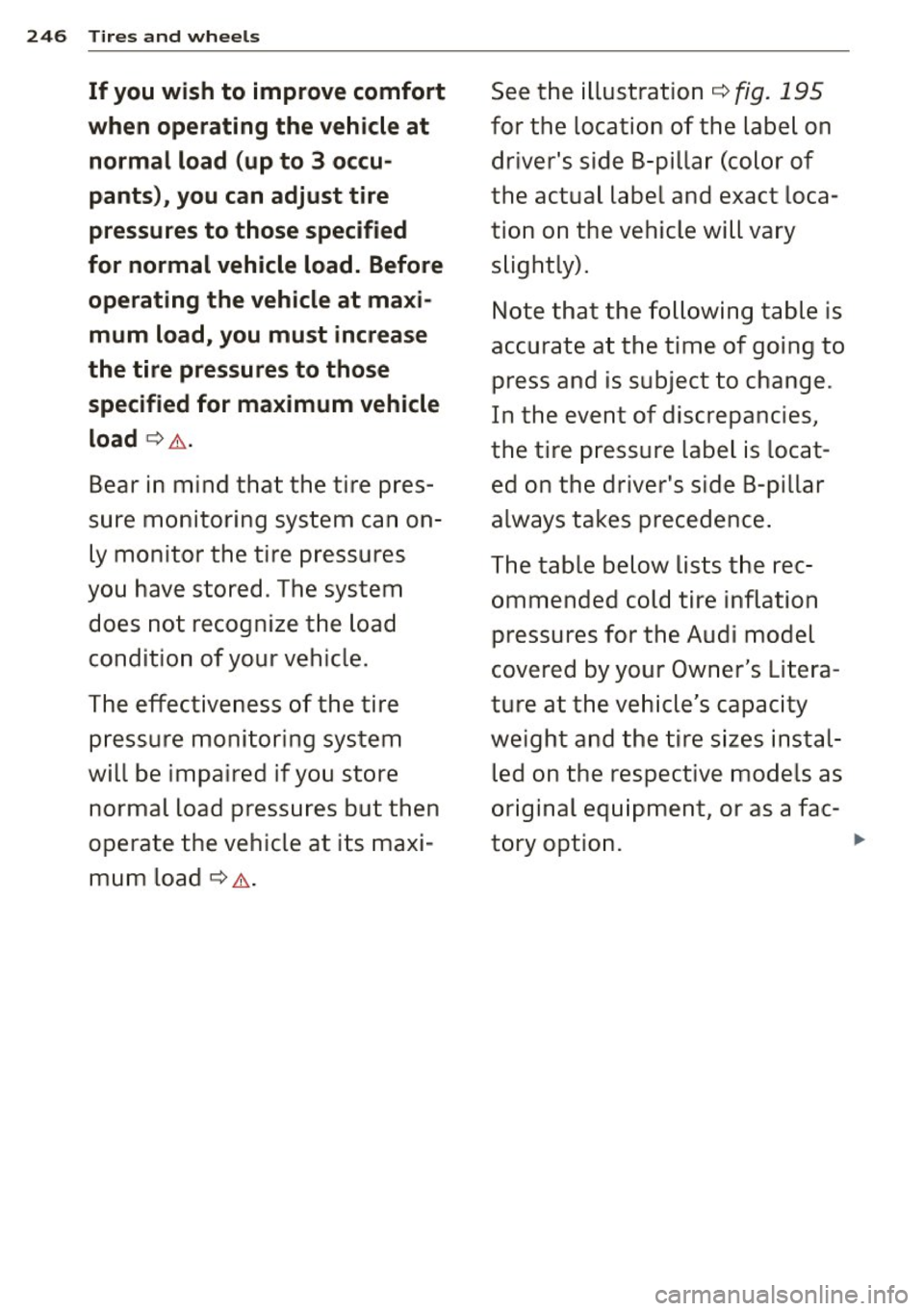
246 Tires and wheel s
If you wish to improve comfort See the illustration ¢ fig. 195
when operating the vehicle at for the locati on of the labe l on
normal load (up to 3 occu -driver's side B -pillar (color of
pants), you can adjust tire the actual label and exact loca-
pressures to those specified tion on the vehic le will vary
for normal vehicle load. Before slight ly) .
operat ing the vehicle at maxi -Note that the following table is
mum load , you must increase accurate at the time of going to
the ti re pressu res to those press and is subject to change .
specified for maximum vehicle In the event of discrepancies,
load¢&. the tire pressure labe l is locat-
Bear in mind that the tire pres- ed on the driver's side 8-pi llar
sure monitoring system can on -always takes precedence .
ly monitor the tire pressures The table below lists the rec-
you have stored . The system
ommended cold tire inflation
does not recogn ize the load
pressures for the Audi model
condition of your vehic le.
covered by your Owner's Litera-
T he effectiveness of the tire ture at the vehicle's capacity
pressure monitoring system weight and the tire sizes instal -
will be impaired if you store led on the respective mode ls as
normal load pressures but then original equipment, or as a fac-
operate the vehicle at its maxi- tory option.
...
mum load¢&.
Page 260 of 314
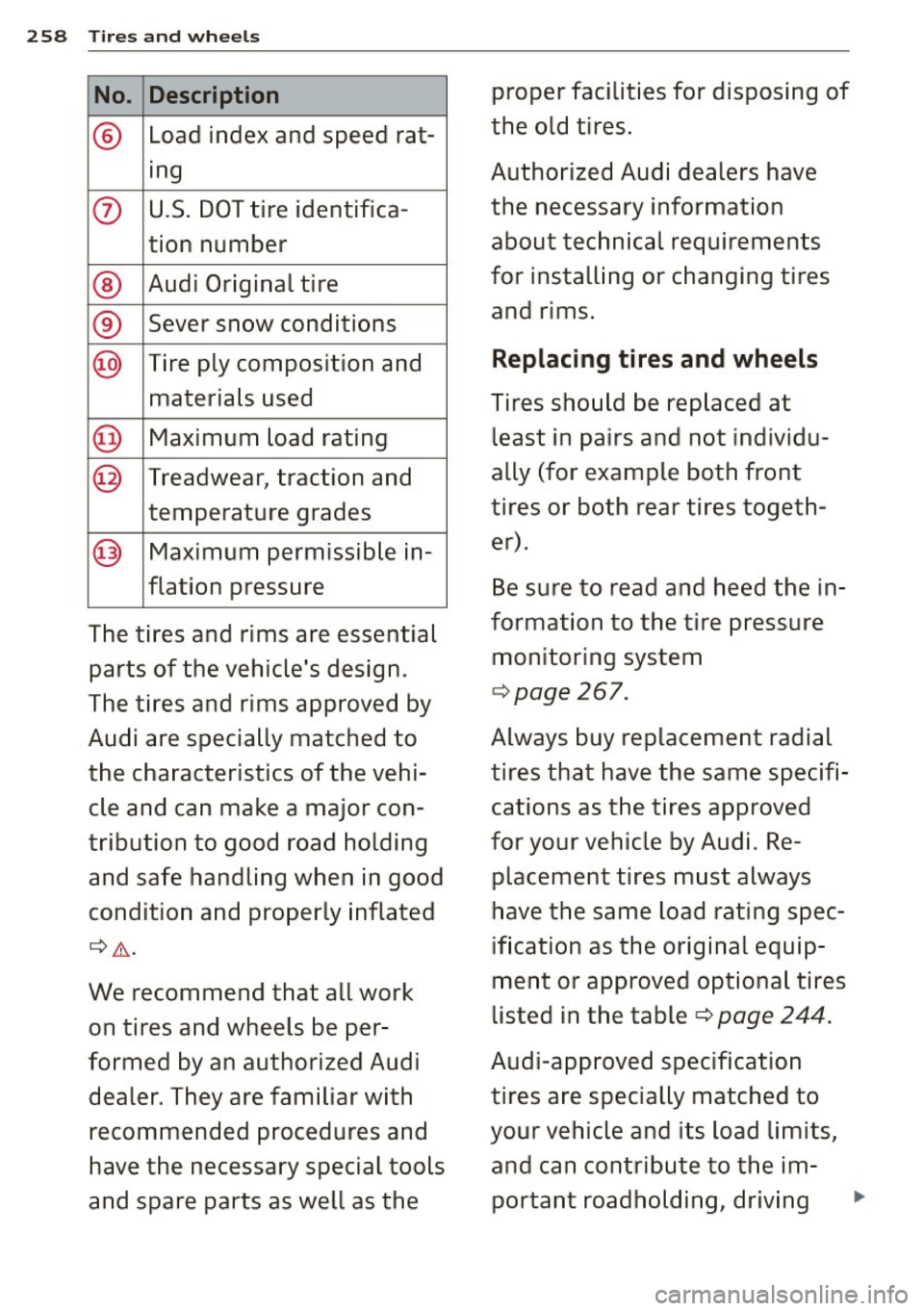
258 Tires an d whee ls
No . Description
® Load index and speed rat-
ing
(J) U.S . DOT tire identifica-
tion number
® Audi Original tire
® Sever snow conditions
@ Tire ply composition and materials used
@ Maximum load rating
@ Treadwear, traction and
temperature grades
@ Maximum permissible in-
flation pressure
T he tires and rims are essential
parts of the vehicle's design .
The tires and rims approved by
Audi are specially matched to
the characteristics of the vehi
cle and can make a major con
tribution to good road holding and safe handling when in good
condition and properly inflated
c::> ,&. .
We recommend that a ll work
on tires and wheels be per
formed by an authorized Audi
deale r. They are familiar with
r ecommended p rocedures and
have the necessary special too ls
and spare parts as well as the proper facilities for disposing of
the old ti res.
Autho rized Audi dealers have
the necessary information
about technical requirements
for installing or changing tires
and rims .
Replacing tires and wheels
Tires sho uld be replaced at
least in pairs and not individu
ally (for example both front
tires or both rear tires togeth
er).
B e sure to read and heed the in
formation to the tire pressure
monitoring system
c::> page 267.
Always buy replacement radial
tires that have the same specifi
cations as the tires approved
f or your vehicle by Audi. Re
placeme nt tires m ust always
have the same load rating spec
ification as the orig inal equip
ment or approved optional tires
listed in the table
c::> page 244.
Audi-app roved spec ificat io n
tires are specially matched to
your vehicle and its load limits ,
and can contribute to the im -
portant roadholding, driv ing .,.
Page 266 of 314
264 Tire s and wheel s
Sustained high temperature can cause the
materia l of the tire to degenerate and reduce
tire life, and excessive temperature can lead
to sudden tire failure<=>,& .
The grade C corresponds to a level of perform
ance which a ll passenger car tires must meet
under the Federa l Motor Veh icle Safety Stand
ard No.
109. Grades Band A represent higher
levels of performance on the laboratory test
wheel than the m inimum required by law .
A WARNING
The traction grade assigned to this t ire is
based on stra ight-ahead braking traction
tests, and does not include acceleration,
corne ring, hydrop lan ing o r peak traction
character istics .
A WARNING ,.,.____
The temperature grade for this tire is es
tablished for a tire that is p roperly inflated
and not overloaded. Excessive speed, un
derinflation, or excessive loading, either
separate ly or in combination, can cause
heat buildup and possible tire fa ilure.
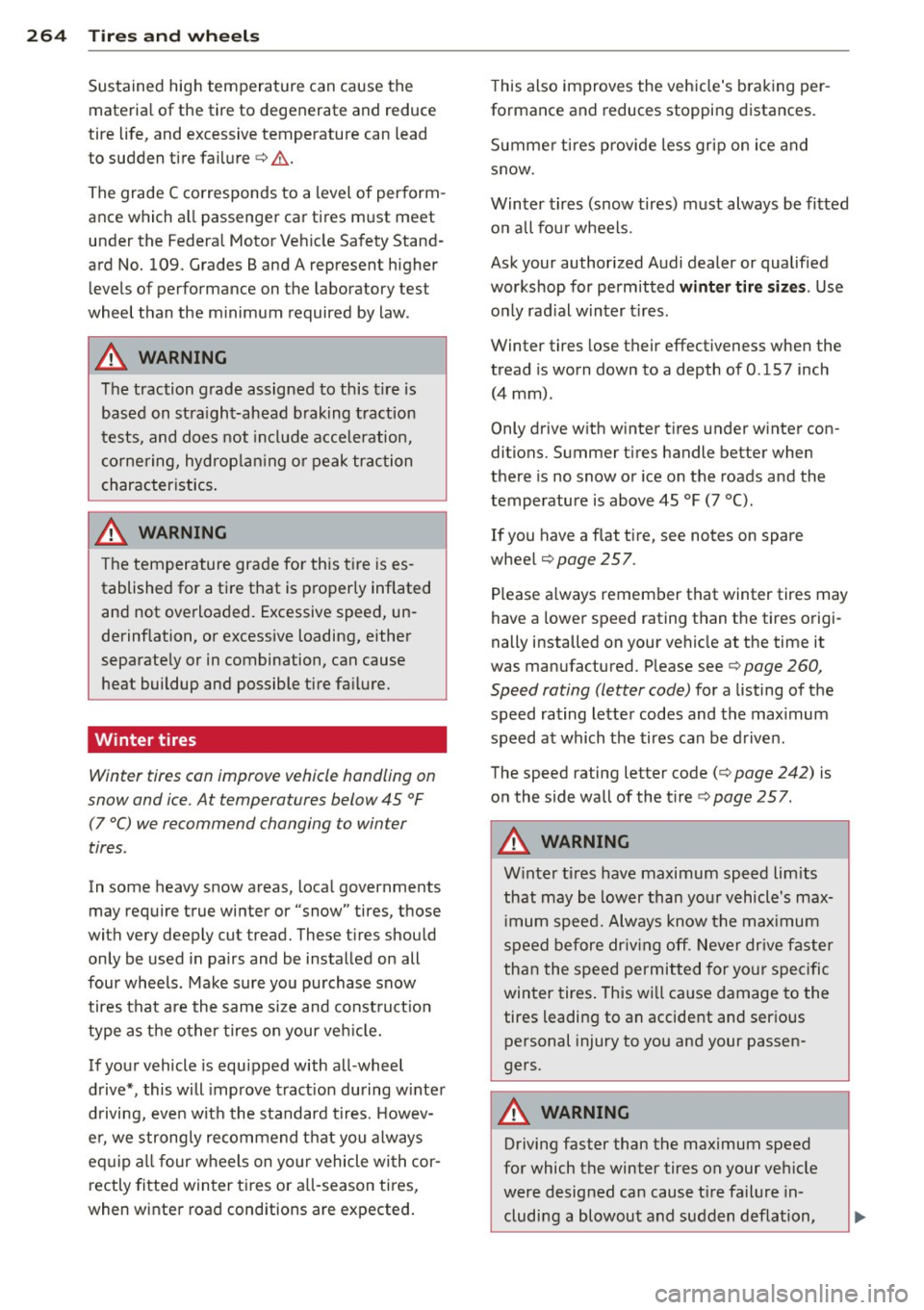
Winter tires
Winter tires can improve vehicle handling on
snow and ice. At temperatures below 45 °F
(7 °C) we recommend changing to winter
tires .
In some heavy snow areas, loca l governments
may require true winter or "snow" tires, those
with very deeply cut tread. These t ires should
only be used in pairs and be installed on all
four wheels. Make sure yo u purchase snow
tires that are the same size and const ruct ion
type as t he other tires on your ve hicle.
If your vehicle is equ ipped with all -wheel
drive*, this will improve t ract ion during w inter
d riving, even wit h the standard tires. Howev
e r, we strong ly recommend that you always
eq uip a ll four w heels on yo ur vehicle wi th cor
rectly fitted win ter tires or a ll-season tires,
when winte r road conditions are expected . This also improves the veh
icle's brak ing per
formance and reduces stopping distances.
Summe r tires p rovide less gr ip on ice and
snow.
Winter tires (snow tires) must always be fitted on all fou r wheels .
Ask your authorized Audi dealer or qualified
workshop for perm itted
winter tire siz es. Use
o n ly rad ial winter t ires .
Winter tires lose their effectiveness when the
tread is worn down to a depth of
0 .157 inch
(4 mm).
Only drive w ith w inter t ires under winter con
ditions. Summer t ires handle better when
there is no snow or ice on the roads and the
temperature is above 45 °F (7 °() .
If you have a flat tire, see notes on spare
wheel
<=>page 257.
Please a lways remember that winter tires may
have a lower speed rating than the tires origi
nally installed on your vehicle at the time it
was manufactured. P lease see<=>
page 260,
Speed rating (letter code)
fo r a listing of the
speed rating lette r codes and the max imum
speed at which the tires can be d riven .
The speed rating letter code (<=>
page 242) is
on the side wall of the t ire
c> page 257.
A WARNING ,.___
W inter t ires have maximum speed lim its
that may be lower than yo ur vehicle's max
i mum speed. Always know the max imum
speed before dr iv ing off. Never dr ive faster
than the speed permitted for yo ur specific
winter tires . This wi ll ca use damage to the
tires leading to an accident and ser ious
personal injury to you and your passen
gers.
A WARNING
'----
Driving faster than the maximum speed
for which the winter tires on your vehicle were designed can cause t ire failure in
cluding a blowout and sudden deflation,
Page 267 of 314
M N
0 <.J 'SI: ,...., \!) ..,.,
,...., ..,., ,....,
loss of control, crashes and serious per
sonal injuries . Have worn or damaged tires
replaced immediate ly.
- Winter tires have maximum speed rating
that may be lower than your vehicle's
maximum speed.
- Never drive faster than the speed for
which the winter or other tires installed
on your vehicle are rated.
A WARNING
Always adjust your driving to the road and
traffic conditions. Never let the good ac
celeration of the winter tires and all-wheel
drive tempt you into taking extra risks. Al
ways remember:
- When braking, an all-wheel drive vehicle
handles in the same way as a front drive
vehicle.
- Drive carefully and reduce your speed on
icy and slippery roads, even winter tires
cannot help under black ice conditions.
@) For the sake of the environment
Use summer tires when weather condi
tions permit. They are quieter, do not wear
as quickly and reduce fuel consumption.
Snow chains
Snow chains may be fitted only to the front
wheels, and only to certain tire sizes. Ask your
authorized Audi dealer on which tire sizes
snow chains can be used.
If you are going to use snow chains, then you
must install them on the front wheels at
least.
The snow chains must have low-profile links
and must not be thicker than 0.4 inch (10,5 mm), including the lock.
Remove wheel center covers and trim discs
before putting snow chains on your vehicle
q(D _ For safety reasons cover caps must then
be fitted over the wheel bolts. These are avail
able from authorized Audi dealers.
Tires and wheels 265
A WARNING
Using the wrong snow chains for your vehi
cle or installing them incorrectly can in
crease the risk of loss of control leading to
serious personal injury.
- Snow chains are available in different sizes . Always make sure to follow the in
structions provided by the snow chain
manufacturer.
- When driving with snow chains never
drive faster than the speed permitted for
your specific snow chains.
- Always observe local regulations.
([) Note
-Remove snow chains before driving on
roads not covered with snow to avoid
damaging tires and wearing the snow
chains down unnecessarily.
- Snow chains, which come into direct con
tact with the wheel rim, can scratch or
damage it. Therefore, make sure that the
snow chains are suitably covered. Check
the position of the snow chains after
driving a few yards and correct if neces
sary. Follow the instructions from the
snow chain manufacturer when doing so.
- If the Adaptive Air Suspension* should
malfunction, do not mount or use snow
chains because the vehicle will be ex
tremely low. If you do drive with snow
chains on while the vehicle is at this lev
el, the snow chains might severely dam
age the wheelhouse and other parts of
the vehicle.
(D Tips
Where snow chains are mandatory oncer
tain roads, this normally also applies to
vehicles with all-wheel drive.
•
•
Page 269 of 314
M N
0 <.J 'SI: ,...., \!) 1.1'1 ,...., 1.1'1 ,....,
thro ugh or over such obstacles can damage
your tires. Impact with a curb may a lso
cause damage to your tires .
- After any impact, immediately inspect your
tires or have them inspected by the nearest
authorized Audi dea ler. Replace a damaged
t ire as soon as possible.
- Inspect yo ur tires every 2,000 miles (3,000
km) for damage and wear . Damage is not al
ways easy to see. Damage can lead to loss of
air and underinflation, wh ich could eventu
ally cause tire fa ilure . If you be lieve that a
t ire may have been damaged, replace the
t ir e as soo n as possible.
- T hese tires may wear more quickly than oth
ers .
- Please also remember that, while these tires deliver respons ive handling, they may ride
less comfortably and make more no ise than
othe r cho ices .
Reduced perf ormance in winter /cold
season condition s
All t ires are des igned for certain pu rposes.
The low aspect ratio, ultra hig h pe rformance
tires orig inally installed on your veh icle are in
tended for maximum dry and wet road per
formance and handling . They are not s uitable
for cold, snowy or icy weather conditions. If
you dr ive under those circumstances, you
should equip your vehicle with all-season or
winter tires, which offer better traction under
those cond itions . We suggest you use the rec
ommended snow or all-season tires specified
fo r your ve hicle, or their equ ivalent.
Refer to¢
page 264 for mo re deta iled infor
mat io n regarding winter t ires .
Tire pressure
monitoring system
U) General notes
Each t ire, includ ing the spare (if provided),
should be checked month ly when cold and in
flated to the inflation pressure recommended by the vehicle manufacture r o n the vehicle
p lacard or tire inflation pressure label. (If yo ur
Tire s an d wheel s 267
vehicle has tires of a different size than the
size indicated on the vehicle placard or tire in
flat ion pressure labe l, you sho uld determine
the proper t ire inflation press ure for those
tires).
As an added safety feature, your vehicle has been equipped with a tire pressure monitoring
system (TPMS) that illum inates a low tire
pressure telltale when one or more of your
ti res is significant ly under-inflated. According
ly, when the low tire pressure telltale illumi
nates, you shou ld stop and check you r tires as
soon as possib le, and inflate them to the
proper pressu re. Driving on a sign ifican tly un
der -infla ted ti re causes the tire to overhea t
and can lead to tire fai lure . Under-inflation al
so reduces fuel efficiency and tire tread life,
and may affect the vehicle 's hand ling and
stopp ing ability.
Please note that the TPMS is not a substitute
for proper tire maintenance, and it is the driv er's respons ibility to maintain correct tire
pressure, even if under-inflation has not
reached the level to tr igger illuminat ion of t he
TPMS low tire pressu re tellta le.
Your vehicle has also been equipped with a
TPMS malfunction indicator to ind icate when
the system is not operating properly. The
TPMS ma lfunction indicator is combined with
the low t ire pressure telltale . Whe n the sys
tem detects a malfunction, the telltale will
flash fo r approximate ly one m inute and then
r em ain continuously illum ina ted . Thi s se
quence will continue upon s ubsequent vehicle
start-ups as long as the malfunction exists .
When the malfunction indicato r is illum inat
ed, the sys tem may no t be ab le to detec t or
s ignal low tire pressure as in tended . TPMS
malfu nctions may occur for a var iety of rea
sons, incl uding the insta llation of rep lace
ment or a lternate tires or wheels on the vehi
cle that prevent the TPMS from functioning properly. Always check the TPMS malfunction
telltale after rep laci ng one or more tires or
whee ls on your vehicle to ensu re that the re
placement o r alternate tires and wheels a llow
the TPMS to con tinue to funct ion p ro perly .
•
•