battery AUDI S6 2015 User Guide
[x] Cancel search | Manufacturer: AUDI, Model Year: 2015, Model line: S6, Model: AUDI S6 2015Pages: 314, PDF Size: 77.57 MB
Page 78 of 314

76 On the road
compartment is additionally heated by
the sun's rays.
(D Note
Do not stop the engine immediate ly after
hard or extended driving. Keep the engine r un ning for approximately two minutes to
prevent excessive heat build -up.
Driver message in the instrument
cluster display
Turn off ignition before leaving car
This message appears and a warning tone
sounds if you open the dr iver 's door when the
i gnit ion is switched on .
Press brake pedal to start engine
This message appears if you press the
I START ENGINE STOP! button to start the en
gine and do not depress the brake peda l. The
engine can on ly be started if the brake pedal
is depressed.
Ill Is key in the vehicle?
If the indicator light turns on and the mes
sage appears, the remote control key was re
moved from the vehicle while the engine was
running . If the ignition key is not in the vehi
cle you will not be ab le to switch on the igni
tion or restart the engine after it has been
switched off. You w ill also not be able to lock
the vehicle from the outside .
Shift to P, otherwise vehicle can roll away.
Doors do not lock if lever is not in P.
This message appears for sa fe ty reasons
a long with an audib le warning tone if the P
selector lever position is not engaged when
stopping the engine with the
I STAR T ENGIN E ST OP ! button . Select the P se
lector lever position . Otherwise the vehicle
could roll and it can not be locked .
II Key is not recognized. Hold back of key
against marked area . See owner's manual.
If the indicator light turns on and this mes
sage appears, there is a malfunction
¢ page 76.
Turn off ignition before leaving car. Battery
is discharging
T h is message appears if the driver's door is
opened while the ignition is switched on. Al
ways switch off the ignit ion if you are leav ing
the vehicle . See also ¢
page 80.
Shift to P and turn off ignition before leav
ing car, otherwise vehicle can roll away
This message appears if the driver's door is
opened wh ile the ignition is switched on and
the selec tor lever is not in the P position. Shift
the selec tor lever into the P position and
swi tch off the ignition when you exit the vehi
cle. Otherwise the vehicle could roll . See also
¢ page 80.
Starting the engine if there is a
malfunction
It may not be possible to start the engine un
der cer tain circums tances, for example if the
ba ttery in the vehicle key is drained, if in ter
ference hos affected the key or if there is a
system malfunction .
Fig. 78 Center co nsol e/master key: star ting the eng ine
i f the re is a mal funct ion
Requirement: The message Key not recog
nized. Hold back of key against marked area.
See owner's manual.
must appear and the in
dicator light
II must sw itch on .
.,. Hold the master key vertically in the loca
tion indicated
f >l) ¢ fig . 78 .
.,. Press the brake pedal ¢ A in Starting the
engine on page
75 .
Page 82 of 314
80 On the road
lever position and take your foot off the brake
pedal.
If you select the R position during a Stop
phase, the engine will start again.
Shift from
D to P quickly to prevent the engine
from starting unintentionally when shifting
through
R.
You can determine for yourself if the engine
will stop or not by reducing or increasing the
amount of force you use to press the brake
pedal. For example, if you only lightly press
on the brake pedal in stop-and and-go traffic
or when turning, the engine will not switch off
when the vehicle is stationary. As soon as you
press the brake down harder, the engine will
switch off.
General information
App lies to vehicles: with Start-Stop-System
The standard Start-Stop-mode can be cancel
led for different system-related reasons.
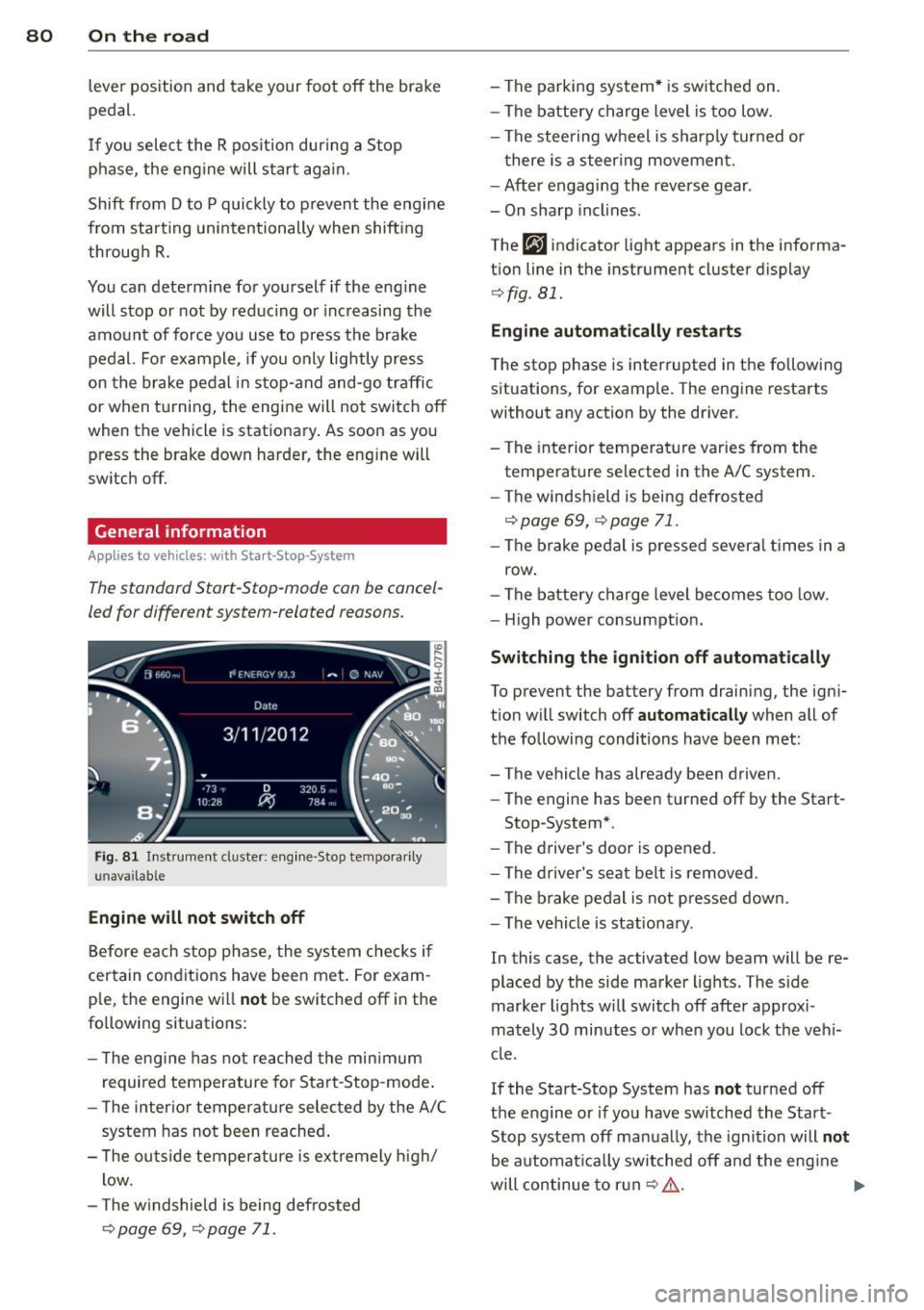
Fig . 81 Instrument cluster: engine -Stop tempo rarily
unava ilable
Engine will not switch off
Before each stop phase, the system checks if
certain conditions have been met. For exam·
ple, the engine will
not be switched off in the
following situations:
- The engine has not reached the minimum
required temperature for Start-Stop-mode.
- The interior temperature selected by the A/C
system has not been reached.
- The outside temperature is extremely high/
low .
- The windshield is being defrosted
¢ page 69, ¢ page 71.
-The parking system* is switched on.
- The battery charge level is too low.
- The steering wheel is sharply turned or
there is a steering movement.
- After engaging the reverse gear .
- On sharp inclines.
The
fjJ indicator light appears in the informa
tion line in the instrument cluster display
¢fig . 81.
Engine automatically restarts
The stop phase is interrupted in the following
situations, for example. The engine restarts
without any action by the driver.
- The interior temperature varies from the
temperature selected in the A/C system.
- The windshield is being defrosted
c:!;> page 69, ¢ page 71.
-The brake pedal is pressed several times in a
row.
- The battery charge level becomes too low.
- High power consumption.
Switching the ignition off automatically
To prevent the battery from draining, the igni
tion will switch off
automatically when all of
the following conditions have been met :
- The vehicle has already been driven.
- The engine has been turned off by the Start-
Stop-System*.
- The driver's door is opened.
- The driver's seat belt is removed .
- The brake pedal is not pressed down.
- The vehicle is stationary.
In this case, the activated low beam will be re
placed by the side marker lights. The side
marker lights will switch off after approxi
mately
30 minutes or when you lock the vehi
cle.
If the Start-Stop System has
not turned off
the engine or if you have switched the Start
Stop system off manually, the ignition will
not
be automatically switched off and the engine
will continue to run
c:!;> ,&. .,..
Page 101 of 314

M N
0 <.J 'SI: ,...., \!) 1.1"1 ,...., 1.1"1 ,....,
@ Tips
-Side assist is not active while you are
making the adjustment.
- Your settings are automatically stored
and assigned to the remote control key
being used.
Driver messages
Applies to vehicles: with side assist
If side assist switches off by itself, the LED in
the button turns off and a message will ap
pear in the instrument cluster display:
Audi side assist: Currently unavailable. No
sensor vision
The radar sensors' vision is affected. Do not
cover the area in front of the sensors with bike
wheels, stickers, dirt or other objects. Clean
the area in front of the sensors, if necessary
c>page97, fig.103.
Audi side assist: Currently unavailable
Side assist cannot be switched on temporarily
because there is a malfunction (for example,
the battery charge level may be too low).
Audi side assist: System fault!
The system cannot guarantee that it will de
tect vehicles correctly and it is switched off .
The sensors have been displaced or are faulty.
Have the system checked by an authorized
Audi dealer or authorized Audi Service Facility
soon.
Audi side assist: Unavailable when towing.
Side assist switches off automatically when a
factory-installed trailer hitch is connected to
the electrical connector on the trailer. There is
no guarantee the system will switch off when
using a retrofitted trailer hitch. Do not use
side assist when towing a trailer.
Audi side assist 99
Page 115 of 314
M N
0 I.J "". rl I.O
"' rl
"' rl
There is a system malfunction in the transmis
sion. You may continue driving. Drive to your
authorized Audi dealer or qualified repair fa
cility soon to have the malfunction corrected.
rm Transmission malfunction: You can con
tinue driving with limited functionality
There is a system malfunction in the transmis
sion. The transmission is switching to emer
gency mode. This mode only shifts into cer
tain gears or will no longer shift at a ll. The en
g ine may stall. Drive to your authorized Audi
dealer or qualified repair facility immediately
to have the malfunction corrected .
rm ffl Transmission malfunction: No reverse
gear. You can continue driving
S tronic transmission: There is a system ma l
function in the transmission. The transmis
sion is switching to emergency mode. This mode on ly shifts into certain gears or will no
longer shift at all. The engine may sta ll. You
cannot engage the reverse gear. Drive to your
author ized Audi dealer or qualified repair fa
cility immed iately to have the malfunction
corrected .
rm Transmission malfunction: Stop vehicle
and shift to P
Do not cont inue driving. Select the P se lector
lever position and see your authorized Aud i
dealer or qualified repair facility for assis
tance.
(D Note
If the transmiss ion switches to emergency
mode, you should take the vehicle to an
author ized Audi dealersh ip as soon as pos
sible to have the cond ition corrected .
Automatic Transmission 113
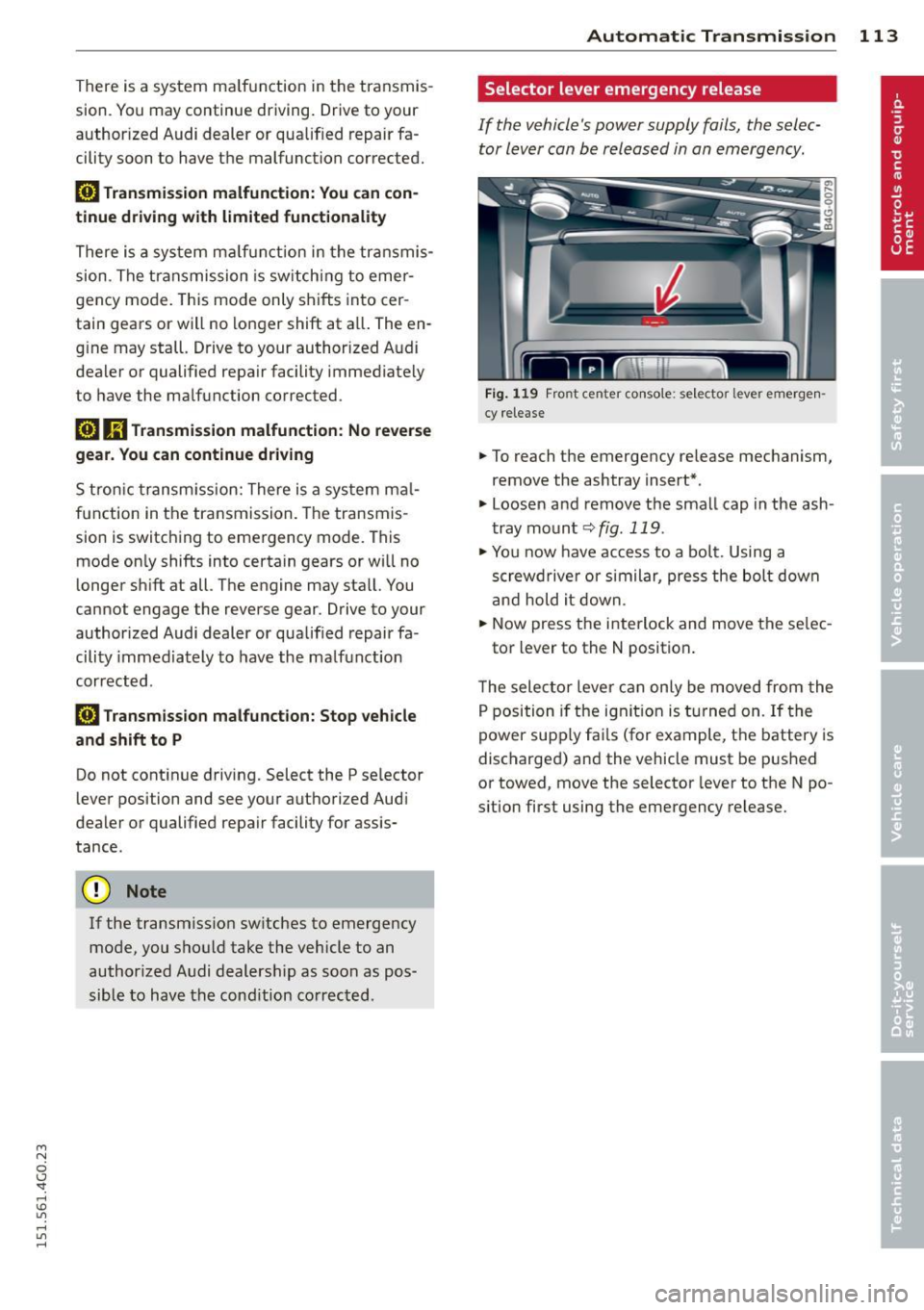
Selector lever emergency release
If the vehicle 's power supply fails, the selec
tor lever can be released in an emergency.
F ig . 1 19 Front center co nsole: selector lever emerge n
cy rele ase
.,. To reach the emergency release mechanism,
remove the ashtray insert*.
.,. Loosen and remove the small cap in the ash
tray mount
q fig. 119 .
.,. You now have access to a bolt. Using a
screwd river or similar, press the bolt down
and hold it down .
.,. Now press the interlock and move the se lec-
tor lever to the N position .
T he selector lever can only be moved from the
P position if the ignit ion is turned on. If the
power supply fai ls (for example, the battery is
discharged) and the vehicle must be pushed
or towed, move the selector lever to the N po
s ition first using the emergency release.
Page 163 of 314
M N
0 <.J 'SI: ,...., \!) 1.1"1 ,...., 1.1"1 ,....,
Repair, care and disposal of the airbags
Parts of the airbag system are installed at
many different places on your Audi. Installing,
removing, servicing or repairing a part in an
area of the vehicle can damage a part of an
airbag system and prevent that system from
working properly in a collision.
There are some important things you have to know to make sure that the effectiveness of
the system will not be impaired and that dis
carded components do not cause injury or pol lute the environment.
A WARNING
Improper care, servicing and repair proce
dures can increase the risk of personal in
jury and death by preventing an airbag from deploying when needed or deploying
an airbag unexpectedly:
- Never cover, obstruct, or change the
steering wheel horn pad or airbag cover
or the instrument panel or modify them
in any way.
- Never attach any objects such as cup
holders or telephone mountings to the
surfaces covering the airbag units.
- For cleaning the horn pad or instrument
panel, use only a soft, dry cloth or one
moistened with plain water. Solvents or
cleaners could damage the airbag cover
or change the stiffness or strength of the
material so that the airbag cannot de
ploy and protect properly.
- Never repair, adjust, or change any parts
of the airbag system.
- All work on the steering wheel, instru
ment panel, front seats or electrical sys
tem (including the installation of audio
equipment, cellular telephones and CB
radios, etc.) must be performed by a
qualified technician who has the training
and special equipment necessary.
- For any work on the airbag system, we
strongly recommend that you see your
authorized Audi dealer or qualified work
shop.
Airbag system 161
-Never modify the front bumper or parts
of the vehicle body.
- Always make sure that the side airbag
can inflate without interference:
- Never install seat covers or replace
ment upholstery over the front seat
backs that have not been specifically
approved by Audi.
- Never use additional seat cushions that
cover the areas where the side airbags inflate.
- Damage to the original seat covers or
to the seam in the area of the side air
bag module must always be repaired
immediately by an authorized Audi
dealer.
- The airbag system can deploy only once. After an airbag has been deployed, it must be replaced with new replacement
parts designed and approved especially
for your Audi model version. Replace
ment of complete airbag systems or air
bag components must be performed by
qualified workshops only . Make sure that
any airbag service action is entered in
your Audi Warranty
& Maintenance book
let under
AIRBAG REPLACEMENT RE
CORD.
- For safety reasons in severe accidents,
the alternator and starter are separated
from the vehicle battery with a pyrotech
nic circuit interrupter.
- Work on the pyrotechnic circuit inter
rupter must only be performed by a
qualified technicians who have the ex
perience, information and special tools
necessary to perform the work safely.
- If the vehicle or the circuit interrupter
is scrapped, all applicable safety pre
cautions must be followed.
@) For the sake of the environment
Undeployed airbag modules and preten
sioners might be classified as Perchlorate
Material - special handling may apply, see
•
•
Page 200 of 314
198 Intelligent technology
Winter tires
When dr iv ing in the w inter, your ve hicl e w ith
a ll-whee l drive has an advantage,
even with
regular ti res . In winter road conditions it may
be advisable to mount winter tires (o r all-sea
son t ires) for improved driveability and brak
ing: these tires must be mounted on
all four
whe els .
See also c:> page 264, Winter tires.
Tire chains
Where tire cha ins are mandatory on certa in
roads, th is normally a lso applies to vehicles
with a ll-wheel drive
c:> page 265, Snow
chains.
Replacing wheel s/tir es
Vehicles w ith all-wheel drive must a lways
have tires of the same size . Also avoid tires
with d ifferent tread depths. For details see
page
c:> page 257, New tires and replacing
tires and wheels.
Off-Road driv ing?
Your Audi does not have enough ground clear
ance to be used as an off-road ve hicle . It is
therefore best to avoid rough tracks and un
even terrain as much as possible. Also refer to
c:> page 201.
A WARNING
Always adjust your driving to road and traf
fic conditions . Do not let the ext ra safety
afforded by all-wheel dr ive tempt you into
taking extra risks.
- Alt hough the all-whee l dr ive is
very ef
fec tive, a lways remember that b raking
c ap aci ty is limited by tire traction. Yo u
sho uld the re fo re not dr ive at excessive
speeds on icy or slippery road su rfaces.
- O n wet road s urfa ces, be c areful not to
drive too fast because the front wheels
cou ld begin to sli de on top of the water
(aq uaplaning) . If this sho uld occ ur, you
will have no warn ing from a sudden in
crease in engine speed as with a front
w heel d rive vehicle. A lways drive at
speeds w hich are suited to the road con
ditions -risk of c rash.
Energy management
Starting ability is optimized
Energy management controls the distribution
of electrical energy and thus optimizes the
availability of electrical energy for starting the engine.
If a vehicle with a conventiona l energy system
is not driven for a long period of t ime, t he bat
te ry is discharged by idling current consume rs
(e .g. immobili ze r). In certa in circumstan ces it
ca n res ult in the re be ing insu ffic ien t energy
available to start the eng ine.
Intelligent energy management in your vehi
cl e ha ndles the dist rib ution o f electr ica l ene r
gy. Start ing abili ty is m arke dly improved and
the life of the battery is extended .
Bas ica lly, energy management consists of
battery diagnosis , idling current manage
ment
and dynamic energy management .
Battery diagnosis
Battery diagnosis continuously determines
the state of the batte ry. Sensors determine
batte ry voltage, batt ery cu rr e nt and battery
tempe ratu re. This de termines the cur ren t
sta te o f cha rge and t he power o f th e battery.
Idling current management
Idli ng cur rent management reduces energy
consumpt ion while the vehicle is standing .
With the ig nition sw itched off, it controls the
energy supp ly to the variou s ele ctri ca l compo
nen ts. Da ta from ba ttery d iagnos is is co nsid
ered.
Depend ing on the batte ry's state of cha rge,
i ndivid ual con sume rs are g radually turned off
to prevent excessive discharge o f the battery
and th us main tain starting capabi lity.
Dynamic energy management
While the vehicle is being d riven, dynamic en
ergy ma nagement distr ib utes the energy ge n
era ted a ccord ing to t he needs of the indivi du-
al components .
It regula tes consumption, so
t h at more electrical energy is not being used ..,.
Page 201 of 314
M N
0 <.J 'SI: ,...., \!) 1.1'1 ,...., 1.1'1 ,....,
than is being generated and ensures an optimal state of charge for the battery.
@ Tips
- But even energy management cannot
negate the limits o f physics. Consider
that the power and life of a battery are
limited.
- If starting ab ility is threatened, the indi
cator light (•) appears
¢ page 17.
What you should know
The highest priority is given to maintaining
starting capability.
The battery is severely taxed in short-dis tance
driving, in city traffic and d uring the co ld time
of year . Abu ndant e lectrica l energy is re
q uired, but only a litt le is generated . It is also
cr itical if the engine is not runn ing and electri
cal components are turned on. In th is in
stance energy is being consumed but none is
be ing generated.
It is in precisely these situations that you w ill
notice energy management actively regulat
i n g the distribution of energy.
Vehicle stand s for an e xte nded period
If yo u do not drive you r vehicle over a period
of severa l days or weeks, electrical compo
nents are grad ually cut back or switched off.
This reduces energy consumption and main tains starting capab ility over a longer per iod.
Some of the conven ience functions may not
operate, such as the inter ior lights o r the
power seat adjustment. The conven ience
f u nctions will be ava ilable again whe n you
switch on the igni tion and start the engine.
With the engine turned off
If you lis ten to t he radio, for example, with
the eng ine turned off or use othe r MM I fu nc
tions, the bat te ry is being discha rged .
If starting capability is jeopardized due to en
e rgy consumpt ion, the follow ing warning ap
pears in the MMI disp lay :
Int ellig ent technolog y 199
Plea se start the engine soon or the sy stem
will be turned off .
The wa rni ng ind ic ates th at the sys tem w ill be
t u rned o ff autom atically a fter 3 minu tes. If
you w ish to continue using the funct ions, yo u
have to start the engine.
With the engine running
Althoug h elec trical energy is generated when
t h e ve hicl e is being driven, t he battery can be
come d isc harged. This happe ns mostly when
little energy is being generated and a g reat
deal consumed and the battery's state of
charge is not opt imal.
T o b ring the energy ba lance back in to equili
brium, consumers which req uir e especially
l a rge amounts of energy a re temporari ly cut
back or sw itched off. Heat ing systems in par
ticular require a great deal of energy. If you notice, for example, that the heated seats* or
the heated rear window are not heating, they
have been temporarily cut back or switched
off . These systems w ill be availabl e again as
soon as the ene rgy balance has been restored.
You w ill also notice that engine id le speed has
been increased slightly . Thi s is no rmal and not
a cause for concern. By inc reas ing engi ne id le
speed the additional e nergy requi red is gene r
ated and the b attery is charged.
•
•
Page 204 of 314
202 Driving and en vir onm ent
- Be aware that just one tank fi lling with
le a ded fuel will already seriously de
grade the performance of the catalytic
converter.
- Do not exceed the correct engine oil leve l
¢page 226.
-Do not drive until the fuel tank becomes
completely empty. The eng ine could mis
fire. Unburned fuel could also get into
the exhaust system and this could cause
t h e catalyt ic converter to overheat.
- Do not switch off the ign ition wh ile the
vehicle is moving.
- Do not continue to operate your vehicle
under these conditions, as otherw ise fuel
can reach the catalytic converter. This
could result in overheat ing of the co n
ve rter, req uiring its repla ceme nt.
- To assure efficient operation of the Emis
s ion Control System:
- Have your vehicle maintained properly
and in accordance with the service rec
ommendations in your Warranty
&
Ma intenance booklet.
- Lack of proper maintenance as well as
improper use of the vehicle will impa ir
the funct ion of the emission control
system and cou ld lead to damage.
@) For the sake of the environment
Even when the Emission Contro l System is
operating properly, the exhaust gas can
have a sulfur-like exhaust gas smell under
some operating states. This depends on
t he s ulfur content of the fue l being used .
Using a differe nt brand of fuel may help,
or filling the tank w it h lead-free super
grade gaso line .
Diesel particulate filter
Appl ies to vehicles: with diesel e ngin e
The diesel particula te filter fi lters nearly a ll of
the soot part icles o ut o f the exhaus t. T he fi l
ter cleans itse lf automatically under normal
driving conditions . If the fi lter cannot clean it- se
lf (for example, because you are on ly driving
short distances), the f ilter becomes clogged
with soot and the
II symbol for the diese l
part icu late filter illuminates
¢page 21.
A WARNING
-Do not park your veh icle over flammable
materials such as grass or leaves because
the high temperature of the diesel par
ticulate fi lt e r could start a fire.
- Do not app ly an underbody protectant in
the ex haust system area o r a f ire could
start.
Shutting down vehicle
If you would like your vehicle to remain inop
erative for a longe r per iod of t ime, contact an
A udi o r othe r spec ia liz ed dealer. They can ad
v ise you on necessa ry precautions e.g. corro
s io n preven tion, mainten ance and s torage.
Pay a ttent ion to addi tional in format ion con
cerning the battery. Refer to¢
page 232 .
Operate your vehicle
economically and
minimize pollution
General
Your personal style of driving will determine
the economy of your vehicle, as well as ex
haust and noise levels.
F uel economy, envi ronmenta l impact, and
wear on your engine, b rakes and tires largely
depend on three factors:
- your pe rsonal d riving s tyle
- operati ng conditions
- technical limitat ions
If you ant ic ipate what you need to do next and
drive economically, you can easily cut your
fuel consumpt io n by 10-15 percent . This sec
t ion w ill give you some tips on how you can
help t he env ironme nt and your pocketbook. ..,.
Page 225 of 314

M N
0 <.J 'SI: ,...., \!) 1.1'1 ,...., 1.1'1 ,....,
-Always disconnect the battery.
- Never smoke or work near heaters or open flames. Fluids in the engine com
partment could start a fire.
- Keep an approved fire extinguisher im
mediately available.
- To avoid electrical shock and personal in
jury while the engine is running or being
started, never touch :
- Ignition cables
- Other components of the high voltage
electronic ignition system.
- If you must perform a check or repair
with the engine running:
- First, fully apply the parking brake,
move selector lever to P (Park).
- Always use extreme caution to prevent
clothing, jewelry, or long hair from get
ting caught in the radiator fan, V-belts
or other moving parts, or from contact ing hot parts. Tie back hair before
starting, and do not wear clothing that
will hang or droop into the engine.
- Minimize exposure to emission and
chemical ha zards c:::> & .
A WARNING
California Proposition 65 Warning:
- Engine exhaust, some of its constituents,
and certain vehicle components contain
or emit chemicals known to the State of
California to cause cancer and birth de
fects and reproductive harm. In addition ,
certain fluids contained in vehicles and
certain products of component wear con
tain or emit chemicals known to the
State of California to cause cancer and
birth defects or other reproductive harm .
Checking and filling 223
-Battery posts, terminals and related ac
cessories contain lead and lead com
pounds, chemicals known to the State of
California to cause cancer and reproduc
tive harms. Wash hands after handling.
(D Note
When adding fluids, always make sure that
they are poured into the proper container
or filler opening, otherwise serious dam
age to vehicle systems will occur.
(® For the sake of the environment
To detect leaks in time, inspect the vehicle
floor pan from underneath regularly . If
you see spots from oil or other vehicle flu ids, have your vehicle inspected by an au
thorized Audi dealer.
Closing the engine hood
.,. Pull the hood down until the pressure from
the struts is reduced.
.,. Let the hood
drop down and latch in place.
Do not try to push it shut; it may fail to en
gage
c:::> ,A .
A WARNING
-
A hood that is not completely latched
could fly up and block your view while driv
ing .
- When you close the engine hood, check it
to make sure the safety catch has proper ly engaged. The hood should be flush
with the surrounding vehicle body parts.
- If you notice while driving that the hood
is not secured properly , stop at once and
close it. •
•
Page 234 of 314
232 Checking and filling
@ For the sake of the environment
Because of the problem of proper disposal
of brake fluid as we ll as the special tools
required and the necessary expertise, we recommend that you have the brake fluid
changed by your author ized Audi dealer.
Battery
General information
Under normal operating conditions, the bat
tery in your Audi does not need any mainte
nance. With
high outside temperatures or
long daily drives we recommend that you have
the electro lyte level checked by a service fa
cility . The electrolyte level should also be
checked each time the battery is charged
¢ page 234.
Have the battery checked when you take your
vehicle in for service . You are well adv ised to
replace a battery that is older than 5 years .
With certain types of airbag deployment, the battery is disconnected from the vehicle elec
tr ical system for safety reasons¢
& in Re
pair, care and disposal of the airbags on
page 161.
Disconnecting the battery terminals
Some vehicle functions (power window regu
lators, for example) are lost if the battery ter
minals are disconnected. These functions have
to be relearned after the battery terminals are
connected again. To prevent this , the battery
should only be disconnected from the vehicle
e lectrica l system when absolutely necessary
for repairs.
Vehicles not driven for long periods
If you do not drive your vehicle over a period
of severa l days or weeks, electrical compo
nents are gradually cut back or switched off.
This reduces energy consumption and main
tains starting capabi lity over a longer period
¢page 198. Some of the convenience func
tions may not operate, such as the interior
lights or power seat adjustment. The conven- ience
functions will be available again when
you switch on the ignition and start the en gine.
Winter operation
During the winter months, battery capac ity
tends to decrease as temperatures drop. This
is because more power is a lso consumed whi le
starting, and the headlights, rear window de
fogger, etc., are used more often.
Avoid unnecessary power consumption, par
ticu larly in city traffic or when traveling only
short distances. Let your authorized Audi
deale r check the capacity of the vehicle bat
tery before winter sets in¢
page 234 . A well
charged battery will no t only prevent star ting
problems when the weather is cold, but will
also last longer .
@ Tips
If your vehicle is left standing for several
weeks at extremely low temperatures, the
vehicle battery shou ld be removed and
stored where it w ill not freeze. This will
prevent it from be ing damaged and having
to be replaced .
Working on the battery
Be especially careful when working on or near
the battery.
The battery is located in the luggage compart
ment under the floor . Before you check any
thing in the luggage compartment,
read and
heed all WARNINGS
¢ .&, .
Always heed the safety warnings , when work
ing on the vehicle battery or the vehicle elec
t rical system to prevent injury.
The following WARNINGS are very
important when working on the battery:
Always heed the following WARNING SYM-
BOLS and safety precautions when working
on the battery.
®
Always wear eye protection.