oil AUDI S6 2015 User Guide
[x] Cancel search | Manufacturer: AUDI, Model Year: 2015, Model line: S6, Model: AUDI S6 2015Pages: 314, PDF Size: 77.57 MB
Page 203 of 314
M N
0 <.J 'SI: ,...., \!) ..,.,
,...., ..,., ,....,
Avoid damaging the
vehicle
When you are driving on poor roads, or over
curbs, steep ramps, etc., make certain that
low-lying parts such as spoilers and exhaust
system parts do not bottom out and get dam
aged.
This is especially true for vehicles with low
slung chassis (sports chassis) * and fully load
ed veh icles.
Driving through water
on roads
Note the following to avoid vehicle damage
when driving through water, for example on
flooded roads:
- T he water must not be any h igher than the
bottom of the veh icle body.
- Do not d rive faster than wa lking speed.
..&, WARNING
After driving through wate r, m ud, slush,
etc., the brakes may be slow to take effect
because o f wet brake rotors and pads . Dry
the brakes first by braking carefully to re
store the full braking effect.
(D Note
- Vehicle components such as the eng ine,
transmission, suspension or e lectrical
system can be severely damaged by driv
ing thro ugh water.
- Always switch
off the Start-Stop-System
when driving through water¢
page 79 .
@ Tips
-Check the depth o f the wate r before driv
ing through it.
- Do not s top the veh icle, dr ive i n reverse
or switc h the engine off when driving
through water.
- Keep in mind that oncom ing vehicles
may create waves that raise the water
l eve l and make it too deep for you r vehi
cle to drive through safely .
-
Dri vin g and en vironm ent 201
- Avo id driving through salt wate r because
it can cause corrosion .
Catalytic converter
Applies to vehicles: w ith gasoline engine
It is very important that your emission con
trol system (catalytic converter) is function
ing properly to ensure that your vehicle is run
ning in an environmentally sound manner.
... Always use lead-free gasoline ¢ page 214,
Fuel supply.
... Never run the tank down all the way to emp
ty.
.,. Never put too much motor o il in your engine
¢ page 226, Adding engine oil~-
... Never try to push- or tow-sta rt your vehicle.
The catalytic converter is an efficient "clean
up" dev ice bui lt into the exhaust system of
the ve hicle. The cata lytic conve rter bu rns
many of the pollutants in the exha ust gas be
fore they are re leased into the atmosphere .
The exclusive use of unleaded fuel is c ritically
important for the life of the ca talyt ic convert
er and proper f unct ion ing of the engine.
A WARNING
The temperature of the exhaust system is
high, both when driving and after s topping
the engine.
- Never touch the exhaust tail pipes once
they have become hot . This cou ld result
in burns .
- Do not park or operate the vehicle in
areas where the hot exha ust system may
come in contact with dry grass, brush,
fue l spill or other material which can
cause a fire.
- Do not apply additional undercoating or
rustproof ing on or near the exhaust
manifold, exhaust pipes, catalytic con
verter or heat shields . Dur ing driv ing, the
substance used fo r undercoating could
overheat and cause a fire.
~
•
•
Page 204 of 314
202 Driving and en vir onm ent
- Be aware that just one tank fi lling with
le a ded fuel will already seriously de
grade the performance of the catalytic
converter.
- Do not exceed the correct engine oil leve l
¢page 226.
-Do not drive until the fuel tank becomes
completely empty. The eng ine could mis
fire. Unburned fuel could also get into
the exhaust system and this could cause
t h e catalyt ic converter to overheat.
- Do not switch off the ign ition wh ile the
vehicle is moving.
- Do not continue to operate your vehicle
under these conditions, as otherw ise fuel
can reach the catalytic converter. This
could result in overheat ing of the co n
ve rter, req uiring its repla ceme nt.
- To assure efficient operation of the Emis
s ion Control System:
- Have your vehicle maintained properly
and in accordance with the service rec
ommendations in your Warranty
&
Ma intenance booklet.
- Lack of proper maintenance as well as
improper use of the vehicle will impa ir
the funct ion of the emission control
system and cou ld lead to damage.
@) For the sake of the environment
Even when the Emission Contro l System is
operating properly, the exhaust gas can
have a sulfur-like exhaust gas smell under
some operating states. This depends on
t he s ulfur content of the fue l being used .
Using a differe nt brand of fuel may help,
or filling the tank w it h lead-free super
grade gaso line .
Diesel particulate filter
Appl ies to vehicles: with diesel e ngin e
The diesel particula te filter fi lters nearly a ll of
the soot part icles o ut o f the exhaus t. T he fi l
ter cleans itse lf automatically under normal
driving conditions . If the fi lter cannot clean it- se
lf (for example, because you are on ly driving
short distances), the f ilter becomes clogged
with soot and the
II symbol for the diese l
part icu late filter illuminates
¢page 21.
A WARNING
-Do not park your veh icle over flammable
materials such as grass or leaves because
the high temperature of the diesel par
ticulate fi lt e r could start a fire.
- Do not app ly an underbody protectant in
the ex haust system area o r a f ire could
start.
Shutting down vehicle
If you would like your vehicle to remain inop
erative for a longe r per iod of t ime, contact an
A udi o r othe r spec ia liz ed dealer. They can ad
v ise you on necessa ry precautions e.g. corro
s io n preven tion, mainten ance and s torage.
Pay a ttent ion to addi tional in format ion con
cerning the battery. Refer to¢
page 232 .
Operate your vehicle
economically and
minimize pollution
General
Your personal style of driving will determine
the economy of your vehicle, as well as ex
haust and noise levels.
F uel economy, envi ronmenta l impact, and
wear on your engine, b rakes and tires largely
depend on three factors:
- your pe rsonal d riving s tyle
- operati ng conditions
- technical limitat ions
If you ant ic ipate what you need to do next and
drive economically, you can easily cut your
fuel consumpt io n by 10-15 percent . This sec
t ion w ill give you some tips on how you can
help t he env ironme nt and your pocketbook. ..,.
Page 205 of 314
M N
0 <.J 'SI: ,...., \!) 1.1'1 ,...., 1.1'1 ,....,
@ Tips
The consumption estimates as published by ENVIRONMENTAL PROTECTION AGENCY (EPA) and Transport Canada may not corre
spond to your actual consumption on the
road, wh ich will vary depend ing upon vehi
cle load and speed, road and weather con
ditions, tr ip length, etc.
Drive smoothly and keep a lookout
ahead
Vehicles use the most fuel when they are ac
celerating.
~ Avoid unnecessary accelerating and braking.
Vehicles use the most fuel when they are ac
celerating . If you anticipate what is go ing to
h appen next, you will need to brake less and,
thus , accelerate less . Let the vehicle coast
wheneve r poss ible -fo r example when you see
that the nex t traffic light is red.
Avoid full throttle
Driving at moderate speeds saves fuel and
improves your mileage.
~ T ry and keep well below your car's max imum
speed.
Accelerating gent ly reduces fuel consump
tion, engine wear, and does not disturb the
environment .
Fuel consumption, exhaust emissions and en
g ine no ise increase d ispropo rtionately at high
speeds . If you dr ive at approximately three
quarters of top speed, fue l consumption will
be red uced by one ha lf. Never dr ive faste r
than the posted speed limit and wea ther con
d itions permit.
Reducing unnecessary idling
E ven when your car is just idling it burns up
fuel .
~ Shut the engine off when you are not dr iv ing
the vehi cle.
Dri vin g and en vironm ent 203
~ Do not warm up the vehicle by lett ing the
engine run at id le .
T he id ling phase is au toma tic ally red uced for
vehicles with the Start -Stop -System . It is eff i
cient to switch off the engine in vehicles with
out the Start-Stop-System when stopp ed at
railroad crossings and long red lights. Turning
the engine off for jus t 30-40 seconds saves
more fuel than is burned by start ing the en-
. . gme again .
It takes a long t ime for the engine to warm up
fully when it is run ning at id le. However, wear
and noxious emissions are especia lly high
when the engine is warm ing up . So you should
dr ive away as soon as you start the engine and
avo id running at high rpms whi le the engine is
sti ll warming up.
(L} Note
Do not leave eng ine idling unattended af
ter start ing .
If wa rni ng lights sho uld come
on to indicate improper ope ration, t hey
wo uld go unheeded . Extended idlin g also
produces heat, wh ich could res ult in ove r
heating or other damage to the veh icle or
other p roperty .
Regular maintenance
A badly tuned engine unnecessarily wastes a
lot of fuel.
~ Have your ve hicle servi ced at reg ular i nter-
vals .
By havi ng your ve hicle regu la rly se rviced by an
Audi dealer he lps to ensu re tha t it ru ns prop
erly and economically . The condition of your
vehicle not on ly affects its safety and ability to
ho ld its va lue, it a lso affects
fuel consump
tion .
Check your oil e ach time you fill your tank.
T he amou nt of oi l used is re lated to engine
load and speed.
It is normal for the oil consumption of a new
engine to reac h its lowest value after a certa in
mileage has been d riven . .,..
•
•
Page 212 of 314

210 Vehicle care and cleaning
A WARNING
-Only wash the vehicle when the ignition
is off and follow the instructions from
the car wash operator to reduce the risk
of accidents .
- To reduce the risk of cuts, protect your
self from sharp metal components when
washing the underbody or the inside of
the wheel housings.
- After washing the vehicle, the braking ef
fect may be delayed due to moisture on
the brake rotors or ice in the winter. The
brakes must be dried first with a few
careful brake applications.
(!;) Note
- If you wash the vehicle in an automatic
car wash, you must retract the rear spoil
er if necessary, and fold the exterior mir
rors in to reduce the risk of damage.
Power folding exterior mirrors* must on
ly be folded in and out using the power
folding function.
- To prevent paint damage, do not wash
the vehicle in direct sunlight. -
To reduce the risk of damage to the sur
face, do not use insect removing spong
es, kitchen sponges or similar items.
- Matte finish painted vehicle compo
nents:
- To reduce the risk of damage to the
surface, do not use polishing agents or
hard wax.
- Never use car wash cycles that apply
protective wax.
It can destroy the
matte finish effect.
- Do not place any stickers or magnetic
signs on vehicle parts painted with matte finish paint. The paint could be
damaged when the stickers or magnets
are removed.
@ For the sake of the environment
Only wash the vehicle in facilities specially
designed for that purpose. This will reduce
the risk of dirty water contaminated with
oil from entering the sewer system.
Cleaning and care information
When cleaning and caring for individual vehi
cle components, refer to the following table.
The information contained there is simply rec
ommendations . For questions or for compo- nents that are not listed, refer to an author
ized
Audi dealer or a qualified workshop. Also
follow the information found in¢,& .
Cleaning exterior
Component Situation Solution
Wiper blades
Dirty ¢ page 49, Cleaning windshield wiper blades
Headlights/ Dirty Soft sponge with a mild soap solutiona>
tail lights
Sensors/
Dirty Sensors: soft cloth with a solvent-free cleaning product
camera lenses Camera lenses: soft cloth with an alcohol-free cleaning
solution
Snow/ice Hand brush/solvent-free de-icing spray
Wheels Road salt Water
Brake dust Acid-free special cleaning solution
Exhaust tail Road salt Water, cleaning solution suitable for stainless steel,
if
pipes necessary
Page 213 of 314
M N
0 <.J 'SI: ,...., \!) 1.1'1 ,...., 1.1'1 ,....,
Vehicl e ca re a nd cl eanin g 211
Component Situat ion Solution
Deco ra ti ve
Dirty Mild soap solutional, a cleaning solution suitab le for
p art s/ stainless steel, if necessary
tri m
P ai nt
Paint damage Refer to the paint number on the vehicle data label, re-
pair with touch up paint
c::> page 289
Spilled fuel Rinse with water immediately
Rust film Rust film1 remover, then protect with hard wax; for ques-
tions, refer to an authorized Audi dea ler or a qualified
workshop
Corrosion Have it removed by an authorized Audi dealer or a qua li-
fied workshop
Water no longer Protect with hard wax (at least twice per year)
beads on the surface
of clean paint
No shine even Treat
with suitable polish; then apply paint protectant if
though paint has the polish that was used does not contain any protec-
been protected/ tant
paint looks poor
Carbo n pa rts Dirty Clean the same way as pa inted parts c:>page 209, Car
washes
al Mild soap solut ion: max im um two tablespoons neutral soap in l quart (l l iter) of water
C le aning int erior
Component Situ ation Solution
W indo ws
Dirty Glass cleaner, then wipe dry
Deco rativ e Dirty Mi
ld soap solutional
parts/
trim
Pl as tic p art s
Dirty Damp cloth
Heavily soiled Mild soap solutional, solvent-free plastic cleaning solu -
tion, if necessary
Di sp lays Dirty Soft cloth with LCD cleaner
Cont rols Dirty Soft brush, then a soft cloth with a mild soap solut iona)
S af ety belts Dirty Mild soap solutional, allow to dry befo re letting them re -
tract
•
•
Page 214 of 314

212 Vehicle care and cleaning
Component Situation Solution
T ex tile s,
Stains adhering to Vacuum cleaner
Vin yl, the surface
A lcan ta ra Water -based stains Absorbent cloth and mild soap solutiona>
such as coffee, tea,
blood, etc.
O il-based stains Apply a mild soap solutiona>, blot away the d issolved oil
such as oil, make- or dye, treat afterward w ith water, if necessary
up, etc.
Special stains such Special stain remover, blot with absorbent material,
as ballpoint pen, treat afterward with mild soap solutiona>, if necessary
na il polish, latex
pa int, shoe po lish,
etc.
N atu ral leather Fresh stains Cotton cloth with a mild soap solutiona>
Water-based stains Fresh stains: absorbent cloth
such as coffee, tea, Dr ied stains: sta in remover suitable for leather
blood, etc.
Oi l-based stains Fresh stains: absorbent cloth and sta in remover suitable
such as oil, make- for leather
up, etc. dried stains: Oil cleaning spray
Special stains such Stain remover suitable for leather
as ballpo int pen,
na il polish, latex
pa int, shoe polish,
etc.
Care Regular
ly apply condit ioning c ream that protec ts from
light a nd penetrates into the materia l. Use specially-col-
ored conditioning cream, if necessary.
Carbon part s Dirty Clean tlhe same way as plastic parts
a) Mi ld soap so lut ion : maximum two tablespoons neut ra l soap in 1 quart (I lite r) of water
& WARNING
The windshie ld may not be treated with
water -repe lling windshield coating agents .
Unfavorab le conditions such as wetness,
darkness, or low sun can result in in
creased glare. W iper blade chatter is a lso
possible .
(V Note
-Headlights /tail lights
- Never clean headlights or tail lights
w it h a dry cloth or sponge. -
Do not use any cleaning product that
contains alcohol, because they could
cause cracks to form.
-Wheels
- Never use any paint polish or other
abrasive mater ials.
- Damage to the protective layer on the
rims such as stone chips or scratc hes
must be repa ired immediately.
- Sensor s/camera len ses
- Never use warm or hot water to re-
move snow or ice from the camera
le ns. This could cause th e lens to crack . ""
Page 217 of 314
M N
0 <.J 'SI: ,...., \!) ..,.,
,...., ..,., ,....,
-Blend must contain not more than 15%
MTBE.
Seasonally adjusted gasoline
Many gasoline grades are blended to perform
espec ially we ll for winter or summer driving.
During seasonal change-over, we suggest that
you fill up at busy gas stat ions where the sea
sonal adjustment is more likely to be made in
time .
(D Note
-Methanol fuels which do not meet these
requirements may cause corrosion and
damage to plastic and rubber compo
nents in the fuel system .
- Do not use fue ls that fail to meet the
specified criter ia in this chapter.
- If you are unable to determine whether
or not a particular fue l blend meets the
specifications, ask your service station or
its fuel supp lier.
- Do not use fuel for which the contents
cannot be identified.
- Fuel system damage and performance
problems resulting from the use of fuels
different from those specified are not
the responsibility of Audi and are not
covered under the New Vehicle or the Emission Control System Warranties.
- If you experience a loss of fuel economy
or driveability and performance prob l ems due to the use of one of these fuel
blends, we recommend that you switch
to unblended fuel.
Gasoline additives
A major concern among many auto manufac
turers is carbon deposit build- up caused by
the type of gasoline you use.
Although gasoline grades differ from one manufacturer to another , they have certain
things in common. All gasoline grades contain
substances that can cause deposits to collect
on vital engine parts, such as fuel injectors
and intake valves. Although most gasoline brands include additives to keep engine and
Fuel supply and filling your fuel tank 215
fuel systems clean, they are not equally effec
tive .
A udi recommends using TOP TIER Detergent
Gasoline. For more info rmation on TOP TIER
Detergent Gasoline, please go to the official
website (www.toptiergas.com).
After an extended period of using inadeq uate
fuels, carbon deposit build-ups can rob your
engine of peak performance.
Q) Note
Damage or malfunction due to poor fue l
quality is not covered by the Aud i New Ve
hicle Limited Warranty.
Diesel fuel
Applies to veh icles: w ith diese l eng ine
Always use ULSD (Ultra Low Sulfur Diesel)
No. 2. The ULS D No. 2 meets the ASTM D975.
D iesel fuel w ith concentrations of biodiese l
highe r than 5 % such as Bll, B2O or BlOO are
strictly prohib ited.
Serv ice stat ion fuel pumps are labeled with
the correct fuel informat ion for easy recogn i
t ion by the user. If the diesel fuel pump is not
labeled ask the station operator what fuel is
being dispensed before filling up your vehicle.
ULSD No. 2 may not be available outside the
USA and Canada. Be sure to check before trav
eling to other countries.
ULSD No. 2 can become thicker in very cold
temperatures, and this can impair the en gine's start ing and running. Depending on the
season, gas stat ions provide ULSD No. 2 that
flows better in cold temperatures so that you
can continue operating your vehicle as usua l.
(D Note
-Your vehicle's diesel engine was de
signed soley for use with ULSD No. 2.
Th erefore, never use gasoline, heating
oil, other f uels or flow improvers . These
contain substances that wi ll severely
damage the fuel system and the engine. .,.
•
•
Page 225 of 314

M N
0 <.J 'SI: ,...., \!) 1.1'1 ,...., 1.1'1 ,....,
-Always disconnect the battery.
- Never smoke or work near heaters or open flames. Fluids in the engine com
partment could start a fire.
- Keep an approved fire extinguisher im
mediately available.
- To avoid electrical shock and personal in
jury while the engine is running or being
started, never touch :
- Ignition cables
- Other components of the high voltage
electronic ignition system.
- If you must perform a check or repair
with the engine running:
- First, fully apply the parking brake,
move selector lever to P (Park).
- Always use extreme caution to prevent
clothing, jewelry, or long hair from get
ting caught in the radiator fan, V-belts
or other moving parts, or from contact ing hot parts. Tie back hair before
starting, and do not wear clothing that
will hang or droop into the engine.
- Minimize exposure to emission and
chemical ha zards c:::> & .
A WARNING
California Proposition 65 Warning:
- Engine exhaust, some of its constituents,
and certain vehicle components contain
or emit chemicals known to the State of
California to cause cancer and birth de
fects and reproductive harm. In addition ,
certain fluids contained in vehicles and
certain products of component wear con
tain or emit chemicals known to the
State of California to cause cancer and
birth defects or other reproductive harm .
Checking and filling 223
-Battery posts, terminals and related ac
cessories contain lead and lead com
pounds, chemicals known to the State of
California to cause cancer and reproduc
tive harms. Wash hands after handling.
(D Note
When adding fluids, always make sure that
they are poured into the proper container
or filler opening, otherwise serious dam
age to vehicle systems will occur.
(® For the sake of the environment
To detect leaks in time, inspect the vehicle
floor pan from underneath regularly . If
you see spots from oil or other vehicle flu ids, have your vehicle inspected by an au
thorized Audi dealer.
Closing the engine hood
.,. Pull the hood down until the pressure from
the struts is reduced.
.,. Let the hood
drop down and latch in place.
Do not try to push it shut; it may fail to en
gage
c:::> ,A .
A WARNING
-
A hood that is not completely latched
could fly up and block your view while driv
ing .
- When you close the engine hood, check it
to make sure the safety catch has proper ly engaged. The hood should be flush
with the surrounding vehicle body parts.
- If you notice while driving that the hood
is not secured properly , stop at once and
close it. •
•
Page 226 of 314
224 Checking and filling
Engine compartment
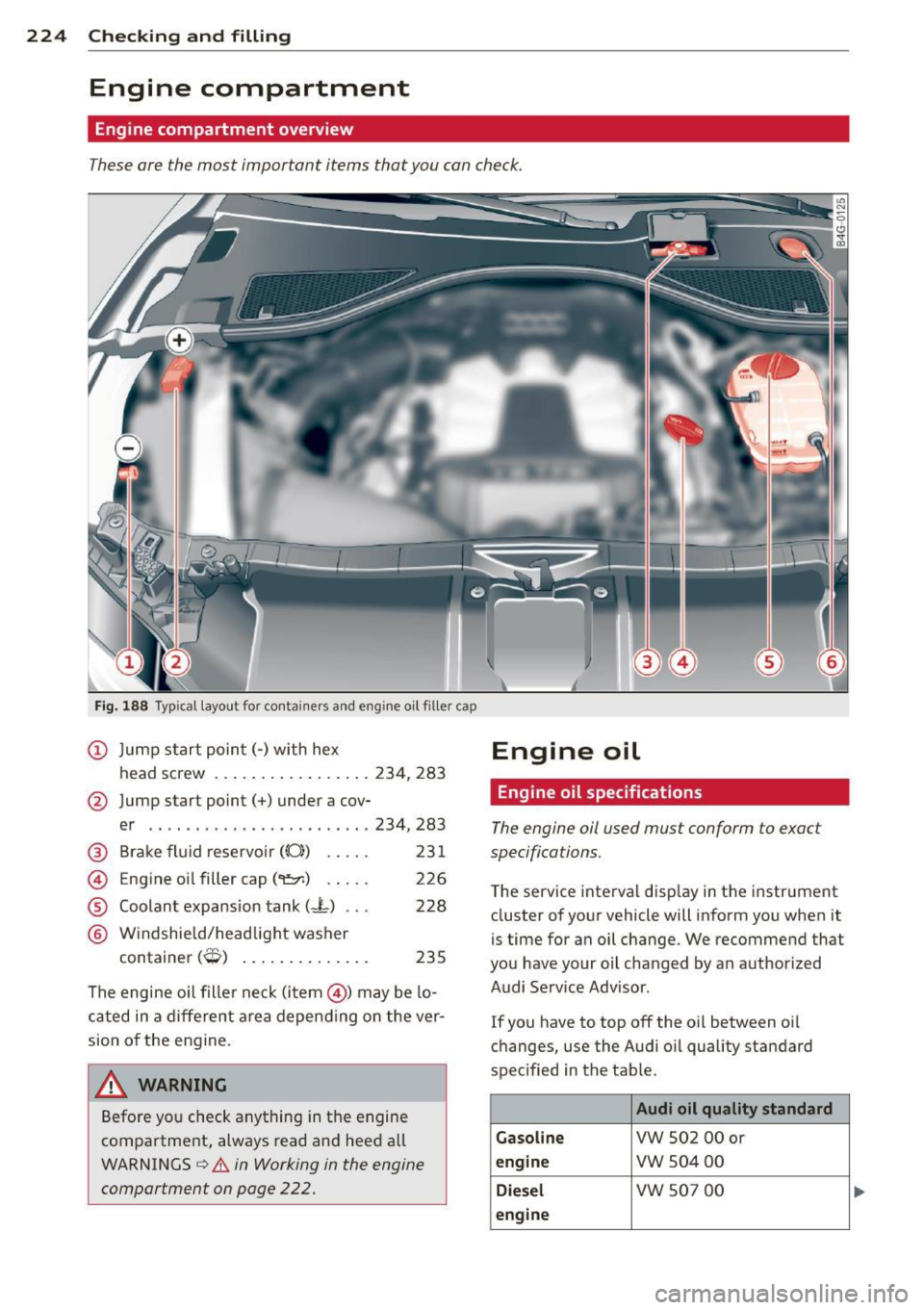
Engine compartment overview
These are the most important items that you can check.
Fig. 188 Typ ical layout for contai ners and eng ine o il filler cap
(D Jump start point(-) with hex
head screw .... ............. 234, 283
@ Jump start point(+) under a cov-
er .. .. ............... .... . 234,283
@ Brake fluid reservoir ((0)) . . . . . 231
© Engine oil filler cap (
® Coolant expansion tank (-L) ... 228
Windshield/headlight washer
. (' " ) container O ............ . . 235
The engine oil filler neck (item @) may be lo
cated in a different area depending on the ver
sion of the engine.
~ WARNING
Before you check anything in the engine
compartment, always read and heed all
WARNINGS
¢ &. in Working in the engine
compartment on page 222.
-
Engine oil
Engine oil specifications
The engine oil used must conform to exact
specifications.
The service interval display in the instrument
cluster of your vehicle will inform you when it
is time for an oil change. We recommend that
you have your oil changed by an authorized Audi Serv ice Advisor.
If you have to top
off the oil between oi l
changes, use the Audi oil quality standard
specified in the table.
Audi oil quality standard
Gasoline
VW 502 00 or
engine vw 504 00
Diesel vw 507 00
engine
Page 227 of 314
M N
0 <.J 'SI: ,...., \!) 1.1'1 ,...., 1.1'1 ,....,
Using the proper engine oil is important for
the functionality and service life of the en
gine. Your engine was factory -filled with a
high-quality oil which can usually be used
t h roughout the entire year.
Your Limited New Vehicle Warranty does not cover damage or malfunctions due to
failure to follow recommended mainte
nance and use requirements as set forth in
the Audi Owner's Manual and Warranty
&
Maintenance booklet .
- Use only a high quality engine oil that ex
pressly complies with the Audi oil quality
standard specified for your vehicle's en
gine . Using any other oil can cause seri
ous engine damage.
- Do not mix any lubricants or other addi
tives into the engine oil. Doing so can
cause engine damage.
If you need to add oil and there is none
available that meets the Audi oil quality
standard your engine requires, you may
add a total of no more than 0.5 quart/liter
of a high-quality "synthetic"oil that meets
the following specifications.
- Vehicles with gasoline engine: ACEA A3
or API SM with a viscosity grade of
SAE 0W-30, SAE SW-30 or SA E SW-40.
- Vehicles with diesel engine: ACEA C3 or
API CF with a viscosity grade of
SAE 0W-30 or SAE SW-30.
- For more information about engine oil
that has been approved for your vehicle, please contact either your authori zed
Audi dealer or Audi Customer Relations
at 1 (800) 822 -2834 or visit our web site
at www.audiusa.com or
www.audicanada .ca.
Checking and filling 225
Engine oil consumption
T he engine in your vehicle depends on an ade
quate amount of oil to lubricate and cool all
of its moving parts .
In order to provide effec tive lubrication and
cooling of internal engine components, all in
ternal combustion engines consume a certain
amount of oil. Oil consumption varies from engine to engine and may change significantly
over the life of the engine. Typically, engines
with a specified break-in period (see
c::> page 200) consume more oil during the
break-in period than they consume after oil
consumption has stabili zed.
Under normal conditions , the rate of oil con
sumption depends on the quality and viscosity
of the oil, the RPM (revolutions per minute) at
which the engine is operated, the ambient
temperature and road condi tions. Further fac
tors are the amount of oil dilution from water
condensation or fuel residue and the oxida
tion level of the oil. As any engine is subject to
wear as mileage builds up, the oil consump
tion may increase over time until replacement
of worn components may become necessary.
With all these variables coming into play, no
standard rate of oil consumption can be es
tablished or specified . There is no alternative
to regular and frequent checking of the oil lev
el , see
Note.
If the yellow engine oil level warning symbol
in the instrument cluster
II lights up, you
should check the oil level as soon as possible
c::> page 226. Top off the oil at your earliest
convenience
c::> page 226.
A WARNING
--
Before you check anything in the engine
compartment, always read and heed all
WARNINGS
c::> & in Working in the engine
compartment on page 222.
(D Note
Driving with an insufficient oil level is like-
ly to cause severe damage to the engine. .,.
•
•