towing AUDI S6 2015 User Guide
[x] Cancel search | Manufacturer: AUDI, Model Year: 2015, Model line: S6, Model: AUDI S6 2015Pages: 314, PDF Size: 77.57 MB
Page 134 of 314
132 Driving Safel y
obtain suitable floor mats from your
authorized Audi Dealer.
Fl oor mat fasteners a re installed in you r Audi .
Floor mats used in your vehicle must be at
tached to these fasteners . Properly secur ing
the floo r mats will p revent them from s liding
i nto pos itions tha t could inte rfe re wi th t he
pedals or impair safe operation o f your vehi cle
in other ways.
A WARNING
Pedals t hat cannot move freely can resu lt
in a loss of veh icle contro l and increase the
r isk of serious personal injury .
- Always make sure that floor mats are
properly secured.
- Never place o r insta ll floo r mats or other
floor coverings in the vehicle that cannot
be properly secured in place to prevent
them from slipping and interfering w it h
the pedals or the ability to control the
vehicle .
- Never place or install floor mats or other
floor coverings on top of a lready insta l
led floor mats . Additional floor mats and
other cove rings w ill reduce the si ze of
the pedal area and in terfere with the
peda ls.
- Always properly rei nstall and se cu re floor
mats that h ave been take n out for clean
ing.
- Always make su re th at ob je cts canno t
fa ll into the driver fo otwe ll wh ile the ve
hicle is moving . Objects can become
t rapped under t he b rake pedal and accel
erator peda l causing a loss of veh icle
control.
Stowing luggage
Loading the luggage compartment
All luggage and other objects must be prop
erly stowed and secured in the luggage com
partment.
Loose items in the luggage compartment can
sh ift suddenly, changing veh icle hand ling characteristics. Loose items can a
lso inc rease
t h e risk of serious persona l injury in a sudden
vehicle maneuve r o r i n a co llision .
.. Dis trib ute the load even ly in the luggage
compa rtment .
.. Always place and properly secure heavy
items in the luggage compartment as fa r
forward as possible .
.. Secure luggage using the tie-downs prov id
ed
¢ page 63, Luggage compartment .
.. Make sure that the rear seatback is securely
latched in place.
A WARNING
Imp roperly stored luggage or other items
can fly t hro ugh the vehi cle causing ser ious
personal injury in the event of hard brak
i ng or an accident . To help reduce the risk
of ser ious personal in ju ry:
- Always put o bjects, fo r example, luggage
or other heavy items in t he luggage com
pa rtment.
- Always secure o bjects in the luggage
compa rtment using the tie-down hoo ks
and suitable straps.
A WARNING
-
Heavy loads w ill influence the way yo ur ve-
hi cle handles. To help reduce the risk of a
l oss of cont ro l leading to serious personal
in Jury :
- Always keep in mind when transporting
heavy objects , tha t a change in the cen
ter of gravity can also cause changes in
veh icle handling:
- Always distribute the load as evenly as
poss ible.
- Place heavy objects as far forward in the luggage compartment as possible.
- Never exceed the Gross Axle We igh t Rat
ing or the Gross Vehicle We ight Ratin g
specif ied on the safety compliance stick
er on the left door jamb. Exceeding per miss ible weight standards can cause the
veh icle to slide and hand le diffe rently.
- Please observe information on safe dr iv
ing
¢ page 126.
Page 195 of 314
M N
0 <.J 'SI: ,...., \!) ..,.,
,...., ..,., ,....,
@ Tips
Your vehicle may be equipped with Audi
connect. Your use of certain Aud i connect
features req uires wireless serv ices that are
provided by a third party wireless telecom
municat ions provider. For details regard
ing how information obtained through
Aud i connect is collected, processed,
transmitted, used, and shared, please see
your contra ct w ith the wire less telecom
municat ions provider and the "About A udi
connect" tab in your vehicle's MMI:
!MENU !
button > Audi connect > About Audi con·
nect .
Electronic Stabilization
Control (ESC)
Description
ESC helps to improve road holding and vehicle
dynamics to help reduce the probability of
skidd ing and loss of veh icle control. It works
only when the eng ine is running. ESC detects
certain difficult driv ing s ituations, including
when the vehicle is beginning to spin (yaw) out of cont ro l and helps you to get the vehicle
back under control by select ively brak ing the
wheels, and/or red ucing engine powe r and
p roviding steering assistance to help hold the
ve hicle on the driver's intended course . The in
dicator light
m in the instrument cluster
blinks when ESC is taking action to help you
control the vehicle.
ESC has limitations.
It is important to remem
ber that ESC cannot overcome the laws of
phys ics. It will not a lways be able to help out
under all conditions you may come up against.
For example, ESC may not always be able to
h elp you master situat ions where there is a
sudden change in the coefficient of fr iction of
the road surface. When there is a sect io n of
d ry road that is s udden ly cove red with water,
slush o r snow, ESC canno t perform the same
way it would on the dry su rface.
If the vehicle
hydroplanes (rides on a c ush ion of wate r in
stead of the road surface), ESC wi ll not be
ab le to he lp you steer the veh icle because con-
Int ellig ent technolog y 193
tact with the pavement has been interrupted
and the vehicle cannot be braked or steered .
D uring fast corner ing, particular ly on wind ing
roads, ESC cannot always deal as effectively
with difficult dr iv ing s ituations than at lower
speeds. When towing a trailer, ESC is not able
to help you regain control as it would if you
were not tow ing a trailer.
Always adjust your speed and driving style to road, traffic and weather conditions . ESC can
not override the vehicle's physical lim its, in
crease the availab le tract ion, or keep a veh icle
o n the road if road departu re is a result of
driver ina ttent io n. Instead , ESC imp roves the
poss ibility of keep ing the vehicle under con
trol and on the road during extreme maneu
vers by using the driver's steering i nputs to
help keep the vehicle go ing in the intended di
rect ion. If you are traveling at a speed that
causes you to run off the road before ESC can
provide any assistance, you may not experi
ence the benefits of ESC.
ESC includes and/or works together with the
anti-lock brake system (ABS), brake ass ist sys
tem, ant i-slip regu lation (ASR), electron ic dif
ferential lock (EDL), dynam ic steer ing* and
El ectronic interax le differentia l lock* /selective
whee l to rque control*. ESC is switched on a ll
the time. In ce rtain sit uat io ns when yo u need
less traction, you can sw itch off ASR by press
ing the b utton
[fil ¢ page 195, fig. 178. Be
s u re to switch ASR on again when you no lon
ger need less traction .
Anti-lock braking system (ABS )
ABS prevents the whee ls from locki ng up
when b raking. The vehicle can st ill be stee red
even during hard braking . App ly steady pres
su re to the brake peda l. Do not pump the ped
al. A pulsing in the brake pedal indicates that
the system is helping you to brake the vehicle.
Brake a ssis t sy ste m
The brake ass ist system can decrease braking
distance . It increases braking power when the
driver presses the brake peda l quickly in emer
gency s ituations. You must press and hold the
brake pedal unti l the situation is over. In .,,.
•
•
Page 207 of 314
M N
0 <.J 'SI: ,...., \!) ..,.,
,...., ..,., ,....,
Trailer towing Driving with a trailer
General information
Your Audi was designed primarily for passen
ger transportation .
If you plan to tow a tra iler, p lease remember
that the addit ional load will affect durab ility,
economy and performance .
Trailer towing not on ly places more stress on
the vehicle, it also calls for more concentra
tion from the driver.
F or this reason, a lways fo llow the operating
and driving instructions provided and use
common sense.
(D Note
If you are going to tow a trai le r, you must
ac tivate the trailer operation mode
c::> page 205, Operating instructions.
Technical requirements
Trailer hitch
Use a weig ht-carrying hitch conforming to the
gross trailer we ight. The hitch must be suita
b le for your veh icle and trailer and must be
mounted secure ly on t he ve hicle's chassis at a
technically sound location . Use only a trail er
hi tch w ith a removab le ball moun t. A lways
check wi th t he tra ile r hi tch man ufactur er to
make sure that you are using the cor rect
h itch.
Do not us e a bumper hitch.
The hitc h m ust be installed in such a way that
i t does not interfe re with the impac t-absorb
i ng bumper syst em. No mod ificat ions should
b e made to the vehi cle e xhaus t and br ake sys
tems . From t ime to time, check th at a ll hitc h
mo unt ing bo lts rem ain securely fas tened.
When you are not towing a trail er, remove the
tra ile r hi tch ball moun t. T h is prevents the
hi tch from causing damage sho uld your ve hi
cle be str uck from behind~ .& .
Trailer towin g 205
Trailer brakes
If your trailer is equippe d wi th a bra king sys
tem, check to be s ure that i t conforms to all
regulations .
T he trailer hyd ra u lic bra ke sys tem mus t not be
d irec tly connec ted to the vehicle's hydraulic
brake system .
Safety chains
Always use safety chains be tween your ve hicle
and t he tra ile r.
Trailer lights
Trai ler lights must meet all reg ulations. Be
su re to c heck with your Audi dea ler for correct
wir ing, switches and relays .
Mirrors
If you a re unable to see the traffic behind you
u sing the regula r outside mirrors, then you
must insta ll extended mir rors. It is important
t h at you
always have clea r vis io n to the rear.
_&. WARNING
-
Afte r removi ng the t railer hitch , do no t
stor e it in yo ur v ehicl e. In case of sudden
b raki ng, the hi tch co ul d fly forwar d and in
j ur e you o r yo ur pass enge rs.
Operating instructions
Maximum trailer weight
A tra ile r fo r you r vehi cle is l imited to a typi cal
cla ss 1 o r class 2 tr ailer.
Trailer load distribution
Be sure the load in the tra ile r is held secure ly
in place to p revent it from shift ing fo rward,
ba ckward or sideways.
Never allow a passenger to ride in a trailer
c::> .& in Driving instructions on page 207 .
Eng ine cooling sy stem
Towing a t railer ma kes the engine wor k hard
er . It is impo rtant that the cooling system's
performance is up to the additional load.
•
•
Page 208 of 314
206 Trailer towing
Make sure that the cooling system has enough
fluid .
Tire pressure
When towing a traile r, inflate the tir es of your
vehi cle to the cold tire pressure listed under
"Full load" on the label located on the driver's
side B-pillar (visible when the door is open) .
Inflate trailer t ires to trai ler and tire manufac
turers' specifications.
Lights
Check to make sure both vehicle and trailer
lights are working properly.
Safety chains
Be sure tra iler safety cha ins are properly con
nected from the trailer to the hitch on the ve
hicle. Leave enough slack in the chains to per
mit turning corners. When you install safety
cha ins, make sure they wi ll not drag on the
road when you are driving.
The chains should cross under the trailer
tongue to prevent it from dropping in case of
separation from the hitch.
Adjusting the Audi drive select
Make sure the vehicle is on a level su rface be
fore
hitching up the traile r and before adjust
ing the tongue weight. The vehicle must be in
auto or comfort driving mode and not raised
q page 100, q(D _
Make sure that the vehicle is lowered. In Info
tainment , se lect:
ICARI f unc tion button> Low
er
control button.
I f you must dr ive under poor road condit ions,
you can raise the vehicle
after coupling the
tra iler or
after adjusting the tongue weight
qpage 102.
-Changes in temperature or load can af
fect the height of the vehicle.
- Always se lect
auto or comfort mode.
Otherwise, the tongue load specified for
your vehicle will no longer be applicable.
Driving instructions
Driving with a trailer always requires extra
care and consideration .
To obtain the best possible handling of vehicle
and trailer, please note the follow ing:
.,. Do not tow a loaded trailer when your car it
self is not loaded.
.,. Be especially careful when passing other
veh icles.
.,. Observe speed limits .
.,. Do not dr ive at the max imum permissib le
speed.
.,. Always apply brakes early .
.,. Mon itor the temperature gauge.
Weight distribution
Towing a loaded trailer with an empty car re
su lts in a highly unstable distribution of
we ight. If this cannot be avoided, drive at very
low speeds only to avoid the risk of losing
steering control.
A "ba lanced " rig is easier to operate and con
t ro l. This means that the tow vehicle should
be load ed to the extent possible and permissi
ble , while keeping the trailer as light as possi
ble under the circumstances . Whenever possi
ble , transfer some cargo to the luggage com
partment of the tow veh icle while observing
tongue load requirements and vehicle load ing
considerations.
Speed
The higher the speed, the more difficult it be
comes for the driver to control the rig . Do not
drive at the maximum permissible speed. Re
duce your speed even more if load, weather or
wind conditions are unfavorable -particularly
whe n going downhill.
Red uce vehicle speed
immediately if the trail
er shows the slightest s ign of sway ing .
Do not
try to stop the swaying by accelerating.
Observe speed limits. In some areas, speeds
for vehicles towing tra ilers are lower than for
regular veh icles . .,.
Page 209 of 314

Always apply brakes early. When driving
downhill, shift into a lower gear to use the en
g ine braking effect to slow the vehicle . Use of
the brakes a lone can cause them to overheat
and fail.
Air suspension*
When driving with a trai ler, activate the trailer
mode of the air suspension. Switch the air
suspension trailer mode on when you are tow
ing a trailer. This will limit the regulation by
the air suspension while driving. Select in the
MMI:
! CARI function button> (C ar) * systems
control button > Vehicle settings > Air susp.:
towing > On .
Coolant temperature
The coolant temperature gauge¢ page 11
must be observed carefully. The coolant tem
perature can increase if you drive on long in
clines in a low gear at high engine speeds . Re
duce your speed immed iately if the LEDs in
the top pa rt of the display turn on.
For more information about indicator lights,
refer to. ¢
page 16 .
A WARNING
Anyone no t properly restrained in a mov
ing veh icle is at a much greater ris k in an
accident . Never let anyone ride in your car
who is not properly wearing the restraints
provided by Audi .
Trailer towing tips
Important to know
Your vehicle handles differently when tow ing
a trailer because of the addit ional weight and
d ifferent weight distribution . Safety, perform
ance and economy w ill greatly depend on how
carefully you load your trailer and operate
your rig.
Before you actually tow your trailer, practice
M N turning, stopping and backing up in an area 0
~ away from traffic. Keep practicing until you
~ have become comp lete ly fam iliar with the way 1.1'1 ,...., 1.1'1 ,....,
Trailer towing 207
your vehicle-trai ler combination behaves and
responds.
Backing up is difficult and requires practice .
Backing up with a trailer generally req uires
steering action opposite to that when backing
up your vehicle without a trai ler.
Maintain a greater distance between your ve
hicle and the one in front of you. You will need
more room to stop. To compensate for the
trailer , you wi ll need a larger than normal
turning rad ius.
When passing, remember that you cannot ac
ce lerate as fast as you norma lly would be
cause of the added load. Make sure you have
enough room to pass . After passing, allow
plenty of room for your trailer before chang
ing lanes again .
Avoid jerky starts, sharp turns or rapid lane changes.
(D Tips
- Do not tow a trailer during the break-in
period of your vehicle.
- If you tow a trailer, your Audi may re
quire more frequent maintenance due to
the extra load ¢
page 292.
Parking on a slope
Do not park on a slope with a trailer. If it can
not be avoided, do so only after doing the fol lowing:
When parking:
.,. App ly the foot brake .
.,. Have someone p lace chocks under both the
vehicle and the trailer wheels.
.,. With chocks in place, slowly release the
brakes until the wheel chocks absorb the
load .
.,. Turn the wheels towards the curb.
.,. Apply the parking brake .
.,. Select the P selector lever posit ion.
When re starting after parking:
.,. App ly the foot brake.
.,. Start the engine.
•
•
Page 210 of 314
208 Trailer towing
• Se lect the D/S se lector lever posit ion .
• Re lease the par king b rake an d slow ly pull
o ut and away from the whee l chocks.
• Stop and have someone retrieve the wheel
chocks.
If you move the se lector lever of the a uto
mat ic transm ission to P before app lying
the park ing brake a nd befo re blocking the
w heels, you may have to use mo re force
la ter to move the lever out of the
P posi
tion.
Page 257 of 314
M N
0 I.J ""'. rl I.O
"' rl
"' rl
being loaded on the vehicle.
That weight may not safely
exceed the available cargo
and luggage load capacity
calculated in Step 4.
6. If your vehicle will be towing
a trailer, load from your trail
er will be transferred to your
vehicle. Consult this manual
to determine how this re
duces the available cargo
and luggage load capacity of
your vehicle.
.,.Che ck the tire sidewall
(¢ page 257, fig. 199) to de
termine the designated load rating for a specific tire.
Tire service life
The service life of tires depends
on a lot of different things in
cluding proper installation and
balancing, correct tire pressure and driving style.
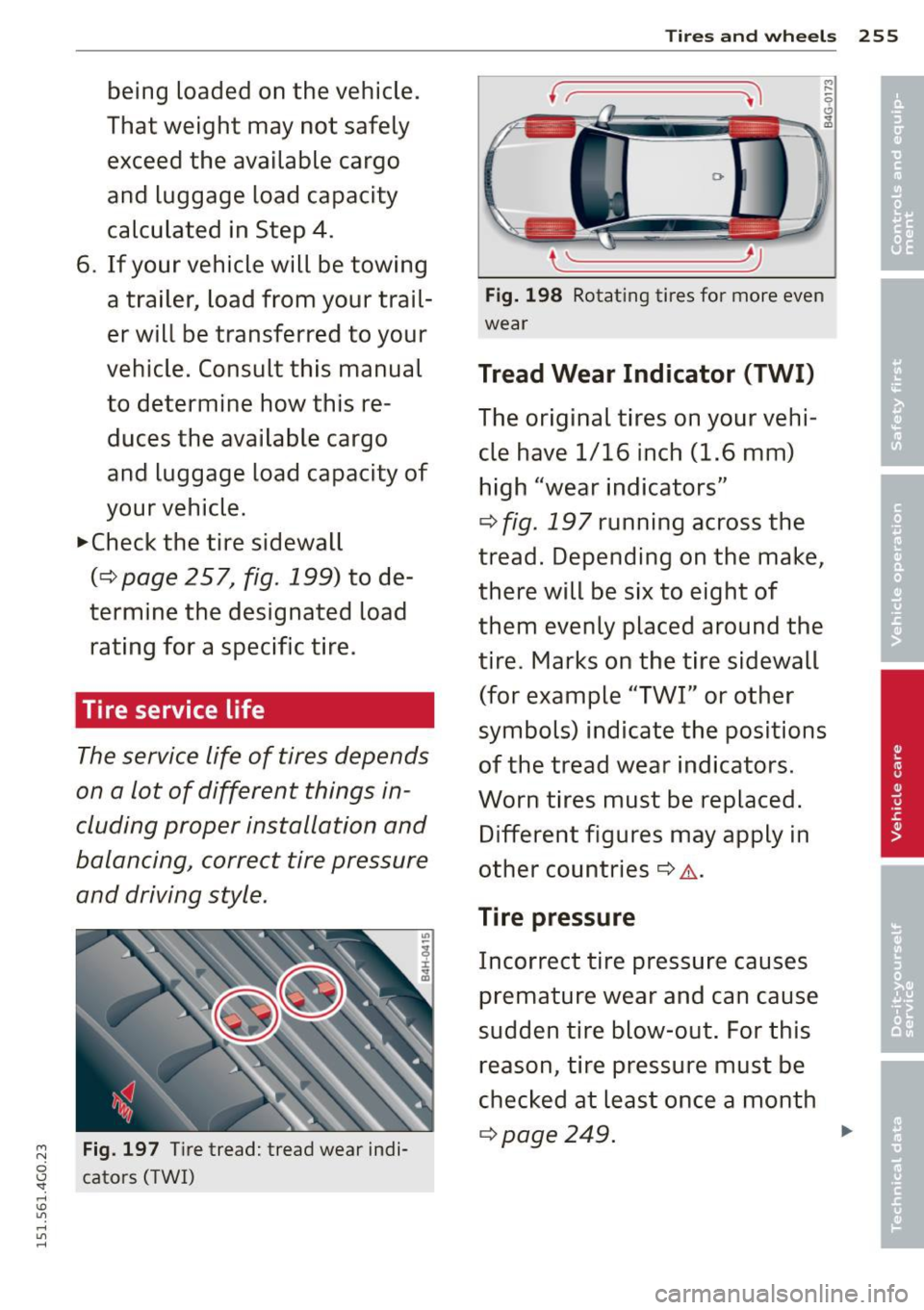
Fig . 197 Tire tread: tread wear indi
cators (TWI)
Tires and wheels 255
Fig. 198 Rotating tires for more even
wear
Tread Wear Indicator (TWI)
The original tires on your vehi
cle have
1/16 inch (1.6 mm)
high "wear indicators"
¢ fig. 197 running across the
tread. Depending on the make,
there will be six to eight of
them evenly placed around the
tire. Marks on the tire sidewall (for example "TWI" or other
symbols) indicate the positions
of the tread wear indicators.
Worn tires must be replaced.
Different figures may apply in
other countries
¢ & .
Tire pressure
Incorrect tire pressure causes
premature wear and can cause
sudden tire blow-out. For this
reason, tire pressure must be
checked at least once a month
¢ page 249.
Page 274 of 314
272 What do I do no w?
• Always store the vehicle too l kit, the jack*
and the replaced tire in the luggage com
partment
¢ page 132.
• Unhook the cargo floor before clos ing the
rear lid.
Using th e spare tir e (compac t spare tir e)
The compact spare tire is on ly intended for
emergencies until yo u can reach a repair shop.
Replace it as quickly as possible with a stand
ard wheel and tire.
There are some restrictions on the use of the compact spare tire. The compact spare tire has been des igned specifically for your type of
vehicle. It must not be swapped with a com pact spare tire from another type of vehicle.
Sn ow chain s
For technical reasons, the use of snow chains
on the compact spare tire is
not permitt ed .
If you do have to dr ive with snow cha ins and a
front tire fails, mount the spare wheel with
tire instead of a rear tire . Install the snow
chains on the rear tire and use it to replace
the defective front tire.
A WARNING
- Never use the spare tire if it is damaged
or if it is worn down to the tread wear in
dicators .
- If the spare tire is more than 6 years o ld,
use it only in an emergency and with ex
t reme caution and careful driving .
- The spare tire is intended only for tem
porary and short-term use. It should be
replaced as soon as possible w ith the
normal wheel and t ire.
- After mounting the compact spare tire,
the tire pressure must be checked as
soon as poss ible. The tire pressure of the
c ompact spare tire must be 4.2 bar; oth
erwise, you risk hav ing an accident .
- Do not drive faster than 50 mph (80 km/
h). You risk having an acc iden t.
- Avoid full-throttle acce le rat ion, heavy
braking, and fast corner ing . You risk hav
ing an a cc ident. -
Never drive using more than one spare
wheel and tire. You r isk having an acci
dent.
- Normal summer or winter tires must not
be mounted on the compact spare wheel
rim.
- For technical reasons, the use of tire
chains on the spare tire is not permitted.
If it is necessary to drive with tire chains,
the spare wheel must be mounted on the
front ax le in the event of a flat in a rear
tire. The new ly available front wheel
m ust then be installed in place of the
rear whee l w ith the flat tire. Installing
the tire chain before mounting the whee l
and tire is recommended.
- Loose items in the passenger compart
ment can cause serious personal injury
during hard braking or in an accident. Never store the inflatable spare tire or
jack and tools in the passenger compart ment.
Changing a wheel
Before changing a wheel
Observe the following precautions for your
own and your passenger's safety when chang
ing a wheel.
• After you experience a t ire failure, pull the
car well away from mov ing traffic and t ry to
reach
l e vel ground before you stop ¢ ,&.
• All passengers should leave th e car and
move to a safe location ( for instance, behind
the guardrail) ¢,& .
• Engage the
par king brake to prevent your
vehicle from rolling unintentionally c> _& .
• Move
selector le ver to pos it ion P c> _& .
• If you are towing a trailer, unhitch the trailer
from your vehicle.
• Take the
jack and the spare tir e out of the
luggage compa rtment c>
page 271,
i=> page 271 . ..,_
Page 285 of 314
M N
0 <.J 'SI: ,...., \!) ..,.,
,...., ..,., ,....,
Emergency situations
General
This chapter i s intended for trained emer
gency crews and working personnel who have the necessary tools and equipment to
perform these operations.
Starting by pushing or
towing
(D Note
Ve hicles w ith an au tomatic tra nsmission
cannot be started by pus hing o r tow ing.
Starting with jumper
cables
If necessary, the engine can be started by
connecting it to the battery of another vehi
cle.
If the engine shou ld fail to start because of a
discha rged o r wea k battery, the battery can be
connected to the battery o f
another vehicle,
using a
pair of jumper cables to start the en
g ine.
Jumper cables
Use only jumper cables of sufficiently la rge
c ross section to carry the starter c urrent safe
l y. Refer to the man ufacturer's specifications.
Use only jumper cables with
insulated te rm i
na l clamps wh ic h are d istinctly marked:
plus(+) cable i n mos t cases co lore d red
minu s(-) cable
in most cases colored black .
A WARNING
Batterie s contain e lec tricity, ac id, an d gas.
A ny of these can cause ve ry ser io us or fatal
inju ry. Follow the instructions below f or
safe han dling of your veh icle's b attery .
- Alway s shield you r eyes and avoid lean
ing over the bat te ry whenever possib le.
- A dis ch arged battery c an free ze at tem
peratures ju st be low 32 °F ( 0 °C ). Befo re
Emergency situations 283
connecting a jumpe r cab le, you must
thaw the fr ozen battery c omp lete ly, ot h
erwise it could explode.
- Do not allow battery acid to contact eyes
or skin. Fl ush any contacted area with
wate r immediately.
- Improper use of a booster battery to start a vehicle may cause an explosion.
- Vehicle batter ies genera te exp losive gas
es. Keep spar ks, flame and lighted c iga
rettes away from batte ries.
- Do not try to jump start any ve hicle w ith
a low ac id leve l in the battery.
- The vo ltage of the booste r batte ry m ust
a lso have a 12-volt rating. The capacity
(Ah) of the booster battery sho uld not be
lowe r tha n that of the discharged bat
tery . U se of batte rie s of d iffe ren t voltage
or substantially diffe rent "Ah" rat ing
may c au se an exp losion and persona l in
JU ry.
- N ever cha rge a fro zen battery. Gas trap
pe d in the ice may cause a n ex plosion.
- Never cha rge or use a batte ry tha t h as
been fr ozen. T he battery case may have
be weakened.
- Us e of b atter ies of differe nt voltage or
sub stant ia lly diffe ren t ca pa city (Ah) ra t
i ng may c ause an ex plosion an d injury .
Th e capac ity (Ah) of the booster bat tery
should not be lower than that of the dis
charged batte ry .
- Before you chec k any thing in the engine
compa rtment, always read and hee d all
WARNINGS¢
page 222.
(D Note
- App lyin g a higher vo ltage booster ba t
t ery w ill cause expens ive damage to se n
sit ive e lectronic com ponents, such as
cont ro l units, relays, rad io, etc.
- The re must be no electrical contact be
tween the vehicles as ot herwise c urrent
co uld a lready start to f low as soon as the
p o sit ive(+) term inals a re connected. ..,. •
•
Page 287 of 314

M N
0 I.J "". rl I.O
"' rl
"' rl
-When connecting jumper cables, make
sure that they cannot get caught in any
moving parts in the eng ine compart
ment .
- Before you check anything in the engine
compartment, always read and heed all
WARNINGS
¢ page 222.
(D Note
Improper hook-up of jumper cables can r u
in the generator.
- Always connect POSITIVE( +) to POSI
TIVE(+), and NEGATIVE(-) to NEGATIVE
( - ) gro und post of the battery manager
control unit .
- Check that all screw plugs on the battery
cells a re screwed in firmly . If not, tighten
pl ugs p rior to connecting clamp on nega
tive battery term inal.
- Please note that the procedure f or con
nect ing a jump er cable as desc ribed
above appl ies spec ifically to the case of
you r vehi cle be ing jump started. When
you are giv ing a jump star t to an othe r ve
hi cle, do
not connec t the negat ive (-) ca
ble to the negat ive (-) terminal on the
discharged battery@¢fig.
219. In
stead, securely connect the negative( -)
cable to e ithe r a solid metal component
that is firmly bolted to the engine block
or to the e ng ine block itse lf. If the bat
te ry tha t is being charged does not vent
to the outside, escaping batte ry gas
could igni te and exp lode!
Emergency towing
with commercial tow truck
General hints
Your Audi requires special handling for tow
tng.
The follow ing information is to be used by
commercia l tow tr uck operators who know
h ow to ope rate thei r equipme nt safe ly.
Emergenc y situ ation s 285
-Ne ver tow your Audi. Towing will cause
damage to the engine and tran smission.
- Never wrap the safety chain s or w inch ca
ble s around the brake lines.
- To prevent unnece ssary damage , your Audi
must be transported with a flat bed tru ck.
- To load the vehicle on to the fl at bed , use
the towing loop found in the vehicle tools
a nd attach to the front or rear anchora ge
¢ page 285 and ¢ page 286 .
_& WARNING
A vehicle being towed is not safe for pas
sengers. Never allow anyo ne to ride in a
vehicle be ing towed, for any reason.
Front towing loop
Only install the front towing loop when it is
needed.
Fig. 22 0 Front bu mpe r: cove r
Fig. 22 1 Front bu mpe r: in stall ing t he tow ing loop
-
The towing loop fits into the threaded hole lo
cated on the right s ide of the front bumpe r
and cove red by a sma ll cover when not in use.
.. Remove the tow ing loop from the vehicle
too l kit .