flat tire AUDI S6 2015 Owner's Manual
[x] Cancel search | Manufacturer: AUDI, Model Year: 2015, Model line: S6, Model: AUDI S6 2015Pages: 314, PDF Size: 77.57 MB
Page 266 of 314
264 Tire s and wheel s
Sustained high temperature can cause the
materia l of the tire to degenerate and reduce
tire life, and excessive temperature can lead
to sudden tire failure<=>,& .
The grade C corresponds to a level of perform
ance which a ll passenger car tires must meet
under the Federa l Motor Veh icle Safety Stand
ard No.
109. Grades Band A represent higher
levels of performance on the laboratory test
wheel than the m inimum required by law .
A WARNING
The traction grade assigned to this t ire is
based on stra ight-ahead braking traction
tests, and does not include acceleration,
corne ring, hydrop lan ing o r peak traction
character istics .
A WARNING ,.,.____
The temperature grade for this tire is es
tablished for a tire that is p roperly inflated
and not overloaded. Excessive speed, un
derinflation, or excessive loading, either
separate ly or in combination, can cause
heat buildup and possible tire fa ilure.
Winter tires
Winter tires can improve vehicle handling on
snow and ice. At temperatures below 45 °F
(7 °C) we recommend changing to winter
tires .
In some heavy snow areas, loca l governments
may require true winter or "snow" tires, those
with very deeply cut tread. These t ires should
only be used in pairs and be installed on all
four wheels. Make sure yo u purchase snow
tires that are the same size and const ruct ion
type as t he other tires on your ve hicle.
If your vehicle is equ ipped with all -wheel
drive*, this will improve t ract ion during w inter
d riving, even wit h the standard tires. Howev
e r, we strong ly recommend that you always
eq uip a ll four w heels on yo ur vehicle wi th cor
rectly fitted win ter tires or a ll-season tires,
when winte r road conditions are expected . This also improves the veh
icle's brak ing per
formance and reduces stopping distances.
Summe r tires p rovide less gr ip on ice and
snow.
Winter tires (snow tires) must always be fitted on all fou r wheels .
Ask your authorized Audi dealer or qualified
workshop for perm itted
winter tire siz es. Use
o n ly rad ial winter t ires .
Winter tires lose their effectiveness when the
tread is worn down to a depth of
0 .157 inch
(4 mm).
Only drive w ith w inter t ires under winter con
ditions. Summer t ires handle better when
there is no snow or ice on the roads and the
temperature is above 45 °F (7 °() .
If you have a flat tire, see notes on spare
wheel
<=>page 257.
Please a lways remember that winter tires may
have a lower speed rating than the tires origi
nally installed on your vehicle at the time it
was manufactured. P lease see<=>
page 260,
Speed rating (letter code)
fo r a listing of the
speed rating lette r codes and the max imum
speed at which the tires can be d riven .
The speed rating letter code (<=>
page 242) is
on the side wall of the t ire
c> page 257.
A WARNING ,.___
W inter t ires have maximum speed lim its
that may be lower than yo ur vehicle's max
i mum speed. Always know the max imum
speed before dr iv ing off. Never dr ive faster
than the speed permitted for yo ur specific
winter tires . This wi ll ca use damage to the
tires leading to an accident and ser ious
personal injury to you and your passen
gers.
A WARNING
'----
Driving faster than the maximum speed
for which the winter tires on your vehicle were designed can cause t ire failure in
cluding a blowout and sudden deflation,
Page 268 of 314
26 6 T ire s and whee ls
Wheel bolts
Wheel bolts must always be tightened to the
correct torque .
The design of wheel bolts is matched to the
factory installed rims. If different rims are fit
ted, the correct wheel bolts with the right
length and correctly shaped bolt heads must
be used. This ensures that wheels are fitted
secure ly and that the brake system functions
correctly .
In ce rtain circumstances, you may not use
wheel bolts from a different vehicle -even if it
is the same mode l
~page 294.
_& WARNING
Improperly tig htened o r maintained whee l
bolts can become loose ca using loss of
contro l, a co llision and serious persona l in
jury.
- Always keep the wheel bolts and the
threads in the wheel hubs clean so the
wheel bolts can turn easily and be prop
erly t ightened.
- Never grease or oil the wheel bo lts and
the threads in the wheel hubs. They can
become loose while driving if greased or
oiled, even if tightened to the specif ied
torque.
- Only use wheel bolts that belong to the
rim being installed.
- Never use different wheels bolts on your
vehicle.
-Always maintain the correct tighten ing
torque for the wheel bolts to reduce the
risk of a wheel loss. If the tightening tor
que of the wheel bolts is too low, they
can loosen and come out when the veh i
cle is moving. If the tightening torque is
too high, the whee l bolts and threads
can be damaged and the wheel can be
come loose.
@ Note
The spec ified torq ue fo r the wheel bo lts is
90 ft lb (120 Nm) w ith a toleran ce of± 7,4
ft lb(± 10 Nm). Torque wheel bo lts diago- nally
. After changing a whee l, the torque
must be checked as soon as possible with a
torque wrench -preferably by an author
i zed Audi dealer or qualified workshop.
Low aspect ratio tires
Your Audi is factory-equ ipped w ith low aspect
r atio tires . These tires have been tho roughly
tested and been se lected specifically for your
model for their superb perfo rmance, road fee l
and hand ling under a variety of d riving cond i
tions . As k your au thor ized A udi dealer for
more de tails .
T he low aspect ratio of these t ires is ind icated
by a numera l of
55 or less in the tire's s ize
designation. The nume ra l represen ts the ra tio
of the tire's sidewall height in relation to its
tread width expressed in percentage . Conven
tiona l tires have a he ight/width ratio of 60 or
more.
The performance of low- aspect-r atio tires is
p ar ticu la rly s ens iti ve to improper infl ation
p re ss ure. I t is th erefore im portant th at low
as pect ratio tires are inflated to the specified
pressure and that the inflation pressu re is
r e gularl y che cked and mainta ined. Tir e pre s
su res should be ch ecked at least onc e a
month and alwa ys bef ore a long trip
~ page 249, Checking tire pressure.
What you can do to a void tire and rim
damage
Low aspect ratio tires can be damaged more
easily by impact w it h potholes, curbs, gull ies
o r r idges on the road, pa rticularly if the tire is
u nderinfla ted .
In order to minimize the occurrence of impact
damage to the tires of you r vehicle, we recom
mend that you observe the follow ing p recau
tions:
- Always ma inta in recommended inflation
pressures. Check your tire pressure eve ry
2,000 miles (3,000 km) and add air if neces
sary .
- Dr ive carefully on roads with potholes, deep
gullies o r ridges. The impact from dr iv ing ..,.
Page 269 of 314
M N
0 <.J 'SI: ,...., \!) 1.1'1 ,...., 1.1'1 ,....,
thro ugh or over such obstacles can damage
your tires. Impact with a curb may a lso
cause damage to your tires .
- After any impact, immediately inspect your
tires or have them inspected by the nearest
authorized Audi dea ler. Replace a damaged
t ire as soon as possible.
- Inspect yo ur tires every 2,000 miles (3,000
km) for damage and wear . Damage is not al
ways easy to see. Damage can lead to loss of
air and underinflation, wh ich could eventu
ally cause tire fa ilure . If you be lieve that a
t ire may have been damaged, replace the
t ir e as soo n as possible.
- T hese tires may wear more quickly than oth
ers .
- Please also remember that, while these tires deliver respons ive handling, they may ride
less comfortably and make more no ise than
othe r cho ices .
Reduced perf ormance in winter /cold
season condition s
All t ires are des igned for certain pu rposes.
The low aspect ratio, ultra hig h pe rformance
tires orig inally installed on your veh icle are in
tended for maximum dry and wet road per
formance and handling . They are not s uitable
for cold, snowy or icy weather conditions. If
you dr ive under those circumstances, you
should equip your vehicle with all-season or
winter tires, which offer better traction under
those cond itions . We suggest you use the rec
ommended snow or all-season tires specified
fo r your ve hicle, or their equ ivalent.
Refer to¢
page 264 for mo re deta iled infor
mat io n regarding winter t ires .
Tire pressure
monitoring system
U) General notes
Each t ire, includ ing the spare (if provided),
should be checked month ly when cold and in
flated to the inflation pressure recommended by the vehicle manufacture r o n the vehicle
p lacard or tire inflation pressure label. (If yo ur
Tire s an d wheel s 267
vehicle has tires of a different size than the
size indicated on the vehicle placard or tire in
flat ion pressure labe l, you sho uld determine
the proper t ire inflation press ure for those
tires).
As an added safety feature, your vehicle has been equipped with a tire pressure monitoring
system (TPMS) that illum inates a low tire
pressure telltale when one or more of your
ti res is significant ly under-inflated. According
ly, when the low tire pressure telltale illumi
nates, you shou ld stop and check you r tires as
soon as possib le, and inflate them to the
proper pressu re. Driving on a sign ifican tly un
der -infla ted ti re causes the tire to overhea t
and can lead to tire fai lure . Under-inflation al
so reduces fuel efficiency and tire tread life,
and may affect the vehicle 's hand ling and
stopp ing ability.
Please note that the TPMS is not a substitute
for proper tire maintenance, and it is the driv er's respons ibility to maintain correct tire
pressure, even if under-inflation has not
reached the level to tr igger illuminat ion of t he
TPMS low tire pressu re tellta le.
Your vehicle has also been equipped with a
TPMS malfunction indicator to ind icate when
the system is not operating properly. The
TPMS ma lfunction indicator is combined with
the low t ire pressure telltale . Whe n the sys
tem detects a malfunction, the telltale will
flash fo r approximate ly one m inute and then
r em ain continuously illum ina ted . Thi s se
quence will continue upon s ubsequent vehicle
start-ups as long as the malfunction exists .
When the malfunction indicato r is illum inat
ed, the sys tem may no t be ab le to detec t or
s ignal low tire pressure as in tended . TPMS
malfu nctions may occur for a var iety of rea
sons, incl uding the insta llation of rep lace
ment or a lternate tires or wheels on the vehi
cle that prevent the TPMS from functioning properly. Always check the TPMS malfunction
telltale after rep laci ng one or more tires or
whee ls on your vehicle to ensu re that the re
placement o r alternate tires and wheels a llow
the TPMS to con tinue to funct ion p ro perly .
•
•
Page 270 of 314
268 Tires and wheels
Tire pressure indicator appears
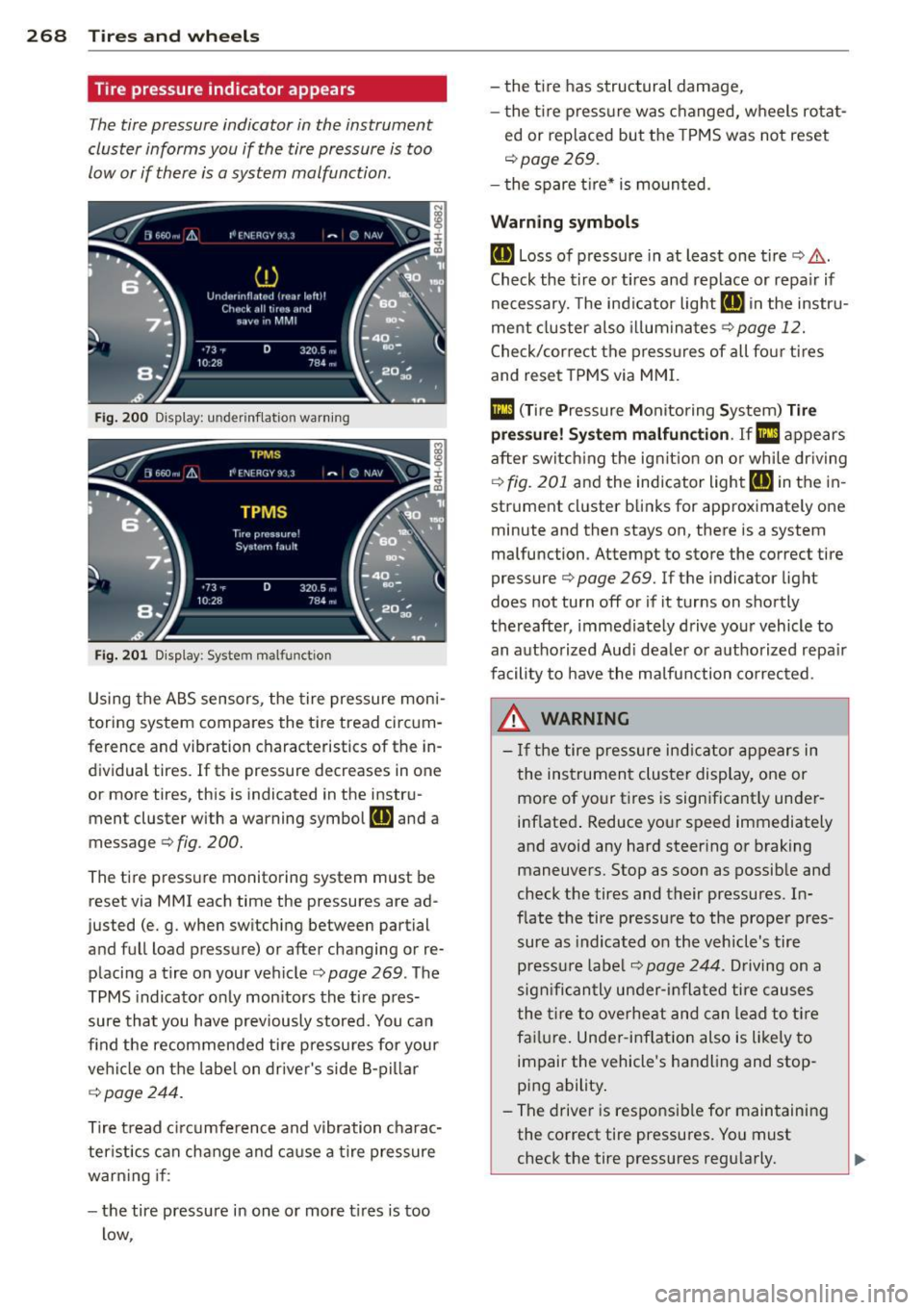
The tire pressure indicator in the instrument
cluster informs you if the tire pressure is too
low or if there is a system malfunction.
Fig. 200 Display : und erinflatio n warn ing
Fig. 201 Display: Syste m malfunction
Using the ABS sensors , the tire pressure moni
toring system compares the tire tread circum
ference and vibration characteristics of the in
dividual tires.
If the pressure decreases in one
or more tires, this is indicated in the instru
ment cluster with a warning symbol
[9] and a
message ¢
fig. 200.
The tire pressure monitoring system must be
reset via MMI each time the pressures are ad
justed (e. g. when switching between partial
and full load pressure) or after changing or re
placing a tire on your vehicle¢
page 269 . The
TPMS indicator only monitors the tire pres
sure that you have previously stored. You can
find the recommended tire pressures for your vehicle on the label on driver's side 8-pillar
¢page 244.
Tire tread circumference and vibration charac
teristics can change and cause a tire pressure
warning if:
- the tire pressure in one or more tires is too
low, -
the tire has structural damage,
- th e tire pressure was changed, wheels rotat-
ed or replaced but the TPMS was not reset
¢page 269.
- the spare tire* is mounted .
Warning symbols
[9] Loss of pressure in at least one tire¢&. .
Check the tire or tires and replace or repair if
necessary. The indicator light
[9] in the instru
ment cluster also illuminates
¢page 12.
Check/correct the pressures of all four tires
and reset TPMS via MMI.
Ill (Tire Pressure Monitoring System ) Tire
pressure! System malfunction . Iflll appears
after switching the ignition on or while driving
¢
fig. 201 and the indicator light [9] in the in
strument cluster blinks for approximately one
minute and then stays on, there is a system
malfunction . Attempt to store the correct tire
pressure ¢
page 269. If the indicator light
does not turn off or if it turns on shortly
thereafter, immediately drive your vehicle to
an authorized Audi dealer or authorized repair
facility to have the malfunction corrected.
A WARNING
- If the tire pressure indicator appears in
the instrument cluster display, one or
more of your tires is significantly under
inflated. Reduce your speed immediately
and avoid any hard steering or braking
maneuvers. Stop as soon as possible and
check the tires and their pressures. In
flate the tire pressure to the proper pres
sure as indicated on the vehicle's tire
pressure label¢
page 244 . Driving on a
significantly under-inflated tire causes
the tire to overheat and can lead to tire
failure. Under-inflation also is likely to
impair the vehicle's handling and stop
ping ability.
- The driver is responsible for maintaining the correct tire pressures. You must
check the tire pressures regularly. ..,
Page 271 of 314

M N
0 <.J 'SI: ,...., \!) 1.1'1 ,...., 1.1'1 ,....,
-Under certain cond itions (such as a spor
ty driving style, w inter condit ions or un
paved roads), the pressure monitor
indicator may be delayed.
- Ask your author ized Audi dealer if run
flat tires may be used on your veh icle.
- The tire pressure monitoring system may
stop working when there is an ESC mal
funct ion.
- Using snow chains may result in a system
malfunction.
- The tire pressure monitoring system on
your Audi was developed using t ires with
the "AO" or "RO" identification on the
tire sidewall
c> page 257. We recom
mend using these t ires.
Reset tire pressure monitoring system
If the tire pressure is adjusted, wheels are ro
tated or changed, the TPMS must be reset via
MMI.
"' Before storing the new tire pressures, check
that the current pressures on all four t ires
correspond to the specified values and
adapt the p ress ures to the current load
c> page 244.
"'Switch on the ignition.
"' Se lect in the MMI:
!CAR ! func tion button>
(Car )* sys tems contro l button > Servicin g &
checks > Tire pre ssure mon ito ring > Store
tire pre ssure s> Y es, sto re now .
Do not store the tire p ress ure if the re a re
snow chains on the tire. Otherwise, a sys
tem ma lf u nction may occu r.
Tires an d wheel s 269
•
•
Page 274 of 314
272 What do I do no w?
• Always store the vehicle too l kit, the jack*
and the replaced tire in the luggage com
partment
¢ page 132.
• Unhook the cargo floor before clos ing the
rear lid.
Using th e spare tir e (compac t spare tir e)
The compact spare tire is on ly intended for
emergencies until yo u can reach a repair shop.
Replace it as quickly as possible with a stand
ard wheel and tire.
There are some restrictions on the use of the compact spare tire. The compact spare tire has been des igned specifically for your type of
vehicle. It must not be swapped with a com pact spare tire from another type of vehicle.
Sn ow chain s
For technical reasons, the use of snow chains
on the compact spare tire is
not permitt ed .
If you do have to dr ive with snow cha ins and a
front tire fails, mount the spare wheel with
tire instead of a rear tire . Install the snow
chains on the rear tire and use it to replace
the defective front tire.
A WARNING
- Never use the spare tire if it is damaged
or if it is worn down to the tread wear in
dicators .
- If the spare tire is more than 6 years o ld,
use it only in an emergency and with ex
t reme caution and careful driving .
- The spare tire is intended only for tem
porary and short-term use. It should be
replaced as soon as possible w ith the
normal wheel and t ire.
- After mounting the compact spare tire,
the tire pressure must be checked as
soon as poss ible. The tire pressure of the
c ompact spare tire must be 4.2 bar; oth
erwise, you risk hav ing an accident .
- Do not drive faster than 50 mph (80 km/
h). You risk having an acc iden t.
- Avoid full-throttle acce le rat ion, heavy
braking, and fast corner ing . You risk hav
ing an a cc ident. -
Never drive using more than one spare
wheel and tire. You r isk having an acci
dent.
- Normal summer or winter tires must not
be mounted on the compact spare wheel
rim.
- For technical reasons, the use of tire
chains on the spare tire is not permitted.
If it is necessary to drive with tire chains,
the spare wheel must be mounted on the
front ax le in the event of a flat in a rear
tire. The new ly available front wheel
m ust then be installed in place of the
rear whee l w ith the flat tire. Installing
the tire chain before mounting the whee l
and tire is recommended.
- Loose items in the passenger compart
ment can cause serious personal injury
during hard braking or in an accident. Never store the inflatable spare tire or
jack and tools in the passenger compart ment.
Changing a wheel
Before changing a wheel
Observe the following precautions for your
own and your passenger's safety when chang
ing a wheel.
• After you experience a t ire failure, pull the
car well away from mov ing traffic and t ry to
reach
l e vel ground before you stop ¢ ,&.
• All passengers should leave th e car and
move to a safe location ( for instance, behind
the guardrail) ¢,& .
• Engage the
par king brake to prevent your
vehicle from rolling unintentionally c> _& .
• Move
selector le ver to pos it ion P c> _& .
• If you are towing a trailer, unhitch the trailer
from your vehicle.
• Take the
jack and the spare tir e out of the
luggage compa rtment c>
page 271,
i=> page 271 . ..,_
Page 275 of 314
M N
0 <.J 'SI: ,...., \!) ..,.,
,...., ..,., ,....,
A WARNING 1=
You or your passengers could be injured
while changing a wheel if you do not fol
low these safety precautions:
- If you have a flat tire, move a safe dis
tance off the road. Turn off the engine,
turn the emergency flashers on and use
other warning devices to alert other mo
torists.
- Make sure that passengers wait in a safe
place away from the vehicle and well
away from the road and traffic.
- To help prevent the vehicle from moving
suddenly and possibly slipping off the
jack, always fully set the parking brake
and block the wheel diagonally opposite
the wheel being changed. When one
front wheel is lifted off the ground, plac
ing the Automatic Transmission in P
(Park) will
not prevent the vehicle from
moving.
- Before you change a wheel, be sure the
ground is level and firm. If necessary,
use a sturdy board under the jack.
- Always store the vehicle tool kit, the jack
and the replaced tire in the luggage com
partment
¢ page 132.
{!) Tips
Before changing the wheel, you must acti
vate the jacking mode, so that the auto matic controls for the Adaptive Air Sus
pension* do not make it more difficult to
lift the vehicle with the jack¢
page 2 75.
Changing a wheel
When you change a wheel, follow the se
quence described below step-by-step and in
exactly that order .
1. Activate the vehicle jack mode*
c::;. page 275.
-
2. Remove the decorative wheel cover* . For
more details see also
¢page 274, Deco
rative wheel covers
or ¢ page 2 7 4,
Wheels with wheel bolt caps.
3. Loosen the wheel bolts¢ page 274.
What do I do now? 273
4.
5.
6.
7.
8.
9.
Locate the proper mounting point for the
jack and align the jack below that point
¢page 275.
Raise the car with the jack ¢page 275.
Remove the wheel with the flat tire and
then install
the spare <=> page 2 76.
Tighten all wheel bolts lightly.
Lower the vehicle with the jack .
Use the wheel bolt wrench and
firmly
tighten all wheel bolts¢ page 274 .
10. Replace the decorative wheel cover*.
11. Deactivate the vehicle jack mode* in the
MMI:
ICARI function button > (Car)* sys
tems
control button > Servicing & checks
> Air susp.: jack mode > Off .
The vehicle jack mode* switches off automati
cally at speeds above 6 mph (10 km/h).
A WARNING
Always read and follow all WARNINGS and information<=>
A in Raising the vehicle on
page 275
and <=> page 277.
After changing a wheel
A wheel change is not complete without the
doing the following.
.,. Always store the vehicle tool kit, the jack*
and the replaced tire in the luggage com
partment
c::;. page 132.
.,. Check the tire pressure on the spare wheel
immediately after mounting it.
.,. As soon as possible, have the
tightening
torques
on all wheel bolts checked with a
torque wrench. The correct tightening tor
que is
90 ft lb (120 Nm) .
.,. Have the flat tire
replaced as soon as possi
ble.
(D Tips
- If you notice that the wheel bolts are
corroded and difficult to turn while
changing a tire, they should be replaced
before you check the tightening torque.
- Drive at reduced speed until you have the
tightening torques checked.
ll>
•
•
Page 280 of 314
278 What do I do no w?
-Repl ace th e flat tire with a n ew one and
h av e it in sta ll ed on you r ve hicle a s soo n a s
possible. Remount the wheel co ve r.
Until then, drive with extr a ca re a nd at re
du ced spee ds.
A WARNING
-
- If you are going to equip your vehicle
with t ires or rims wh ich d iffer from those
wh ich were factory installed, then be
sure to read the informat ion
c::> page 257,
New tires and replacing tires and
wheels.
- Always make sure the damaged wheel or
even a flat tire and the jack and tool kit
are properly secured in the luggage com
partment and are not loose in the pas
senger compartment.
- In an accident or sudden maneuver they
cou ld fly forward, inju ring anyone in the
vehicle.
- Always store damaged wheel, jac k and
tools secure ly in the luggage compart
ment. Otherw i5e, in an acc ident or 5ud
den maneuver they cou ld fly forward,
causing injury to passengers in the vehi
cle .
Page 289 of 314

M N
0 I.J "". rl I.O
"'
@ Tips
Check carefully to make sure the hook-up
is secure before moving the car up the flat
bed truck ramp .
Vehicle transport
Whenever you hov e your vehicle transported,
be sure to note the following :
(D Note
Mount the tie-down chains/cables over the
running surface (circumference) of the
tires. Never secure the vehicle by the axle,
the suspension struts or the front or rear
towline eye . For technical reasons, the
pressure in the suspension struts may
change du ring the transport and this will
adve rsely affect vehicle handling.
Lifting vehicle
Lifting with workshop hoist and with
floor jack
The vehicle may onl y be li~ed at the lif ting
points illu stra ted.
Fi g. 2 25 Front l ift ing po int
Fig. 226 Rea r lifti ng poin t
:;:; N 0 6 ., a,
5 .. Read and heed WARNING Q ,&..
Emergenc y situ ation s 287
.. Activate the vehicle jack mode* in the MM I:
!CAR I function button > (C ar)* s ystem s con
trol button>
S e rv ic ing & check s> Air su sp. :
jack m ode> On .
.. Locate lifting poin ts Q fig . 225 and
Q fig . 226 .
.. Adjust lifting arms of workshop hoist or
floor jack to match veh icle lifting points.
.. Insert a rubber pad be tween the floor jack/
workshop hoist and the lift ing po in ts.
The vehicle jack mode* must be activated so
that the automat ic adjustment of the Adap
tive Ai r Suspens ion* does not make it more
diffi cult to raise the vehicle with the floor
jack.
If yo u must lift your v ehi cle with a floor jack
t o wo rk und ern eath , be sure th e vehicle i s
s af ely s upported on s tands intended for thi s
purpo se.
Front lifting point
The lifting po int is located on the floor pan re
inforcement abo ut at the same leve l as the
jac k mounting point
Q fig. 225 . Do n ot lift
t h e ve hicle at th e verti cal sill reinforc em ent .
Re ar lifting point
The lifting point is located on the vert ical rein
forcement of the lower sill for the on-boa rd
ja ck
c::> fig. 226 .
Lifting with veh icle j ack
Re fer to Q page 275.
A WARNING
-To reduce the risk of ser ious injury and
veh icle damage .
- Always lift the veh icle only at the spe
cia l workshop hoist and floor jack lift
po ints illust rated
c::> fig . 225 and
c::> fig . 226.
- Failu re to lift the vehicle at these
po ints could cause the vehicle to tilt or
fall from a lift if there is a change in ve
hicle weight distribution and balance .
This might happen, for example, when
-
Page 309 of 314
M N
0 <.J 'SI: ,...., \!) ..,.,
,...., ..,., ,....,
_______________________________ I~ n~ d:::: e~x 307
Steering wheel column
Adjusting electrica lly ............ .. .. 73
Adjusting manually ................. 73
Steering wheel with tiptronic ... .. .. .. . 11 1
Steps for determining correct load limit . 254
Stopping the engine .......... .. .. .. .. 75
Storage ... ... ...... ....... ...... ... 59
S tron ic transm ission
Launch Control Program ... .. .. .. .. . 112
S tronic (automatic t ransmission) ... .. . 107
Sunroof .... ... ................ .... . 40
Sun shade Rear window ............. .... .. .. .. 47
Side doors .. ............. .... .. .... 47
Sun visors ... .. ........... .. .. .. .... 47
Symbols
refer to Warning/indicator lights .. .. .. 12
T
Tachome ter . . . . . . . . . . . . . . . . . . . . . 12, 24
T ail lights
Clean ing ... ................. .. ... 210
TO I clean diesel
refer to AdBlue . .......... .. .. .. ... 218
Technical data .......... ...... .... .. 289
T echnica l modifications ..... .. .. .. .. . 295
Temperature d isp lay ........ .. .. .. .. .. 24
Tether anchors ............... .... .. 188
Tether strap ... ........... .. .. .. ... 188
Text iles
Cleaning . .. .... ............. .. .. . 212
T he first 1,000 miles (1,500 km) and after-
wards . .. ... ... ................ .... 200
Three-zone climate control .......... .. 68
Tie-downs 65,133
Tips for the env ironment
Saving fue l . . . . . . . . . . . . . . . . . . . . . . . . 62
tiptronic (automatic transmission) 107, 1 11
T ire pressure .............. .... .. ... 249
Tire pressure monitoring system .. .. .. . 267
Tires . ..... .. .. ... .......... .. .. ... 237
Service life .............. .. .. .. ... 255
Speed rating letter code ..... .. .. .. . 260
Tire manufacturing date ... .. .. .. .. . 259
Tire specifications ........ .. .. .. .. . 259 Tread depth
........ .. .......... .. 255
Uniform tire quality grading ....... .. 263
Winter tires ... .. .. . .. .......... .. 264
T ires and vehicle load limits ....... .. .. 252
Tires and wheels Checking t ire pressure ... ...... .... . 249
Cold tire inflation pressure .......... 244
Dimensions .. .. .. .... ........... .. 257
General notes .. ...... ............. 23 7
Glossary of tire and loading terminolo-
gy ....... .. .... .. . .. .... ...... .. 239
Low aspect ratio tires . .......... .. .. 266
New tires and wheels . ............ . .
Replacing ... .. .. ............... . .
Snow cha ins ... .. ................ .
Tires and veh icle load limits ........ .
Wheel bolts
... .. .. .. .. ...... .....
Winter tires
r · l'f
ire service , e .. .. .... ............ .
Tool s
.... .. .. .. .. ... .. .......... ..
Torn or frayed safety belts ........... .
Towing 257
258
265
252
266
264
255
271
139
Tow truck procedures ........... .... 285
TP MS
T ire pressure mon itoring system ... .. 267
Trailer towing ...... ...... .......... 205
Operating instructions ............. . 205
Parking system ... .... ........... .. 125
T echnical requirements . . . . . . . . 205, 206
T ra ile r towing tips ................. 207
Train (transport ing your veh icle) ...... . 287
T ransmission . ... .. .. . ............ .. 107
T ransmission malfunction (in dicator
light) ...... .. .. .. ................. 112
Transport Canada
Transporting yo ur vehicle ............ .
T read Wear Indicator (TWI) .......... .
T. d np o ometer ... .. ................. .
Wha t does i t mean when DEF appears in 134
287
255 27
the tr ip odometer display? ........... 27
Trunk
refer to Luggage compartment ... .. .. . 63
T ru nk escape handle ............. .. .. 270
Trunk lid
refer to Rear lid ......... ........... 37
Turn signals ... .. .. .. .. ........... .. . 45
Warning/ind icator lights ............ . 23
•
•