service AUDI S6 2015 Owner's Manual
[x] Cancel search | Manufacturer: AUDI, Model Year: 2015, Model line: S6, Model: AUDI S6 2015Pages: 314, PDF Size: 77.57 MB
Page 206 of 314
204 Driving and en vir onm ent
You must drive your vehicle about 3,000 miles
(5,000 kilometers) before you can properly
assess o il consumption.
This a lso applies to fuel consumption and en
gine output.
0 Note
- Have yo ur vehicle maintained properly
and in accordance with the service rec
ommendations in your Warranty
& Main
tenance booklet. Lack of proper mainte
nance as well as improper use of the ve
hicle will impair the funct ion of the
emission control system and could lead
to damage .
- Do not alter or remove any component of
the Emi ssion Control System unless ap
proved by the manufacturer .
- Do not alter or remove any dev ice, such
as heat shields, switches, ignition wires,
valves, wh ich are designed to protect
your vehicle's Emiss ion Control System
and othe r important veh icle compo
nen ts.
Fewer short trips
Fuel consumption will always be relatively
high on short trips .
.. Try to avo id driving short d istances with a
co ld eng ine .
The engine and ca talytic conver ter have to
reach their optimal
op erating temp eratur e to
reduce fuel consumption and noxious emis
sions effect ively.
Jus t after s tarting, a cold engine in a mid-size
car only achieves a fuel economy of 6 -8 miles
per gallon (30-40 l/100 km) . After about a
ha lf a m ile, fue l economy climbs to 12 mpg
(20 l/100 km). Afte r abo ut
2 .5 m iles (4 km),
the eng ine is at its proper ope rat ing tempera
ture and fue l economy has reached a norma l
l eve l. So you can see that you should avoid
short trips whenever possib le . T
he
ou tsid e tempe rature is also critical in this
regard . Your car consumes more fue l in the
winter than in the summer.
Page 217 of 314
M N
0 <.J 'SI: ,...., \!) ..,.,
,...., ..,., ,....,
-Blend must contain not more than 15%
MTBE.
Seasonally adjusted gasoline
Many gasoline grades are blended to perform
espec ially we ll for winter or summer driving.
During seasonal change-over, we suggest that
you fill up at busy gas stat ions where the sea
sonal adjustment is more likely to be made in
time .
(D Note
-Methanol fuels which do not meet these
requirements may cause corrosion and
damage to plastic and rubber compo
nents in the fuel system .
- Do not use fue ls that fail to meet the
specified criter ia in this chapter.
- If you are unable to determine whether
or not a particular fue l blend meets the
specifications, ask your service station or
its fuel supp lier.
- Do not use fuel for which the contents
cannot be identified.
- Fuel system damage and performance
problems resulting from the use of fuels
different from those specified are not
the responsibility of Audi and are not
covered under the New Vehicle or the Emission Control System Warranties.
- If you experience a loss of fuel economy
or driveability and performance prob l ems due to the use of one of these fuel
blends, we recommend that you switch
to unblended fuel.
Gasoline additives
A major concern among many auto manufac
turers is carbon deposit build- up caused by
the type of gasoline you use.
Although gasoline grades differ from one manufacturer to another , they have certain
things in common. All gasoline grades contain
substances that can cause deposits to collect
on vital engine parts, such as fuel injectors
and intake valves. Although most gasoline brands include additives to keep engine and
Fuel supply and filling your fuel tank 215
fuel systems clean, they are not equally effec
tive .
A udi recommends using TOP TIER Detergent
Gasoline. For more info rmation on TOP TIER
Detergent Gasoline, please go to the official
website (www.toptiergas.com).
After an extended period of using inadeq uate
fuels, carbon deposit build-ups can rob your
engine of peak performance.
Q) Note
Damage or malfunction due to poor fue l
quality is not covered by the Aud i New Ve
hicle Limited Warranty.
Diesel fuel
Applies to veh icles: w ith diese l eng ine
Always use ULSD (Ultra Low Sulfur Diesel)
No. 2. The ULS D No. 2 meets the ASTM D975.
D iesel fuel w ith concentrations of biodiese l
highe r than 5 % such as Bll, B2O or BlOO are
strictly prohib ited.
Serv ice stat ion fuel pumps are labeled with
the correct fuel informat ion for easy recogn i
t ion by the user. If the diesel fuel pump is not
labeled ask the station operator what fuel is
being dispensed before filling up your vehicle.
ULSD No. 2 may not be available outside the
USA and Canada. Be sure to check before trav
eling to other countries.
ULSD No. 2 can become thicker in very cold
temperatures, and this can impair the en gine's start ing and running. Depending on the
season, gas stat ions provide ULSD No. 2 that
flows better in cold temperatures so that you
can continue operating your vehicle as usua l.
(D Note
-Your vehicle's diesel engine was de
signed soley for use with ULSD No. 2.
Th erefore, never use gasoline, heating
oil, other f uels or flow improvers . These
contain substances that wi ll severely
damage the fuel system and the engine. .,.
•
•
Page 218 of 314
216 Fuel supply and filling your fuel tank
Such damage will not be covered by your
New Vehicle Limited Warranty.
- If you p ut any amount of incorrect fuel in
the fue l tank, do not start the engi ne un
der any circumstances. Immediately con
tact the nearest authorized Audi dealer
or authorized Audi Service Facility for as
s istance. These fuels contain substances
that can severely damage the fuel sys
tem and the engine if the engine is start ed.
Fuel tank
Fuel filler neck
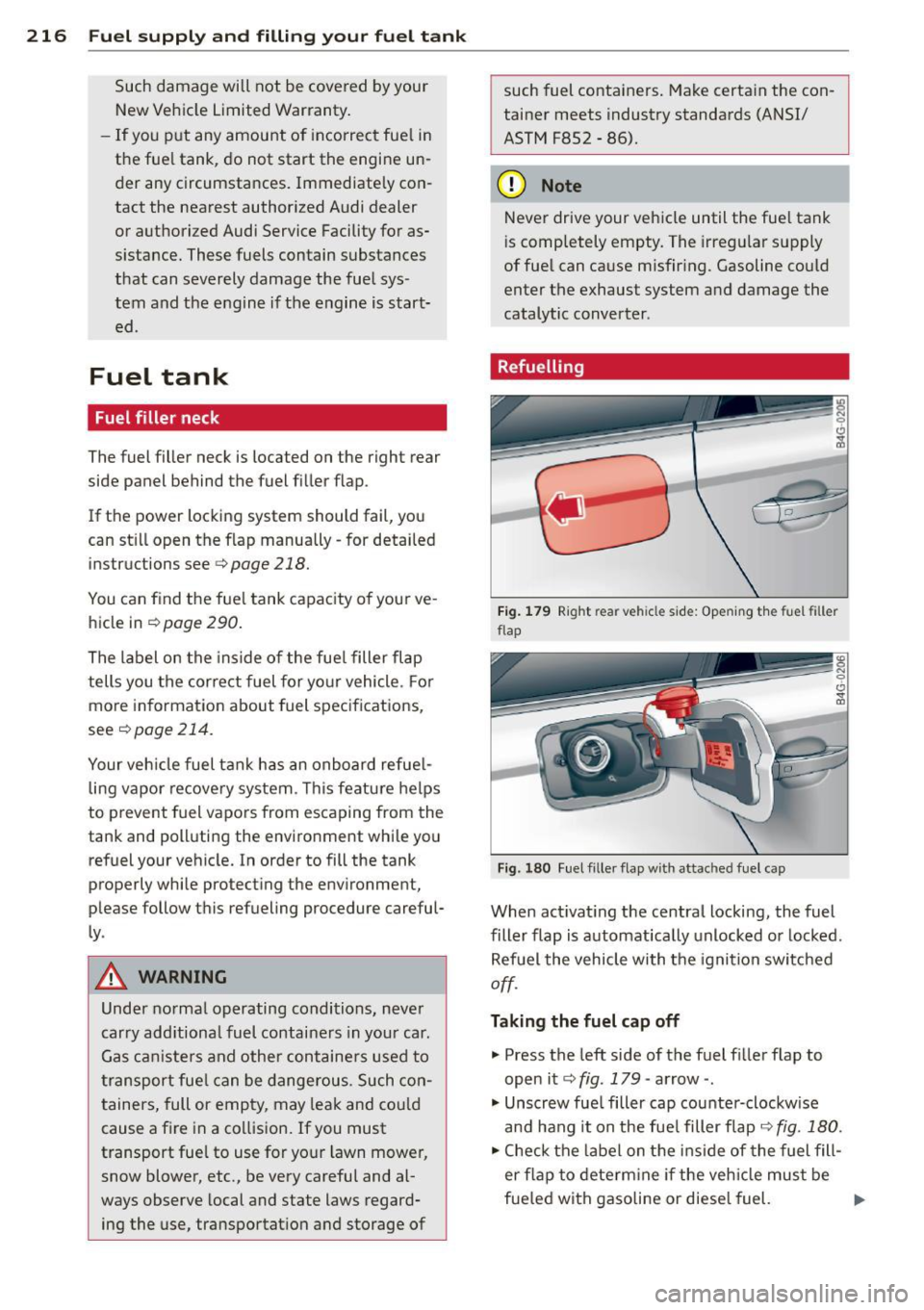
The fuel filler neck is located on the right rear
side panel behind the fuel filler flap.
If the power locking system should fa il, you
can st ill open the flap manually -for detailed
instructions see
c;, page 218.
You can find the fue l tank capacity of your ve
hicle in
c;, page 290.
The label on the inside of the fue l filler flap
tells you the cor rect fuel for your vehicle . Fo r
more information about fuel specifications,
see
c;, page 214.
Your veh icle fuel tank has an onboard refue l
ling vapor recovery system. This feature helps
to prevent fuel vapors from escaping from the
tank and polluting the environment while you refuel your vehicle. In order to fill the tank
properly whi le protecting the env ironment,
please follow this refueling procedure careful
ly .
A WARNING
Under normal operating conditions, neve r
carry additiona l fuel containers in you r car.
Gas canisters and other containers used to
transport fuel can be dangerous. Such con
tainers, full or empty, may leak and could
cause a fire in a collision. If you must
transport fue l to use for yo ur lawn mower,
snow blower, etc., be very careful and al
ways observe local and state laws regard
ing the use, transportation and storage of such
fuel containers . Make certain the con
tainer meets industry standards (ANSI/
ASTM F852 -86).
(D Note
Never drive your vehicle until the fue l tank
is completely empty. The irregu lar supply
of fue l can cause misfiring. Gasoline could
enter the exhaust system and damage the
catalytic converter .
Refuelling
Fig. 179 Right rea r veh icle side: Opening the fuel filler
flap
Fig . 180 Fu el filler flap with attac hed fuel cap
When act ivat ing the central locking, the fuel
filler flap is automatically unlocked or locked.
Refuel the vehicle with the ignition switched
off.
Taking the fuel cap off
" Press the left side of the fuel filler flap to
open it
c;, fig. 179 -arrow -.
" Unscrew fuel filler cap counter-clockwise
and hang it on the fue l filler flap
c;, fig. 180.
"Check the label on the inside of the fuel fill
er f lap to determine if the veh icle must be
fue led with gasoline or diesel fuel.
Ill>
Page 226 of 314
224 Checking and filling
Engine compartment
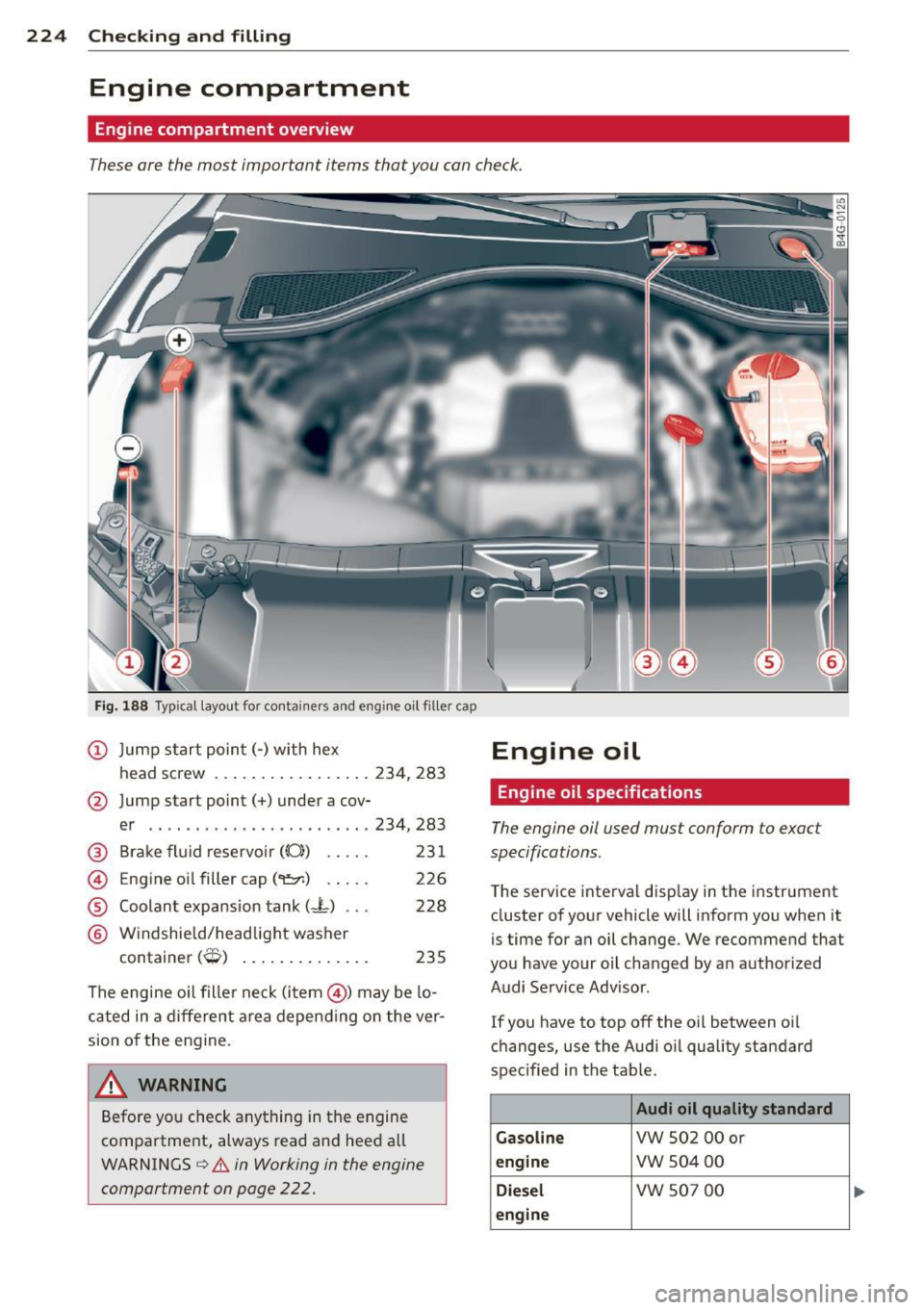
Engine compartment overview
These are the most important items that you can check.
Fig. 188 Typ ical layout for contai ners and eng ine o il filler cap
(D Jump start point(-) with hex
head screw .... ............. 234, 283
@ Jump start point(+) under a cov-
er .. .. ............... .... . 234,283
@ Brake fluid reservoir ((0)) . . . . . 231
© Engine oil filler cap (
® Coolant expansion tank (-L) ... 228
Windshield/headlight washer
. (' " ) container O ............ . . 235
The engine oil filler neck (item @) may be lo
cated in a different area depending on the ver
sion of the engine.
~ WARNING
Before you check anything in the engine
compartment, always read and heed all
WARNINGS
¢ &. in Working in the engine
compartment on page 222.
-
Engine oil
Engine oil specifications
The engine oil used must conform to exact
specifications.
The service interval display in the instrument
cluster of your vehicle will inform you when it
is time for an oil change. We recommend that
you have your oil changed by an authorized Audi Serv ice Advisor.
If you have to top
off the oil between oi l
changes, use the Audi oil quality standard
specified in the table.
Audi oil quality standard
Gasoline
VW 502 00 or
engine vw 504 00
Diesel vw 507 00
engine
Page 227 of 314
M N
0 <.J 'SI: ,...., \!) 1.1'1 ,...., 1.1'1 ,....,
Using the proper engine oil is important for
the functionality and service life of the en
gine. Your engine was factory -filled with a
high-quality oil which can usually be used
t h roughout the entire year.
Your Limited New Vehicle Warranty does not cover damage or malfunctions due to
failure to follow recommended mainte
nance and use requirements as set forth in
the Audi Owner's Manual and Warranty
&
Maintenance booklet .
- Use only a high quality engine oil that ex
pressly complies with the Audi oil quality
standard specified for your vehicle's en
gine . Using any other oil can cause seri
ous engine damage.
- Do not mix any lubricants or other addi
tives into the engine oil. Doing so can
cause engine damage.
If you need to add oil and there is none
available that meets the Audi oil quality
standard your engine requires, you may
add a total of no more than 0.5 quart/liter
of a high-quality "synthetic"oil that meets
the following specifications.
- Vehicles with gasoline engine: ACEA A3
or API SM with a viscosity grade of
SAE 0W-30, SAE SW-30 or SA E SW-40.
- Vehicles with diesel engine: ACEA C3 or
API CF with a viscosity grade of
SAE 0W-30 or SAE SW-30.
- For more information about engine oil
that has been approved for your vehicle, please contact either your authori zed
Audi dealer or Audi Customer Relations
at 1 (800) 822 -2834 or visit our web site
at www.audiusa.com or
www.audicanada .ca.
Checking and filling 225
Engine oil consumption
T he engine in your vehicle depends on an ade
quate amount of oil to lubricate and cool all
of its moving parts .
In order to provide effec tive lubrication and
cooling of internal engine components, all in
ternal combustion engines consume a certain
amount of oil. Oil consumption varies from engine to engine and may change significantly
over the life of the engine. Typically, engines
with a specified break-in period (see
c::> page 200) consume more oil during the
break-in period than they consume after oil
consumption has stabili zed.
Under normal conditions , the rate of oil con
sumption depends on the quality and viscosity
of the oil, the RPM (revolutions per minute) at
which the engine is operated, the ambient
temperature and road condi tions. Further fac
tors are the amount of oil dilution from water
condensation or fuel residue and the oxida
tion level of the oil. As any engine is subject to
wear as mileage builds up, the oil consump
tion may increase over time until replacement
of worn components may become necessary.
With all these variables coming into play, no
standard rate of oil consumption can be es
tablished or specified . There is no alternative
to regular and frequent checking of the oil lev
el , see
Note.
If the yellow engine oil level warning symbol
in the instrument cluster
II lights up, you
should check the oil level as soon as possible
c::> page 226. Top off the oil at your earliest
convenience
c::> page 226.
A WARNING
--
Before you check anything in the engine
compartment, always read and heed all
WARNINGS
c::> & in Working in the engine
compartment on page 222.
(D Note
Driving with an insufficient oil level is like-
ly to cause severe damage to the engine. .,.
•
•
Page 229 of 314
M N
0 <.J 'SI: ,...., \!) 1.1"1 ,...., 1.1"1 ,....,
-If your skin has come in contact with the
engine oil, you must subsequent ly
cleanse it thoroughly.
0 Note
- Check the oil leve l using t he M MI. If the
message
Please reduce oil level appears,
contact your author ized Audi dealer or
other qualified workshop to have excess
oi l extracted if necessary .
-Audi does not recommend the use of oil
add it ives. They may damage the engine
and adversely affect your New Vehicle
Warrant y.
@ For the sake of the environment
-Under no circumstances ca n the o il come
i n contact wit h the sewage network or
the soil.
- Observe and fo llow lega l regu lations
when disposing of em pty oil con tainers .
Changing the engine oil
We recommend tha t have your oil changed by
an authorized Audi dealer or a qualified serv
ice station .
Before you check any thing in the engine com
pa rtment,
always read and heed all WARN
INGS
~ .&. in Working in the engine compart
ment on page 222 .
The engine oil must be changed according to
the intervals specified in your Warra nty
&
Ma intenance book let . This is very important
because the l ubr icating prope rties of oil di
m inish gradua lly dur ing no rmal veh icle use.
Unde r some circumstances the engine o il
should be changed more frequently . Change
oil more often if you driv e most ly short dis
tances , ope rate the vehicle in d usty areas or
u nd er predomin antly stop-and-go t raff ic con
di tions , or have your veh icle w here tempe ra
tures remain below free zing fo r ex tended pe
riods .
D etergen t additi ves i n the o il w ill ma ke fresh
oil look dark a fter the eng ine has been run -
Checkin g and fillin g 22 7
ning for a sho rt time. This is normal an d is not
a reaso n to cha nge the oil more often t han
recommended.
Bec ause of t he pro blem o f proper disposal,
along wi th the specia l tools and necessa ry ex
pertise req uired, we st ro ngly recommend that
you have your oil changed by an a uthorized
Audi dealer or a qualified service station.
If you choose to change your oil yourself ,
please note the following important info rma
t ion:
_& WARNING
To reduce the risk of pe rsonal inj ury if you
must change the eng ine oil in your vehicle
yourself:
- Wear eye protect io n.
- To reduce t he risk of burns from hot en -
gine oil, let the engine c ool down to the
touch.
- When removing the o il dra in p lug with
your fingers, stay as fa r away as possible .
Always keep you r forearm parallel to the
grou nd to help prevent hot o il from run
ning down you r arm.
- Dra in the oil into a container designed
for this purpose, one la rg e enough to
hold at l east the tota l am ou nt of oil in
your engine.
- Engine oil is poisonous. Keep it well o ut
of the rea ch of childre n.
- Con tinuous contact wit h used eng ine o il
is harmful to yo ur ski n. A lways protect
your skin by washi ng oil off t horoughly
w it h s oap and w ater.
d) Note
N eve r mix oil additives wi th you r engine
oil. Th ese additives can damage your en
g ine and adversely affect your Au di Li m it
e d N ew Vehicle Warr anty.
(® For the sake of the environment
- Befor e changi ng your oil, first make s ure
yo u k now where yo u ca n prope rly dispose
o f the used oil.
1J11>
•
•
Page 230 of 314
228 Check ing and filling
- Always dispose of used engine oil proper
l y . Do not dump it on garden soi l, wood
ed areas, into open streams or down
sewage dra ins.
- Recycle used engine oil by taking it to a
used engine oil collection facility in your
area, or contact a service station.
Engine cooling system
Coolant
The engine coolant performs two functions: it
keeps the engine from overheating and it pro tects the engine from freezing in the winter.
The cooling system is sealed and generally re
qu ires little attention.
The cooling system has been filled at the fac
tory with a permanent coolant which does not need to be changed. The coolant consists of a
mixture of spec ially conditioned water and the
manufacturer's glycol-based coolant addi-
tive G13 antifreeze with ant icorros ion addi
tives (50% for USA models; 60% for Canadian
models). This mixture both assures the neces
sary frost protection and protects metal com
ponents in the engine's coo ling system from
corrosion and scaling . It also raises the boil
ing point of the coolant.
Do not reduce the concentration of the coo l
ant in the summer by adding plain water.
The
p ropo rtion of coolant add itive must be at
l e a st 50 % but not mo re th an 60 %
to ma in
tain antifreeze protection and cooling efficien
cy . If the coolant frost protect ion is too low,
the coo lant cou ld freeze and damage the veh i
cle heating and eng ine cool ing system.
For year-round driving, antifreeze is added at
the facto ry for temperatures down to:
- -31°F(-35°C)USA
- -40 °F ( -40 °C) Canada.
If you m ust add coo lant, use a m ix tu re of wa
ter and coo lant addit ive . M ixing the coolant
additive with disti lled water is recommended .
A WARNING
Before you check anything in the engine
compartment, always read and heed all
WARNINGS~ &.
in Working in the engine
compartment on page
222 .
(D Note
-Before winter sets in, have the coolant
checked to see if the coolant additive in
your vehicle is sufficient to meet the cli mate conditions. This is especia lly impor
tant if you live in a reg ion where t he win
t er is ex treme ly cold. If necessary, in
crease the p roportion of coo lant add it ive
to 60% .
- When adding coolant addi tive to yo ur
c ooling sys tem, remembe r:
- We recommend us ing on ly coolant ad
d itive G12++ or G13 (check the label)
for your vehicle . This coolant additive is
ava ilable at autho rized Aud i dea le rs.
Other types of antifree ze ca n sign ifi
ca ntly reduce co rros io n protec tion. The
res ulting corrosion c an cause a loss of
coolant and serious engine damage.
- Do not add any type of r ad iator le ak seal
ant to yo ur vehicle 's engine coolant .
Adding radiator repair flu id may adverse
ly affect the function and performance of
your cooling system and cou ld resu lt in
damage not covered by your New Vehicle Limited Warranty.
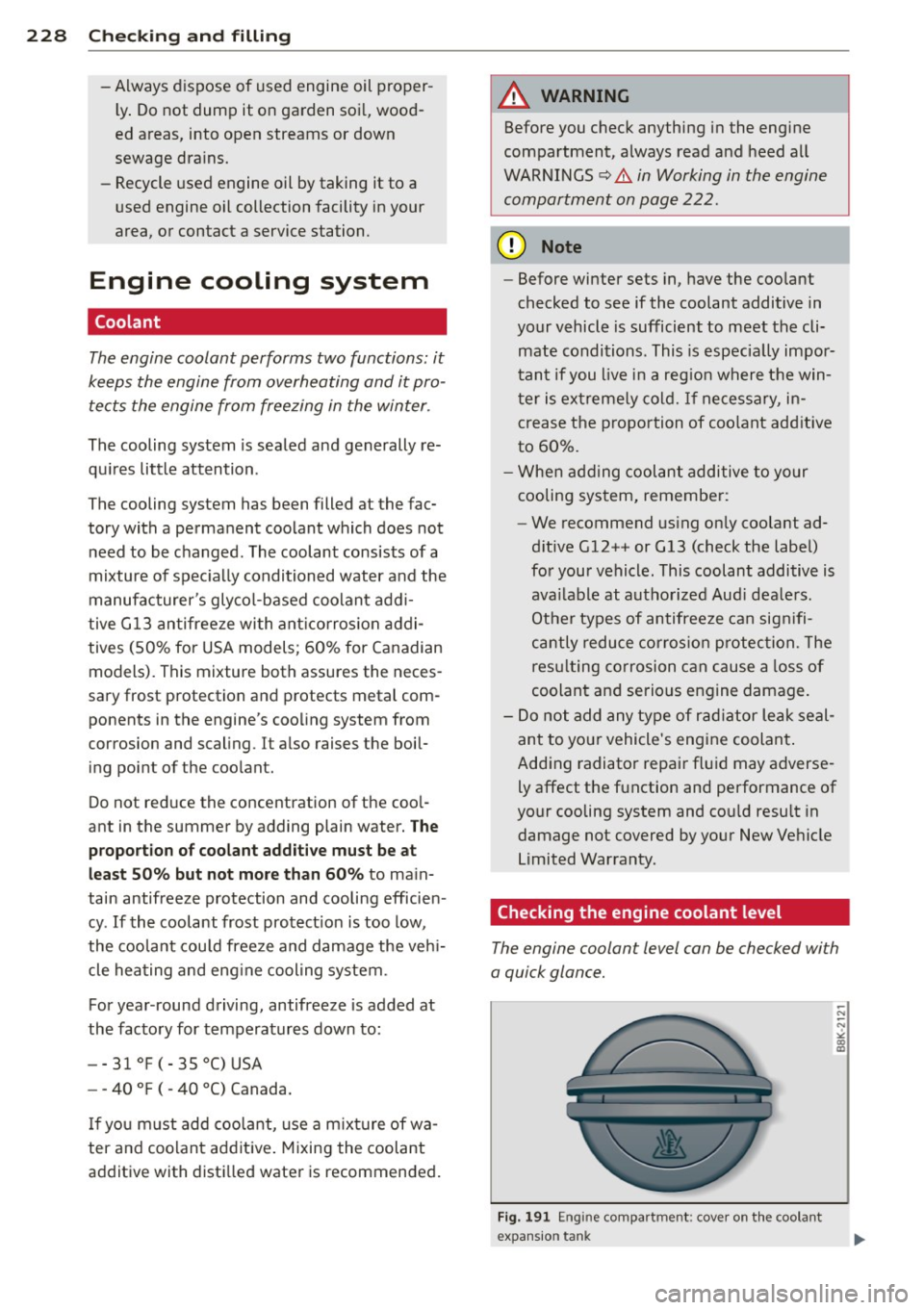
Checking the engine coolant level
-
The engine coolant level can be checked with
a quick glance.
F ig. 1 91 Engi ne compartment: cover on the coola nt
expansio n tank
Page 234 of 314
232 Checking and filling
@ For the sake of the environment
Because of the problem of proper disposal
of brake fluid as we ll as the special tools
required and the necessary expertise, we recommend that you have the brake fluid
changed by your author ized Audi dealer.
Battery
General information
Under normal operating conditions, the bat
tery in your Audi does not need any mainte
nance. With
high outside temperatures or
long daily drives we recommend that you have
the electro lyte level checked by a service fa
cility . The electrolyte level should also be
checked each time the battery is charged
¢ page 234.
Have the battery checked when you take your
vehicle in for service . You are well adv ised to
replace a battery that is older than 5 years .
With certain types of airbag deployment, the battery is disconnected from the vehicle elec
tr ical system for safety reasons¢
& in Re
pair, care and disposal of the airbags on
page 161.
Disconnecting the battery terminals
Some vehicle functions (power window regu
lators, for example) are lost if the battery ter
minals are disconnected. These functions have
to be relearned after the battery terminals are
connected again. To prevent this , the battery
should only be disconnected from the vehicle
e lectrica l system when absolutely necessary
for repairs.
Vehicles not driven for long periods
If you do not drive your vehicle over a period
of severa l days or weeks, electrical compo
nents are gradually cut back or switched off.
This reduces energy consumption and main
tains starting capabi lity over a longer period
¢page 198. Some of the convenience func
tions may not operate, such as the interior
lights or power seat adjustment. The conven- ience
functions will be available again when
you switch on the ignition and start the en gine.
Winter operation
During the winter months, battery capac ity
tends to decrease as temperatures drop. This
is because more power is a lso consumed whi le
starting, and the headlights, rear window de
fogger, etc., are used more often.
Avoid unnecessary power consumption, par
ticu larly in city traffic or when traveling only
short distances. Let your authorized Audi
deale r check the capacity of the vehicle bat
tery before winter sets in¢
page 234 . A well
charged battery will no t only prevent star ting
problems when the weather is cold, but will
also last longer .
@ Tips
If your vehicle is left standing for several
weeks at extremely low temperatures, the
vehicle battery shou ld be removed and
stored where it w ill not freeze. This will
prevent it from be ing damaged and having
to be replaced .
Working on the battery
Be especially careful when working on or near
the battery.
The battery is located in the luggage compart
ment under the floor . Before you check any
thing in the luggage compartment,
read and
heed all WARNINGS
¢ .&, .
Always heed the safety warnings , when work
ing on the vehicle battery or the vehicle elec
t rical system to prevent injury.
The following WARNINGS are very
important when working on the battery:
Always heed the following WARNING SYM-
BOLS and safety precautions when working
on the battery.
®
Always wear eye protection.
Page 254 of 314
252 Tires and wheels
-Always inflate tires to the
recommended and correct
tire pressure before driving
off .
-Driving with underinflated tires bend more, letting
them get too hot resulting
in tread separation, sudden
tire failure and loss of con
trol.
-Excessive speed and/over loading can cause heat
build-up, sudden tire failure
and loss of control.
-If the tire pressure is too low or too high, the tires
will wear prematurely and the vehicle will not handle
well.
- If the tire is not flat and you
do not have to change a
wheel immediately, drive at
reduced speed to the near
est service station to check
the tire pressure and add air
as required.
@ Note
Driving without valve stem
caps can cause damage to
the tire valves. To prevent
this, always make sure that
factory installed valve stem caps on all
wheels are secure
ly mounted on the valve.
@) For the sake of the environment
Underinflated tires will also
increase the fuel consump
tion.
Tires and vehicle load limits
There are limits to the amount of load or weight that any vehi
cle and any tire can carry. Ave
hicle that is overloaded will not
handle well and is more diffi
cult to stop. Overloading can not only lead to loss of vehicle
control, but can also damage
important parts of the vehicle
and can lead to sudden tire fail
ure, including a blowout and
sudden deflation that can cause
the vehicle to crash.
Your safety and that of your
passengers also depends on
making sure that load limits are
not exceeded. Vehicle load in
cludes everybody and every
thing in and on the vehicle.
These load limits are technical
ly referred to as the vehicle's
Gross Vehicle Weight Rating
("GVWR "). .,..
Page 257 of 314
M N
0 I.J ""'. rl I.O
"' rl
"' rl
being loaded on the vehicle.
That weight may not safely
exceed the available cargo
and luggage load capacity
calculated in Step 4.
6. If your vehicle will be towing
a trailer, load from your trail
er will be transferred to your
vehicle. Consult this manual
to determine how this re
duces the available cargo
and luggage load capacity of
your vehicle.
.,.Che ck the tire sidewall
(¢ page 257, fig. 199) to de
termine the designated load rating for a specific tire.
Tire service life
The service life of tires depends
on a lot of different things in
cluding proper installation and
balancing, correct tire pressure and driving style.
Fig . 197 Tire tread: tread wear indi
cators (TWI)
Tires and wheels 255
Fig. 198 Rotating tires for more even
wear
Tread Wear Indicator (TWI)
The original tires on your vehi
cle have
1/16 inch (1.6 mm)
high "wear indicators"
¢ fig. 197 running across the
tread. Depending on the make,
there will be six to eight of
them evenly placed around the
tire. Marks on the tire sidewall (for example "TWI" or other
symbols) indicate the positions
of the tread wear indicators.
Worn tires must be replaced.
Different figures may apply in
other countries
¢ & .
Tire pressure
Incorrect tire pressure causes
premature wear and can cause
sudden tire blow-out. For this
reason, tire pressure must be
checked at least once a month
¢ page 249.