fuel AUDI S6 2016 User Guide
[x] Cancel search | Manufacturer: AUDI, Model Year: 2016, Model line: S6, Model: AUDI S6 2016Pages: 294, PDF Size: 73.88 MB
Page 35 of 294
.... N
0 CJ '
-If the power locking system should mal
function, you can lock the driver's door
using the mechanical key¢
page 36.
-If the power locking system should fail, you
can still open the fuel tank flap in an emer
gency
c!;> page 212.
- You are well advised not to keep valuables
inside an unattended vehicle, visible or not.
Even a properly locked vehicle cannot pro
vide the security of a safe.
- If the LED in the upper edge of the driver's
door panel comes on for about 30 seconds
after the vehicle is locked, there is a mal
function in the power locking or the anti
theft warning system. Have the malfunction
corrected by an authorized Audi dealership
or qualified repair facility.
Setting central locking
In the Infotainment system, you can set which
doors the central locking system will unlock.
... Select: the I CA R I function button > (Car)* Sys
tems
control button > Vehicle settings > Cen
tral locking* .
Door unlocking -
You can decide if All doors or
only the
Driver should unlock. The luggage com
partment lid also unlocks when
All is selected. If
you select Driver in a vehicle with a convenience
key*, only the door whose handle you pull will un
lock.
If you select Driver, all the doors and luggage
compartment lid will unlock if you press the
l@J
button on the remote control master key twice.
Disable tailgate handle -If you select On, the
luggage compartment lid handle is locked. In
this case the luggage compartment lid can be
opened with the
l= I button on the master key or
with the
l =I button* in the driver's door. In
vehicles with a convenience key*, you can still
open the luggage compartment lid using the
handle if an authorized master key is near the
proximity sensor* .
Fold mirrors when locking* -If you select On ,
the exterior rearview mirrors fold in automatical
ly when you press the[@] button on the remote
Opening and closing
control master key or touch the sensor* in the
handle.
Tone when locking -if you select On, a tone will
sound when you lock the vehicle.
Locking and unlocking the vehicle with the
remote control
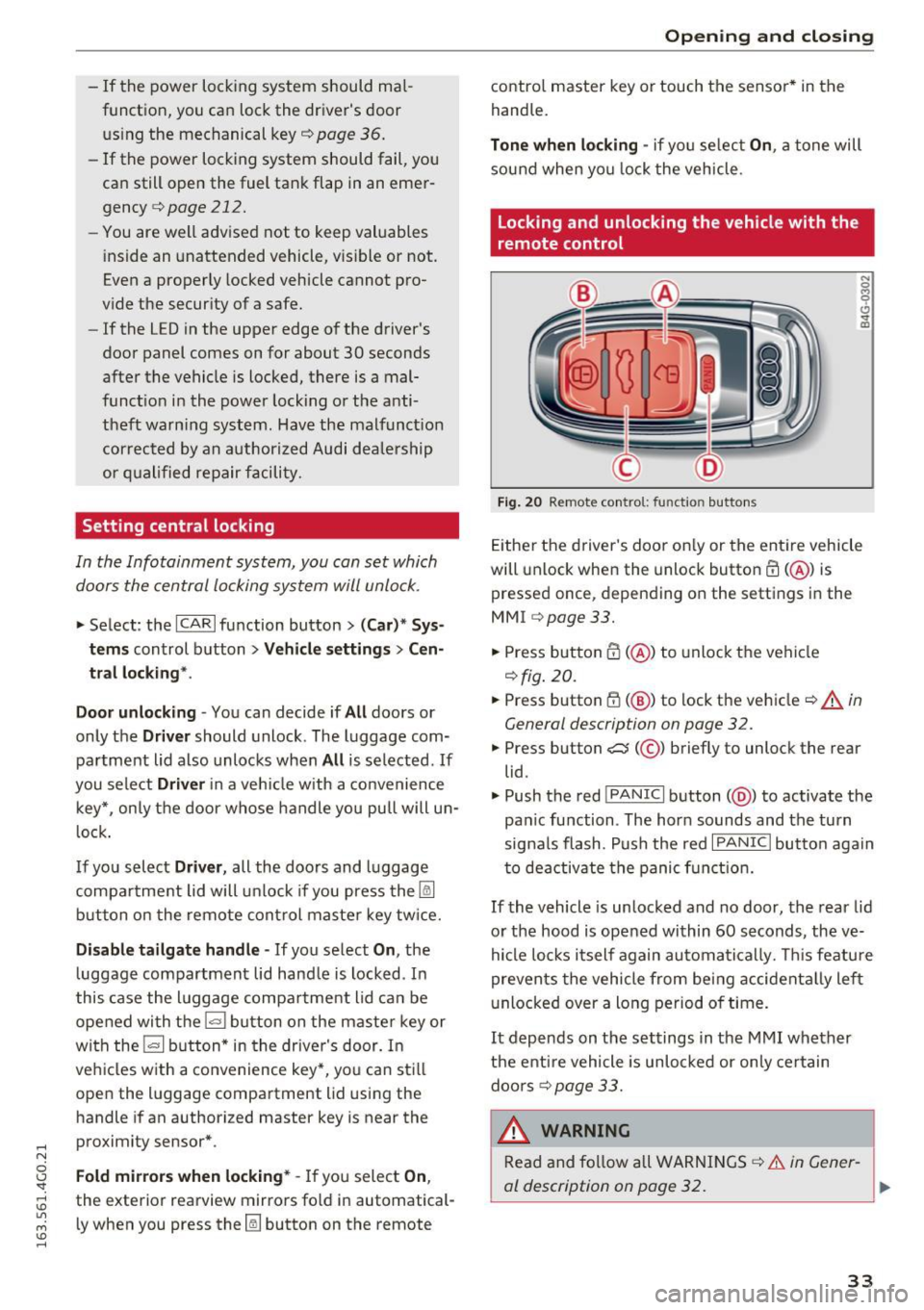
Fig. 20 Remote control: function buttons
N
0 ...,
9 C)
"' m
Either the driver's door only or the entire vehicle
will unlock when the unlock button
m (@ ) is
pressed once, depending on the settings in the
MMI c> page 33 .
1> Press button m (@ ) to unlock the vehicle
c> fig. 20 .
... Press button lil (@ ) to lock the vehicle c!;> .&. in
General description on page 32.
... Press button C:$ (@ ) briefly to unlock the rear
lid.
... Push the red
!PANIC I button( @) to activate the
panic function . The horn sounds and the turn
signals flash. Push the red
I PANIC I button again
to deactivate the panic function.
If the vehicle is unlocked and no door, the rear lid
or the hood is opened within 60 seconds, the ve
hicle locks itself again automatically. This feature
prevents the vehicle from being accidentally left
unlocked over a long period of time.
It depends on the settings in the MMI whether
the entire vehicle is unlocked or only certain
doors
c!,> page 33.
_& WARNING ~
Read and follow all WARNINGS¢&. in Gener-
al description on page 32. ..,.
33
Page 65 of 294
-Objects fal ling from the roof of a vehicle can
cause a crash and personal injury.
- Only mount the roof rack on the designated
locations on the roof
c:> fig. 67.
-The roof rack system must be installed ex
act ly according to the instructions provided .
- When driving with a roo f rack system,
changes to the center of gravity and wind
resistance can change the vehicle handling
and lead to a collision. Always adapt your
dr iv ing and your speed to the current condi
t ions.
- Your vehicle warranty does not cover any
damages to the vehicle caused by using roof
racks or mounting structures not approved
by Audi for your vehicle . The same applies to
damage result ing from incorrect roof rack
i nstallation.
-Always check the roof rack mount ings and
hardware before each t rip and dur ing a tr ip
to make sure everyt hing is securely tight
ened.
If necessary, ret igh ten the mo unt ings
and c hec k the en tire system from time to
time.
- After mounting a roof rack system, or when
you transport objects on the roof of your ve
hicle, the height of the vehicle is naturally
increased . Be careful when driving under
l ow bridges or in parking garages for exam
ple. This could cause damage to the load
and even the vehicle itself.
- Make s ure the open rear lid and the sun
roof* do not come into contact with the roof
rack.
Loading the roof rack
Always distribute loads evenly. Make sure any
thing on the roof rack is securely tied down.
~ Always distribute the loads on the roof rack
evenly .
~ Always attach items to the roof rack securely
before you drive off.
The maximum perm iss ible roof weight is
220 lb
( 100 kg ).
The roof weight is the total of the
Seat s and sto rage
weight o f the roof rack, the attachments and the
cargo you are carrying. You must a lso not exceed
the max imum load weight for the roof rack you
are using.
When using a roo f rack system which has a lower
load carrying capacity, you must not use up the
total max imum permissible load carry ing capac i
ty specified above. Instead, you should load the
roof rack system only to the maximum capacity
specified by the manufacturer of the roof rack
system .
A WARNING
= -Weak, damaged or imprope r straps used to
secure items to the roof rac k can fail d uring
hard brak ing o r in a co llision and cause seri
ous persona l injury.
- Make sure the roof r ack is installed exactly
as specified above
c:> page 62.
- Always use suitable mounting straps fo r se
cur ing items to the roof rac k to he lp prevent
items from shifting o r flying forward .
- Items on the roof rack mus t always be se
curely mounted.
- The use of a roof rack can negative ly affect
the w ay a vehicle hand les. Cargo tha t is
large, heavy, b ulk y, long or flat wi ll have a
grea ter negat ive infl uence on the vehicle's
aerodynamics, center of gravity and overa ll
handling. Always drive slowly, avoid sudden
braking and maneuvers when transporting
cargo on the roof of your vehicle.
- Never exceed the max imum permissib le
load carrying capacity of the roof of your ve
h icle, the permiss ible axle weights and the
perm iss ible total we ight of your vehicle
c:> page 2 70, Weights .
@ For the sake of the environment
As a result of the increased wind res istance
created by a roof rack, your vehicle is using
fuel unnecessarily . So remove the roof rack
after using it .
63
Page 69 of 294
Warm and cold Climate control system
Description
App lies to vehicles: with three-zone climate control or four
zone a utomat ic climate contro l
The climate control system warms, cools and
adds humidity to the air in the vehicle interior . It
is the most effective when the windows and sun
roof* are closed .
If the temperature inside the
parked vehicle becomes very warm, opening the
window briefly will speed up the cooling process.
In all heating mode functions except
defrost, the
blower only switches to a higher speed once the
engine coolant has reached a certain tempera
ture.
Condensat ion from the cooling system can drip
and form a puddle of water under the vehicle.
This is normal and does not mean there is a leak.
Pollutant filter
The pollutant filter removes pollutants such as
dust and pollen from the air.
T he air pollutants filter must be changed at the
intervals specified in your Warranty
& Mainte
nance booklet, so that the air conditioner can
properly work .
If you drive your vehicle in an area with high air pollution, the filter may need to be changed
more frequently than specified in your Audi War
ranty
& Maintenance booklet . If in doubt, ask
your authorized Audi Service Advisor for advice .
Key coded settings
Three-zone climate control: The blower setting
and air distribution are stored automatically and
assigned to the remote contro l key that is in use.
Four-zone automatic climate control: Th e cli
mate control settings are automatically stored
and assigned to the remote contro l key that is in
use.
Warm and cold
A WARNING
Reduced visibility is dangerous and can cause
accidents .
- For safe driving it is very important that all
windows be free of ice, snow and condensa
tion .
- Completely familiarize yourself with the
proper use and function of the heating and
ventilation system and especially how to de
fog and defrost the windows .
- Never use the windshield wiper/washer sys tem in freezing weather until you have warmed the windshield first, using the heat
ing and vent ilation system. The washer so lu
tion may freeze on the w indshield and re
duce visibility.
(D Note
- If you suspect that the air conditioner has
been damaged, sw itch the system off to
avoid further damage and have it inspected
by a qualified dealership.
- Repa irs to the Aud i air cond itioner require
special technical knowledge and special
tools. Contact an authorized Audi dea ler for
assistance.
@ For the sake of the environment
By reduc ing the amount of fuel you use, you
also reduce the amount of pollutants emitted
into the air.
(D Tips
- Keep the air intake slots (in front of the
windshield) free from ice, snow and debris
in order to maintain the proper function of
the climate control system.
- The energy management system may switch
the seat heating* or rear window defroster off temporarily . These systems are availab le
again as soon as the energy balance has
been restored .
- Air escapes through vents under the rear
window. When placing items of clothing on the luggage compartment cover, ensure
that the openings are not covered.
67
Page 81 of 294
..... N
0 CJ '
the associated components (ABS, ASR, EDL)
cannot overcome the laws of physics. In cor
ners and when road or weather conditions are
bad, a full brake applicat ion can cause the ve
hicle to s kid or the rea r end to break away,
w hic h inc reases the r isk of an a cc iden t.
Start-Stop-System
Description
Applies to vehicles: with Sta rt-Stop-System
T he Sta rt-Stop -System can help increase fuel
economy and reduce CO2 emissions .
I n Start -Stop mode , the eng ine sh uts
off auto
mat ica lly when the veh icle is stopped , such as at
a traffic light. The ignition remains switched on
during this stop phase. The eng ine will restart
automatically when needed.
Vehicles with 6 -cylinder-eng ine: The Start-Stop
System is a utomatically activated each time you
switch on the ignit ion.
Vehicles with 4-cylinder -eng ine, 5-mode l: Th e
l ast Start -Stop-System setting will be restored
when the ignition is switched on .
Basic requirements for Start -Stop mode
- T he driver's door is closed.
- T he driver' seat belt is la tched .
- The hood is closed .
- The veh icle must have been dr iven faster than
2.5 mph (4 km/h) since the last stop .
- A tra iler is not hitched to t he vehicle.
(D Note
Always sw itch the Start-Stop-System off
when dr iv ing th rough water
c:> page 79.
(D Tips
The e ngine sto ps shortly before the vehicle
comes to a stop
1l. The full funct io n of the
brake booster and the power steering is still
ava ilab le.
M ~ ll de pend ing on e ngine
D rivi ng
Stopping/starting the engine
Applies to vehicles: with Start-Stop -System
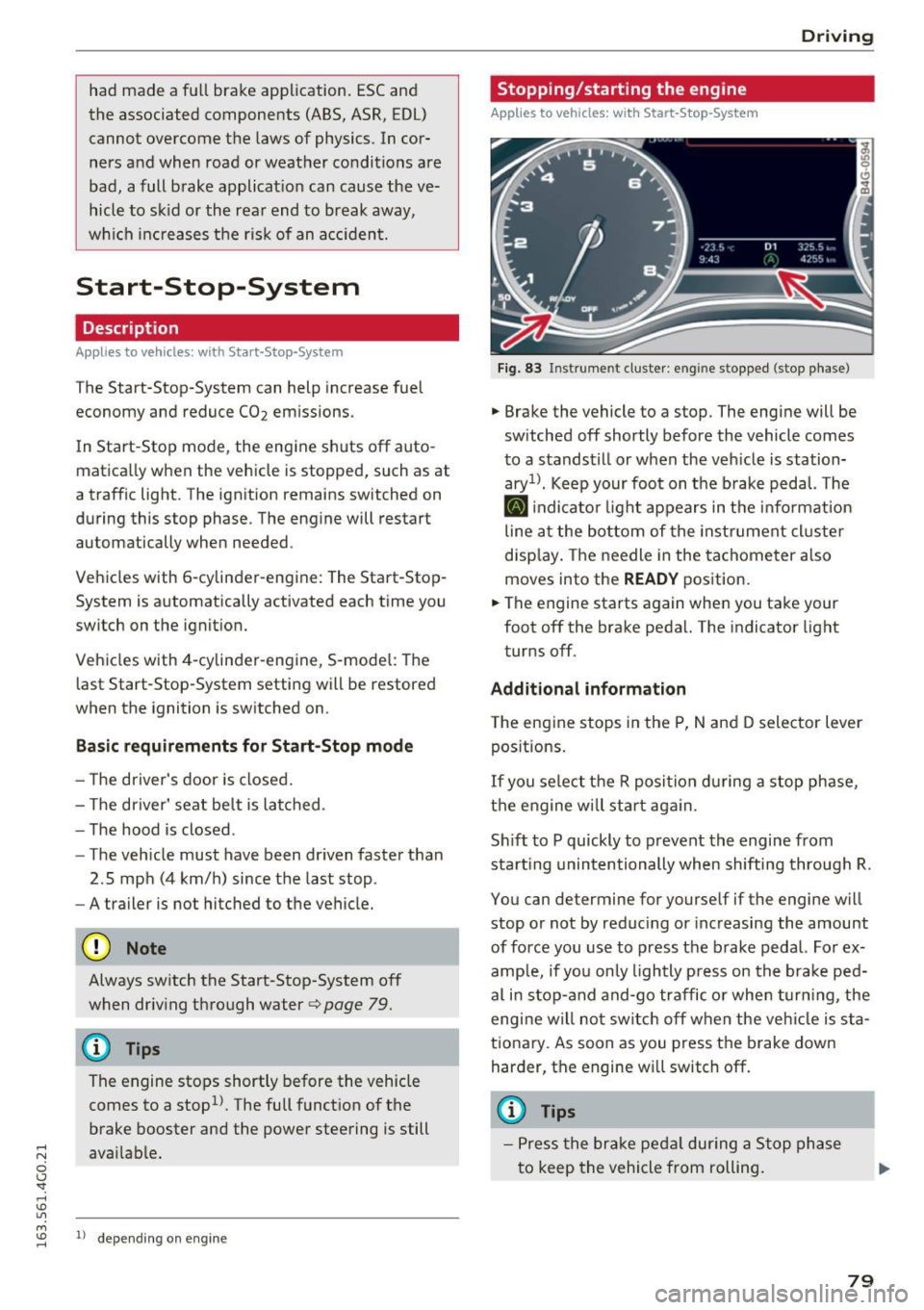
Fi g. 83 Inst rume nt c lu ste r: en gin e stopped (stop p hase )
"' Brake the vehicle to a stop. The engine will be
sw itched
off shortly before the vehicle comes
to a stands till or when the veh icle is station
aryn. Keep your foo t on the b rake pedal. The
II indicato r light appears in the info rmat ion
line a t the bo ttom of the instrument cl uste r
disp lay . T he needle in the tachometer a lso
moves into the
READY pos ition.
"' The engine sta rts again whe n you take your
foot
off the bra ke pedal. The indicator light
turns
off.
Additional information
T he engine stops in the P, N and D selector lever
pos itions.
If you se lect t he R posi tion d uring a stop phase,
t h e e ngine will sta rt aga in.
Sh if t to P quickly to p revent the engine from
sta rt ing unintentionally when shifting through R.
You can determine for yourse lf if the engine w ill
stop or not by reduc ing or increasing the amount
of force you use to press the b rake pedal. For ex
amp le, if yo u only ligh tly p ress on the bra ke pe d
al i n stop- and and -go traffic o r whe n turning, the
engi ne will no t sw itch
off w hen the ve hicle is sta
tiona ry. As soon as you press the brake down
harder, the engine w ill switch
off .
(D Tips
- P ress the brak e pe dal during a Stop ph ase
t o keep the vehicle from rolling.
79
Page 108 of 294
Automatic transmission
Automatic transmission S tronic, tiptronic
Introduction
The automatic transmission is controlled elec
tronically. The transmission upshifts or down
shifts automatically depending on which drive
program is selected.
When a
moderate driving style is used, the
transmission selects the most economical driving
mode. The transmission upshifts at a lower RPM
and downshifts at a higher RPM to improve fuel
efficiency.
The transmission switches to a sporty mode after
a kick-down or when the driver uses a
sporty
driving style
characterized by quick accelerator
pedal movements, heavy acceleration, frequent
changes in speed and traveling at the maximum
speed.
If desired , th e driver can also select the gears
manually (tiptronic mode) 9 page 110.
Various automatic transmissions may be instal
led, depending on the model:
S tronic transmission
The S tronic is a dual-clutch transmission. Power
is transferred using two clutches that work inde
pendently from one another. They replace the
torque converter used in conventional automatic
transmissions and allow the vehicle to accelerate
without a noticeable interruption in traction.
tiptronic transmission
In the tiptronic transmission, power is transfer
red by a torque converter.
106
Selector lever positions
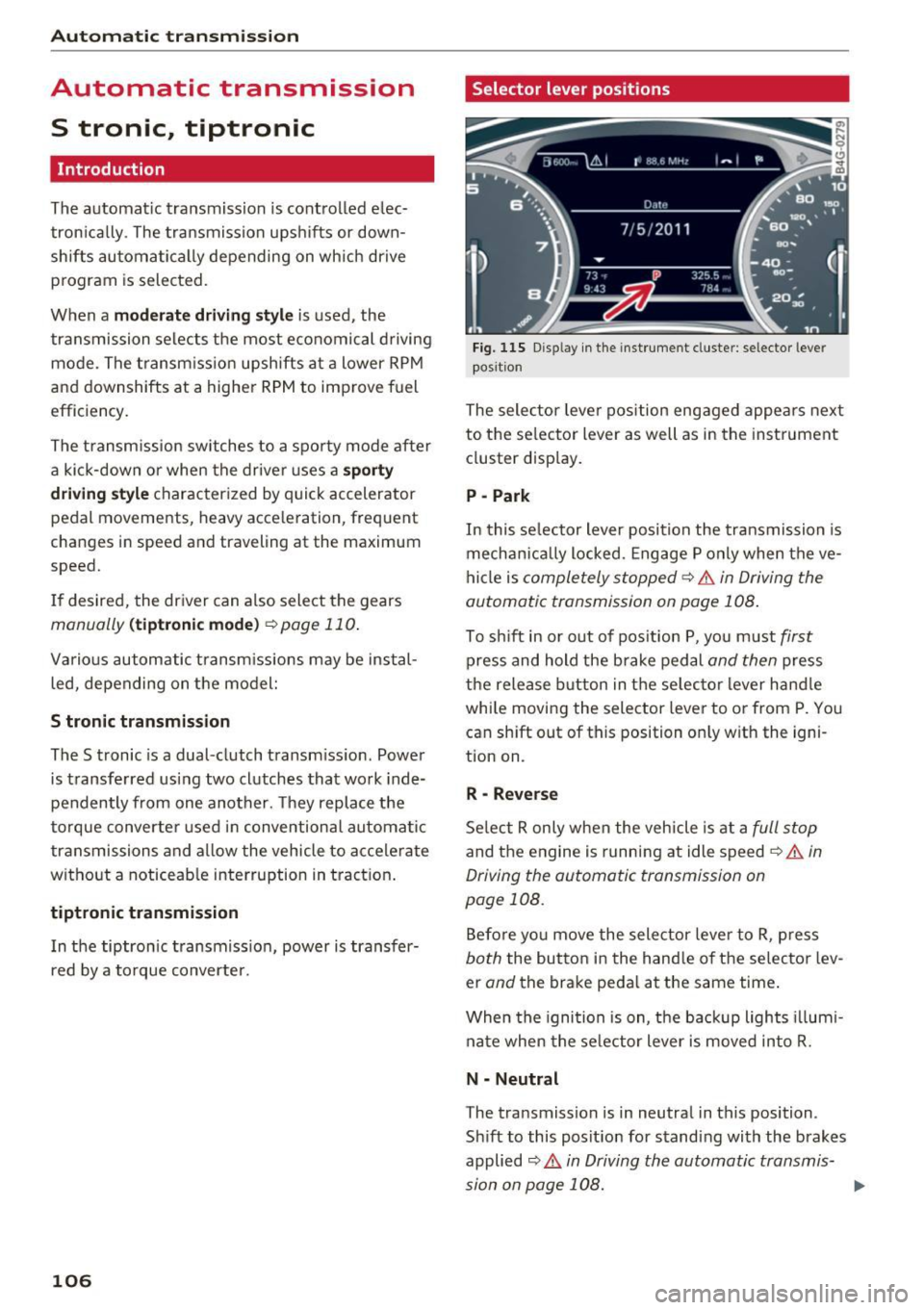
Fig. 115 Display in the instrument cluster: selector lever
position
The selector lever position engaged appears next
to the selector lever as well as in the instrument
cluster display.
P -Park
In this selector lever position the transmission is
mechanically locked. Engage P only when the ve
hicle is
completely stopped¢&. in Driving the
automatic transmission on page 108.
To shift in or out of position P, you must first
press and hold the brake pedal and then press
the release button in the selector lever handle
while moving the selector lever to or from P. You
can shift out of this position only with the igni
tion on.
R -Reverse
Select R only when the vehicle is at a full stop
and the engine is running at idle speed¢&. in
Driving the automatic transmission on
page 108.
Before you move the selector lever to R, press
both the button in the handle of the selector lev
er
and the brake pedal at the same time.
When the ignition is on, the backup lights illumi
nate when the selector lever is moved into R.
N -Neutral
The transmission is in neutral in this position.
Shift to this position for standing with the brakes
applied
9 A in Driving the automatic transmis
sion on page 108.
...
Page 196 of 294
Driving and the environment
Driving and the
environment
Breaking in
New engine
The engine needs to be run-in during the first
1,000 miles (1,500 km).
For the first 600 miles (1,000 kilometers):
.,. Do not use full throttle .
.,. Do not drive at engine speeds that are more
than 2/3 of the maximum permitted RPM .
.,. Avo id high engine speeds.
From 600 to 1,000 miles (1,000 to 1,500
kilometers):
.,. Speeds can gradually be increased to the maxi
mum perm issib le road or engine speed.
During and after break-in period
.,. Do not rev the engine up to high speeds when it
is cold . This applies whether the transmission is
i n N (Neutral) or in gear .
After the break-in period
.,. Do not exceed maximum engine speed under
any circumstances.
.,. Upshift into the next higher gear
before reach
i ng the red area at the end of the tachometer
scale~
page 10 .
During the first few hours of driving, the engine's
internal friction is higher than later when all the
mov ing parts have been broken in. How well this
break- in process is done depends to a considera
b le extent on the way the vehicle is d riven during
the first 1,000 miles (1,500 kilometers).
(D Note
Extremely high engine speeds are automati
cally reduced. However, these rpm lim its are
programmed for an engine we ll run-in, not a
new engine .
194
® For the sake of the environment
Do not drive with unnecessarily high engine
speeds -upshifting early saves fuel, reduces
noise and protects the environment.
New tires
If your vehicle is running on new tires, drive par
ticularly careful for the first 350 m iles (500 kilo
meters) after f itting .
.8, WARNING
New tires tend to be slippe ry and must also
be "broken-in". Be sure to remember this dur
ing the first 350 mi les (500 kilometers).
Brake gent ly. Avoid following closely behind
other ve hicles or other situations that might
require sudden, hard braking.
Avoid damaging the
vehicle
When you are driving on poor roads, or over
curbs, steep ramps, etc., make certain that low
lying parts such as spo ilers and exhaust system
parts do not bottom out and get damaged .
-
This is especially true for vehicles with low-slung
chassis (sports chassis)* and fully loaded
vehicles.
Driving through water on
roads
Note the following to avoid vehicle damage when
driving through water, for examp le on flooded
roads:
- The water must not be any highe r than the bot
tom of the vehicle body.
- Do not drive faster than walk ing speed .
.8, WARNING
After driving through water or mud, the brak
ing effect can be red uced due to moisture on
the brake discs and brake pads . A few careful
brake applications should dry off the brakes.
Page 197 of 294
CD Note
-Vehicle components such as the engine,
transmission, suspension or electrical sys
tem can be severely damaged by driving
through water.
- Always switch the Start-Stop-System* off
when driving through water
9 page 79.
@ Tips
- Determine the depth before driving through
water.
- Do not stop the vehicle, drive in reverse or
switch the engine off when driving through
water.
- Keep in mind that oncoming vehicles may
create waves that raise the water level and
make it too deep for your vehicle to drive
through safely.
-Avoid driving through salt water (corrosion).
Catalytic converter
Applies to vehicles: with gasoline engine
It is very important that your emission control
system (catalytic converter) is functioning prop
erly to ensure that your vehicle is running in an
environmentally sound manner .
... Always use lead-free gasoline 9 page 208,
Fuel supply.
... Never run the tank down all the way to empty.
.,. Never put too much motor oil in your engine
9 page 220, Adding engine oil~-
.,. Never try to push- or tow-start your vehicle.
The catalytic converter is an efficient "clean-up"
device built into the exhaust system of the vehi
cle. The catalytic converter burns many of the
pollutants in the exhaust gas before they are re
leased into the atmosphere.
The exclusive use of unleaded fuel is critically im
portant for the life of the catalytic converter and
proper functioning of the engine.
A WARNING
The temperature of the exhaust system is
high, both when driving and after stopping
the engine.
Driving and the environment
- Never touch the exhaust tail pipes once they
have become hot. This could result in burns.
- Do not park or operate the vehicle in areas
where the hot exhaust system may come in contact with dry grass, brush, fuel spill or
other material which can cause a fire.
- Do not apply additional undercoating or
rustproofing on or near the exhaust mani
fold, exhaust pipes, catalytic converter or heat shields. During driving, the substance
used for undercoating could overheat and
cause a fire.
CD Note
- Be aware that just one tank filling with
leaded fuel will already seriously degrade
the performance of the catalytic converter .
- Do not exceed the correct engine oil level
9page220.
- Do not drive until the fuel tank becomes
completely empty . The engine could mis
fire. Unburned fuel could also get into the
exhaust system and this could cause the
catalytic converter to overheat.
- Do not switch off the ignition while the vehi
cle is moving.
- Do not continue to operate your vehicle un
der these conditions, as otherwise fuel can
reach the catalytic converter. This could re
sult in overheating of the converter, requir
ing its replacement .
- To assure efficient operation of the Emis
sion Control System:
- Have your vehicle maintained properly and
in accordance with the service recommen
dations in your Warranty
& Maintenance
booklet.
- Lack of proper maintenance as well as im
proper use of the vehicle will impair the
function of the emission control system
and could lead to damage.
@ For the sake of the environment
Even when the Emission Control System is op
erating properly, the exhaust gas can have a
sulfur-like exhaust gas smell under some op
erating states. This depends on the sulfur
195
Page 198 of 294
Driving and th e en vironm ent
content of the fuel be ing used. Using a differ
ent brand of fue l may he lp, or filling the tank
w ith lead-free super grade gasoline.
Diesel particulate filter
Applies to vehicles: with diesel engine
The diesel particulate fi lter fi lters nearly all of
the soot particles out of the exhaust. The fi lter
cleans itself automatically under normal driving
conditions.
If the filter cannot clean itself (for ex
ample, because you are only driving short distan
ces), the filter becomes clogged w ith soot and
the
II symbo l for the diesel particulate filter il
lum inates ¢
page 20.
_& WARNING
-Do not park you r vehicle over flammable
materials such as grass or leaves because
the high temperature of the diese l particu
late fi lter could start a fire .
-
-Do not apply an underbody protectant in the
exhaust system area or a fire could start.
Placing your vehicle out
of service
If you would like to take your vehicle out of serv
ice for a longer time, contact your authorized
Audi dealer or qualified repair facility. They will
adv ise you of important measures, such as corro
sion protection, maintenance and storage proce
dures. A lso follow the information about the bat
tery ¢
page 226 .
Economical and environ
mentally-friendly driving
General
Your personal style of driving will determine the
economy of your vehicle, as well as exhaust and
noise levels .
Fuel economy, environmental impact, and wear
on your engine, brakes and tires largely depend
on three factors :
-your personal driving style
- operating conditions
196
- technical limitations
If you ant icipate what you need to do next and
drive economically, you can easily cut your fuel
consumption by 10-15 percent. This sect ion will
give you some tips on how you can help the envi
ronment and your pocketbook.
(D Tips
'
The consumption estimates as published by
ENVIRONMENTAL PROTECTION AGENCY
(EPA) and Transport Canada may not corre
spond to your actual consumption on the
road, which will vary depending upon vehicle
load and speed, road and weather conditions,
trip length, etc.
Drive smoothly and keep a lookout ahead
Vehicles use the most fuel when they are acceler
ating.
.. Avoid unnecessary accelerat ing and braking .
Vehicles use the most fuel when they are acceler
ating. If you anticipate what is going to happen
next, you will need to brake less and, thus, accel
erate less. Let the vehicle coast whenever possi
ble -for example when you see that the next traf
fic light is red.
Avoid full throttle
Driving at moderate speeds saves fuel and im
proves your mileage.
.. Try and keep well below your car's maximum
speed.
Acce lerating gently reduces fuel consumption,
engine wear, and does not disturb the environ
ment .
Fuel consumption, exhaust emissions and engine
noise increase disproportionate ly at high speeds.
If you drive at approximately three quarters of
top speed, fuel consumption will be reduced by
one half. Never drive faster than the posted
speed limit and weather conditions permit.
Page 199 of 294
Reducing unnecessary idling
Even when your car is just idling it burns up fuel.
~ Shut the engine off when you are not driving
the vehicle.
~ Do not warm up the vehicle by letting the en-
gine run at idle .
The idling phase is automat ically reduced for
veh icles w ith the Start-Stop-System. It is effi
cient to switch off the engine in vehicles without
the Start-Stop-System when stopped at ra ilroad
crossings and long red lights . Turning the engine
off for just 30-40 seconds saves more fuel than is
b ur ned by sta rting the engine ag ain.
It takes a long t ime for the engine to warm up
fu lly when it is runni ng at idle . Howeve r, wear
and noxio us emiss ions a re espe cially high when
the eng ine is wa rm ing up. So you sho uld d rive
away as soon as you sta rt the engi ne and avoid
r u nning at high rpms whi le the engine is still
warming up .
(D Note
Do not leave engine id ling unatten ded a fter
starting . If warning lights should come on to
indicate im proper operation, they wou ld go
unheeded. Extended id ling a lso produces
heat, wh ich could result in overheat ing or
other damage to the vehicle or other proper
ty.
Regular maintenance
A badly tuned engine unnecessarily wastes a lot of fuel.
~ Have your veh icle serviced at regu lar intervals.
By having your veh icle reg ularly serviced by an
Audi dea ler helps to ensure that it runs proper ly
and econom ica lly. The condition of your veh icle
not on ly affects its safety and ability to ho ld its
va lue, it a lso affects
fuel consumption .
Check you r oil each time you fill your tank.
The amount of oil use d i s re lated to e ngine lo ad
a nd speed.
Driving and the envir onment
It is normal for the oil consumption of a new e n
gine to reach its lowest value after a certain mi le
age has been dr iven.
Yo u m ust dr ive your ve hicl e abou t 3,0 00 m iles
(S, 000 kilometers) befo re yo u can properly as
sess oil consumption .
T h is also ap plies to f ue l cons umption and eng ine
o utput .
CD Note
-Have your ve hicle maintained pro perly and
in acc ordance w ith the se rvice rec ommend a
ti ons i n your W arra nty
& M ain ten ance book
let . Lack of proper maintenan ce as we ll as
improper use of the ve hicl e w ill impair the
function of the em ission cont rol system and
co uld lead to damage.
- Do not alte r or remove any component of
the Emission Contro l System unless ap
proved by the man ufacturer.
- Do not alte r or remove any device, such as
heat shields, switches, ign it ion w ires,
valves, which are designed to protect your
vehicle's Emission Contro l System a nd othe r
im por tan t ve hicle components .
Fewer short trips
Fuel consumption will always be relatively high
on short trips.
~ Try to avo id driv ing short distances with a cold
eng ine .
T he engine and cata lytic conve rter have to reach
their opt imal
operating temperature to reduce
fuel consumpt io n and noxious emiss ions effec
tively.
Just afte r starting, a cold engine in a mid-size car
only achieves a fuel economy of 6-8 m iles per
gallo n (30-40 l/ 100 km) . After about a half a
mile, fuel economy climbs to 12 mpg (20 l/100
km) . Afte r about
2 .5 m iles (4 km), the eng ine is
at its p roper operat ing temperature and fue l
eco nomy has reached a no rma l level. So yo u can
see th at yo u should avoid short trips w heneve r
poss ible. .,.
197
Page 200 of 294
Driving and the environment
T he
outside temperature is also critical in this re
ga rd. Yo ur car consumes mo re fuel in the winter
than in t he s umme r.
198