height AUDI S6 2016 User Guide
[x] Cancel search | Manufacturer: AUDI, Model Year: 2016, Model line: S6, Model: AUDI S6 2016Pages: 294, PDF Size: 73.88 MB
Page 140 of 294
Safe ty belts
Autom ati c s afet y belt retr actors
Every safety belt is equ ipped with an automa tic
be lt retractor on the shoulder belt. This feature
locks the belt when the belt is pulled out fast,
during hard braking and in a n accident . The belt
may a lso lock when you drive up or down a steep
hill or through a sharp curve. Dur ing normal driv
ing the belt lets you
move freely .
Safety belt p ret en sion ers
The safety belts are equipped with a belt preten
sioner that helps to t ighten the safety belt and
remove slack when the pretensioner is activated
¢
page 140 . The function of the pretensioner is
mon itored by a warn ing light
¢page 18.
Con vertible loc king retracto r
Every safety belt except the one on the driver
seat is equipped with a convertible locking retrac
tor that
must be used when the safety belt is
used to attach a child seat. Be sure to read the
important information about this feature
¢ page 176 .
.&_ WARNING
Improperly pos it ioned safety be lts can cause
ser ious injury in an accident ¢
page 138,
Safety belt position.
- Safety belts offer optimum protection only
when the seatback is upright and belts are
properly positioned on the body.
- Always make sure that the rear seat bac k
rest to which the center rea r safety belt* is
attached is secure ly latched whenever the
rear center safety belt is being used. If the
backrest is not securely latched, the passen
ger will move forward with the backrest dur
ing sudden braking, in a sudden maneuver
and especially in a crash.
- Never attach the safety belt to the buckle for another seat. Attaching the belt to the
wrong b uckle will reduce safety belt effec
t iveness and can cause serious persona l in
jury.
- A passenger who is not properly restrained can be seriously in jured by the safety be lt it
self when it
moves from the stronger parts
138
of the body into critical areas like the abdo men.
- Always lock the convertible locking retractor
when you are securing a child seat in the ve
hicle
¢ page 178.
(D Tips
For information on safety belt pretensioners,
refer to¢
page 140 .
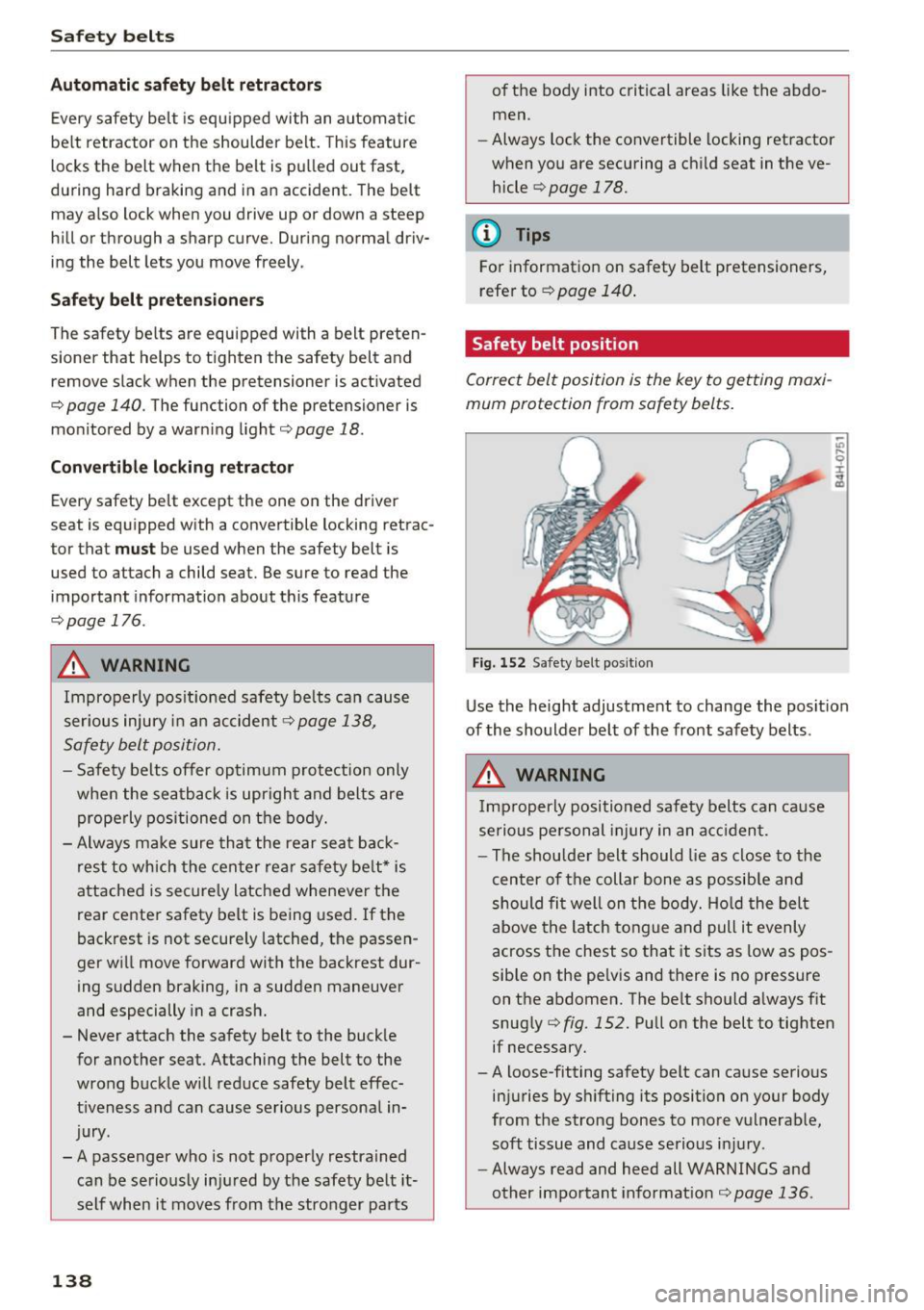
Safety belt position
Correct belt position is the key to getting maxi
mum protection from safety belts.
Fig. 152 Safety belt posit ion
Use the height adjustment to change the posit ion
of the shoulder belt of the front safety belts .
.&_ WARNING
Imp roperly positioned safety belts can cause
serio us pe rsonal injury in an a cc ident.
- The shou lde r belt should lie as close to the
center of the collar bone as possib le and
should fi t well on the body. Ho ld the belt
above the latch to ngue and pull it evenly
across the chest so that it sits as low as pos
sible on the pe lvis and there is no pressure
on the abdomen. The belt should a lways f it
snug ly ¢
fig. 152. Pull on the belt to tighten
if necessary.
- A loose-fitting safety belt can cause serious
injuries by sh ifting its position on your body
from the strong bones to more vulnerable,
soft tissue and cause serious i nju ry .
- Always read and heed all WARNINGS and
other important informat ion
r=;, page 136 .
Page 141 of 294
.... N
0 CJ '
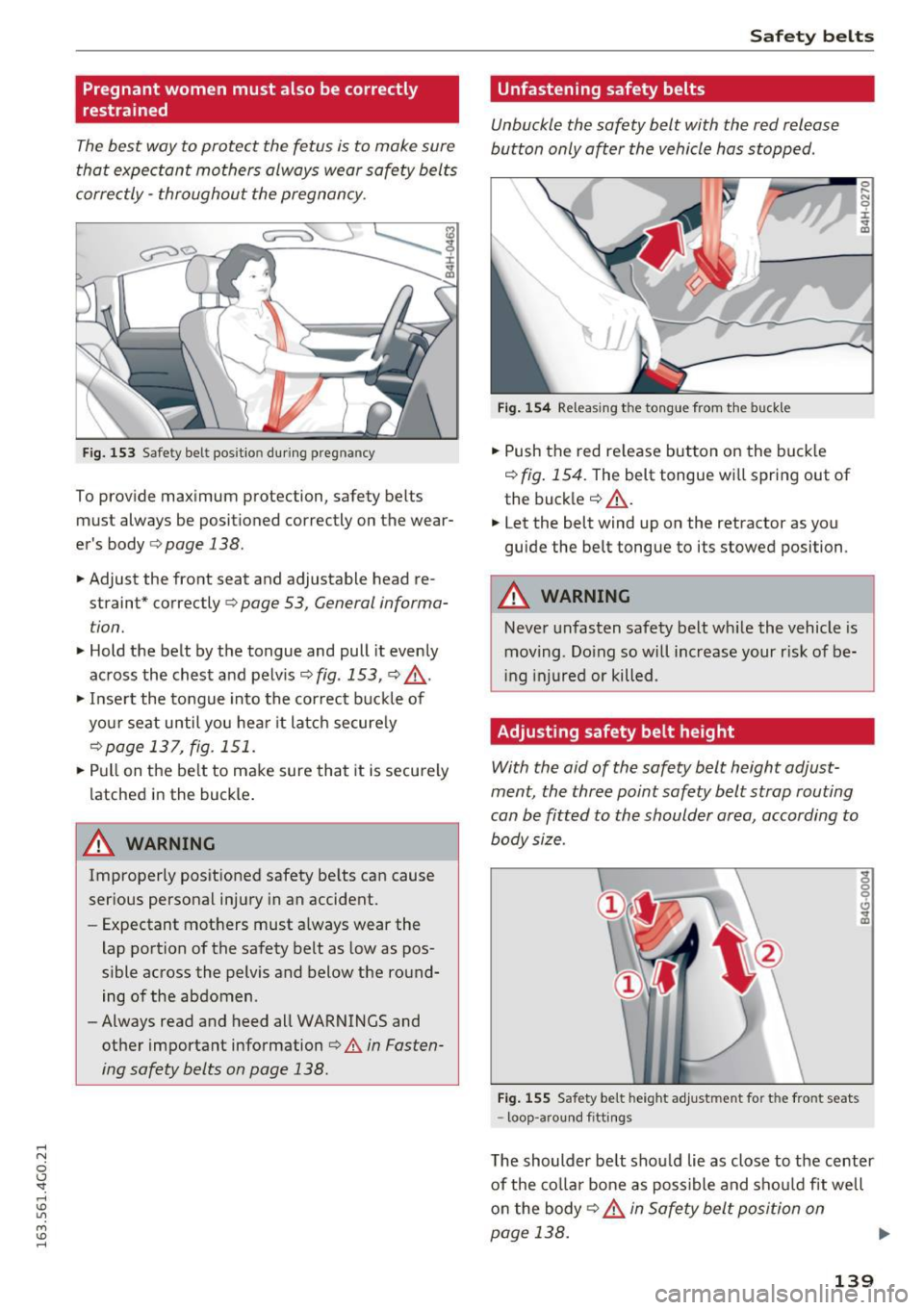
Pregnant women must also be correctly
restrained
The best way to protect the fetus is to make sure
that expectant mothers always wear safety belts
corre ctly -throughout the pregnan cy.
F ig. 153 Safety belt pos itio n dur ing pregnancy
To provide max imum protection, safety belts
must always be posit ioned correctly on the wear
er 's body
¢ page 138.
.. Adjust the front seat and adjustable head re
straint* correctly
r:::;, page 53, General informa
tion .
.. Hold the belt by the tongue and pull it evenly
across the chest and pelv is
r:::;, fig . 153, r:::;, &_ .
.,. Inse rt the tongue into the cor rect b uckle of
yo ur seat until you hea r it latch secure ly
r:=:>poge 137, fig . 151.
.,. Pull on the be lt to make sure that it is secu rely
latched in the buckle .
_& WARNING
Improperly positioned safety be lts can cause
ser ious personal injury in an accident.
- Expectant mot hers must a lways wear the
lap portion of the safety belt as low as pos
sible across the pelvis and below the round ing of the abdomen .
- Always read and heed all WARNINGS and
other important information
¢ A in Fasten
ing safety belts on page 138.
Safet y bel ts
Unfastening safety belts
Unbuckle the safety belt with the red release
button only o~er the vehicle hos stopped .
J-L
Fig . 1 54 Releasing t he tongue from the buckle
.. Push the red re lease button on the buck le
r:::;, fig . 154. The belt tongue w ill spring out of
the buck ler:::;, &_.
.,. Let the belt wind up on the retractor as you
guide the belt tongue to its stowed position .
_& WARNING
-Never unfasten safety belt wh ile the vehicle is
moving . Do ing so will increase your r isk of be
i ng injured or killed .
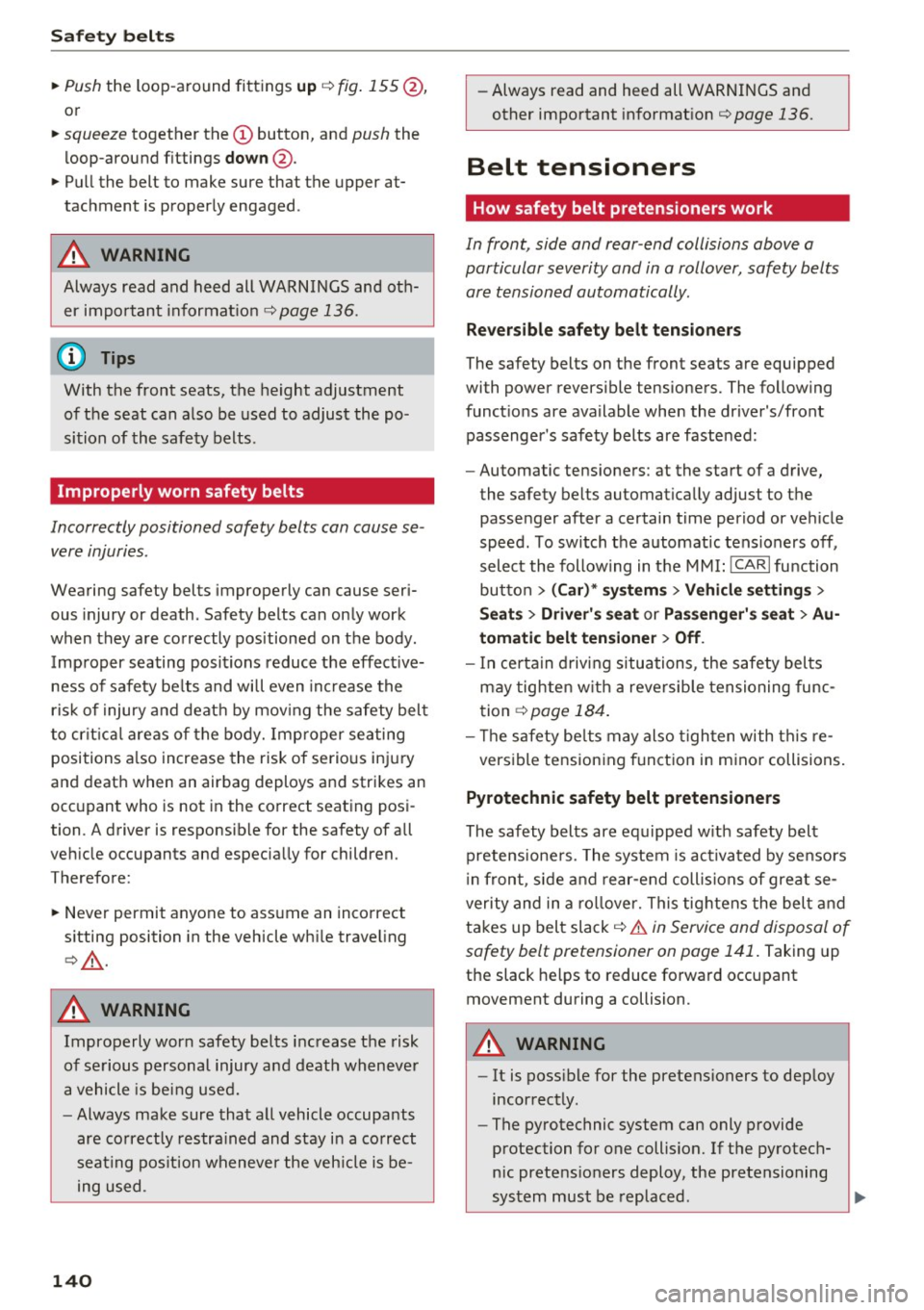
Adjusting safety belt height
With the aid of the safety belt height adjust
ment, the three point safety belt strop routing
con be fitted to the shoulder area, according to
body size.
F ig . 1 55 Safety belt height adj ust m ent fo r th e fro nt seats
- loop -arou nd f itt ings
0 ..... N
0
:i:
"' CD
The shoulder be lt shou ld lie as close to the center
of the co ll ar bone as possible and shou ld fit well
o n the body
¢ &. in Safe ty belt position on
page 138. .,,.
139
Page 142 of 294
Safety belt s
"'Push the loop -around fittings up c> fig . 155 @,
or
"'squeeze together the (D button, and push the
loop-around fittings
down @.
"'Pull the belt to make sure that the upper at
tachment is properly engaged.
A WARNING
Always read and heed all WARNINGS and oth
er impo rtant informat ion
c> page 136.
(D Tips
With the front seats , the height adjustment
of the seat can also be used to adjust the po
sition of the safe ty belts.
Improperly worn safety belts
Incorrectly positioned safety belts can cause se
vere injuries.
Wearing safety belts imprope rly can cause seri
ous injury or death. Safety belts can only work
when they a re correctly pos itioned on the body.
Imp roper seating positions reduce the effect ive
ness of safety be lts and will even inc rease the
ris k of injury a nd deat h by mov ing the safety bel t
to cr it ica l areas of the bo dy. Imp roper seating
positions a lso increase the risk of serio us inj ury
and deat h when an airbag deploys and strikes an
occ upant who is not in the co rrect seat ing pos i
tion. A driver is responsible for the safety of all
ve hicle occupants and especia lly for children.
Therefore:
"' Never permit anyone to assume an inco rrect
s itting position in the vehicle wh ile trave ling
c> ,&. .
A WARNING
Impro perly wor n safety belts increase t he risk
of se rious personal injury a nd death wheneve r
a vehicle is bei ng use d.
- Always make sure tha t all veh icle occupa nts
are co rrectly restra ined and stay in a co rrect
seat ing pos ition w heneve r the veh icle is be
ing used.
140
- Always read and heed all WAR NINGS and
o ther impo rtant in format ion
c> page 136.
Belt tensioners
How safety belt pretensioners work
In front, side and rear-end collisions above a
particular severity and in a rollover, safety belts are tensioned automatically.
Reversible safety belt tensioner s
The safety belts on the front seats are equipped
with power revers ible tensioners. The following
funct io ns are available when the dr iver's/front
passenger 's safety belts are faste ned:
- Automatic tensione rs: at the start of a drive,
the safety belts automat ica lly adjust to the
passenger after a certain time period or ve hicle
spee d. To switch the a utomat ic tens ioners off,
select the following in t he M MI :
!CARI function
button
> ( Car )* systems > Vehicle settings >
Seat s > Driver's seat or Pas senger's seat > Au ·
tomatic belt tensioner > Off .
-In certain drivi ng s ituations, the s afe ty bel ts
m ay tighten w ith a reversib le tensioning func
tion
c> page 184.
- The s afety be lts may also tigh ten with this re-
vers ible tension ing f unct io n in m ino r collisions .
Pyrotechnic safety belt pretensioners
The safety belts are eq uipped w it h safety bel t
pretensione rs. The system is activa ted by se nsors
i n front, s ide a nd r ear-end collisions of grea t se
verity and in a ro llover. This tig htens the bel t and
takes up belt slack
c> &. in Service and disposal of
safety belt pretensioner on page 141.
Taking up
the slack helps to reduce forward occupant
movement during a collision.
A WARNING
-It is poss ible for the pretensioners to dep loy
incorrectly .
- The pyrotechnic system can only p rovide
protection for one collision. If the py rotech
nic pretens ioners deploy, the pretensioning
sys tem must be rep laced.
Page 160 of 294
Airbag system
@ For the sake of the environment
Undeployed airbag modu les and pretension
ers might be classified as Perchlorate Materi
al -special handling may apply, see
www.dtsc.ca.gov/hazardouswaste/perchlo
rate . When the vehicle or parts of the re
straint system including airbag modules and
safety belts w ith pretensioners are scrapped,
all applicable laws and regulations must be
observed. Your authorized Audi dealer is fa
m iliar with these requirements and we recom
mend that you have your dealer perform this
service for you.
Other things that can affect Advanced
Airbag performance
Changing the vehicle's suspension system can
cha nge the way that the Advanced Airbag System
pe rforms in a crash. For example, using tire-r im
comb inat ions not approved by Audi, lower ing the
veh icle, changing the stiffness of the suspens ion,
including the spr ings, suspension struts, shock
absorbers etc . can change the forces that are
measured by the airbag sensors and sent to the
electronic control unit . Some suspens ion changes
can, for example, increase the force levels meas
ured by the sensors and make the airbag system
deploy in crashes in wh ich it would not deploy if
the changes had not been made. Other ki nds of
changes may reduce the force levels measured by
the sensors and prevent the airbag from deploy
ing when it should .
A WARNING
Changing the vehicle's suspension including
use of unapproved tire-rim combinations can
change Advanced A irbag performance and in
crease the risk of serious personal injury in a
crash.
- Never install suspension components that
do not have the same performance charac
teristics as the components originally insta l
led on your veh icle.
- Never use tire-rim comb inations that have
not been approved by Audi.
158
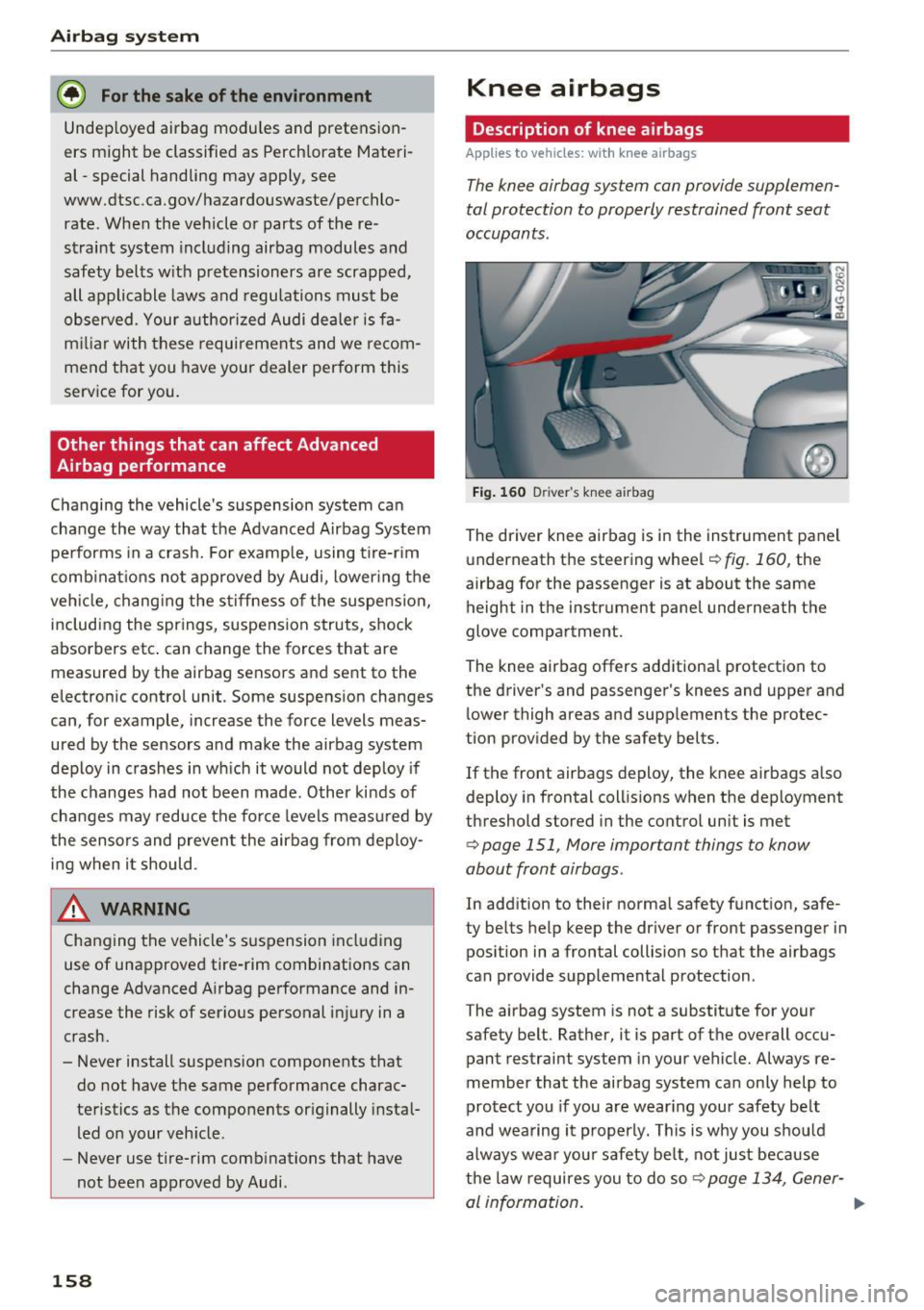
Knee airbags
Description of knee airbags
App lies to vehicles: with knee airbags
The knee airbag system can provide supplemen
tal protection to properly restrained front seat
occupants.
Fig. 160 Driver 's knee airbag
The driver knee airbag is in the instrument panel
underneath the steering whee l
¢fig. 160, the
airbag for the passenger is at about the same
height in the instrument panel underneath the
glove compartment.
The knee airbag offers additiona l protection to
the driver 's and passenger's knees and upper and
lower thigh areas and supplements the protec
tion provided by the safety belts.
If the front airbags deploy, the knee airbags a lso
deploy in frontal collisions when the deployment
threshold stored in the control unit is met
c> page 151, More important things to know
about front airbags .
In addition to their normal safety function, safe
ty belts help keep the dr iver or front passenger in
position in a frontal collision so that the airbags
can provide supplemental protection .
The airbag system is not a substitute for your
safety belt. Rather, it is part of the overall occu
pant restraint system in your vehicle. Always re
member that the airbag system can only help to
protect you if you are wear ing your safety belt
and wearing it p roperly. This is why you shou ld
always wea r your safety be lt, not just because
the law requires you to do so
c> page 134, Gener-
al information. ..,..
Page 234 of 294
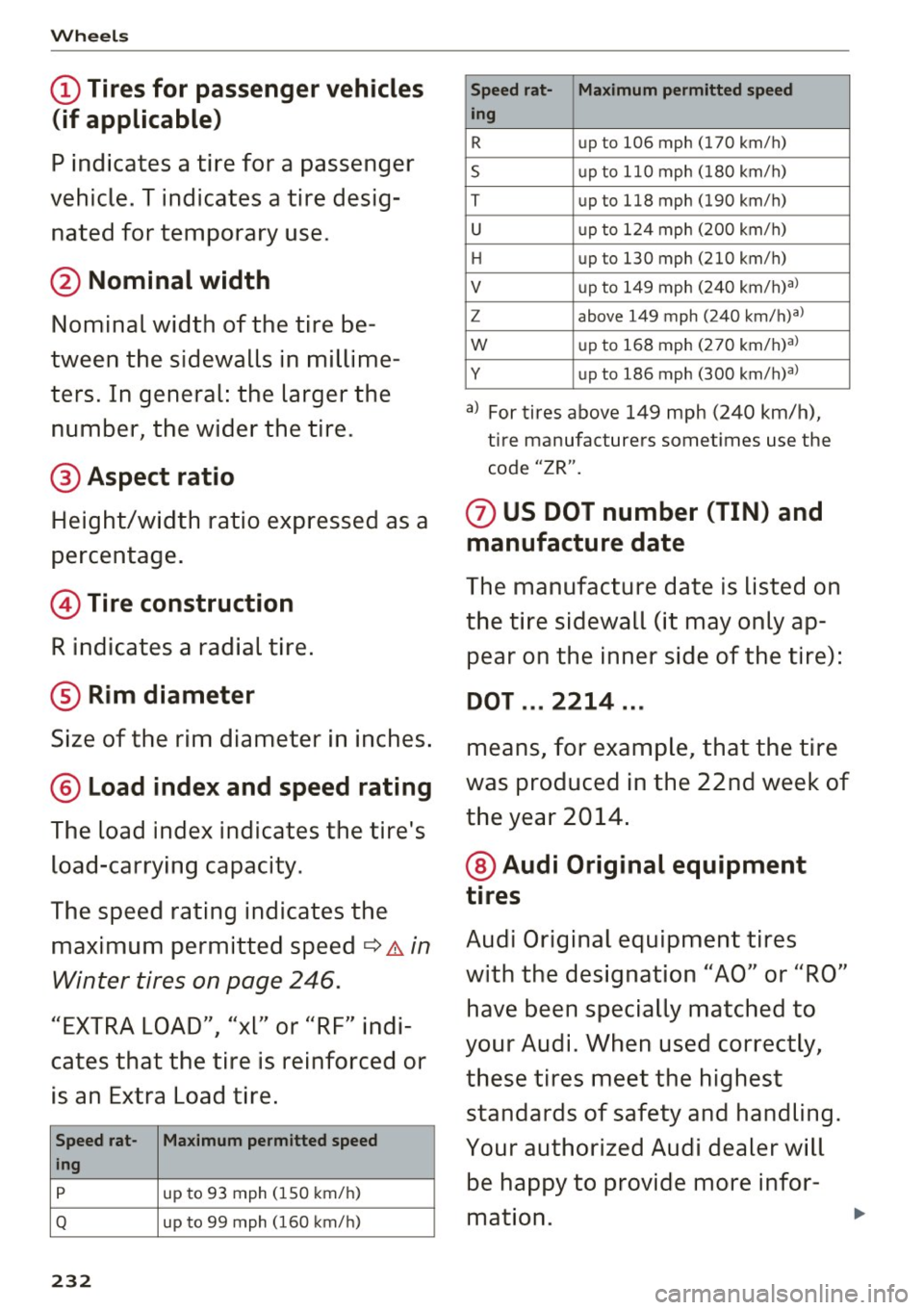
Wheels
(D Tires for passenger vehicles
(if applicable)
P indicates a tire for a passenger
vehicle. T indicates a tire desig
nated for temporary use.
@ Nominal width
Nominal width of the tire be
tween the sidewalls in millime
ters. In general: the larger the
number, the wider the tire.
@ Aspect ratio
Height/width ratio expressed as a
percentage.
@ Tire construction
R indicates a radial tire.
® Rim diameter
Size of the rim diameter in inches.
@ Load index and speed rating
The load index indicates the tire's
load-carrying capacity.
The speed rating indicates the maximum permitted speed
¢ & in
Winter tires on page 246.
"EXTRA LOAD", "xl" or "RF" indi
cates that the tire is reinforced or
is an Extra Load tire.
Speed rat- Maximum permitted speed
ing
p
up to 93 mph (150 km/h)
Q up to 99 mph (160 km/h)
232
Speed rat- Maximum permitted speed
Ing
R
up t o 106 mph (170 km/h)
s up to 110 mph (180 km/h)
T up to 1 18 mph (190 km/h)
u up to 124 mph (200 km/h)
H up to 130 mph (210 km/h)
V up to 149 mph (240 km/h)al
z above 149 mph (240 km/h)al
w up to 168 mph (270 km/h)al
y up to 186 mph (300 km/h)al
a) For tires above 149 mph (240 km/h),
tire manufacturers sometimes use the
code "ZR".
(j) US DOT number (TIN) and
manufacture date
The manufacture date is listed on
the tire sidewall (it may only ap
pear on the inner side of the tire):
DOT ... 2214 ...
means, for example, that the tire
was produced in the 22nd week of
the year 2014.
@ Audi Original equipment
tires
Audi Original equipment tires
with the designation "AO" or "RO"
have been specially matched to
your Audi. When used correctly,
these tires meet the highest standards of safety and handling.
Your authorized Audi dealer will
be happy to provide more infor
mation.
Page 235 of 294
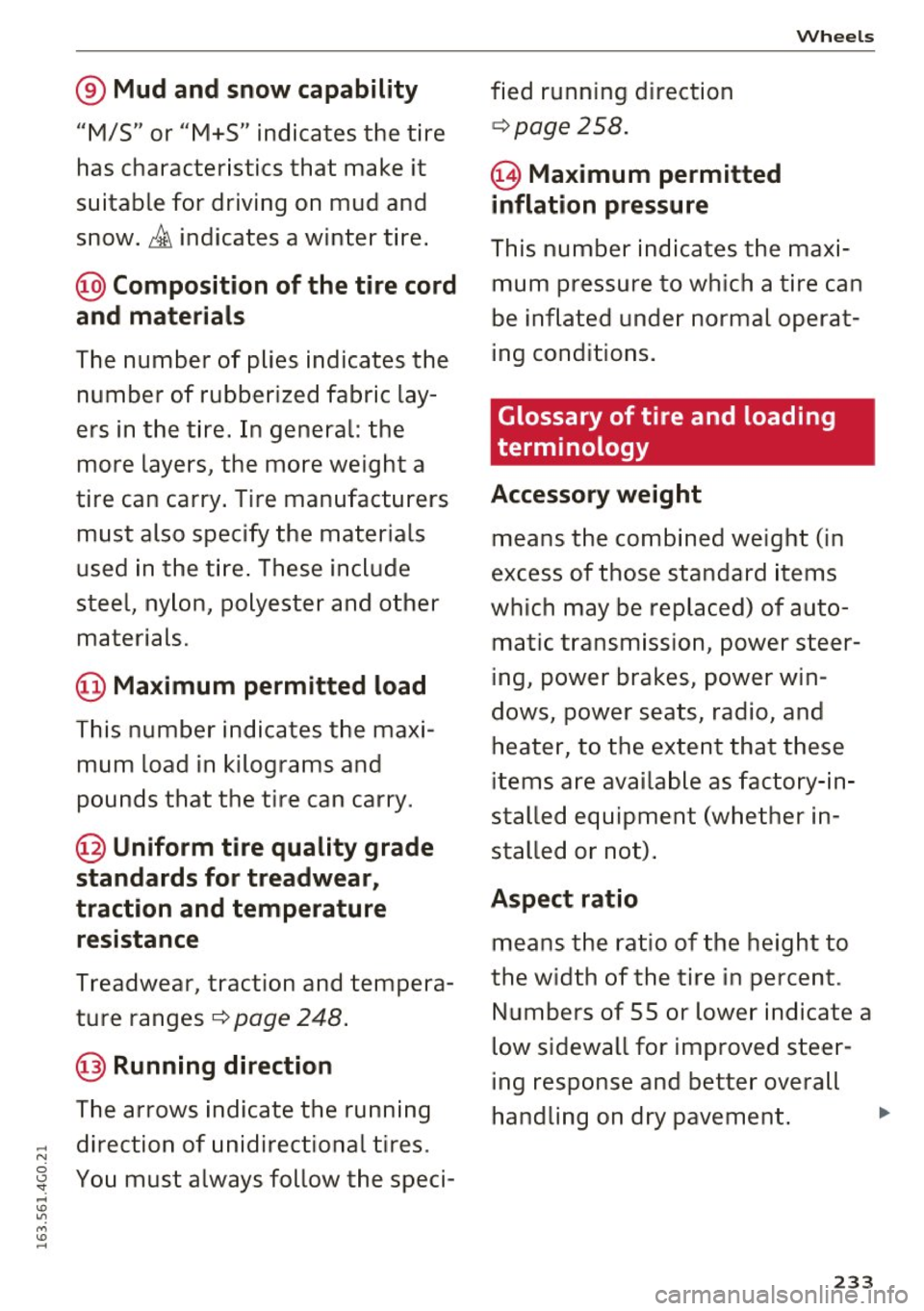
® Mud and snow capability
"M/5" or "M+S" indicates the tire
has characteristics that make it
suitable for driving on mud and
snow .
& indicates a winter tire .
@ Composition of the tire cord
and materials
The number of plies indicates the
number of rubber ized fabric lay
ers in the t ire. In general : the
more layers, the more weight a
tire can carry . Tire manufacturers
must also specify the materials
used in the ti re . These incl ude
stee l, nylon, polyester and other
materials .
@Maximum permitted load
This number indicates the maxi
mum load in kilograms and
pounds that the tire can carry .
@ Uniform tire quality grade
standards for treadwear,
traction and temperature resistance
Treadwear , traction and tempera
ture ranges¢
page 248.
@ Running direction
The arrows indicate the running
direction of unidirectional t ires .
You must always follow the speci- fied running direction
¢
page 258.
€3) Maximum permitted
inflation pressure
Wheels
This number indicates the max i
mum pressure to which a tire can
be inflated unde r normal operat
ing conditions.
Glossary of tire and loading
terminology
Accessory weight
means the combined we ight (in
excess of those standard items
wh ich may be replaced) of auto
matic transmission, power steer
ing, power brakes, power win
dows, power seats, radio, and
heater, to the extent that these
items are available as factory-in
stalled equipment (whether in
stalled or not).
Aspect ratio
means the ratio of the height to
the w idth of the tire in percent .
Numbers of 55 or lower indicate a
low s idewall for improved steer
ing response and better overall
handling on dry pavement . .,.
233
Page 249 of 294
~ Check and correc t the seating of the snow
chains if necessary after driving a few feet. Fol
l ow the instructions from the manufacturer .
~ Note the maximum permitted speed when driv
ing with snow chains. Do not exceed 30 mph
(SO km/h) .
Snow chains not only improve the
driving in win
ter road cond itions, but also the
braking.
Use of snow chains is on ly permitted with certain
rim/tire combinations due to tec hnical reasons .
Check with an authorized Audi dealer or author ized repair facility to see if you may use snow
cha ins.
You must remove the chains when driving on roads that are
free of snow. When roads are free
of snow, snow chains can impair handling and
damage the t ires, and the chains w ill quickly be
destroyed .
A WARNING
Using incorrect snow chains o r installing snow
chains incorrect ly can result in loss of vehicle
c ont rol, w hic h in cr eases the risk of a n acci
de nt.
- Snow cha ins can damage the rims/wheel
covers* if the cha ins come into d irect con
tact wi th them . Remove the whee l cove rs*
first. Use coated snow cha ins.
- Usi ng snow chai ns tha t add more than 0.4
i nch (10.5 mm) of he igh t ca n severely dam
age the wheel ho usings and othe r vehicle
components .
- Do no t install and use s now chains if there is
a mal funct ion in the adaptive air suspen
sion*, because the vehicle height wi ll be
very low. If you d rive with snow chains any
way, the wheel ho usings and othe r vehicle
components can be severely damaged.
Low aspect ratio tires
Your Aud i is factory -equipped with low aspect ra
tio tires . These t ires have been tho rough ly tested
and been se lected specifically for yo ur model fo r
Wheel s
their superb performance, road fee l and handling
u nder a variety of driving conditions . Ask your au
thorized Audi dea le r fo r more detai ls.
T he low aspect rat io o f th ese tires is indicated by
a n umeral of
55 or le ss in the tire's size des igna
tion . The numera l represents the ratio of the
t ir e's s idewall height in relation to its tread w idth
expressed in percentage. Conventiona l tires have
a he ight/width ratio of 60 or more.
The performance of low-aspect- ratio tires is par
ticularly sen sitive to imprope r inflat ion pres
s ure. It is the refore important that low aspect
rat io tires are inflated to the speci fied pre ssure
and that the inflation pressure i s regularly
checked and m aintain ed. Tir e pr essures should
be checked at least once a month and always
b efor e a long trip
~ page 241.
What you can do to avo id tire and rim
damage
Low aspect ratio tires can be damaged more eas i
ly by impact w ith po tholes, curbs, gullies or
ridges on the road, particularly if the tire is un
deri nflated.
In orde r to m in imize the occurrence of impact
damage to t he tires of yo ur vehicle , we recom
me nd that you observe the following pre ca u
t ions:
- Always ma intain recommended inflat ion pres
sures. Check yo ur tir e pressure every 2,000
m iles (3 ,00 0 k m) and add air if necessary.
- Dr ive ca refully on roads w it h potholes, deep
gullies o r ridges. T he impact from dr iving
t hrough or over such obstacles can damage
your tires. Impac t wi th a curb may a lso ca use
damage to your tires.
- Afte r any impac t, immed iate ly inspect yo ur
t ires or have them inspected by the nearest au
thorized A udi dealer. Rep lace a damaged tire as
soon as possible.
- Inspect your tires every 2,000 m iles (3,000 km)
for damage and wear. Damage is not a lways
easy to see. Damage can lead to loss of air and
underinflation, wh ich could eventually cause
tire fa ilure. If you believe that a tire may have
been damaged, replace the tire as soon as pos -
sible . .,.
247
Page 258 of 294
Emerg ency assis ta nce
button > Se rvicing & c heck s > Air sus p.: jac k
m od e> On .
.. Engage the pa rking b rake to prevent your vehi
cle from rolling unintentionally.
.. Move the
se lect or l eve r to pos it ion P .
.. Find the mark ing (impr int) on the sill that is
nearest the whee l that will be changed
¢ fig . 205 . Behind the marking, there is a lift
ing p oint on the sill for the vehicle jack.
.,. Vehicles with a sill: remove the cover from the
si ll before lifting the vehicle with a vehicle jack
¢ page 256.
.. Turn the vehi cle j ack located under the lift ing
point on the sill to ra ise the jack until its arm@
c> fig. 206 is located under the designated plas
tic mount
c> .&, c>(D.
.. Al ign the jack so that its arm@ c> fig. 206 en
gages in the des ignated lift ing po int i n the door
si ll and the movable base @ lies flat on the
ground. The base @ must be
vertical under the
l ift ing point @.
.. Wind the jack up further unt il the flat tire
comes off the ground
¢ .&, .
Position the veh icle jack on ly under the designat
ed lifting points on the sill
c> fig. 205 . There is ex
actly
one locat ion for each wheel. The jack must
not be positioned at any other location
c> .&. c>0 .
An un sta ble s urface under the jack can cause the
ve hicle to slip off the jack . Always provide a firm
base for the jack on the ground. If necessa ry
p lace a sturdy board or similar support under th e
jack . On
h ar d, s lippe ry surface s (such as tiles)
use a rubber mat or similar to prevent the jack
from slipping¢ &.
A WARNING
-
- You or your passengers could be injured
wh ile changing a wheel if you do not follow
these safety precaut ions:
- Position the vehicle jack only at the desig
nated lifting points and align the jack.
Otherw ise, the vehicle jack cou ld slip and
cause an injury if it does not have suffi
cient hold on the vehicle.
- A soft or unstable surface under the jack
may cause the vehicle to slip off the jack.
Always provide a firm base for the jack on
256
the ground. If necessary, use a sturdy board under the jack .
- On hard, slippery surface (such as tiles)
use a rubber mat or similar to prevent the
jack from slipping .
- To help prevent injury to yourself and your
passengers:
- Do not raise the veh icle until you are sure
the jack is securely engaged .
- Passengers must not remain in the vehicle
when it is jacked up.
- Make su re that passengers wait in a safe
place away from the vehicle and well away
from the road and traffic.
- Make sure jack position is correct, adjust
as necessary and then continue to ra ise
the jack .
- Changes in temperatu re or load can affect
the height of the vehicle.
(D Note
Do not lift the ve hicle by the si ll. Pos ition the
vehicle jack only at the des ignated l ift ing
po ints on the sill. Othe rwise, your veh icle will
be damaged.
(j) Tips
The vehicle jack mode* switches off automati
cally at speeds above 6 mph (10 km/h) .
Removing and installing the sill extension
cover
Appl ies to vehicles: with sill extension
F ig. 207 S ill: r em ovin g the cover
.,. Pull the cover down to remove it . c> fig. 207
.,. To install the cove r, insert it in the mount and
press it upwa rd until it clicks into place . The .,..
Page 287 of 294
Pregnant women
Special considerations when wearing a safe-
ty belt . . . . . . . . . . . . . . . . . . . . . . . . . . . . . 139
Pre sense .. .. .. .. ........... .. .. .... .
Pressure (tires)
Pretensioners 184
249
Pre sense . . . . . . . . . . . . . . . . . . . . . . . . . . 184
Preventative passenger protection . . . . . . . 184
Prewarming . . . . . . . . . . . . . . . . . . . . . . . . . . 74
Proper occupant seating positions . . . . . . . 126
Proper safety belt position . . . . . . . . . . . . . . 138
Proper seating position Front passenger . . . . . . . . . . . . . . . . . . . . . 127
Occupants . . . . . . . . . . . . . . . . . . . . . . . . . . 126
Rear passengers . . . . . . . . . . . . . . . . . . . . . 128
Protecting . . . . . . . . . . . . . . . . . . . . . . . . . . . 205
Q
quattro (all wheel drive).......... ..... . 191
Quest ion
What happens to unbelted occupants? 135
R
Radiator fan 224
Rain/light sensor Headlights . . . . . . . . . . . . . . . . . . . . . . . . . . 44
Indicator light . . . . . . . . . . . . . . . . . . . . . . . 22
Intermittent (windshield wipers) . . . . . . . . 51
Raising the vehicle . . . . . . . . . . . . . . . . . . . . 268
Range (fuel level) . . . . . . . . . . . . . . . . . . . . . . 24
Reading lights . . . . . . . . . . . . . . . . . . . . . . . . . 47
Rear fog lights . . . . . . . . . . . . . . . . . . . . . . . . 44
Rear lid Escape hand le . . . . . . . . . . . . . . . . . . . . . . 251
Opening and clos ing . . . . . . . . . . . . . . . . . . 36
Rear light Indicator light . . . . . . . . . . . . . . . . . . . . . . . 21
Rearview camera
refer to Parking systems . . . . . . . . . . 114, 115
Rear view m irror . . . . . . . . . . . . . . . . . . . . . . . 49
Rear window defogger (four-zone automatic
climate control) . . . . . . . . . . . . . . . . . . . . . . . 71
Rear window defogger (three-zone climate
control) . . . . . . . . . . . . . . . . . . . . . . . . . . . . . . 69
Index
Recirculation mode (four-zone automatic cli
mate control) . . . . . . . . . . . . . . . . . . . . . . . . . 70
Recirculation mode (three-zone climate con-
trol) . . . . . . . . . . . . . . . . . . . . . . . . . . . . . . . . . 68
Recuperation . . . . . . . . . . . . . . . . . . . . . . . . . 24
Refilling AdBlue With bottle . . . . . . . . . . . . . . . . . . . . . . . . . 214
With canister . . . . . . . . . . . . . . . . . . . . . . . 214
Refuelling . . . . . . . . . . . . . . . . . . . . . . . . . . . 210
Remote control Garage door opener (Homelink) . . . . . . . . . 42
Unlocking and locking . . . . . . . . . . . . . . . . . 33
Remote control key LED . . . . . . . . . . . . . . . . . . . . . . . . . . . . . . . . 31
Replacing the battery . . . . . . . . . . . . . . . . . 31
Remote rear lid release . . . . . . . . . . . . . . . . . 36
Repair manuals . . . . . . . . . . . . . . . . . . . . . . . 273
Repairs Airbag system . . . . . . . . . . . . . . . . . . . . . . 157
Replacing Light bulbs . . . . . . . . . . . . . . . . . . . . . . . . . 263
Replacing windshield wiper blades . . . . . . . . 52
Reporting Safety Defects . . . . . . . . . . . 132, 133
Reset button (trip odometer) . . . . . . . . . . . . 26
Resetting the trip odometer . . . . . . . . . . . . . 26
Residual heat (four-zone automatic climate
control) . . . . . . . . . . . . . . . . . . . . . . . . . . . . . . 71
Retractor . . . . . . . . . . . . . . . . . . . . . . . . . . . . 13 7
Rims ..... ... .. .. .. ... ....... ... .. .. 246
Roof rack . . . . . . . . . . . . . . . . . . . . . . . . . . . . . 62
Loading . . . . . . . . . . . . . . . . . . . . . . . . . . . . . 63
Roof weight . . . . . . . . . . . . . . . . . . . . . . . . . 63
s
Safe driving habits
Safety 12S
Airbag system . . . . . . . . . . . . . . . . . . . . . . 142
Belts . . . . . . . . . . . . . . . . . . . . . . . . . . . . . . 134
Cargo . . . . . . . . . . . . . . . . . . . . . . . . . . . . . 131
Correct seating position . . . . . . . . . . . . . . 126
Pedal area . . . . . . . . . . . . . . . . . . . . . . . . . . 130
Safety belt pos ition . . . . . . . . . . . . . . . . . . . 138
Safety belt height adjustment . . . . . . . . . 139
Safety be lts worn by pregnant women . . . 139
Safety belt pretens ioner
Service and disposal . . . . . . . . . . . . . . . . . . 141
285