brake AUDI S7 2012 Workshop Manual
[x] Cancel search | Manufacturer: AUDI, Model Year: 2012, Model line: S7, Model: AUDI S7 2012Pages: 294, PDF Size: 73.33 MB
Page 227 of 294
_& WARNING
-The cooling system is under pressure and
can get very hot. Reduce the risk of
scald ing from hot coolant by following
these steps.
- Turn
off the engine and a llow itto cool
down.
- Protect your face, hands and arms from
escaping fluid and steam by covering
the cap with a large, thick rag.
- Turn the cap slow ly and very carefully
in a counter-clockwise direction while
applying light, downward pressure on
the top of the cap.
- To avoid being burned, do not spi ll an
tifreeze or coolant on the exhaust sys
tem or hot engine parts . Under certain
conditions, the ethylene glycol in en
g ine coolant can catch fire .
- Antifreeze is poisonous. Always store an
tifreeze in its or iginal containe r and we ll
out of the reach of children.
- If you drain the coolant, it must be
caught and safely stored in a proper con
tainer clearly marked "poison".
(D Note
- Coolant pollutes the env ironment and
could cause an engine fire. Excess cool
ant will be forced out through the pres
su re relief valve in the cap when the en
gine becomes hot.
- If, in an emergency, only water can be
added, the cor rect ratio between water
and antifreeze ¢
page 223 must be re
stored as soon as possib le.
@ For the sake of the environment
Drained coolant should not be reused . A l
ways dispose of used coolant while obse rv
ing all environmental reg ulations.
Checkin g and fillin g 225
Radiator fan
The radiator fan switches on automatically by
itself.
An auxiliary electric radiator fan switches on
and
off depending on coolant temperature
and other vehicle operat ing cond it ions .
After you switch the engine
off, the auxiliary
fan can continue running for up to 10 minutes
- even with the ignition
off. It can even switch
on again later by itself ¢&. , if
- the temperature of the engine coo lant rises
due to the heat build-up from the engine in
the engine compartment, or
- the engine compartment heats up because
the vehicle is parked in intense sunlight.
_& WARNING
-To reduce the risk of personal injury nev
er touch the radiator fan .
- The auxiliary electric fan is temperature
controlled and can sw itch on suddenly
even when the engine is not running.
- The a uxiliary radiator fan sw itches on au
tomatically when the engine coo lant
reaches a certa in temperature and will
continue to ru n until the coolant temper
ature drops.
Brake fluid
Checking brake fluid level
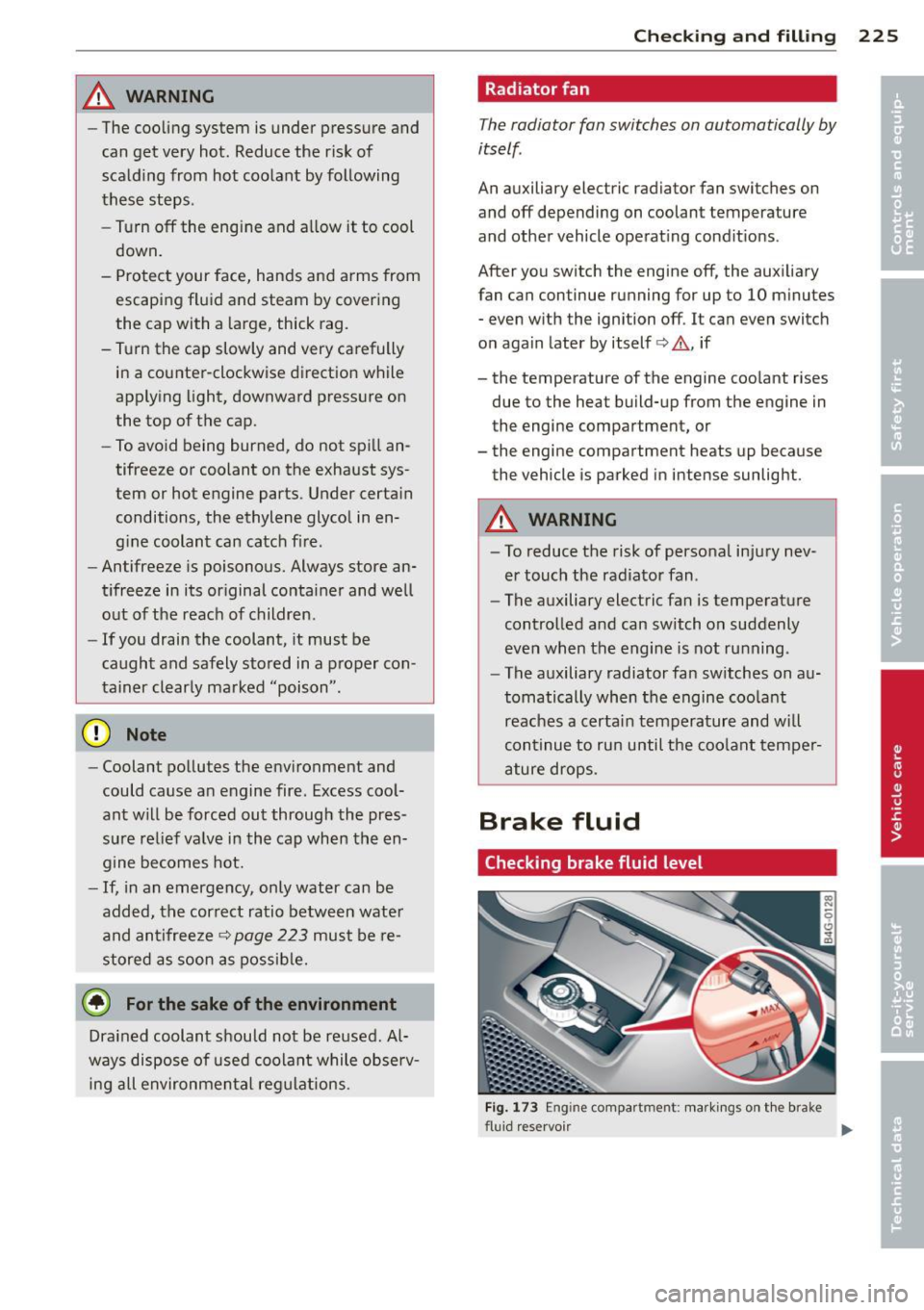
Fig. 173 En gin e compartment: mark ings on th e brake
fluid rese rvoir
Page 228 of 294
226 Check ing and filling
Before you check anything in the engine com
partment,
always r ea d and heed all W ARN
INGS
¢ A in Working in the engine compart
ment on page 216.
• Read the brake fluid leve l from the brake
fluid reservoir
¢ fig. 173. The brake fluid
l evel must be between the
"MIN" and
"MAX" markings .
The location of the brake fluid reservoir can be
seen in the engine compartment illustration
co page 218.
The fl uid level may drop slightly after some
time due to the automatic adjustment of the brake pads . This is not cause for alarm .
I f the b rake fluid level falls
considerably be
l ow the "MIN" mark, the brake wa rning/indi
cator light- (U.S.
models) ;II (Canadian
models) will come on
¢ page 14. Do not con
tinue to operate the vehicle. The comp lete
brake system shou ld be thoroughly checked
by an authorized Audi dealer or other quali
fied fac il ity and the cause corrected. If the
brake fluid level is too low, the brake warn ing/
i ndicator light w ill illuminate. Contact an au
thor ized Audi dealer
imm ediatel y.
Changing brake fluid
Have the brake fluid changed by an experi
enced technician .
Brake fluid absorbs moistu re from the a ir . If
the water content in the brake fluid is too
h igh, corrosion in the brake system may result
after a per iod of t ime . The bo iling po int of the
b rake fluid w ill also decrease considerably and
dec rease braking per formance.
Therefore, the brake flu id must be changed
ev ery tw o y ear s. Always use new b rake fluid
which confo rms to Fede ral Motor Vehicle
Standard "FMVSS 1 16 DO T 4".
The brake flu id rese rvoi r can be difficult to
r each, therefo re , we re commend that yo u
have the brake fl uid changed by yo ur a utho r
ized
Audi dealer. Your dea ler has the correct tools, the
right brake flu id and t he know -how
to do this for you.
A WARNING
-- Brake flu id is poisonous. It must be stor-
ed only in the closed or igina l container
out of the reach of children!
- Brake failure can resu lt from o ld or inap
propriate brake f lu id. Observe these pre
cautions:
- Use only brake f luid that meets SA E
spe cifi cation
J 17 03 and conforms to
Federa l Motor Vehicle Standard 1 16 .
Always chec k with your authorized A udi
dealer to make sure yo u are using the
correct brake fluid. The cor rect type of
brake flu id is also ind icated on the
brake f lu id reservoir.
- The brake fluid must be new. Heavy use
of the brakes can cause a vapor lock if
the brake fluid is left i n the system too
long . This can se riously affect the effi
c iency of the brakes as well as your
safety . T h is i:ou ld result in an ai;i;ident.
(D Note
Brake fluid will damage the pai nt of you r
vehicle .
@ For the sake of the environment
Because of the prob lem of proper disposal
of brake fluid as well as the spec ial too ls
r equired and the necessary expertise, we
r ecommend that yo u have the brake flu id
changed by yo ur autho rized Aud i dea le r.
Battery
General information
Under normal operat ing cond itions, the bat
te ry in your Audi does not need any ma inte
nance. With
high outside temperatures or
long da ily drives we recommend that you have
the e lectrolyte leve l che cked by a se rv ice fa
c il ity. The electroly te leve l should also be
chec ked each time the battery is cha rged
¢ page 22 9.
Page 233 of 294
Tires and wheels
Tires
General notes
Tires may be the least appreciated and most
abused parts of a motor vehicle .
Tires may be the least appreciated and most
abused parts of a motor vehicle . Tires are,
however, one of the most important parts of a
vehicle, particularly considering the compara
tively small patch of rubber on each tire that
assures that a ll- important contact between
you, your vehicle and the road.
Maintaining the correct tire pressure, mak ing
sure that your vehicle and its tires do not have
to carry more weight than they can safely han
d le, avoiding damage from road hazards and
r eg ularly inspect ing t ires for damage i nclud
ing cuts, slashes irregu la r wear and ove rall
condition are the most important things that
you can do to he lp avoid sudden tire failure in
cluding tread separat ion and blowouts.
A vo idin g damage
If you have to drive over a curb or similar ob
stacle, drive very slow ly and as close as possi
b le at a right angle to the curb.
A lways keep chemicals includ ing grease, o il ,
gasoline and brake fluid off the t ires .
I nspect the t ires regularly for damage (cuts,
cracks or b listers, etc.). Remove any fo reign
bod ies embedded in the treads.
Storing tires Mark tires when you remove them to indicate
the direction of rotation . Th is ensures you to
be ab le to mount them correctly when you re
i nstall them .
When removed, the wheels or t ires should be
sto red in a cool, dry and preferably dark place .
Store tires in a vertical pos ition if they are not
mounted on rims, in a horizontal pos it ion if
they are mounted on rims .
Tires an d wheel s 231
New tires
New ti res have to be broken in¢& .
The tread depth of new t ires may vary, accord
ing to the type a nd make of t ire and the tread
patte rn.
H idden damage
Damage to tires and r ims is often not readily
visible . If you notice unusual v ib rat ion or the
vehicle pulls to one s ide, th is may ind icate
that one of the t ires has been damaged . T he
ti res m ust be chec ked immed iate ly by an au
thorized Audi dea le r or q ua lified wor kshop .
Unidirectional tires
A un idirectional tire can be identified by ar
rows on the sidewa ll, that po int in the direc
tion the t ire is designed to rotate. You must
f ol low the specified di rection of rotation . T his
is necessary so that these tires can develop
their optimum characteristics regarding grip, road noise, wear and hydrop laning resistance.
For more information ¢
page 258.
A WARNING
New tires or t ires that are o ld, worn or
damaged cannot provide maximum con
trol and braking ability .
-
-New tires tend to be slippery and must
be broken in. To reduce the r isk of losing
control, a co llision and ser ious personal
in ju ries, d rive with special ca re for the
fi rst 350 m iles (560 km).
- Driving with worn or damaged tires can
lead to loss of control, sudden tire fail
ure, including a blowout and sudden de
fl ation, cras hes and se riou s personal in
juries . Have worn or damaged t ires re
placed immediate ly.
- Tires age even if they are not being used
and can fai l sudden ly, especially at hig h
speeds. Tires that are more than 6 years
old can only be used in an emergency
and then w ith special care and at low
speed.
•
•
Page 235 of 294

Maximum loaded vehicle weight
means the sum of:
(a) Curb weight
(b) Accessory weight
(c) Vehicle capacity weight, and
(d) Production options weight
Maximum (permissible) inflation pressure
means the maximum cold inflation pressure
to which a tire may be inflated. Also called
"maximum inflation pressu re."
Normal occupant weight
means 150 lbs . (68 k ilograms) times the
number of occupants seated in the vehicle up
to the total seating capacity of your vehicle .
Occupant distribution
means distribution of occupants in a vehicle .
Outer diameter means the overall diameter of an inflated new
tire.
Overall width
means the linear distance between the exteri
ors of the sidewalls of an inflated tire, includ
ing e levations due to labeling, decorations, or
protective bands or ribs.
Ply
means a layer of rubber-coated para llel cords.
Production options weight
means the comb ined weight of those installed
regular production options weighing over 5
lbs . (2 .3 kg) in excess of those standard items
which they replace, not previously considered
in curb weight or accessory weight, including
heavy duty brakes, r ide leve lers, roof rack,
heavy duty battery, and specia l trim .
Radial ply tire
means a pneumatic t ire in which the p ly cords
that extend to the beads are laid at substan
tially 90 degrees to the centerline of the
tread.
Tires and wheels 233
Recommended inflation pressure
see~
page 232, Cold tire inflation pressure.
Reinforced tire
means a t ire design to operate at higher loads
and at higher inflation pressures than the cor
responding standard tire. Reinforced tires
may be identified as "XL" , "x l", " EXTRA LOAD",
o r "R F" on the sidewall.
Rim
means a metal support for a tire or a t ire and
tube assembly upon which the tire beads are
seated.
Rim diameter
means nom inal d iameter of the bead seat. If
you change your wheel s ize, you w ill have to
purchase new tires to match the new r im di
ameter.
Rim size designation
means r im diameter and width.
Rim width
means nom inal distance between rim fla nges.
Sidewall
means that portion of a tire between the
tread and bead.
Speed rating (letter code)
means the speed at which a tire is designed to
be driven for extended periods of time. The
ratings range from 93 mph (150 km/h) to
186 mph (298 km/h)
~ page 243 . You may
not find this information on all tires because
it is not requ ired by law.
The speed rating letter code, where applica
ble, is molded on the tire sidewall and indi
cates the max imum pe rm issib le road speeds
~ .&. in Winter tires on page 247 .
Tire pressure monitoring system*
means a system that detects when one or
more of a veh icle's tires are underinflated and
illuminates a low tire pressure warning tell
tale.
•
•
Page 239 of 294
-The brakes o n a vehicle t hat has been
overloaded may not be a ble to stop the
vehicle within a safe distance.
- Tires on a vehicle that has been overload
ed can fail suddenly causing loss of con
trol and a crash.
- Always make sure that the tota l load be
ing transported -including the we ight of
a tra ile r hitch and the tongue weight of a
loaded trailer - does not make the veh i
cle heav ier than the veh icle's Gross Vehi
cl e Weight Rating.
A WARNING
- Incorrect tire pressures and/or underin
fla tion can lead to a serious o r fatal acci
dent.
- Incorrect tire pressures and/or underin
fla tion cause increased tire wea r and can
affect the handling of the vehicle .
- Incorrect tire pressures and/or underin
flation can also lea d to sud den tire fa il
ure, incl uding a blowo ut and sudden de
flation, causing loss of vehicle control.
Checking tire pressure
.
The correct tire pressure for the tires original
ly installed on your vehicle is listed on the tire
pressure Lobel located on driver's side 8-pil lor.
The re commended t ire press ures a re o n the
tire pressure label and in the tab le
c=> page 235, Cold tire inflation pressure. This
means that the pressure must be checked and
adj usted when the tire has not been driven for
more than a couple of m iles (kilometers) at
low speeds during the previous three hours .
A ir i n the tires expands when the tire heats up
as a result of inte rnal fr iction as it flexes in
use. The t ire p ress ure is higher w hen the tire
h as wa rmed up th an when it is "cold."
It is the inflat io n pressu re in a "cold" tire that
counts. Therefore, you shou ld never let air out
of a warm t ire to ma tch "Cold tire in flation
p ressu re" recommend ations
c::> page 235. T he
Tire s an d wheel s 237
tires wo uld then be unde rinflated and co uld
fail suddenly.
T he tire pressure label on your Aud i lis ts the
re commended co ld tire inflation pressures at
maximum capacity for the new, orig inal
equipment tires that were on your ve hicle at
the time it was manufactured. For the loca
tion of the labe l
c::> page 235, fig. 176.
Most tires lose air naturally over t ime. They
can a lso lose some air if yo u drive over a pot
ho le or hit a curb while par king. It is usually
not possible to see whether the rad ia l tires
u sed today are underinflated just by looking
at them .
There fore, be sure to check t ire p ress ures at
l east once a month and always before going
on a long tr ip. Make sure to take the n umber
of peop le and the amount of luggage into ac
count when adjust ing tire pressure for a tr ip -
even one that you wou ld not conside r to be
"long." See
c::> page 239, Tires and vehicle
food limits
f or mo re import ant inform ation .
Always use an accurate ti re pressu re gauge
when checking and ad justing inflation pres
s ur es. Check a ll of t he tires and be s ure not to
forge t the spare tire.
If the pressure in any t ire
is too high when the ti re is "cold," let air out
of the ti re s low ly with the edge of the tire
gauge and keep checking the pressure until
you reach the pressure that is correct for the
load (passengers and luggage) and k ind of
driv ing you plan to do.
If the pressure in any ti re is too low, note the
difference between the pressure in the co ld
tire and the pressure you need and add the air
that you need to reach the correct pressure for
the ve hicle load (passengers and luggage) for
the tires on you r veh icle as listed on the on
you r vehicle and in this ma nual and the kind
of d rivi ng you plan to do .
Never exceed th e maximum inflation pr es
sure listed on the tire sidewall for any rea
s on.
•
•
Page 241 of 294
@ For the sake of the environment
Underinflated tires will a lso increase the
fue l consumption .
Tires and vehicle load limits
There are limits to the amount of load or
weight that any vehicle and any t ire can carry.
A vehicle that is overloaded w ill not handle
well and is more difficult to stop. Overload ing
can not only lead to loss of vehicle control, but can a lso damage importan t pa rts of the
ve hicle and can lead to s udden tire failure, in
cluding a blowout and sudden deflation that
can cause the veh icle to crash.
Your safety and that of yo ur passenge rs a lso
depends on making s ure that load limits are
not exceeded . Vehicle load includes everybody
and everything in and on the vehicle. These
load limits are technica lly referred to as the
vehicle's
Gross Veh icle We ight R ating
("GVWR").
The "GVWR" includes the weight of the basic
vehicle, all factory insta lled accessories, a full
tank of f ue l, oil, coolant and other fluids plus
maximum load. The maximum load includes
the number of passengers that the vehicle is intended to carry ("seating capacity") with an
assumed weight of 150 lbs (68 kg) for each
passenger at a des ignated seat ing pos ition
and the total we ight of any l uggage in the ve
hi cle. If you tow a trailer, the weight of the
trailer hitch and the tong ue weight of the
loaded trailer must be included as part of the
vehicle load.
The
Gro ss Axl e W eight R ating ("GAWR") is
the maximum load that can be app lied at each
of the vehicle's two axles.
The Gross Vehicle Weight Rating and the
Gross Axle Weight Rating a re listed on the
safety compliance sticker labe l located on the
driver's side B -pillar . Your A udi has 4 seating
positions, 2 in the front and 2 in the rear for
total seating capacity of 4. Each seating pos i
tion has a safety belt¢
page 128, Safety
belts .
Tire s an d wheel s 239
The fact that there is an upper limit to your
vehicle's Gross Vehicle Weight Rating means
that the total weight of whatever is being car
ried in the vehicle ( includ ing the weight of a
trailer hitch and the tongue weight of the
loaded tra iler) is lim ited. The more passen
gers in the vehicle or passengers w ho are
heavier than the standard we ights assumed
mean that less we ight can be ca rried as lug
gage.
The tire pressure label on your Aud i also lists
the maximum combined weight of a ll of the
occupants and luggage or other cargo that
the ve hicl e can carry . For t he locat ion of the
label¢
page 235, fig . 176.
.&_ WARNING ~
Overloading a vehicle can cause loss of ve -
h icle contro l, a crash or other accident, se
rious personal injury, and even death.
- Carrying more weight than your vehicle
was designed to carry wi ll prevent the
veh icle from handling properly and in
crease the risk of the loss of vehicle con
trol.
- The brakes on a vehicle that has been
overloaded may not be able to stop the
veh icle w ith in a safe distance.
- Tires on a vehicle that has been over load
ed can fail suddenly, including a blowout
and sudden deflation, causing loss of
control and a crash .
- Always make sure that the total load be
ing transported -includ ing the weight of
a t railer hitch and the tongue we ight of a
loaded trailer - does not ma ke t he vehi
cle heavier than the vehicle's G ross Vehi
cle Weight Rating.
Determining correct load limit
U se th e exa mple below to cal
c ulat e the total weight of the
pa ssen ger s a nd lu ggag e or ot h-
e r thin gs that you pl an t o .,..
•
•
Page 244 of 294

242 Tires and wheels
& WARNING
Sudden tire failure can lead to loss of con
trol, a crash and serious personal injury!
- Never drive a vehicle when the tread on
any tire is worn down to the wear indica
tors.
- Worn tires are a safety hazard, they do
not grip well on wet roads and increase
your risk of "hydroplaning" and loss of control.
- Always keep chemicals that can cause tire damage, such as grease, oil, gasoline
and brake fluid away from tires.
- Tires age even if they are not be ing used
and can fail suddenly, especially at high
speeds. Tires that are more than 6 years
old can only be used in an emergency
and then with special care and at lower
speeds.
- Never mount used tires on your vehicle if
you are not sure of their "previous histo
ry." Old used tires may have been dam
aged even though the damage cannot be
seen that can lead to sudden tire failure
and loss of vehicle control.
New tires and replacing tires and wheels
New tires and wheels have to be broken in .
Fig. 180 Tir e specificat ion codes on the s idewall of a
t ire
No. Description
(!) Passenger car tire (where applicable)
@ Nominal width of t ire in millimeters
@ Ratio of height to width (aspect ratio)
© Rad ial
® Rim diameter code
@ L oad index and speed rating
(J) U.S. DOT tire identification number
@ Audi Original tire
@ Sever snow conditions
@ T ire ply composition and materials
used
Maximum load rating
Treadwear, traction and temperature
grades
Maximum permissible inflation pres
sure
T he tires and rims are essential parts of the
vehicle 's design . The tires and rims approved
by Audi are spec ially matched to the charac
teristics of the vehicle and can make a major .,..
Page 247 of 294

Driving with different tires reduces vehi
cle handling and can lead to a loss of
control.
- If the spare tire is not the same as the
tires that are mounted on the vehicle -
for example with winter tires -only use
the spare tire for a short period of time
and drive with extra care. Refit the nor
mal road wheel as soon as safely possi
ble.
- Never drive faster than the maximum
speed for which the tires on your vehicle
are rated because tires that are driven
faster than their rated speed can fail
suddenly.
- Overloading tires cause heat build-up,
sudden tire failure, including a blowout
and sudden deflation and loss of control.
- Temperature grades apply to tires that
are properly inflated and not over or un
deri nflated.
- For technical reasons it is not always
possible to use wheels from other vehi
des -in some cases not even wheels
from the same vehicle model.
- If you install wheel trim discs on the ve
hicle wheels, make sure that the air flow
to the brakes is not blocked. Reduced air
flow to the brakes can them to overheat, increasing stopping distances and caus
ing a collision.
- Run flat tires may only be used on vehi
cles that were equipped with them at the
factory. The vehicle must have a chassis designed for run flat tires . Incorrect use
of run flat tires can lead to vehicle dam
age or accidents. Check with an author
ized Audi dealer or tire specialist to see if
your vehicle can be equipped with run flat tires. If run flat tires are used, they
must be installed on all four wheels. Mix
ing tire types is not permitted.
- For technical reasons, it is not generally
possible to use the wheel rims from oth
er vehicles. This can hold true for wheels
of the same vehicle type.
Tires and wheels 245
- If the spare tire is different from the
tires that you have mounted on your ve
hicle (for example winter tires or wide
profile tires), then use the spare tire for a
short period of time only and drive with
extra care. Replace the flat tire with the
tire matching the others on your vehicle
as soon as possible .
- Never drive without the valve stem cap .
The valves could get damaged.
@) For the sake of the environment
Dispose of old tires in accordance with the
local requirements.
' Uniform tire quality grading
-Tread wear
- Traction AA A B C
- Temperature ABC
Quality grades can be found where applicable
on the tire side wall between tread shoulder
and maximum section width
c:> page 242,
fig. 180.
For example: Tread wear 200, Traction AA,
Temperature A.
All passenger car tires must conform to Feder
al Safety Requirements in addition to these
grades.
Tread wear
The tread wear grade is a comparative rating
based on the wear rate of the tire when tested
under controlled conditions on a specified
government test course.
For example, a tire graded 1S0 would wear
one and one half (11/2) times as well on the
government course as a tire graded 100.
The relative performance of tires depends
upon the actual conditions of their use, how
ever, and may depart significantly from the
norm due to variations in driving habits, serv
ice practices and differences in road character-
istics and climate. .,.. •
•
Page 250 of 294
248 Tire s and whee ls
Where snow chains are mandatory oncer
tain roads, this normally also applies to ve
hicles with a ll-wheel drive.
Wheel bolts
Wheel bolts must always be tightened to the
correct torque .
The design of whee l bolts is matched to the
factory insta lled rims . If different rims are fit
ted, the correct wheel bolts with the r ight
length and correctly shaped bolt heads must
be used. This ensures that wheels are fitted
securely and that the brake system functions
correctly .
In certain circumstances, you may not use
wheel bolts from a different vehicle -even if it
is the same model
r=> page 275.
A WARNING
Improperly tightened or maintained wheel
bolts can become loose caus ing loss of
cont ro l, a co llision and serious persona l in
Jury .
- Always keep the wheel bolts and the
threads in the wheel hubs clean so the
wheel bolts can turn easily and be prop
er ly t ightened .
- Never grease or oil the wheel bo lts and
the threads in the wheel hubs. They can
become loose while d riving if greased or
oiled, even if tightened to the specified
torque.
- Only use wheel bolts that belong to the
rim being installed.
- Never use different whee ls bolts on your
vehicle.
- Always maintain the co rrect tighten ing
torq ue fo r the wheel bo lts to reduce the
risk of a wheel loss . If the tightening tor
que of the wheel bo lts is too low, they
can loosen and come out w hen the veh i
cle is moving. If the tighteni ng torque is
too high, the whee l bolts and threads can be damaged and the whee
l can be
come loose.
@ Note
The specified torque for the whee l bolts is
90 ft lb (120 Nm) with a tolerance of± 7,4
ft lb(± 10 Nm) . Torque whee l bolts diago
nally. After changing a whee l, the torque
must be checked as soon as possible with a
torque wrench -preferably by an author
i zed Audi dealer or qualified workshop .
Low aspect ratio tires
Your Audi is factory-eq uipped w it h low aspect
ratio tires. These tires have been tho roughly
tested and been se lected specifically fo r your
model for their superb perfo rmance, road fee l
and handling under a variety of driving condi
t ions . Ask your author ized A udi dealer for
more details.
T he low aspect ratio of these tires is ind icated
by a numera l of
55 or less in the tire's s ize
designation. The numera l represents the ratio
of the tire's sidewa ll height in relation to its
tread width expressed in percentage. Conven
t iona l tires have a he ight/w idth ratio of 60 or
more .
The performance of low-aspect -ratio tires is
particularly sens iti ve to imp roper inflation
pre ssure. It is therefore important that low
a spect ratio tires ar e inflat ed to the specified
pre ssure and that the inflation pressure i s
r e gularly ch ecked and maintain ed. Tire pre s·
sure s should be checked at lea st once a
m onth and alw ays bef ore a long trip
r=> page 237, Checking tire pressure .
What you can do to avoid tire and rim
damage
Low aspect ratio tires can be d amaged more
easily by impact with potholes, curbs, gull ies
or ridges on t he road, particularly if the tire is
u nd eri nflated.
Page 256 of 294

254 What do I do now?
-Never st ore the inflatable spare tire or
jack and tools in the passenger com
partm ent.
- Always s tore a ll jacking equipment,
too ls, and the inflatable spare tire in
the luggage compartment.
- Tighten the knurled retaining screw for
the inflatable spare tire securely.
Changing a wheel
Before changing a wheel
Observe the following precautions for your
own and your passenger's safety when chang
ing a wheel .
" After you experience a tire fa ilure, pull t he
ca r well away from moving traffic and try to
r each
level gro und before you stop c::> ,&. .
" All passengers sho uld leave the car and
move to a safe loca tion (fo r inst ance, behind
the g uardrail)
c::> ,&. .
" Engage the parking brake to prevent your
vehicle from ro lling unintentionally
c::> ,&. .
" Move selecto r lever to pos ition Pc::> ,&. .
" If you are tow ing a trailer, unh itch the tra il
er from your veh icle .
" Take the
jack and the spare tire out of the
l uggage compartment
c::> page 252 ,
c::> page 253.
.&_ WARNING
You or your p assengers cou ld be injured
while changing a whee l if you do not fol
low t hese safety preca utions:
- If you have a fl at t ire, move a safe dis
tance off the road . Tur n off the engine,
t ur n the emergency flas hers o n and use
other warning dev ices to alert other mo
torists .
- Make su re that passengers wait in a safe
place away from the vehicle and well
away from the road and traff ic.
- To help p revent the veh icle from mov ing
sudden ly and possibly slipping off the
jack, always fully set the parking brake and block th e whee l diago na lly opposite
-
the wheel be ing changed . When one
front wheel is lifted off the ground, plac ing the Automatic Transmission in "P"
(Park) will
not prevent the vehicle from
mov ing .
- Before you change a wheel, be sure t he
ground is level and firm. If necessary, use a sturdy board under the jack .
- After insta lling the spare wheel, make
sure tha t you replace the fla t tire/wheel
i n its storage area prope rly and tighten
the knurled retain ing screw secu rely.
Changing a wheel
When you change a wheel , follow these
quence described below step-by-step and in
exactly that order.
1. Remove the decorative wheel cover* . For
more details see also
c::> page 255, Deco
rative wheel covers
or c::> page 255,
Wheels with wheel bolt caps.
2 . Loosen the wheel bolt s c::>page 255.
3. Loc ate the p roper moun ting poin t for th e
jac k an d align the jack be low that poin t
c::>page 256 .
4. Raise the car with the jack c::> page 256.
5. Remove the wheel with the flat tire and
then insta ll
the spare c::> page 257.
6. Tig hte n all whee l bolts lightly .
7.
Lower the vehicle wi th the jack .
8 . Use the wheel bolt w rench and
firmly
t ig ht en al l w heel bo lts c::> page 25 5.
9. Re place the decora tive wheel cover* .
A WARNING
Always read and fo llow all WA RNINGS and
i nformat io n
c::> & in Raising the vehicle on
page 257
and c::> page 258 .
After changing a wheel
A wheel change is not complete withou t the
doing the following .
" Replace the too ls and the jac k in their prop-
er lo cat io n. .,.