seat adjustment AUDI S7 2013 User Guide
[x] Cancel search | Manufacturer: AUDI, Model Year: 2013, Model line: S7, Model: AUDI S7 2013Pages: 310, PDF Size: 77.45 MB
Page 178 of 310
176 Child Safety
-Always install rear-facing child safety
seats on the rear seat.
- If you must install a rearward facing
child safety seat on the front passenger
seat in exceptional circumstances and
the
PASSENGER AIR BAG OFF light does
not come on and stay on, immediately
install the rear-facing child safety seat in
a rear seating position and have the air
bag system inspected immediately by
your Audi dealer.
_&, WARNING
- Forward-facing child seats installed on
the front passenger seat may interfere
with the deployment of the airbag and
cause serious personal injury to the
child.
- If exceptional circumstances require the
use of a forward-facing child restraint on
the front passenger 's seat, the child's
safety and well-being require the follow ing special precautions to be taken:
- Always make sure that the forward-fac
ing seat has been designed and certi
fied by its manufacturer for use on a
front passenger seat with a front and
side airbag.
- Always carefully follow the manufac
turer's instructions provided with the
child seat or infant carrier.
- Never install a child restraint without a
properly attached top tether strap if
the child restraint manufacturer's in
structions require the top tether strap
to be used.
- Never put the forward-facing child re
straint up against or very near the in
strument panel.
- Always set the safety belt upper an
chorage to the adjustment position
that permits proper installation in ac
cordance with the child restraint manu
facturer's instructions.
-Always move the passenger seat into
its rearmost position in the seat's fore
and aft adjustment range, as far away
.
from the airbag as possible before in
stalling the child restraint. The back
rest must be adjusted to an upright po
sition .
- Always make sure that nothing pre
vents the front passenger's seat from
being moved to the rearmost position
in its fore and aft adjustment range.
- Never place objects on the seat (such
as a laptop, CD player, electronic
games device or power inverter). These
may influence the electrical capaci
tance measured by the capacitive pas
senger detection system and can also
fly around in an accident and cause se
rious personal injury.
- Never place or use any electrical device
(such as a laptop, CD player, electronic
games device or power inverter) on the
front passenger seat if the device is
connected to the 12-volt socket or the
cigarette lighter socket.
- If a seat heater has been retrofitted or
otherwise added to the front passen
ger seat, never install any child re
straint system on this seat.
- Make sure that there are no wet objects
(such as a wet towel) and no water or
other liquids on the front passenger
seat cushion .
- Always make sure that the
PASSENGER
AIR BAG OFF
light comes on and stays
on all the time whenever the ignition is
switched on.
- If the
PASSENGER AIR BAG OFF light
does not come on and stay on, immedi
ately install the forward-facing child
seat in a rear seating position and have
the airbag system inspected by your
authorized Audi dealer.
- Always buckle the child seat firmly in
place even if a child is not sitting in it.
A loose child seat can fly around during
a sudden stop or in a collision.
- Always read and heed all WARNINGS
whenever using a child restraint in ave
hicle
¢ page 140, Safety belts,
¢ page 149, Airbag system and ~
Page 182 of 310
180 Child Safety
-The child and the passenger can also
injure each other in an accident.
- Never install rear-facing child safety
seats or infant carriers on the front pas
senger seat. A child will be seriously in
jured and can be killed when the passen ger airbag inflates -even with an Ad
vanced Airbag System.
- The inflating airbag will hit the child
safety seat or infant carrier with great
force and will smash the child safety seat and child against the backrest, center
armrest, door or roof.
- Always install rear-facing child safety
seats or infant carriers on the rear seat.
- Forward-facing child safety seats instal
led on the front passenger's seat can in
terfere with the airbag when it inflates
and cause serious injury to the child. Al
ways install forward-facing child safety
seats on the rear seat.
- If exceptional circumstances require the
use of a forward-facing child restraint on
the front passenger's seat, the child's safety and well-being require that the
following special precautions be taken:
- Make sure the forward-facing seat has
been designed and certified by its man
ufacturer for use on a front seat with a
passenger front and side airbag.
- Always carefully follow the manufac
turer's instructions provided with the
child safety seat or carrier.
- Always move the front passenger seat
into the rearmost position of the pas
senger seat's fore and aft adjustment
range, and as far away from the airbag
as possible before installing the child
restraint.
- Always make sure that nothing pre
vents the front passenger's seat from
being moved to the rearmost position
in its fore and aft adjustment range.
- Always make sure that the backrest is
in the upright position .
- Never place or use any electrical device (such as a laptop, CD player, electronic
games device or power inverter) on the front passenger seat
if the device is
connected to the 12-volt socket or the
cigarette lighter socket.
- If a seat heater has been retrofitted or
otherwise added to the front passen
ger seat, never install any child re
straint system on this seat .
- Make sure that there are no wet objects
(such as a wet towel) and no water or
other liquids on the front passenger
seat cushion .
- Never place objects on the seat (such as a laptop, CD player, electronic
games device or power inverter). These
may influence the electrical capaci
tance measured by the capacitive pas
senger detection system and can also
fly around in an accident and cause se rious personal injury.
- Always buckle the child safety seat firmly in place even if a child is not sitting in it.
A loose child safety seat can fly around during a sudden stop or in a collision.
- Always read and heed all WARNINGS
whenever using a child restrained in ave
hicle is being used
r::> page 140, Safety
belts, r::> page 149, Airbag system
and
r::> page 17S, Child Safety .
A WARNING
To reduce the risk of serious injury, make
sure that the
PASSENGER AIR BAG OFF
light comes on and stays on whenever a
child restraint is installed on the front pas
senger seat and the ignition is switched
on.
- Take the child restraint off the front pas
senger seat and install it properly at one
of the rear seat positions if the
PASSEN
GER AIR BAG OFF
light does not stay on.
- Have the airbag system inspected by
your authorized Audi dealer immediate
ly.
Page 186 of 310
184 Child Safety
-Always move the front passenger seat in
to the rearmost position of the passen
ger seat's fore and aft adjustment range,
and as far away from the airbag as possi
ble before installing the child restraint .
- Always make sure that nothing prevents
the front passenger's seat from being
moved to the rearmost position in its
fore and aft adjustment range.
- Always make sure the backrest is in an
upright position .
- Never place or use any electrical device
(such as a laptop, CD player, electronic
games device or power inverter) on the
front passenger seat if the device is con
nected to the 12-volt socket or the ciga
rette lighter socket.
- If a seat heater has been retrofitted or
otherwise added to the front passenger
seat, never install any child restraint sys
tem on this seat.
- Make sure that there are no wet objects
(such as a wet towel) and no water or
other liquids on the front passenger seat
cushion.
- Never place objects on the seat (such as
a laptop, CD player, electronic games de
vice or power inverter). These may influ
ence the electrical capacitance measured by the capacitive passenger detection
system and can also fly around in an acci dent and cause serious personal injury.
- Make sure that the
PASSENGER AIR BAG
OFF
light comes on and stays on all the
time whenever the ignition is switched
on.
- If the
PASSENGER AIR BAG OFF light
does not come on and stay on, immedi
ately install the forward-facing child seat
at a seating position on the rear seat and
have the airbag system inspected by your
authorized Audi dealer.
- Take the child restraint off the front pas
senger seat and install it properly at one
of the rear seat positions if the
PASSEN
GER AIR BAG OFF
light does not stay on
whenever the ignition is switched on.
Booster seats and safety belts
Properly used booster seats can help protect
children weighing between about 40 lbs . and
80 lbs . (18 kg and 36 kg) who are less than 4
ft. 9 in. (57 inches/1.45 meters) tall.
Fig. 174 Rea r seat : child p rop erly res trained in a boos
te r se at
The vehicle's safety belts alone will not fit
most children until they are at least 4 ft . 9 in .
(57 inches/1.45 meters) tall and weigh about
80 lbs.
(36 kg). Booster seats raise these chil
dren up so that the safety belt will pass prop
erly over the stronger parts of their bodies
and the safety belt can help protect them in a
crash.
"" Do not use the convertible locking retractor
when using the vehicle's safety belt to re
strain a child on a booster seat.
"" The shoulder belt must lie as close to th e
center of the child's collar bone as possible
and mu st lie flat and snug on the upper
body.
It must never lie across the throat or
neck . The lap belt must lie across the pelvis
and never across the stomach or abdomen .
Make sure the belt lies flat and snug . Pull on
the belt to tighten if necessary .
"" If you must transport an older child in a
booster seat on the front passenger seat,
you can use the safety belt height adjust
ment to help adjust the shoulder portion
properly .
"" Secure unused safety belts on the rear seat
c:;,page 181.
Children up to at least 8 years old (ove r 40 lbs
or 18 kg) are best protected in child safety
seats designed for their age and weight . Ex-
perts say that the skeletal structure, ..,.
Page 189 of 310
-Forward-facing child safety seats or in
fant carriers installed on the front pas
senger's seat may interfere with the de ployment of the airbag and cause serious
injury to the child.
- It is safer to install a forward-facing
child safety seat on the rear seat .
- Always read and heed all WARNINGS
whenever using a child restrained in ave
hicle is being used
c:::;,page 175. Special
precautions apply when installing a child
safety seat on the front passenger seat
c:::;, page 151, Child restraints on the front
seat -some important things to know.
A WARNING
-
Always take special precautions if you
must install a forward or rearward-facing
child restraint on the front passenger's
seat in exceptional situations:
- Whenever a forward or rearward-facing
child restraint is installed on the front
passenger seat, the
PASSENGER AIR
BAG OFF light must come on and stay on
whenever the ignition is switched on.
- If the
PASSENGER AIR BAG OFF light
does not come on and stay on, perform
the checks described
c> page 161, Moni
toring the Advanced Airbag System .
-Take the child restraint off the front pas
senger seat and install it properly at one
of the rear seat positions if the
PASSEN
GER AIR BAG OFF
light does not stay on
whenever the ignition is switched on.
- Improper installation of child restraints
can reduce their effectiveness or even
prevent them from providing any protec
tion.
- An improperly installed child restraint
can interfere with the airbag as it de
ploys and seriously injure or even kill the
child.
- Always carefully follow the manufactur
er's instructions provided with the child
safety seat or carrier.
- After checking to make sure that the
child restraint is properly installed, make
Child Safety 187
certain that the child restraint is correct
ly recognized by the capacitive passenger
detection system in the front passenger
seat and that the
PASSENGER AIR BAG
OFF
light signals the correct front pas
senger frontal airbag status .
A WARNING
Forward-facing child restraints:
-Always make sure the forward-facing seat has been designed and certified by its manufacturer for use on a front seat
with a passenger front and side airbag.
- Never put the forward-facing child re
straint up, against or very near the in
strument panel.
- Always
move the passenger seat into its
rearmost position in the seat's fore and
aft adjustment range, as far away from
the airbag as possible before installing
the forward-facing child restraint. The
backrest must be adjusted to an upright
position.
- Make sure that the PASSENGER AIR BAG
OFF light comes on and stays on all the
time whenever the ignition is switched
on .
A WARNING
Rearward-facing child restraints:
-A child in a rearward-facing child safety
seat installed on the front passenger
seat will be seriously injured and can be killed if the front airbag inflates -
even
with an Advanced Airbag System .
- The inflating airbag will hit the child
safety seat or infant carrier with great
force and will smash the child safety seat
and child against the backrest, center
armrest, door or roof.
- Always be especially careful if you must
install a rearward facing child safety seat
on the front passenger seat in exception
al circumstances.
- Make sure that the
PASSENGER AIR BAG
OFF
light comes on and stays on all the .,..
•
•
Page 205 of 310
Vehicle stands for an extended period
If you do not drive you r vehicle over a period
of several days or weeks, electrical compo
nents are grad ually cut back or switched off.
This reduces energy consumption and main
tains starting capabi lity over a longer period.
Some of the convenience functions may not
operate, such as the inter ior lights or the
power seat adjustment . The conven ience
functions will be ava ilable again when you
switch on the ignit io n and start the engine.
With the engine turned off
If you listen to the radio, for example, with
the engine turned off or use other MMI func
tions, the battery is being discharged .
If starting capability is jeopardized due to en
ergy consumpt ion, the following warning ap
pears in the MMI display:
Please start the engine soon or the system
will be turned off.
The warning indicates that the system will be
turned off automatically after 3 minutes. If
you wish to continue using the functions, you
have to start the engine.
With the engine running
Although electrical energy is genera ted when
the vehicle is being driven, the battery can be
come discharged. This happens mostly when
litt le energy is being generated and a great
deal consumed and the battery's state of
charge is not optimal.
To bring the energy balance back into equili
brium, consumers which require especially
large amounts of energy are temporarily cut
back or switched off. Heating systems in par
ticular requ ire a great deal of energy. If you
notice, for example, that the heated seats* or
the heated rear window are not heating, they
have been temporarily cut back or switched
off. These systems will be ava ilabl e again as
soon as the energy ba lance has been restored .
You will also notice that engine idle speed has
been increased slightly. This is normal and not
a cause for concern . By increasing engine idle
Intelligent technology 203
speed the additional energy required is gener
ated and the battery is charged.
•
•
Page 243 of 310
Disconne cting the batt ery t erminals
Some vehicle functions (power w indow regu
l ators, for example) are lost if the battery ter
minals are disconnected . These functions have
to be re learned after the battery terminals are
connected again. To prevent this, the battery
should only be disconnected from the vehicle
electrical system when absolutely necessary
for repairs .
Vehicles not driven fo r lo ng period s
If you do not drive your vehicle over a period
of several days or weeks, electrical compo
nents are gradually cut back or switched off .
This reduces energy consumption and main
tains starting capab ility over a longer per iod
c> page 202 . Some of the convenience func
tions may not operate, such as the inte rior
lights or power seat adjustment. The conven
ience functions will be ava ilable again when
you switch on the ignition and start the en
g ine.
Winter operation
D uring the winter months, batte ry capacity
tends to decrease as tempe ratu res d rop . This
is because more power is also consumed while
starting , and the headlights, rear window de
fogger, etc., are used more often.
Avoid unnecessary power consumption, par
ticularly in city t raffic or when traveling on ly
short distances. Let your a uthorized Audi
dealer check the capacity of the vehicle bat
tery before winter sets inc>
page 243. A well
charged battery w ill not only prevent starting
prob lems when the weather is cold, but will
also last longer .
@ Tips
If your vehicle is left standing for severa l
weeks at extremely low temperatu res, the
veh icle battery should be removed and
sto red where it will not freeze. This will
prevent it from being damaged and hav ing
t o be rep la ced.
Checkin g and fillin g 241
Working on the battery
Be especially careful when working on or near
the battery.
The battery is located in the luggage compart ment under the floor. Before you check any
th ing in the luggage compartment,
read and
he ed all WARNINGS
<=> ..&_ .
Always heed the safet y warnings , when work
i ng on the vehicle batte ry or the vehicle e lec
trical system to prevent inju ry.
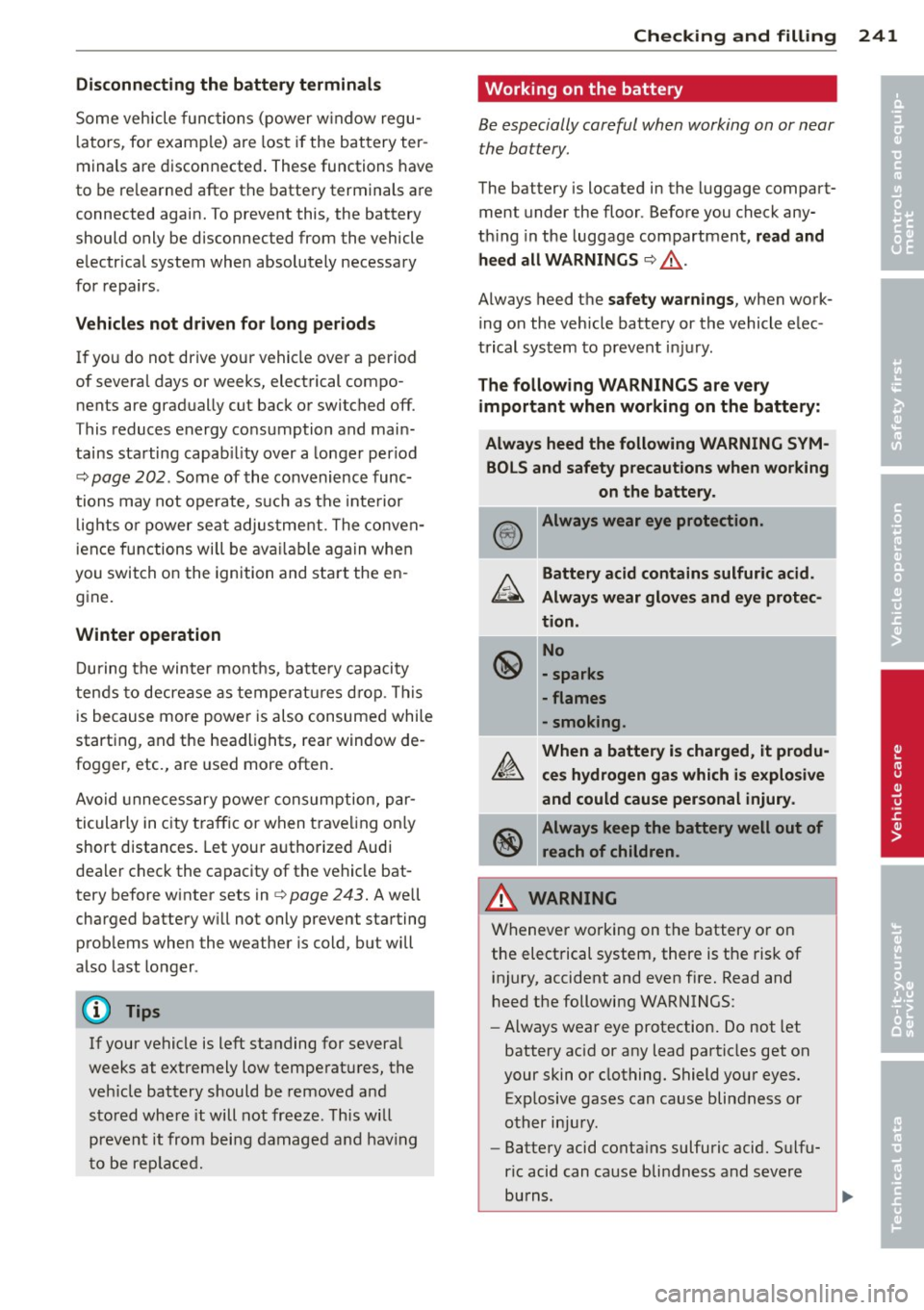
The following WARNINGS ar e very
important when wor king on the battery:
Always heed the following WARNING SYM BOLS and safety pre cautions when working
on the battery.
Always wear eye protection.
Battery acid contains sulfuri c acid .
Always w ear glove s and eye protec
tion.
No
- sparks
- flames
- smoking .
1
When a batter y is charged, it produ
ce s hydrogen g as which is e xplo sive
and could cause per sonal injury .
---·-
®
Always keep the battery well out of
reach of children .
A WARNING
Whenever working on the battery o r on
the electrical system, there is the risk of injury, accident and even fire. Read and
heed the following WARNINGS :
- Always wear eye protection. Do not let
-
battery ac id or any lead particles get on
your skin or clothing. Shield your eyes. Exp losive gases can cause blindness or
other inju ry.
- Battery acid conta ins sulfuric acid. Sulfu
ric acid can cause blindness and severe
bu rns.
•
•
Page 278 of 310
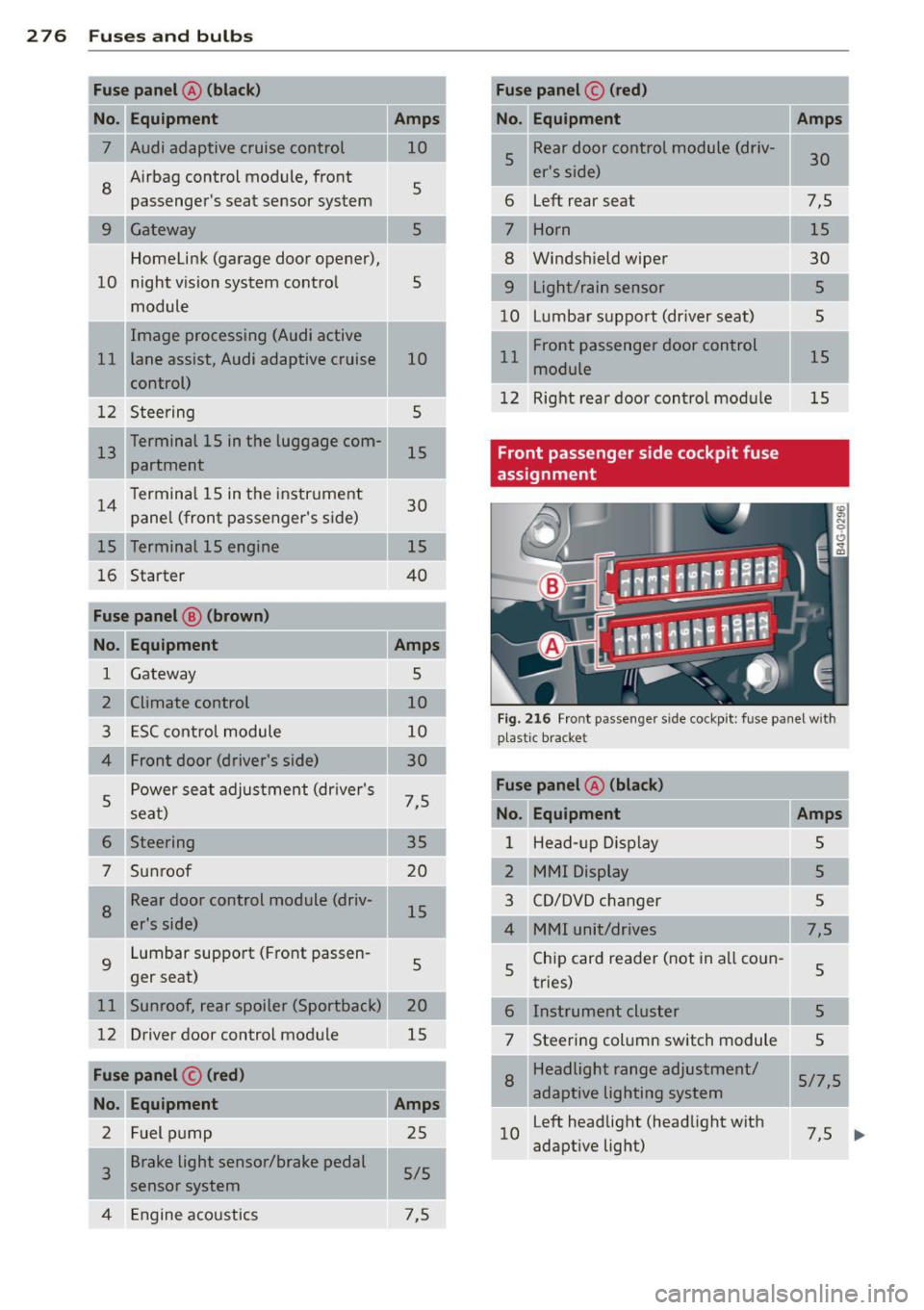
2 76 Fuses and bulbs
Fuse panel
@ (bl ack )
No. Equ ipment
= 7 Audi adaptive cruise control
8 Airbag control module, front
passenger's seat sensor system
9 Gateway
Homelink (garage door opener),
10 night vision system contro l
module
Image processing (Audi active
11 lane assist, Audi adaptive cruise
control)
12 Steering
I 13 Terminal 15 in the luggage com-
partment
14 T
ermina l 15 in the instr ument
pane l (front passenger's s ide)
15 Terminal 15 engine
16 Starter
Fuse panel B (brown)
No. Equipment
1 Gateway
2 Climate control
3 E SC con trol module
Front door (driver's side)
5 Power seat adjustment (dr
iver's
sea t)
6 Steering
7 Sun roof
8
R ear door control module (driv-
er's side)
9
Lumbar support ( Front passen-
ger seat)
11 Sunroof, rear spoiler ( Sportbac k)
12 Driver door control mod
ule
Fuse panel c (red)
No. Equipment
2 Fuel p ump
.
3
Brake light sensor/brake pedal
sensor s ystem
4 Engine aco ustics
Amp s
10
5
5
10
5
15
30 15
40
Amps
5
10
10
30
7,5
35
20 15
5
20
15
Amps
25
5/5
7 ,5
-Fuse panel © (red )
No. Equipment Amps
=· Rear door control module (driv-
5 30
er's side)
6 Left rear seat ______ , 7,5
Ho rn 15
Windshield wiper ____ 30
Light/rain sensor ___ 5
10 Lumba r support (dr iver seat) 5
11 Front passenger door control
module
1 2 Rig ht rear door control mod ule
Front passenger side cockpit fuse
assignment
15
15
Fig. 21 6 Fro nt passen ger sid e co ckp it : fu se pa nel w it h
p last ic brac ket
Fuse panel @ (black)
No. Equipment Amps
1 Head-up D is p la y 5
2
MMI Display 5
3 C D/DVD changer 5
4 MMI unit/drives 7,5
5 Chi
p card rea der (not in a ll co un-
5
tries)
6 Instrument cluster 5
7 Stee
ring column switch module
5
8 Headlight range adjustment/
5/7,5
adaptive lighting sys tem
1 0 Left headlight (head
light wit h
7,5
adaptive light)
I
...
Page 279 of 310

Fuse s and bulb s 2 77
Fuse panel @ (brown) Fuse panel@ (red )
No. Equipment Amps No.
Equipment Amps
Climate control 10 1 Left belt tensioner 25
Climate control system blower 40 2 Right belt tensioner 25
3
Diagnost ic connec tor 10 3 Socke t 20
4
Electrical ignition lock 5 4 Socket 20
5
Power s teering colum n adj ust-
5 ment
5 Ele ctromechanical parking brake 5
6 adaptive air suspension 15
6 Steering column switch module 10
7
Power steering column adjust -
25
ment
7
Rear door (front passenger 's
30 side)
8 Rear e xterior lighting 30
8 Light switch 5
9
L u ggage compa rtment lid con-
30
trol modu le
Luggage compartment fuse assignment Telephone 5
11
Sound amplif ier 30
12
Rear spoiler (Sportback) 20
Fuse panel © (b rown )
No . Amps
1
Radio receiver, Sound amplifier/ 30/20
MMI unit/drives
2 Tank leak detection system 5
Fig. 2 17 Luggage co mpar tment: fuse panel w ith plas-
t ic b racke t 4
AEM co ntrol module/battery 10/15
module
Fuse p anel A (black )
Battery fan 35
Radio receive r 7,5
No. Equipment Amps 8 Rear Seat Entertainment 7,5
Electromechanical parking brake 30
Electromechanical parking brake 30 9
Automatic d imm ing interior 5/15
rearview mirror/battery mod ule
6
Front door (front passenger's
30 side)
10 Parking system 5
7
Rear exterior lighting 30 Fuse panel @ (green )
Rear sun shade, clos ing aid, lug-No .
Equipment Amps
8
gage compartment lock, con-
20 venience key, START ENGINE
1 Aud i pre sense 5
2
Electromechanical parking brake 5
STOP, fuel fi ller door 3 ad aptive air suspens ion 5
9 Power seat adjustment 15
4 Automatic transmission 7,5
10
Parking system 5 5 Parking system 5
11
Rear seat heating 30 6 Rear Seat Entertainment 5
7
Sta rt -Stop-Sys tem 5
8 Audi side assist 5
Page 303 of 310
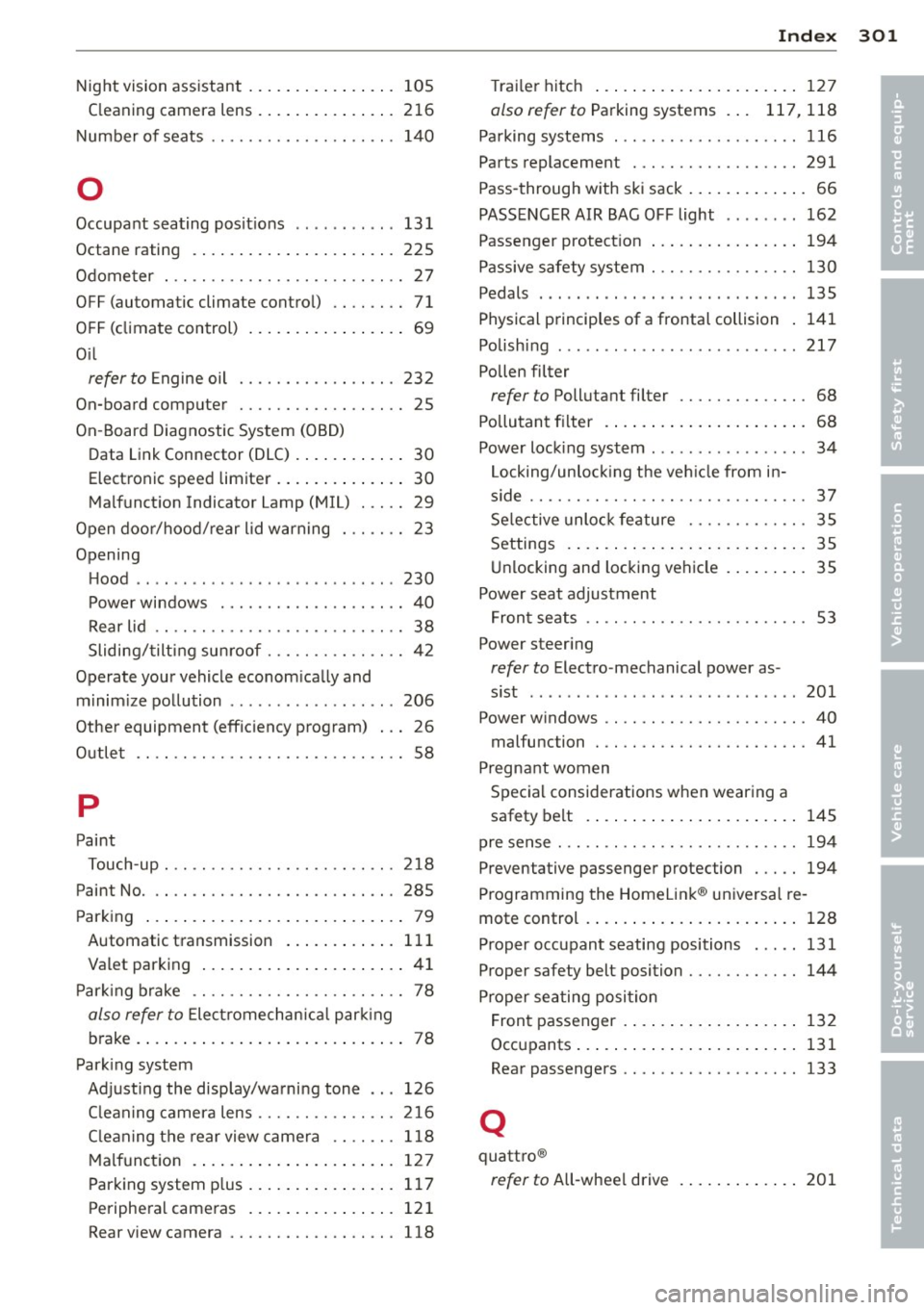
Night vision assistant .... ... .. .. .. .. . 105
C leaning camera lens ... ... .. .. .. .. . 2 16
Number of seats ........... .... .. ... 1 40
0
Occupa nt seating pos it ions .. .. .. .. .. . 13 1
Octane rating . ..... .... ... .. .. .. .. . 225
Odometer . .. .... ............. .. .. .. 27
OFF (automatic climate control) . . . . . . . . 71
OFF (climate control) .... ... .. .. .. .. .. 69
O il
refer to Engine oil ........ .... .. .. . 23 2
On-board computer ........ .. .. .. .. .. 25
On -Board Diagnostic System (OBD)
D ata L ink Connector (DLC) . ... .. .. .. .. 30
Electronic speed limiter . . . . . . . . . . . . . . 30
Malfunct ion Indicator Lamp (MIL) . .. .. 29
Open doo r/hood/ rear lid warning . . . . . . . 23
Opening Hood .. .. .. .. ........ ... .. ... ... . 230
Powe r windows . ...... ... .. .. .. .. .. 40
R ear lid . . . . . . . . . . . . . . . . . . . . . . . . . . . 38
Sliding/ tilt ing su nroof ..... .. .. .. .. .. 42
Operate your vehicle econom ically and
m inim ize po llution ... ...... .. .. .. .. . 206
Othe r equipment (effic iency program) . .. 26
O utle t .. .. .. .... ............. .. .. .. 58
p
Paint
Touch-up . .. .... ......... .... .. .. .
Paint No. 2
18
285
P ark ing ..... ... .. ..... ... .. .. .. .... 79
Automatic transmission ... .. .. .. .. . 11 1
Va let parking ... .. .... ... .. .. .. .. .. 41
P ark ing b rake .... ......... .. .. .. .. .. 78
also refer to E lectromechan ica l par king
b rake . ..... .. ... .. ... ... .. .. .. .... 78
Park ing system
Ad justing the disp lay/wa rni ng tone .. . 126
C lean ing camera lens ...... .. .. .. .. . 216
C le a ning the rear view camera .. .. .. . 118
M alf u nc tion . .... .. ... ... .. .. .. ... 127
Parking system p lus .... ... .. .. .. .. . 117
Periphera l came ras . . . . . . . . . . . . . . . . 12 1
Rearviewcamera ......... .. .. .. .. . 118
Inde x 301
Trai le r hitch
127
also refer to Parking systems . . . 117, 118
Pa rking systems . .. ................. 116
Parts replacement . ............. .... 291
Pass- through w ith ski sack . . . . . . . . . . . . . 66
PASS ENGER AIR BAG OFF light ....... . 162
Passenger protect ion .. .. ... .... ... .. 194
Passive safe ty system ... ......... .. .. 130
Pedals . .. .. .. .. .. .. . ... ...... ... .. 135
Physical p rinciples of a frontal collision . 141
Polishing .......... ................ 217
Pollen filter
refer to Poll utant filter ........... .. . 68
Pollu tan t filter .. .. .. . ... ...... ... .. . 68
Power locking system . ................ 34
L ocking/unloc king t he veh icle from in-
s ide ...... .. .. .. .... ............. . 37
Se lective unloc k feature ........ .. .. . 35
S ettings . ... .... .. . .. .. ..... ... .. . 3S
Unl ocking and locking vehicle . ... .. .. . 35
Power seat adjustment Fron t seats . . . . . . . . . . . . . . . . . . . . . . . . 53
Power steer ing
refer to Electro -mechanical power as
s ist
. . ... ... .. .... .. ........ ..... 201
Power w indows .. .. ............. .... . 40
malfunction . .. .. ................. . 41
Pregnant women Special considerations when wearing a
safety belt . . . . . . . . . . . . . . . . . . . . . . . 145
pre sense . . . . . . . . . . . . . . . . . . . . . . . . . . 194
Preventative passenger protection . .. .. 194
Programming the Homelin k® un iversa l re -
mote control . ..... .. . .. .. ..... ... .. 128
Proper occupant seating positions . .. .. 131
Proper safety belt position . . . . . . . . . . . . 144
P roper sea ting posi tion
Fron t passenger .... . .. .. ..... ... .. 132
Occ upants ... .... .. . .. .. ..... ... .. 131
Rea r passengers ...... ............. 133
Q
quatt ro®
refer to All-whee l drive . ..... ... .. .. 201
•
•
Page 304 of 310
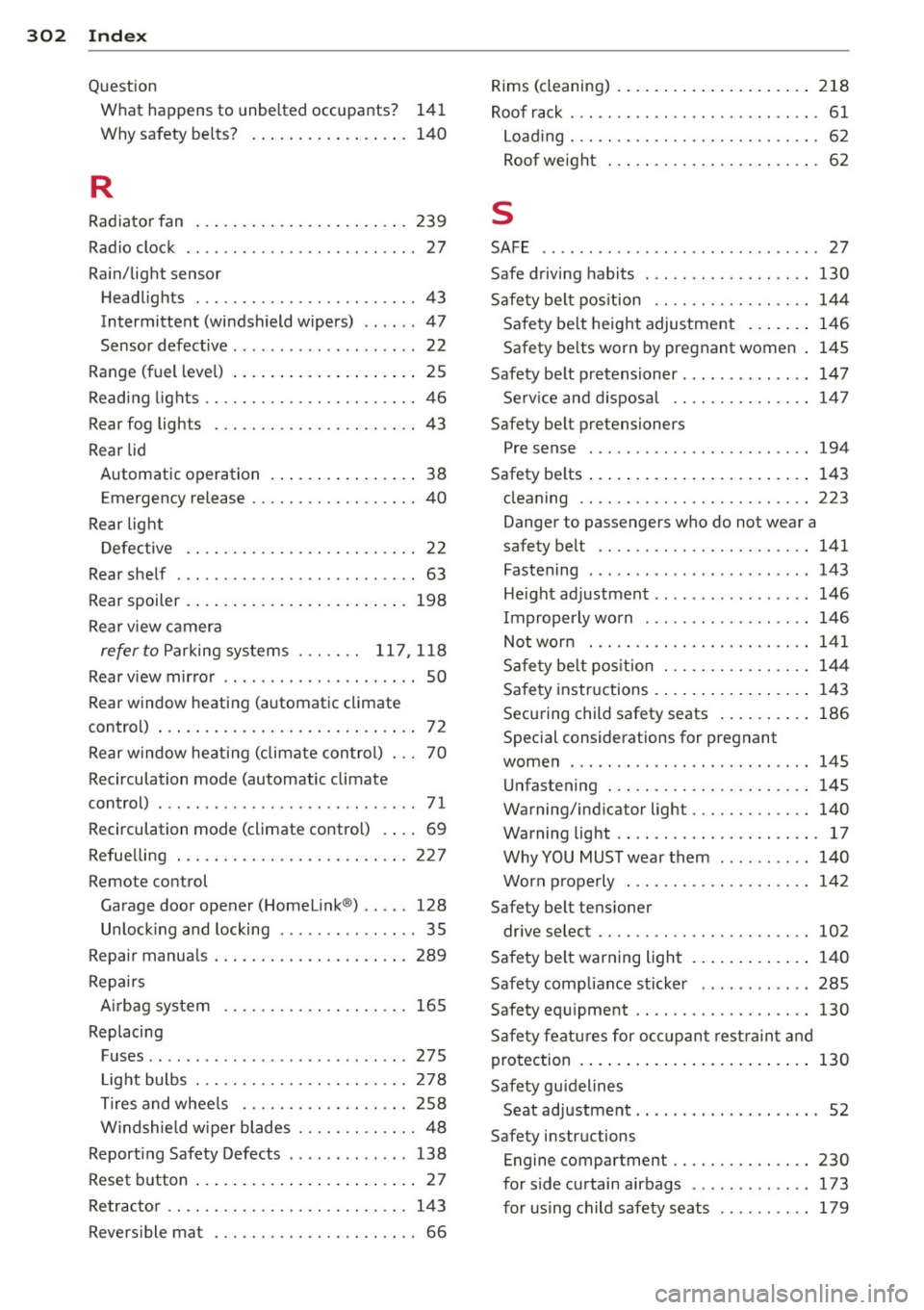
302 Index
Question What happens to unbelted occupants? 141
Why safety be lts? ...... .... .. .... . 140
R
Rad iato r fan .. .. .......... .. .. .... . 23 9
Radio clock .. ................ ... .... 27
Rain/light sensor
He adlig hts ................ .. .... .. 43
Intermittent (windshield wipers) .. .... 47
Sensor defective . . . . . . . . . . . . . . . . . . . . 22
Range (fuel leve l) ........ .. .. .. .... .. 25
Reading lights ....................... 46
Rear fog lights .. .......... ........ .. 43
R ear lid
Automatic operation . . . . . . . . . . . . . . . . 38
Emergency release . . . . . . . . . . . . . . . . . . 40
Rear light
D efe ctiv e ............... .... .. .. .. 22
Rear shelf . . . . . . . . . . . . . . . . . . . . . . . . . . 63
Rear spoiler .. ... .......... ........ . 198
R ear view came ra
refer to Parking systems . .. .. .. 117 ,118
Rear view mirror . . . . . . . . . . . . . . . . . . . . . 50
R ear window heating (automatic climate
contro l) . . . . . . . . . . . . . . . . . . . . . . . . . . . . 72
Rea r window heating (climate control) . . . 70
Recirculation mode (automatic climate
control) . . . . . . . . . . . . . . . . . . . . . . . . . . . . 71
Recirculation mode (climate control) . . . . 69
Refu elling ..... ................... . 227
Remote control
Garage door opener (HomeLink ®) .. ... 128
Unlock ing and locking .......... ..... 35
Repair manua ls ............ .. .. .. .. . 289
Repairs Airbag system .................... 165
Replacing Fuses .. .. .. ... .. ..... ...... ... .. . 275
L ight bulbs . ............... .. .. .. . 278
Tires and wheels ............. ..... 258
W indshie ld wiper blades . .. .. .. .... .. 48
Report ing Safety Defects ............. 138
Reset button .... ............ .. .... .. 27
Retractor . . . . . . . . . . . . . . . . . . . . . . . . . . 143
Reversible mat ................ .... .. 66 R
ims (cleaning) .... ............. .... 218
Roof ra ck ........................... 61
Loading ...................... ..... 62
Roof weight . .. .. ............. .... . 62
s
SAFE ......... ... .. ................ 27
Safe driving habits .................. 130
Safety belt pos itio n . . . . . . . . . . . . . . . . . 144
Safety be lt height adjustment . . . . . . . 146
Safety be lts worn by pregnant women . 145
Safety belt pretensioner .............. 147
Serv ice and disposa l ............... 147
Safety belt pretensioners
Pre sense ..... .. ................ . 194
Safety be lts . . . . . . . . . . . . . . . . . . . . . . . . 143
cleaning ......................... 223
Danger to passengers who do not wear a
safety belt .... ................... 141
Fastening ........................ 143
Height adjustment ............ ... .. 146
Improperly wo rn ................. . 146
Not worn . .... ............... .... 141
Safety be lt position . . . . . . . . . . . . . . . . 144
Safety inst ruct ions ................ . 143
S ecu ring child safety seats ....... ... 186
Special considerations for pregnant
women ... .. .. .. ... .............. 145
Unf astening ..... ... .......... .... 14S
Warning/indicator light ........... .. 140
Warning light . . . . . . . . . . . . . . . . . . . . . . 17
Why YOU MUST wear them .. ... ... .. 140
Wo rn properly . . . . . . . . . . . . . . . . . . . . 142
Safety be lt tens ioner
drive select .... ................... 102
Saf ety belt warning light .......... ... 140
Safety comp liance sticker ........... . 285
Safety equipment ................... 130
Safety features for occupant re straint and
protection .. .... .. ................ . 130
Safety gu idelines
Seat adjustment. . . . . . . . . . . . . . . . . . . . 52
Safety i nstr uctions
Engine compartment ............... 230
for side curtain airbags .... .... ... .. 173
for using child safety seats .......... 179