weight AUDI S7 2013 Owner's Guide
[x] Cancel search | Manufacturer: AUDI, Model Year: 2013, Model line: S7, Model: AUDI S7 2013Pages: 310, PDF Size: 77.45 MB
Page 254 of 310
252 Tires and wheels
This is especia lly important if the vehicle be
longs to someone else or you bought the vehi
cle with different rims/tires or you bought the
vehicle as a previously owned vehicle.
Remember, your safety and that of your pas
sengers also depends on making sure that
load limits are not exceeded. Vehicle load in
cludes everybody and everything in and on the
vehicle. These load limits are technically refer
red to as the vehicle's Gross Vehicle Weight
Rating (' 'GVWR"). The Gross Axle Weight Rat
ing ("GAWR") is the maximum load that can
be applied at each of the vehicle's two axles.
The Gross Vehicle Weight Rating and the
Gross Axle Weight Rating are listed on the
safety compliance sticker label located on the
driver's side 8-pillar. The tire pressure label on
your Audi lists the maximum combined
weight of all of the occupants and luggage or
other cargo that the vehicle can carry. For the
location of the tire pressure labe l
¢fig . 196.
A WARNING
Overloading a vehicle can cause loss of ve
hicle control, a crash or other accident, se
rious personal injury, and even death.
- Carrying more weight than your vehicle
was designed to carry will prevent the
vehicle from handling properly and in crease the risk of a loss of vehicle con
trol.
- The brakes on a vehicle that has been
overloaded may not be able to stop the
vehicle within a safe distance.
- Tires on a vehicle that has been overload
ed can fail suddenly causing loss of con
tro l and a crash.
- Always make sure that the total load be
ing transported -including the weight of
a trailer hitch and the tongue weight of a
loaded trailer - does not make the vehi
cle heavier than the vehicle's Gross Vehi
cle Weight Rating.
A WARNING
- Incorrect tire pressures and/or underin
flation can lead to a serious or fatal acci
dent.
- Incorrect tire pressures and/or underin
flation cause increased tire wear and can affect the handling of the vehicle.
- Incorrect tire pressures and/or underin
flation can also lead to sudden tire fail
ure, including a blowout and sudden de
flation, causing loss of vehicle control.
Checking tire pressure
The correct tire pressure for the tires original
ly installed on your vehicle is listed on the tire
pressure label located on driver's side 8-pil lar.
The recommended tire pressures are on the
tire pressure label and in the table
¢ page 250, Cold tire inflation pressure.This
means that the pressure must be checked and
adjusted when the tire has not been driven for
more than a couple of miles (kilometers) at
low speeds during the previous three hours.
Air in the tires expands when the tire heats up
as a result of internal friction as it flexes in
use. The tire pressure is highe r when the tire
has warmed up than when it is "cold ."
It is the inflation pressure in a "cold" tire that
counts. Therefore, you should never let air out
of a warm tire to match "Cold tire inflation
pressure" recommendations¢
page 250. The
tires would then be underinflated and could
fail suddenly.
The tire pressure label on your Audi lists the
recommended cold tire inflation pressures at
maximum capacity for the new, original
equipment tires that were on your vehicle at
the time it was manufactured. For the loca
tion of the label¢
fig. 196.
Most tires lose air naturally over time . They
can also lose some air if you drive over a pot
hole or hit a curb while parking. It is usually
not possible to see whether the radial tires ..,.
Page 256 of 310
254 Tire s and wheel s
-The use of incorrect tire pressure values
can lead t o acci dents or other damage .
T herefore it is essential that t he driv er
o bserve the specified tire pressure values
for the ti res and the correct pressu res for
the f unct ion of the tire pressure mon itor
ing system*.
- Always inflate tires to the recommended
and co rrect tire pressure befo re d riving
off.
- Driv ing with under inflated ti res bend
more, lett ing them get too hot resu lting
in t read separation, sudden t ire fa il u re
and loss o f control.
- E xcess ive speed and/ove rloading can
c ause heat bui ld-up, sudden t ire fail ure
and loss o f control.
- If the t ire p ress ure is too low or too high,
the tires w ill wear prematu rely and the
vehicle will not hand le we ll.
- If the t ire is no t flat and you do no t have
to change a wheel immed iate ly, drive at
reduced speed to the nearest service sta
t ion to check t he tire pressure and add
air as required.
(D Note
Dr iving w ithou t va lve s tem caps can cause
damage to the tire va lves. To prevent this,
always make sure that facto ry installed
valve stem caps on all wheels are secure ly
mounted on the valve.
@ For the sake of the environment
Unde rinflated tires will a lso increase the
fue l cons umption.
Tires and vehicle load limits
There are limits to the amount of load or
weight that any vehicle and any t ire ca n car ry .
A vehicle that is overloaded w ill not handle
well and is more difficult to stop . Over load ing
can no t on ly lead to loss of veh icle contro l,
b ut can also damage impor tan t par ts of the
vehi cle and can lead to s udden tire failure, in
cluding a blowout and sudden deflation that
can cause the veh icle to crash. Your safety and that of your passengers also
depends on making sure that load limits are
not exceeded . Vehicle load includes everybody
and everything in and on the veh icle. These
load lim its are technically referred to as the
vehicle's
Gro ss Vehicle Weight Rating
("GVWR").
The "GVWR" includes t he weight of the basic
vehicle, a ll factory installed accessories, a full
tank of fuel, o il, coolant and other fluids plus
maximum load. The max imum load incl udes
the number of passengers that the vehicle is
i ntended to car ry ("seat ing capac ity") with an
ass umed we igh t of 150 lbs (68 kg) for e ach
passenge r at a designated seating posi tion
and the total weight of any luggage in the ve
hicle . If you tow a trai ler, the weight of the
trai ler hitch and the tongue weight of the
loaded tra iler must be included as part of the
vehicle load.
The
Gros s Axle Weight R ating ("GAWR") is
the maximum load that can be applied at each of the vehicle's two axles.
The Gross Vehicle Weight Rat ing and the
Gross Ax le Weight Rating are listed on the
safety comp liance sticker label located on the
driver's side B-pillar . Your Audi has 4 seat ing
pos itions, 2 in the front and 2 in the rear for
total seating capacity of 4 . In some vehicles
the re a re 5 seating pos it ions, 2 in the front
and 3 in the rear for tota l seating capacity of
5. Each seat ing position has a safety belt
¢ page 140, Safety belts .
T he fact that there is a n upper limit to yo ur
vehicle's G ross Vehicle Weight Rating means
t h at the total weig ht of whatever is bei ng car
ried in the vehicle ( in cl udi ng the weight of a
trai ler hi tch and the tongue weight of the
l oaded trai le r) is limited . The more passen
gers in the vehicle or passengers who are
heavier than the standard we ights assumed
mean that less we ight can be carried as lug
gage.
T he tire pressure label on your Audi also lists
the maximum combined weight of a ll of the
occupants and luggage or other cargo that .,..
Page 257 of 310
the vehicle can carry. For the location of the
label
~ fig. 196.
A WARNING
Overloading a vehicle can cause loss of ve
hicle control, a crash or other accident, se
rious personal injury, and even death.
- Carrying more weight than your vehicle was designed to carry will prevent the
vehicle from handling properly and in
crease the risk of the loss of vehicle con
trol.
- The brakes on a vehicle that has been
overloaded may not be able to stop the
vehicle within a safe distance.
- Tires on a vehicle that has been overload
ed can fail suddenly, including a blowout
and sudden deflation, causing loss of
control and a crash.
- Always make sure that the total load be
ing transported -including the weight of
a trailer hitch and the tongue weight of a
loaded trailer -does not make the vehi
cle heavier than the vehicle's Gross Vehi
cle Weight Rating.
Determining correct load limit
Use the example below to cal
culate the total weight of the
passengers and luggage or oth
er things that you plan to trans
port so that you can make sure
that your vehicle will not be
overloaded.
Steps for Determining Correct Load Limit
1. Locate the statement "THE
COMBINED WEIGHT OF OC
CUPANTS AND CARGO
SHOULD NEVER EXCEED XXX
Tires and wheels 255
KG OR XXX LBS" on your ve
hicle's placard (tire inflation
pressure label)
¢ fig. 196.
2. Determine the combined weight of the driver and pas
sengers that will be riding in
your vehicle.
3. Subtract the combined
weight of the driver and pas
sengers from
"XXX" kilo
grams or
"XXX" pounds
shown on the sticker
¢ fig. 196.
4. The resulting figure equals
the available amount of car
go and luggage load capaci
ty. For example, if the "XXX"
amount equals 1400 lbs.
and there will be five 150
lbs. passengers in your vehi
cle, the amount of available
cargo and luggage load ca
pacity is 650 lbs. (1400-7 SO
(5
X 150) = 650 lbs.)
5. Determine the combined
weight of luggage and cargo
being loaded on the vehicle.
That weight may not safely
exceed the available cargo
and luggage load capacity
calculated in Step 4.
•
•
Page 285 of 310
@ Tips
Check carefully to make sure the hook-up
is secure before moving the car up the flat
bed truck ramp .
Vehicle transport
Whenever you hov e your vehicle transported,
be sure to note the following :
(D Note
Mount the tie-down chains/cables over the
running surface (circumference) of the
tires. Never secure the vehicle by the axle,
the suspension struts or the front or rear
towline eye . For technical reasons, the
pressure in the suspension struts may
change du ring the transport and this will
adve rsely affect vehicle handling.
Lifting vehicle
Lifting with workshop hoist and with
floor jack
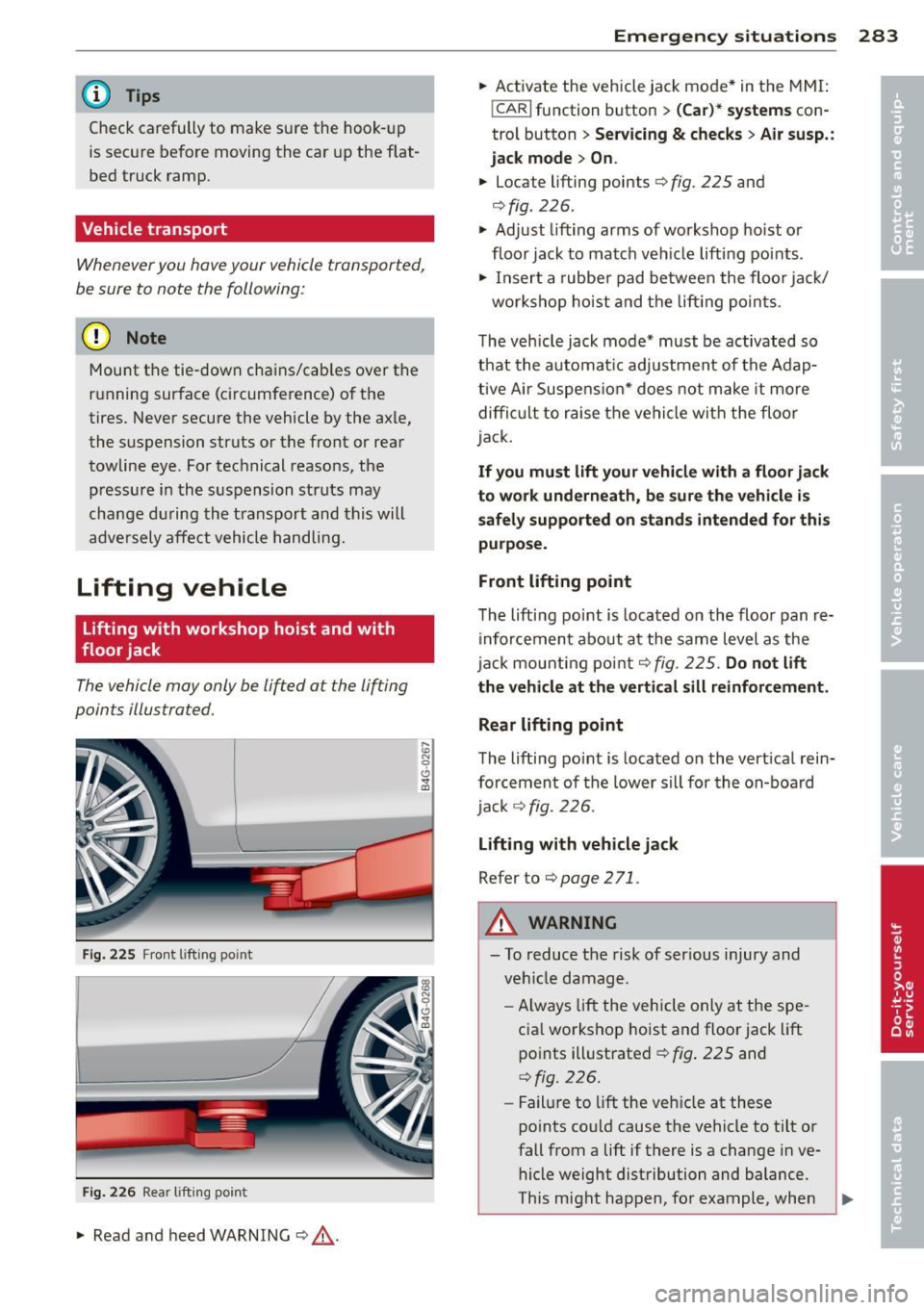
The vehicle may onl y be li~ed at the lif ting
points illu stra ted.
Fi g. 2 25 Front l ift ing po int
Fig. 226 Rea r lifti ng poin t
.. Read and heed WARNING c::> ,& .
:;:; N 0 6 ., a,
Emergenc y situ ation s 283
.. Activate the vehicle jack mode * in the MMI:
!CAR I function button > (C ar)* s ystem s con
trol button>
Se rvic ing & check s> Air su sp. :
jack m ode > On .
.. Loca te lifting poin ts c::> fig. 225 and
c::> fig . 226 .
.. Adjust lifting arms of workshop hoist o r
floor jack to match veh icle lifting points.
.. Insert a rubbe r pad between the floor jack/
workshop hoist and the lift ing po in ts.
The vehicle jack mode* must be activated so
that the automat ic adjustment of the Adap
tive Air Suspens ion* does not make it more
di fficu lt to raise the vehicle with the floor
jack.
If yo u must lift your v ehi cle with a floor jack
t o wo rk und ern eath , be sure th e vehicle i s
s af ely s upported on stand s intended for thi s
purpo se.
Front lifting point
The lifting po int is located on the floor pan re
inforcement abo ut at the same level as the
ja ck mounting point
c::> fig. 225 . Do n ot lift
t h e ve hicle at th e verti cal sill reinforc em ent .
Re ar lifting point
The lifting point is located on the vertical rein
fo rcement of the lower sill for the on-boa rd
ja ck
c::> fig. 226 .
Lifting with vehicle j ack
Re fer to c::> page 2 71 .
A WARNING
-To reduce the risk of ser ious injury and
veh icle damage .
- Always lift the veh icle only at the spe
cia l workshop hoist and floor jack lift
po ints illust rated
c::> fig . 225 and
c::> fig . 226.
- Failu re to lift the vehicle at these
po ints could cause the vehicle to tilt or
fall from a lift if there is a change in ve
hicle weight distribution and balance .
This might happen, for example, when
-
Page 286 of 310
284 Emergency situations
heavy components such as the engine
b lock or transmiss io n are removed.
- W he n removing heavy components like
these, ancho r vehicle to ho ist o r add cor
responding weig hts to ma inta in the cen
ter of g ravity . Othe rwise, the vehicle
might tilt or s lip off t he hoist, causing
ser ious p erson al injury.
(D Note
-Be awa re of the follow ing points befo re
li fting the vehicle:
- The vehicle should never be lifted or
jacked up from underneath the engine oil pan, the transmission housing, the
front or rear axle or the body side
membe rs. This could lead to ser ious
damage.
- To avoid damage to the underbody or
chassis frame , a rubber pad must be
i nserted between the floor jack and
the l ift points.
- Before driving over a workshop hoist,
check that the veh icle weight does not
exceed the permissible lifting capacity
of the hoist .
- Before driving over a workshop hoist,
ensure that there is sufficient clear
ance between the hoist and low parts
of the vehicle.
Page 287 of 310
General information Explanation of
technical data
Som e of t he technical data listed in this man
ual requires further explanation .
The technical data for your vehicle is listed in
the charts starting on
Q page 287 . This sec
tion provides general information, notes and r estr ictions wh ich app ly to this data.
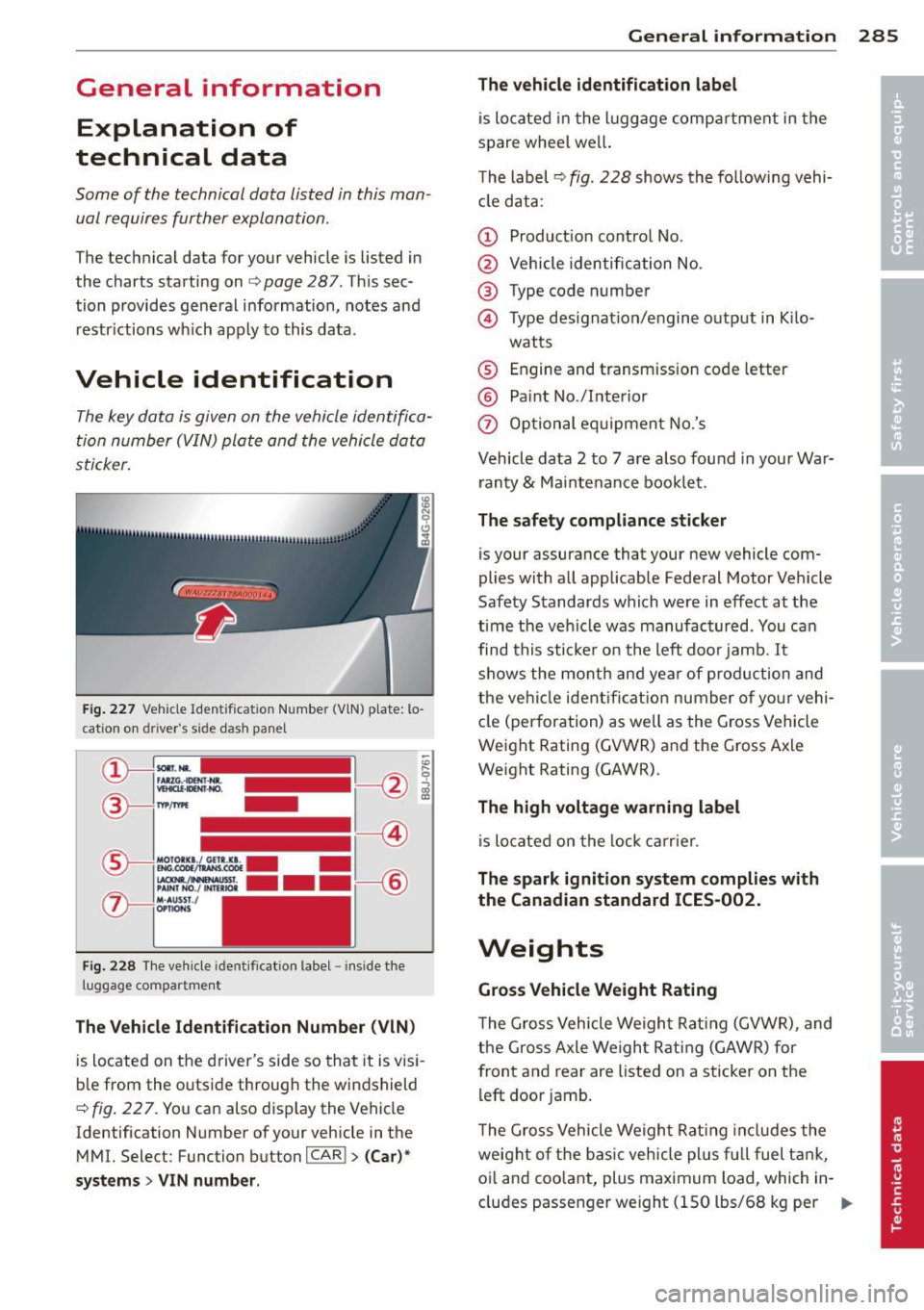
Vehicle identification
The key data is given on the vehicle identifi ca
tion number ( VIN) plate and the vehicle data
sti cker .
Fig. 22 7 Vehicle Ident ific atio n Num ber (V lN) p la te: lo
cation o n dri ve r"s s ide das h pa nel
Fi g. 2 28 The ve hicle iden tifi cat ion label -inside the
l u ggage co mpartme nt
The Vehicle Identification Number (VlN)
is located on the d river's side so tha t it is v is i
b le from the outside throug h the windshield
Q fig . 22 7. You can also d isplay the Vehicle
Identification N umber of your vehicle in the
MMI. Select: Function button
!CAR I> (Car )*
systems
> VIN number .
General inform ation 285
The vehicle identification label
is lo cated in the l uggage comp artment in the
spare whee l we ll.
T he label
r:::> fig. 228 shows th e fo llow ing vehi
cl e data :
(D Product ion cont ro l No.
@ Vehicle identific ation No.
@ Type code number
© Type designat ion/e ngine o utput in K ilo-
wat ts
® Engine and transm ission code letter
® Pa int No ./lnterior
0 Op tio nal eq uipment No.'s
Vehicle data 2 to 7 are a lso found in your War
ranty
& Mai nte nance bookle t.
The safety compliance sticker
is your assurance that your new vehicle com
plies with a ll applicab le Fede ral Motor Vehicle
Safety Standards which were in effect at the
time the ve hicle was manufactur ed . You can
find this sticke r o n the left doo r jamb.
It
sh ows the month an d ye ar of pro duction and
t he ve hicl e ident ificat io n number of yo ur vehi
cle (perforation) as well as the G ross Vehicle
Weight Rating (GVW R) and the Gross Axle
Weight Rating (GAWR) .
The high voltage warning label
is lo cate d on the lock ca rrie r.
The spark ignition system complies with
the Canadian standard ICES-002.
Weights
Gross Vehicle Weight Rating
T he Gro ss Vehicle Weigh t Rat ing (GVWR), and
t he Gross Axle We igh t Rati ng (GAWR) for
fron t and rear are listed on a sticker on the
l eft door jamb .
T he Gro ss Vehicle Weigh t Rat ing incl udes the
weight of the bas ic vehicle plus f ull fuel t ank,
oi l and coo lant, plus maximum load, which in
cludes passen ger we ight (150 lbs/68 kg per ..,.
Page 288 of 310
28 6 G enera l inform ation
designated seating position) and luggage
w eight ¢.&, .
Gross Axle W eight Rating
The Gross Axle Weight Rating is the maximum
l oad that can be applied at each axle of the
vehicle ¢Lr!, .
Vehicle capacit y weight
The vehicle capac ity we ight (max . load) is list
ed either on the dr iver's side B-pilla r or inside
the fuel filler flap.
Roof weight
T he m aximum perm iss ible roo f we igh t is
22 0 lb (100 kg ). The roof weight is made up
of the weight of the roof rack system and the
weight of the object be ing transported
¢ page 62 , Loading the roof rack.
A WARNING
- T he ac tual Gross Axle Weight Rat ing at
the front and rear axles shou ld not ex
ceed the permissible weights, and their
combination must not exceed the Gross
Vehicle Weight Rat ing .
- Exceeding permissib le weight ratings can
result in vehicle damage, accidents and
personal injury.
{[) Note
- The vehicle capacity weight figures apply
when the load is distributed evenly in the
vehicle (passengers and luggage) . When
transporting a heavy load in the luggage
compartment, carry the load as near to
the rear axle as possib le so that the vehi
cle 's ha ndling is not impa ired.
- Do not exceed the maximum permissible
axle loads or the max imum gross vehicle
weight . Always remember that the vehi
cle's handling will be affected by the ex
tra load . Therefore, adjust your speed ac
cord ingly.
- Always obse rve lo ca l regu lations.
-
Dimensions
The specifications refer to the basic model.
Diff erences may occur dep ending on th e mod
el type and options o rdered, for example, ti re
si zes.
~ Note
When driving up steep ramps, on rough
roads, over curbs, etc . it is important to re
member that some parts of your vehicle,
such as spo ilers or exhaus t system compo
nents, may be close to the ground . Be
careful not to damage them .
Page 301 of 310
Fue l filler neck . ... .... ... .. .. .. ... 226
F ue l gauge ...... ..... ... ... ... .... 12
Gasoline ... .... ........ ... .. .. .. . 225
Gasoline additives ........ .. .. .. .. . 226
Low fuel level symbol . . . . . . . . . . . . . . . 22
Octane rating ............... ... ... 225
Recommendation .... ..... .. .. .. .. . 225
Refue lling ............ ...... .... .. 227
Reserve .. .. ............. .. .. .. .. .. 12
Tank capacity . . . . . . . . . . . . . . . . . 12, 287
Fuses Assignment ..... .. ...... .. .. .. .. . 275
Replacing .. ................ ... ... 275
G
Garage door opener (Homel ink ®) . ... .. 128
Garment hooks . . . . . . . . . . . . . . . . . . . . . . 60
Gas dis charge lamps ........ .. .. .. .. . 278
Gauges Eng ine coolant temperature .. .. .. ... . 11
Fuel gauge . .. .............. ... ... . 12
Speedometer . ........ .... ... ... ... 27
Tachometer . . . . . . . . . . . . . . . . . . . . . . . 12
Trip odometer ........... .. .. .. .. .. 27
General illustration . ....... .. .. .. .. ... 8
Generator (warning/indicator lights) . ... 17
Glossary of t ire and load ing te rmino logy 247
Glove compartment (cooled) . .. .. .. .. .. 60
Gross Veh icle Weight Ra ting (GVWR) .. . 285
H
Head -up Display . . . . . . . . . . . . . . . . . . . . . 29
H eadlights
Cleaning system . ............. ... ... 47
Defective . . . . . . . . . . . . . . . . . . . . . . . . . 22
H eadlight range control . . . . . . . . . 22, 43
Washer rese rvoir ......... .. .. .. .. . 24 4
H ead restraints . . . . . . . . . . . . . . . . . 55, 134
Ad justing .. .. ... .. ... ... .. .. .. .. . 134
F ront seats ........ ... ...... .... ... 55
Rear seats . . . . . . . . . . . . . . . . . . . . . . . . . 55
Removing .. .... ......... .... .. .. .. 55
Heated exterior m irrors . ...... ... .. .. .. .. .. 49
rear window (automatic climate control) 72
rea r wi ndow (cl imate control) . .. ... ... 70
Inde x 299
seats (automatic cl imate control) ... ... 72
seats (climate cont ro l) . . . . . . . . . . . . . . . 70
windshield washer spray nozz les ... .. . 47
Heating .. .. .. .. .. .... ........... .. . 68
Heavy clothing and safety be lts .. .. .. .. 143
Hig h beam . ... .... .. . .. .. ..... ... .. . 45
Hig h voltage warn ing label .......... . 285
Hill descent contro l ................. 112
Homelin k® un iversal remote control . .. 128
Hood (re lease lever) .. ... ....... .... . 230
Hooks ... .. .. .. .... . ... ...... ... .. . 65
Hor n ...... .. .. .. ................. .. 8
How are child restraint system anchors re-
l ated to ch ild safety .. .............. . 189
How many airbags does my vehicle have? 157
How often should I chec k my tire pres-
s ur es? ....... .. ...... ............. 253
How safety belt pretens ioners work .. .. 147
Hydrop laning ..... .. . .. .. ..... ... .. 257
I
Immobili ze r .. .. .. .... ........... .. . 27
Impo rtant th ings to do before driving .. 130
Improper ly worn safety be lts . . . . . . . . . . 146
Ind icator lig hts
refer to Warn ing/ indica to r li ghts ... .. . 12
Infant seats . . . . . . . . . . . . . . . . . . . . . . . 181
Installing child safety seats Safety be lts ..... .. . .. .. ..... ... .. 186
Installing the upper tether strap on the
an chorage .. .. .. .. .. .. ........... .. 192
Instruments Adjusting the light ing .. .. .. ... ... .. . 46
Instruments and controls General illustration . . . . . . . . . . . . . . . . . . 8
Instrument cluster ................. . 11
Interior lighting Amb ience lighting . .. .. .. ..... ... .. . 46
Front and rear ... .. .. .. .. .... ... .. . 46
Inter mittent (w indshield wipers) .. .. .. . 47
J
Jack 267
Jump-starting . .. .. ................. 279
Jumper cables . .. .. ................. 280
•
•
Page 304 of 310
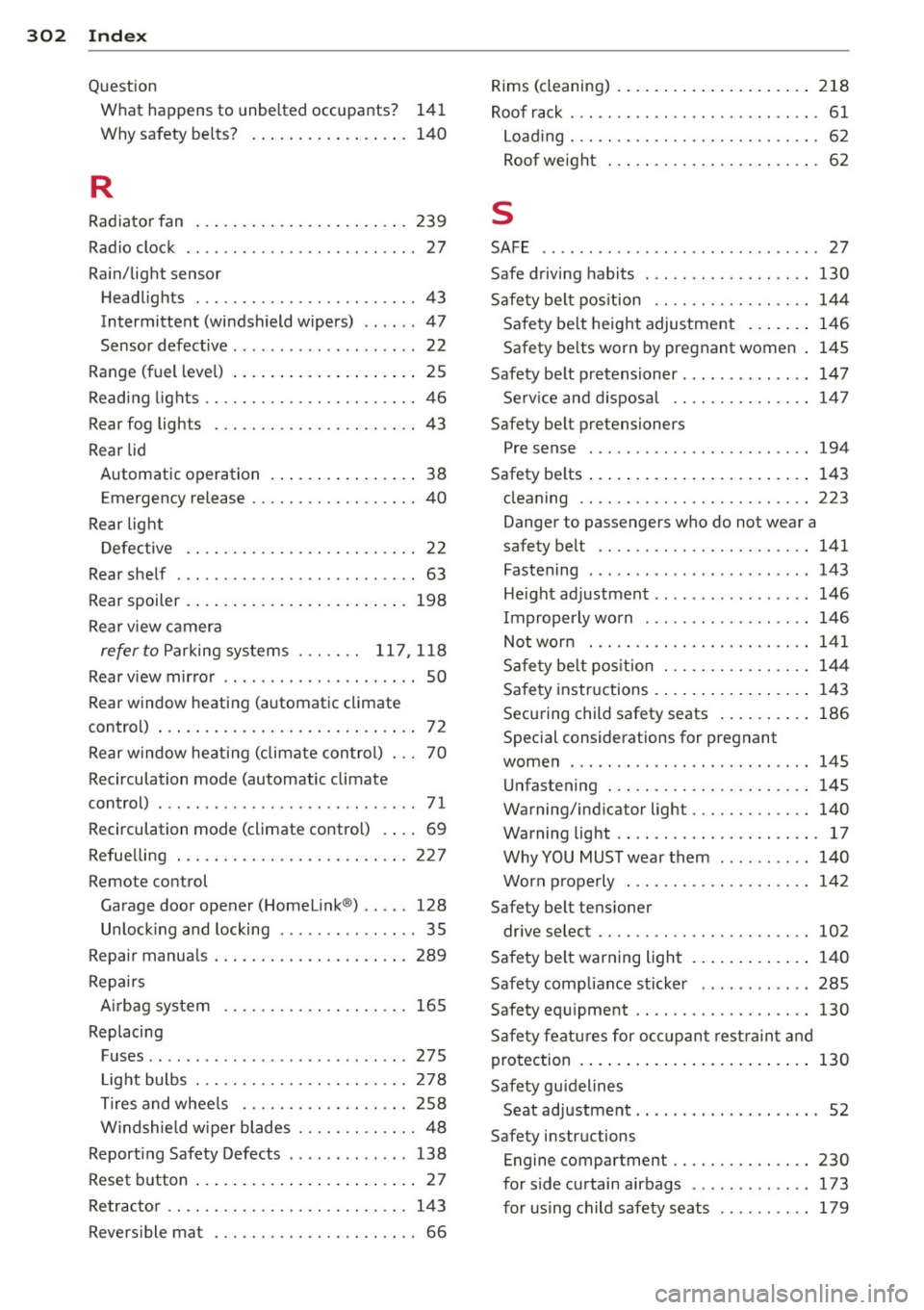
302 Index
Question What happens to unbelted occupants? 141
Why safety be lts? ...... .... .. .... . 140
R
Rad iato r fan .. .. .......... .. .. .... . 23 9
Radio clock .. ................ ... .... 27
Rain/light sensor
He adlig hts ................ .. .... .. 43
Intermittent (windshield wipers) .. .... 47
Sensor defective . . . . . . . . . . . . . . . . . . . . 22
Range (fuel leve l) ........ .. .. .. .... .. 25
Reading lights ....................... 46
Rear fog lights .. .......... ........ .. 43
R ear lid
Automatic operation . . . . . . . . . . . . . . . . 38
Emergency release . . . . . . . . . . . . . . . . . . 40
Rear light
D efe ctiv e ............... .... .. .. .. 22
Rear shelf . . . . . . . . . . . . . . . . . . . . . . . . . . 63
Rear spoiler .. ... .......... ........ . 198
R ear view came ra
refer to Parking systems . .. .. .. 117 ,118
Rear view mirror . . . . . . . . . . . . . . . . . . . . . 50
R ear window heating (automatic climate
contro l) . . . . . . . . . . . . . . . . . . . . . . . . . . . . 72
Rea r window heating (climate control) . . . 70
Recirculation mode (automatic climate
control) . . . . . . . . . . . . . . . . . . . . . . . . . . . . 71
Recirculation mode (climate control) . . . . 69
Refu elling ..... ................... . 227
Remote control
Garage door opener (HomeLink ®) .. ... 128
Unlock ing and locking .......... ..... 35
Repair manua ls ............ .. .. .. .. . 289
Repairs Airbag system .................... 165
Replacing Fuses .. .. .. ... .. ..... ...... ... .. . 275
L ight bulbs . ............... .. .. .. . 278
Tires and wheels ............. ..... 258
W indshie ld wiper blades . .. .. .. .... .. 48
Report ing Safety Defects ............. 138
Reset button .... ............ .. .... .. 27
Retractor . . . . . . . . . . . . . . . . . . . . . . . . . . 143
Reversible mat ................ .... .. 66 R
ims (cleaning) .... ............. .... 218
Roof ra ck ........................... 61
Loading ...................... ..... 62
Roof weight . .. .. ............. .... . 62
s
SAFE ......... ... .. ................ 27
Safe driving habits .................. 130
Safety belt pos itio n . . . . . . . . . . . . . . . . . 144
Safety be lt height adjustment . . . . . . . 146
Safety be lts worn by pregnant women . 145
Safety belt pretensioner .............. 147
Serv ice and disposa l ............... 147
Safety belt pretensioners
Pre sense ..... .. ................ . 194
Safety be lts . . . . . . . . . . . . . . . . . . . . . . . . 143
cleaning ......................... 223
Danger to passengers who do not wear a
safety belt .... ................... 141
Fastening ........................ 143
Height adjustment ............ ... .. 146
Improperly wo rn ................. . 146
Not worn . .... ............... .... 141
Safety be lt position . . . . . . . . . . . . . . . . 144
Safety inst ruct ions ................ . 143
S ecu ring child safety seats ....... ... 186
Special considerations for pregnant
women ... .. .. .. ... .............. 145
Unf astening ..... ... .......... .... 14S
Warning/indicator light ........... .. 140
Warning light . . . . . . . . . . . . . . . . . . . . . . 17
Why YOU MUST wear them .. ... ... .. 140
Wo rn properly . . . . . . . . . . . . . . . . . . . . 142
Safety be lt tens ioner
drive select .... ................... 102
Saf ety belt warning light .......... ... 140
Safety comp liance sticker ........... . 285
Safety equipment ................... 130
Safety features for occupant re straint and
protection .. .... .. ................ . 130
Safety gu idelines
Seat adjustment. . . . . . . . . . . . . . . . . . . . 52
Safety i nstr uctions
Engine compartment ............... 230
for side curtain airbags .... .... ... .. 173
for using child safety seats .......... 179
Page 307 of 310
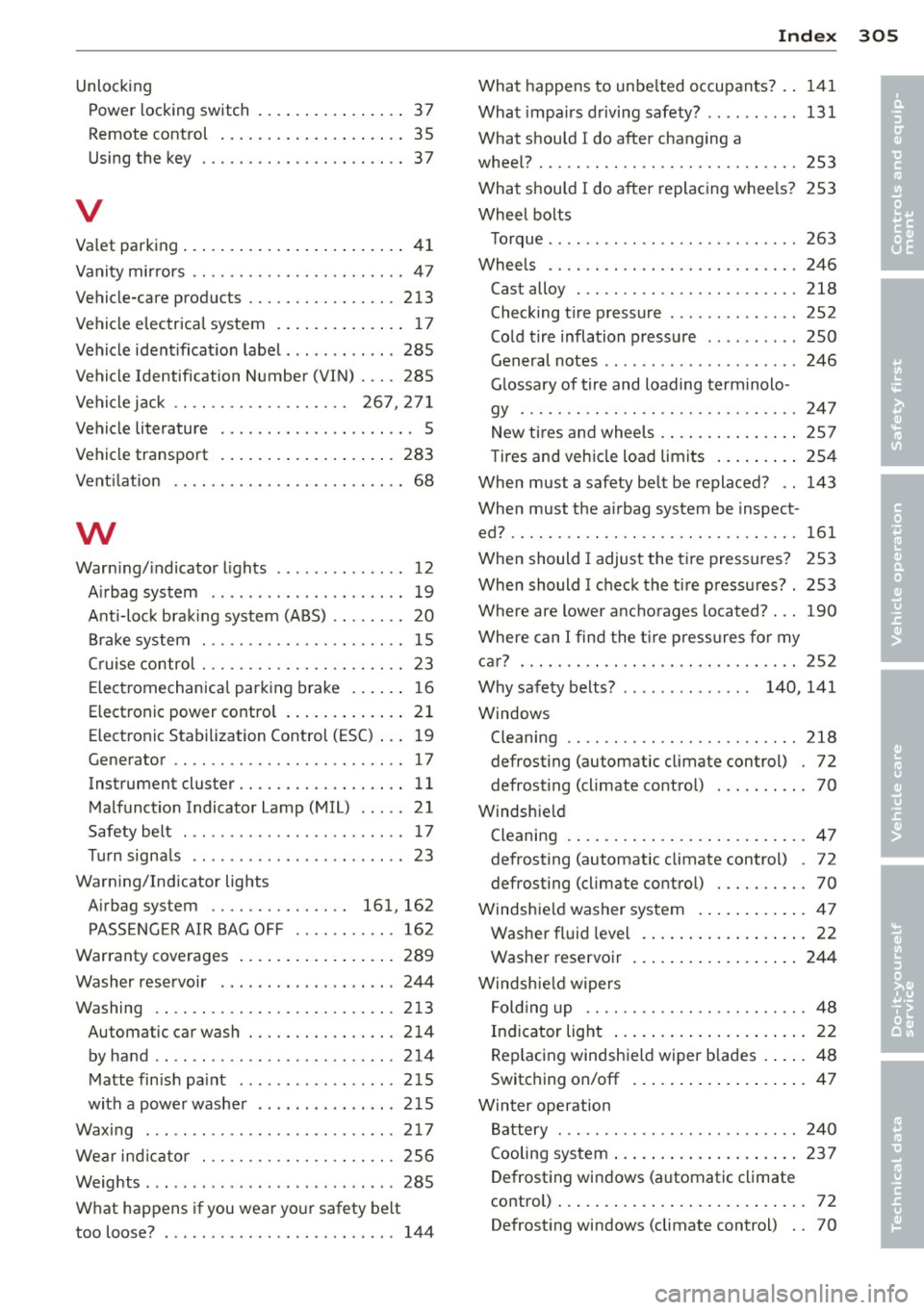
Unlocking Power lock ing switch ... ... ... ... .. .. 37
Remote control ......... ... .. .. .. .. 35
Us ing the key ... .. .... ... .... .. .. .. 37
V
Va let parking ..... .. .... ... .. .. .. .. .. 41
Vanity mirrors .... ......... .... .. .. .. 47
Vehicle-care produc ts ....... .. .. .. .. . 213
Vehicle e lectrica l system . . . . . . . . . . . . . . 17
Vehicle ident ificat ion label ....... ... .. 285
Vehicle Identification N umber (VIN) . .. . 285
Vehicle jack .. .... ........... .. 267,27 1
Vehicle literature . . . . . . . . . . . . . . . . . . . . . 5
Vehicle transport .. ..... ... .. .. .. .. . 283
Vent ilation .. .. .. .. .. .... ... .. .. .. .. 68
w
Warn ing/ indicato r lights ....... .. .... . 12
A irbag system ............ ... ... ... 19
Anti-loc k bra king system (ABS) .. .. .. .. 20
Brake system . ........... .. .. .. .... 15
C ruise con trol . . . . . . . . . . . . . . . . . . . . . . 23
E lect romechanical park ing brake . ... .. 1 6
Electronic power contro l . . . . . . . . . . . . . 21
Elect ronic Stabilization Control (ESC) ... 19
Gene rator . . . . . . . . . . . . . . . . . . . . . . . . . 17
Instrument cluster. . . . . . . . . . . . . . . . . . 11
Malfunct ion Indicator Lamp (MIL) ... .. 21
Safety belt . . . . . . . . . . . . . . . . . . . . . . . . 17
Turn signa ls ... ........... ... ... ... 23
Warn ing/Ind icator lights
A irbag system . . . . . . . . . . . . . . . 161, 162
PASS ENG ER AIR BAG OFF ...... ... .. 162
Warranty coverages ..... ... .. .. .. .. . 289
Wash er rese rvoir . ...... ... .... .. ... 244
Washing .. .. ................. .. ... 213
Automatic ca r wash ....... .. .. .. .. . 214
by hand . ... .. ........ ... .. ... ... . 214
Matte fin is h pa int ..... ...... .... .. 215
with a powe r washe r ... ... .. .. .. .. . 215
Waxing ... .. ................. .. ... 217
Wear ind icator ............ .... .. .. . 256
Weights . .. ... ...... ............. .. 285
W hat happens if you wear your safety belt
too loose? . .. .. ........... .. .. .. ... 144
Inde x 305
What happens to unbe lted occupants? . . 141
Wha t impairs d riving safety? .......... 131
What should I do after changing a
whee l? ..... .. .. .. ................. 253
Wha t shou ld I do after replac ing whee ls? 253
Wheel bolts To rque ...... .. .... .......... ..... 263
Wheels ...... .. .. ................. 246
Cast alloy . .. .. .. .... ............. 218
Check ing t ire pressu re ............. . 252
Co ld t ire inflation p ressure ..... ... .. 250
General notes .. ... ...... .......... 246
G lossary of tire and loading term inolo-
gy ....... .. .. .. .. .. ........... .. 24 7
New t ires and wheels . ... .... ... .. .. 257
Tires and vehicle load limits .. ... .. .. 254
When must a safety belt be replaced? .. 143
When must the airbag system be inspect -
ed? ........ .. .. .. ................. 161
When should I adjust the t ire pressures? 253
When should I chec k the ti re p ressu res? . 253
Where are lower anchorages located? . .. 190
Where can I find the t ire p ress ures for my
car? .. ... .. .. .. .. .. . .. ... .... ... .. 252
Why safety belts? . . . . . . . . . . . . . . 140, 141
Windows Cleaning .. .. .. .. ................. 218
defrosting (automatic climate control) . 72
defrosting (climate control) . . . . . . . . . . 70
Windshie ld
Cleaning . ... .... .. . .. .. ..... ... .. . 47
defrosting (automatic climate control) . 72
defrosting (climate control) . . . . . . . . . . 70
Windshie ld washer system .... ... .. .. . 47
Washer fl uid level . .. .. ..... ... .. .. . 22
Washer reservoir ... . ... .... ... .. .. 244
Windsh ie ld w ipers
F o ldi ng up .. .. .. ................. . 48
Ind icator light ..... . .. .. ..... ... .. . 22
Rep lacing windsh ield wiper b lades . ... . 48
Switching on/off .... .. ..... ... .. .. . 47
Win ter operation
B attery . . . . . . . . . . . . . . . . . . . . . . . . . . 240
Cooling system ... .. .. ... ..... ... .. 237
Defrost ing win dows (a utomatic climate
control) . . . . . . . . . . . . . . . . . . . . . . . . . . . 72
Defrost ing windows (climate control) . . 70
•
•