oil AUDI S7 2014 User Guide
[x] Cancel search | Manufacturer: AUDI, Model Year: 2014, Model line: S7, Model: AUDI S7 2014Pages: 306, PDF Size: 76.83 MB
Page 79 of 306

Starting th e engin e
"'Press the brake peda l c::> _&..
"'Press the !START ENGINE STOP I button
c::>fig. 79. The engine will start .
"' It is possible that the re wi ll be a slight de lay
when starting the engine for diesel vehicles
in colder temperatures. Therefore, you must
hold the brake pedal down until the eng ine
starts. The indicator lamp
&I illum inates
when the eng ine is preheated .
If the engine should not start immediately,
the starting process is automatically stopped
after a short time . Repeat starting procedure .
Start-Stop-Sy stem *:
Note the information on c::> page 81, Start
S top-Sys tem.
A WARNING
- Never allow the engine to run in confined
spaces -danger of asphyxiation .
- Never turn off the eng ine unti l the vehi
cle has come to a complete stop .
- The brake booster and power steer ing
only work when the engine is running . If
the engine is off, you have to use more
force when steering or braking. Because
you cannot stee r and brake as you usua l
ly wou ld, this could lead to crashes and
serious injur ies.
- Avoid high engine rpm, fu ll throttle and
heavy engine loads unti l the engine has
reached operating temperature - ot her
wise yo u risk eng ine dam age.
- The eng ine cannot be started by pushing
or tow ing the veh icle.
(D Tips
- After a cold engine is started, there may
be a brief period of increased noise be
cause oil press ure must fi rst bu ild up in
the hydraulic valve adjusters. This is nor
mal and not a ca use for concern .
-If yo u leave the vehicle with the ignit ion
switched on, the ignition will switch off
On th e ro ad 77
after a certain period of time. Please
note that electrical equipment such as
exterior lights will sw itch off as well
when that happens.
Stopping the engine
"' Bring your vehicle to a complete stop.
"' Move the selector lever to the P or N posi
tion .
"' Press the
I STA RT E NGINE ST OP I button
c::> page 76, fig. 79.
When you stop and the Start-Stop-System*
turns off the engine, the ignition remains on .
Press the
! S TAR T ENGIN E ST OPI button to
switch the ign ition off du ring a stop phase.
Steerin g lock
The steering locks when you tur n the engine
off using the
I START ENGINE STOP I button
and open the driver's door. The locked steer
i ng helps prevent vehicle theft.
Eme rgency off
If necessary, the engine can be switched off
with the selector lever in the R or D/S posi
tion. The engine stops if you press the
I S TART ENGINE STOP I button at speeds below
6 mph (10 km/h) .
A WARNING
-Never turn off the engine until the vehi
cle has come to a complete stop.
- The brake boos ter and power steering
only work when the engine is r unning . If
the engine is off, yo u have to use more
force when steering or braking. Because
you cannot steer and brake as you usual
ly would, th is cou ld lead to crashes and
serious injuries.
- For safety reasons, you sho uld a lways
park your vehicle w ith the selector lever
in P . Otherwise, the vehicle could inad
vertently roll away.
- After the eng ine has been switched off,
the radiator fan can cont inue to run for
up to 10 minutes - even with the ignition .,..
Page 201 of 306
Rear spoiler
The rear spoiler improves vehicle handling
and enhances driver control.
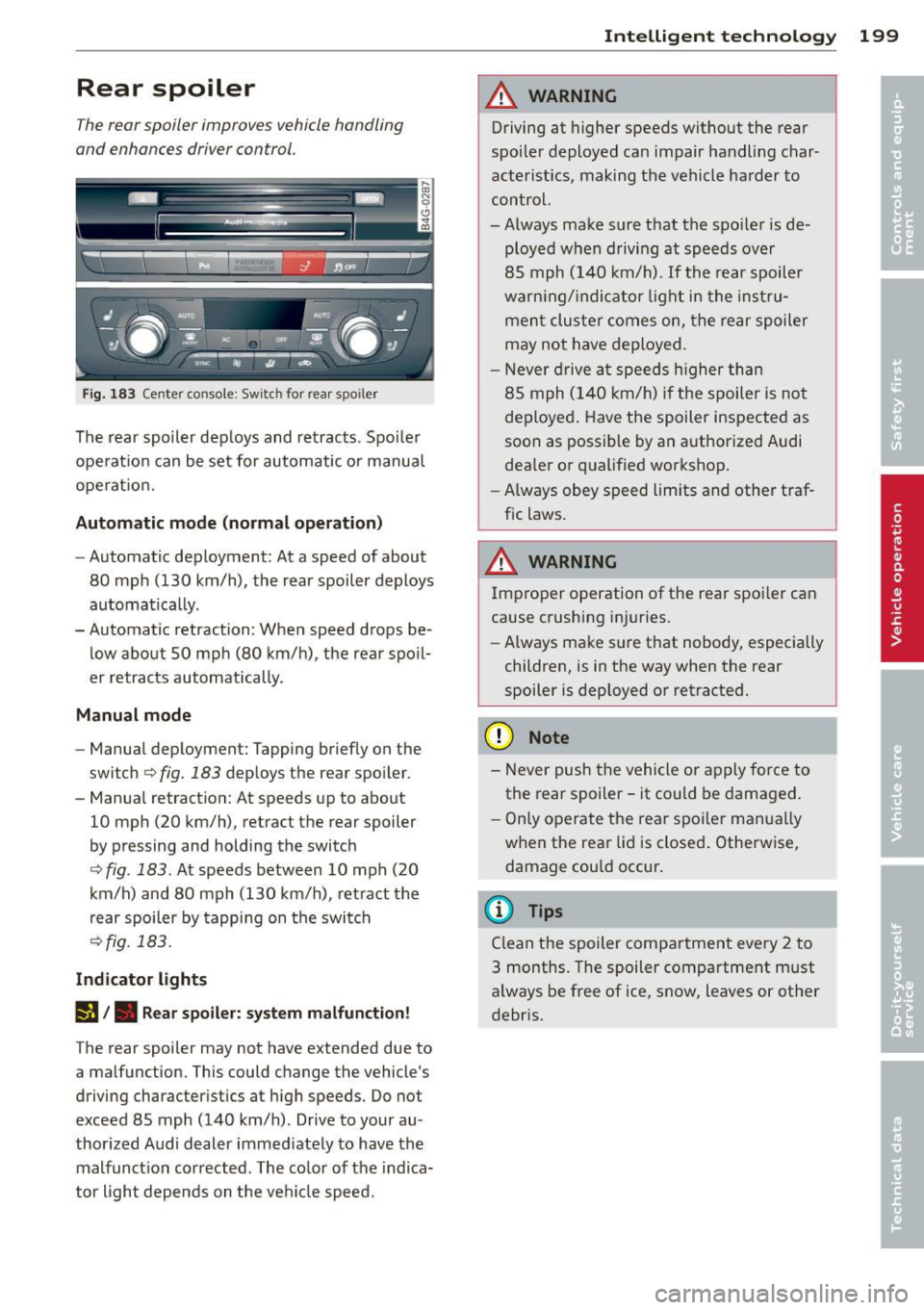
F ig. 183 Center console: Switch for rear spo iler
The rear spoiler dep loys and retracts . Spo iler
ope rat ion can be set for automatic or manual
operat ion.
Automatic mode (no rmal oper at ion )
-Automatic deployment: At a speed of about
80 mph (130 km/h), the rear spoiler deploys
automatical ly .
- Automatic retraction: When speed drops be low about SO mph (80 km/h), the rear spo il
er retracts automatically.
M anual mode
- Manual deployment: Tapping briefly on the
switch¢
fig. 183 deploys the rear spo iler .
- Manual retraction: At speeds up to about
10 mph (20 km/h), retract the rear spoiler
by pressing and holding the switch
¢ fig . 183. At speeds between 10 mph (20
km/h) and 80 mph (130 km/h), retract the
rear spoiler by tapping on the switch
¢fig. 183.
Indicat or light s
(I/. Re ar spoiler: syste m malfunct ion!
The rear spoiler may not have extended due to
a malfunction. This could change the vehicle's
driving characteristics at high speeds. Do not
exceed 85 mph (140 km/h). Drive to your au
thor ized Audi dealer immed iately to have the
malfunct ion corrected . The co lor of the indica
tor light depends on the ve hicle speed.
Intelligen t technolog y 199
A WARNING
Driving at higher speeds without the rear
spoiler deployed can impair handling char
acter istics, making the vehicle ha rder to
control.
-Always make sure that the spo iler is de
ployed when driving at speeds over
85 mph (140 km/ h).
If the rear spoiler
warn ing/ indi ca tor light in the inst ru
men t cluster comes on, the rear spoiler
may not have deployed.
- Never d rive a t speeds h igher than
85 mph (140 km/ h) if the spoiler is not
deployed . Have the spoiler inspected as
soon as possible by an a uthorized Audi
dea ler or qualified workshop .
- Always obey speed limits and other traf
fic laws .
A WARNING
Improper operation of the rear spoi ler can
cause crushing injuries.
- Always make sure that nobody, especially
children, is in the way when the rear
spoiler is deployed or retracted.
(D Note
- Never push the vehicle or apply force to
the rear spoiler -it could be damaged.
- O nly operate the rear spoiler man ua lly
when the rea r lid is closed . Otherwise,
damage cou ld occur .
(D Tips
Clean the spoiler compa rtment every 2 to
3 months. The spoiler compartment must
a lways be free of ice, snow, leaves or other
debris.
Page 203 of 306
overheat, premature wear and increased
stopp ing distance.
- Under certain climatic and operating
conditions such as passing through wa
ter, driving in heavy rain or after wash ing
the vehicle, the effect iveness of the
brakes can be reduced. In winter, ice can
accumulate on the brake pads, linings,
discs and drums. Carefully apply brakes
for a test. Brakes will dry and ice coat ings will be cleaned off after a few ca re
f ul brake applications.
- Driv ing for an extended period of time on
salt-covered roads w ithout using your
brakes can also affect braking efficiency.
Clean off accumulated salt coating from
brake discs and pads w ith a few caref ul
brake applicat ions.
- If you damage the front spoiler, or if you
install a different spoiler, be sure the air
flow to the front brakes is not obstruct ed. Otherwise the brake system could
overheat reducing the effectiveness of
the ent ire brake system.
- Failure of one brake c ircuit will impair
the braking capability resulting in an in
c reased stopp ing distance. Avoid driv ing
the vehicle and have it towed to the near
est Aud i dea ler o r q ualified workshop.
- Never let the vehicle roll to a stop w ith
the engine shu t off.
- If the brake booster is not work ing, the
brake pedal must be pressed conside ra
bly harder to make up for the lac k of
booster assistance.
Electro-mechanical
power assist
The electro-mechanical power assist helps
the driver when steering.
Powe r steering adapts electronically based on
the vehicle speed.
Indicator lights and message s
• Steerin g defective! Stop th e vehicle
Int ellig ent technolog y 201
If this indicato r light turns on and stays on
and t his message appears, the power steering
may have failed.
Do
not con tinue dr iv ing . See your au thor ized
Audi dealer or other qualified repair facility
for assistance .
'I-Y Steering: System malfun ction! You may
c ontinue dri ving
If the indicato r light turns on and the mes
sage appea rs, the stee ring may be more diffi
c ult to move o r more sens itive than usual.
Drive slowly to your authorized Aud i dealer or
qualified workshop to have the ma lfunction
corre cted.
0) Tips
If the . or 1:z;lj indicator light on ly stays
on for a short t ime, yo u may continue dr iv
i ng.
Driving with your
quattro
App lies to veh icl es: w ith all-w hee l drive
With all-wheel drive, all four wheels are driv
en.
General information
Wi th a ll W heel Drive, power is distributed to
all four wheels . This happens automatically
depending on your driving style and the road
conditions at the time . See also
~ page 196.
With the sport different ia l* , power distribu
tion to the rear wheels is variable and can be
adjusted with Audi dr ive select*
~ page 102.
Always read and follow safety precautions
~ .&. .
Winter tires
When dr iving in the winter, yo ur vehicle with
all-wheel drive has an advantage, even wit h
regular tires . In winter road conditions it may
be advisable to mount winter tires (or all-sea
son tires) for improved driveability and brak
ing: these tires must be moun ted o n
all four
wh eel s.
See also~ page 258, Winter tires. ..,.
•
•
Page 207 of 306
Catalytic converter
Applies to vehicles: with gasoline engine
It is very important that your emission con
trol system (catalytic converter) is function
ing properly to ensure that your vehicle is run
ning in an environmentally sound manner .
... Always use lead-free gasoline c::> page 218,
Fuel supply .
... Never run the tank down all the way to emp
ty .
... Never put too much motor oil in your engine
c::> page 232, Adding engine oil
The catalytic converter is an eff icient "clean
up" device built into the exhaust system of
the vehicle. The catalytic converter burns
many of the pollutants in the exhaust gas be
fore they are released into the atmosphere.
The exclusive use of unleaded fuel is cr it ically
i mportant for the life of the cata lytic convert
e r and proper functioning of the engine.
& WARNING ,~
T he temperature of the exhaust system is
high, both when driving and after stopping
the engine .
- Never touch the exha ust tail pipes once
they have become hot. This could result
in burns.
- Do not park or operate the vehicle in
areas where the hot exhaust system may
come in contact with dry grass, brush,
fuel spill or other material which can
cause a fire.
- Do not apply additional undercoating or
rustproofing on or near the exhaust
manifold, exhaust p ipes, catalytic con
verter or heat shields . During driving, the
substance used for undercoating cou ld
overheat and cause a fire.
(D Note
- Be aware that just one tank f illing with
leaded fuel will already seriously de-
grade the performance of the catalytic
conve rter.
Dri vin g and en vironm ent 205
-Do not exceed the correct engine oil level
c::>page 232.
-Do not drive until the fue l tank becomes
completely empty. The engine cou ld mis
fire . Unburned fuel could also get into
the exhaust system and this cou ld cause
the catalytic converter to overheat.
- Do not switch off the ignition while the
vehicle is mov ing .
- Do not continue to operate your veh icle
under these conditions, as otherwise fuel
can reach the catalyt ic converter. Th is
cou ld result i n overheating of the con
verter, requir ing its replacement.
- To assure efficient operation of the Emis
sion Control System:
- Have you r vehicle main tained properly
and in accordance w ith the se rv ice rec
ommendations in your Warranty & Maintenance book let.
- Lack of proper maintenance as we ll as
improper use of t he vehicle wi ll impair
the function of the emission cont ro l
system and could lead to damage.
@) For the sake of the env ironment
Even when the Emission Control System is
ope rat ing properly, the exhaust gas can
have a sulfur-like exhaust gas smell under
some operat ing states. This depends on
the sulfur content of the fuel being used .
Using a different brand of fuel may help,
or filling the tank with lead-free s uper
g rade gasoline.
Diesel particulate filter
App lies to vehicles: wit h diese l eng ine
The diesel part iculate filter filters nearly all of
the soot pa rticles out of the exhaust . T he fil
te r clea ns itself automat ica lly unde r no rma l
driv ing cond itions. If the filter cannot clean it
self (for example, because you are on ly driving
sho rt distances), the filter becomes clogged
with soot and the
Ill symbo l for the diesel
particulate filter i lluminates
c::> page 22. ..,_
•
•
Page 208 of 306

206 Driving and en vir onm ent
8_ WARNING
- Do not park your vehicle over flammable
materials such as grass or leaves because
the high temperature of the diesel par
t icu late filter could start a fire .
- Do not apply an underbody protectant in
the exhaust system area or a fire could start.
Avoid damaging the vehicle
When you are driving on poor roads, or over
curbs, steep ramps, etc., make certain that
low-lying parts such as spoilers and exhaust
system parts do not bottom out and get dam
aged.
This is especia lly true for vehicles with low
slung chassis (sports chassis)* and fully load
ed vehicles.
Driving through water
on roads
Note the following to avoid vehicle damage
when dr iving through water, for example on
flooded roads:
- The water must not be any higher than the bottom of the vehicle body.
- Do not drive faster than wa lking speed.
8_ WARNING
After driving through water, mud, slush,
etc., the brakes may be slow to take effect
because of wet brake rotors and pads. Dry
the brakes f irst by brak ing carefully to re
sto re the full braking effect.
(D Note
- Vehicle components such as the engine,
transmission, suspension or electrical
system can be severely damaged by driv
ing through water.
- Always switch off the Start-Stop-System
when driving through water~
page 81.
-
(D Tips
-Check the depth of the water before d riv
ing through it .
- Do not stop the vehicle, drive in reverse
or switch the engine off when driving
through water.
- Keep in mind that oncoming vehicles
may create waves that raise the water
level and make it too deep for your vehi
cle to drive through safely.
- Avoid driving through salt water because
it can cause corrosion.
Shutting down vehicle
If you would like your vehicle to remain inop
erative for a longer period of time, contact an
Audi or other specialized dealer. They can ad
vise you on necessary precautions e .g. corro
sion prevention, maintenance and storage .
Pay attention to additional information con
cern ing the battery. Refer to
~ page 238.
Operate your vehicle
economically and
minimize pollution
General
Your personal style of driving will determine
the economy of your vehicle, as well as ex
haust and noise levels.
Fuel economy, env ironmental impact, and
wear on your eng ine , brakes and tires largely
depend on three factors:
- your personal driving style
- operating conditions
- technical limitations
If you anticipate what you need to do next and
drive economically, you can easily cut your
fuel consumption by 10-15 percent . This sec
tion will give you some tips on how you can
help the environment and your pocketbook.
Page 209 of 306

@ Tips
The consumption estimates as published by ENVIRONMENTAL PROTECTION AGENCY (EPA) and Transport Canada may not corre
spond to your actual consumption on the
road, wh ic h will vary depend ing upon vehi
cle load and speed, road and weather con
ditions, tr ip length, etc.
Drive smoothly and keep a lookout
ahead
Vehicles use the most fuel when they are ac
celerating.
~ Avoid unnecessary accelerating and braking.
Vehicles use the most fuel when they are ac
celerating . If you anticipate what is go ing to
h appen next, you will need to b rake less and,
thus, accelerate less. Let the vehicle coast
wheneve r poss ible -fo r example when you see
that the nex t tr affic light is red.
Avoid full throttle
Driving at moderate speeds saves fuel and
improves your mileage.
~ T ry and keep well below your car's max imum
speed.
Accelerating gent ly reduces fuel consump
tion, engine wear, and does not dist urb the
environment.
Fuel consumption, exhaust emissions and en
g ine no ise increase d ispropo rtionately at high
speeds. If you dr ive at approxima tely three
q uarters of top speed, fue l consumption will
be red uced by one ha lf. Never dr ive faste r
than the posted speed limit and wea ther con
d itions permit.
Reducing unnecessary idling
E ven when your car is just idling it burns up
fuel.
~ S hu t the engine off when you a re not dr iv ing
t h e vehi cle.
Dri vin g and en vironm ent 207
~ Do not warm up the vehicle by lett ing the
engine run at id le .
T he id ling phase is au toma tic ally red uced for
vehicles with the Start/S top system . It is eff i
cient to switch off the engine in vehicles with
out the Start-Stop-System when stopped at
railroad crossings and long red lights. Turning
the engine off for just 30-40 seconds saves more fuel than is burned by start ing the en-
. . gme again .
It takes a long t ime for the engine to warm up
fully when it is run ning at id le. However, wear
and noxious emissions are especia lly high
when the eng ine is warm ing up. So you should
dr ive away as soon as you start the engine and
avo id running at high rpms whi le the engine is
sti ll warming up.
(L} Note
Do not leave eng ine idling unattended af
ter start ing.
If wa rni ng lights sho uld come
o n t o indi cate improper ope rat ion, t hey
wo uld go unheeded. Extended idlin g also
produces heat, wh ich could res ult in ove r
heating or other damage to the veh icle or
other p roperty .
Regular maintenance
A badly tuned engine unnecessarily wastes a
lot of fuel.
~ Have your ve hicle servi ced at reg ular i nter-
vals .
By havi ng your ve hicle regu la rly se rviced by an
Audi dealer he lps to ensu re tha t it ru ns prop
erly and economically . The condition of your
vehicle not on ly affects its safety and ability to
ho ld its va lue, it a lso affects
fuel consump
tion .
Check your oil each t ime y ou fill your tank.
The amou nt of o il used is re lated to engine
l oad and speed.
It is normal for the oil consumption of a new
engine to reac h its lowest value after a certa in
mileage has been d riven. .,..
•
•
Page 217 of 306
Vehicl e ca re a nd cl eanin g 215
Component Situat ion Solution
Deco ra ti ve
Dirty Mild soap solutional, a cleaning solution suitab le for
p art s/ stainless steel, if necessary
tri m
P ai nt
Paint damage Refer to the paint number on the vehicle data label, re-
pair with touch up paint
c::> page 282
Spilled fuel Rinse with water immediately
Rust film Rust film1 remover, then protect with hard wax; for ques-
tions, refer to an authorized Audi dea ler or a qualified
workshop
Corrosion Have it removed by an authorized Audi dealer or a qua li-
fied workshop
Water no longer Protect with hard wax (at least twice per year)
beads on the surface
of clean paint
No shine even Treat
with suitable polish; then apply paint protectant if
though paint has the polish that was used does not contain any protec-
been protected/ tant
paint looks poor
Carbo n pa rts Dirty Clean the same way as pa inted parts c:>page 213, Car
washes
al Mild soap solut ion: max im um two tablespoons neutral soap in a lite r of water
C le aning int erio r
Component Situ ation Solution
W indo ws
Dirty Glass cleaner, then wipe dry
Deco rativ e Dirty Mi
ld soap solutional
parts/
trim
Pl as tic p art s
Dirty Damp cloth
Heavily soiled Mild soap solutional, solvent-free plastic cleaning solu -
tion, if necessary
Di sp lays Dirty Soft cloth with LCD cleaner
Cont rols Dirty Soft brush, then a soft cloth with a mild soap solutiona)
S af ety belts Dirty Mild soap solutional, allow to dry befo re letting them re -
tract
•
•
Page 218 of 306
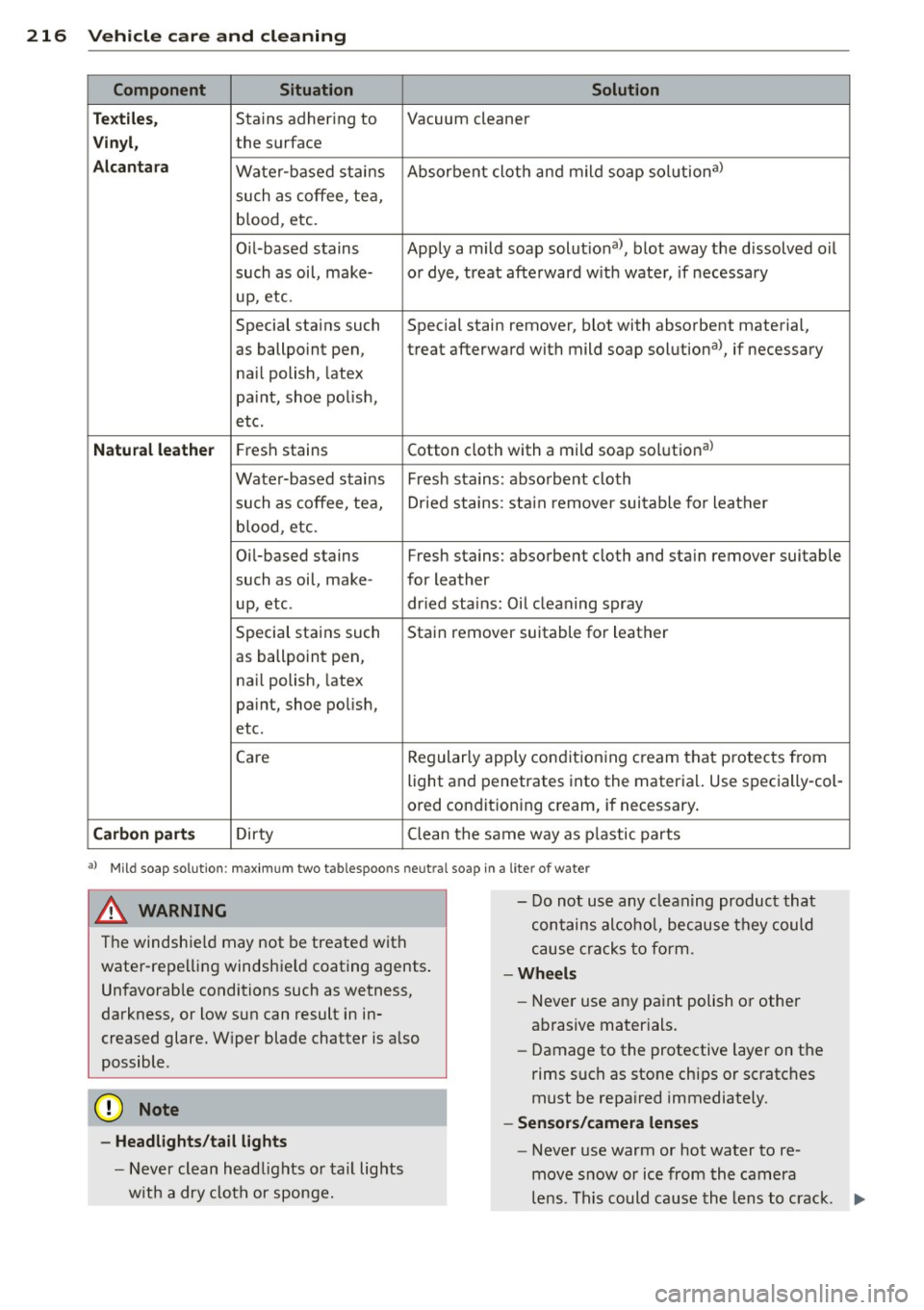
216 Vehicl e c are and cle aning
Component Situation Solution
Tex tile s,
Stains adhering to Vacuum cleaner
Vin yl, the surface
A lcan ta ra Water -based stains Absorbent cloth and mild soap solutiona>
such as coffee, tea,
blood, etc.
O il-based stains Apply a mild soap solutiona >, blot away the d issolved oil
such as oil, make- or dye, treat afterward w ith water, if necessary
up, etc.
Special stains such Special stain remover, blot with absorbent material,
as ballpoint pen, treat afterward with mild soap solutiona >, if necessary
na il polish, latex
pa int, shoe polish,
etc.
N atu ral l eathe r Fresh stains Cotton cloth with a mild soap solution a>
Water-based stains Fresh stains: absorbent cloth
such as coffee, tea, Dr ied stains: sta in remover suitable for leather
blood, etc.
Oil-based stains Fresh stains: absorbent cloth and stain remover suitable
such as oil, make- for leather
up, etc. dried stains: Oil cleaning spray
Special stains such Stain remover suitable for leather
as ballpo int pen,
na il polish, latex
paint, shoe polish,
etc.
Care Regular
ly apply conditioning cream that protects from
light a nd penetrates into the material. Use specially-col-
ored conditioning cream, if necessary.
Carbon part s Dirty Clean tlhe same way as plastic parts
a) Mil d soap so lution : m ax im um two ta b les poons neu tral soa p in a lite r of wate r
& WARNING
The windshie ld may not be treated with
water-repe lling windshield coating agents.
Unfavorab le conditions such as wetness,
darkness, or low sun can result in in
creased glare. W iper blade chatter is also
possible .
(V Note
-Headlights /tail li ghts
- Never clean headlights or tail lights
w ith a dry cloth or sponge. - Do not use any cleaning product that
contains alcohol, because they could
cause cracks to form.
-W hee ls
- Never use any paint polish or other
abrasive mater ials.
- Damage to the protective layer on the
rims such as stone chips or scratches
must be repa ired immediately.
- Sen sor s/c ame ra len ses
-Never use warm or hot water to re-
move snow or ice from the camera
le ns. This could cause the lens to crack . ""
Page 222 of 306
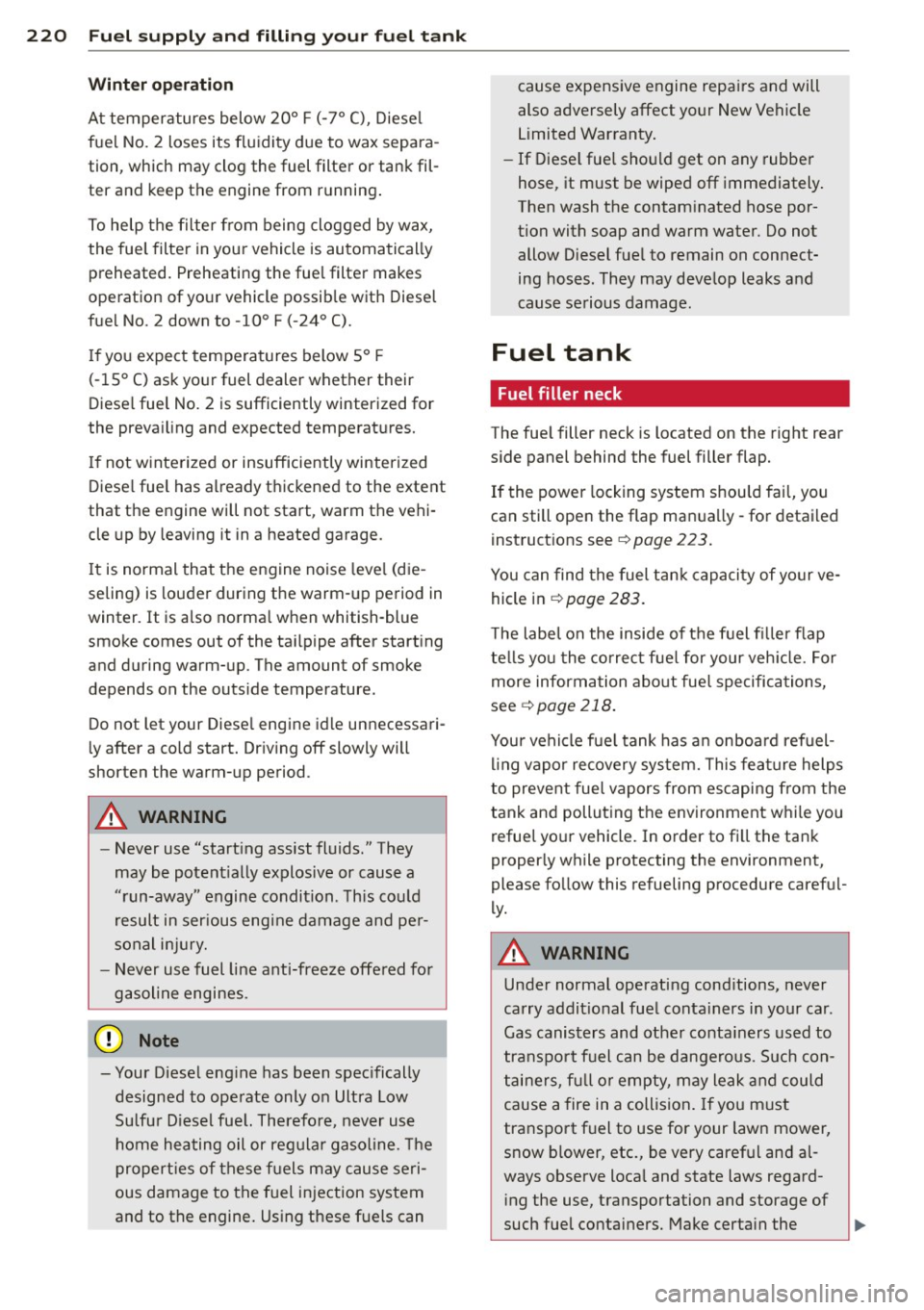
220 Fuel supply and filling your fuel tank
Winter operation
At temperatures below 20° F (-7° C), Diesel
fuel No.
2 loses its fluidity due to wax separa
tion, which may clog the fuel filter or tank fil
ter and keep the engine from running .
To help the filter from being clogged by wax,
the fue l filter in your vehicle is automatically
preheated. Preheating the fuel filter makes
operation of your vehicle possible with Diesel
fuel No. 2 down to -10° F (-24° C).
If you expect temperatures below
5° F
(-15° C)
ask your fuel dealer whether their
Diese l fuel No.
2 is sufficiently winterized for
the prevailing and expected temperatures.
If not winterized or insufficiently winterized
Diesel fuel has already thickened to the extent
that the engine will not start, warm the vehi
cle up by leaving it in a heated garage.
It is normal that the engine noise leve l (die
seling) is louder during the warm-up period in
winter. It is also norma l when whitish-blue
smoke comes out of the tailpipe after starting
and during warm-up . The amount of smoke
depends on the outs ide temperature.
Do not let your Diese l engine idle unnecessari
ly after a cold start. Driving off slowly will
shorten the warm-up period.
A WARNING
- Never use "starting assist fluids." They
may be potent ially explosive or cause a
"run-away" engine condition. This could
result in ser ious engine damage and per
sonal injur y.
- Never use fuel line anti-freeze offered for
gasoline engines.
(D Note
- Your Diesel engine has been specifically designed to operate only on Ultra Low
Sulfur Diesel fuel. Therefore, never use
home heating oil or regular gasoline. The
properties of these fuels may cause seri
ous damage to the fuel injection system
and to the engine. Using these fuels can
-
cause expensive engine repairs and will
also adversely affect your New Vehicle
Limited Warranty.
- If Diesel fuel sho uld get on any rubber
hose, it must be wiped off immediately.
Then wash the contaminated hose por
tion with soap and warm water. Do not allow D iesel fuel to remain on connect
ing hoses . They may develop leaks and
cause serious damage.
Fuel tank
Fuel filler neck
The fuel filler neck is located on the right rear
side panel behind the fuel filler flap.
If the power locking system shou ld fail, you
can still open the flap manua lly -for detailed
instructions see
¢ page 223.
You can find the fuel tank capacity of your ve
hicle in
¢ page 283.
The label on the inside of the fuel filler flap
te lls you the correct fuel for your vehicle. For
more information about fuel specifications,
see
¢ page 218.
Your vehicle fuel tank has an on board refuel
ling vapo r recovery system. This feature helps
to prevent fue l vapors from escaping from the
tank and polluting the environment while you refuel your vehicle. In order to fi ll the tank
proper ly while protecting the environment,
please fo llow this refueling procedure careful
ly.
A WARNING
-Under normal operating conditions, never
carry addit ional fuel conta iners in your car .
Gas canisters and other conta iners used to
transport fuel can be dangerous. Such con
tainers, full or empty, may leak and could
cause a fire in a collision.
If you must
transport fuel to use for your lawn mower,
snow blower, etc., be very careful and al
ways observe loca l and state laws regard
ing the use, transportation and storage of
such fuel containers. Make certain the ..,.
Page 230 of 306

228 Check ing and filling
- Always disconnect the battery.
- Never smoke or wor k near heaters or
open flames . Fluids in the engine com
partment could start a fire.
- Keep an approved fire extinguisher im
mediately available.
- To avoid electrical shock and persona l in
jury while the engine is running or being started, never touch:
- Ignition cables
- Other components of the high voltage
electronic ignition system.
- If you must perform a check or repa ir
with the engine running:
- Fi rst, fully apply the parking brake,
move se lec tor lever to P (Pa rk) .
- Always use extreme caution to prevent
clot hing, jewe lry, or long ha ir from ge t
ting caught in the radiator fan, V -belts
or other moving parts, or from contact ing hot parts . Tie back hair before
start ing, and do not wear cloth ing that
will hang or droop into the eng ine .
- Minimize exposure to emission and chemica l ha zards¢ ,&..
A WARNING
California Propos ition 65 Warning:
- Engine exhaust, some of its constituents,
and certa in veh icle components conta in
or emit chemicals known to the State of
Califor nia to cause cancer and b irth de
fects a nd reproduct ive ha rm. In addition ,
certain fluids conta ined in vehicles and
certa in prod ucts of co mponent wear co n
ta in or emi t chemicals known to the
State o f Ca lifornia to cause can cer and
birth defects or other reproductive harm . -
Battery posts, terminals and re lated ac
cessories conta in lead and lead com
pounds, chemicals known to the State of
California to cause cancer and reproduc
tive harms. Wash hands after handling .
(D Note
When adding flu ids, always make sure that
they are poured into the proper conta iner
or f iller opening, otherwise serious dam
age to vehicle systems w ill occur.
® For the sake of the environment
To detect leaks in time, inspect the vehicle
floor pan from underneath regularly. If
you see spots from oil or other ve hicle flu
i ds, have yo ur vehicle inspected by a n au
thori zed Audi dea le r.
Closing the engine hood
.,. Pull the hood down un til the pressure from
the struts is reduced.
.,. Let the hood
drop down and latch in p lace .
Do not try to push it shut; it may fail to en
gage ¢&_ .
A WARNING
-
A hood that is not completely latched
could fly up and b lock your view while dr iv
ing .
-When you close the engine hood, check it
to make sure the safety catch has p roper
ly engaged. The hood sho uld be flush
with the surrou nding vehicle body pa rts.
- If you notice while driv ing that the hood
is not s ecured prope rly, stop at onc e and
close it.