tires AUDI S7 2014 User Guide
[x] Cancel search | Manufacturer: AUDI, Model Year: 2014, Model line: S7, Model: AUDI S7 2014Pages: 306, PDF Size: 76.83 MB
Page 215 of 306
Vehicle care and clean ing
General information
Regular, proper care helps to maintain your
vehicle 's value. It can also be a requirement
when submitting warranty claims for corro
sion damage and paint defects on the body .
The required cleaning and care products can
be obtained from your authorized Audi dealer
or a qualified workshop . Read and follow the
instructions for use on the packaging.
A WARNING
-Us ing clean ing and care products incor
rectly can be dangerous to your hea lth.
- Always store cleaning and care products
out of reach of children to reduce the risk
of poisoning.
@) For the sake of the environment
-Preferably use environmentally-friendly
products when buying cleaning agents.
- Do not d ispose of leftover cleaning and
care products with household trash .
Car washes
-
The longer that deposits such as insects, bird
droppings, tree sap or road salt remain on the
vehicle, the more the surface can be dam aged. High temperatures such as those
caused by sunlight increase the corrosive ef
fect.
Before washing, wet heavy deposits w ith plen
ty of water.
Also, wash the underside of your vehicle once road salt stops be ing used for the season.
Pressure washers
When washing your vehicles with a pressure
washer, always follow the operating instruc
tions provided w ith the pressure washer . Th is
is especially important in regard to the pres
sure and spraying distance. Do not aim the
spray directly at seals on side w indows, doors,
Vehicle care and cleaning 213
the hood, the rear lid or the sunroof* or at
tires, rubber hoses, insulating material, sen sors* or camera lenses* . Keep a distance of at
least 16 inches (40 cm).
Do not remove snow and ice with a pressure
washer.
Never use rotary nozzles or high pressure noz
zles.
The water temperature must not be above
140 °F (60 °C) .
Automatic car washes
Spray off the vehicle before washing.
Make sure that the windows and roof* are
closed and the windshield wipers are
off. Fol
low instructions from the car wash operator,
especially if there are accessories attached to
your vehicle.
If possible, use car washes that do not have
brushes .
Washing by hand
Clean the vehicle starting from the top and
working down using a soft sponge or cleaning
brush. Use solvent-free cleaning products.
Washing vehicles with matte finish paint
by hand
To avoid damaging the paint when washing,
first remove dust and large particles from
your vehicle. Insects, grease spots and finger prints are best removed with a special cleaner
for matte finish paint.
Apply the product using a microfiber cloth. To
avoid damaging the paint surface, do not use
too much pressure .
Rinse the vehicle thoroughly with water. Then
clean using a neutral shampoo and a soft mi
crof iber cloth.
Rinse the vehicle thoroughly again and let it
air dry . Remove any water residue using a
shammy.
Stubborn deposits such as bi rd droppings or
tree sap are best removed with plenty of wa-
ter and a microfiber cloth.
Ill-
•
•
Page 245 of 306
Tires and wheels
Tires
General notes
Tires may be the least appreciated and most
abused parts of a motor vehicle .
Tires may be the least appreciated and most
abused parts of a motor vehicle . Tires are,
however, one of the most important parts of a
vehicle, particularly considering the compara
tively small patch of rubber on each tire that
assures that a ll- important contact between
you, your vehicle and the road.
Maintaining the correct tire pressure, mak ing
sure that your vehicle and its tires do not have
to carry mo re weight than they can safely han
d le, avoiding damage from road hazards and
r eg ularly inspect ing t ires for damage i nclud
ing cuts, slashes irregu la r wear and ove rall
condition are the most important things that
you can do to he lp avoid sudden tire failure in
cluding tread separat ion and blowouts.
A voidin g damage
If you have to d rive over a curb or similar ob
stacle, drive very slow ly and as close as possi
b le at a right angle to the curb.
A lways keep chemicals includ ing grease, o il ,
gasoline and brake fluid off the t ires .
I nspect the t ires regularly for damage (cuts,
cracks or b listers, etc.). Remove any fo reign
bod ies embedde d in the treads.
Storing tires Mark tires when you remove them to indicate
the direction of rotation . T his ensures you to
be ab le to mount them correctly when you re
i nstall them .
When removed, the wheels or t ires should be
sto red in a cool, d ry and preferably dark place .
Store tires in a vertical pos ition if they are not
mounted on rims, in a horizontal pos it ion if
they are mounted on rims .
Tires an d wheel s 243
New tires
New ti res have to be broken in¢& .
The tread depth of new t ires may vary, accord
ing to the type a nd make of t ire and the tread
patte rn.
H idden damage
Damage to tires and r ims is ofte n not readily
visible . If you notice unusual v ib rat ion or the
vehicle pulls to one s ide, th is may ind icate
that one of the t ires has been damaged . T he
ti res m ust be chec ked immed iate ly by an au
thorized Audi dea le r or q ua lified wor kshop .
Unidirectional tires
A un idirectional tire can be identified by ar
rows on the sidewa ll, that po int in the direc
tion the t ire is designed to rotate. You mus t
f ol low the specified di rection o f rotation . T his
is necessary so that these tires can develop
their optimum characteristics regarding grip, road noise, wear and hydrop laning resistance.
For more information
¢ page 271.
A WARNING
New tires or t ires that are o ld, worn or
damaged cannot provide maximum con
trol and braking ability .
-
-New tires tend to be slippery and must
be broken in. To reduce the r isk of losing
control, a co llision and ser ious personal
in ju ries, d rive with special ca re for the
fi rst 350 m iles ( 560 km).
- Driving with worn or damaged tires can
lead to loss of control, sudden tire fail
ure, including a blowout and sudden de
fl ation, cras hes and se riou s personal in
juries . Have worn or damaged t ires re
placed immediate ly.
- Ti res age even if they are not being used
and can fai l sudden ly, especially at hig h
speeds. Tires that are more than 6 years
old can only be used in an emergency
and then w ith special care and at low
speed.
•
•
Page 246 of 306
24 4 T ire s and wheel s
-Never mount used tires on yo ur vehicle if
you are not sure of their "previous histo
ry." Old used tires may have been dam
aged even though the damage cannot be
seen that can lead to sudden t ire failure
and loss of vehicle control.
- If you notice unusual vibration or if the
vehicle pulls to one side when driving, al
ways stop as soon as it is safe to do so
and check the wheels and tires for dam
age.
(D Note
Please note that summer and winter tires
are designed for the cond itions that are
Glossary of tire and loading terminology
Accessory weight
means t he comb ined we ight (in excess of
those sta ndard items which may be rep laced)
of au toma tic tra nsmission, power steer ing,
power brakes, power windows, power seats,
radio, and heater, to the extent that th ese
items are availab le as factory -installed equip
ment (whether installed or not) .
Aspect ratio
means t he ratio of the he ight to the w idth of
the tire in percent . Numbers of 55 or lower in
dicate a low sidewall for improved steering re
sponse and better overall handling on dry pavement .
Bead
means the part of the ti re that is made of
steel wires, wrapped or reinforced by ply cords
and that is shaped to fit the rim.
Bead separation
means a b reakdown of the bond between
components in the bead.
Cord
means the strands forming the plies in the
tire . typ
ica l in those seasons . Audi recommends
using winter tires during the winter
months . Low temperatures signif icant ly
decrease the e lasticity of summer tires,
which affects tract ion and brak ing ability.
If summer tires are used in very co ld tem
peratures, cracks ca n form on the tread
bars, res ulting in permanent tire damage
that can cause loud driving no ise and un
balan ced t ires. Audi is not responsible for
th is type of damage .
Cold tire inflation pressure
means the tire p ressu re recommended by t he
vehicle manufacturer fo r a tire of a des igna ted
s iz e that has not bee n driven for more than a
coup le of miles (k ilometers) at low speeds in
t h e three hour period before the tire pressure
is measured or adjusted.
Curb weight
mea ns the we ight of a motor ve hicl e w ith
standard equipment including the max imum
capacity of fuel, oil, and coolant, air condi
tioning and additional weight of optiona l
equipment.
Extra load tire
me ans a t ire design to operate at higher loads
and at h igher inflation pressures than the cor
responding standard tire . Extra load tires may
be identified as "XL", "x l" , "EXTRA LOAD", or
"RF" on the sidewall.
Gross A xle Weight Rating ("GAWR ")
means the lo ad -c a rry ing c apac ity of a s ingle
axle system , measured a t the tire-ground in
terfaces.
Gross Vehicle Weight Rating ("GVWR ")
mea ns the maximum total loaded we ight of
t h e ve hicl e. .,.
Page 247 of 306

Groove
means the space between two adjacent tread
ribs.
Load rating (code)
means the maximum load that a tire is rated
to carry for a given inflation pressure. You
may not find this information on all tires be
cause it is no t req uired by law.
Maximum load rating
means the load rating for a t ire at the max i
mum permissible inflation pressure for that
tire.
Maximum loaded vehicle weight
means the sum of:
(a) Curb weight
(b) Accessory weight
(c) Vehicle capacity weight, and
(d) Production options weight
Maximum (permissible) inflation pressure
means the maximum cold inflation pressure
to which a tire may be inflated. Also called "maximum inflation pressure."
Normal occupant weight
means 150 lbs. (68 kilograms) times the
number of occupants seated in the vehicle up
to the total seating capacity of your vehicle.
Occupant distribution
means distribution of occupants in a vehicle.
Outer diameter
means the overa ll diamete r of an inflated new
tire.
Overall width
means the linear distance between the exteri
ors of the sidewalls of an inflated tire, includ
in g elevations due to labeling, decorations, or
protective bands or ribs.
Ply
means a layer of rubber-coated parallel cords.
Tires and wheels 245
Production options weight
means the combined weight of those installed
regular production options we ighing over 5
lbs. (2.3 kg) in excess of those standard items
which they replace, not previously considered
in curb weight or accessory weight, including
heavy duty brakes, ride levelers, roof rack,
heavy duty battery, and spec ial tr im .
Radial ply tire
means a pneumatic tire in which the ply cords
that extend to the beads are laid at substan
tia lly 90 degrees to the center line of the
tread .
Recommended inflation pressure
see ¢ page 244, Cold tire inflation pressure.
Reinforced tire
means a t ire design to operate at higher loads
and at h igher inflation pressures than the cor
re sp onding standard tire. Reinforced tires
may be identified as "XL", "xl", "EXTRA LOAD",
or "RF" on the sidewa ll.
Rim
means a metal support for a tire or a t ire and
tube assembly upon which the tire beads are
seated.
Rim diameter
means nom inal diameter of the bead seat. If
you change your wheel s ize, you will have to
purchase new tires to match the new rim di
ameter.
Rim size designation
means r im diameter and width .
Rim width
means nominal distance between rim flanges .
Sidewall
means that portion of a tire between the
tread and bead.
•
•
Page 248 of 306
246 Tires and wheels
Speed rating (letter code)
means the speed at wh ic h a tir e is des igned to
be d riven for extended per io d s of t ime. The
ratings range from 93 mph (150 km/h) to
186 mph (298 km/h)
¢ page 255. You may
not find this in format ion on all tires because
it is not required by law.
The speed rating letter code, w here a pplica
b le, is molded on the tire s idewa ll and indi
cates the maxim um permissible road speeds
¢ &. in Winter tires on page 259.
Tire pressure monitoring sy stem*
means a system tha t d etects when one or
mo re of a vehicle's t ires are under inflated and
i llum inates a low t ire p ress ure warn ing te ll
tale.
Tread
means t hat port ion of a tire tha t comes into
con tact w it h t he road.
Tread separation
means pull ing away of the t read from the t ire
car cass .
Treadwear indicators (TWI)
means t he projections withi n the pr inc ipal
g rooves designed to give a v isua l ind ication of
the deg rees of wea r of the tre ad . See
¢
pag e 253, Tread W ear Indicator (TWI) for
mo re inf ormat io n on measu ring tire we ar.
Uniform Tire Quality Grading
is a tire i nfo rmation system developed by the
United States Nat io nal Highway Traffic Safety
Admin istration (N HTSA) that is designed to
h e lp buye rs make re lative compa risons among
tires. The UT QG i s no t a safety r ating and no t a
g uar antee t hat a t ire will las t fo r a presc ribed
n umber of m iles (kilome ters) or pe rform in a
certain way. It s imply gives ti re bu ye rs addi
tional information to combine with other con -s
iderations, such as p rice , brand loya lty and
dealer recommendations. Un der UTQ G, tires
are grade d by the t ire manufacturers in three
areas : treadwea r, traction, and temperature
resistance. The UTQG informat ion on the tires,
molded into the sidewalls .
U.S. DOT Tire Identification Number (TIN )
This is the tire's "se ria l numbe r" . It be gins
with the letters "DOT" and ind icates that the
t ire meets all federa l standards . The next two
numbers or letters ind icate the plant where it
was ma nufactu red, and the last four numbe rs
r eprese nt the week and year of ma nufact ure.
Fo r exampl e,
DOT ... 2213 ...
means that the tire was produced in t he 22nd
wee k of 2013. The ot her numbers are market
ing codes that may or may not be used by the
t ire manufacturer. This information is used to
contact consumers i f a tire defect requires a
r ecall .
Vehicle capacity weight
means the rated cargo and luggage load plus
150 lbs. (68 k ilograms) times the vehicle's to
ta l seating capacity as listed on the label lo
cated on the driver's side B-pilla r.
Vehicle maximum lo ad on the tire
means that load on an individua l tire that is
determined by distributing to eac h axle its
share of the maxim um loaded vehicle weight
and divid ing by two .
Vehicle normal load on the tire
means that load on an individua l t ir e that is
determined by distributing to eac h ax le its
share of the curb weight, accessory weight,
and normal occ upant weig ht (d istr ibuted in
accorda nce wit h tab le below ¢
page 247)
and divid ing by two .
Page 249 of 306
Tires and wheels 247
Occupant loading and distribution for vehicle normal load fo r various d esignated seat ing
capaci tie s
Designated seating capacity , Vehicle normal load , number Occupant distribution in a nor-
number of occupants of occupants mally loaded vehicle
4 2 2 in front
5
3 2 in front, 1 in back seat
Cold tire inflation pressure
Tire pressure affects the overall handling, performance and safety of a vehicle.
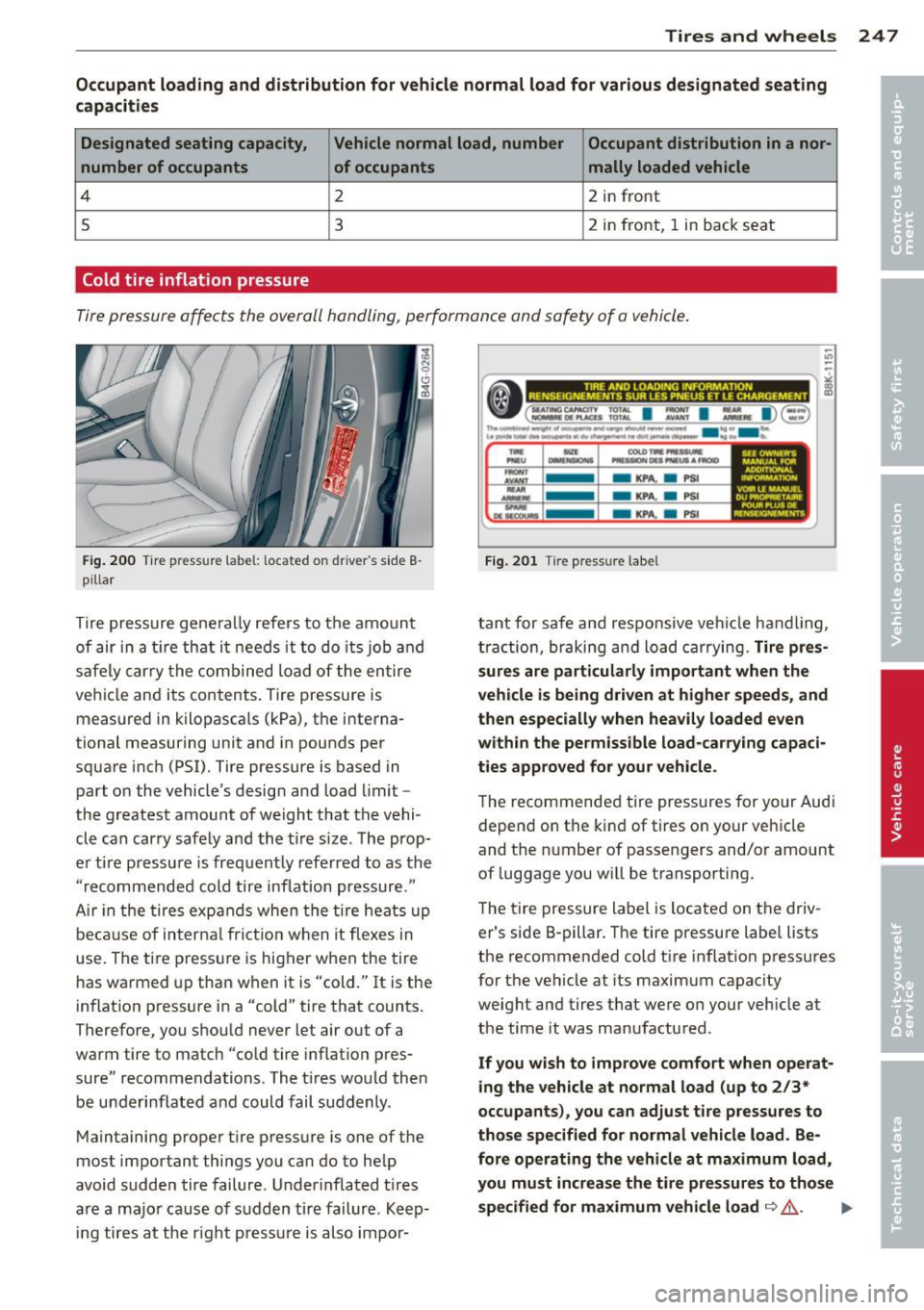
Fig. 2 00 Tire pressu re lab el: located o n drive r's side B
p ill ar
Tire pressure generally refers to the amo unt
of air in a t ire that it needs it to do its job and
safely car ry the combined load of the entire
vehicle and its contents . T ire pressure is
measured in kilopascals (kPa) , the interna
tional measu ring unit and in pounds per
s quare inch (PSI). Tire p ressure is based in
part on the vehicle's design and load limit -
the greatest amount of weight that the vehi
cle can carry safely and the t ire size . The prop
er tire pressure is frequent ly referred to as the
" recommended cold tire inf lation pressure ."
Air in the tires expands when the ti re heats up
beca use of internal fri ct ion when it flexes in
use. The tire p ressure is higher when the tire
has warmed up than when it is "cold ." It is the
inflat ion p ressure in a "cold" ti re that counts.
Therefore, you should never let air out of a
warm tire to match "cold tire inflation p res
sure" recommendations. The t ires would then
be underinflated and could fail suddenly .
Maintaining proper tire pre ssure is one of the
most important things you can do to help
avoid sudde n tire failure . Underinflated t ires
are a majo r cause of sudden tire failure . Keep
i ng tires at the r ight pressure is also impor-
-"' --~ -- ,e
• (:::=~. ~: I =: I :,.. I)( ::: ) l3 n,........,..,.__...,~ ........ ....,_...... • ... _ .. , ....................................... ..,_ "" ..
-""u
--
-...........
- KPA. a PSI
-KPA. a PSI
-KPA. a PSI
Fi g. 201 Ti re pres sure label
tant for safe and respons ive ve hicle hand ling,
tra ction, braking and load carrying.
Tir e pre s
sure s are parti cul arly important when the
v ehicle i s being dr iven at higher sp eed s, and
then e speciall y when hea vily loaded even
withi n the pe rmissible load -carrying capaci
t ies app roved for your veh icle .
The recommended t ire pressures for your Audi
depend on th e kind of tires on your vehicle
and the n umber of passengers and/or amount
of luggage you will be transporting.
The tire pressure label is located on the driv
er 's side B-pillar. The tire pressure labe l lists
the recommended cold tire inflat ion pressures
for the vehicle at its maximum capacity
weight and tires that were on your veh icle at
the time it was manufactured .
If you wish to imp ro v e co mfort when operat
ing the vehicle at normal lo ad (up to 2 /3*
occup ants ), you can adju st ti re pres sures to
those specified for normal v ehicle load . Be
fore operating the vehicl e at maximum load ,
you must increase th e tire pre ssu res to tho se
spe cified for maximum v ehicl e load
¢ ,&. . IJi,,-
Page 250 of 306

248 Tires and wheels
Bear in mind that the tire press ure monitoring
system* can only monitor the tire pressures
you have stored . The system does not recog
n ize the load condit ion of yo ur vehicle.
T he effectiveness of the tire p ressu re monitor
ing system * will be impaired if you store nor
mal load pressures but the n operate the vehi
cle at its max imum load
c:> &. .
See the i llustra tion c:> fig. 2 00 for the location
of the la b el on dr iver's side B-pillar (co lor of
the act ua l labe l and exact location on the ve
h icle w ill vary slig htly).
Model / Tire designation
Note that the fo llowing ta ble is acc urate at
t h e time of going to press and is s ubject to
c h ange . In the event of d iscrepancies, the t ire
pressure label is located on the d river's side B
pillar always takes precedence.
T he table below lists t he recommen ded cold
t ir e inflat ion pressu res for the Audi mode l
cove red by your Owner's Lite rat ure at the vehi
cle's capacity weig ht and the t ire sizes instal
l ed on the respective models as or ig inal
equipmen t, or as a factory opt ion.
Tire pressure
Engine normal load condition full load condition
fronta > reara
>
front rear
PSI kPA PSI kPA PSI kPA PSI kPA
A7 : 235/55 Rl 7 99Y
32 220 29 200 35 240
38 260 3.0 liter High Performance
6-cylinder 255/45 R18 99H
All Season
3 2 2 20 29 200 35 24 0 3 8 260
255/45 Rl8 99Y 32 220 29 200
35 2
4 0
38 260
High Perfo
rmance
255 /40 R19 lOOH XL
35 240 32 220 38 260 280 All Season 4 1
255/40 Rl9100YXL
36 2 50 32 220 38 260 41 280 High Performance
265/35 R20 99H XL
35 240
32 220 38 260 41
280 All Season
265 /35 R20 99Y XL
36 250 32 22 0 38 26 0 41 280 High Performance
S7: 255/40 Rl9 lOOY XL
39
270
33 230
42 290 42 290 4.0 liter High Performance
a-cylinder 265/35 R20 99V XL
High Performance
41 280 35 240 44 300 44 300
XL= reinforced or extra load tire. It may also appear as xl, EXTRA LOAD, or RF on the tire side-
wall.
al no
rm al load co ndi tio n r:::., page 24 7.
The correct tire pressure for the spare wheel is
l ocated o n a label o n the dr ive r's side B -pillar .
Because technical changes may be made to
ve hicle equ ipment dur ing the model year, a l
ways compare the tire size designation on the
tire pressure labe l on your vehicle w it h the t
ires on you r vehicle. Make sure that the tire
s ize informa tion on the vehicle labe l is the
same as the size o f the tires on the veh icle .
Page 251 of 306
This is especially important if the vehicle bel ongs to someone else or you bought the vehi
cle with different rims/tires or you bought the
veh icle as a previously owned vehicle.
Remember, your safety and that of your pas
sengers also depends on making sure that l oad limits are not exceeded . Vehicle load in
cludes everybody and everything in and on the
vehicle. These load limits are technically refer red to as the vehicle's Gross Vehicle Weight
Rati ng ( "GVWR") . The Gross Axle Weight Rat
i ng ("GAWR") is the maximum load that can
be applied at each of the veh icle 's two axles.
The G ross Vehicle We ight Rating and the
Gross Axle We ight Rating are listed on the
safety compliance sticker labe l located on the
driver's side B -pillar . The tire pressure label on
your Audi lists the maximum combined
weight of all of the occupants and luggage or
other cargo that the vehicle can carry. For the
locat io n of the tire pressure label¢
fig . 200 .
.,&. WARNING
Overloading a vehicle can cause loss of ve
hicle control, a crash or other accident, se
rious personal inju ry, and even death.
- Carry ing more weight than yo ur vehicle
was designed to ca rry will p revent the
vehicle from hand ling p roperly and in
crease the ris k of a loss of veh icle con
t ro l.
- T he bra kes on a veh icle that h as been
overloaded may not be able to stop the
vehicle within a safe distance .
- T ires on a vehicle that has been overload
ed can fail suddenly causing loss of con
tro l and a c rash.
- Always make sure that the tota l load be
ing transported -includ ing the weight of
a tra iler hitc h and the tongue weight of a
loaded trailer -does not make the veh i
cle heav ier than the veh icle's Gross Vehi
cle Weight Rating.
Tire s an d wheel s 249
.,&. WARNING
-Incorrect tire pressures and/or underin
f lation can lead to a ser ious or fatal acci
dent .
- Incorrect tire pressures and/or underin
f lation cause increased tire wear and can
affect the handl ing of the vehicle .
- Incorrect tire pressures and/or underin
f lation can a lso lead to sudden t ire fail
ure, including a blowout and sudden de
f lation , causing loss of veh icle cont ro l.
Checking tire pressure
The correct tire pressure for the tires original
ly installed on your vehicle is listed on the tire
pressure label located on driver's side 8-pil lar.
The recommended tire pressures are on the
t ire p ress ure label and i n the table
¢ page 247, Cold tire inflation pressure.This
means th at the pressure m ust be chec ked and
adjusted when the t ire has not been dr iven for
more than a couple of miles (kilometers) at
l ow speeds d uring the previous th ree ho urs .
Air in the tires expands when the tire heats up
as a result of internal frict ion as it flexes in
use. The tire pressure is higher when the tire
has warmed up than when it is "cold."
It is the inflation pressure in a "cold" tire that
counts. Therefore, you should never let a ir out
o f a warm tire to match "Cold t ire inflat io n
pressure" recommendat ions ¢
page 247 . The
ti res wou ld then be unde rinflated and co uld
fail suddenly .
The tire pressure label on your Audi lists the recommended co ld tire inflation pressures at
max imum capacity for the new, or ig inal
equipment tires that were on your ve hicle at
t h e time it was ma nufactu red. For the lo ca
t ion o f the labe l¢
page 247, fig. 200.
Most t ires lose air naturally ove r time . They
can a lso lose some air if yo u drive over a pot
ho le or hit a curb while par king.
It is usually
not poss ible to see whether the rad ia l t ires ...,
•
•
Page 252 of 306

250 Tire s and wheel s
used today are underinflated just by looking
at them.
Therefore, be sure to check tire pressures at least once a month and always before going
on a long tr ip. Make sure to take the number
of people and the amount of luggage into ac
count when adjusting tire pressure for a trip -
even one that you would not consider to be
"long." See
c> page 251, Tires and vehicle
load limits
for more important information .
Always use an accurate tire pressure gauge
when checking and adjusting inflation pres
sures . Check all of the t ires and be sure not to
forget the spare tire . If the pressure in any tire
i s too high when the tire is "cold," let air out
of the tire slowly with the edge of the tire
gauge and keep checking the pressure unt il
you reach the pressu re that is correct for the
l oad (passengers and luggage) and kind of
driving you plan to do.
I f the p ress ure in any tire is too low, note the
d ifference between the pressure in the cold
tire and the pressure you need and add the a ir
that you need to reach the correct pressure for
the vehicle load (passengers and luggage) for
the tires on your veh icle as listed on the on
you r veh icle and in this manual and the k ind
of dr iving you plan to do.
Ne ver e xceed the m aximum inflation pre s
su re li sted on the ti re sidewall for an y rea
son.
Remember that the vehicle manufacturer, not
the tire manufacturer, determines the correct
tire p ressure fo r the t ires on your vehicle .
It is important to check the tire pressu re when
the tires are cold.
- Read the requ ired t ire p ress ure from the tire
pressure label. The ti re pressu re labe l is lo
cated on the drive r's side 8-pi llar.
- T urn the valve stem cap counter- clockwise
to remove i t from the tire valve.
- Place the air pressu re gauge on the valve .
- The tire pressures should only be checked
and adjusted when the tires a re cold . The slightly raised pressures of warm tires must
not be reduced.
- Adjust the tire pressure to the load you are
carrying.
- Reins tall the valve stem cap on the va lve.
When sh ould I check the tire pressure?
The correct tire pressure is especially impor
tant at h igh speeds. The pressure should
the refore be checked at least once a mo nth
and always before starting a jo urney. Do not
f orget to c heck the ti re p ress ure fo r the spare
whee l
i=;,poge 265.
When should I adjust the tire pressures?
Adjust the tire pressure to the load you are
ca rrying. After changing a whee l
or replaci ng
whee ls yo u have to adj ust the ti re press ures
on all whee ls. In addition, you m ust then
store the new tire pressures in the tire pres
s u re monito ring system*
c> page 261.
A WARNING ~
Incorrect tire pressures and/or underinfla-
tion can lead sudden tire fa ilure, loss of
control, collision, serious personal injury
or even death.
- When the warn ing symbol
RI] appears in
the instrument cluster, stop and inspect
the t ires.
- Incorrect tire pressure and/or underinfla
tion can cause increased tire wear and can affect the handling of the vehicle and
stopping ability .
- Inco rrect tire pressures and/or underin
flation can a lso lead to sudden t ire fail
ure, including a blowou t and sudden de
flation, ca us ing loss of veh icle cont ro l.
- The drive r is responsible for the co rrect
tire pressures for all tires on the veh icle.
T he applicable pressure values are loca t
ed on a sticke r on the dr iver's s ide 8-pil
lar .
- On ly when all tires on the vehicle are fil
led to the correct pressu re, the t ire pres
sure monitoring* system can work cor rectly.
Page 253 of 306
-The use of incorrect tire pressure values
can lead to accidents or other damage.
Therefore it is essential that the driver observe the specified tire pressure values
for the tires and the correct pressu res for
the funct ion of the tire pressure mon itor
ing system*.
- Always inflate t ires to the recommended
and correct tire pressure before driving
off.
- Driv ing with under inflated tires bend
more, letting them get too hot resu lting
in tread separation, sudden t ire fa il u re
and loss o f control.
- Excessive speed and/ove rloading can
cause heat bui ld-up, sudden tire fail ure
and loss o f control.
- If the t ire pressure is too low or too high,
the tires w ill wear prematurely and the
vehicle will not hand le we ll.
- If the t ire is no t flat and you do not have
to change a wheel immediate ly, drive at
reduced speed to the nearest service sta
tio n to check the tire pressure and add
air as required.
(D Note
Dr iving without va lve stem caps ca n cause
damage to the tire va lves. To prevent this,
always make sure that factory installed
valve stem caps on all wheels are secure ly
mounted on the va lve.
@ For the sake of the environment
Underinflated tires will a lso increase the
fue l consumption .
Tires and vehicle load limits
There are limits to the amount of load or
weight that any veh icle and any t ire can carry .
A vehicle that is overloaded w ill not handle
well and is more difficult to stop . Overload ing
can not on ly lead to loss of vehicle con trol,
b ut can a lso damage important par ts of the
vehicle and can lead to sudden tire failure, in
cluding a blowout and sudden deflation that
can cause the vehicle to crash.
Tire s an d wheel s 251
Your safety and that of your passengers also
depends on making sure that load limits are
not exceeded. Vehicle load includes everybody
and everything in and on the veh icle. These
load lim its are technically referred to as the
vehicle's
Gro ss Ve hicle Wei ght R ating
("GVWR") .
The "GVWR" includes the weight of the basic
vehicle, all factory installed accessories, a full
tank of fuel, o il, coolant and other fluids plus
maximum load. The max imum load includes
the number of passengers that the vehicle is
in tended to carry ("seat ing capac ity") with an
assumed we ight of 150 lbs (68 kg) for each
passenger at a designated seating posit ion
and the total weight of any luggage in the ve hicle . If you tow a trai ler, the weight of the
trailer hitch and the tongue weight of the
loaded tra iler must be included as part of the
vehicle load.
The
Gr oss Ax le We ight R ating ("GAWR") is
the maximum load that can be applied at each
of the vehicle's two axles.
The Gross Vehicle Weight Rating and the
Gross Axle Weight Rating are listed on the
safety comp liance sticker label located on the
driver's side B-pillar. Your Audi has 4 seat ing
pos itions, 2 in the front and 2 in the rear for
total seating capacity of 4 . In some vehicles
there are 5 seating pos it ions, 2 in the front
and 3 in the rear for tota l seating capacity of
5. Each seat ing position has a safety belt
~ page 140, Safety belts .
The fact that there is a n upper limit to you r
vehicle's Gross Vehicle Weight Rating means
that the total weig ht of whatever is being car
ried in the vehicle ( includ ing the weight of a
trailer hitch and the tongue weight of the
loaded trai ler) is limited . The more passen
gers in the vehicle or passengers who are
heavier than the standard we ights assumed
mean that less we ight can be carried as lug
gage .
The tire pressure label on your Audi also lists
the maximum combined weight of a ll of the
occupants and luggage or other cargo that ..,.
•
•