weight AUDI S7 2014 Owner's Manual
[x] Cancel search | Manufacturer: AUDI, Model Year: 2014, Model line: S7, Model: AUDI S7 2014Pages: 306, PDF Size: 76.83 MB
Page 187 of 306
~ Secure unused safety belts on the rear seat
¢page 181.
Children up to at least 8 years old (over 40 lbs
or 18 kg) are best protected in child safety
seats designed for their age and weight. Ex
perts say that the skeletal structure, particu
larly the pelvis, of these children is not fully
developed, and they must not use the vehicle
safety belts without a suitable child restraint .
It is usually best to put these children in ap
propriate booster seats. Be sure the booster
seat meets all applicable safety standards .
Booster seats raise the seating position of the
child and reposition both the lap and shoulder
parts of the safety belt so that they pass
across the child 's body in the right places. The
routing of the belt over the child's body is very
important for the child's protection, whether
or not a booster seat is used . Children age 12
and under must always ride in the rear seat.
Children who are at least 4
ft . 9 in. (57 in
ches/1.45 meters) tall can generally use the
vehicle's three point lap and shoulder belts .
Never use the lap belt portion of the vehicle's
safety belt alone to restrain any child, regard
less of how big the child is. Always remember
that children do not have the pronounced pel
vic structure required for the proper function
of lap belt portion of the vehicle's three point
lap and shoulder belts. The child's safety ab
solutely requires that a lap belt portion of the
safety belt be fastened snugly and as low as
possible around the pelvis. Never let the lap
belt portion of the safety belt pass over the
child's stomach or abdomen.
In a crash, airbags must inflate within a blink
of an eye and with considerable force. In order
to do its job, the airbag needs room to inflate
so that it will be there to protect the occupant
as the occupant moves forward into the air
bag.
A vehicle occupant who is out of position and
too close to the airbag gets in the way of an inflating airbag. When an occupant is too
close, he or she will be struck violently and
Child Safety 185
will receive serious or possibly even fatal in
jury.
In order for the airbag to offer protection, it is
important that all vehicle occupants, especial
ly any children, who must be in the front seat
because of exceptional circumstances, be
properly restrained and as far away from the
airbag as possible . By keeping room between
the child's body and the front of the passen
ger compartment, the airbag can inflate com
pletely and provide supplemental protection
in certain frontal collisions .
_&. WARNING
Not using a booster seat, using the boos
ter seat improperly, incorrectly installing a booster seat or using the vehicle safety
belt improperly increases the risk of seri
ous personal injury and death in a collision
or other emergency situation. To help re
duce the risk of serious personal injury
and/or death:
- The shoulder belt must lie as close to the
center of the child's collar bone as possi
ble and must lie flat and snug on the up
per body . It must never lie across the
throat or neck . The lap belt must lie
across the pelvis and never across the
stomach or abdomen. Make sure that the
belt lies flat and snug. Pull on the belt to
tighten if necessary.
- Failure to properly route safety belts
over a child's body will cause severe inju
ries in an accident or other emergency
situation
¢ page 140.
- The rear side of the child safety seat
should be positioned as close as possible
to the backrest on the vehicle seat. Ad
just or remove the rear seat head re straint if it is difficult to install the child
seat with the head restraint in place
¢ page 57. Install the head restraint
again immediately once the child seat is
removed . Driving without head restraints
or with head restraints that are not prop
erly adjusted increases the risk of serious
.
or fatal neck injury dramatically. ~
•
•
Page 190 of 306
188 Child Safety
-Always be especially careful if you must
install a rearward facing child safety seat
on the front passenger seat in exception
al circumstances.
- Make sure that the
PASSENGER AIR BAG
OFF
light comes on and stays on all the
time whenever the ignition is switched
on.
- If the
PASSENGER AIR BAG OFF light
does not come on and stay on, immedi
ately install the rear-facing child safety
seat in a rear seating position and have
the airbag system inspected by your Audi dealer.
Activating the convertible locking retractor
Use the convertible locking retractor to se
cure a child restraint.
Always heed the child safety seat manufactur
er's instructions when installing a child re
straint in your vehicle. To activate the conver
tible locking retractor:
"" Place the child restraint on a seat, prefera
bly on the rear seat.
""Slowly pull the belt
all the way out.
""Route it around or through the child re
straint belt path¢,&. .
"" Push the child safety se at down with you r
full weight to get the safety belt really tight.
"" Insert the belt tongue into the buckle for
that seating position.
""Guide the safety belt back into the retractor
until the belt lies flat and snug on the child
safety seat.
""You should hear a "clicking" noise as the
belt winds back into the inertia reel. Test the
convertible locking retractor by pulling on
the belt. You should no longer be able to
pull the belt out of the retracto r. The con
vertible locking retractor is now activated.
"" Make sure that the red release button is fac
ing away from the child restraint so that it
can be unbuckled quickly .
""Pull on the belt to make sure the safety belt
is properly tight and fastened so that the seat cannot move forward or sideways more
than one inch (2.5 cm).
A WARNING .,__
Using the wrong child restraint or an im
properly installed child restraint can cause
serious personal injury or death in a crash.
- Always make sure that the safety belt re-
tractor is locked when installing a child
safety seat. An unlocked safety belt re
tractor cannot hold the child safety seat
in place during normal driving or in a
crash.
- Always buckle the child safety seat firmly
in place even if a child is not sitting in it.
A loose child safety seat can fly around
during a sudden stop or in a crash.
- Always make sure the seat backrest to
which the child restraint is installed is in
an upright position and securely latched
into place and cannot fold forward. Oth
erwise, the seatback with the child safety
seat attached to it could fly forward in
the event of an accident or other emer
gency situation.
- Always read and heed all WARNINGS
whenever using a child restrained in ave
hicle is being used
¢ page 175. Special
precautions apply when installing a child
safety seat on the front passenger seat
¢ page 151, Child restraints on the front
seat -some important things to know.
Deactivating the convertible locking
retractor
-
The convertible locking retractor for child re
straints will be deactivated automatically when the belt is wound all the way back into
the retractor.
"" Press the red button on the safety belt buck
le. The belt tongue will pop out of the buck
le.
""Guide the safety belt all the way back into
its stowed position .
Always let the safety belt retract completely
into its stowed position. The safety belt can
IJll-
Page 211 of 306

Trailer towing Driving with a trailer
General information
Your Audi was designed primarily for passen
ger transportation .
If you plan to tow a tra iler, p lease remember
that the addit ional load will affect durab ility,
economy and performance .
Trailer towing not on ly places more stress on
the vehicle, it also calls for more concentra
tion from the driver.
F or this reason, a lways fo llow the operating
and driving instructions provided and use
common sense.
(D Note
If you are going to tow a trai ler, you must
ac tivate the trailer operation mode
c::> page 209, Operating instructions.
Technical requirements
Traile r hitch
Use a weig ht-carrying hitch conforming to the
gross trailer we ight. The hitch must be suita
b le for your veh icle and trailer and must be
mounted securely on t he ve hicle's chassis at a
technically sound location . Use only a trail er
hi tch w ith a removab le ball moun t. A lways
check wi th t he tra ile r hi tch man ufa ctur er to
make sure that you are using the cor rect
h itch.
Do not us e a bumper hitch .
The hitch m ust be installed in such a way that
i t does not interfe re with the impac t-absorb
i ng bumper syst em. No mod ificat ions should
b e made to the vehi cle e xhaus t and br ake sys
tems . From t ime to time, check th at a ll hitc h
mo unt ing bo lts rem ain securely fas tened.
When you are not towing a trail er, remove the
tra ile r hi tch ball moun t. T h is prevents the
hi tch from causing damage sho uld your ve hi
cle be str uck from behind~ .&.
Trailer towin g 209
Trailer brakes
If your trailer is equippe d wi th a bra king sys
tem, check to be s ure that i t conforms to all
regulations .
T he trailer hyd ra u lic bra ke sys tem mus t not be
d irec tly connec ted to the vehicle's hydraulic
brake system .
Safety chains
Always use safety chains be tween your ve hicle
and t he tra ile r.
Trailer lights
Trai ler lights must meet all reg ulations. Be
su re to c heck with your Audi dea ler for correct
wir ing, switches and relays .
Mirrors
If you a re unable to see the traffic behind you
u sing the regula r outside mirrors, then you
must insta ll extended mir rors. It is important
t h at you
always have clea r vis io n to the rear.
_&. WARNING
-
Afte r removi ng the trailer hitch , do no t
s tor e i t in yo ur v ehicl e. In case of sudden
b raki ng, the hi tch co uld fly forwar d and in
j ur e you o r yo ur pass enge rs.
Operating instructions
Maximum trailer weight
A tra ile r fo r you r vehi cle is l imited to a typi cal
cla ss 1 o r class 2 tr ailer.
Trailer load distribution
Be sure the load in the tra ile r is held secure ly
in place to p revent it from shift ing fo rward,
ba ckward or sideways.
Never allow a passenger to ride in a trailer
c::> .& in Driving instructions on page 211 .
Engine cooling sy stem
Towing a t railer ma kes the engine wor k hard
er . It is impo rtant that the cooling system's
performance is up to the additional load.
•
•
Page 212 of 306
210 Trailer towing
Make sure that the cooling system has eno ugh
fluid .
Tire p res sure
When tow ing a trai le r, inflate the t ires of your
vehi cle to the co ld tire pressure listed under
"Full load" on the label located on the driver's
side B-pillar (visible when the door is open) .
Inflate trailer t ires to trai ler and tire manufac
turers' specifications.
Lights
Chec k to make s ure both veh icle and trailer
lights are working properly.
Safety chains
Be sure tra iler safety cha ins are properly con
nected from the trailer to the hitch on the ve
h icle. Leave enough slack in the chains to per
mit turn ing corners . When you install safety
cha ins, make su re they wi ll not drag on the
road when yo u are driving.
The chains shou ld cross under the tra iler
tongue to prevent it from dropping in case of
separation from the hitch.
Adjusting the Audi drive select
Make sure the vehicle is on a level su rface be
for e
hitching up the tra ile r and b efor e adjust
ing the tongue weight. The vehicle must be in
auto or comfort dr iving mode and no t raised
qpage 102, q(D _
Make sure that the vehicle is lowered. In Info
tainment , se lect:
ICARI f u nction button> Low
e r
control b utton .
I f you m ust dr ive under poor road co ndit ions,
you can raise the veh icle
aft er coup ling the
tra iler or
after adjusting the tong ue weig ht
q page 104.
-Changes in tempe ratu re or load can af
fect the heig ht of the veh icle.
- Always se lect
auto or comfort mode.
Otherwise, the tongue load spec ified for
your vehicle will no longer be applicable.
Driving instructions
Driving with a trailer always requires extra
care and consideration .
To obtain the best possible handling of vehicle
and trailer, please note the fo llow ing:
.,. Do not tow a loaded t railer when yo ur car it
self is not loaded.
.,. Be especially careful when passing other
veh icles.
.,. Observe speed limits .
.,. Do not dr ive at the max imum permissib le
speed.
.,. Always app ly brakes early .
.,. Mon itor the tempe ratu re ga uge.
Weight distribut ion
T owing a loaded trailer with an empty car re
su lts in a highly unstable distribution of
we ight. If this cannot be avoided, drive at very
low speeds on ly to avoid t he risk of losing
steering con tro l.
A "ba lanced " rig is easier to ope rate and con
t ro l. This means that the tow vehicle should
be loaded to the extent possible and permissi
ble , while keep ing the trai ler as light as possi
ble under the c ircumstances . Whenever poss i
ble , transfer some cargo to the luggage com
partment of the tow veh icle while observing
tong ue load requirements and vehicle load ing
considerations.
Speed
The higher the speed, the more difficu lt it be
comes for the driver to control the rig . Do not
drive at the maximum permissib le speed. Re
duce your speed even more if load, weather or
wind conditions are unfavorable -particularly
whe n going downhill.
Red uce veh icle speed
immediately if the trail
er shows the slightest s ign of sway ing .
Do not
try to stop the s way ing b y accele rating .
Observe speed limits . In some a reas, speeds
for vehicles tow ing tra ilers are lower than for
regular veh icles . .,.
Page 213 of 306

Always apply brakes early. When driving
downhill, shift into a lower gear to use the en
g ine braking effect to slow the vehicle . Use of
the brakes a lone can cause them to overheat
and fail.
Coolant temperature
The coolant temperature gauge ¢ page 11
must be observed carefully. The coo lant tem
perature can increase if you drive on long in
clines in a low gear at high engine speeds. Re
duce your speed immediately if the LEDs in
the top part of the display turn on .
For more information about indicator lights,
refer to.
c> page 17 .
A WARNING
Anyone not properly restrained in a mov
ing vehicle is at a much greater risk in an
accident . Never let anyone r ide in your car
who is not properly wearing the restra ints
provided by Aud i.
Trailer towing tips
Important to know
Your vehicle hand les different ly when towing
-
a trailer because of the additional weight and
d ifferent weight distribution . Safety, perform
ance and economy w ill greatly depend on how
carefully you load your trailer and operate
your rig .
Before you actually tow your trailer, practice
turning, stopp ing and backing up in an area
away from traffic . Keep practicing until you
have become completely familiar with the way
your veh icle-trailer comb ination behaves and
responds .
Backing up is diff icult and requires practice .
Backing up with a tra iler genera lly requires
steer ing action opposite to that when backing
up your vehicle without a trailer.
Maintain a greater distance between your ve
hicle and the one in front of you. You will need
more room to stop. To compensate for the
Trailer towing 211
trailer, you wi ll need a larger than normal
turning radius.
When passing, remember that you cannot ac
ce lerate as fast as you norma lly would be
cause of the added load. Make sure you have
enough room to pass. After passing, allow
plenty of room for your trailer before chang
ing lanes again.
Avoid jerky starts, sharp turns or rapid lane
changes.
(0 Tips
- Do not tow a trailer during the break-in
period of your vehicle.
- If you tow a trailer, your Audi may re
quire more frequent maintenance due to
the extra load¢
page 285.
Parking on a slope
Do not pork on a slope with a trailer . If it can
not be avoided, do so only after doing the fol
lowing:
When parking:
"' App ly the foot brake .
.,. Have someone place chocks under both the
veh icle and the trailer wheels.
"' With chocks in place, slowly release the
brakes until the wheel chocks absorb the
load .
.,. Turn the wheels towards the curb.
.,. Apply the parking brake.
.,. Select the P selector lever posit ion.
When restarting after parking:
.,. App ly the foot brake.
.,. Start the engine.
.,. Select the D/S selector lever position .
.,. Release the parking brake and slowly pull
out and away from the wheel chocks.
.,. Stop and have someone retr ieve the wheel
chocks .
111>
•
•
Page 245 of 306
Tires and wheels
Tires
General notes
Tires may be the least appreciated and most
abused parts of a motor vehicle .
Tires may be the least appreciated and most
abused parts of a motor vehicle . Tires are,
however, one of the most important parts of a
vehicle, particularly considering the compara
tively small patch of rubber on each tire that
assures that a ll- important contact between
you, your vehicle and the road.
Maintaining the correct tire pressure, mak ing
sure that your vehicle and its tires do not have
to carry mo re weight than they can safely han
d le, avoiding damage from road hazards and
r eg ularly inspect ing t ires for damage i nclud
ing cuts, slashes irregu la r wear and ove rall
condition are the most important things that
you can do to he lp avoid sudden tire failure in
cluding tread separat ion and blowouts.
A voidin g damage
If you have to d rive over a curb or similar ob
stacle, drive very slow ly and as close as possi
b le at a right angle to the curb.
A lways keep chemicals includ ing grease, o il ,
gasoline and brake fluid off the t ires .
I nspect the t ires regularly for damage (cuts,
cracks or b listers, etc.). Remove any fo reign
bod ies embedde d in the treads.
Storing tires Mark tires when you remove them to indicate
the direction of rotation . T his ensures you to
be ab le to mount them correctly when you re
i nstall them .
When removed, the wheels or t ires should be
sto red in a cool, d ry and preferably dark place .
Store tires in a vertical pos ition if they are not
mounted on rims, in a horizontal pos it ion if
they are mounted on rims .
Tires an d wheel s 243
New tires
New ti res have to be broken in¢& .
The tread depth of new t ires may vary, accord
ing to the type a nd make of t ire and the tread
patte rn.
H idden damage
Damage to tires and r ims is ofte n not readily
visible . If you notice unusual v ib rat ion or the
vehicle pulls to one s ide, th is may ind icate
that one of the t ires has been damaged . T he
ti res m ust be chec ked immed iate ly by an au
thorized Audi dea le r or q ua lified wor kshop .
Unidirectional tires
A un idirectional tire can be identified by ar
rows on the sidewa ll, that po int in the direc
tion the t ire is designed to rotate. You mus t
f ol low the specified di rection o f rotation . T his
is necessary so that these tires can develop
their optimum characteristics regarding grip, road noise, wear and hydrop laning resistance.
For more information
¢ page 271.
A WARNING
New tires or t ires that are o ld, worn or
damaged cannot provide maximum con
trol and braking ability .
-
-New tires tend to be slippery and must
be broken in. To reduce the r isk of losing
control, a co llision and ser ious personal
in ju ries, d rive with special ca re for the
fi rst 350 m iles ( 560 km).
- Driving with worn or damaged tires can
lead to loss of control, sudden tire fail
ure, including a blowout and sudden de
fl ation, cras hes and se riou s personal in
juries . Have worn or damaged t ires re
placed immediate ly.
- Ti res age even if they are not being used
and can fai l sudden ly, especially at hig h
speeds. Tires that are more than 6 years
old can only be used in an emergency
and then w ith special care and at low
speed.
•
•
Page 246 of 306
24 4 T ire s and wheel s
-Never mount used tires on yo ur vehicle if
you are not sure of their "previous histo
ry." Old used tires may have been dam
aged even though the damage cannot be
seen that can lead to sudden t ire failure
and loss of vehicle control.
- If you notice unusual vibration or if the
vehicle pulls to one side when driving, al
ways stop as soon as it is safe to do so
and check the wheels and tires for dam
age.
(D Note
Please note that summer and winter tires
are designed for the cond itions that are
Glossary of tire and loading terminology
Accessory weight
means t he comb ined we ight (in excess of
those sta ndard items which may be rep laced)
of au toma tic tra nsmission, power steer ing,
power brakes, power windows, power seats,
radio, and heater, to the extent that th ese
items are availab le as factory -installed equip
ment (whether installed or not) .
Aspect ratio
means t he ratio of the he ight to the w idth of
the tire in percent . Numbers of 55 or lower in
dicate a low sidewall for improved steering re
sponse and better overall handling on dry pavement .
Bead
means the part of the ti re that is made of
steel wires, wrapped or reinforced by ply cords
and that is shaped to fit the rim.
Bead separation
means a b reakdown of the bond between
components in the bead.
Cord
means the strands forming the plies in the
tire . typ
ica l in those seasons . Audi recommends
using winter tires during the winter
months . Low temperatures signif icant ly
decrease the e lasticity of summer tires,
which affects tract ion and brak ing ability.
If summer tires are used in very co ld tem
peratures, cracks ca n form on the tread
bars, res ulting in permanent tire damage
that can cause loud driving no ise and un
balan ced t ires. Audi is not responsible for
th is type of damage .
Cold tire inflation pressure
means the tire p ressu re recommended by t he
vehicle manufacturer fo r a tire of a des igna ted
s iz e that has not bee n driven for more than a
coup le of miles (k ilometers) at low speeds in
t h e three hour period before the tire pressure
is measured or adjusted.
Curb weight
mea ns the we ight of a motor ve hicl e w ith
standard equipment including the max imum
capacity of fuel, oil, and coolant, air condi
tioning and additional weight of optiona l
equipment.
Extra load tire
me ans a t ire design to operate at higher loads
and at h igher inflation pressures than the cor
responding standard tire . Extra load tires may
be identified as "XL", "x l" , "EXTRA LOAD", or
"RF" on the sidewall.
Gross A xle Weight Rating ("GAWR ")
means the lo ad -c a rry ing c apac ity of a s ingle
axle system , measured a t the tire-ground in
terfaces.
Gross Vehicle Weight Rating ("GVWR ")
mea ns the maximum total loaded we ight of
t h e ve hicl e. .,.
Page 247 of 306

Groove
means the space between two adjacent tread
ribs.
Load rating (code)
means the maximum load that a tire is rated
to carry for a given inflation pressure. You
may not find this information on all tires be
cause it is no t req uired by law.
Maximum load rating
means the load rating for a t ire at the max i
mum permissible inflation pressure for that
tire.
Maximum loaded vehicle weight
means the sum of:
(a) Curb weight
(b) Accessory weight
(c) Vehicle capacity weight, and
(d) Production options weight
Maximum (permissible) inflation pressure
means the maximum cold inflation pressure
to which a tire may be inflated. Also called "maximum inflation pressure."
Normal occupant weight
means 150 lbs. (68 kilograms) times the
number of occupants seated in the vehicle up
to the total seating capacity of your vehicle.
Occupant distribution
means distribution of occupants in a vehicle.
Outer diameter
means the overa ll diamete r of an inflated new
tire.
Overall width
means the linear distance between the exteri
ors of the sidewalls of an inflated tire, includ
in g elevations due to labeling, decorations, or
protective bands or ribs.
Ply
means a layer of rubber-coated parallel cords.
Tires and wheels 245
Production options weight
means the combined weight of those installed
regular production options we ighing over 5
lbs. (2.3 kg) in excess of those standard items
which they replace, not previously considered
in curb weight or accessory weight, including
heavy duty brakes, ride levelers, roof rack,
heavy duty battery, and spec ial tr im .
Radial ply tire
means a pneumatic tire in which the ply cords
that extend to the beads are laid at substan
tia lly 90 degrees to the center line of the
tread .
Recommended inflation pressure
see ¢ page 244, Cold tire inflation pressure.
Reinforced tire
means a t ire design to operate at higher loads
and at h igher inflation pressures than the cor
re sp onding standard tire. Reinforced tires
may be identified as "XL", "xl", "EXTRA LOAD",
or "RF" on the sidewa ll.
Rim
means a metal support for a tire or a t ire and
tube assembly upon which the tire beads are
seated.
Rim diameter
means nom inal diameter of the bead seat. If
you change your wheel s ize, you will have to
purchase new tires to match the new rim di
ameter.
Rim size designation
means r im diameter and width .
Rim width
means nominal distance between rim flanges .
Sidewall
means that portion of a tire between the
tread and bead.
•
•
Page 248 of 306
246 Tires and wheels
Speed rating (letter code)
means the speed at wh ic h a tir e is des igned to
be d riven for extended per io d s of t ime. The
ratings range from 93 mph (150 km/h) to
186 mph (298 km/h)
¢ page 255. You may
not find this in format ion on all tires because
it is not required by law.
The speed rating letter code, w here a pplica
b le, is molded on the tire s idewa ll and indi
cates the maxim um permissible road speeds
¢ &. in Winter tires on page 259.
Tire pressure monitoring sy stem*
means a system tha t d etects when one or
mo re of a vehicle's t ires are under inflated and
i llum inates a low t ire p ress ure warn ing te ll
tale.
Tread
means t hat port ion of a tire tha t comes into
con tact w it h t he road.
Tread separation
means pull ing away of the t read from the t ire
car cass .
Treadwear indicators (TWI)
means t he projections withi n the pr inc ipal
g rooves designed to give a v isua l ind ication of
the deg rees of wea r of the tre ad . See
¢
pag e 253, Tread W ear Indicator (TWI) for
mo re inf ormat io n on measu ring tire we ar.
Uniform Tire Quality Grading
is a tire i nfo rmation system developed by the
United States Nat io nal Highway Traffic Safety
Admin istration (N HTSA) that is designed to
h e lp buye rs make re lative compa risons among
tires. The UT QG i s no t a safety r ating and no t a
g uar antee t hat a t ire will las t fo r a presc ribed
n umber of m iles (kilome ters) or pe rform in a
certain way. It s imply gives ti re bu ye rs addi
tional information to combine with other con -s
iderations, such as p rice , brand loya lty and
dealer recommendations. Un der UTQ G, tires
are grade d by the t ire manufacturers in three
areas : treadwea r, traction, and temperature
resistance. The UTQG informat ion on the tires,
molded into the sidewalls .
U.S. DOT Tire Identification Number (TIN )
This is the tire's "se ria l numbe r" . It be gins
with the letters "DOT" and ind icates that the
t ire meets all federa l standards . The next two
numbers or letters ind icate the plant where it
was ma nufactu red, and the last four numbe rs
r eprese nt the week and year of ma nufact ure.
Fo r exampl e,
DOT ... 2213 ...
means that the tire was produced in t he 22nd
wee k of 2013. The ot her numbers are market
ing codes that may or may not be used by the
t ire manufacturer. This information is used to
contact consumers i f a tire defect requires a
r ecall .
Vehicle capacity weight
means the rated cargo and luggage load plus
150 lbs. (68 k ilograms) times the vehicle's to
ta l seating capacity as listed on the label lo
cated on the driver's side B-pilla r.
Vehicle maximum lo ad on the tire
means that load on an individua l tire that is
determined by distributing to eac h axle its
share of the maxim um loaded vehicle weight
and divid ing by two .
Vehicle normal load on the tire
means that load on an individua l t ir e that is
determined by distributing to eac h ax le its
share of the curb weight, accessory weight,
and normal occ upant weig ht (d istr ibuted in
accorda nce wit h tab le below ¢
page 247)
and divid ing by two .
Page 249 of 306
Tires and wheels 247
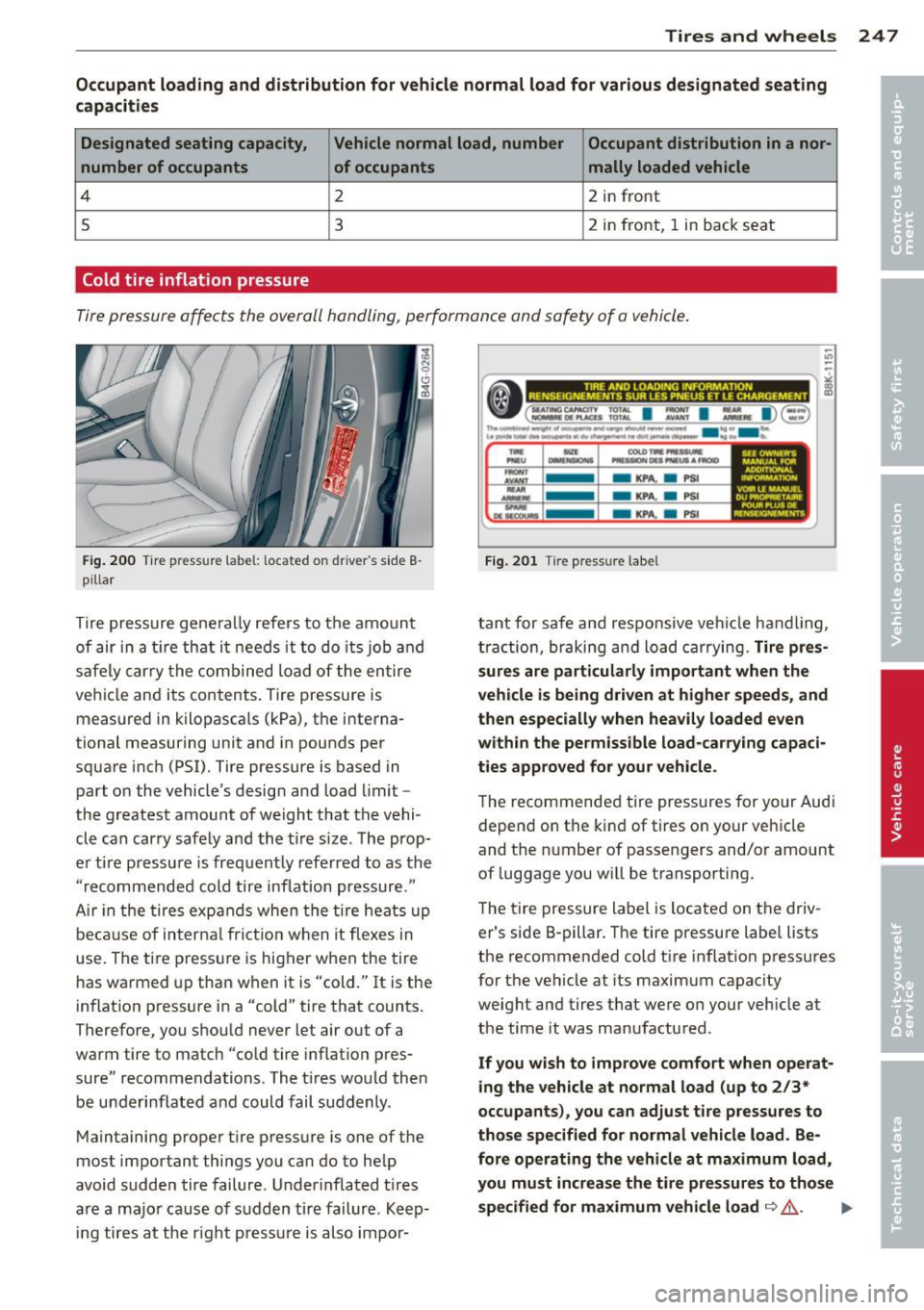
Occupant loading and distribution for vehicle normal load fo r various d esignated seat ing
capaci tie s
Designated seating capacity , Vehicle normal load , number Occupant distribution in a nor-
number of occupants of occupants mally loaded vehicle
4 2 2 in front
5
3 2 in front, 1 in back seat
Cold tire inflation pressure
Tire pressure affects the overall handling, performance and safety of a vehicle.
Fig. 2 00 Tire pressu re lab el: located o n drive r's side B
p ill ar
Tire pressure generally refers to the amo unt
of air in a t ire that it needs it to do its job and
safely car ry the combined load of the entire
vehicle and its contents . T ire pressure is
measured in kilopascals (kPa) , the interna
tional measu ring unit and in pounds per
s quare inch (PSI). Tire p ressure is based in
part on the vehicle's design and load limit -
the greatest amount of weight that the vehi
cle can carry safely and the t ire size . The prop
er tire pressure is frequent ly referred to as the
" recommended cold tire inf lation pressure ."
Air in the tires expands when the ti re heats up
beca use of internal fri ct ion when it flexes in
use. The tire p ressure is higher when the tire
has warmed up than when it is "cold ." It is the
inflat ion p ressure in a "cold" ti re that counts.
Therefore, you should never let air out of a
warm tire to match "cold tire inflation p res
sure" recommendations. The t ires would then
be underinflated and could fail suddenly .
Maintaining proper tire pre ssure is one of the
most important things you can do to help
avoid sudde n tire failure . Underinflated t ires
are a majo r cause of sudden tire failure . Keep
i ng tires at the r ight pressure is also impor-
-"' --~ -- ,e
• (:::=~. ~: I =: I :,.. I)( ::: ) l3 n,........,..,.__...,~ ........ ....,_...... • ... _ .. , ....................................... ..,_ "" ..
-""u
--
-...........
- KPA. a PSI
-KPA. a PSI
-KPA. a PSI
Fi g. 201 Ti re pres sure label
tant for safe and respons ive ve hicle hand ling,
tra ction, braking and load carrying.
Tir e pre s
sure s are parti cul arly important when the
v ehicle i s being dr iven at higher sp eed s, and
then e speciall y when hea vily loaded even
withi n the pe rmissible load -carrying capaci
t ies app roved for your veh icle .
The recommended t ire pressures for your Audi
depend on th e kind of tires on your vehicle
and the n umber of passengers and/or amount
of luggage you will be transporting.
The tire pressure label is located on the driv
er 's side B-pillar. The tire pressure labe l lists
the recommended cold tire inflat ion pressures
for the vehicle at its maximum capacity
weight and tires that were on your veh icle at
the time it was manufactured .
If you wish to imp ro v e co mfort when operat
ing the vehicle at normal lo ad (up to 2 /3*
occup ants ), you can adju st ti re pres sures to
those specified for normal v ehicle load . Be
fore operating the vehicl e at maximum load ,
you must increase th e tire pre ssu res to tho se
spe cified for maximum v ehicl e load
¢ ,&. . IJi,,-