inflation pressure AUDI S7 2015 User Guide
[x] Cancel search | Manufacturer: AUDI, Model Year: 2015, Model line: S7, Model: AUDI S7 2015Pages: 316, PDF Size: 78.09 MB
Page 259 of 316

and increase the risk of the loss of vehicle control.
-The brakes on a vehicle that
has been overloaded may
not be able to stop the vehi
cle within a safe distance.
-Tires on a vehicle that has
been overloaded can fail
suddenly, including a blow
out and sudden deflation,
causing loss of control and a
crash.
-Always make sure that the total load being transported - including the weight of a
trailer hitch and the tongue
weight of a loaded trailer - does not make the vehicle heavier than the vehicle's
Gross Vehicle Weight Rat
ing .
Determining correct load
limit
Use the example below to cal
culate the total weight of the
passengers and luggage or oth
er things that you plan to trans
port so that you can make sure
that your vehicle will not be
~ overloaded.
Steps for Determining
Correct Load Limit
1. Locate the statement "THE
COMBINED WEIGHT OF OC
CUPANTS AND CARGO
SHOULD NEVER EXCEED XXX KG OR XXX LBS" on your ve
hicle's placard (tire inflation
pressure label)
¢ page 247,
fig. 200.
2. Determine the combined
weight of the driver and passengers that will be riding in
your vehicle.
3. Subtract the combined
weight of the driver and pas
sengers from
"XXX" kilo
grams or
"XXX" pounds
shown on the sticker
¢ page 247, fig. 200.
4. The resulting figure equals the available amount of cargo and luggage load capaci
ty. For example, if the
"XXX"
amount equals 1400 lbs.
and there will be five 150 lbs. passengers in your vehi
cle, the amount of available
cargo and luggage load ca
pacity is 650 lbs. (1400-7 50
(5
X 150) = 650 lbs.)
5. Determine the combined
weight of luggage and cargo ""
•
•
'
Page 266 of 316

264 Tires and whee ls
tires because they meet the
h ighest standards regarding
safety and driving characteris
tics when used correctly. Your
authorized Audi dealer w ill
g ladly provide you with more
information.
Tire ply composition and materials used
T he number of plies indicates
the number of layers of rubber
coated fabric in the tire. In gen
eral, the greater the number of
plies , the more weight a tire
can support . Tire manufactur
ers also must indicate the ma
ter ia ls in the tire, wh ich include
steel, nylon, polyester, and oth
ers .
Maximum Load Rating
This number indicates the max
imum load in kilograms and
pounds that can be carried by
the tire.
Tire quality grading for
treadwear, traction, and
temperature resistance
Tread wear, trac tion and tem
perature grades
¢ page 266.
Ma ximum Permissible
Inflation Pressure
T his number is the greatest
amount of air pressure that should ever be put in the tire
under normal driv ing condi
tions.
A WA RNING
-Using incorrect or unmatch
ed tires and/ or wheels or improper tire and wheel
combinations can lead to loss of control , collision and
ser ious personal injury.
-Always use tires, rims and
wheel bolts that meet the
specifications of original
factory-installed tires or
other combinations that
have been specifically ap
proved by the vehicle manu
facturer.
- Tires age even if they are
not being used and can fail
sudden ly, especially at high
speeds. Tires that a re more
than 6 years old can on ly be
used in an eme rgency and
then with special care and
at lower speeds.
-Never mount used tires on
your vehicle if you are no t
Page 271 of 316
M N <( (.J
'SI: ,...., \!) ..,.,
,...., ..,., ,....,
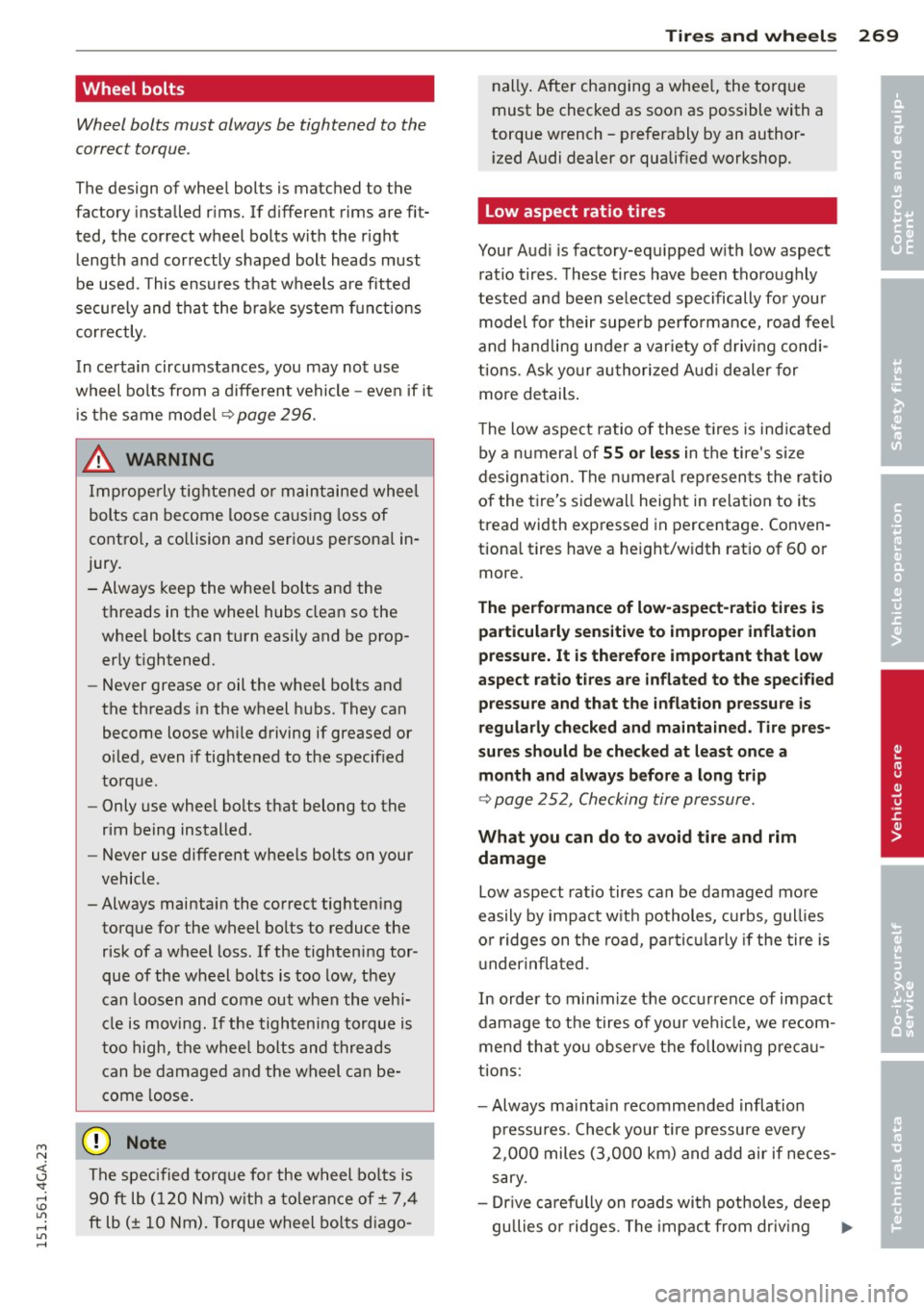
Wheel bolts
Wheel bolts must always be tightened to the
correct torque .
The design of wheel bolts is matched to the
factory installed r ims. If differen t rims are fit
ted, the correct wheel bolts with the right l ength and correctly shaped bolt heads must
be used. This ensures that wheels are fitted
securely and that the brake system functions
correctly .
In certain circumstances, you may not use
wheel bo lts from a different vehicle -eve n if it
i s the same model
~ page 296.
_&. WARNING
Improperly tig htened or maintained whee l
bolts can become loose ca using loss of
contro l, a co llision and serious persona l in
jury.
- Always keep the wheel bolts and the threads in the wheel hubs clean so the
whee l bolts can turn easily and be prop
erly t ightened.
- Never grease or oil the wheel bo lts and
the threads in the wheel hubs. They can become loose wh ile driving if greased or
o iled, even if tightened to the specif ied
torque .
- Only use wheel bolts that belong to the
rim being installed.
- Never use different whee ls bolts on your
vehicle .
-Always maintain the correct tighten ing
torque for the wheel bo lts to reduce the
risk of a wheel loss . If the tightening tor
que of the wheel bolts is too low, they
can loosen and come out when the vehi
cl e is moving.
If the tightening torque is
too high, the whee l bolts and threads
can be damaged and the wheel can be
come loose.
Q;) Note
The spec ified torque fo r the wheel bo lts is
90 ft lb (120 Nm) w ith a toleran ce of± 7,4
ft lb(± 10 Nm). Torque wheel bo lts diago-
Tire s an d wheel s 269
nally . After changing a whee l, the torq ue
must be checked as soon as possible with a
torque wrench -preferably by an author
i zed Audi dealer or qualif ied workshop.
Low aspect ratio tires
Your Audi is factory-equ ipped w ith low aspect
ratio tires . These tires have been thoroughly
tested and been selected specifically for your model for their superb perfo rmance, road fee l
and hand ling u nder a variety of driving condi
tions . Ask your au thorized Aud i dealer for
more details .
T he low aspect ratio of these t ires is ind icated
by a numera l of
55 or l ess in the tire's si ze
designation. The n umera l represents the ra tio
of the ti re's sidewall height in relation to its
tread width expressed in percentage . Conven
tiona l tires have a height/width ratio of 60 or
more.
The perform ance o f low-a spe ct-r atio tire s is
p ar ticul arl y s ens it iv e to imp ro per infl ation
pressur e. It is t herefo re im porta nt t hat low
a spect ratio t ires are inflat ed to the specified
pr essure and that the inflation pressure is
r e gularly checked and ma int ained. Tire pr es
s ure s should be check ed at lea st on ce a
month and alwa ys befor e a long trip
~ page 252 , Checking tire pressure.
What you c an do to avoid tire and rim
damage
Low aspect ratio tires can be damaged more
easily by impact w it h potholes, curbs, gull ies
o r r idges on the road, pa rtic ularly if the tire is
u nder infla ted .
In order to minimize the occurrence of impact
damage to the tires of your vehicle, we recom
mend that you observe the following p re ca u
tions:
- Always ma inta in recommended inflation
p ressures . Check your tire pressu re eve ry
2 ,000 miles (3,000 km) and add air if neces
sary .
- Dr ive caref ully on roads wi th potholes , deep
gullies o r ridges. The impact from driv ing ..,. •
•
Page 272 of 316

2 70 T ire s and wheel s
through or over such obstacles can damage
your tires. Impact with a curb may also
cause damage to your tires.
- After any impact, immediately inspect your
tires or have them inspected by the nearest
authorized Audi dealer. Rep lace a damaged
t ire as soon as possible.
- Inspect your t ires every 2,000 miles (3,000
km) for damage and wear . Damage is not al
ways easy to see. Damage can lead to loss of air and underinflation, wh ich could eventu
ally cause t ire failu re. If you bel ieve that a
t ire may have been damaged, replace the
t ire as soon as possible.
- These tires may wear more quickly than oth
ers.
- Please also remember that, while these t ires
deliver respons ive handling, they may ride
less comfortably and make mo re no ise than
othe r cho ices .
Reduced performance in winter /co ld
season condition s
All tires are des igned for certain pu rposes.
The low aspect ratio, ultra high pe rformance
tires orig inally installed on your veh icle are in
tended for maximum dry and wet road per
formance and handling. They are not suitable for cold, snowy or icy weather conditions. If
you dr ive under those circumstances, you
should equip your vehicle with all-season or
winter tires, which offer better traction under
those cond it ions. We suggest you use the rec
ommended snow or a ll-season tires specified
for your vehi cle, or their equ ivalent.
Refer to¢
page 267 for more deta iled infor
mat ion regarding winter tires.
Tire pressure
monitoring system
U) General notes
Each t ire, includ ing the spare (if provided),
should be checked monthly when cold and in
flated to the inflation pressure recommended by the vehicle manufacture r on the vehicle
p lacard or tire inflation pressure label. (If your vehicle has tires of a diffe
rent size than the
size indicated on the vehicle placard or tire in
flat ion pressure labe l, you shou ld determ ine
the proper t ire inflation pressure for those
t ires).
As an added safety feature, your ve hicle has
been equipped with a tire pressure monitoring
system (TPMS) that illum inates a low tire
pressure telltale when one or more of your
t ires is significantly under-inflated. According
ly, when the low tire pressure telltale illumi
nates, you shou ld stop and check you r tires as
soon as possib le, and inflate them to the
proper p ressu re. Driving on a sig nifican tly u n
der- inflated t ire causes the tire to overheat
and can lead to tire fai lure . Under-inflation al
so reduces fuel efficiency and tire tread life,
and may affect the vehicle 's hand ling and
stopp ing ability.
Please note that the TPMS is not a substitute
for proper tire maintenance, and it is the driv er's respons ibility to maintain correct tire
pressure, even if under-inflation has not
reached the level to trigger illumination of the
TPMS low tire pressure telltale .
Your vehicle has also been equipped with a
TPMS malfunction indicator to ind icate when
the system is not operating properly. The
TPMS ma lfunction indicator is combined w ith
the low tire pressure telltale . When the sys
tem detects a malfunction, the telltale will
flash fo r approxima te ly one m inute and then
rema in continuously illum ina ted. This se
quence will continue upon subsequent vehicle
start-ups as long as the malfunction exists.
When the malfunction indica to r is illum inat
ed, the system m ay not be ab le to detect or
signal low tire pressure as intended . TPMS
malfunctions may occur for a var iety of rea
sons, incl uding the insta llation of replace
ment or alternate tires or wheels on the vehi
cle that prevent the TPMS from functioning
properly. Always check the TPMS malfunction
telltale after replacing one or more tires or
whee ls on you r vehicle to ensu re that the re
placement o r alternate ti res and wheels a llow
the TPM S to cont inue to func tion p roperly.
Page 273 of 316

M N <( I.J "". rl I.O
"' rl
"' rl
Tire pressure indicator appears
The tire pressure indicator in the instrument
cluster informs you if the tire pressure is too
low or if there is a system malfunction.
Fig. 205 Display: underinflation warning
Fig. 206 Display: System malfunction
Using the ABS sensors, the tire pressure moni
toring system compares the tire tread circum ference and vibration characteristics of the in
dividual tires. If the pressure decreases in one
or more tires, this is indicated in the instru
ment cluster with a warning symbol
rD] and a
message
c:> fig . 205.
The tire pressure monitoring system must be
reset via MMI each time the pressures are ad
justed (e.g. when switching between partial
and fu ll load pressure) or after changing or re
placing a tire on your vehicle
c:> page272 . The
TPMS indicator only monitors the tire pres
sure that you have previously stored. You can
find the recommended tire pressures for your
vehicle on the label on driver's side 8-pillar
c:>page247.
Tire tread circumference and vibration charac
teristics can change and cause a tire pressure
warning if:
- the tire pressure in one or more tires is too
low,
Tires and wheels 2 71
- the tire has structural damage,
- the tire pressure was changed, wheels rotat-
ed or replaced but the TPMS was not reset
c:>poge272.
- the spare tire* is mounted .
Warning symbols
[I] Loss of pressure in at least one tire¢.& .
Check the tire or tires and replace or repair if
necessary. The indicator light
rD] in the instru
ment cluster also illuminates <=:>
page 12.
Check/correct the pressures of all four tires
and resetTPMS via MMI.
l!I (Tire Pressure Mon itoring System) Tire
pressure! System malfunction .
Ifljl appears
after switching the ignition on or while driving
¢
fig. 206 and the indicator light rD] in the in
strument cluster blinks for approximately one
minute and then stays on, there is a system
malfunction. Attempt to store the correct tire
pressure
c:> page 272. If the indicator light
does not turn off or if it turns on shortly
thereafter, immediately drive your vehicle to
an authorized Audi dealer or authorized repair
facility to have the malfunction corrected.
_& WARNING
- If the tire pressure indicator appears in
the instrument cluster display, one or
more of your tires is significantly under
inflated. Reduce your speed immediately
and avoid any hard steering or braking
maneuvers. Stop as soon as possible and
check the tires and their pressures. In
flate the tire pressure to the proper pres
sure as indicated on the vehicle's tire
pressure label<=:>
page 247 . Driving on a
significantly under-inflated tire causes
the tire to overheat and can lead to tire
failure. Under-inflation also is likely to
impair the vehicle's handling and stop
ping ability.
- The driver is responsible for maintaining
the correct tire pressures. You must check the tire pressures regularly.
.
Page 303 of 316
M N <( (.J
'SI: ,...., \!) 1.1'1 ,...., 1.1'1 ,....,
Certification .... ... .... ... .. .. .. ... 297
Changing a wheel ................... 275
Changing engine o il ........ .. .. .. .. . 230
Chec king
E ng ine coolant leve l .... ... .. .. .. .. . 23 1
Tire pressure . .. .. ..... ... .. .. .. ... 252
Ch ild restra ints
D anger of using c hild restra ints in the
fro nt sea t . . . . . . . . . . . . . . . . . . . . . . . . 149
Where can I get add it ional information
about child restra ints and their use? .. 19 1
Ch ild restra int system anchors . ....... 187
Ch ild safety .. ............. .... .. ... 173
Convertible locking retractor . . . . . . . . . 184
Important safety instructions for us ing
ch ild safety seats ...... ..... .. .. .. . 177
I mportant th ings to know when dr iv ing
wi th ch ild ren ............ .... .. ... 173
Tether anchors ........... .. .. .. ... 190
Tether straps ... ...... ... .. .. .. .. . 190
Ch ild safety lock
Rear doors ........................ 40
Ch ild safety seats .......... .... .. ... 179
Booster seats ............ .... .. .. . 182
Convertible c hild seats ....... ... .. . 180
Convertible locking retracto r .. ....... 184
H ow do I properly install a child safety
seat in my vehicle? ........ .. .. .. .. . 177
I nfant sea ts ............. .... .. .. . 179
I ns tall ing .. ............. .. .. .. .. . 184
I ns tal ling a child restraint using the
L A TCH system .. .. ..... ... .. .. .. ... 189
LATCH system . . . . . . . . . . . . . . . . . . . . . 189
Lower anchorages ........ .. .. .. .. . 188
Mounting and releasing the anchorage
hook .. .. .. .. ........ ..... ... ... . 189
Safety instructions ................. 177
Unused safety belts on the rea r seat .. 179
Cigarette lighter . . . . . . . . . . . . . . . . . . . . . 59
Cle aning .. .. ............. .... .. .. . 212
Climate control Air vents ... ... .. .. ... ... .. .. .. .. .. 71
Climate controls . . . . . . . . . . . . . . . . . . . . . 69
Climate con trol sy stem
Supp lementary hea ter .. ... .. .. .... .. 74
Climate control (four-zone) Operation . . . . . . . . . . . . . . . . . . . . . . . . . 72
Inde x 301
Climate control (three -zone)
Operation . . . . . . . . . . . . . . . . . . . . . . . . . 70
Clock .............................. 27
Closing Rear lid ........................... 37
Slid ing/tilting sunroof ......... .... .. 41
Cold tire inflation p ress ure ..... ... .. .. 247
Coming home . .. .. ................. . 46
Compact spare tire .................. 274
Compartments .. .... . ... ...... ... .. . 60
Compliance ....... .. ............... 297
Consumer Information . . . . . . . . . . 136, 294
Consu mption (f uel) ............. .. .. . 25
Contacting NH TSA ................. . 136
Controls Cleaning . ... .. .. .. .. .. ...... ... .. 214
Convenie nce key . ...... ............. . 35
Star ting the engine . ........... .... . 76
S topping the eng ine (START ENG INE
STOP b utton) . . . . . . . . . . . . . . . . . . . . . . 77
Switching the ignition on .... ... .. .. . 76
U nlocking and locking vehicle ......... 35
Convertib le child sa fe ty se ats ......... 180
Convertib le locking retractor
Activati ng . . . . . . . . . . . . . . . . . . . . . . . . 186
Deact ivating . .. .. .. ..... .......... 186
U sing to secu re a child safety seat 1B4, 186
Coolant
refer to Engine coolant ............ . 231
Cooling mode (automatic climate control) 72
Cooling mode (climate cont rol) . . . . . . . . . 70
Cruise contro l
Changi ng speed .. .. . .. .. ... ..... .. . 84
P resett ing your speed ............... 85
Switching off ...................... 85
Switch ing on . .. .. .... ........... .. . 84
Wa rning/ind icator lights ........ .. .. . 23
(upholder .. .. .. .. ... ... ...... ..... . 60
C ur ve lig ht . ... .... ... .. .. ..... ... .. 102
Cylinder managem ent
refer to Cyli nder on dema nd System .. . 25
Cyl inder on demand System
25
D
Data recorder ... ...... ............. 194
Date d isp lay .. .. .. .. ............... . 27
•
•
Page 311 of 316
M N <( (.J
'SI: ,...., \!) 1.1'1 ,...., 1.1'1 ,....,
Starting from rest . . . . . . . . . . . . . . . . . . . . 80
Starting off with a trai ler .............. 80
St arting the eng ine . ..... .. .. .. .. .. .. 76
S teer ing
E lectrically ad justab le steer ing whee l .. 75
M anually adjustab le steering whee l .. .. 75
also ref er to Electromechanica l power as-
sist . .... .. ................. .. ... 200
S teer ing whee l
E asy entry featu re ..... ... .. .. .. .. .. 76
I ndicator light . . . . . . . . . . . . . . . . 18, 200
Steer ing whee l heating . ... .. .. .. .. .. 74
Steer ing whee l co lumn
Ad justing e lec trica lly ...... .. .. .. .. .. 75
Ad justing manually .... ... .. .. .. .. .. 75
Steer ing whee l with t iptronic . .. .. .. .. . 113
Steps fo r determining correct load limit . 257
Stopping the engine . . . . . . . . . . . . . . . . . . 77
Storage . . . . . . . . . . . . . . . . . . . . . . . . 60, 64
S tronic transmission Launch Contro l Program . . . . . . . . . . . . 113
S tron ic (automatic t ransm ission) . .. .. . 109
Sunroof ... .. .. ............. .. .. .... 41
Sun shade . . . . . . . . . . . . . . . . . . . . . . . . . . 48
Sun visors . ................ ... ... ... 4 8
Symbo ls
refer to Warning/ind icator lights .. .. .. 12
T
Tachometer . . . . . . . . . . . . . . . . . . . . . 1 2, 24
Ta il lights
C le a ning . .. ................. .. ... 2 13
T OI clean diese l
refer to AdBlue ............ ... ... .. 22 1
T ec hnica l data . ... .. .... ... .. .. .... . 29 1
Techni cal mod ifications ..... .. .. .. .. . 297
T emperature d isp lay ..... ... .. .. .. .. .. 24
Tether anchors ... .. .... ... .. .. .. ... 190
Tethe r strap . ................ ... ... 190
Textiles Cleaning . .. .... ............. .. .. . 215
The first 1,000 mi les (1,500 km) and after -
wards ..... .. .. ... .. ..... ... .. .. ... 203
Three-zone cl imate co ntrol .. .. .. .. .. .. 70
Tie-downs . . . . . . . . . . . . . . . . . . . . . 66, 135
Inde x 309
Tips for the environment
Saving f uel . ... .. .. . ... ...... ... .. . 63
t iptron ic (automat ic t ransm ission) 109, 113
Tire pressure .. .. .. ................. 252
T ire pressure mon itoring system ... .. .. 270
Tires ...... ... .. .... .......... ..... 240
Se rv ice life .. .. .. .. .......... ..... 258
Speed ra tin g letter code ........ .... 263
T ire manufac turing date
T ire specifications . .. .. ..... ... .. . .
Tread depth ....... . .. .. ..... ... . .
U niform tire quality grading .. ... .. . . 2
62
262
258
266
Winter tires . .. .. ................. 267
T ires and vehicle load lim its ....... .. .. 255
Tires and wheels Check ing t ire pressu re .. .... ... ... .. 252
Co ld tire inflation pressure .......... 247
D ime nsions .. .. .. ................. 260
General notes .. .. .... ........... .. 240
G lossary of tire and loading term inolo -
gy .. ... .. .. .. .... . ... ...... ... .. 242
Low aspect ratio tires . .. ..... ... .. .. 269
New tires and wheels ........... .... 260
Rep lacing . .. .. .. .... ........... .. 261
Snow cha ins . .. .. ................. 268
Tires and veh icle load limits ......... 255
Wheel bolts ... .. .. . .. .... .... .. .. 269
Winter tires ...... ................ 267
Tire service life .. .. ............... .. 258
T oo ls ...... .. .. .. .... ............. 273
Torn or frayed safety belts ............
141
Towing
Tow truck procedures ........... .... 287
T PMS
T ire pressure monitoring system ... .. 2 70
T ra iler tow ing . .. .. .. ... ....... ..... 208
Operating instr uctions ............. . 208
Pa rking system . .. ............... .. 12 7
T echnical requiremen ts . . . . . . . . 208, 209
T rai le r tow ing tips . ... ...... ... .. .. 210
Trai n (transporting your veh icle) ...... . 289
Transmiss ion . ... .. .. .. ... ..... ... .. 109
T rans miss ion malfunc tion ( indi cato r
li gh t) . . . . . . . . . . . . . . . . . . . . . . . . . . . . . 114
T ransport Canada ......... .......... 136
T ransporting yo ur vehicle . ..... ... .. .. 289
T read Wea r Ind icator ( TW I) ....... .. .. 258
•
•
Page 312 of 316
310 Index
Trip odometer ..... ..... ... .. .. .... .. 27
What does it mean whe n DEF appears in
the trip odometer d isp lay? ... .. .... . . 27
T runk
refer to L uggage compa rtment . . . . . . . . 64
Trunk pass -through ......... ... .. .. .. 68
Turn signa ls . .... . ...... ... .. .. .... .. 46
Warn ing/ indicator lights ... .. .. .... .. 23
u
ULSD No. 2 (Diese l fuel) ... .. .. .. .. .. . 218
Unfasten ing safety belts .. .. .. .. .. .. . 143
Unid irect iona l tires ......... .. .. .... . 241
Unifo rm tire q uality g rading
Unlock ing 266
P owe r locking sw itch ....... ... .. .... 36
Remote cont rol . . . . . . . . . . . . . . . . . . . . 34
Using the key . ........... .. .. .... .. 36
V
Valet park ing . ................ ... ... . 41
Vanity mirrors .. ........... ........ .. 48
Vehicle care/cleaning .. .. ..... ... .. .. .... . 212
Vehicle control mod ules . .. .. .. .. .. .. . 194
Vehicle e lectrica l system .... .. .. .. .. .. 17
Vehicle ident ificat ion labe l ... .. .. .. .. . 29 1
Vehicle Identification Number (VIN) ... . 291
Vehicle jack . . . . . . . . . . . . . . . . . . . 273, 277
Vehicle literature . . . . . . . . . . . . . . . . . . . . . S
Vehicle shutt-down ......... .. .. .... . 20S
Vehi cle transport ..... ... .. .. .. .... . 289
Vent ilation .. ..... ........... ... .. .. 69
Viny l
C leaning . ....................... . 215
w
War ning/indicato r lights . ... .. .... .. . . 1 2
A irbag system ........... .. .. .... .. 19
Anti-lock braking system (ABS) .. .. .... 19
Brake system . ........... .. .. .... .. 15
C ruise control . . . . . . . . . . . . . . . . . . . . . . 23
Elect romechan ical park ing brake .. .... 16
E lect ronic power control . . . . . . . . . . . . . 20
E lec troni c Stabilization Co ntrol ( ESC) ... 19 Generator
. . . . . . . . . . . . . . . . . . . . . . . . . 17
G low p lug system . .... ..... ... .. .. . 21
Instrument cluster . .. .. ..... ... .. .. . 11
Malfunction Ind icator Lamp (MIL) .... . 21
Safety be lt . . . . . . . . . . . . . . . . . . . . . . . . 17
Turn signals ..... ................ .. 23
Warning/Indicator lights
Airbag system . . . . . . . . . . . . . . . 159, 160
PASSENGER AIR BAG OFF ....... .. .. 160
Warran ty cove rages ............. .. .. 294
Washer reservo ir .. .......... ...... . 238
Wea r indicato r .... .. ... ..... ... .. .. 258
Weights .. .. .. .. . .............. .. .. 291
Wha t happens if you wear your safety belt
too loose? ...... .. .......... ...... . 142
What happens to unbe lted occupants? . . 139
What impa irs d riving safety? ...... .. .. 129
What shou ld I do after changing a
whee l? ..... .. .. .. ... .......... .... 254
What shou ld I do after replacing whee ls? 254
Whee l bo lts
T orque .... .... .. ............. .... 269
Wheels .... .... .. ............. .... 240
Checking t ire pressure ..... ...... ... 252
Cleaning ...... .. ..... ....... ... .. 213
Co ld tire inflation pressur e ......... . 247
Genera l notes .. .. ... .......... .. .. 240
G lossary of tire and loading term inolo-
gy ....... .. .. . .................. 242
New t ires and whee ls . .. ..... ... .. .. 260
T ires and vehicle load limits .. ... .. .. 255
When must a safety be lt be replaced? .. 141
When must the a irbag system be inspect-
ed? ........ .. ... . .. .... ...... ... .. 159
When should I adjust the ti re pressures? 254
When should I c hec k th e tire p ressu res? . 254
Where are lower anchorages located? . .. 188
Where can I find the t ire press ures for my
ca r? .. ... .. .. .. .. .. ... .. ..... ... .. 252
Why safety belts? . . . . . . . . . . . . . . 138, 139
Windows Cleaning/removing ice .......... .... 214
defrosting (automatic climate control) . 73
defrosting (cl imate control) . . . . . . . . . . 71