instrument panel AUDI S7 2015 User Guide
[x] Cancel search | Manufacturer: AUDI, Model Year: 2015, Model line: S7, Model: AUDI S7 2015Pages: 316, PDF Size: 78.09 MB
Page 156 of 316

154 Airbag sys te m
of a typ ica l 1 year -old, but less than the
weight of a sma ll adult, the front airbag on
the passenger side may deploy (the
PASSEN
GER AIR BAG OFF
li ght does not come on).
For exa mple , the air b ag m ay depl oy if:
- a small child that is heavier than a typical 1
year-o ld child is on the front passenger seat
(regardless of whe ther the child is in one of
the chi ld seats listed
c':> page 175),
-a ch ild who has outgrown child rest raints is
on the front passenger seat.
If the front passenger airbag is turned off, the
PA SSENGER AIR BAG OFF light in the cente r
of the instrument panel w ill come on and stay
on.
If the front passenger airbag deploys, the Federal Standard requires the a irbag to meet
the "low risk" deployment criteria to help re
duce the risk of injury through interaction
with the airbag. " Low risk" deployment occurs
in those crashes that take place at lower de
celerations as defined in the e lectronic control
un it
c':>page 159.
Alwa ys rememb er: Even tho ugh your vehicle
is equipped with Advanced Airbags, the safest
p lace for children is properly restrained on the
back seat. Please be sure to read the impor
tant information i n the sect ions that follow
and be sure to heed a ll of the WARNINGS .
A WARNING
To reduce the risk of injury when an airbag
inf lates, a lways wear safety belts prope rly.
- If you are unrestrained, lean ing forward,
sitting sideways or out of position in any
way, your risk of injury is much higher.
- You w ill also receive serious in juries and
cou ld even be killed if you are up against
the a irbag or too close to it when it in
fla tes -even with an Advanced Airbag
c':> page 147.
A WARNING
A child in a rearward -facing child seat in
stalled on the front passenger seat will be seriously injured and can be killed
if the
front airbag inflates - even w ith an Ad
vanced Airbag System.
- Altho ugh the Advanced Airbag System in
your veh icle is designed to turn off the
front airbag when a rearward-facing
child restraint has been installed on the
front passenge r seat, nobody can abso
lutely guarantee that dep loyment is im
possible in all con ceivable s ituations that
may h appen dur ing the usefu l life of y our
veh icle .
- T he inflating airbag will h it the ch ild seat
or infant carrier wi th grea t force and will
smash the child seat and child against
the backrest, center armrest, door, or
roof.
- Always install rearward-facing chi ld re
straints on the rear seat.
- If you must install a rearward fac ing
child seat on the front passenger seat
because of exceptional circumstances
and the
PASSENGER AIR BAG OFF light
does not come on and stay on, immed i
ately insta ll the rear-facing child seat in a
rea r seat ing pos ition and have the airbag
system inspected by you r Audi dealer.
A WARNING
If, in except iona l circumstances, you must
i nsta ll a forward-facing child restraint on
the front passenge r's sea t:
- Always make sure the forward-facing
seat has been designed and ce rtified by
its manufacture r fo r u se on a fron t seat
with a passenger fron t and s ide a irbag .
- Never p ut the fo rward-facing child re
straint up agains t or ve ry near the instru
ment panel.
- Always move the p assenge r seat into its
rearmost pos ition in the seat's fore and
aft ad justment range, as fa r away from
the airbag as possible, before installing
the forward-facing ch ild restra int. The
backrest must be ad justed to an upright
position.
Page 157 of 316

M N <( (.J
'SI: ,...., \!) 1.1'1 ,...., 1.1'1 ,....,
-Always make sure that there is nothing
on the front passenger seat that will
cause the capacitive passenger detection
system in the seat to s ignal to the A irbag
System that the seat is occupied by a person when it is not, or to signal that it
is occupied by someone who is heavier
than the person actually s itting on the
seat . The presence of additiona l objects
cou ld cause the passenger front airbag
to be t urned on when it sho uld be off, or
cou ld cause the airbag to work in a way
that is different from the way it wou ld
have worked without the object on the
seat .
- Make sure that the
PASSENGER AIR BAG
OFF
light comes on and stays on all the
t ime whenever the ignition is switched
on.
Advanced Airbag System components
The front passenger seat in your vehicle has a
l ot of very important parts of the Advanced
Ai rbag System in it. These parts incl ude the
capacitive passenger detection system, wir
i n g, brackets, and more . The control unit
monitors the system o n the front passenger
seat when the ign ition is switched on and
turns the airbag indicator light on when a
malfunct ion in the one of the system compo
nents is detected ¢
page 160. Because the
front passenger seat contains important parts
of the Advanced Airbag System, you must
t ake care to p reven t it from being damaged.
D amage to the seat may preven t the Ad
vanced A irbag System for the front passenger
seat from doing its job in a crash .
The front Advanced Airbag System
consists of the following:
-Crash sensors in the front o f the veh icle that
measure vehicle acceleration/dece leration
to provide information to the Advanced Air
bag System about the severity of the crash .
- An electronic co ntrol unit, with integrated
crash sensors for front and side impacts .
The contro l unit "decides" whether to fire
A irbag system 15 5
the front airbags based on the in format ion
received from the crash sensors. The contro l
unit also "decides" whether the safety be lt
pretens ioners sho uld be activated .
- An Advanced Airbag with gas generator and
contro l valve for the driver ins ide the steer
ing wheel hub.
- An Advanced Airbag with gas gene rator and
contro l valve inside the instrument pane l for
the front passenger.
- A capacitive passenger detection system un
derneath the front passenger seat cover.
This system measures the electrical capac i
tance of the person in the seat. The informa
tion registered is se nt cont inuously to the
el ectr onic contro l un it to regu late deploy
ment of the front Advan ced A irbag on the
passenger side .
- An airbag monitoring system and ind icator
light in the instr ument cluster ¢
page 159.
-A sensor in each front seat registers the dis
tance be twee n the respec tive seat a nd the
s teer ing whee l or inst rument p anel. The i n
forma tion regis tered is sent cont inuo usly to
the electronic contro l unit to regulate de
p loyment of the front Adv a need Airbags.
- The
PASSENGER AIR BAG OFF light comes
on and stays on in the center of the instr u
ment panel ¢
page 160, fig. 164 and tells
you when the front Advanced Airbag on the passenger side has been turned off.
- A sensor in the safety belt latch for the driv
er and for the front seat passenger that
senses whether that safety belt is latched or
not and transmits this information to the
electronic control un it .
.&_ WARNING
D amage to the front passe nger seat can
p revent the front air bag from wor king
properly.
- I mp roper repa ir or d isassembly of the
fro nt pa ssenge r and dr iver seat will pre
vent the Advanced Airbag System from
functioning p roperly.
- Repair s to t he front passenge r seat m ust
be pe rformed by qualified and p roperly
-
trained workshop person ne l. 111>
•
•
Page 165 of 316

M N <( (.J
'SI: ,...., \!) 1.1"1 ,...., 1.1"1 ,....,
Repair, care and disposal of the airbags
Parts of the airbag system are installed at
many different places on your Audi. Installing,
removing, servicing or repairing a part in an
area of the vehicle can damage a part of an
airbag system and prevent that system from
working properly in a collision.
There are some important things you have to know to make sure that the effectiveness of
the system will not be impaired and that dis
carded components do not cause injury or pol lute the environment.
A WARNING
Improper care, servicing and repair proce
dures can increase the risk of personal in
jury and death by preventing an airbag from deploying when needed or deploying
an airbag unexpectedly:
- Never cover, obstruct, or change the
steering wheel horn pad or airbag cover
or the instrument panel or modify them
in any way.
- Never attach any objects such as cup
holders or telephone mountings to the
surfaces covering the airbag units.
- For cleaning the horn pad or instrument
panel, use only a soft, dry cloth or one
moistened with plain water. Solvents or
cleaners could damage the airbag cover
or change the stiffness or strength of the
material so that the airbag cannot de
ploy and protect properly.
- Never repair, adjust, or change any parts
of the airbag system.
- All work on the steering wheel, instru
ment panel, front seats or electrical sys
tem (including the installation of audio
equipment, cellular telephones and CB
radios, etc.) must be performed by a
qualified technician who has the training
and special equipment necessary.
- For any work on the airbag system, we
strongly recommend that you see your
authorized Audi dealer or qualified work
shop.
Airbag system 163
-Never modify the front bumper or parts
of the vehicle body.
- Always make sure that the side airbag
can inflate without interference:
- Never install seat covers or replace
ment upholstery over the front seat
backs that have not been specifically
approved by Audi.
- Never use additional seat cushions that
cover the areas where the side airbags inflate.
- Damage to the original seat covers or
to the seam in the area of the side air
bag module must always be repaired
immediately by an authorized Audi
dealer.
- The airbag system can deploy only once. After an airbag has been deployed, it must be replaced with new replacement
parts designed and approved especially
for your Audi model version. Replace
ment of complete airbag systems or air
bag components must be performed by
qualified workshops only . Make sure that
any airbag service action is entered in
your Audi Warranty
& Maintenance book
let under
AIRBAG REPLACEMENT RE
CORD.
- For safety reasons in severe accidents,
the alternator and starter are separated
from the vehicle battery with a pyrotech
nic circuit interrupter.
- Work on the pyrotechnic circuit inter
rupter must only be performed by a
qualified technicians who have the ex
perience, information and special tools
necessary to perform the work safely.
- If the vehicle or the circuit interrupter
is scrapped, all applicable safety pre
cautions must be followed.
@) For the sake of the environment
Undeployed airbag modules and preten
sioners might be classified as Perchlorate
Material - special handling may apply, see
•
•
Page 167 of 316

M N <( I.J "". rl I.O
"' rl
"' rl
Remember too, airbags will deploy only once
and only in certain kinds of accidents -your
safety belts are a lways there to offer protec
tion in those acc idents in which airbags are
not supposed to deploy or when they have al
ready deployed, for example when your vehi
cle str ikes or is struck by another afte r the
fi rst coll is ion.
This is just one of the reasons why an a irbag is
not a substitute for the safety belt . The airbag
system works most effectively when used with
the safety belts . Therefore, always wear your
safety bel ts correctly .
It is important to remember that while the
supplemental knee a irbag system is des igned
to reduce the like lihood of serious injur ies,
o ther in juries, fo r example, swel ling , bruising
and minor abras io ns and frict ion bu rns ca n al
so occur when an airbag inflates.
The knee airbag system basically consists
of :
-The elec tronic control mod ule
- T wo inf latab le airbags (airbag and gas gen-
erato r), one for the driver and one for the
front passenger
- T he airbag ind icator light in the instrument
pane l
The knee airbag system will not deploy:
-when the ign ition is switc hed off
- in frontal collisions w hen the decelerat ion
measured by the control unit is too low
- in s ide collisions
- in rear-end collisions
- in ro llovers
- in the event of a system malfunct io n (wa rn -
i ng/indicator ligh t is on)
r::!>page 19.
& WARNING
- Safety belts and the airbag system can
only p rov ide protection when occ upants
are in the proper seating posit ion
c::>page 157.
-If the airbag indicator light c::> page 19
comes when the vehicle is be ing used,
have the system inspected immediately
A irba g sy stem 165
by your authorized A udi dealer. It is pos
sib le that the airbag will inflate when it
is not supposed to , or will not inflate
when it should .
How knee airbags work
Applies to vehicles: with knee airbags
The risk of injury to the leg area can be re
duced by fully inflated knee airbags.
~ N 0 :..c---0
i::....---ali
Fi g. 166 In flated a irbags protect ing in a fronta l coll i·
s ion
The knee airbag system has been designed so
that the airbags for the driver and front pas
senger deploy in certain but not all frontal
collisions.
If the front airbags dep loy, the knee airbags
also dep loy in fronta l collisions when the de
ployment th resho ld stored in the control unit
is met.
When the system deploys, the ai rbags fill
with a propellant gas, and inflate between the l ower part of the instrument pane l and the
driver and t he lower part of the instrument
panel and the front passenger
c::> page 157,
fig . 163 .
Although they are not a soft pi llow, they can
"cushion" the impact and in th is way they can
help to reduce the risk of injury to the lower
extremit ies .
A ll of th is takes place in the blink o f an eye, so
fast that many people don't even realize that
the a irbags have deployed. The airbags a lso
i nfla te with a g reat dea l of fo rce and i t is im
po rtant for occupant safety t hat nothing
sho uld be in their way whe n they deploy. ..,.
Page 168 of 316

166 Airbag system
Fully inflated airbags in combination with
properly worn safety belts slow down and lim
it the occupant's forward movement and help
to reduce the risk of injury.
Important safety instructions on the
knee airbag system
Appl ies to vehicles: with knee airbags
Airbags are only supplemental restraints. Al
ways wear safety belts correctly and ride in a
proper seating position.
There is a lot that you and your passengers
must know and do to help the safety belts and
a irbags to provide supplemental protection .
A WARNING
An inflating knee airbag can cause serious
injury. Wearing safety belts incorrectly and
improper seating positions increase the
r isk of serious personal injury and death
whenever a vehicle is being used.
- The knee airbag system cannot protect
you properly if you are seated too close
to any of the airbag locations. When ad
justing their seat positions, it is impor tant that both the driver and the front
passenger keep their upper bodies and
knees at the following minimum safe
distances:
- at least 10 inches (25 cm) between the
chest and the steering wheel/instru
ment panel.
- at least 4 inches (10 cm) between the
knees and the lower part of the instru
ment panel.
- The risk of personal injury increases if
you lean forward or to the side, or if the
seat is improperly positioned and you are
not wearing your safety belt. The risk in
creases even more should the airbag de
ploy.
-Always make sure that the knee airbag
can inflate without interference. Objects between you and the airbag can increase
the risk of injury in an accident by inter
fering with the way the airbag deploys or by being pushed
into you as the airbag
deploys.
- Never let anybody, especially children
o r animals ride in the footwell in front
of the passenger seat. If the airbag de
ploys, this can result in serious or fatal
injuries.
- Never carry objects of any kind in the
footwell area in front of the driver's or
passenger's seat. Bulky objects (shop
ping bags, for example) can interfere
with or prevent proper deployment of
the airbag. Small objects can be
thrown through the vehicle if the air bag deploys and injure you or your pas
sengers.
- Make sure there are no cracks, deep
scratches or other damage in the area of
the instrument panel where the knee air
bags are located.
- If children are incorrectly seated, their
risk of injury increases in a collision
~ page 173, Child Safety.
Side airbags
Description of side airbags
The airbag system can provide supplemental
protection to properly restrained occupants.
Fig. 167 S ide a irbag location in the driver's seat
The side airbags are located in the sides of the
front seat backrests¢
fig. 167 and the rear
backrest facing the doors. They are identified
by the word "AIRBAG ".
The side airbags installed for the front seating
positions have been designed and certified to
help reduce the risk of injury that can be .,_
Page 172 of 316

1 70 Airbag system
The side curtain airbags are located on both
sides of th e interior above the front and rear
side windows ~
fig. 169. They are ident ified
by the word "AIRBAG" on the windshield
frame and the center roof pillar.
The side curtain airbag system supplements
the safety belts and can help to reduce the risk of injury for occupants' heads and uppe r
torso on the side of the vehicle that is struck
in a side collision . The side curtain airbag in
flates in side impacts and only when the vehi
cle acceleration registered by the control unit is high enough. If this rate is below the refer
ence value programmed into the control unit,
the side curtain airbag will not be triggered,
even though the car may be badly damaged as
a result of the collision. It is not possible to
define an airbag triggering range that will
cover every possible angle of impact, since the
circumstances will vary considerably between
one collision and another. Important factors
include, for example, the nature (hard or soft)
of the impacting object, the angle of impact,
vehicle speed, etc.~
page 171, How side cur
tain airbags work.
Aside from their normal safety function, safe
ty belts work to help keep the driver or front
passenger in position in the event of a colli
sion so that the side curtain airbags can pro
vide protection.
The airbag system is not a substitute for your
safety belt. Rather, it is part of the overall oc
cupant restraint system in your vehicle. Al
ways remember that the airbag system can
only help to protect you if you are wearing
your safety belt and wearing it properly. This
is another reason why you should always wear
your safety belts, not just because the law re
quires you to do so
Q page 138, General
notes.
It is important to remember that while the
side curtain airbag system is designed to help
reduce the likelihood of serious injuries, other
injuries, for example, swelling, bruising, fric
tion burns and minor abrasions can also be as
sociated with these airbags upon deployment. Remember too, these airbags will deploy only once and only in certain kinds of accidents
-
your safety belts are always there to offer pro
tection.
The side curtain airbag system basically
consists of:
- The electronic control module and external
side impact sensors
- The side curtain airbags above the front and
rear side windows
- The airbag indicator light in the instrument
panel
The airbag system is monitored electronically
to make certain it is functioning properly at all
times. Each time you switch on the ignition,
the airbag system indicator light will come on
for a few seconds (self diagnostics).
The side curtain airbag is not activated:
- if the ignition is switched off,
- in side collisions when the acceleration
measured by the sensor is too low,
- in rear-end collisions.
_&. WARNING
- Safety belts and the airbag system will
only provide protection when occupants
are in the proper seating position
¢page 53, General recommendations.
- If the airbag indicator light Q page 19
comes when the vehicle is being used,
have the system inspected immediately
by your authorized Audi dealer. It is pos
sible that the airbag will inflate when it
is not supposed to, or will not inflate
when it should.
.
Page 177 of 316

M N <( (.J
'SI: ,...., \!) ..,.,
,...., ..,., ,....,
-Always read and heed a ll WARNINGS
whenever using a child restraint in ave
h icle
¢ page 138, Safety belts,
¢ page 147, Airbag system and
¢ page 173, Important things to
know.
(D Tips
Always replace child restraints that were
installed in a vehicle during a crash. Dam
age to a child rest raint that is not vis ible
could cause it to fail in another collis ion
situation.
Advanced front airbag system and children
Your vehicle is eq uipped with a front "Ad
vanced Airbag System" in compliance w ith
United States Federal Motor Vehicle Safety
Standard (FMVSS) 208 as applicable at the
time your veh icle was manufactured .
T he Advanced Airbag system in your vehicle
has been certified to meet the "low-risk" re
qu irements for 3-and 6-year old ch ildren on
the passenger s ide and small adults o n the
driver side. The low risk deployment criter ia
a re i ntended to reduce the risk of inju ry
through interaction with the a irbag that can
oc cu r, fo r example , by be ing too close to the
steering whee l and instrument panel when
the airbag inflates . In addition, the system
has been certified to comply with the "sup
press ion" requirements of the Safety Stand
ard, to turn off the front airbag for infants up
to 12 months who are restra ined on the front
passenger seat in ch ild restraints that are list
ed i n the Standard .
Even though your vehicle is equipped with an
Advanced Airbag system, all chi ldren, espe
cially those 12 years and younger, shou ld al
ways ride in t he back seat properly rest ra ined
fo r the ir age and s ize. The a irbag on t he pas
senger side makes the fro nt seat a poten tially
d a ngerous pla ce for a child to ride. The front
seat is not the safest place fo r a child in a fo r
ward-facing child safety seat . It can be a very
Child Sa fet y 175
dange rous place fo r an infant o r a larger child
in a rearward-facing seat.
T he veh icle's Advan ced Ai rb ag Sys tem has a
capacit ive passenger detec tion system in the
front passenger seat cush ion that can detect
the presence of a baby or a c hild in a child re
stra int system on this seat .
T he capaci tive passenge r detection system
r egisters the changes that result in an electri
ca l fie ld when a chi ld, a ch ild restraint, and a
baby blanket are on the front passenger seat .
The change in the measured capac itance due
to the presence of a child, a child restraint,
and a baby blanket on the front passenger
seat is related to the ch ild restraint system
rest ing on the seat . The meas ured capacitance
of a child res traint system va ries depend ing
o n the type of sys tem and specific m ake and
model.
T he elect rical capac itance of the va rious
types, ma kes, a nd models of child restra ints
spe cified by the U.S. Nationa l Highway Traff ic
Safety Administra tion (N HTSA) in the re levant
sa fety standard are stored in the Advanced
Airbag System contro l unit together with the
capacitances typical of infants and a 1-year
o ld child. W hen a child restraint is used on t he
front passenger seat with a typica l 1 year-old
infant, t he Advanced Airbag System compares
the capacitance measu red by the capacitive
passenger detection system with the data
s tored in the ele ctronic co ntrol unit.
Child restraints and Advanced front
airbag system
Rega rdless of the c hild restraint that you use,
make sure that it has been certified to meet
U nited States Federal Motor Vehicle Safety
Standards and has been certified by its manu
facturer for use with an airbag. A lways be sure
that the ch ild restra int is properly installed at
o ne of the rear seating positions. If in excep
t iona l circumsta nces yo u must use it on the
fron t passenger sea t, ca re fully read all of the
i nformation on child sa fe ty and Advanced Air -
bags and heed all of the applicable ..,.
•
•
Page 227 of 316

M N <( I.J ""'. rl I.O
"' rl
"' rl
Checking and filling Engine hood
Releasing the engine hood
The engine hood is released from inside the
vehicle .
Fig. 191 Dr iver footwell: release leve r
Fig. 192 Rocker switch under the hood
Make sure the wiper arms are not raised up
from the w indshield. Otherw ise the paint
could be damaged.
.. With the driver's door open , pull the lever
under the instrument panel in the direction
of the arrow
c::> fig. 191.
.. Raise the hood slightly c::> .&. .
.. Press the rocker switch under the hood up
ward
c::> fig. 192. This releases the catch.
.. Open the hood .
A WARNING
Hot engine coo lant can burn you.
- To reduce the risk of being burned, never
open the hood if you see or hear steam
or coolant escaping from the engine
compartment . Wait until no steam or
coolant can be seen or heard before care
fully opening the hood.
Checkin g and fillin g 225
Working in the engine compartment
Be especially careful whenever you work in
the engine compartment.
Wh ene ve r y ou must p erform an y wor k in the
en gine com pa rtm ent , for e xample checking
a nd filling diff ere nt fluids, th ere is a risk of
inju ry, burn s and accid ent s. To pr eve nt per
so nal injury alwa ys observ e the foll owing
WARNING S. The engin e compartm ent of any
v e hicle i s a h az a rdou s area
c::> ,& .
h WARNING
To help avoid injury, before yo u check any
thing under the hood:
- Turn off the engine.
- Sw itch off the ignition .
- Apply the parki ng brake.
- Move selector leve r to P (Park) .
- Always let the engine cool down . Hot
components w ill burn skin on contact .
- To reduce the risk of being burned, never
open the hood if you see or hear steam
or coo lant escaping from the engine
compa rtment. Wait unt il no steam or
coolant can be seen or heard before care
fu lly opening the hood.
- Keep ch ildren away from the engine com
pa rtment.
- Never sp ill fluids on hot engine compo
nents . They can cause a fire .
- Never touch the rad iator fan. The auxili
ary electric fan is temperat ure controlled
and can sw itch on suddenly .
- Never open the coolant reservoir cap
when the engine is still warm . The cool
a nt system is p ressu rized and hot cool
a nt cou ld spray o ut.
- Protect your face, hands and arm from
steam or hot engine coolant by plac ing a
thick rag ove r the cap when you open the
coo lant rese rvoir.
- Do not remove the engine cover under
any circumstances. This inc reases the
ris k of burns.
- If work on the fue l system o r the elec tri -
cal system is necessary:
II>-
Page 284 of 316
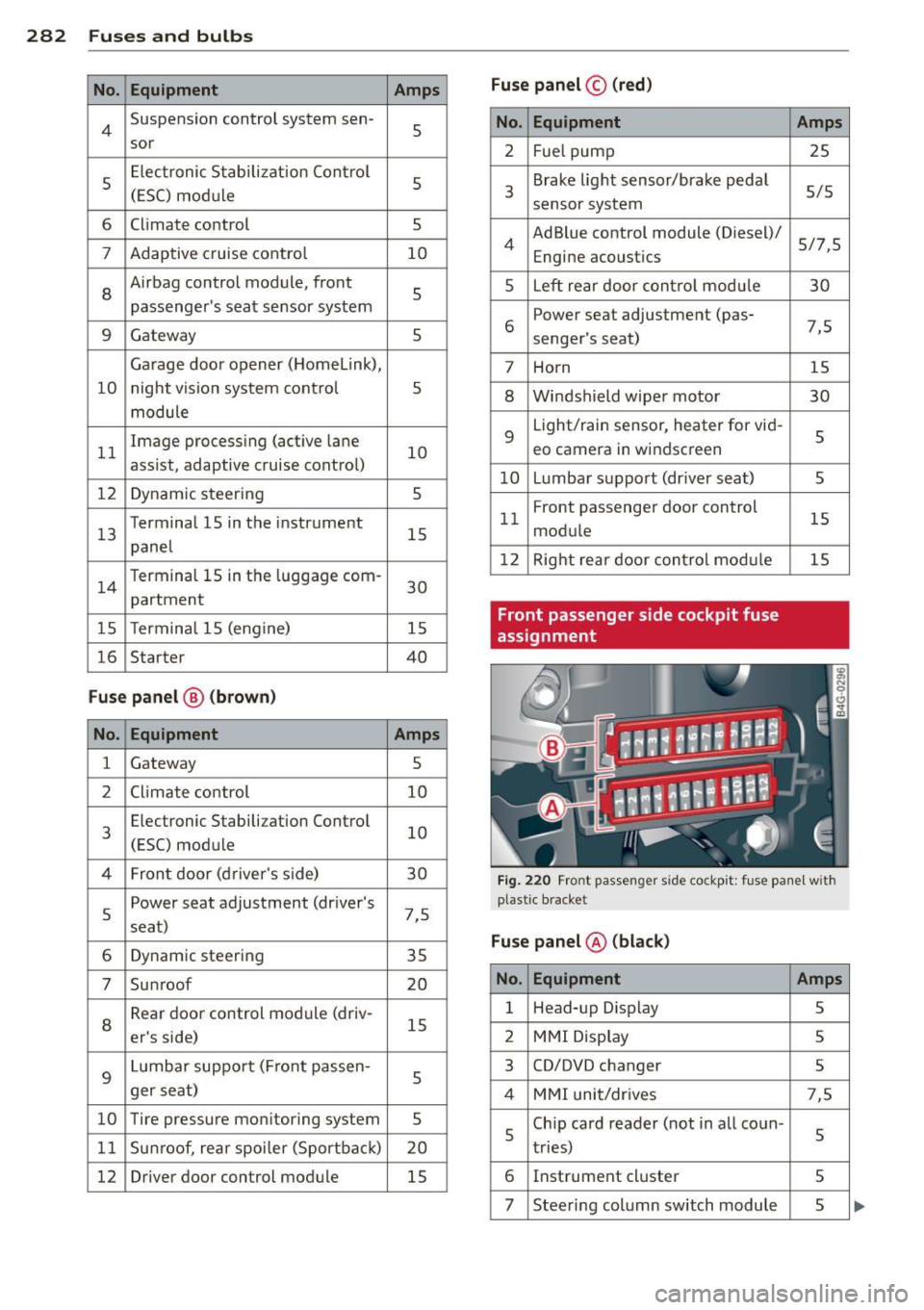
282 Fuses and bulbs
No . Equipment Amps
4 Suspension control system sen-
5
sor
5 Electron
ic Stabilization Control
5
(ESC) mod ule
6 Climate
control
5
7 Adaptive cruise control 10
8
Airbag control module, front
5
passenger's seat sensor system
9 Gateway 5
Garage door opener (Homelink),
10 night vision system contro l 5
module
11 Image processing (active
lane
10
ass ist, adaptive cruise control)
12 Dynamic steering 5
13 Terminal 15
in the instrument
15
panel
14 T
ermina l 15 in the luggage com-
partment 30
15 T
erminal 15 (engine)
15
16 Starter 40
Fuse panel @ (brown)
No . Equipment Amps
1 Gateway
5
2 Climate control 10
E lec tronic Stabilization Contro l
10
3
(ESC) module
4 Front door (driver's
side)
30
5 Power seat adjustment (driver's
7,5
seat)
6 Dynamic steering
35
7 Su nroof 20
Rear door control module (driv- 15
8
er's side)
9 Lumbar support (Front passen-
5
ger seat)
10 Tire pressure monitoring system
5
11 Su
nroof, rear spoiler (Sportbac k)
20
12 Driver door
control module
15
Fuse panel© (red)
No . Equipment
2 Fuel pump
3 Brake light sensor/brake pedal
sensor system
4 AdBlue control module (Diesel)/
Engine acoustics
5 Left rear door contro l modu le
6 Power
seat adjustment (pas-
senger's seat)
7 Horn
8 Windshield wiper motor
9
Light/rain sensor, heater for vid-
eo camera in windscreen
10 Lumbar support (dr iver seat)
11 Front
passenger door control
module
12 Right rear door control mod ule
Front passenger side cockpit fuse
assignment Amps
25
5/5
5/7,5 30
7,5 15
30
5
5
15
15
Fig. 220 Front passenger side cockpit: fu se pane l w ith
plastic bracket
Fuse panel @ (black)
No. Equipment Amps
1 Head-up Display
5
2 MMI Display 5
3 CD/DVD changer
5
4 MMI unit/dr ives 7,5
5 Chip card reader (not
in all coun-
5
tries)
6 Instrument cluster
5
7 Steering column switch module 5