brakes AUDI S7 2015 Owner's Manual
[x] Cancel search | Manufacturer: AUDI, Model Year: 2015, Model line: S7, Model: AUDI S7 2015Pages: 316, PDF Size: 78.09 MB
Page 212 of 316
210 Trailer towing
A lways apply brakes early. When driving
downhill, shift into a lower gear to use the en
g ine braking effect to slow the vehicle . Use of
the brakes alone can cause them to overheat
and fail.
Air su spen sion *
When driving with a trai ler, activate the trailer
mode of the air suspension. Switch the air
suspension trailer mode on when you are tow
ing a trailer. This will limit the regulation by
the air suspens ion while driving. Select in the
MMI:
! CARI function button> (C ar)* sys te m s
control button > Vehicl e se tting s> Air s usp .:
t o wing > On .
Coolant t emperatur e
The coolant temperature gauge¢ page 11
must be observed carefully. The coolant tem
perature can increase if you drive on long in
clines in a low gear at high engine speeds. Re
duce your speed immed iate ly if the LEDs in
the top pa rt of the display turn on.
For more information about indicator lights,
refer to. ¢ page 16 .
A WARNING
Anyone not properly restrained in a mov
ing veh icle is at a much greater risk in an
accident. Never let anyone r ide in your car
who is not prope rly wearing the restraints
provided by Audi .
Trailer towing tips
Important to know
Your vehicle handles differently when tow ing
-
a trailer because of the addit ional weight and
d ifferent weight dist ribution. Safety, perform
ance and economy w ill greatly depend on how
carefu lly you load your trailer and operate
your rig.
Before you actually tow your trailer, practice
turn ing, stopp ing and back ing up in an area
away from traffic. Keep practicing until you
have become comp letely familiar with the way your vehicle
-trailer combination behaves and
responds .
Backi ng up is diffic ult and requi res p ractice.
Backing up w ith a trailer generally req uires
steering action opposite to that when backing
up your vehicle without a trailer.
Maintai n a greater d ista nce between yo ur ve
hicle and the one in fron t of yo u. You w ill need
more room to stop. To compensate for the
trailer, you will need a larger than normal
turning radius.
When passing, remember that you cannot ac ce le rate as fast as you norma lly would be
ca use of the added load. Make sure you have
enough room to pass . After passing, allow
plenty of room for your trailer before chang
ing lanes again.
Avoid jerky starts, sharp tu rns o r rapid lane
changes.
(D Tips
- Do not tow a trailer during the break-in
period of your vehicle.
- If you tow a trailer, your Audi may re
quire more frequent maintenance due to
the extra load ¢
page 294.
Parking on a slope
Do not park on a slope with a trailer. If it can
not be avoided, do so only after doing the fol
lowing:
When parking:
.,. App ly the foot brake .
.,. Have someone place choc ks unde r both the
vehicle and the trailer wheels.
.,. With chocks in place, slowly release the
brakes unt il the whee l chocks absorb the
load .
.,. Turn the whee ls towards the curb.
.,. Apply the parking brake.
.,. Select the P selector lever posit ion.
When re sta rting after p ark in g :
.,. App ly the foot brake .
.,. Start the engine.
Page 215 of 316

M N <( (.J
'SI: ,...., \!) 1.1'1 ,...., 1.1'1 ,....,
Vehicl e ca re a nd cl eanin g 213
A WARNING
-Only wash the vehicle when the ignition
is off and follow the instructions from
the car wash operator to reduce the risk of accidents .
- To reduce the r isk of cuts, protect your
self from sharp metal components when
wash ing the underbody or the inside of
t he wheel housings.
- After washing the vehicle, the braking ef
fec t may be delayed due to mo isture on
the brake rotors or ice in the winter. The
brakes must be dried first with a few
careful brake applications.
Q) Note
- If you wash t he vehicle in an automatic
car wash, yo u must retrac t the rear spoil
er if necessary, and fo ld the exter ior mir
rors in to reduce the risk of damage.
Power folding exterior mirrors* must on
l y be folded in and out using the power
fo ld ing funct ion.
- To prevent paint damage, do not wash
the veh icle in direct sunlight. -
To reduce the risk of damage to the sur
face, do not use insect removing spong
es, kitchen sponges or similar items.
- Matte finish painted vehicle compo
nents:
- To reduce the risk of damage to the surface, do not use polishing agents or hard wax.
- Never use car wash cycles that apply protective wax.
It can destroy the
matte fi nish effect.
- Do not place any stickers or magnet ic
signs on vehicle parts painted w ith
matte fi nish paint. The paint cou ld be
damaged when the stickers o r magnets
are removed.
@ For the sake of the environment
Only wash the vehi cle in facilities spec ial ly
designed for that purpose . This will red uce
the risk of dirty water contam inated with
oil from entering the sewer system.
Cleaning and care information
When cleaning and caring for individua l vehi
cle components, refer to the follow ing tab le.
The information contained there is s imply rec
ommendations. For quest ions or for compo- nents
that are not listed, refer to an author
ized Audi dealer or a qualified workshop. Also
follow the information found inc>,& .
Cle aning e xte rior
Component Situation Solution
W ip er bl ade s
Dirty c> page 49, Cleaning windshield wiper blades
Headlights/ Dirty Soft
sponge with a mild soap solution al
tail lights
S ensor s/
Dirty Sensors: soft cloth with a solvent-free cleaning product
cam era l enses Camera lenses: soft cloth with an alcohol-free cleaning
so lution
Snow/ice Hand brush/solvent-free de-icing spray
Whe els Road sa lt Water
Brake dust Acid-free special cleaning solution
Ex haust t ail Road sa lt Water, cleaning solut
ion suitable for sta inless steel, if
pipe s necessary
•
•
Page 236 of 316
234 Checking and filling
Brake fluid
Checking brake fluid level
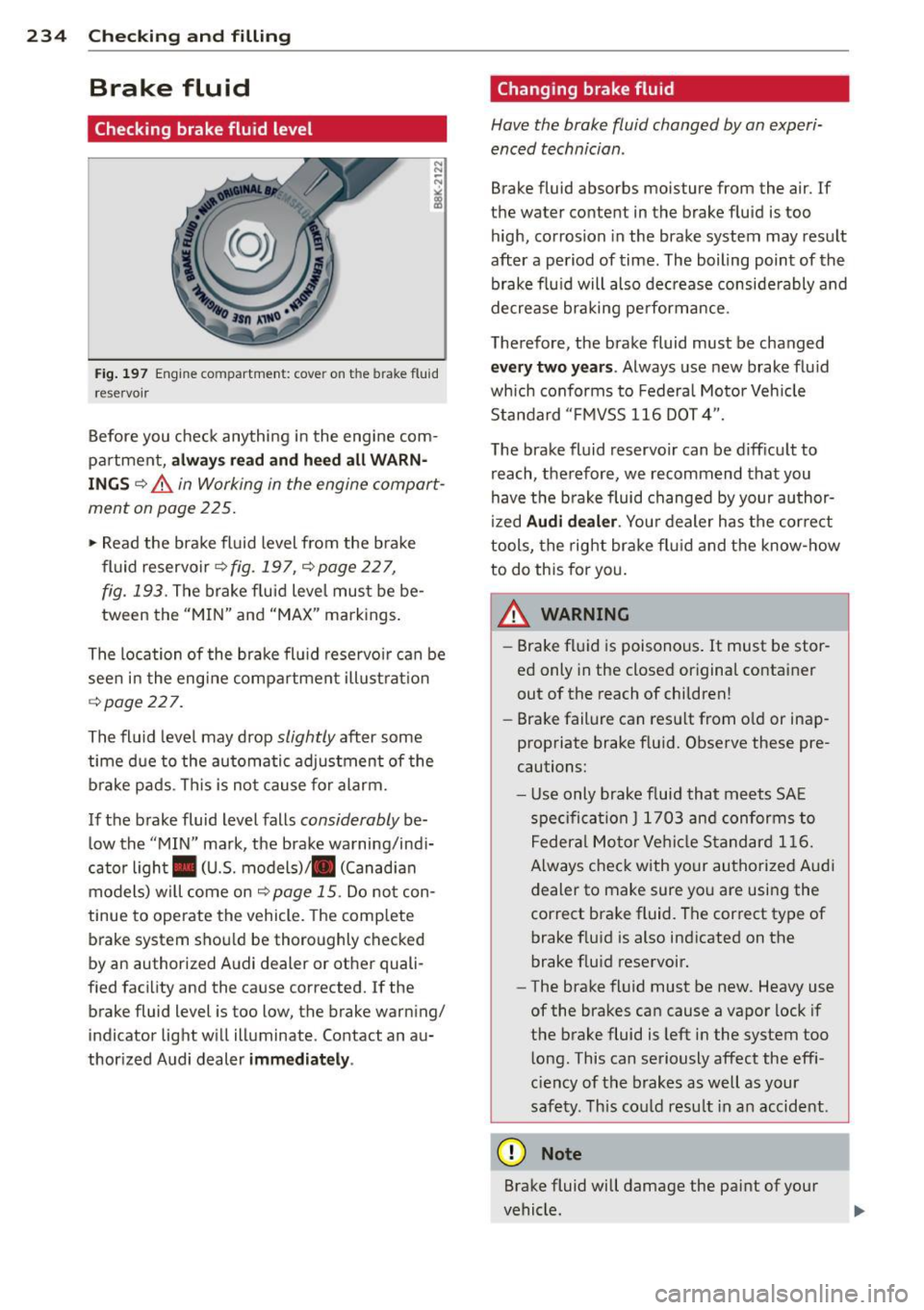
Fig . 197 Engine compartment: cove r on the brake fluid
reservo ir
Before you check anything in the engine com
partment,
always read and heed all WARN
INGS ¢&. in Working in the engine compart
ment on page 225.
,.. Read the brake fluid level from the brake
fluid reservoir¢
fig . 197, ¢ page 22 7,
fig. 193.
The brake flu id level must be be
tween the "MIN" and "MAX" markings.
The location of the brake flu id reservoir can be
seen in the engine compartment illust rat ion
¢ page 227.
The fluid level may drop
slightly after some
time due to the automatic adjustment of the
brake pads. This is not cause for alarm.
If the brake fluid level falls
considerably be
low the "MIN" mark, the brake warning/indi
cator light . (U.S. models)/ . (Canadian
models) will come on¢
page 15. Do not con
tinue to operate the vehicle. The comp lete
brake system shou ld be thoroughly checked
by an authorized A udi dealer or other quali
fied facility and the cause corrected.
If the
brake fluid level is too low, the brake warning/
indicator light will illuminate. Contact an au
thorized Audi dealer
immediately .
Changing brake fluid
Have the brake fluid changed by an experi
enced technician .
Brake fluid absorbs moisture from the air. If
the water content in the brake fluid is too high, corrosion in the brake system may result
after a period of time . The boiling point of the
brake flu id will also decrease conside rably and
decrease braking pe rformance.
Therefore, the brake fluid must be changed
every two years . Always use new brake flu id
which conforms to Federal Motor Vehicle
Standard "FMVSS 116 DOT 4".
The brake fluid reservoir can be difficult to reach, therefore, we recommend that you
have the brake fluid changed by your author
ized
Audi dealer. Your dealer has the correct
tools, the right brake fluid and the know-how
to do this for you.
A WARNING
- Brake fluid is poisonous . It must be stor
ed only in the closed original container
out of the reach of children!
- Brake failure can resu lt from o ld or inap
propriate brake fluid. Observe these pre
cautions:
- Use only brake fluid that meets SA E
specification
J 1703 and conforms to
Federal Motor Vehicle Standard 116.
Always check with your authorized Audi
dealer to make sure you are using the
correct brake fluid. The correct type of
brake f luid is also indicated on the
brake fluid reservoir.
- The brake fluid must be new. Heavy use
of the brakes can cause a vapor lock if
the brake fluid is left in the system too
long. This can seriously affect the effi
c ie ncy of the brakes as well as your
safety. This could resu lt in an accident.
(D Note
Brake fluid will damage the paint of your
vehicle .
Page 244 of 316

242 Tires and wheels
-If you notice unusual vibra
tion or if the vehicle pulls to
one side when driving, al
ways stop as soon as it is
safe to do so and check the
wheels and tires for dam
age.
0 Note
-Please note that summer and winter tires are de
signed for the conditions
that are typical in those sea
sons. Audi recommends us
ing winter tires during the
winter months. Low tem peratures significantly de
crease the elasticity of
summer tires, which affects
traction and braking ability. If summer tires are used
in
very cold temperatures, cracks can form on the tread
bars, resulting in perma
nent tire damage that can
cause loud driving noise and
unbalanced tires. Audi is not
responsible for this type of
damage.
-Burnished, polished or chromed rims must not be used in winter road condi
tions. The surface of the
rims does not have suffi
cient corrosion protection
for this and could be perma
nently damaged by road salt
or similar substances.
Glossary of tire and loading terminology
Accessory weight
means the combined weight (in
excess of those standard items
which may be replaced) of auto matic transmission, power
steering, power brakes, power
windows, power seats, radio, and heater, to the extent that
these items are available as fac
tory-installed equipment (whether installed or not).
Aspect ratio
means the ratio of the height to
the width of the tire in percent.
Numbers of 55 or lower indi
cate a low sidewall for im
proved steering response and
better overall handling on dry
pavement.
...
Page 246 of 316
244 Tires and whee ls
Ma ximum load r ating
means the load rating for a tire
at the maximum permissible in
flation pressure for that tire.
Maximum lo ad ed vehicle
weight
means the sum of:
(a) Curb weight
(b) Accessory weight
(c) Vehicle capacity weight, and
(d) Production options weight
Ma ximum (permissible )
inflation pressure
means the maximum cold infla
tion pressure to which a tire
may be inflated. Also called
"maximum inflation pressure."
Normal occupant weight
means 150 lbs. (68 kilograms)
times the number of occupants seated in the vehicle up to the
total seating capac ity of your
vehicle.
Occupant di stribution
means distribution of occu
pants in a vehicle .
Outer diameter
means the overall diameter of
an inflated new tire.
Overall width
means the linear distance be
tween the ex teriors of the side
walls of an inflated tire, includ
ing elevations due to labeling,
decorations, or protective bands or ribs .
Ply
means a layer of rubber -coated
parallel cords .
Production options weight
means the combined we ight of
those installed regular produc
tion options weighing over 5
lbs . (2 .3 kg) in excess of those
standard items which they re
place, no t previously consid
ered in curb weight or accessory
weight, including heavy duty
brakes, ride leve lers, roof rack,
heavy duty bat tery, and special
trim.
Radial ply tire
means a pneumatic tire in
wh ich the p ly cords that extend
to the beads are laid at sub
stantially 90 degrees to the
centerline of the tread .
Page 253 of 316
technically referred to as the
vehicle's Gross Vehicle Weight Rating ("GVWR"). The Gross
Axle Weight Rating ("GAWR") is
the maximum load that can be applied at each of the vehicle's
two axles. The Gross Vehicle
Weight Rating and the Gross
Axle Weight Rating are listed on the safety compliance stick
er label located on the driver's
side B-pillar. The tire pressure
label on your Audi lists the
maximum combined weight of
all of the occupants and lug
gage or other cargo that the ve
hicle can carry. For the location
of the tire pressure label
c> fig . 200.
A WARNING
-
Overloading a vehicle can
cause loss of vehicle control,
a crash or other accident, se rious personal injury, and
even death.
-Carrying more weight than your vehicle was designed to carry will prevent the vehicle from handling properly
and increase the risk of a
~ loss of vehicle control. <(
~ -The brakes on a vehicle that has been overloaded may
Tires and wheels 251
not be able to stop the vehi
cle within a safe distance.
- Tires on a vehicle that has
been overloaded can fail
suddenly causing loss of control and a crash.
-Always make sure that the total load being transported
- including the weight of a
trailer hitch and the tongue
weight of a loaded trailer -
does not make the vehicle
heavier than the vehicle's
Gross Vehicle Weight Rat
ing.
A WARNING
-Incorrect tire pressures
and/or underinflation can
lead to a serious or fatal ac
cident.
-Incorrect tire pressures and/or underinflation cause
increased tire wear and can
affect the handling of the
vehicle.
-Incorrect tire pressures and/or underinflation can
also lead to sudden tire fail
ure, including a blowout
and sudden deflation, caus
ing loss of vehicle control.
•
•
'
Page 259 of 316

and increase the risk of the loss of vehicle control.
-The brakes on a vehicle that
has been overloaded may
not be able to stop the vehi
cle within a safe distance.
-Tires on a vehicle that has
been overloaded can fail
suddenly, including a blow
out and sudden deflation,
causing loss of control and a
crash.
-Always make sure that the total load being transported - including the weight of a
trailer hitch and the tongue
weight of a loaded trailer - does not make the vehicle heavier than the vehicle's
Gross Vehicle Weight Rat
ing .
Determining correct load
limit
Use the example below to cal
culate the total weight of the
passengers and luggage or oth
er things that you plan to trans
port so that you can make sure
that your vehicle will not be
~ overloaded.
Steps for Determining
Correct Load Limit
1. Locate the statement "THE
COMBINED WEIGHT OF OC
CUPANTS AND CARGO
SHOULD NEVER EXCEED XXX KG OR XXX LBS" on your ve
hicle's placard (tire inflation
pressure label)
¢ page 247,
fig. 200.
2. Determine the combined
weight of the driver and passengers that will be riding in
your vehicle.
3. Subtract the combined
weight of the driver and pas
sengers from
"XXX" kilo
grams or
"XXX" pounds
shown on the sticker
¢ page 247, fig. 200.
4. The resulting figure equals the available amount of cargo and luggage load capaci
ty. For example, if the
"XXX"
amount equals 1400 lbs.
and there will be five 150 lbs. passengers in your vehi
cle, the amount of available
cargo and luggage load ca
pacity is 650 lbs. (1400-7 50
(5
X 150) = 650 lbs.)
5. Determine the combined
weight of luggage and cargo ""
•
•
'
Page 267 of 316
Tires and wheels 265
sure of their "previous histo-and sudden deflation and •
ry." Old used tires may have loss of control. • '
been damaged even though -Temperature grades apply
the damage cannot be seen to tires that are properly in-
that can lead to sudden tire flated and not over or un-
failure and loss of vehicle derinflated.
control. -For technical reasons it is
-All four wheels must be fit- not always possible to use
ted with radial tires of the wheels from other vehicles -
same type , size (rolling cir-
in some cases not even
cumference) and the same wheels from the same vehi-
tread pattern. Driving with cle model.
different tires reduces vehi- -If you install wheel trim
cle handling and can lead to discs on the vehicle wheels,
a loss of control. make sure that the air flow
-If the spare tire is not the to the brakes is not blocked.
same as the tires that are Reduced airflow to the
mounted on the vehicle - for brakes can them to over-
example with winter tires - heat, increasing stopping
only use the spare tire for a distances and causing a col-
short period of time and lision.
drive with extra ca re. Refit -Run flat tires may only be
the normal road wheel as used on vehicles that were
soon as safely possible. equipped with them at the
-Never drive faster than the factory. The vehicle must
maximum speed for which have a chassis designed for
the tires on your vehicle are run flat tires. Incorrect use
rated because tires that are of run flat tires can lead to
driven faster than their rat- vehicle damage or acci-
ed speed can fail suddenly. dents. Check with an au-
M -Overloading tires cause heat thorized Audi dealer or tire N <(
build-up, sudden tire fail- specialist to see if your vehi-(.J
'SI: ,....,
ure, including a blowout cle can be equipped with ... \!) 1.1'1 ,...., 1.1'1 ,....,
Page 302 of 316
300 Index
AUTO automatic climat e control .. .. ... ... ..
73
Automatic headlights ....... .. .... .. 44
climate control . . . . . . . . . . . . . . . . . . . . . 70
Auto Lock . . . . . . . . . . . . . . . . . . . . . . . . . . 3 3
Automatic belt retractor .. ... ..... .. .
141
Automatic climate control
Air vents . .... ........... .... .... ..
7 3
Automatic recirculation .... .. .. .. .. . . 74
Opera tion . . . . . . . . . . . . . . . . . . . . . . . . . 72
Setup . .. .. ................ ... .. .. 74
synchron izing .... ......... ... .. .. .. 73
Automatic Shift Lock (ASL) .... .. .. .. . 110
Automatic transmission ..... .. .. .. .. . 109
Automatic Shift Lock (ASL) .......... 110
Driving . . . . . . . . . . . . . . . . . . . . . . . . . . 111
Emergency mode . . . . . . . . . . . . . . . . . . 114
Emergency release .......... .. .... . 115
Kick-down ............... .. .. .... . 113
Manual shift program ..... .... .... . 113
Selector lever . . . . . . . . . . . . . . . . . . . . . 109
Automatic wipers .................. .. 48
Auto Safety Hotline ........ .. .. .. .. . 136
Ave rage consumption ....... .. .. .. .. . . 25
Average speed . . . . . . . . . . . . . . . . . . . . . . .
25
Avoid damaging the vehicle .. .. .. .. .. . 204
B
Brake fluid
Changing the brake fluid ............
234
Checking the brake fluid level ........ 234
What is the correct brake fluid level? .. 234
What should I do if the brake fluid warn-
ing light comes on? ................
234
Brake system
Anti- lock braking system . . . . . . . . . . . . .
19
Brake assist system . ....... .... .. .. 195
Brake booster .. ... .............. .. 199
Brake fluid .. .. .. .......... ...... . 234
Brake fluid specifications for refill and re-
placement ...... ................ .
234
Brake pads .... .. ............. .... 203
Electromechanical parking brake ... .. . 79
Fluid reservoir ... ................ . 234
How does moisture or road salt affect the
brakes? . . . . . . . . . . . . . . . . . . . . . . . . . .
198
Warning/indicator lights ........ .. .. . 15
Worn brake pads symbol . . . . . . . . . . . . . 20
braking guard
Settings .. .... .. .. .............. ..
93
Brak ing guard . .. .. .......... ...... .. 86
Messages ... .. .. .. ....... .... .... . 93
Break-in period .. .. ............. .... 203
Brake pads .. ... . ... ... .... ... .. .. 203
Tires ........ ... .. .............. . 203
Bulbs .......... .. .. .............. . 284
Bag hooks . . . . . . . . . . . . . . . . . . . . . . . . . . 67 C
Battery ..... ................ ..... .
Charging ................... ..... .
Important warnings ...... .. .. .. .. .
Jump starting . .... ....... .. .. .. .. .
Location
. .. .... ........... .. .... .
low ..... .. ................ ... ' . .
Replacing the battery ..... .. .. .. .. .
State of charge ........... .. .. .. .. .
w· t · 1n er operation ......... .... .... .
Working on the battery .... .. .. .... .
Before driving .............. ... .. .. .
235
237
235
285
235
201
238
201
235
235
128
Blended gasoline . . . . . . . . . . . . . . . . . . . 217
Blower (automatic climate control) . . . . . . 73
Blower (climate con trol) . . . . . . . . . . . . . . . 70
Booster seats .............. ... .... . 182
California Proposition 65 Warning ..... 226
Battery specific .. ............. .... 236
Capacities .. .. .. .. ............. .. .. 292
Engine oil ..... .. ............. .... 227
Carbon par ts
Cleaning . . . . . . . . . . . . . . . . . . . .
214,215
Car carrier
Transporting your vehicle ....... ....
289
Care ..... .. .. .. .. .... ......... .... 212
Cargo area ...... .. .. ... ........... . 134
Cargo net . . . . . . . . . . . . . . . . . . . . . . . . . . . 66
Catalytic converter . ... .. ... ..... .. .. 204
Center armrest
Cockpit . .. .. .. .. ............. .. .. .
56
Central locking .... ............. ..... 33
Emergency locking ................ ..
37