cooling AUDI S7 2016 User Guide
[x] Cancel search | Manufacturer: AUDI, Model Year: 2016, Model line: S7, Model: AUDI S7 2016Pages: 294, PDF Size: 73.82 MB
Page 203 of 294
M N <( (.J
'SI: ,...., \!) ..,.,
N \!) ,....,
Trailer mode Driving with a trailer
General information
Your Audi was designed primarily for passenger
transportation .
If you plan to tow a trailer, p lease remember that
the additional load will affect durability, econo
my and performance.
Trailer towing not only places more stress on the
vehicle, it also calls for more concentration from
the driver.
For this reason, always follow the operating and
driving instructions provided and use common
sense.
(D Note
If you are going to tow a trai ler, you must ac
tivate the trailer operat ion mode
c::> page 201, Operating instructions.
Technical requirements
Trailer hitch
Use a weight-carrying hitch conforming to the
gross trailer weight. The hitch must be suitable
for your vehicle and trailer and must be mounted
securely on the vehicle's chassis at a
technically
sound
location. Use only a trailer hitch with a re
movable ball mount. Always check with the trail
e r hitch manufacturer to make sure that you are
using the correct hitch.
Do not use a bumper hitch.
The hitch must be installed in such a way that it
does not interfere with the impact-absorbing
bumper system. No modifications should be
made to the vehicle exhaust and brake systems.
From time to time, check that all hitch mounting
bolts remain securely fastened .
When you are not towing a trailer,
remove the
trailer hitch ball mount. This prevents the hitch
from causing damage should your vehicle be
struck from behind
c::> &, .
Trailer mode
Trailer brakes
If your trailer is equipped with a brak ing system,
check to be sure that it conforms to all regula
tions.
T he trailer hydraulic brake system must not be di
rect ly connected to the vehicle's hydraulic b rake
system.
Safety chains
Always use safety chains between your veh icle
and the tra iler.
Trailer lights
Trailer lights must meet all regulations. Be sure
to check with your Aud i dealer for correct wiring,
switches and relays.
Mirrors
If you are unable to see the traffic behind you us
ing the regular outside mirrors, then you
must in
stall extended mirrors. It is important that you
always have clear vision to the rear .
A WARNING
--
After removing the trailer hitch, do not store
i t in your vehicle. In case of sudden braking,
the hitch could fly forward and injure you or
your passengers.
Operating instructions
Maximum trailer weight
A trailer for your vehicle is limited to a typical
class 1 or class 2 trailer.
Trailer load distribution
Be sure the load in the trailer is held securely in
place to prevent it from sh ifting forward, back
ward or sideways.
Never allow a passenger to ride in a trailer c::> &.
in Driving instructions on page 203 .
Engine cooling system
Towing a trailer makes the engine work harder. It
is important that the cooling system's perform
ance is up to the additional load. Make sure that
the cooling system has enough fluid . .,..
201
Page 226 of 294
Checking and F ill in g
areas, into open streams or down sewage
drains.
- Recycle used engine o il by taking it to a used
engine oil collection facility in your area, or
contact a service station.
Cooling system
Coolant
T he engine coolant performs two functions: it
keeps the engine from overheating and it pro
tects the engine from freezing in the winter .
The cooling sys tem is sealed and generally re
qu ires little attention .
T he cooling system has been filled at the facto ry
with a permanent coo lant wh ich does not need to
be changed . T he coolan t consists of a mixture of
specially condit ioned water and the manufactur
er's glycol-based coolant addit ive Gl3 ant ifreeze
with a nticorrosion add itives (50% fo r USA mod
e ls · 60% for Canadian mode ls). Thi s m ix tu re both
'
assures the ne cessary fros t protection and pro -
t ects meta l components in t he engine's cooling
system from corrosion and scaling. It a lso raises
the boiling point of the coolant.
D o not reduce the concentr ation o f the coo lant in
the summer by addi ng p la in water.
The propor
tion of coolant additive must be at least 50 %
but not more than 60 %
to maintain antifreeze
protection and cooling efficiency .
If the coolant
frost protection is too low, the coolant could
freeze and damage the ve hicle heati ng and en
g ine cooling system .
For year-round driving, antifreeze is added at the
factory for tempera tures down to:
- -3 1 °F (- 35°C)USA
- - 4 0 °F ( - 4 0 °C) Canada.
I f you must add coo lant, use a m ixt ur e of wate r
a nd coolant add it ive. Mixing the coolant additive
w ith d istilled w ate r is recommended.
_& WARNING
Before yo u check any thing in t he engine com
par tment, always read and hee d all WA RN -
224
INGS ~ &. in Working in the engine compart
ment on page 218.
(D Note
- Be fore wi nter sets in, have the coo lant
checke d to see if the coolant additive in you r
vehicle is sufficient to meet the climate con ditions. This is espec ia lly impo rtant if you
live in a region where the winter is extreme
ly cold . If necessary, increase the p roportion
of coolan t addit ive to 60% .
- Whe n adding coolant additive to your cool
ing system, remember:
- We re commend usin g on ly cool ant addi
tive Gl2++ o r Gl3 (chec k the label) fo r
your ve hicle. This coo lant additive is avai l
ab le at aut horized Aud i dea le rs . Othe r
types of ant ifreeze can significant ly re
d uce co rrosion protection. The resulting
corrosion can cause a loss of coolant a nd
serious e ngine damage .
- Do not add any type of rad iator leak sealant
to your vehicle's engine coolant. Adding ra
diator repa ir fl uid may adverse ly affec t the
func tion and perfo rmance of your cooling
system a nd could result in d amage not cov
ere d by yo ur N ew Vehi cle Lim ited War ranty.
Checking the engine coolant level
The engine coolant level can be checked with a
quick glance.
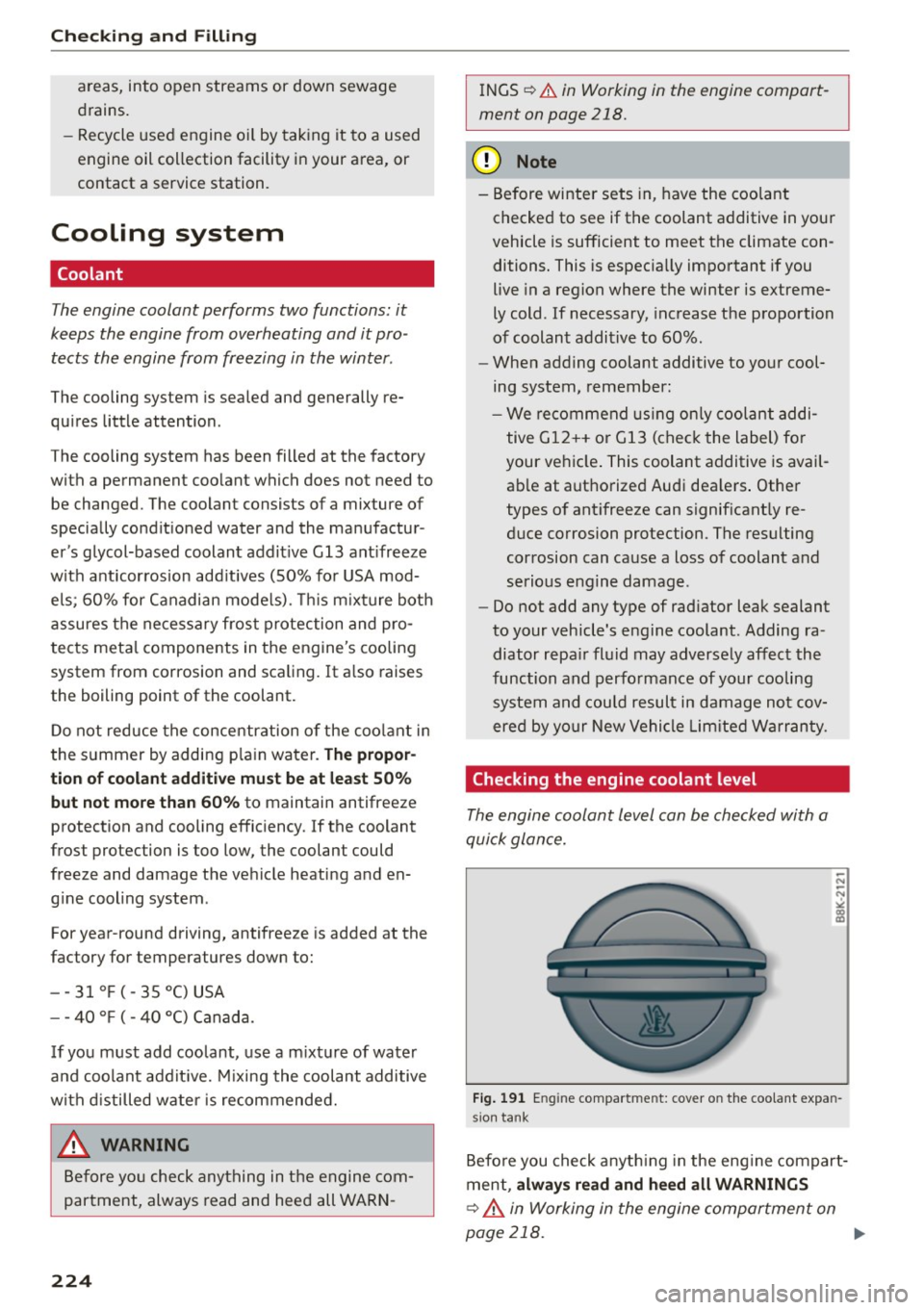
Fi g. 1 91 Eng ine co mpar tmen t: c over on t he coo la nt expa n
sio n tan k
Befo re you check a nyth ing in the eng ine compart
men t,
always read and he ed all WARNINGS
~ A in Working in the engine compartmen t on
page 218. ..,.
Page 227 of 294
M N <( (.J
'SI: ,...., \!) 1.1'1
N \!) ,....,
~ Park your vehicle on a level surface.
~ Switch off the ignition .
~ Read the eng ine coolant leve l from the coolant
expansion tank
c> fig. 191, c> page 220,
fig. 188.
With a cold engine, the coolant level
should be between the "min" and "max" mark
i ngs. When the engine is warm, the level may
be s light ly above the "max" marking.
The location of the coolant expans ion tank can be
seen in the engine compartment illustrat ion
i=>page220.
To obtain an accurate reading, the engine must
be sw itched
off.
The expansion tank in you r vehicle is equipped
with an electric coolant level sensor.
When the coo lant level is too low, the warning
light in the Auto-Check System
c:> page 15 wi ll il
l uminate unti l you a dd coolant and the level has
been restored to norma l. Even though there is an
e lectric coolant level sensor, we still recommend
you check the coolant level from time to time.
Coolant loss
Coolant loss may i ndicate a leak in the coo ling
system . In the event of coo lant loss , the cooling
system should be inspected immed iate ly by your
author ized Audi dealer. It is not enough merely
to add coolant .
In a
sealed system, losses can occur only if the
boiling point of the coo lant is exceeded as a re
sult of overheat ing.
A WARNING
The cooling system is under pressure and can
get very hot. Reduce the risk of scalding from
hot coolant by following thes e steps.
- Turn off the engine and allow it to coo l
dow n.
- Protect yo ur face, hands and arms from es
caping fluid and steam by cove ring the cap
with a la rge, th ick rag.
- Turn the cap slowly and ve ry carefu lly in a
counte r-clockw ise direct io n wh ile a pplying
light, downwa rd pr essur e on the top of the
c ap.
Checking and Fillin g
-To avo id being burned, do not sp ill anti
freeze o r coolant on the exha ust system or
hot engine parts. Under certa in cond itions,
the ethylene glyco l in engi ne coo lant can
ca tch fire.
(D Note
Do not add any type o f radiator leak sea lant
to you r vehicle 's engi ne coolant . Add ing radia
tor repair fluid may adversely affect the func
tion and pe rformance of your coo ling system
and could r esult in damag e not cover ed by
your New Veh icle Limited Warranty.
Adding coolant
Be very careful when adding engine coolant.
Before you check a nyth ing in the eng ine compart
me nt,
always read and heed all WARNINGS
c> .&. in Working in the engine compartment on
page 218.
~ Requirement: T here must be a residua l amount
of coolant in the expansion tank
c:> (D .
~Tu rnoff the engi ne.
~ Le t the eng ine cool down.
~ Place a thick rag ove r the coo lan t expansion
t ank
c:>page 224, fig. 191 and carefully tw ist
t he cap coun ter- clockwise
c:> .&, .
~ Ad d coo lant mixed in the correc t ra tio
c:> page 224, Coolant up to the MAX marking .
~ Make sure that the fl uid leve l remains stab le.
Add more coo lant if necessary.
~ Twist the cap o n again tightly.
Rep lacement engine coo lant must confo rm to ex
act specifications
c> page 224, Coolant.
We recommend using only coo lant add it ive G1 2+
+ , G 13 or in an emergency G12+. Do
not use a
different additive. In an emergency use p lain wa
ter unt il you can get the correct add itive and can
restore the correct ratio. This should be done as
soon as possib le.
If you have lost a considerab le amou nt of cool
ant, then you shou ld add cold antifreeze and co ld
water only whe n the eng ine is co ld.
Always use
new engine coo lant w hen refilling.
225
Page 228 of 294

Checking and Filling
Do not fill coolant above the "MAX" mark. Excess
coolant will be forced out through the pressure relief valve in the cap when the engine becomes
hot.
A WARNING
- The cooling system is under pressure and
can get very hot. Reduce the risk of scalding
from hot coolant by following these steps .
- Turn off the engine and allow it to cool
down.
- Protect your face, hands and arms from
escaping fluid and steam by covering the
cap with a large, thick rag.
- Turn the cap slowly and very carefully in a
counter-clockwise direction while applying light, downward pressure on the top of
the cap.
- To avoid being burned, do not spill anti
freeze or coolant on the exhaust system or
hot engine parts. Under certain condi
tions, the ethylene glycol in engine cool
ant can catch fire .
-Antifreeze is poisonous. Always store anti
freeze in its original container and well out
of the reach of children .
- If you drain the coolant, it must be caught
and safely stored in a proper container
clearly marked "poison" .
(D Note
- Do not add coolant if the expansion tank is empty. Air could enter the cooling system
and damage the engine. If this is the case,
do not continue driving. Seek professional
assistance .
- Coolant pollutes the environment and could cause an engine fire. Excess coolant will be
forced out through the pressure relief valve
in the cap when the engine becomes hot.
- If, in an emergency, only water can be add
ed, the correct ratio between water and an
tifreeze
¢ page 224 must be restored as
soon as possible.
226
-
® For the sake of the environment
Drained coolant should not be reused. Always
dispose of used coolant while observing all
environmental regulations.
Radiator fan
The radiator fan switches on automatically by it
self
An auxiliary electric radiator fan switches on and
off depending on coolant temperature and other
vehicle operating conditions.
After you switch the engine off, the auxiliary fan
can continue running for up to 10 minutes -even
with the ignition off. It can even switch on again later by itself ¢& . if
- the temperature of the engine coolant rises due
to the heat build-up from the engine in the en
gine compartment, or
- the engine compartment heats up because the
vehicle is parked in intense sunlight.
A WARNING
- To reduce the risk of personal injury never
touch the radiator fan.
- The auxiliary electric fan is temperature con
trolled and can switch on suddenly even
when the engine is not running.
- The auxiliary radiator fan switches on auto
matically when the engine coolant reaches a
certain temperature and will continue to run
until the coolant temperature drops. -
Page 282 of 294
Index
Checking
Engin e coolant leve l. . . . . . . . . . . . . . . . . .
224
Ch ild restra ints
D anger of using ch ild restra ints in the front
seat... .. .. .. .... ... .. .. .... .. .. .. .
144
Where can I get additional information
about child restraints and their use? . . . .
184
Ch ild restra int system anchors . . . . . . . . . . 180
Ch ild safety . . . . . . . . . . . . . . . . . . . . . . . . . . 167
Important sa fety ins truc tions for us ing ch ild
safety seats . . . . . . . . . . . . . . . . . . . . . . . .
170
Important things to know when dr iv ing with
chi ldren . . . . . . . . . . . . . . . . . . . . . . . . . . .
167
Tethe r anchors . . . . . . . . . . . . . . . . . . . . . . 183
Tether st raps . . . . . . . . . . . . . . . . . . . . . . . 183
Ch ild safety lock
Rear doors, windows in the rear . . . . . . . . .
39
Ch ild safety seats
Booster seats . . . . . . . . . . . . . . . . . . . . . . .
176
Convertible c hild seats . . . . . . . . . . . . . . . 174
Convertible locking retractor . . . . . . . . . . . 179
H ow do I p roperly install a ch ild safety seat
. h' l 7 170 in myve 1c e .... ... ..... ... .. .. .. .. .
I nfant sea ts . . . . . . . . . . . . . . . . . . . . . . . .
173
Insta lling a child res traint using the LA T CH
system . . . . . . . . . . . . . . . . . . . . . . . . . . . .
18 2
LA T CH system . . . . . . . . . . . . . . . . . . . . . . . 182
Lower anchorages . . . . . . . . . . . . . . . . . . . 181
Mounting and re leasing the anchorage
hook . . . . . . . . . . . . . . . . . . . . . . . . . . . . . .
182
Safety instructions . . . . . . . . . . . . . . . . . . . 170
Unused safety belts on the rear seat . . . . 172
Chil d seats . . . . . . . . . . . . . . . . . . . . . . . . . . 173
Secur ing . . . . . . . . . . . . . . . . . . . . . . . . . . . 177
Ciga re tte lig hte r . . . . . . . . . . . . . . . . . . . . . . . 58
Clea ning . . . . . . . . . . . . . . . . . . . . . . . . . . . . 205
Clea ning/removing ice from windows . . . . . 207
C lea ning Alcanta ra . . . . . . . . . . . . . . . . . . . . 208
Clean ing artificia l leather. . . . . . . . . . . . . . . 208
C lean ing carbon parts . . . . . . . . . . . . . 207, 20 8
Cleaning controls . . . . . . . . . . . . . . . . . . . . . 207
Clean ing deco rative parts and trim . . . 206, 207
C lea ning displays . . . . . . . . . . . . . . . . . . . . . 207
Clean ing exhaust ta il pipes . . . . . . . . . . . . . 206
Clea ning plastic parts . . . . . . . . . . . . . . . . . . 207
Clea ning rims . . . . . . . . . . . . . . . . . . . . . . . . 206
Clean ing texti les . . . . . . . . . . . . . . . . . . . . . . 208
280
Climate control system . . . . . . . . . . . . . . . . . 68
Closing
Su nroof. . . . . . . . . . . . . . . . . . . . . . . . . . . . .
40
Windows . .. .... .. .. .. ........... .. . 39
Coming home . . . . . . . . . . . . . . . . . . . . . . . . . 45
Compact spare tire . . . . . . . . . . . . . . . . . . . . 254
Compartments . . . . . . . . . . . . . . . . . . . . . . . . 59
Compliance . . . . . . . . . . . . . . . . . . . . . . . . . .
277
Consumer info rmation . . . . . . . . . . . . . . . . . 2 74
Consumer Information . . . . . . . . . . . . . . . . . 133
Co nsumption (fuel) . . . . . . . . . . . . . . . . . . . . 24
Contacting NHTSA . . . . . . . . . . . . . . . . . . . . 133
Convenience key . . . . . . . . . . . . . . . . . . . . . . . 34
Starting the engine (START ENGINE S TOP
button) . . . . . . . . . . . . . . . . . . . . . . . . . . . . . 75
Stopping the eng ine (START ENG INE S TOP
bu tton) . . . . . . . . . . . . . . . . . . . . . . . . . . . . .
76
Swi tc hi ng the ignit ion on . . . . . . . . . . . . . . 75
U nlocking and locking vehi cle . . . . . . . . . . .
34
Convenience opening . . . . . . . . . . . . . . . . . . . 40
Convertib le child safety seats . . . . . . . . . . . 1 74
Conve rtib le locki ng retractor
Activati ng . . . . . . . . . . . . . . . . . . . . . . . . . .
179
Dea ct ivatin g . . . . . . . . . . . . . . . . . . . . . . . . 180
U sing to secure a child safety seat . . . . . . 179
Coolant
refer to Eng ine coolan t . . . . . . . . . . . . . . . 224
Cooling mode (four- zone automatic climate
control) . . . . . . . . . . . . . . . . . . . . . . . . . . . . . .
71
Cooling mode (three-zone climate control) . 69
Cross ing wa ter . . . . . . . . . . . . . . . . . . . . . . . 196
Cruise contro l
Switc hing off . . . . . . . . . . . . . . . . . . . . . . . .
84
Warning/indicator lights . . . . . . . . . . . . . . . 22
Cruise contro l system
Changi ng speed . . . . . . . . . . . . . . . . . . . . . .
83
Preselect ing speed . . . . . . . . . . . . . . . . . . . . 84
switching on . . . . . . . . . . . . . . . . . . . . . . . . . 83
(upholder . . . . . . . . . . . . . . . . . . . . . . . . . . . . 59
Cu rve light . . . . . . . . . . . . . . . . . . . . . . . . . . .
101
Cylinder management
refer to Cylinder on demand System . . . . . 24
Cylinder on demand System . . . . . . . . . . . . .
24
D
Data recorde r . . . . . . . . . . . . . . . . . . . . . . . . 18 7
Page 292 of 294
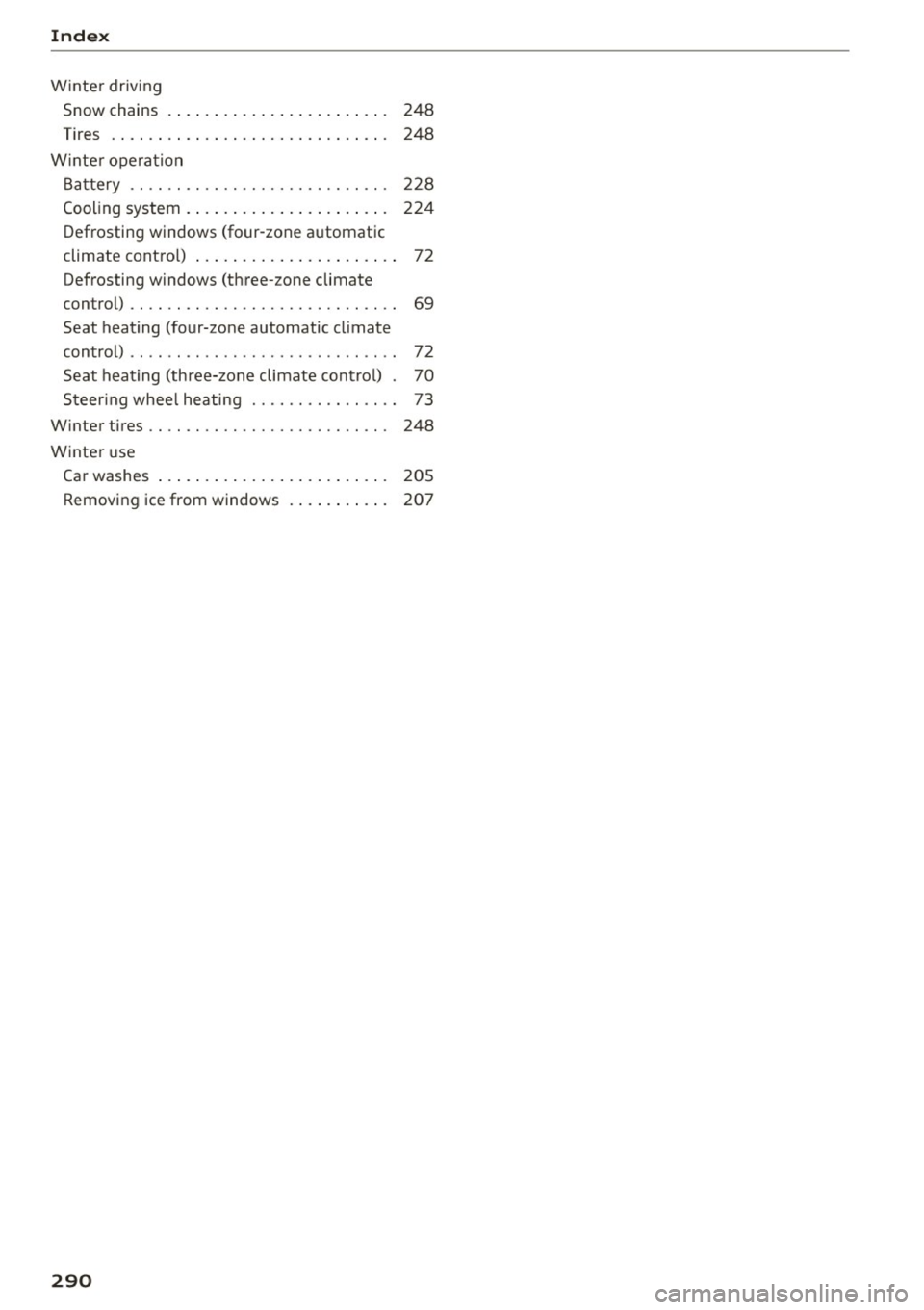
Index
Winter driving
Snow chains . . . . . . . . . . . . . . . . . . . . . . . . 248
Tires ... ... .. .. ................ .... 248
W inter operation
Battery . . . . . . . . . . . . . . . . . . . . . . . . . . . . 228
Cooling system . . . . . . . . . . . . . . . . . . . . . . 224
Defrosting windows (four-zone automatic
climate control) . . . . . . . . . . . . . . . . . . . . . . 72
Defrosting windows (three-zone climate
control) . . . . . . . . . . . . . . . . . . . . . . . . . . . . . 69
Seat heating (four-zone automatic climate
control) . . . . . . . . . . . . . . . . . . . . . . . . . . . . . 72
Seat heating (three-zone climate control) . 70
Steer ing whee l heating . . . . . . . . . . . . . . . . 73
Winter tires . . . . . . . . . . . . . . . . . . . . . . . . . . 248
Winter use
Car washes . . . . . . . . . . . . . . . . . . . . . . . . . 205
Removing ice from windows . . . . . . . . . . . 207
290