engine oil AUDI S7 2016 User Guide
[x] Cancel search | Manufacturer: AUDI, Model Year: 2016, Model line: S7, Model: AUDI S7 2016Pages: 294, PDF Size: 73.82 MB
Page 196 of 294
Intelligent Technology
& WARNING
Improp er operat ion of the rear spoiler can
cause crushing injuries.
- Always make sure that nobody, espec ially
children , is in the way when the rea r spo ile r
i s deployed or retracted.
@ Note
- Neve r push on the vehicle on the rear spoi l
er. Th is co uld cause damage .
- To prevent damage to the rear spoiler do
not lean or p lace anyth ing on it.
- Only ope rate the rear spoi ler manually when
the luggage compartment lid is close and
the rear spo iler moving parts are not
blocked . Ot herwise, damage could occur.
(D Tips
Clean the rear spoiler compartment every 2 to
3 mont hs. To function correct ly, the rear
sp oiler must be free of ice, sn ow and leav es.
Energy management
The starting ability is optimized
The energy management system manages the
ele ctrical energy distribu tion and op timi zes the
availability of elec trical energy for starting the
engine .
Whe n a ve hicle wit h a co nven tional e nergy sys
tem is not dr iven for a long time, the ba tte ry is
d rained by equipmen t (fo r example the immobil
izer). In certa in circ umstances, there cou ld may
not be eno ugh energy to start the engine .
Your veh icle i s equ ipped w ith an intellige nt ener
gy managemen t system for distr ibuting electr ic i
ty . Th is significantly improves the starti ng ability
a nd increases the battery life .
T he energy m anagemen t sys tem Is made up of
battery diagno sis, idling current management
and dynamic energy management.
Battery diagnosis
T he batte ry diagnos is determines the ba tte ry
ch arge leve l. The sen sors de te ct the ba tte ry, the
194
batte ry current, an d the batte ry tempera ture.
The c urrent charge leve l and the perfo rmance of
t h e battery are determined based on th is.
Idling current management
The idling cur ren t management decr eases the
energy used wh ile pa rke d. Wi th the eng ine
switched off, it manages the energy dis trib ution
to t he d ifferent e lectr ica l components . Date from
battery diagnos is is ta ken into acco unt for this .
Depend ing on the batte ry charge leve l, elec trical
equipmen t is switched off one item afte r th e o th
e r, to prevent the battery from dra ining and to
r etain the starting ability.
Dynamic energy management
While driv ing , d ynam ic ene rgy man agement dis
t ribu tes the ap propri ate amount of energy to the
e lectrica l equ ipment. It controls the battery
c h arge level so t hat more ene rgy is not use d then
i s be ing generated in order to maintain an opti
mal battery charge level.
(D Tips
- Energy management can not overcome the
laws of p hys ics. Note that the charge level
and length of the battery life a re limited.
- W he n the sta rting ability is endange red, the
(•j indicator light t urns on¢ page 16 .
What you should know
Maintaining the starting ability is the highest
priority .
A lot of st ress is placed on the ba ttery when dr iv
i ng sho rt distances, in t raff ic, and at cold t imes
of the year . A lot of ene rgy is used but little is
generated .
It is also critical when the engine is
not ru nning but e lectr ica l equipment is sw itched
o n. In th is case, energy is used but none is gener
ated.
In sit uat ions like this, energy ma nagement w ill
active ly regu lated the distribution of energy.
Long periods without use
If you do not drive yo ur vehicle for several days or
weeks, e lectr ica l equipment is grad ually scaled ..,.
Page 198 of 294
Driving and the environment
Driving and the
environment
Breaking in
New engine
The engine needs to be run-in during the first
1,000 miles (1,500 km).
For the first 600 miles (1,000 kilometers ):
.,. Do not use full throttle .
.,. Do not drive at engine speeds that are more
than 2/3 of the maximum permitted RPM .
.,. Avoid high engine speeds.
From 600 to 1,000 miles (1,000 to 1,500
kilometers ):
.,. Speeds can gradually be increased to the maxi
mum perm issible road or eng ine speed.
During and after break-in period
.,. Do not rev the engine up to high speeds when it
is cold . This applies whether the transmission is
i n N (Neutral) or in gear .
After the break-in period
.,. Do not exceed maximum engine speed under
any circumstances.
.,. Upshift into the next higher gear
before reach
i ng the red area at the end of the tachometer
scale~
page 10 .
During the first few hours of driving, the engine's
internal friction is higher than later when all the
mov ing parts have been broken in. How well th is
break-in process is done depends to a cons idera
b le extent on the way the vehicle is driven during
the first 1,000 miles (1,500 kilometers).
(D Note
Extremely high engine speeds are automati
cally reduced. However, these rpm limits are
programmed for an engine wel l run-in, not a
new engine.
196
® For the sake of the environment
Do not drive with unnecessarily high engine
speeds -upshifting early saves fuel, reduces
noise and protects the environment.
New tires
If your vehicle is running on new tires, drive par
ticularly careful for the first 350 miles (500 kilo
meters) after f itting .
.8, WARNING
New tires tend to be slippery and must also
be "broken- in". Be sure to remember this dur
ing the first 350 mi les (500 kilometers).
Brake gently. Avoid following closely behind
other ve hicles or other situations that might
require sudden, hard braking.
Avoid damaging the
vehicle
When you are driving on poor roads, or over
curbs, steep ramps, etc ., make certain that low
lying parts such as spoilers and exhaust system
parts do not bottom out and get damaged .
This is especially true for vehicles with low-slung chass is (sports chassis)* and fully loaded
vehicles .
-
Driving through water on
roads
Note the following to avoid vehicle damage whe n
driving through water, for example on flooded
roads:
- The water must not be any highe r than the bot
tom of the vehicle body.
- Do not dr ive faster than walk ing speed .
.8, WARNING
After driv ing through water or mud, the brak
ing effect can be reduced due to moisture on
the brake discs and brake pads. A few careful
brake applications shou ld dry off the brakes.
Page 199 of 294

M N <( (.J
'SI: ,...., \!) 1.1"1
N \!) ,....,
CD Note
-Vehicle components such as the engine ,
transmission, suspension or e lectr ical sys
tem can be severe ly damaged by driving
through water .
- Always switch the Start-Stop -System* off
when driving through water
c> page 80.
@ T ips
- Determine the depth before driving through
water.
- Do not stop the vehicle, drive in reverse or
switch the eng ine off when driving through
water.
- Keep in mind that oncoming vehicles may
create waves that raise the water level and
make it too deep for your vehicle to drive
through safely.
- Avoid driving through sa lt water (corrosion).
Catalytic converter
Applies to vehicles: with gasoline engine
It is very impor tan t tha t your emission control
system (catalyti c converter) is functioning prop
erly to ensure that your vehicle is running in an
environmentally sound manner .
... Always use lead-free gasoline c> page 210,
F uel supply .
... Never run the tank down all the way to empty .
.,. Never put too much motor oil in your engine
c> page 222, Adding engine oil~-
.,. Never try to push- or tow-start your veh icle.
The catalytic converter is an eff icient "clean-up"
dev ice bu ilt into the exhaust system of the vehi
cle . T he catalytic converter burns many of the
pollutants in the exhaust gas before they are re
l eased into the atmosphere.
The exclusive use of unleaded fuel is cr itically im
portant for the life of the catalyt ic converte r and
proper functioning o f the eng ine .
A WARNING
The temperature o f the exhaust system is
high, both when driving and after stopping
the engine .
Driving and th e en vir onm ent
- Never touch the exhaust tail pipes once they
have become hot. Th is could resu lt in burns.
- Do not park or operate the vehicle in areas
where the hot exhaust system may come in contact w ith dry grass, brush, fuel spill or
other material which can cause a fire.
- Do not app ly additional undercoating or
rustproofing on or near the exhaust mani
fold, exhaust pipes, catalytic converter or heat shields . During dr iving, the substance
used for undercoat ing could overheat and
cause a fire .
CD Note
-Be aware that just one tank filling with lead
ed
fuel w ill already ser iously degrade the
performance of the catalyt ic converter .
- Do not exceed the correct engine oil level
¢ page 222.
-Do not drive until the fuel tank becomes
completely empty . The engine cou ld misfire .
Unburned fuel could also get into the ex
haust system and this cou ld cause the cata
lyt ic converter to overheat.
- Do not switch off the ignit io n while the veh i
cle is movi ng.
- Do not continue to ope rate your veh icle un
der these conditions, as othe rwise f uel can
reach the catalytic converter . This could re
sult in overheating of the co nve rter , requ ir
ing its replacement .
- T o assu re eff icient operation of the Emission
Contro l System:
- Have your vehicle maintained properly and
in accordance w ith the serv ice recommen
dat ions in your Warranty
& Maintena nce
booklet .
- Lack of proper maintenance as we ll as im
p roper use of the vehicle will impair the
function of the emission control system
and could lead to damage.
@ For the sake of the environment
Even when the Emiss ion Control System is op
erating properly, the exhaust gas can have a
su lfu r-like exhaus t gas sme ll unde r some op
erating states. Th is depends on the s ulf ur
197
Page 201 of 294
M N <( (.J
'SI: ,...., \!) 1.1'1
N \!) ,....,
Reducing unnecessary idling
Even when your car is just idling it burns up fuel.
~ Shut the engine off when you are not driving
the vehicle.
~ Do not warm up the vehicle by letting the en-
gine run at idle .
The idling phase is automatically reduced for
veh icles with the Start-Stop-System . It is effi
cient to switch off the engine in vehicles without
the Start-Stop-System when stopped at railroad
crossings and long red lights. Turning the engine
off for just 30-40 seconds saves more fuel than is
burned by starting the engine again.
It takes a long time for the engine to warm up
fully when it is running at idle . However, wear
and noxious emissions are especially high when
the engine is warm ing up. So you shou ld drive
away as soon as you start the engine and avoid
running at high rpms while the engine is still
warming up .
(D Note
Do not leave engine idling unattended after
starting. If warning lights should come on to
indicate improper operation, they would go
unheeded. Extended idling a lso produces
heat, wh ich could resu lt in overheating or oth
er damage to the vehicle or other property.
Regular maintenance
A badly tuned engine unnecessarily wastes a lot of fuel.
~ Have your vehicle serviced at regular intervals.
By having your vehicle regularly serviced by an
Aud i dea ler helps to ensure that it runs properly
and economica lly. The condition of your vehicle
not only affects its safety and ability to hold its
value, it a lso affects fuel consumption .
Check your oil each time you fill your tank.
The amount of oil used is related to engine load
and speed.
Driving and the environment
It is normal for the oil consumption of a new en
gine to reach its lowest value after a certain mile
age has been driven.
You must drive your veh icle about 3,000 miles
(5,000 kilometers) before you can properly as
sess oil consumption .
T h is also applies to fuel consumption and engine
o ut put .
CD Note
- Have your vehicle maintained properly and
in accordance with the service recommenda
tions in your Warranty
& Maintenance book
let . Lack of proper maintenance as well as
improper use of the vehicle will impair the
function of the em ission contro l system and
cou ld lead to damage.
- Do not alter or remove any component of
the Emission Control System unless ap
proved by the manufacturer.
- Do not alter or remove any device, such as
heat shields, sw itches, ignition wires,
valves, which are designed to protect your
vehicle's Emission Control System and other important vehicle components .
Fewer short trips
Fuel consumption will always be relatively high
on short trips .
~ Try to avoid dr iv ing short distances w ith a co ld
eng ine .
The engine and cata lytic converter have to reach
their optimal operating temperature to reduce
fuel consumpt ion and nox ious em issions effec
t ively.
Just after starting, a co ld engine in a mid-size car
only achieves a fuel economy of 6-8 mi les per
gallon (30-40 l/100 km) . After about a half a
mile, fuel economy climbs to 12 mpg (20 l/100
km). After about
2.5 miles (4 km), the eng ine is
at its proper operating temperature and fuel
economy has reached a norma l level. So you can
see that you should avoid short trips whenever
poss ible. .,.
199
Page 213 of 294
fill up at busy gas stations where the seasonal
adjustment is more likely to be made in time.
(D Note
- Methanol fuels which do not meet these re
quirements may cause corrosion and dam
age to plastic and rubber components in the
fuel system.
- Do not use fue ls that fail to meet the speci
fied criteria in this chapter.
- If you are unable to determine whether or
not a particular fuel blend meets the speci
fications, ask your service station or its fuel
supplier.
- Do not use fuel for which the contents can
not be identified.
- Fuel system damage and performance prob
l ems resulting from the use of fuels differ
ent from those specified are not the respon
s ibility of Audi and are not covered under
the New Vehicle or the Emission Control
System Warranties.
- If you experience a loss of fuel economy or
driveability and performance problems due
to the use of one of these fuel blends, we
recommend that you switch to unb lended
fuel.
Gasoline additives
A ma jor concern among many auto manufactur
ers is carbon deposit build-up caused by the type
of gasoline you use.
Although gasol ine grades differ from one manu
facture r to another, they have certa in things in
common. All gasoline grades contain substances
that can cause deposits to collect on vita l engine
parts, such as fuel injectors and intake valves. Al
though most gasoline brands include additives to
keep engine and fuel systems clean, they are not
equally effective .
Audi recommends using TOP TIER Detergent Gas
oline. For more information on TOP TIER Deter-
M gent Gasoline, please go to the official website N
j (www .toptiergas.com).
'SI: ,...., \!) 1.1'1
N \!) ,....,
Fuel and Refueling
After an extended period o f using inadequate
fuels, carbon deposit build-ups can rob your en
gine of peak performance .
(D Note
Damage or malfunction due to poor fuel qual
ity is not covered by the Audi New Vehicle
Limited Warranty.
Diesel fuel
Applies to vehicles: with diesel engine
Always use ULSD (Ultra Low Su lfur Diesel) No. 2.
The ULSD No. 2 meets the ASTM 0975.
Diesel fuel with concentrations of biodiese l high
er than 5
% such as Bl 1, B20 or 8100 are strictly
prohibited.
Service station fue l pumps are labeled with the
correct fue l information for easy recognit ion by
the user .
If the d iese l fue l pump is not labe led
ask the station operator what fuel is being dis
pensed before fi lling up your vehicle.
ULSD No. 2 may not be available outside the USA
and Canada . Be sure to check before traveling to
other countries.
ULSD No. 2 can become thicker in very cold tem
peratures, and this can impair the engine's start
ing and running. Depending on the season, gas
stations provide ULSD No. 2 that flows better in
cold temperatures so that you can continue oper
ating your vehicle as usual.
@ Note
- Your vehicle's diesel engine was designed
soley for use with ULSD No. 2. Therefore,
never use gasoline, heating oil, other fuels
or flow improvers. These conta in substances
that will severely damage the fuel system
and the engine . Such damage will not be
covered by your New Vehicle Limited War
ranty.
- If you put any amount of incorrect fuel in
the fuel tank, do not start the engine under
any circumstances. Immediately contact the
nearest authorized Audi dealer or author
ized Audi Service Facility for assistance.
211
Page 221 of 294
M N <( (.J
'SI: ,...., \!) 1.1'1
N \!) ,....,
-Do not remove the engine cover under any
circumstances. This increases the risk of
burns.
- If work on the fuel system or the electrical
system is necessary :
- Always disconnect the battery.
- Never smoke or work near heaters or open
flames . Fluids in the engine compartment
could start a fire.
- Keep an approved fire extinguisher imme
diately available.
- To avoid electrical shock and personal injury
while the engine is running or being started,
never touch:
- Ignition cables
- Other components of the high voltage
electronic ignition system.
-If you must perform a check or repair with
the engine running:
- First, fully apply the parking brake, move
selector lever to P (Park).
- Always use extreme caution to prevent
clothing, jewelry, or long hair from getting
caught in the radiator fan, V-belts or other moving parts, or from contacting hot
parts. Tie back hair before starting, and do
not wear clothing that will hang or droop
into the engine.
- Minimize exposure to emission and chemi
cal hazards ¢.&. .
..&, WARNING
California Proposition 65 Warning:
- Engine exhaust, some of its constituents,
and certain vehicle components contain or
emit chemicals known to the State of Cali
fornia to cause cancer and birth defects and
reproductive harm. In addition, certain flu
ids contained in vehicles and certain prod
ucts of component wear contain or emit
Checking and Filling
chemicals known to the State of California
to cause cancer and birth defects or other
reproductive harm.
- Battery posts, terminals and related acces
sories contain lead and lead compounds,
chemicals known to the State of California
to cause cancer and reproductive harms.
Wash hands after handling .
([) Note
When adding fluids, always make sure that
they are poured into the proper container or
filler opening, otherwise serious damage to
vehicle systems will occur .
® For the sake of the environment
To detect leaks in time, inspect the vehicle
floor pan from underneath regularly. If you
see spots from oil or other vehicle fluids, have
your vehicle inspected by an authorized Audi
dealer .
Closing the engine hood
.,.. Pull the hood down until the pressure from the
struts is reduced.
.,.. Let the hood
drop down and latch in place. Do
not try to push it shut;
it may fail to engage
¢ ,& .
..&, WARNING
--A hood that is not completely latched could
fly up and block your view while driving .
- When you close the engine hood, check it to
make sure the safety catch has properly en
gaged . The hood should be flush with the
surrounding vehicle body parts .
- If you notice while driving that the hood is
not secured properly, stop at once and close
it .
-
219
Page 222 of 294
Checking and Fill in g
Engine compartment
Engine compartment overview
These are the most important items that you can check .
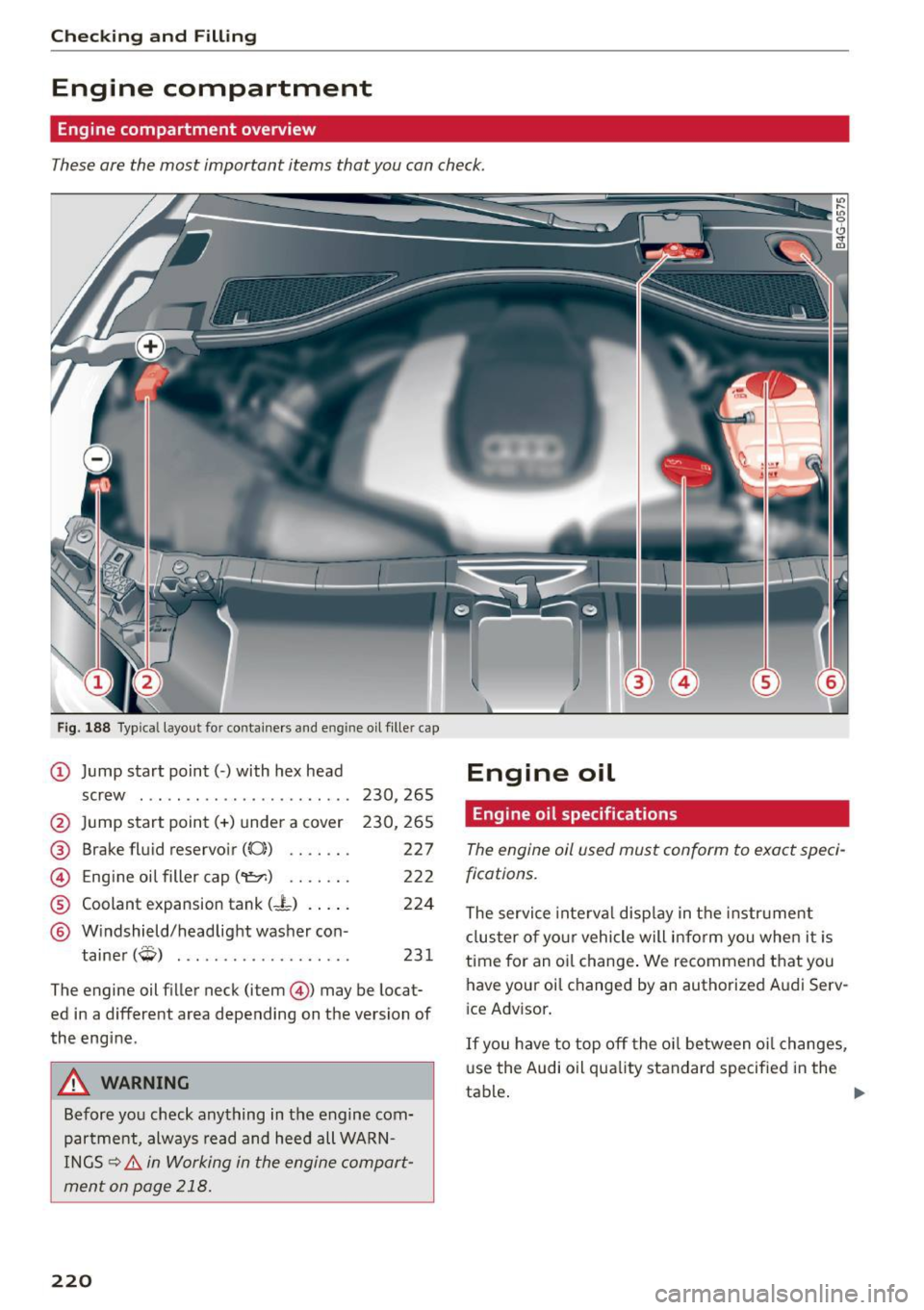
Fig. 188 Typica l layou t fo r con tainers and en gin e oil fille r cap
@ Jump start point( -) with hex head Engine oi L
screw . . . . . . . . . . . . . . . . . . . . . . . 230 , 265
@ Jump start point(+) under a cover
@ Brake fluid reservoir (0)) ...... .
@ Eng ine oil filler cap
('t::71) .. .. .. .
® Coolant expansion tank (-L) .... .
@ Windshield/headlight washer con -
t .
(~ ) amer ~ ................. . .
230,265
227
222
224
231
The engine oil filler neck (item @) may be locat
ed in a different area depending on the version of
the engine .
A WARNING
Before you check anything in the engine com
partment, always read and heed all WARN
INGS~.&.
in Working in the engine compart
ment on page 218.
220
Engine oil specifications
The engine oil used must conform to exact speci
fications.
The service inte rval disp lay in the instr ument
cl us ter of your vehicle will inform you whe n it i s
time for an oi l change . We recommend that you
have your oil changed by an authorized A ud i Serv
i ce Advisor .
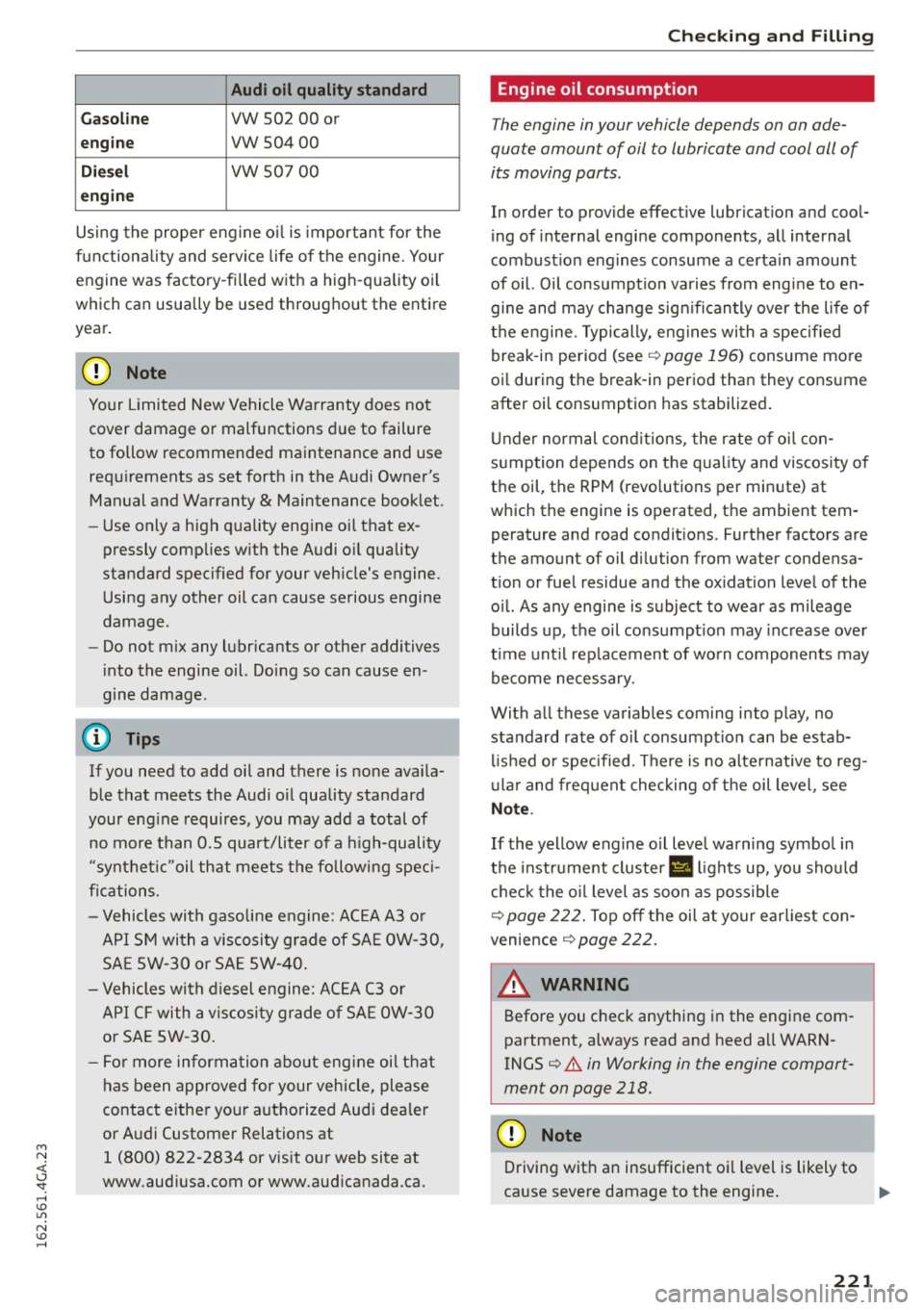
If you have to top off the o il between oi l changes,
use the Audi oil quality standard specifie d in the
table . ..,.
Page 223 of 294
M N <( (.J
'SI: ,...., \!) 1.1"1
N \!) ,....,
Audi oil quality standard
G as oli ne
VW 502 00 or
engi ne vw 504 00
Diese l vw 507 00
eng in e
Using the proper engine o il is important for the
functiona lity and service life of the engine. Your
engine was factory-fi lled with a high-quality oil
which can usually be used throughout the entire
year.
@ Note
Your L imited New Vehicle Warranty does not
cover damage or malfunctions due to failure
to follow recommended maintenance and use
req uirements as set forth in the Audi Owner's
Manual and Warranty
& Maintenance booklet.
- Use only a high quality eng ine oil that ex-
pressly complies w ith the Audi o il quality
standard specified for your veh icle's engine.
Using any other oil can cause serious engine
damage .
- Do not mix any lubricants or other additives
into the engine oil. Doing so can cause en
gine damage.
(D Tips
If you need to add oil and there is none availa
ble that meets the Audi o il quality standard
your eng ine requires, you may add a total of
no more than 0.5 quart/liter of a high-quality
"synthet ic"oil that meets t he followi ng speci
fications.
- Vehicles with gaso line engine: ACEA A3 or
API SM with a viscosity g rade of SAE OW-30,
SAE SW-30 or SAE SW-40.
- Vehicles with diesel engine: AC EA C3 or
API CF with a v iscosi ty grade of SA E OW -30
or SA E SW-30.
- For more information abo ut eng ine oil that
has been approved for your vehicle, please
contact e ither your a uthorized Audi dea ler
or A udi Customer Relations at
1 (800) 822-2834 or visit our web site at
www.audiusa.com or www.aud icanada.ca.
Checking and Fillin g
Engine oil consumption
The engine in your vehicle depends on on ade
quate amount of oil to lubricate and cool oil of
its moving ports.
In order to provide effective lubricat ion and cool
i ng of internal engine components, all internal
combust ion eng ines consume a certain amount
of oil. Oil consumpt io n varies from eng ine to en
gine and may change sign ificantly over the life of
the engine. Typi cally, engines wi th a specified
break -in period (see
¢ page 196) consume more
o il during the b reak-in period than they consume
after oil consumption has stabilized .
Under normal cond itions, the rate of oil con
sumption depends on the quality and viscos ity of
the oil, the RPM (revolutions per min ute) at
which the engine is operated, the ambient tem
perature and road conditions. Further factors are
the amount of oil dilution from water condensa
t ion or fuel residue and the ox idation level of the
o il. As any engine is subject to wear as mileage
builds up, the oil consumption may increase over
t ime unt il replacement of worn components may
become necessary.
With all these variables coming into play, no
standard rate of oil consumpt ion can be estab
lished or spec ified . There is no alte rnative to reg
u la r and freq uent checking of the oil level, see
Note .
If the yellow engine o il leve l warning symbo l in
the instrument cluster
Ill li ghts up, you should
che ck the o il level as soon as possible
¢ page 222. Top off the oil at your earliest con
venience
¢ page 222.
A WARNING
--=-
Before you check anythi ng i n the engine com-
partment, always read and heed a ll WARN
INGS
¢ &. in Working in the engine comport
ment on page 218.
(D Note
Driving wit h an insufficient oil level is likely to
cause severe damage to the engine.
IJJ,,
221
Page 224 of 294
Checking and Fill in g
@ Tips
-The oil pre ssure warning displ ay. is not
a n ind icato r of the oil le vel. Do no t rel y on
i t. In stead , che ck the oil level i n your en
gine at regular inte rvals, preferab ly each
tim e you r efu el, and alway s befor e going
on a long trip .
-If you have the impression your engine con
sumes excess ive amounts of o il, we recom
mend that you cons ult your Audi dealer to
have the cause of your concern prope rly di
agnosed. Keep in mind that t he accurate
measurement of oil consumpt ion req uires
great care and may take some time . Your
A udi dealer has instructions about how to
measure oil consumption accurately.
Checking the eng ine oil level
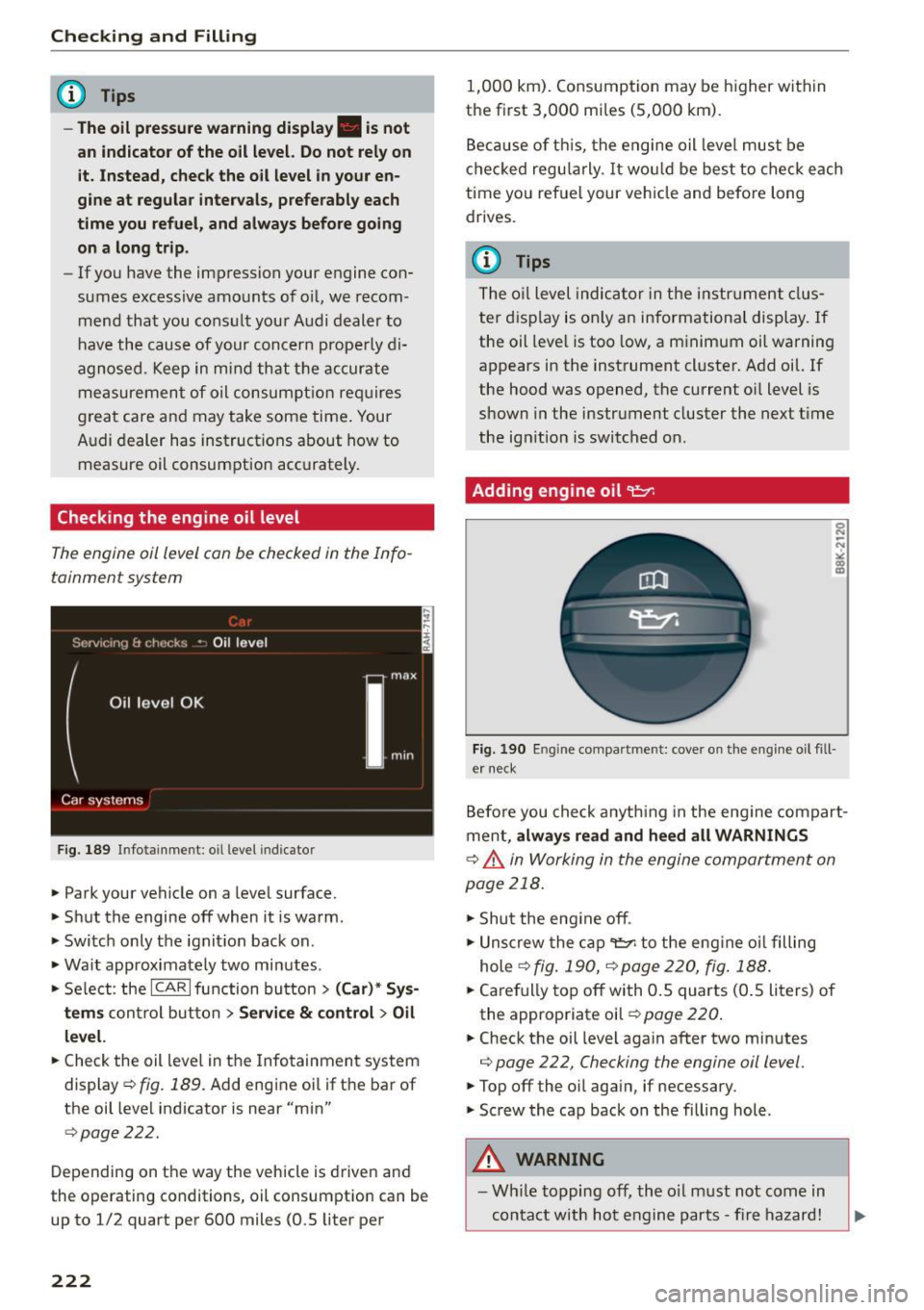
The engine oil level can be checked in the Info
tainment system
F ig. 189 Infotainment: o il level indicato r
• Park your vehicle on a level surface.
• Shut the engine off when it is warm.
• Switch only the ignit ion back on .
• Wait approximately two minutes .
• Se lect : the
ICAR I function button > (C ar)* Sys
tem s
control but ton > S er vic e & con trol > O il
le vel.
• Check the oil leve l in the Info tainment system
display ¢
fig. 189. Add engine oil if the bar of
the oil level indicator is near "min"
r::!;>page222.
Depending on the way the vehicle is driven and
the operating conditions, oil consumption can be
up to 1/2 quart per 600 miles (0.5 liter per
222
1,000 km). Consumption may be h igher within
the first 3,000 miles (5,000 km).
Because of t his, the engine oil Leve l must be
chec ked regu larly . It wo uld be best to check each
time you refuel your vehicle and before long
drives .
{!) Tips
The oil level indicator in the instr ument clus
ter d isplay is only an informational display. If
the oil leve l is too low, a m inimum oil warning
appears in the instrument cluster. Add oil. If
the hood was opened, the current oi l Level is
shown in the instrument cluster the next ti me
the ignition is switched on.
Adding engine oil 'l:::1:
Fig. 190 Engine compart ment: cover on the engine oil fill
er neck
Before you check anyth ing in the eng ine compart
ment,
alwa ys read and h eed all WARN ING S
r::!;> .&. in Working in the engine compartment on
page 218.
• Shu t the eng ine off .
• Unscrew the cap~ to the eng ine oi l filling
hole
r::!;> fig. 190, r::!;> page 220, fig. 188.
• Carefully top off with 0 .5 quarts (0.S liters) of
the appropriate oil
r::!;> page 220.
• Check the oil level again after two minutes
r::!;> page 222, Checking the engine oil level.
• Top off the oil aga in, if necessary.
• Screw the cap back on the filling hole.
_&. WARNING
-Wh ile topping off, the o il must not come in
con tact with hot engine parts -fire hazard!
Page 225 of 294
M N <( (.J
'SI: ,...., \!) ..,.,
N \!) ,....,
-The oil fi ller ca p m ust be prope rly secure d to
preve nt oil from being sprayed on t he hot
eng ine and exhaust system when t he engine
is runn ing -fire haza rd!
- If your skin has come i n contact w ith the en
gine oil, you m ust subsequently clea nse it
th oroughly.
@ Note
-Check the oil level using the MMI. If the
message
Please red uce oil le vel a p pears,
contact your author ized Audi dealer or other
qualified workshop to have excess o il ex
tracted if necessary .
-Audi do es not recommend th e use of o il
additiv es. They ma y damage th e engin e
and ad ve rs e ly affect your New Vehicle War
rant y.
@ For the sake of the environment
-Under no circumstances can the o il come in
contact with the sewage network o r the soil.
- Observe and follow lega l regu lations whe n
dispos ing of empty oil conta iners.
Changing the engine oil
We recommend that have your oil changed by an
authorized Audi dealer or a qualified service sta
tion.
Before you check anything in the engine compart
ment,
alw ay s re ad and heed all WARNINGS c> .&.
in Working in the engine compartment on
page 218 .
The engine oil must be changed according to the
interva ls specified in your Warranty
& Mainte
n ance booklet . This is ve ry important because the
lub ricat ing propert ies of o il diminish gradually
du ring normal vehi cle use.
Unde r some circumstances the engine o il should
be changed more frequently. Change oil more of
ten if you d rive mostly short distances, ope rate
the vehicle in dusty areas or unde r predom inantly
s top-a nd-go tr aff ic condit io ns, o r have you r vehi
cle whe re temperatures rema in below freezing
for extended periods .
Checking and Fillin g
Detergent additives in the oil will make fresh oil
l ook dark after the engine has been running for a
sho rt time. Th is is norma l and is not a reason to
change the oi l more often than recommended.
Beca use of the p roblem of p roper disposal, along
with t he specia l too ls and necessary expertise re
quired, we strongly recommend that yo u have
yo ur o il changed by an authorized
Audi dealer or
a qua lified service station.
If y ou choo se to change your oil yourself , please
note the following important informat ion:
A WARNING "--
To reduce the risk of personal in jury if you
must change the eng ine oi l in your vehicle
yourself:
- Wear eye protect ion.
-
- To reduce the risk of burns from hot eng ine
oil, let the engine coo l down to the touch.
- W hen removing the o il dra in p lug with your
f ingers, stay as far away as possib le. Always
keep yo ur forearm parallel to the ground to
he lp prevent hot o il from running down your
arm.
- Dra in the oil into a container designed for
this purpose, one la rge enough to hold at
least the tota l amou nt of oil in yo ur engine.
- Engine oil is poisonous . Keep it we ll out of
the reach of ch ild ren .
- Continuous contact wit h used eng ine o il is
harmful to your skin. Always protect your
skin by washing oil off thoro ughly wi th soap
a nd water .
«I) Note
Never mix oil additives with yo ur engine oil.
These additives can damage your engine and
adverse ly affect your Aud i Limited New Vehi
cle Warranty.
@ For the sake of the environment
- Before changi ng your oil, first make sure
you know where you can prope rly dispose of
the used oi l.
- Always dispose of used eng ine oi l properly.
Do not dump it o n ga rden soi l, wooded
223