tire pressure AUDI S7 2016 Owner's Manual
[x] Cancel search | Manufacturer: AUDI, Model Year: 2016, Model line: S7, Model: AUDI S7 2016Pages: 294, PDF Size: 73.82 MB
Page 251 of 294

M N <( (.J
'SI: ,...., \!) 1.1'1
N \!) ,....,
~ Check and correct the seating of the snow
chains if necessary after driving a few feet. Fol
low the instructions from the manufacturer.
~ Note the maximum permitted speed when driv
ing with snow chains. Do not exceed 30 mph
(SO km/h) .
Snow chains not only improve the driving in win
ter road conditions, but also the braking.
Use of snow chains is only permitted with certain
rim/tire combinations due to technical reasons.
Check with an authorized Audi dealer or author
i z ed repair facility to see if you may use snow
chains .
You must remove the chains when driving on roads that are free of snow. When roads are free
of snow, snow chains can impair handling and
damage the tires, and the chains will quickly be
destroyed.
A WARNING
Using incorrect snow chains or installing snow
chains incorrectly can result in loss of vehicle
control, which increases the risk of an acci
dent.
- Snow chains can damage the rims/wheel
covers* if the chains come into direct con
tact with them. Remove the wheel covers*
first. Use coated snow chains.
- Using snow chains that add more than 0 .4
inch (10.5 mm) of height can severely dam
age the wheel housings and other vehicle
components.
- Do not install and use snow chains if there is
a malfunction in the adaptive air suspen
sion*, because the vehicle height will be
very low. If you drive with snow chains any
way, the wheel housings and other vehicle
components can be severely damaged.
Low aspect ratio tires
Your Audi is factory-equipped with low aspect ra
tio tires . These tires have been thoroughly tested
and been selected specifically for your model for
Wheels
their superb performance, road feel and handling
under a variety of driving conditions. Ask your au
thorized Audi dealer for more details.
The low aspect ratio of these tires is indicated by
a numeral of
55 or less in the tire's size designa
tion. The numeral represents the ratio of the
tire's sidewall height in relation to its tread width
expressed in percentage. Conventional tires have
a heigh t/width ratio of 60 or more.
The performance of low-aspect-ratio tires is par
ticularly sensitive to improper inflation pres
sure. It is therefore important that low aspect
ratio tires are inflated to the specified pressure
and that the inflation pressure is regularly
checked and maintained. Tire pressures should be checked at least once a month and always
before a long trip
~ page 2 43.
What you can do to avoid tire and rim
damage
Low aspect ratio tires can be damaged more easi
ly by impact with potholes, curbs , gullies or
ridges on the road, particularly if the tire is un
deri nflated.
In order to minimize the occurrence of impact
damage to the tires of your vehicle, we recom
mend that you observe the following precau
tions:
- Always maintain recommended inflation pres
sures. Check your tire pressure every 2,000
miles (3 ,000 km) and add air if necessary.
- Drive carefully on roads with potholes , deep
gullies or ridges. The impact from driving
through or over such obstacles can damage
your tires. Impact with a curb may also cause
damage to your tires.
- After any impact, immediately inspect your
tires or have them inspected by the nearest au
thorized Audi dealer. Replace a damaged tire as
soon as possible.
- Inspect your tires every 2,000 miles (3,000 km)
for damage and wear. Damage is not always
easy to see . Damage can lead to loss of air and
underinflation, which could eventu ally cause
tire failure . If you believe that a tire may have
been damaged, replace the tire as soon as pos -
sible . .,.
249
Page 253 of 294
M N <( I.J "". rl I.O
"' N I.O rl
_& WARNING
Temperature grades apply to tires that are properly inflated and not over or underinflat
ed .
Tire pressure monitoring
system
CD General notes
Each tire, includ ing the spare (if provided),
should be checked monthly when cold and inflat
ed to the inflation pressure recommended by the
vehicle manufacturer on the vehicle placard or tire inflation pressure label. (If your veh icle has
tires of a different size than the size indicated on
the vehicle placard or tire inflation pressure la
be l, you shou ld determine the proper tire infla
tion pressure for those tires).
As an added safety feature, your vehicle has been
equipped with a tire pressure monitoring system
(TPMS) that illuminates a low tire pressure tell
tale when one or more of your tires is significant ly under -inflated. Accordingly, when the low tire
pressure telltale illuminates, you should stop and
check your tires as soon as poss ible, and inflate
them to the proper pressure. Driving on a signifi cantly under-inflated tire causes the tire to over
heat and can lead to t ire failure. Under-inflation
also reduces fuel efficiency and tire tread life,
and may affect the vehicle's handling and stop
ping ability .
Please note that the TPMS is not a substitute for
proper tire maintenance, and it is the driver's re
sponsib ility to ma inta in correct tire pressure,
even if under-inflation has not reached the level
to trigger illuminat ion of the TPMS low t ire pres
sure telltale.
Your vehicle has also been equ ipped with a TPMS
malfunction indicator to indicate when the sys
tem is not operating properly. The TPMS mal
function indicator is combined with the low tire
pressure telltale. When the system detects a
malfunction, the telltale will flash for approxi
mately one minute and then remain continuously
illuminated . This sequence will cont inue upon
Wheels
subsequent vehicle start -ups as long as the mal
function exists.
When the malfunction indicator is illuminated ,
the system may not be able to detect or signal
low tire pressure as intended . TPMS malfunctions
may occur for a variety of reasons, including the
i nsta llation of replacement or alternate tires or
wheels on the vehicle that prevent the TPMS
from functioning properly. Always check the
TPMS malfunction telltale after replacing one or
more t ires or wheels on your veh icle to ensure
that the replacement or alternate t ires and
whee ls allow the TPMS to continue to function
properly.
If the Tire Pressure Monitoring System
indicator appears
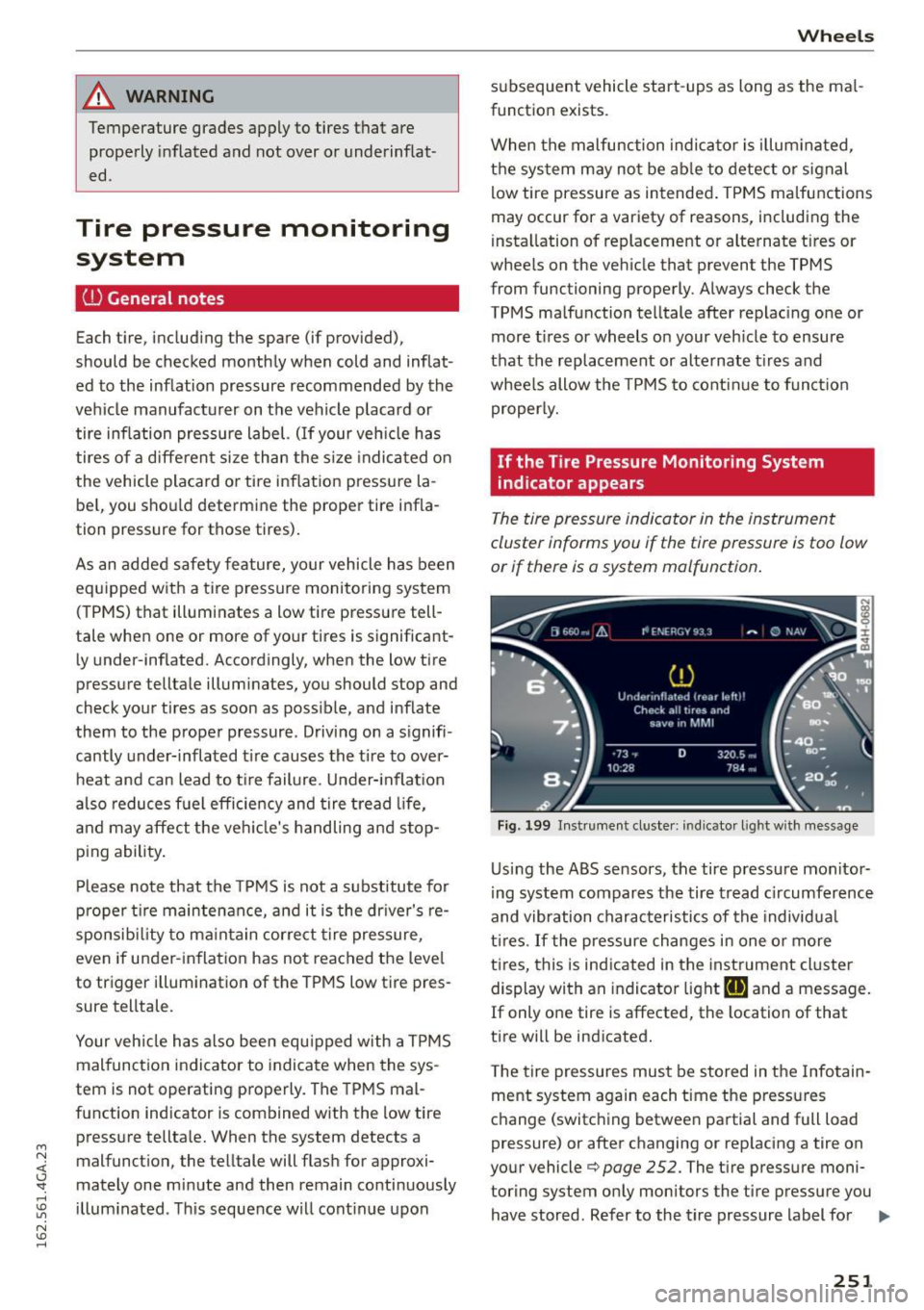
The tire pressure indicator in the instrument
cluster informs you if the tire pressure is too low
or if there is a system mo/function .
Fig. 199 Instrument cluster: indicator light with message
Using the ABS sensors, the tire pressure monitor
ing system compares the tire tread circumference
and vibration characteristics of the individual
tires . If the pressure changes in one or more
t ir es, this is indicated in the instrument cluster
display with an indicator light
HE and a message.
If only one tire is affected, the location of that
tire will be indicated.
T he tire pressures must be stored in the Infotain
ment system again each time the pressures
change (switching between partial and full load
pressure) or after changing or rep lacing a tire on
your vehicle
¢ page 252. The ti re pressure moni
toring system only monitors the tire pressure you have stored. Refer to the tire pressure label for ..,.
251
Page 254 of 294
Wheels
the recommended tire pressure for your vehicle
¢ page 243, fig. 198.
Tire tread ci rcumfe rence and v ibration character
istics can change and cause a tire pressure warn
ing if:
- the tire pressure in one or more t ires is too low .
- the tire has structural damage .
- the tire was replaced or the tire pressure was
changed and it was not stored
¢ page 252.
-the spare tire* is installed .
Indicator lights
IE Loss of pressure in at least one tire¢.&. .
Check the tires and replace or repair if necessary.
Check/correct the pressures of all four tires and
store the pressure again in the Infotainment sys
tem
¢page 252 .
mm (Tire Pressure Monitoring System) Tire pres
sure: System malfunction!. Ifffim
appears after
switching the ignition on or while driving and the
IE indicator light in the instrument cluster
blinks for approximately one minute and then
stays on, there is system malfunction . Try to
store the correct tire pressures¢ page 252. If
the indicator light does turn off or turns on again
after a short period of time, drive to your author
ized Audi dealer or authorized Audi Service Facili
ty immediately to have the malfunction correct
ed .
A WARNING
- If the tire pressure indicator appears in the
display, reduce your speed immediately and
avoid any hard steering or braking maneu
vers . Stop as soon as possible and check the
t ir es and their pressure .
- The driver is responsible for maintaining the correct tire pressure. You must check the
tire pressure regularly.
- Under certain conditions (such as a sporty
dr iving style, winter cond itions or unpaved
roads), the tire pressure monitoring system
indicator may be delayed.
- Do not use run-flat tires on your veh icle. Us
ing them when not permitted can lead to
vehicle damage or accidents.
252
(D Tips
-The tire pressure monitoring system can al
so stop working when there is an ESC mal
function.
- Using snow chains may result in a system
malfunction.
- The tires with the identification "AO" or
"RO" ¢
page 240 have been matched with
your Audi tire pressure monitoring system.
We recommend that you use these tires.
Storing tire pressures
If the tire pressure changes or a tire is replaced,
it must be confirmed in the Infotainment sys tem.
... Make sure before storing that the tire pressures
of all four tires meet the specified values and
are adapted to the load¢
page 243 .
... Switch the ignition on .
... Select: the
I CARI function button > (Car)* Sys
tems
control button > Servicing & checks > Tire
pressure monitoring
> Store tire pressures >
Yes, store now.
(D Tips
Do not store the tire pressures if snow chains
are instal led.
Page 256 of 294
Emerg enc y ass is tance
- Never use the jack supplied with your Audi
on another vehicle, particularly on a heavier
one. The jack is only suitable for use on the
vehicle it came w ith.
(D Tips
- Some of the on board items listed above are
provided on certain models only or are op
tiona l extras .
- Before you can raise your vehicle using the
jack, you must act ivate the jacking mode
c:> page257.
Space-saving spare tire {compact spare
tire)
The spare tire/wheel is located in the luggage
compartment under the cargo floor cover. It is
intended for short-term use only.
Taking out the sp are ti re
.,. Fo ld the floor to the seatback with the help of
the handle .
.,. Turn the large sc rew
c:> page 253, fig. 201 coun
te r-clockwise .
.,. Take out the spare tire .
.,. Always store the vehicle too l kit, the jack* and
the replaced tire in the luggage compartment
c:> page 132.
Using the spare tire (compact spare tir e)
The compact spare tire is only intended for emer
gen cies until you can reach a repair shop. Rep lace
it as qu ickly as possible with a standard wheel
and tire .
There are some rest rictions on the use of the
compact spare t ire. The compact spare t ire has
been designed specifically for yo ur type of vehi
cle.
It must not be swapped w ith a compact
spare tire from another type of vehicle.
Snow chains
F or technical reasons, the use of snow chains on
the compact spa re tire is
not permitted .
If you do have to drive w ith snow chains and a
front tire fails, mount the spare whee l w ith tire
instead of a rear t ire. Install the snow chains on
254
the rear t ire and use it to replace the defect ive
front tire.
A WARNING
- Never use the spare t ire if it is damaged or if
it is worn down to the tread wear indicators.
- If the spare tire is more than 6 years old,
use it only in an emergency and with ex
treme caution and careful driv ing.
- The spare tire is intended only for tempora
ry and short-term use.
It should be replaced
as soon as poss ible with the normal wheel
and tire .
- After mount ing the compact spare t ire, the
tire pressure must be checked as soon as
possible . The tire pressure of the compact
spare tire must be 4 .2 bar; otherwise, you
r is k havi ng an accident.
- Do not dr ive faster than SO mph (80 km/h) .
You risk hav ing an accident .
-Avoid full -thrott le acceleration, heavy brak
ing, and fast cornering . You risk hav ing an
accident .
- Never d rive us ing more than one spare
w heel and ti re . You r isk having an accident .
- Normal summer or w inter t ires must not be
mou nted on the compact spare wheel rim.
- For technical reasons , the use of tire chains
on the spa re tire is not permitted .
If it is
necessary to dr ive with tire chains, the spa re
w heel must be mounted on the front a xle in
t he event of a fla t in a re ar tire. The newly
avail able front whee l m ust th en be insta lled
in place of the rear wheel with the flat tire.
Insta lling the tire c hain before mounting
the whee l and tire is recommended.
- Loose items in the passenger compartment can cause se rious personal injury d uring
hard b raking o r in an accident. Never store
the inflatable spare t ire or jack and tools in
the passenge r compartment.
Page 258 of 294
Emergency assistance
After changing a wheel
A wheel change is not complete without the do
ing the following .
• Always store the vehicle tool kit, the jack* and
the replaced tire in the luggage compartment
¢page 132.
• Check the tire pressure on the spare wheel im
med iately after mounting it.
• As soon as possible, have the
tightening tor
ques
on all wheel bolts checked with a torq ue
wrench . The correct tightening torque is 90 ft
lb (120 Nm).
• Have the flat tire
replaced as soon as possible.
@ Tips
-If you notice that the wheel bolts are cor
roded and difficult to turn while changing a
tire, they should be replaced before you
check the tightening torque.
- Drive at reduced speed until you have the
tightening torques checked .
- After changing a wheel, the tire pressure in
all four tires must be checked/corrected and
the tire pressure mon itor ing indicator must
be stored in the MMI
¢ page 252.
Decorative wheel covers
App lies to veh icles: w ith decorative wheel covers
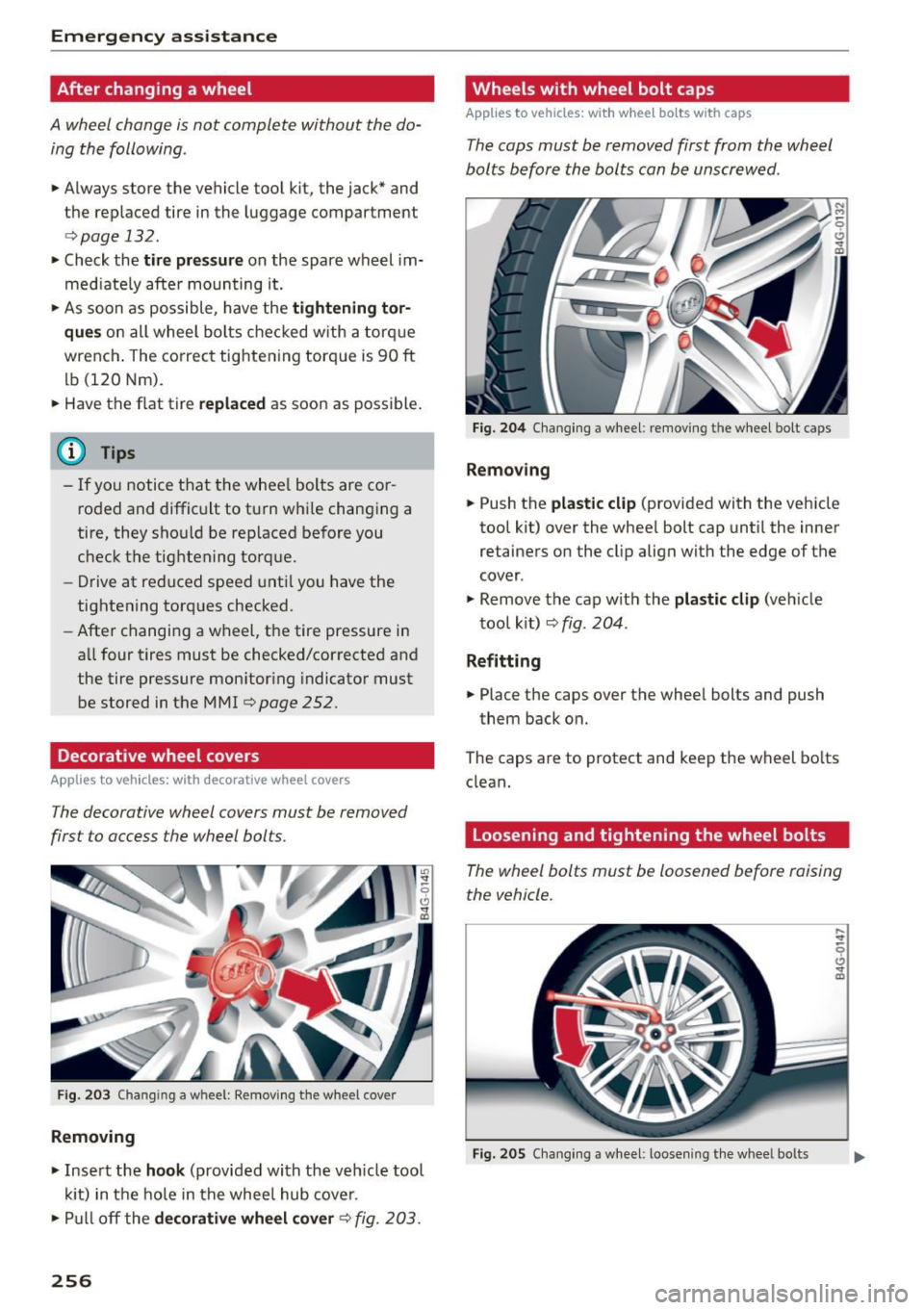
The decorative wheel covers must be removed
first to access the wheel bolts .
Fig. 203 Changing a wheel : Removing the wheel cover
Removing
• Insert the hook (provided with the vehicle tool
kit) in the hole in the wheel hub cover.
• Pull off the
decorative wheel cover¢ fig. 203.
256
Wheels with wheel bolt caps
Applies to vehicles: wi th whee l bo lts with caps
The caps must be removed first from the wheel
bolts before the bolts can be unscrewed .
Fig. 204 Changing a wheel: removing th e wheel bolt caps
Removing
• Push the plastic clip (provided with the vehicle
tool kit) over the whee l bolt cap until the inner
retainers on the clip align with the edge of the
cover .
• Remove the cap with the
plastic clip (vehicle
tool k it)
~ fig . 204 .
Refitting
• Place the caps over the wheel bolts and push
them back on.
The caps are to protect and keep the wheel bolts
clean.
Loosening and tightening the wheel bolts
The wheel bolts must be loosened before raising
the vehicle.
Fig. 205 Changing a wheel: loosen ing the whee l bo lts
Page 262 of 294
Emergency assistance
-If the spare tire has to be installed in the incor
rect direction, use the spare tire only tempora
rily s ince the tire will not be able to achieve its
optimum performance characteristics with re gard to aquaplaning, noise and wear.
- We recommend that you pay particular atten
tion to this fact during wet weather and that
you adjust your speed to match road condi
tions.
- Replace the flat tire with a new one and have it
installed on your vehicle as soon as possible to
restore the handling advantages of a unid irec
tiona l tire .
Notes on wheel changing
Please read the information r=:> page 240, New
tires or wheels
if you are going to use a spa re tire
which is diffe rent from the tires on your vehicle.
After you change a tire:
-Check the tire pressure on the spare immedi
ately after installation.
- Have the wheel bolt tightening torque
checked with a torque wrench as soon as pos
sible by your authorized Audi dealer or a
qualified service station.
- With steel and alloy wheel rims, the wheel
bolts are correctly tightened at a torque of 90
ft lb (120 Nm).
- If you notice that the wheel bolts are corroded
and difficult to turn while changing a tire,
they should be replaced before you check the
tightening torque.
- Replace the flat tire with a new one and have
it installed on your vehicle as soon as possi
ble. Remount the wheel cover .
Until then, drive with extra care and at reduced
speeds .
.8, WARNING
-If you are going to equip your vehicle with
tires or rims which differ from those which
were factory installed, then be sure to read
the information
r=;, page 240, New tires or
wheels .
260
-
-Always make sure the damaged wheel or
even a flat tire and the jack and tool kit are
properly secured in the luggage compart
ment and are not loose in the passenger
compartment.
- In an accident or sudden maneuver they
could fly forward, injuring anyone in the ve
hicle.
- Always store damaged wheel, jack and tools
securely in the luggage compartment. Oth
erwise, in an accident or sudden maneuver
they could fly forward, causing injury to pas
sengers in the vehicle.
Page 270 of 294
Emergency situations
pulled out when towing the vehicle and that
could cause an accident.
Rear towing loop
Only install the rear towing loop when it is need
ed.
0 0
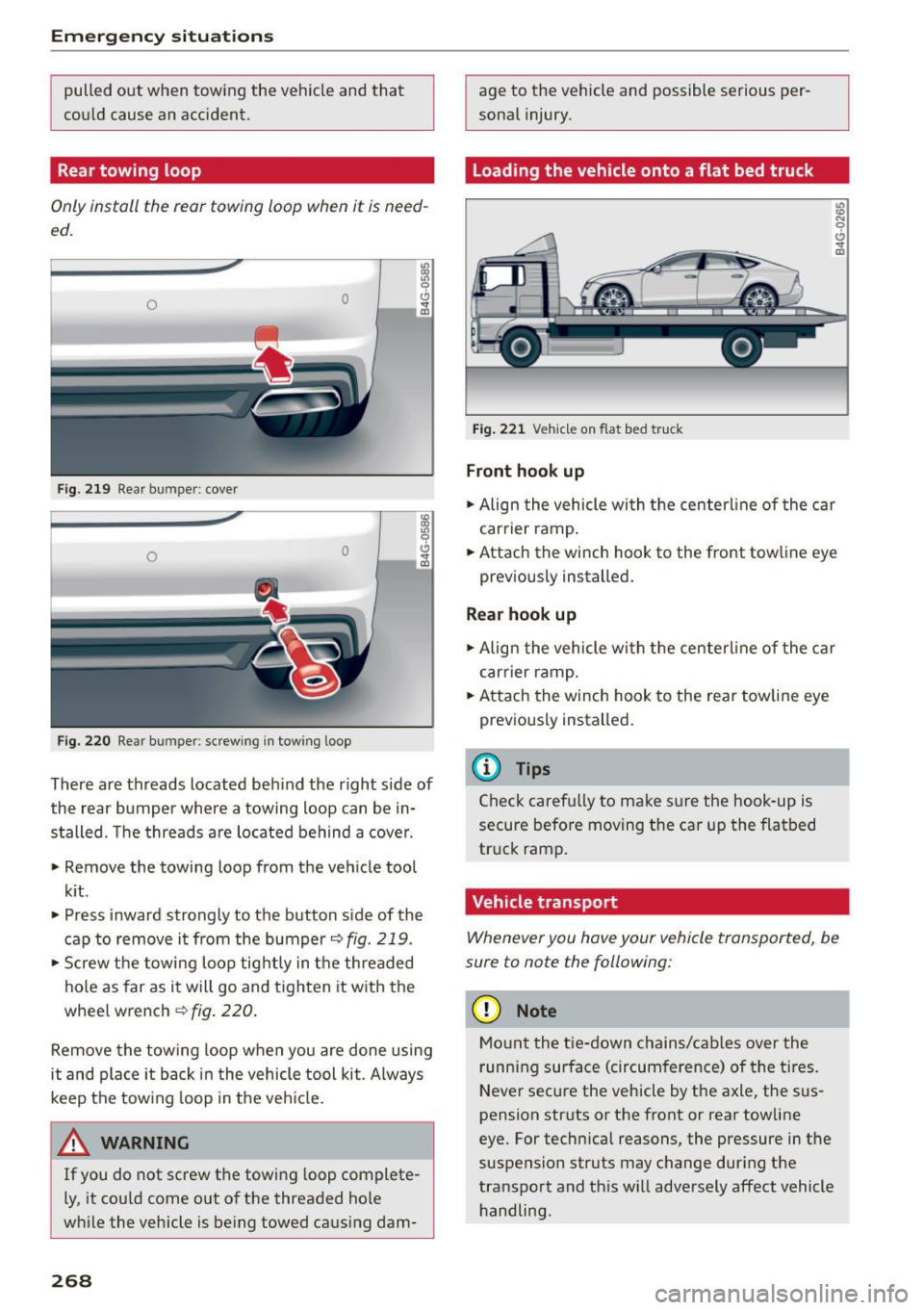
Fig. 219 Rear bumper: c over
0 0
Fig. 220 Rear bump er: sc rew ing in towing loop
There are threads located behind the right side of
the rear bumper where a towing loop can be in
stalled. The threads are located behind a cover.
" Remove the towing loop from the vehicle tool
kit .
.. Press inward strongly to the button side of the
cap to remove it from the bumper
r=;,fig. 219 .
"Screw the towing loop tightly in the threaded
hole as far as it will go and tighten it with the
wheel wrench
r=;, fig. 220.
Remove the towing loop when you are done using
it and place it back in the vehicle tool kit . Always
keep the towing loop in the vehicle.
&_ WARNING
If you do not screw the towing loop complete
ly, it could come out of the threaded hole
while the vehicle is being towed causing dam·
268
age to the vehicle and possible serious per
sonal injury .
Loading the vehicle onto a flat bed truck
Fig. 221 Vehicle on flat bed tru ck
Front hook up
:g N 0 t!, .., m
"Align the vehicle with the centerline of the car
carrier ramp .
.. Attach the w inch hook to the front towline eye
previously installed.
Rear hook up
"Align the vehicle with the centerline of the car
carrier ramp .
.. Attach the winch hook to the rear towline eye
previously installed.
@ Tips
Check carefully to make sure the hook-up is
secure before moving the car up the flatbed
truck ramp.
Vehicle transport
Whenever you hove your vehicle transported, be
sure to note the following:
(D Note
Mount the tie-down chains/cables over the
running surface (circumference) of the tires.
Never secure the vehicle by the axle, the sus
pension struts or the front or rear towline
eye. For technical reasons, the pressure in the
suspension struts may change during the
transport and this will adversely affect vehicle handling.
Page 285 of 294
M N <( (.J
'SI: ,...., \!) 1.1'1
N \!) ,....,
Octane rating ....................... 210
Recommendation ............ ... .. ... 210
Refuelling . ... .............. ... .. .. . 212
Saving fuel . . . . . . . . . . . . . . . . . . . . . . . . . 198
Tank capacity . . . . . . . . . . . . . . . . . . . . . . . 272
F ueling
Fuel filler door emergency release . . . . . . 214
Fue l gauge . . . . . . . . . . . . . . . . . . . . . . . . . . 11
Fu ses
Assignment . . . . . . . . . . . . . . . . . . . . . . . . 262
Replacing . . . . . . . . . . . . . . . . . . . . . . . . . . 261
G
Garage door opener (Homelink) . . . . . . . . . . 41
Garment hooks . . . . . . . . . . . . . . . . . . . . . . . . 60
Gauges Engine coolant temperature . . . . . . . . . . . . 10
General illustration . . . . . . . . . . . . . . . . . . . . . 8
Generator (warning/indicator lights) . . . . . . 16
Glossary of ti re and loading terminology .. 235
Glove compartment (cooled) . . . . . . . . . . . . . 60
Glow plug system
Indica tor light . . . . . . . . . . . . . . . . . . . . . . . 20
Gross Vehicle Weight Rating (GVWR) . . . . . 271
H
H ead -up display . . . . . . . . . . . . . . . . . . . . . . . 27
Headlight Assistt. .. ... ...... ............. ... .. 44
Headlight range control system . . . . . . . . . . 43
H eadlights
Cleaning . . . . . . . . . . . . . . . . . . . . . . . . . . . 206
Headlight range control . . . . . . . . . . . . . . . 22
Headlight range control system . . . . . . . . . 43
Washer reservoir . . . . . . . . . . . . . . . . . . . . 231
Washer system . . . . . . . . . . . . . . . . . . . . . . . 49
H ead restraints . . . . . . . . . . . . . . . . . . . . . . . 129
Adjusting . . . . . . . . . . . . . . . . . . . . . . . . . . 129
Front seats . . . . . . . . . . . . . . . . . . . . . . . . . . 55
Rear seats . . . . . . . . . . . . . . . . . . . . . . . . . . . 56
Removing . . . . . . . . . . . . . . . . . . . . . . . . . . . 56
H eated
Exterior mirrors . . . . . . . . . . . . . . . . . . . . . . 47
Rear window (four-zone automatic climate
control) . . . . . . . . . . . . . . . . . . . . . . . . . . . . . 72
Rear window (three-zone climate control) . 70
Index
Seats (four-zone automatic climate control) .7.2
Seats(three-zone climate control) . . . . . . . 70
Washer nozzles . . . . . . . . . . . . . . . . . . . . . . 49
Heating . . . . . . . . . . . . . . . . . . . . . . . . . . . . . . 68
Heavy clothing and safety belts . . . . . . . . . . 137
High beam . . . . . . . . . . . . . . . . . . . . . . . . . . . . 44
High voltage warning label . . . . . . . . . . . . . 271
Hill descent control . . . . . . . . . . . . . . . . . . . 110
Homelink (garage door opener) . . . . . . . . . . 41
Hood (release lever) . . . . . . . . . . . . . . . . . . . 218
Hooks . . . . . . . . . . . . . . . . . . . . . . . . . . . . . . . 65
Horn . . . . . . . . . . . . . . . . . . . . . . . . . . . . . . . . . 8
How are child restraint system anchors relat-
ed to child safety . . . . . . . . . . . . . . . . . . . . . 180
How many airbags does my vehicle have? . . 150
How safety belt pretens ioners work 141
I
Ignition
Indicator light . . . . . . . . . . . . . . . . . . . . . . . 17
Switching on/off . . . . . . . . . . . . . . . . . . . . . 7S
Imbalance (wheels) . . . . . . . . . . . . . . . . . . . 241
Immobilizer . . . . . . . . . . . . . . . . . . . . . . . . . . 26
Important things to do before driving . . . . 126
Improperly worn safety belts . . . . . . . . . . . . 141
Ind icator lights .. .. ............. .. .... . 11
also refer to Warning/ind icator lights . . . . 11
Infant seats . . . . . . . . . . . . . . . . . . . . . . . . . 173
Inflation pressure (tires) . . . . . . . . . . . . . . . 243
Inspection interval . . . . . . . . . . . . . . . . . . . . . 26
Installing child safety seats Safety belts . . . . . . . . . . . . . . . . . . . . . . . . 177
Installing the upper tether strap on the an
chorage . . . . . . . . . . . . . . . . . . . . . . . . . . . . . 183
Instrument cluster . . . . . . . . . . . . . . . . . . . . . 10
Indicator lights . . . . . . . . . . . . . . . . . . . . . . 11
Messages . . . . . . . . . . . . . . . . . . . . . . . . . . . 11
Instruments . . . . . . . . . . . . . . . . . . . . . . . . . . 10
Adjust ing illumination . . . . . . . . . . . . . . . . . 47
Instruments and controls General illustration . . . . . . . . . . . . . . . . . . . . 8
Interior lighting
Ambient lighting . . . . . . . . . . . . . . . . . . . . . 46
Front and rear . . . . . . . . . . . . . . . . . . . . . . . 46
Intermittent (w indshield w ipers) . . . . . . . . . 49
283
Page 290 of 294
Index
Sport differentia l . . . . . . . . . . . . . . . . . . . . . 101
Indicator light . . . . . . . . . . . . . . . . . . . . . . . 22
Star button . . . . . . . . . . . . . . . . . . . . . . . . . . . 24
Start-Stop-System . . . . . . . . . . . . . . . . . . . . . 80
Eng ine does not switched off . . . . . . . . . . . 81
Eng ine starts automatically . . . . . . . . . . . . 81
Indicato r lights . . . . . . . . . . . . . . . . . . . . . . 80
M essages . . . . . . . . . . . . . . . . . . . . . . . . . . . 8 2
Starti ng/stopping the engine . . . . . . . . . . . 80
Sw itchi ng off/on . . . . . . . . . . . . . . . . . . . . . 82
START E NGINE STOP button . . . . . . . . . . . . . 75
Starting from a stop Hill start assist . . . . . . . . . . . . . . . . . . . . . . . 79
S tarti ng to d rive
W ith a t ra iler . . . . . . . . . . . . . . . . . . . . . . . . 79
Starti ng (engine) . . . . . . . . . . . . . . . . . . . 75 , 80
Steering Electrically ad justab le steering whee l . . . . 74
Electromechan ical stee ring ..... .. .. . 192, 0
Indicator light . . . . . . . . . . . . . . . . . . . 17, 192
Manually adjustable steer ing whee l . . . . . . 74
also refer to Elect romechan ica l stee ring . 192
Steer ing whee l
Buttons.... .. .. ............. .. .. .. .. 24
Easy seat entry . . . . . . . . . . . . . . . . . . . . . . . 75
Steer ing whee l heating . . . . . . . . . . . . . . . . 73
Steering whee l co lumn
Ad justing e lectr ically. ......... .. .. .. .. 74
Ad justing manually . . . . . . . . . . . . . . . . . . . 74
S teer ing whee l with tip troni c... .. .. .... . 11 1
Steps fo r determ ining correct load lim it . . . 24 7
Stopping the engine . . . . . . . . . . . . . . . . . . . . 76
S topping (e ngine) . . . . . . . . . . . . . . . . . . . . . . 80
Sto rage . . . . . . . . . . . . . . . . . . . . . . . . . . . . . . 63
Storage compartments . . . . . . . . . . . . . . . . . 59
Sto rage hooks . . . . . . . . . . . . . . . . . . . . . . . . . 65
S tron ic (aut omatic transmission) . . . . . . . . 107
Launch control program . . . . . . . . . . . . . . 111
Sunroof . . . . . . . . . . . . . . . . . . . . . . . . . . . . . . 4 0
Conven ience opening . . . . . . . . . . . . . . . . . . 40
Eme rgency closing . . . . . . . . . . . . . . . . . . . . 41
Sun shade . . . . . . . . . . . . . . . . . . . . . . . . . . . . 49
Sun visors . . . . . . . . . . . . . . . . . . . . . . . . . . . . 49
Symbo ls
refer to Warn ing/indicator lights . . . . . . . . 11
288
T
Tachometer ... .... .. .. ... . .. .... 1 0, 11, 23
Tail lights Cleaning . . . . . . . . . . . . . . . . . . . . . . . . . . . 206
TOI clean diesel
refer to Ad Blue... .. ............... .. 214
Technical data . . . . . . . . . . . . . . . . . . . . . . . . 271
Technical modifications . . . . . . . . . . . . . . . . 276
T emperature display . . . . . . . . . . . . . . . . . . . . 23
Coolant . . . . . . . . . . . . . . . . . . . . . . . . . . . . . 10
Te ther anchors . . . . . . . . . . . . . . . . . . . . . . . 18 3
Tether strap . . . . . . . . . . . . . . . . . . . . . . . . . 183
Three-zone climate cont ro l
Air vents . . . . . . . . . . . . . . . . . . . . . . . . . . . . 70
Auxiliary heater . . . . . . . . . . . . . . . . . . . . . . 70
Bas ic settings . . . . . . . . . . . . . . . . . . . . . . . . 70
Operati ng . . . . . . . . . . . . . . . . . . . . . . . . . . . 69
Tie-downs . . . . . . . . . . . . . . . . . . . . . . . . 65, 133
Time . . . . . . . . . . . . . . . . . . . . . . . . . . . . . . . . 26
Tips for the environment Sav ing fuel . . . . . . . . . . . . . . . . . . . . . . . . . . 62
tiptronic (automatic transmission) ... 1 07,
111
Tires. . . . . . . . . . . . . . . . . . . . . . . . . . . . . . . . 233
A ll wheel d rive . . . . . . . . . . . . . . . . . . . . . . 192
Low aspect ra tio tires . . . . . . . . . . . . . . . . . 2 49
Rep lacing . . . . . . . . . . . . . . . . . . . . . . . . . . 255
Service life . . . . . . . . . . . . . . . . . . . . . . . . . 241
Tire pressure. . . . . . . . . . . . . . . . . . . . 243, 252
Tire pressure mo nitoring system . . . . . . . 251
Tire pressure table . . . . . . . . . . . . . . . . . . . 244
Treadwear indicators . . . . . . . . . . . . . . . . . 241
Uni directional . . . . . . . . . . . . . . . . . . . . . . . 235
Uni form tire quality g radi ng . . . . . . . . . . . 250
Tires and wheels Glossary of tire and loading terminology . 235
Tires and veh icle load limits . . . . . . . . . . . 245
Too ls . . . . . . . . . . . . . . . . . . . . . . . . . . . . . . . 253
To rn o r frayed safety belts 137
Towing Tow trucks . . . . . . . . . . . . . . . . . . . . . . . . . 267
Towing loop . . . . . . . . . . . . . . . . . . . . . . . . . . 267
TPMS (tire pressu re mon itoring system) . . . 251
Trai ler mode . . . . . . . . . . . . . . . . . . . . . . . . . 201
Notes .... .. .... .. .. .. ........... .. 203