ESP AUDI S8 2008 Owners Manual
[x] Cancel search | Manufacturer: AUDI, Model Year: 2008, Model line: S8, Model: AUDI S8 2008Pages: 404, PDF Size: 52.7 MB
Page 301 of 404
_____________________________________________ C_ l_ e _a_ n_ in~ g_a
_ n_d_ p_ r_ o_ t
_ e_ c_t _io _ n __ fflll
•
from fading . Slight color variations will develop in normal use and
are not an indication of material deterioration.
0 Note
• Never use chemical solvents (e.g. lighter fluid, turpentine),
waxes, shoe polish or similar products on Alcantara® surfaces.
• To avoid damage, have stubborn stains removed by a commer
cial cleaning specialist.
• Do not use brushes, stiff sponges or similarly abrasive cleaning
aids. •
Safety belts
Only well-maintained safety belts work reliably when
needed.
- Keep belts clean.
- For cleaning, use a mild soap and water solution. Let
belts dry thoroughly and away from direct sunlight.
- Do not allow inertia reel safety belts to retract before
they are completely dry.
- Check the condition of your safety belts
regularly.
Heavily soiled safety belts may not retract properly.
& WARNING
Damaged safety belts can break in a crash.
• Anything that might damage your safety belts could mean that
you and your passengers would not be adequately protected in an
accident.
• Safety belt performance depends on correct installation. Never
remove belts from the vehicle to clean them.
&, WARNING (continued)
• Do not use chemical cleaning agents, bleach or dyes. They have
corrosive properties which weaken the webbing.
• When cleaning your safety belts, inspect them for damage. If
you discover damage, see your Audi dealer.
• Always read and heed all WARNINGS and other information
=> page 288. •
Engine compartment
Be especially careful when cleaning the engine compart
ment.
Always switch off the ignition before cleaning the engine => &,.
Plenum panel
Remove leaves from the plenum panel in front of the windshield
under the engine hood. This prevents the water drain holes from
becoming blocked, and it prevents debris from entering the vehicle
interior through the heating and ventilation ducts.
Corrosion protection
The engine compartment and transmission have been corrosion
protected at the factory.
Good anti-corrosion treatment is very important, particularly in the
winter. If the vehicle is frequently driven on salt treated roads, the
entire engine compartment and plenum panel should be thor
oughly cleaned at the end of winter and retreated to prevent salt
damage. At the same time, the underside of the vehicle should be
washed as well.
If the engine compartment is cleaned at any time with grease
removing solutions
11 , or if you have the engine washed, the anti
corrosion treatment is almost always removed as well. It is therefore .,_
11 Use only the correct cleaning solut ions. Never use gasoline or diesel fuel.
Vehicle care
Page 304 of 404
Fuel supply and filling your fuel tank
Blend of gasoline and ethanol (grain alcohol or ethyl alcohol}
• Anti -knock index must be 87 AKI or higher.
• Blend must not contain more than 10% ethanol.
Blend of gasoline and MTBE
• Anti-knock index must be 87 AKI or higher.
• Blend must contain not more than 15% MTBE.
Seasonally adjusted gasoline
Many gasoline grades are blended to perform especially well for
winter or summer driving. During seasonal change-over, we suggest
that you fill up at busy gas stations where the seasonal adjustment
is more likely to be made in time.
0 Note
• Methanol fuels which do not meet these requirements may
cause corrosion and damage to plastic and rubber components in
the fuel system.
• Do not use fuels that fail to meet the specified criteria in this
chapter.
• If you are unable to determine whether or not a particular fuel
blend meets the specifications, ask your service station or its fuel
supplier.
• Do not use fuel for which the contents cannot be identified.
• Fuel system damage and performance problems resulting from
the use of fuels different from those specified are not the responsi
bility of Audi and are not covered under the New Vehicle or the
Emission Control System Warranties.
• If you experience a loss of fuel economy or driveability and
performance problems due to the use of one of these fuel blends,
we recommend that you switch to unblended fuel. •
Gasoline additives
A major concern among many auto manufacturers is carbon
deposit build-up caused by the type of gasoline you use.
Although gasoline grades differ from one manufacturer to another,
they have certain things in common. All gasoline grades contain
substances that can cause deposits to collect on vital engine parts,
such as fuel injectors and intake valves. Although most gasoline
brands include additives to keep engine and fuel systems clean,
they are not equally effective.
Audi recommends using TOP TIER Detergent Gasoline. For more
information on TOP TIER Detergent Gasoline, please go to the offi
cial website (www.toptiergas.com).
After an extended period of using inadequate fuels, carbon deposit
build -ups can rob your engine of peak performance.
(D Note
Damage or malfunction due to poor fuel quality is not covered by
the Audi New Vehicle Limited Warranty. •
Fuel tank
Fuel filler neck
The fuel filler neck is located on the right rear side panel behind the
fuel filler flap.
If the power locking system should fail, you can still open the flap
manually - for detailed instructions
see=> page 305.
You can find the fuel tank capacity of your vehicle in Technical Data
=> page 378. ~
Page 306 of 404
Fuel supply and filling your fuel tank
Refuelling procedure
- Insert the fuel nozzle from the gasoline pump into the
fuel filler neck as far as it will go.
- Select a medium refuelling rate so that the nozzle switches off automatically when the tank is full.
Putting the fuel cap back on
-After filling your tank, twist the fuel filler cap clockwise
until you hear a definite click.
- Close the fuel filler flap.
To avoid fuel spilling or evaporating from the fuel tank always close
fuel filler cap properly and completely. An improperly closed fuel
filler cap may also cause the MIL
lamp=> page 27 to come on.
& WARNING
Improper refueling or handling of fuel can cause fire, explosion
and severe burns.
• Fuel is highly flammable and can cause severe burns and other
injuries.
• Failure to shut the engine off while refueling and/or to insert
the pump nozzle fully into the fuel filler neck could cause fuel to spray out of filler neck or to overflow. Fuel spray and overflowing
fuel can cause a fire.
• Never use a cellular telephone while refueling. The electromag
netic radiation can cause sparks that can ignite fuel vapors and
cause a fire.
• Never get back into your vehicle while refueling. If in excep
tional circumstances you must get back in your vehicle while refu
eling, make certain that you close the door and touch metal to
discharge static electricity before touching the filler nozzle again.
Static electricity can cause sparks that can ignite fuel vapors
released during refueling .
& WARNING (continued)
• Never smoke or have an open flame anywhere in or near your
vehicle when refueling or filling a portable fuel container.
• For your safety, we strongly recommend that you do not travel
with a portable fuel container in your vehicle. The container, full or
empty may leak and could cause a fire, especially in a crash.
• If, under exceptional circumstances, you must transport a
portable fuel container, please observe the following:
-Never fill a portable fuel container while it is anywhere in or
on the vehicle (for example, in the luggage compartment, or on
the trunk). Static electricity can build up while filling and can
ignite fuel vapors causing a fire.
- Always place a portable fuel container on the ground before
filling.
- Always keep the filler nozzle completely inside the portable
container before and during filling.
- If filling a portable container made of metal, the filler nozzle
must always be in contact with the container. This will help
prevent static electricity from discharging and cause a fire.
- Never spill fuel inside the vehicle or luggage compartment. Fuel vapors are highly flammable .
- Always observe local and state/provincial laws regarding the
use, storage and transportation of fuel containers.
- Make certain the fuel container meets industry standards
(ANSI / ASTM F852-86).
0 Note
If any fuel has spilled onto the car, it should be removed immedi-
ately to prevent damage to the paint.
~
Page 309 of 404
___________________________________________ C=..:...: h:.:e :.: c:.: k.:.: i.:.: n :3:g ~ a:.:.n .:.: d::......:. f..:..:il ..:..:li .:.:n3g !._ _9I
•
Closing the engine hood
- Pull the hood down until the pressure from the struts is
reduced .
- Let the hood
drop down and latch in place. Do not try to
push it shut;
it may fail to engage =>& .
& WARNING
A hood that is not completely latched could fly up and block your
view while driving.
• When you close the engine hood, check it to make sure the
safety catch has properly engaged. The hood should be flush with
the surrounding vehicle body parts.
• If you notice while driving that the hood is not secured prop
erly, stop at once and close it. •
Working in the engine compartment
Be especially careful whenever you work in the engine
compartment.
Whenever you must perform any work in the engine compartment,
for example checking and filling different fluids, there is a risk of injury, burns and accidents. To prevent personal injury always
observe the following WARNINGS. The engine compartment of any
vehicle is a hazardous area
~ & .
& WARNING
To help avoid injury, before you check anything under the hood :
• Turn off the engine. • Remove the ignition key.
• Apply the parking brake.
• I I • • I
& WARNING (continued)
• Move selector lever to "P" (Park).
• Always let the engine cool down. Hot components will burn
skin on contact.
• To reduce the risk of being burned, never open the hood if you
see or hear steam or coolant escaping from the engine compart
ment. Wait until no steam or coolant can be seen or heard before
carefully opening the hood.
• Keep children away from the engine compartment .
• Never spill fluids on hot engine components. They can cause a
fire.
• Never touch the radiator fan. The auxiliary electric fan is
temperature controlled and can switch on suddenly.
• Never open the coolant reservoir cap when the engine is still
warm. The coolant system is pressurized and hot coolant could spray out.
• Protect your face, hands and arm from steam or hot engine
coolant by placing a thick rag over the cap when you open the
coolant reservoir.
• If work on the fuel system or the electrical system is necessary:
- Always disconnect the battery.
- Never smoke or work near heaters or open flames . Fluids in
the engine compartment could start a fire.
- Keep an approved fire extinguisher immediately available.
• To avoid electrical shock and personal injury while the engine
is running or being started, never touch:
-Ignition cables
- Other components of the high voltage electronic ignition system.
• If you must perform a check or repair with the engine running: -First, fully apply the parking brake, move selector lever to
"P"
(Park). .,_
Vehicle care
Page 317 of 404
___________________________________________ C;:_:_: h..:e ..:c :..;.k..: i_n ..::g :.._ a_n _d_ f_il _li _n ..::g :.._--JIIIII
0 Note
• Before winter sets in, have the coolant checked to see if the
coolant additive in your vehicle is sufficient to meet the climate
conditions. This is especially important if you live in a region where
the winter is extremely cold. If necessary , increase the proportion of
coolant additive to 60%.
• When adding coolant additive to your cooling system,
remember:
-We recommend using only coolant additive G12+ + (check the
label) for your vehicle. This coolant additive is available at autho
rized Audi dealers. Other types of antifreeze can significantly
reduce corrosion protection . The resulting corrosion can cause a
loss of coolant and serious engine damage .
• Do not add any type of radiator leak sealant to your vehicle's
engine coolant. Adding radiator repair fluid may adversely affect the
function and performance of your cooling system and could result
in damage not covered by your New Vehicle Limited Warranty .•
Checking the engine coolant level
The engine coolant level can be checked with a quick
glance.
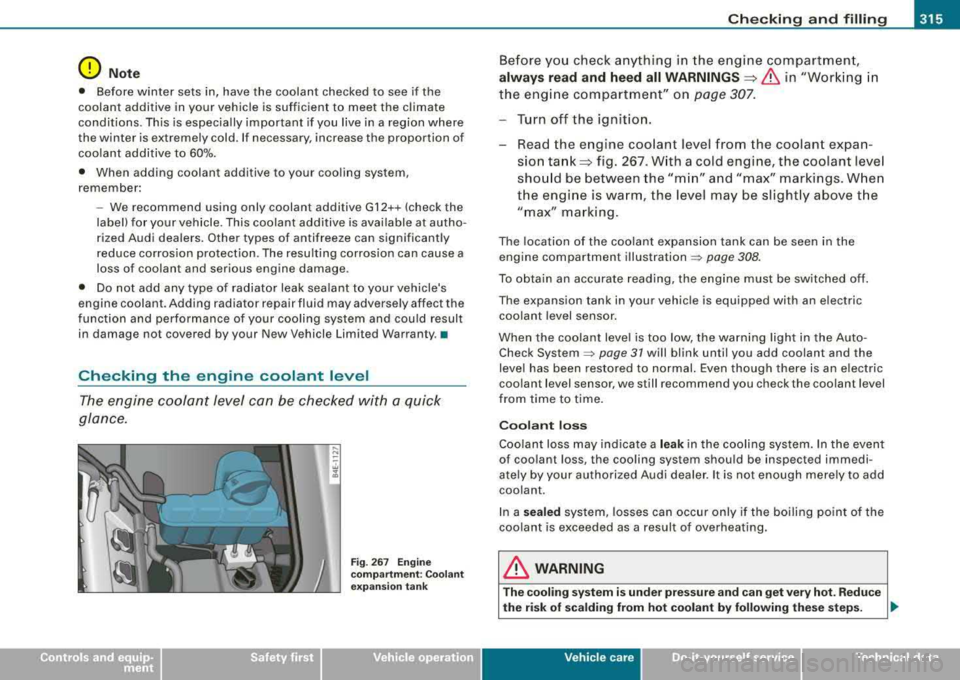
Fig . 267 Engine
compartment : Coolant
expansion tank
Before you check anything in the engine compartment,
always read and heed all WARNINGS => & in "Working in
the engine compartment" on
page 307.
Turn off the ignition.
Read the engine coolant level from the coolant expan
sion
tank => fig. 267 . With a cold engine, the coolant level
should be between the "min" and "max" markings. When
the engine is warm, the level may be slightly above the
"max" marking.
The location of the coolant expansion tank can be seen in the
engine compartment illustration =>
page 308.
To obtain an accurate reading, the engine must be switched off.
The expansion tank in your vehicle is equipped with an electric
coolant level sensor.
When the coolant level is too low, the warning light in the Auto
Check
System => page 31 will blink until you add coolant and the
level has been restored to normal. Even though there is an electric
coolant level sensor, we still recommend you check the coolant level
from time to time.
Coolant loss
Coolant loss may indicate a leak in the cooling system. In the event
of coolant loss, the cooling system should be inspected immedi
ately by your authorized Audi dealer . It is not enough merely to add
coolant .
In a
sealed system, losses can occur only if the boiling point of the
coolant is exceeded as a result of overheating.
& WARNING
The cooling system is under pressure and can get very hot. Reduce
the risk of scalding from hot coolant by following these steps.
.,_
Vehic le care I I Technical data
Page 321 of 404
_____________________________________________ C_h_ e_ c
_ k_in -= g_a
_ n_d _ f_il _li _n ..;::g ;;.___.IIIII
checked by a service facility. The e lectrolyte level should also be
checked each time the battery is charged =>
page 321.
Have the battery checked when you take your vehicle in for service.
You are well advised to replace a battery that is older than 5 years.
With ce rtain types of airbag deployment, the battery is discon
nected from the vehicle electrical system for safety reasons=>
& in
"Repair, care and disposal of the airbags" on
page 232.
Di sconn ecting the b atte ry terminal s
Some veh ic le functions (power window regulators, for example) are
lost if the battery terminals are disconnected. These functions have
to be relearned after the battery terminals are connected again. To
prevent this, the battery should only be disconnected from the
veh icle electrical sys tem when absolu tely necessary for repairs.
Veh icl es not driv en for lo ng p eriods
If you do not drive your vehicle over a period of several days or
weeks, electrical components are gradually cut back or switched off.
This reduces energy consumpt ion and maintains starting capability
over a longer period
=> page 274 .
Be aware that when you unlock your vehicle, some of the conve
nience functions may not operate, such as the Advanced Key*, the
remote control or the power seat adjustment. The convenience
functions will be ava ilable again when you turn on the ignition and
start the engine.
W int er operati on
During the winter months, battery capacity tends to decrease as
temperatures drop. This is because more power is also consumed
while starting, and the headlights, rear window defogger, etc. , are
used more often .
Avoid unnecessary power consumption, particularly in city traffic or
when trave ling only short distances . Let your authorized Audi dea ler
check the capacity of the vehicle battery before winter sets in
=> page 321. A well charged battery will n ot only prevent starting
problems when the weather is cold, but wi ll also last longer.
[ i ] Tips
If your vehic le is left standing for severa l weeks at extreme ly low
temperatures, the vehicle battery should be removed and stored
where it will not freeze. Th is wil l prevent it from be ing damaged and
having to be replaced.•
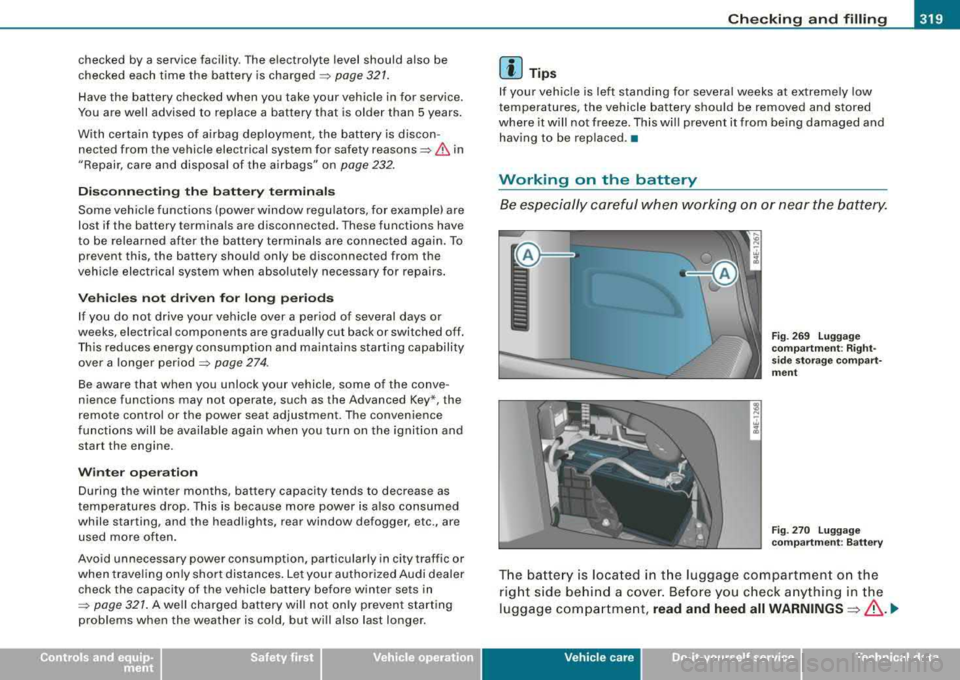
Working on the battery
Be espe cially careful when w orking on or near the battery.
Fig . 2 69 Lugg age
co mpartment : R ight
si de sto ra ge c omp art
m ent
F ig. 2 70 Lugg age
co mp artment : B atte ry
T h e ba tter y is lo ca te d in t he luggage compartm ent on the
r ight side b ehind a c ove r. Before you check a nything in the
luggag e co m partment,
read and heed all WARNINGS =>& . .,.
Vehic le care I I irechnical data
Page 324 of 404
-Checking and filling PW~---=---=----------------
It is not necessary to remove the battery from the luggage compart
ment, and it is also not necessa ry t o disco nnec t the cab les.
F a st ch arging th e batt ery ( charging rate above 14 .8
V olts )
For technical reasons do not use a battery charger that uses voltage
greater tha n 14.8 Vo lts to charge your veh ic le's battery.
& WARNING
C harging a b attery can be dangerou s.
• Always follow the operating in structions provided by the
battery charger manufacturer when ch arging your b attery .
• Never charge a frozen battery . It may expl ode because of ga s
t rapped in the ice . Allow a frozen batter y to tha w out fir st .
• Do not reu se batteries which were fro zen. The battery hou sing
m ay have cracked and weakened when the battery froze.
• Charge the battery in a well ventilated are a. Keep aw ay from
open flame or electric al spar k. Do not smoke . Hydr ogen gas gener
ated by the battery i s explosive.
• To reduc e the danger of e xplosion , never conne ct or dis conn ect
charger cable s while the charger i s oper ating.
• Fa st charging a batter y is dangerous and should only be
a ttempted by a competent technician with the proper equipment .
• Battery ac id that may spill during charging should be washed
off with a solution of warm water and b aking soda to neutralize
the a cid .
0 Note
Never use a fast charger as a booster to start the engine. This wil l
ser iously damage sens it ive elect ronic compo nents, such as control
units, r elays, radio , etc ., as wel l as the battery charger. •
Battery replacement
The new batte ry mus t have t he s ame s pecificati ons and
dimensions as the original equipment battery.
I ntel ligent energy management in your vehicle is responsible for
distr ibut ing the e lectr ica l energy throughout your veh icle
~ page 274. The inte lligent energy management system will keep
t he engine ba ttery charged be tter than vehicles without t his sys tem.
T o make sure the add it ional electr ical energy is avai lab le once aga in
after you have changed t he battery, we recommend that you ins tall
batteries of the same type and manufacture only (the same as those
insta lled at the time your vehicle was delivered). Specifications are
listed on the battery housing . Your authorized Audi dea ler wi ll then
code the battery management contro l unit .
The new battery must have the same capacity, voltage (12 volts), amperage, construction and p lug sea ling.
When instal ling the battery, make sure the ign ition and all elect rica l
consumers are turned off .
0 Note
Make sure the ventilation hose on the side of the battery is
connected, otherwise fumes or battery acid can leak out.
'£> For the sake of the environment
Because of the problem of proper disposal of a battery, we recom
mend your authorized Audi dealer change the battery for you.
Batteries contain sulfur ic acid and lead and must always be
disposed of proper ly i n compliance with all environmental regula
tions . Disposing of vehicle batteries improper ly is very dangerous to
t he environment .•
Page 327 of 404
Tires and wheels -
----------------
•
& WARNING (continued)
crashes and serious personal injuries . Have worn or damaged tires
replaced immediately.
• Tires age even if they are not being used and can fail suddenly,
especially at high speeds. Tires that are more than 6 years old can
only be used in an emergency and then with special care and at
low speed.
Glossary of tire and loading terminology
Accessory weight
means the combined weight (in excess of those standard items
which may be replaced) of automatic transmission, power steering,
power brakes, power windows, power seats, radio, and heater, to
the extent that these items are available as factory-installed equip
ment (whether installed or not).
Aspect ratio means the ratio of the height to the width of the tire in percent.
Numb ers of 55 or lower indicate a low sidewall for improved
steering response and better overall handling on dry pavement.
Bead
means the part of the tire that is made of steel wires, wrapped or
reinforced by ply cords and that is shaped to fit the rim.
Bead separation
means a breakdown of the bond between components in the bead.
Cord
means the strands forming the plies in the tire.
& WARNING (continued)
• Never mount used tires on your vehicle if you are not sure of
their
"previous history." Old used tires may have been damaged
even though the damage cannot be seen that can lead to sudden
tire failure and loss of vehicle control.
• If you notice unusual vibration or if the vehicle pulls to one side
when driving, always stop as soon as it is safe to do so and check
the wheels and tires for damage.
•
Cold tire inflation pressure
means the tire pressure recommended by the vehicle manufacturer
for a tire of a designated size that has not been driven for more than
a couple of miles (kilometers) at low speeds in the three hour period
before the tire pressure is measured or adjusted.
Curb weight
means the weight of a motor vehicle with standard equipment
including the maximum capacity of fuel, oil, and coolant, air condi
tioning and additional weight of optional equipment.
Extra load tire
means a tire design to operate at higher loads and at higher infla
tion pressures than the corresponding standard tire. Extra load tires
may be identified as
"XL", "xi", "EXTRA LOAD", or "RF" on the side
wall.
Gross Axle Weight Rating
("GAWR")
means the load-carrying capacity of a single axle system, measured
at the tire -ground interfaces.
Gross Vehicle Weight Rating
( " GVWR")
means the maximum total loaded weight of the vehicle.
Vehicle care
Page 328 of 404
_L--_T_ ir_e_ s_ a_ n_d _ w_ h_ e_e _l_s _________________________________________________ _
Groove
means the space between two adjacent tread ribs.
L oa d r atin g (code)
means t he m aximum load that a t ire is rated to carry for a given
inf lation pressure . You may not find this information on a ll tires
because it is not required by law.
M ax imum l oad r ating
means t he load rating for a tire a t the maximum permissib le infla
tion pressure for that tire.
Maximum l oaded v ehi cle wei ght
means the sum of:
(a) Curb weight
(b) Accessory weight
(c) Vehicle capaci ty weight, and
(d) Product ion options weight
M ax imum (p er mis sibl e) infl ati on pr essure
means the maximum cold i nflation pressure to wh ic h a t ire may be
inflated. Also cal led "maximum inflation pressure."
Normal occ upant we ight
means 150 lbs. (68 ki lograms) times the number of occupants
seated in the veh ic le up to the total seating capacity of your vehicle.
Oc cupant distributi on
means distribution of occupants in a vehicle .
Outer di ameter
means the overal l diameter of an inf lated new tire.
O verall width
means the linear distance between the exteriors of the sidewa lls of
an infla ted t ire, includ ing elevat ions due to labe ling, decorat ions, or
protective bands or ribs .
Ply
means a layer of rubber -coated para llel cords.
P rodu cti on opt ion s we ig ht
means the co mbined weight of those insta lled regular product ion
options weighing over 5 lbs. (2.3 kg) in excess of those standard
items which t hey replace, not previously considered in curb weight
or accessory weight, inc luding heavy duty brakes, ride levelers, roof
rack, heavy du ty bat tery, and special trim .
Rad ia l pl y tir e
means a pneumat ic t ire in wh ich t he ply cords that extend to the
beads are laid at substantially 90 degrees to the centerline of the
t read .
Recomm ended infl ation pres su re
see :::::> page 325, "Cold tire inflat ion pressure".
R einforc ed tir e
means a tire des ign to operate at higher loads and at higher infla
tion pressures than the corresponding standard tire. Reinforced
t ires may be iden tified as
"XL", "xi", "EXTRA LOAD", or "RF" on the
sidewa ll.
Rim
means a metal support for a tire or a tire and tube assembly upon
whic h the t ire beads are seated.
Rim di ame ter
means nominal diameter of the bead seat. If you change your whee l
size, you wi ll have to purchase new tires to match the new rim diam
eter.
Rim siz e design ation
means rim diameter and width.
Rim w idth
means nominal distance between rim flanges .
Page 330 of 404
lllffl...__T_ ir_e _ s_ a_ n
_ d_ w_ h_ e_ e_ls _________________________________________________ _
Occupant loading and distribution for vehicle normal load for various designated seating capacities Designated seating capacity , num
ber of occupants
4
5
Cold tire inflation pressure
Vehicle no rmal load, number of
oc cupants
2
3
Occupant distribution in a normally
loaded vehicle
2 in front
2 in front, 1 in back seat
Tire pressure affects the overall handling, performance and safety of a vehicle.
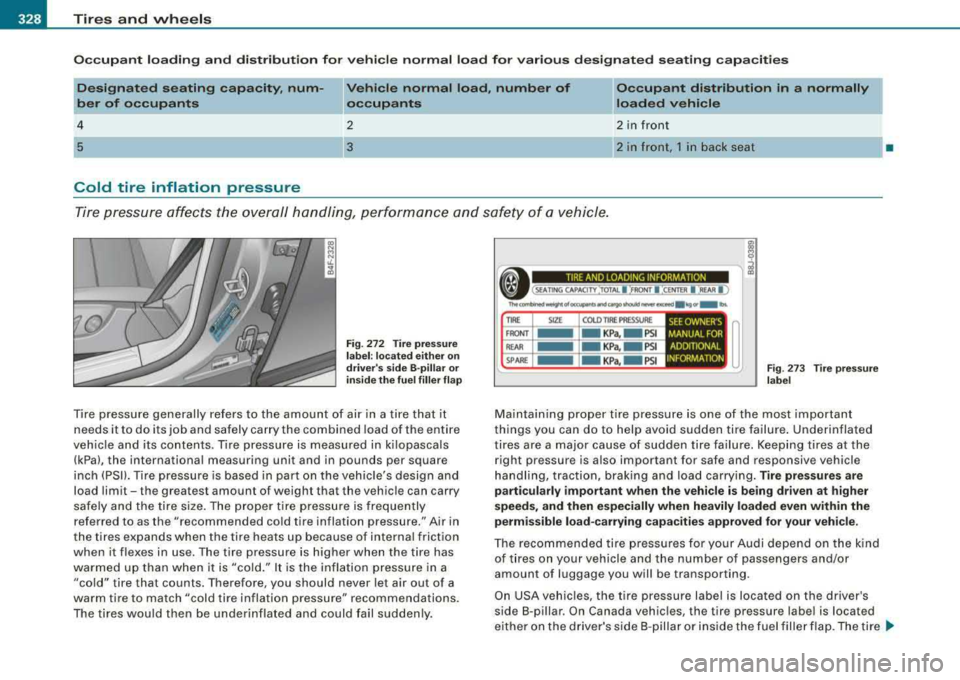
Fig . 272 Tire pressure
label: located either on
driver's side B-pillar or
inside the fuel filler flap
llRE AND LOADING INFORMATION
T IRE SIZE COLO TIRE PRESS URE
FRONT -KPa, -PSI
REAR -KP a, -PSI
SPARE -KPa , -PSI \.~__., ::::::::;=~ ===..:;,;_. Fig. 273 Tire pressure
label
Maintaining proper tire pressure is one of the most important
things you can do to help avoid sudden tire failure. Underinflated
tires are a major cause of sudden tire failure. Keeping tires at the
right pressure is also important for safe and responsive vehicle
handling, traction, braking and load carrying.
Tire pressures are
particularly important when the vehicle is being driven at higher
speeds, and then especially when heavily loaded even within the
permissible load-carrying capacities approved for your vehicle.
The recommended tire pressures for your Audi depend on the kind
of tires on your vehicle and the number of passengers and/or
amount of luggage you will be transporting.
•
Tire pressure generally refers to the amount of air in a tire that it
needs it to do its job and safely carry the combined load of the entire
vehicle and its contents . Tire pressure is measured in kilopascals
(kPa), the international measuring unit and in pounds per square
inch (PSIJ. Tire pressure is based in part on the vehicle's design and
load limit
-the greatest amount of weight that the vehicle can carry
safely and the tire size. The proper tire pressure is frequently
referred to as the "recommended cold tire inflation pressure." Air in
the tires expands when the tire heats up because of internal friction
when it flexes in use. The tire pressure is higher when the tire has
warmed up than when it is "cold." It is the inflation pressure in a
"cold" tire that counts. Therefore, you should never let air out of a
warm tire to match "cold tire inflation pressure " recommendations .
The tires would then be underinflated and could fail suddenly. On
USA vehicles, the tire pressure label is located on the driver's
side 8-pillar . On Canada vehicles , the tire pressure label is located
either on the driver's side 8 -pillar or inside the fuel filler flap . The tire
l)ll-