change wheel AUDI S8 2008 User Guide
[x] Cancel search | Manufacturer: AUDI, Model Year: 2008, Model line: S8, Model: AUDI S8 2008Pages: 404, PDF Size: 52.7 MB
Page 286 of 404

ffl.___T_ r_a _il _e_ r_ t_o _w_ i_ n """g"'- ---------------------------------------------------
Speed
The higher the speed, the more difficu lt it becomes for the driver to
control the rig. Do not drive at the maximum permissible speed. Reduce your speed even more if load, weather or wind conditions
are unfavorable
-particularly when going downhi ll.
Reduce vehicle speed
i mm edia te ly if the trailer shows the slightest
sign of swaying.
Do not try t o stop the sway ing by accelerating.
Observe speed lim its. In some areas, speeds for vehicles towing
trai lers are lower than for regular ve hicles .
Always apply brakes ear ly. When driving down hill, shift into a lower
gear to use the engine braking effect to slow the vehicle. Use of the
brakes a lone can cause them to overheat and fail.
Cool ant temp era tu re
The coolant temperature gauge=> page 12 must be observed care
ful ly. If the needle moves close to the upper end of the scale, reduce
speed immed iately and/or turn off the air conditioner.
If the coolant temperature warning light in the instrument cluster
starts flas hing
-F- , pul l off the road, stop and let t he engine idle for
about two m inutes to prevent heat build-up.
& WARNING
An yone n ot properl y re str aine d in a mo ving vehi cle is at a mu ch
g re ate r ri sk in an accid ent . N ever let any on e rid e in y our car who
i s not properl y wea rin g th e res tra int s pr ov ided by Audi.
•
Trailer towing tips
Important to know
Your vehicle handles differently when towing a trailer because of
the additional weight and different weight distribution. Safety, performance and economy wi
ll greatly depend on how carefully you
l oad your trailer and opera te your r ig.
Before you actual ly tow your trailer, practice turn ing, stopping and
backing up in an area away from traffic . Keep practicing unti l you
have become comp letely fam iliar with the way your vehicle-trai ler
combination behaves and responds.
Backing up is di fficult and requires practice. Backing up with a
trai ler generally requires steering action opposite to that when
backing up your veh ic le without a tra iler.
Ma inta in a greater distance between your veh ic le and the one in
front of you . You will need more room to stop. To compensate for
the trai ler, you w ill need a larger than norma l turning radius.
When passing, remember that you cannot accelerate as fast as you n or mally wou ld because of t he added load . Make su re you have
enough room to pass . After passing, al low plenty of room for your
t rai ler befo re changing lanes again .
Avo id jerky starts, sharp turns or rapid lane changes.
[ i ] T ips
• Do not tow a tra iler during the break-in period o f your veh ic le.
• I f you tow a trailer, your Audi may require more frequent main te
nance due to t he extra
load=> page 380. •
Parking on a slope
Do n ot park on a slope with a trailer. If it cannot be
avoided, do
so o nly after doing the followi ng:
When p arking :
-Apply the foot b rake.
- Have someone p lace chocks under both the vehicle and
the trailer wheels. _,,,
Page 332 of 404
___ T_ ir_e _s_ a_n_ d_ w_ h
_ e_e_ l_ s _______________________________________________ _
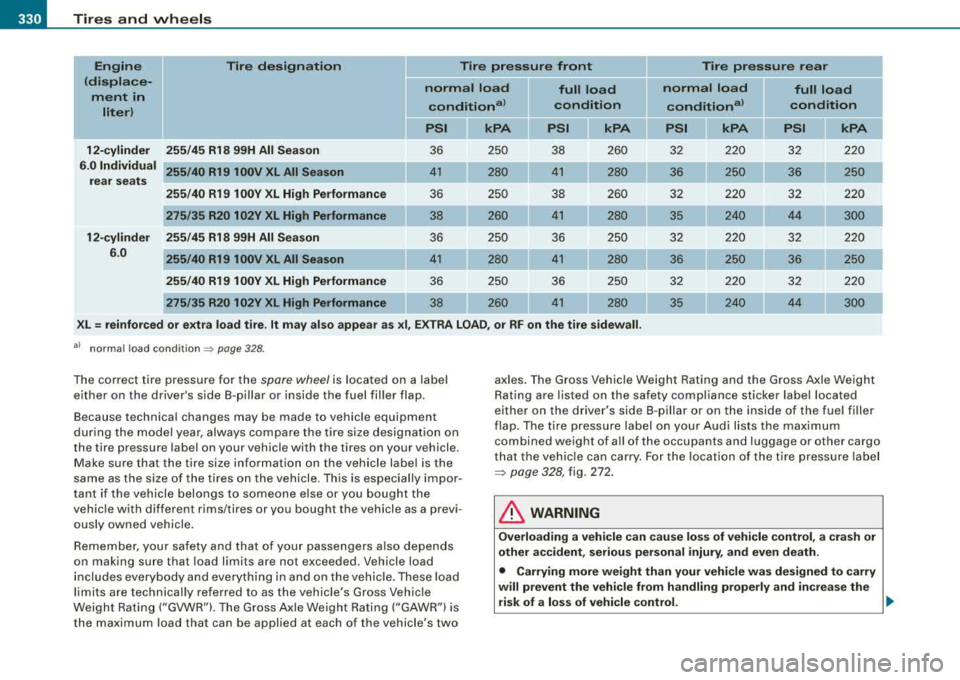
Engine Tire designation Tire pressure front Tire pressure rear
( displace-
normal load full load normal load
full load
ment in
liter)
condition al condition conditiona l condition
kPA PSI kPA PSI kPA PSI
12-cylinder
255/45 R18 99H All Season 36 250 38 260 32 220 32 220
6.0 Individual
255 /40 R19 100V XL All Season 41 280 4 1 280 36 250 36 250
rear seats
255/40 R19 100V
XL High Performance
36 2
50
38 260 3
2 220 32 2 20
275 /35 R20 102Y
XL High Performance 38 41 280 35 2 40 44 300
12 -cylinder 255 /45 R18 99H All Season 36 250 36 250 32 220 32 220
6 .0
255 /40 R19 100V XL All Season 4 1
280 4
1
280 36 250 36 250
255 /40 R19 100V
XL High Performance
36 250 36 250 32 2 20 32 220
275 /35 R20 102Y XL High Performance 38 260 4 1 280 35 240 44 300
XL = reinforced or extra load tire . It may also appear as xi , EXTRA LOAD , or RF on the tire sidewall .
al norma l load cond ition => page 328.
The co rrect tire pressure for the spare wheel is located on a label
either on the driver 's s ide 8-pillar or inside t he fue l fil ler flap.
Because technica l changes may be made to vehicle equipment
du ring t he mode l year, always co mpare the tire si ze desig nati on on
the tire pressure label on your vehicle with the tires on your vehicle .
M ake s ure t hat the tire si ze info rmat ion o n the ve hicle labe l is the
same as the size of the tires on the vehicle . T his is especial ly impor
t an t if t he vehicle bel ongs t o so me one e lse o r yo u boug ht the
vehic le with different rims/tires or you bought the vehicle as a previ
ously owned ve hicle.
Reme mber, you r safety and that of y our passengers a ls o depe nds
on making su re that load limits are not exceeded. Vehicle load
i nc ludes every body and everyt hin g in and o n th e veh icle . T hese load
limits are technically referred to as the vehicle's Gross Veh ic le
Weig ht Ratin g ("GVWR"). T he Gro ss Axle Weigh t Ra tin g ("GAWR") is
the maximum load that can be applied at each of the vehicle's two axles
. The Gross Vehic le We ight Rating and the Gross Axle Weight
Rating are l isted on the safety compl iance sticker labe l located
either on the driver's side 8 -pillar or on the inside of the fuel filler
fl ap . T he t ire p ressure label on you r A ud i lists t he m axi mum
combined weight of a ll of the occupants and luggage or other cargo
th at the v ehicle can carry . Fo r the locati on of the t ire press ure la be l
=> page 328, fig . 27 2.
& WARNING
Overloading a vehicle can cause loss of vehicle control , a crash or
other accident, serious per sonal injury , and even death .
• Carrying more weight than your vehicle was designed to carry
will prevent the vehicle from handling properly and increase the risk of a loss of vehicle control. ...,
Page 334 of 404
-Tires and wheels Pft'::I _______________ _
It is important to check the t ire pressur e wh en the tires are cold .
• Read the req uire d tire p re s su re from the tire p re ssur e la bel. On
USA ve hicles, the tir e pressure label is located on the driver's side
8 -pilla r. On Canada vehic les, the ti re p ress ure label is located eit her
o n the driv er's s ide 8-pill ar or ins id e th e fuel fill er flap .
• Tur n the va lve stem cap co unte r-cloc kw ise to re move it fr om t he
tire valv e.
• Place th e a ir p re s sur e ga uge on th e valve .
• T he tire pressures should o nly be checked and ad justed when
th e tir es are col d. The s lig ht ly ra ise d pres sur es of wa rm tir es mu st
not b e re duc ed .
• Adjus t the tire pre ss ure to the l oad y ou are carry ing.
• Reinstal l the valve stem cap on the valve.
When should I check the tire pressure?
The co rrec t tir e pr ess ure is especiall y important a t hi gh spee ds. T he
pressu re should th er efor e b e checked a t le ast once a mo nth an d
a lwa ys be fore s ta rti ng a j ourn ey . D o not for get to chec k the ti re pr es
sure fo r the sp are wh eel
=> page 350.
When should I adjust the tire pressures?
Adjust the tire pr essur e to the load you are carrying . After chan gin g
a w hee l or r epl ac ing w hee ls you have to ad just th e tire pr essu re s on
a ll whee ls. I n ad ditio n, yo u must t hen sto re the ne w tire pressu res
in t he t ire pres sure m onit or ing
system => page 40.
& WARNING
Incorrect tire pressures and /or underinflation can lead sudden tire
failure , loss of control, collision, serious personal injury or even
death .
• When the warning symbol
(l) appears in the instrument
cluster , stop and inspect the tires .
& WARNING (continued)
• Incorrect tire pressure and /or underinflation can cause
increased tire wear and can affect the handling of the vehicle and
stopping ability .
• Incorrect tire pressures and/or underinflation can also lead to
sudden tire failure, including a blowout and sudden deflation,
causing loss of vehicle control .
• The driver is responsible for the correct tire pressures for all
tires on the vehicle. The applicable pressure values are located on
a sticker on the driver's side B-pillar or on the inside of the fuel
filler flap.
• Only when all tires on the vehicle are filled to the correct pres
sure , the tire pressure monitoring system can work correctly.
• The use of incorrect tire pressure values can lead to accidents
or other damage . Therefore it is essential that the driver observe
the specified tire pressure values for the tires and the correct pres
sures for the function of the tire pressure monitoring system .
• Always inflate tires to the recommended and correct tire pres
sure before driving off .
• Driving with underinflated tires bend more , letting them get
too hot resulting in tread separation , sudden tire failure and loss
of control.
• Excessive speed and /overloading can cause heat build-up ,
sudden tire failure and loss of control.
• If the tire pressure is too low or too high , the tires will wear
prematurely and the vehicle will not handle well.
• If the tire is not flat and you do not have to change a wheel
immediately, drive at reduced speed to the nearest service station
to check the tire pressure and add air as required . _..
Page 353 of 404
What do I do now? Ill
------------------~;___
•
-Disengage and lower the floor panel before you close the
luggage compartment lid again.
Storing the replaced wheel
-Place the replaced wheel inside the spare wheel well in
the luggage compartment.
Tighten the knurled retaining screw clockwise to secure
the wheel in place.
-Disengage and lower the floor panel before you close the
luggage compartment lid again.
& WARNING
Loose items in the passenger compartment can cause serious
personal injury during hard braking or in an accident .
• Never store the spare wheel or jack and tools in the passenger
compartment.
• Always store all jacking equipment, tools, and the spare wheel
in the luggage compartment .
• Tighten the knurled retaining screw for the spare wheel
securely.
[ i] Tips
Check the inflation pressure of the spare tire periodically to keep the
tire ready for use. •
Changing a wheel
Before changing a wheel
Observe the following precautions for your own and your
passenger's safety when changing a wheel.
-After you experience a tire failure, pull the car well away
from moving traffic and try to reach level ground before
you stop
~ &,. .
-All passengers should leave the car and move to a safe
location (for instance, behind the
guardrail) ~&,. .
-Engage the parking brake to prevent your vehicle from
rolling
unintentionally ~&,. .
-Move selector lever to position P ~ &,..
-If you are towing a trailer: unhitch the trailer from your
vehicle.
-Take the jack and the spare tire out of the luggage
compartment~ page 349.
& WARNING
You or your passengers could be injured while changing a wheel if
you do not follow these safety precautions:
• If you have a flat tire, move a safe distance off the road. Turn off
the engine, turn the emergency flashers on and use other warning
devices to alert other motorists.
• Make sure that passengers wait in a safe place away from the
vehicle and well away from the road and traffic.
• To help prevent the vehicle from moving suddenly and possibly
slipping off the jack, always fully set the parking brake and block
the wheel diagonally opposite the wheel being changed. When one _..
Do -it -yourself service
Page 354 of 404
-What do I do now? PW-------------------------
&, WARNING (continued)
front wheel is lifted off the ground, placing the Automatic Trans
mission in
"P" (Park) will not prevent the vehicle from moving.
• Before you change a wheel, be sure the ground is level and firm.
If necessary, use a sturdy board under the jack.
• After installing the spare wheel, make sure that you replace the
flat tire/wheel in its storage area properly and tighten the knurled
retaining screw securely.
[ i] Tips
Before changing the wheel, you must activate the jacking mode, so
that the automatic controls for the Adaptive Air Suspension do not
make it more difficult to lift the vehicle with the
jack ~ page 7 88. •
Changing a wheel
When you change a wheel, follow the sequence described
below step-by-step and in exactly that order.
1. Activate the vehicle jacking mode => page 188.
2. Remove the decorative wheel cover*. For more details
see also
=> page 353, "Decorative wheel covers" or
=> page 353, "Wheels with wheel bolt caps" .
3. Loosen the wheel bolts => page 354.
4. Locate the proper mounting point for the jack and align
the jack below that
point=> page 354.
5. Lift the car with the jack=> page 354.
6. Remove the wheel with the flat tire and then install the
spare
=> page 356 .
7. Tighten all wheel bolts lightly. 8.
Lower the vehicle with the jack.
9. Use the wheel bolt wrench and firmly tighten all wheel
bolts
=> page 354.
10. Replace the decorative wheel cover*.
11. Deactivate the vehicle jacking mode => page 188 .
& WARNING
Always read and follow all WARNINGS and information ~ & in
"Raising the vehicle" on
page 354 and ~ page 357. •
After changing a wheel
A wheel change is not complete without the doing the
following.
-Store and secure the wheel you replaced in the spare
wheel well.
-Replace the tools and the jack in their proper location.
-Check the tire pressure on the spare wheel immediately
after mounting it.
-As soon as possible , have the tightening torques on all
wheel bolts checked with a torque wrench. The correct
tightening torque is 90 ft lb (120 Nm) .
-Have the flat tire replaced as soon as possible.
[ i] Tips
• If you notice that the wheel bolts are corroded and difficult to
turn while changing a tire, they should be replaced before you check
the tightening torque . .,_
Page 359 of 404
What do I do now? -
----------------
•
hub. Remove all dirt from these surfaces before remounting the
wheel. •
Tires with unidirectional tread design
Tires with unidirectional tread design must be mounted
with their tread pattern pointed in the right direction.
Using a spare tire with a tread pattern intended for use
in a specific direction
When using a spare tire with a tread pattern intended for use in a specific direction , please note the following:
• The direction of rotation is marked by an arrow on the side of the
tire .
• If the spare tire has to be installed in the incorrect direction, use
the spare tire only temporarily since the tire will not be able to
achieve its optimum performance characteristics with regard to
aquaplaning, noise and wear.
• We recommend that you pay particular attention to this fact
during wet weather and that you adjust your speed to match road
conditions.
• Replace the flat tire with a new one and have it installed on your
vehicle as soon as possible to restore the handling advantages of a
unidirectional tire. •
Notes on wheel changing
Please read the information =:> page 336, "New tires and replacing
tires and wheels" if you are going to use a spare tire which is
different from the tires on your vehicle.
After you change a tire :
• Check the tire pressure on the spare immediately after installa
tion. •
Have the wheel bolt tightening torque checked with a torque
wrench as soon as possible by your authorized Audi dealer or a
qualified service station .
• With steel and alloy wheel rims, the wheel bolts are correctly
tightened at a torque of 90 ft lb (120 Nm}.
• If you notice that the wheel bolts are corroded and difficult to
turn while changing a tire, they should be replaced before you check
the tightening torque.
• Replace the flat tire with a new one and have it installed on your
vehicle as soon as possible. Remount the wheel cover.
Until then, drive with extra care and at reduced speeds .
& WARNING
• If you are going to equip your vehicle with tires or rims which
differ from those which were factory installed, then be sure to read
the information
=:> page 336, "New tires and replacing tires and
wheels".
• Always make sure the damaged wheel or even a flat tire and
the jack and tool kit are properly secured in the luggage compart
ment and are not loose in the passenger compartment.
• In an accident or sudden maneuver they could fly forward,
injuring anyone in the vehicle .
• Always store damaged wheel, jack and tools securely in the
luggage compartment . Otherwise, in an accident or sudden
maneuver they could fly forward, causing injury to passengers in
the vehicle .
• Do not use commercially available tire sealants. Otherwise, the
electrical components of the tire pressure monitoring system will
no longer work properly and the sensor for the tire pressure moni
toring system will have to be replaced by a qualified workshop. •
Do -it -yourself service
Page 380 of 404
___ D_ a_ ta ______________________________________________________ _
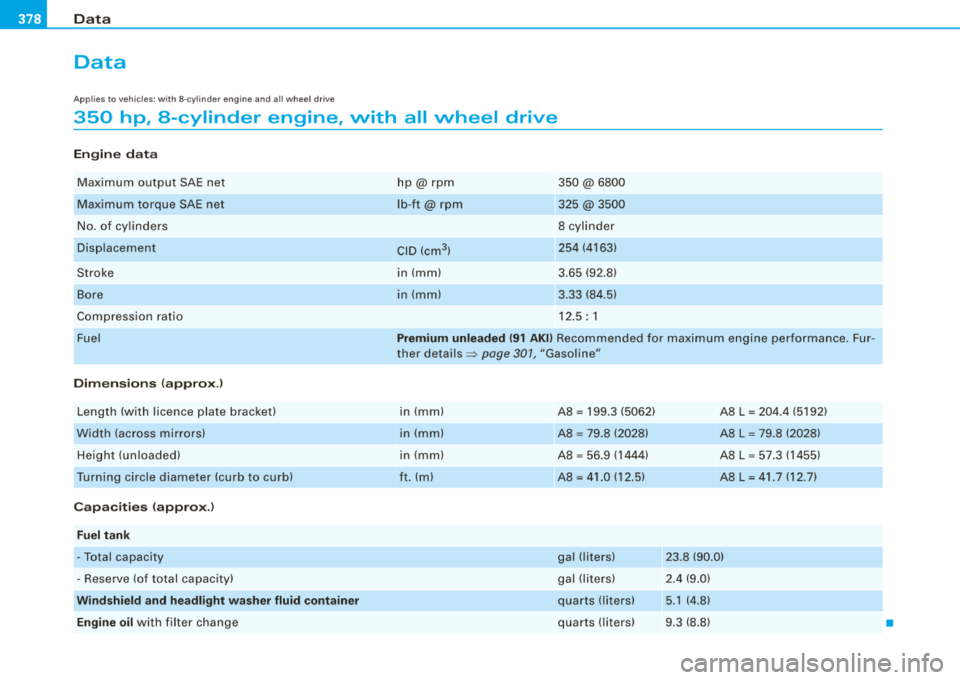
Data
Applies to vehicles: with 8 -cylinder engine and all wheel drive
350 hp, a-cylinder engine, with all wheel drive
Engin e da ta
Max imum output SAE net
Maximum torque SAE net
No . of cy linders
Disp lacement
Stroke
Bore
Compress ion ratio
Fuel
Dimension s (appro x.)
Length (with licence plate bracket)
Width (across mirro rs)
He ight (un loaded)
T urning circle diameter (curb to curb)
Capa citie s (a pprox.)
Fuel t ank
-Total capacity
- Reserve (of total capacity)
Wind shi eld and h eadlight wa sh er fluid contain er
Engine oil
with filter change hp@ rpm
lb -ft@ rpm
CID (cm
3 )
in (mm)
in (mm)
350@ 6800
325 @3500
8 cylinder
254 (4163)
3.65 (92.8)
3.33 (84.5) 12.5: 1
Premium unleaded (91 AKII Recommended fo r maximum engine per formance . Fur
ther
details ::::;, page 307, "Gasoline"
in (mm)
in (mm)
in (mm)
ft. (ml
A8 = 199.3 (5062)
AB = 79 .8 (2028)
A8 = 56.9 ( 1444)
AB = 41.0 (12.5)
gal (liters)
gal (liters)
quarts (liters)
quarts (liters)
A8 L = 204 .4 (5 192)
AB L = 79 .8 (2028)
A8 L = 57.3 (1455)
A8L =41.7(12.7)
23.8 (90.0)
2.4 (9 .0)
5.1 (4.8)
9.3
(8.8) •
Page 381 of 404
_____________________________________________________ D_a_ t_ a __ llJIII
App lies to veh ic les: w it h 12-cy linder eng ine and a ll whee l dr ive, lon g wheel base (LW B)
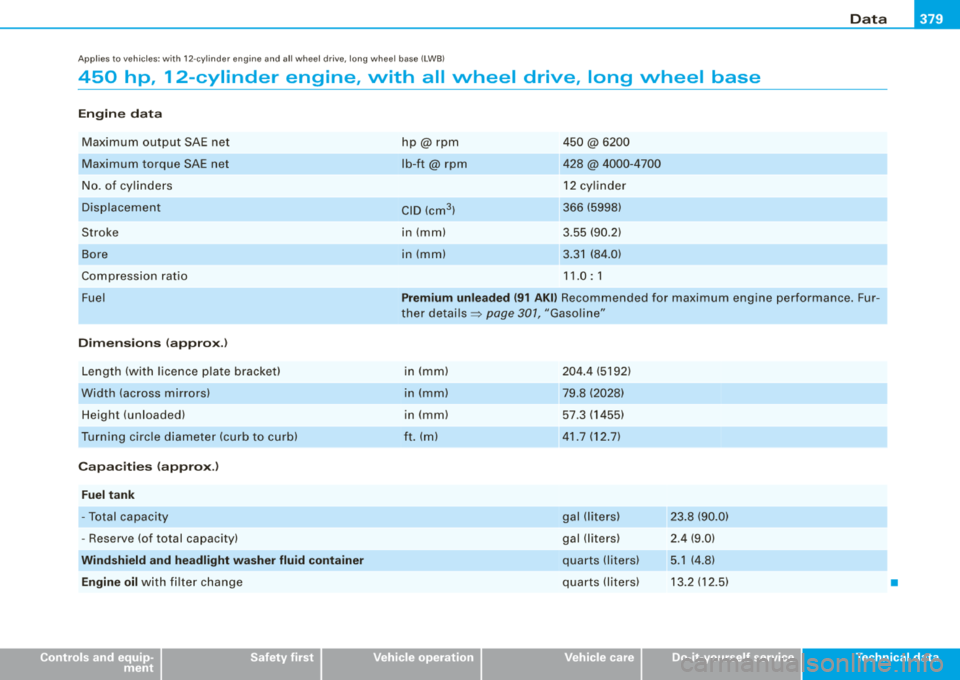
450 hp, 12-cylinder engine, with all wheel drive, long wheel base
En gin e data
Maximum output SAE net
Maximum torque SAE net
No. of cy linders
Displacement
Stroke Bore
Compression ratio Fuel
Dim ension s (appro x.)
Lengt h (wi th lice nce p late bracket)
Width (ac ross mirrors)
Height (unloaded)
Turning circle diameter (curb to cu rb)
Ca pac itie s (a pprox.>
Fuel tank
-Total capac ity
-Reserve (of total capacity)
Windshield and headlight washer fluid container
Engine oil
with fi lte r change hp@rpm
lb-ft@ rpm
CID (cm
3l
in (mm)
in (mm) 450@ 6200
428 @ 4000-4700
12 cy linder
366 (5998)
3 .55 (90 .2)
3 .3 1 (84 .0)
1 1.0 : 1
Premium unleaded (91 AKI! Recommended for maximum engine performance . Fur
t her
de tails => page 301, "Gasoline"
i n ( mm)
in (mm)
in (mm)
ft. (ml 20
4.4 (5192)
79.8 (2028)
57 .3 (1455)
41.7 (12 .7)
gal (liters)
gal (liters)
quarts (liters)
quarts (liters ) 2
3 .8 (90 .0)
2 .4 (9 .0)
5.1 ( 4.8)
13 .2 (1 2 .5)
•
Controls and equip
ment Safety first Vehicle operation
Vehicle care Do-it-yourself service Technical data