flat tire AUDI S8 2008 User Guide
[x] Cancel search | Manufacturer: AUDI, Model Year: 2008, Model line: S8, Model: AUDI S8 2008Pages: 404, PDF Size: 52.7 MB
Page 329 of 404
Tires and wheels -
-----------------------------
•
Sidewall
means that portion of a tire between the tread and bead.
Speed rating
extended periods of time. The ratings range from 93 mph (150 km/h)
to 186 mph (298
km/h)=> page 338. You may not find this informa
tion on all tires because it is not required by law.
The speed rating letter code, where applicable, is molded on the tire
sidewall and indicates the maximum permissible road
speeds=> &
in "Winter tires" on page 341.
Tire pressure monitoring system
means a system that detects when one or more of a vehicle's tires
are underinflated and illuminates a low tire pressure warning tell
tale.
Tread
means that portion of a tire that comes into contact with the road.
Tread separation
means pulling away of the tread from the tire carcass.
Treadwear indicators (TWI)
means the projections within the principal grooves designed to give
a visual indication of the degrees of wear of the tread . See
=> page 335, "Tread Wear Indicator (TWI)" for more information on
measuring tire wear .
Uniform Tire Quality Grading
is a tire information system developed by the United States National
Highway Traffic Safety Administration (NHTSA) that is designed to
help buyers make relative comparisons among tires. The UTQG is
not a safety rating and not a guarantee that a tire will last for a
prescribed number of miles (kilometers) or perform in a certain way.
It simply gives tire buyers additional information to combine with
other considerations, such as price, brand loyalty and dealer recom- mendations
. Under UTQG, tires are graded by the tire manufac
turers in three areas: treadwear, traction, and temperature resis
tance . The UTQG information on the tires, molded into the
sidewalls.
U.S. DOT Tire Identification Number (TIN)
This is the tire's "serial number" It begins with the letters "DOT" and
indicates that the tire meets all federal standards . The next two
numbers or letters indicate the plant where it was manufactured,
and the last four numbers represent the week and year of manufac
ture. For example,
DOT ... 2207 ...
means that the tire was produced in the 22th week of 2007 . The
other numbers are marketing codes that may or may not be used by
the tire manufacturer . This information is used to contact
consumers if a tire defect requires a recall.
Vehicle capacity weight
means the rated cargo and luggage load plus 150 lbs. (68 kilograms)
times the vehicle's total seating capacity as listed on the label located either on the driver's side 8-pillar or on the inside of the fuel
filler flap.
Vehicle maximum load on the tire
means that load on an individual tire that is determined by dis trib
uting to each axle its share of the maximum loaded vehicle weight
and dividing by two.
Vehicle normal load on the tire
means that load on an individual tire that is determined by dis trib
uting to each axle its share of the curb weight, accessory weight,
and normal occupant weight (distributed in accordance with table
below => page 328) and dividing by two. ..,.
Vehicle care
Page 330 of 404
lllffl...__T_ ir_e _ s_ a_ n
_ d_ w_ h_ e_ e_ls _________________________________________________ _
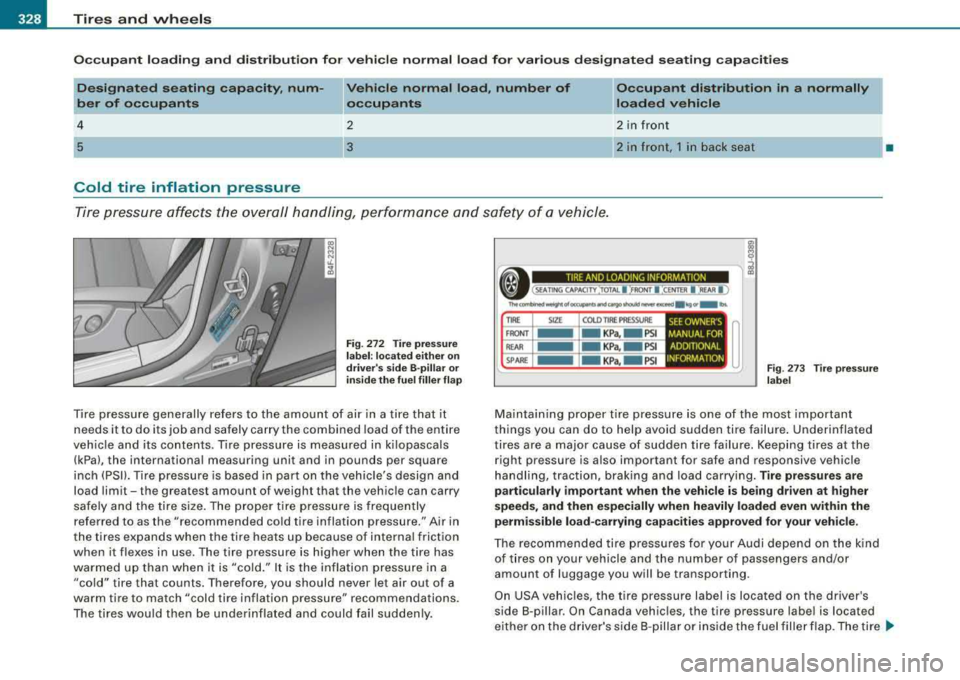
Occupant loading and distribution for vehicle normal load for various designated seating capacities Designated seating capacity , num
ber of occupants
4
5
Cold tire inflation pressure
Vehicle no rmal load, number of
oc cupants
2
3
Occupant distribution in a normally
loaded vehicle
2 in front
2 in front, 1 in back seat
Tire pressure affects the overall handling, performance and safety of a vehicle.
Fig . 272 Tire pressure
label: located either on
driver's side B-pillar or
inside the fuel filler flap
llRE AND LOADING INFORMATION
T IRE SIZE COLO TIRE PRESS URE
FRONT -KPa, -PSI
REAR -KP a, -PSI
SPARE -KPa , -PSI \.~__., ::::::::;=~ ===..:;,;_. Fig. 273 Tire pressure
label
Maintaining proper tire pressure is one of the most important
things you can do to help avoid sudden tire failure. Underinflated
tires are a major cause of sudden tire failure. Keeping tires at the
right pressure is also important for safe and responsive vehicle
handling, traction, braking and load carrying.
Tire pressures are
particularly important when the vehicle is being driven at higher
speeds, and then especially when heavily loaded even within the
permissible load-carrying capacities approved for your vehicle.
The recommended tire pressures for your Audi depend on the kind
of tires on your vehicle and the number of passengers and/or
amount of luggage you will be transporting.
•
Tire pressure generally refers to the amount of air in a tire that it
needs it to do its job and safely carry the combined load of the entire
vehicle and its contents . Tire pressure is measured in kilopascals
(kPa), the international measuring unit and in pounds per square
inch (PSIJ. Tire pressure is based in part on the vehicle's design and
load limit
-the greatest amount of weight that the vehicle can carry
safely and the tire size. The proper tire pressure is frequently
referred to as the "recommended cold tire inflation pressure." Air in
the tires expands when the tire heats up because of internal friction
when it flexes in use. The tire pressure is higher when the tire has
warmed up than when it is "cold." It is the inflation pressure in a
"cold" tire that counts. Therefore, you should never let air out of a
warm tire to match "cold tire inflation pressure " recommendations .
The tires would then be underinflated and could fail suddenly. On
USA vehicles, the tire pressure label is located on the driver's
side 8-pillar . On Canada vehicles , the tire pressure label is located
either on the driver's side 8 -pillar or inside the fuel filler flap . The tire
l)ll-
Page 331 of 404
________________________________________________ T_ i
_ r_e _s_ a_n_ d_ w_ h_ e_e _ l_s __ fflll
•
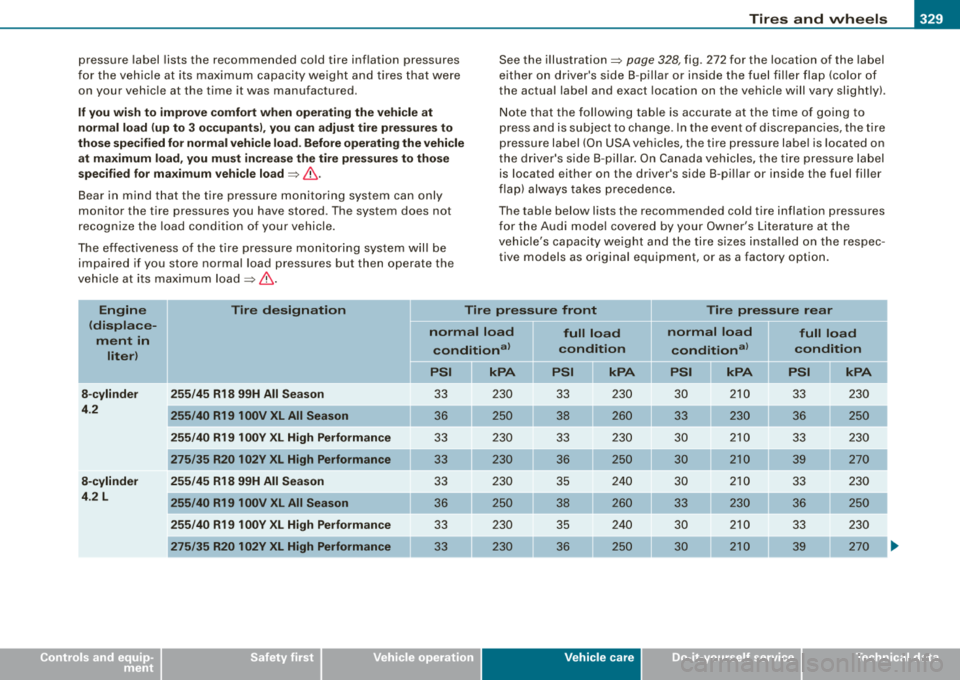
pressure label lists the recommended cold tire inflation pressures
for the vehic le at its maximum capacity weight and tires that were
on your vehicle at the time it was manufactured .
If yo u w is h to impro ve comfo rt when oper ating the vehi cle at
norm al lo ad (up to 3 occup ants), y ou can adju st tire pre ssure s to
tho se spe cified for norm al v ehi cle lo ad . Before oper ating the vehi cle
a t maximum lo ad , you mu st incre as e the tire pre ssure s to tho se
s p ec ified for m aximum vehi cle lo ad ::::>
& .
Bear in m ind that the tire pressure monito ring system can only
monitor the tire pressures you have stored . The system does not
recognize the load condition of your vehicle .
The effect iveness of the t ire pressure mon itoring system will be
impaired if you store normal load pressures but then operate the
veh ic le at its maximum
load ::::>& .
Engin e II Tire design ati on See the i
llustration::::>
page 328, fig . 272 for the location of the label
e it h er o n driver's side 8 -p illar or inside the fue l fil ler flap (color of
the actual label and exact location on the vehicle will vary slight ly!.
Note that the following tab le is accurate at the time of going to
press and is subject to change . In the event o f discrepanc ies, the t ire
pressure label (On USA vehic les, the tire pressure labe l is located on
the driver's s ide 8 -p illar . On Canada vehicles, the tire pressure label
is located either on the driver's side 8 -pi llar or inside the fuel fil ler
fl ap) always takes precedence .
The table below lists the recommended cold tire inflation pressures
for the Audi mode l covered by your Owner's Literature at the
veh ic le's capacity weight and the tire s izes insta lled on the respec
tive models as original equipment, or as a factory option.
Tire pressure front Tire pressure rear
( displa ce-
normal load
II full load norm
al load
full load
ment in
c ondition al condition condition al condition
liter)
PSI II kPA PSI II kPA PSI I I kPA If PSI IT kPA .,
8-c ylinder 255 /45 R1 8 99H All Sea son
33 230 33 230 30 2
10
33 230
4 .2
255/40 R19100V XL All Sea son 36 250 38 260 33 230 36 250
255 /40 R1 9 1 00 Y XL High P erformanc e 33 230 33 230 30 2 10 33 230
275 /35 R20 102V XL High Performance
33 230 36 250 30 2
10
39 270
8-cylinder 2 55/45 R1 8 99H All Sea son
33 230 35 240 30 2
10
33 230
4 .2 L
255/40 R1 9 100V XL All Sea son 36 250 38 260 33 230 36 250
255 /40 R1 9 1 00Y XL High Perfo rman ce
33 230 35 240
30 2
10
33 230
275 /35 R20 102V XL High Performance 33 230 36 250 30 2 10 39 270
Vehicle care
I
Page 333 of 404
Tires and wheels Ill
----------------
•
& WARNING (continued )
• The brakes on a vehicle that has been overloaded may not be
able to stop the vehi cle within a safe distance .
• Tires on a vehicle that has been overloaded can fail suddenly
c au sing lo ss of control and a cra sh.
• Always make sure that the total load being transported -
including the we ight of a trailer hitch and the tongue weight of a
loaded trailer -does not make the vehicle heavier than the
v ehicle's Gross Vehicle Weight Rating .
& WARNING
• Incorrect tire pressures and /or underinflation can lead to a
serious or fatal accident.
• Incorre ct tire pressures and /or underinflation cause in creased
tire wear and can affect the handling of the vehicle .
• Incorrect tire pressures and /or underinflation can also lead to
sudden tire failure, including a blowout and sudden deflation,
c ausing loss of vehi cle control.
•
Checking tire pressure
The c orrect tire pressu re f or the tires ori gina lly installe d
on your vehicle is lis ted on the ti re pressure la bel loca ted
either on driver's side 8-pillar or inside the fuel filler flap.
The rec omme nded ti re p ressu res a re on the tire pr essure la be l an d
in the
table~ page 328, "Co ld tire inflation pressure". This means
t ha t th e pres su re m us t be c hecked a nd adjus ted w he n t he ti re has
not been driven for more than a couple of miles (kilometers) at low
speeds du rin g the p revio us th ree hou rs . Ai r in t he tires ex pand s
when the tire heats up as a resu lt of internal fr iction as it flexes in
use. The tire pressure is hig her when the tire has warmed up than
when it is "co ld ." I
t is the inflation pressure in a "cold" t ire that counts . Therefore, you
s h oul d never le t air ou t of a warm ti re to matc h "Co ld t ire in fl ati on
pressure"
recommendations~ pa ge 328 . The tires wou ld then be
u nde rinflate d and could fail sud denly .
The t ire pressure label o n your Au di lists the recomme nded cold t ire
inflation press ures at maximum capacity for the new, origina l equip
m ent tires t hat we re on yo ur vehicle at t he t ime it was manufac
tured. For the location of the
labe l~ page 328, fig . 272.
M ost tires lose a ir natu rally ove r ti m e. T hey can a lso lose so me air if
you drive ov er a pothole or h it a curb while parkin g. It is usually not
pos sible to see whe the r the rad ial tir es use d today are unde rin flated
just by look in g at t hem .
T herefore, be sure to chec k tire pressures at least once a month and
a lways be fore go ing o n a lo ng trip . Make su re to take the nu mber o f
people and the amount of luggage into account when ad justing tire
pr ess u re fo r a trip -even one t hat you wou ld not conside r to be
" long ."
See~ page 333, "Tires and vehic le load limits" for more
i mp ort ant i nfor mati on .
A lways use a n accu rate ti re p ressure gauge w hen c hec kin g a nd
adjusting inflation pressures . Chec k all of the tires and be sure not
t o fo rget t he spare t ire . If the pressu re i n an y tire is too high when
the tire is "co ld," let air out of the tire slow ly with the edge of the tire
ga uge and kee p checking the press ure u ntil y ou r each th e pr essu re
that is correct for the load (passengers and luggage) and kind of
d riv in g yo u plan to do .
I f the pressure in any tire is too low, note the difference between the
pressure in the cold tire and the pressure you need and add the air
t hat you need to r each the correct pressure for the veh ic le load
(passengers and luggage) for the tires on your vehicle as listed on
t he o n you r vehicl e and i n thi s m anua l a n d t he kind of driving yo u
p lan to do.
Never exceed the maximum inflation pressure listed on the tire
sidewall for any reason .
Remember that the vehic le manufacturer, not the tire manufacturer,
deter mines the correc t tire pressure for the ti res on your vehicle.
~
Vehicle care
Page 334 of 404
-Tires and wheels Pft'::I _______________ _
It is important to check the t ire pressur e wh en the tires are cold .
• Read the req uire d tire p re s su re from the tire p re ssur e la bel. On
USA ve hicles, the tir e pressure label is located on the driver's side
8 -pilla r. On Canada vehic les, the ti re p ress ure label is located eit her
o n the driv er's s ide 8-pill ar or ins id e th e fuel fill er flap .
• Tur n the va lve stem cap co unte r-cloc kw ise to re move it fr om t he
tire valv e.
• Place th e a ir p re s sur e ga uge on th e valve .
• T he tire pressures should o nly be checked and ad justed when
th e tir es are col d. The s lig ht ly ra ise d pres sur es of wa rm tir es mu st
not b e re duc ed .
• Adjus t the tire pre ss ure to the l oad y ou are carry ing.
• Reinstal l the valve stem cap on the valve.
When should I check the tire pressure?
The co rrec t tir e pr ess ure is especiall y important a t hi gh spee ds. T he
pressu re should th er efor e b e checked a t le ast once a mo nth an d
a lwa ys be fore s ta rti ng a j ourn ey . D o not for get to chec k the ti re pr es
sure fo r the sp are wh eel
=> page 350.
When should I adjust the tire pressures?
Adjust the tire pr essur e to the load you are carrying . After chan gin g
a w hee l or r epl ac ing w hee ls you have to ad just th e tire pr essu re s on
a ll whee ls. I n ad ditio n, yo u must t hen sto re the ne w tire pressu res
in t he t ire pres sure m onit or ing
system => page 40.
& WARNING
Incorrect tire pressures and /or underinflation can lead sudden tire
failure , loss of control, collision, serious personal injury or even
death .
• When the warning symbol
(l) appears in the instrument
cluster , stop and inspect the tires .
& WARNING (continued)
• Incorrect tire pressure and /or underinflation can cause
increased tire wear and can affect the handling of the vehicle and
stopping ability .
• Incorrect tire pressures and/or underinflation can also lead to
sudden tire failure, including a blowout and sudden deflation,
causing loss of vehicle control .
• The driver is responsible for the correct tire pressures for all
tires on the vehicle. The applicable pressure values are located on
a sticker on the driver's side B-pillar or on the inside of the fuel
filler flap.
• Only when all tires on the vehicle are filled to the correct pres
sure , the tire pressure monitoring system can work correctly.
• The use of incorrect tire pressure values can lead to accidents
or other damage . Therefore it is essential that the driver observe
the specified tire pressure values for the tires and the correct pres
sures for the function of the tire pressure monitoring system .
• Always inflate tires to the recommended and correct tire pres
sure before driving off .
• Driving with underinflated tires bend more , letting them get
too hot resulting in tread separation , sudden tire failure and loss
of control.
• Excessive speed and /overloading can cause heat build-up ,
sudden tire failure and loss of control.
• If the tire pressure is too low or too high , the tires will wear
prematurely and the vehicle will not handle well.
• If the tire is not flat and you do not have to change a wheel
immediately, drive at reduced speed to the nearest service station
to check the tire pressure and add air as required . _..
Page 335 of 404
Tires a nd wh eels -
----------------
•
0 Not e
Driving without valve stem caps can cause damage to the tire
valves. To prevent this, a lways make sure that factory instal led valve
stem caps on a ll whee ls are securely mounted on the va lve .
W Fo r the sake of the env ironm ent
Underinflated tires wil l a lso increase the fuel consumption. •
Tires and vehicle load limits
There are lim its to t he amount of load or weight that any ve hicle and
any tire can carry . A vehicle that is overload ed wil l not hand le well
and is more difficu lt to stop. Overload ing can not only lead to loss
of vehic le control , but can a lso damage important parts of the
vehic le and ca n lead to sudden t ire fa ilure, inc luding a blowout a nd
sudden deflation that can cause the vehic le to crash.
Your safety and that of your passengers also depends on making
sure that load l imits are not exceeded. Vehicle load includes every
body and everything in and on the vehic le. These load limits are
technica lly referred to as the vehicle's
Gross Ve hicle We ig ht R ating
("GVWR").
The "GVWR" includes t he weight of the bas ic ve hicle, al l factory
insta lled accessories, a full tank of fuel , oil , coolant and other fluids
p lus maximum load . The maximum load i ncludes the number of
passengers that the vehicle is intended to carry ("seating capacity")
with an assumed weight of 150 lbs (68 kg) for each passenger at a
designated seating position and the total weight of any luggage in
the vehicle . If you tow a trailer, the weight of the trailer h itch and the
tongue we ight of the loaded trai ler must be included as part of the
vehic le load.
The
Gros s Axle We ight Rating ("GAWR") is the maximum load t hat
can be applied at each of the vehicle's two axles. The Gross Vehicle Weight Rating and the Gross Axle Weight Rating
are listed on the safety comp liance s ticker label loca ted either on
the driver's side B-pillar or on the inside of the fuel fil ler flap . Your
Audi has 5 seating positions, 2 in the front and 3 in the rear for total
seating capacity of 5. Vehicles with power individual rear seats*
have 4 seating positions, 2 in the front and 2 in the rear for total
seating capacity of 4. Eac h seating position has a safety be lt
~ page 209, "Safety be lts".
The fact that there is an upper limit to your veh icle's Gross Vehicle
Weight Rating means that the total weight of whatever is being
carried in the veh ic le ( including t he we ight of a trai ler hitch and the
tongue weight of the loaded trai ler) is limited . The more passengers
in the vehicle or passengers who are heavier than the standa rd
we ights assumed mean that less weight can be carried as luggage .
The tire pressure labe l on your Audi also lists the maximum
combined we ight of a ll of the occupants and luggage or other cargo
that th e vehicle can carry. For the location of the lab el
~ page 328 ,
fig. 272 .
& WARNING
Overloading a v ehicl e can cau se loss of vehicl e control , a cras h or
o ther ac cident , serious p ers on al injur y, and eve n de ath.
• C arrying more weight th an your vehi cle was designed to c arry
will prevent the vehicl e from handling prop erl y and in cre a se the
ri sk of the l oss of vehi cle control.
• The br akes on a vehi cle that has b een overload ed may not be
a bl e to sto p the vehi cle within a safe di sta nce.
• Tir es on a ve hic le th at ha s bee n ov erlo ad ed c an fail sudd enl y,
in clu din g a bl owout and sud den d efl atio n, ca usi ng loss of con trol
and a crash .
• Al ways m ake sur e th at the total lo ad being tr ansp orted -
includin g th e w eight of a tr ailer hitch and th e tong ue weight of a
load ed tr ailer -do es not m ake the vehi cle he avie r than the
vehicle 's Gro ss Vehicl e W eight R ating. •
Vehicle care
Page 339 of 404
Tires a nd wh eels -
----------------
•
0
©
U.S. DOT tire identification number
Sever snow cond itions
Ti re ply composition and materials used
Maximum load rating
Treadwear, traction and temperature grades
@ Maximum permissible inflation pressure
The tires and rims are essentia l parts of the vehicle 's design. The
tires and rims approved by Audi are special ly matched to the char
acteristics of the vehic le and can make a major contribution to good
road hold ing and safe handling when in good cond ition and prop
erly inf lated
=> .&, .
We recommend tha t all work on tires and wheels be performed by
an authorized Audi dea ler . They are familiar with recommended
procedures and have the necessary special too ls and spare parts as
we ll as the proper facilities for disposing of the old tires.
Authori zed Audi dea lers have the necessary information about tech
n ical requirements for insta lling or changing tires and rims.
R ep lac ing t ires and wh eels
Tires shou ld be replaced at least in pairs and not individual ly (for
examp le both front tires or both rear tires together).
Be sure to read and heed the informat ion to the tire pressure mon i
toring
system => page 338.
Always buy replacement radial tires t hat have the same specifica
tions as the tires approved for your vehicle by Audi. Rep lacement
tires must always have the same load rating specification as the
origina l equipment or approved optional t ires listed in the table
=> page 328.
Audi -approved specification tires are specially matched to your
vehicle and its load limits, and can contribute to the important road- holding, driving characteristics, and safety of the vehicle
. The table
(=> page 328) lists specificat ions of the tires approved for the Audi
models covered by your Owner's Literature .
The tire pressure labe l located either on driver's side 8 -pil lar or
ins ide the fuel fi ller
flap( => page 328, fig. 273) lists the specifica
tions of the original equipment tires installed on your vehicle at the
t ime it was manufactured.
Federa l law requires tire manufacturers to place standardized infor
mation on the sidewa ll of all
tires => page 336, fig . 276. This informa
tion identifies and describes the fundamental characteristics, the quality grade of the tire and a lso provides a tire identification
number for sa fety standard cert ificat ion and in case of a recall.
T ire s pec ificat ion s
Knowledge of tire specifications makes it easier to choose the
correct tires . Radial tires have the tire specifications marked on the
sidewall, for example :
255/45 R 18 99 H
This contains the fo llowing information:
P Indicates the tire is for passenger cars (where applicable)
255 Nominal tire width in mm of the tire from sidewall edge to side -
wa ll edge. In general, the larger the number, the wider the tire
45 Height/width ratio in percent (aspect ratio)
R Tire construction: Radial
18 Rim diameter code (in inches)
99 Load rat ing code
H Speed rat ing letter code
XL (or "xi", "EXTRA LOAD" or "RF") indicates that the tire is a "Rein
forced" or an "Extra Load" tire
M +S (or "M/S") Indicates tha t the tire has some mud and snow capa
bility
The tires could a lso have the information of direction of rotation
=> page 324.
Vehicle care
Page 341 of 404
________________________________________________ T_ i
_ r_e _s_ a_n_ d_ w_ h_ e_e _ l_s __ l'III
•
• T he batt ery inside of the tire pressure sensor has a l imited
s er vice l ife.
• Al ways drive with the va lve stem ca ps sec ure ly m ounted. We
r ec om mend u sin g fa ctor y in sta lle d v alv e stem caps. Ask your autho
rized Audi d ealer to replac e lost valve stem caps .
T he in stalla tio n of replacement ti res with steel cord body plies i n
th e tire s id ewal l may cause malfunct ion of the tire pressure moni
toring sy ste m, and is not recommended (c ord mate ria l infor mation
i n mo lded on the tire s idewa ll).
Al ways check your tir e pressure monitor ing system indicator after
r eplac ing on e o r m ore tire s on y our vehi cle. If the tire pressu re
monitorin g system indicator flashes, or is on, your system is not
w orki ng pr ope rly. You r rep lace ment tir e mi ght be in co m pati ble w ith
your t ire pr essure monitoring system, or some component of the
t ir e pr ess ure m oni to ring sys te m m ay be damaged .
& WARNING
• Using incorrect or unmatched tires and / or wheels or improper
tire and wheel combinations can lead to loss of control , collision
and serious personal injury .
• Always use tires , rims and wheel bolts that meet the specifica
tions of original factory -installed tires or other combinations that
have been specifically approved by the vehi cle manufacturer .
• Tires age even if they are not being used and can fail suddenly,
espe cially at high speeds . Tires that are more than 6 years old can
only be used in an emergency and then with special care and at
lower speeds .
• Never mount used tires on your vehicle if you are not sure of
their "previous history ." Old used tires may have been damaged
even though the damage cannot be seen that can lead to sudden
tire failure and loss of vehicle control.
• All four wheels must be fitted with radial tires of the same type ,
size (rolling cir cumference ) and the same tread pattern . Driving
&, WARNING (continued )
with different tires reduces vehicle handling and can lead to a loss
of control.
• If the spare tire is not the same as the tires that are mounted
on the vehicle
-for example with winter tires -only use the spare
tire for a short period of time and drive with extra care . Refit the
normal road wheel as soon as safely possible.
• Never drive faster than the maximum speed for which the tires
on your vehicle are rated because tires that are driven faster than
their rated speed can fail suddenly.
• Overloading tires cause heat build -up , sudden tire failure,
including a blowout and sudden deflation and loss of control.
• Temperature grades apply to tires that are properly inflated and
not over or underinflated.
• For techni cal reasons it is not always possible to use wheels
from other vehicles -in some cases not even wheels from the
same vehicle model.
• If you install wheel trim discs on the vehicle wheels , make sure
that the air flow to the brakes is not blocked . Reduced airflow to
the brakes can them to overheat , increasing stopping distances
and causing a collision.
• Run flat tires may only be used on vehicles that were equipped
with them at the factory . The vehicle must have a chassis designed
for run flat tires and a factory-installed tire pressure monitoring
system that indicates a loss of tire pressure. Incorrect use of run
flat tires can lead to vehicle damage or accidents . Check with an
authorized Audi dealer or tire specialist to see if your vehicle can
be equipped with run flat tires . If run flat tires are used , they must
be installed on all four wheels . Mixing tire types is not permitted.
0 Note
• Fo r tec hnica l reaso ns, i t is not gene rally p oss ibl e to use the
whee l rims from other vehicles . T his can hold true for wheels of t he
sa me v ehicl e typ e.
Vehicle care
Page 342 of 404
___ T_ ir_e _s_ a_n_ d_ w_ h
_ e_e_ l_ s _______________________________________________ _
• If the spare tire is different from the tires that you have mounted
on your vehicle (for example winter tires or wide profile tires), then
use the spare tire for a short period of time only and drive with extra
care . Replace the flat tire with the tire matching the others on your
vehicle as soon as possible.
• If you should put different wheels and tires on your vehicle (e.g.
winter wheels and tires), you must be certain that the wheels and
tires are compatib le with the tire pressure monitoring system.
Otherwise the system will register a malfunction and a fault message will be displayed. For more information, contact your Audi
dea ler.
0 Note
• When installing new tires, be careful not to damage the valves or
tire pressure monitoring system sensors.
• Never drive without the va lve stem cap. The valves could get
damaged.
• If the sensors must be replaced, then the valve must also be
replaced at the same time.
For the sake of the environment
Dispose of o ld tires in accordance with the loca l requirements. •
Uniform tire quality grading
• Tread wear
• Traction AA A B C
• Temperature A B C
Qua lity grades can be found where applicable on the tire side wal l
between tread shoulder and maximum section width
=> page 336,
fig. 276.
For example: Tread wear 200, Traction AA, Temperature A.
All passenger car tires must conform to Federal Safety Require
ments in addit ion to these grades.
Tread wear
The tread wear grade is a comparative rating based on the wea r rate
of the tire when tested under contro lled conditions on a specified
government test course.
For example, a tire graded 150 wou ld wear one and one half (1 1/2)
times as well on the government course as a tire graded 100.
The relative performance of tires depends upon the actua l condi
tions of their use, however, and may depart significantly from the
n orm due to variations in driving habits, service practices and differ
ences in road characteristics and climate .
Traction
The traction grades, from highest to lowest, are AA, A, Band C.
T hose grades represent the tire's ability to stop on wet pavement as
measured under contro lled conditions on specified government
t est surfaces o f asphalt and concrete. A tire marked C may have
poor traction performance
=:> & .
Temperature
The temperature grades are A (the highest), B, and C, representing
t he tire's resistance to the genera tion of heat and its abi lity to dissi
pate heat when tested under control led conditions on a specified
indoor laboratory test wheel.
Sustained high temperature can cause the mater ial of the tire to
degenerate and reduce tire life, and excessive temperature can lead
to sudden tire
failure=> &.
The grade C corresponds to a leve l of performance which a ll
passenger car tires must meet under the Federal Motor Vehicle
Safety Standard No. 109. Grades Band A represent higher levels of
performance on the laboratory test whee l than the minimum
required by law.
~
Page 343 of 404
__________________________________________________ T_ ir_e_ s_ a_ n_d _ w_ h_ e_ e_l_s __ 9II
•
& WARNING
The tr action grade assigned to this tire i s ba sed on straight -ahead
braking traction tests, and does not include acceleration,
c ornering , hydroplaning or peak tra ction chara cteristic s.
& WARNING
The temperature grade for this tire is established for a tire that is
properly inflated and not overloaded. Excessive speed , underinfla
tion , or ex cessive loading , either separately or in combination , can
c ause heat buildup and po ssible tire failure . •
Winter tires
Winter tires c an im prove vehicle handlin g on snow and
i ce. At tem pera tures belo w 4 5 °F (7 °C ) we re commend
changi ng to w inte r tires.
In some heavy snow areas, loca l governments may require true
winter or "s now" tire s, those with very deeply cut tread. These tires
s h ou ld on ly be used in pairs and be i nstalled on all four wheels .
M ake sure you purchase snow tires that a re the same size and
co nstruct io n type as t he othe r tires on your ve hicle.
I f your vehicle is equipped with all -wheel drive *, this will improve
t raction d uring winte r dr iving , eve n wit h th e sta n dar d tir es .
However, we strongly recommend that you always equip a ll four
w hee ls on you r vehic le wi th co rrectl y fi tted w inte r tires or all-season
t ir es, w hen w inter road condi tions are expec ted . T his also improves
the vehicle 's br aking perfo rma nce a nd reduces stopping distances .
Summe r tires p rov ide less gr ip on ice a nd s now.
Wint er tires (snow tires) must a lways be fitted on all four whee ls .
Compatible ti re p ressu re m oni to ring sen so rs must be instal led on
a ll four w inte r tires for t he ti re pr essur e moni tor ing s yste m to fu nc
tion
proper ly => page 33 8.
Ask your authorized Audi dealer or qualifi ed workshop for permitted
winter tire sizes. Use only ra di al winter tires .
W inter tires lose their eff ectiveness when the tr ead is worn down to
a depth of 0 .157 inc h (4 mm).
O nly d rive wi th winte r ti res under w inter cond itio ns. S um mer tire s
handle better when there is no snow or ice on the roads and the
te mpera ture i s abov e 45 °F ( 7 °C) .
I f you have a f lat tire, se e notes on spar e whee l
=> page 336.
Please a lways remember that winter tires may have a lower speed
r ati ng t han th e tires orig in ally ins talled o n you r ve hicle at t he time
it was manufactu red . P lease
see => page 338, "Speed rating (letter
co de)" for a l is tin g of th e sp eed ratin g letter code s an d th e
maximum speed at which the tires can b e driven .
The speed ra ti ng le tter
co de( => page 327) is on the side wa ll of the
t ire
=> page 336.
& WARNING
Winter tires have ma ximum speed limits that may be lower than
your vehicle's maximum speed . Always know the maximum speed
before driving off . Never drive faster than the speed permitted for
your specific winter tires. This will cause damage to the tires leading to an accident and serious personal injury to you and your
passengers .
& WARNING
Driving faster than the maximum speed for which the winter tires
on your vehicle were designed can cause tire failure including a
blowout and sudden deflation, loss of control , crashes and serious
per sonal injuries . Have worn or damaged tires replaced immedi
ately.
• Winter tires have maximum speed rating that may be lower
than your vehicle's maximum speed.
Vehicle care