key battery AUDI S8 2008 User Guide
[x] Cancel search | Manufacturer: AUDI, Model Year: 2008, Model line: S8, Model: AUDI S8 2008Pages: 404, PDF Size: 52.7 MB
Page 116 of 404
___ w_ a
_ r_m _ a_ n_d_ c_ o_ ld __________________________________________________ _
Warm and cold
Climate controls
Description
The air conditioner is fully automatic and is designed to
maintain a comfortable and uniform climate inside the
vehicle.
We recommend the following settings:
- Set the temperature to 75 °F (+23 °C).
- Press the !AUTO
I button.
With this setting, you attain maximum comfort in the least amount
of time. Change this setting, as desired, to meet your personal needs.
The climate controls are a combination of heating, ventilation and cooling systems, which automatically reduce humidity and cool the
air inside your vehicle.
The air temperature, air flow and air distribution are automatically
regulated to achieve and maintain the desired passenger compart
ment temperature as quickly as possible.
The system automatically compensates for changes in outside
temperature and for the intensity of the sunlight entering the
vehicle. We recommend you use the
Automatic mode=> page 117
for year -round comfort.
Please note the following:
Turn on the air conditioner to reduce humidity in the vehicle. This also prevents the windows from fogging up.
When the outside temperature is high and the air is very humid ,
condensation from the evaporator may drip under the vehicle. This
is normal and does not indicate a leak. If the outside temperature is
low, the fan normally only switches to
a higher speed once the engine coolant has warmed up sufficiently.
The air conditioner temporarily switches off when you drive off from
a standstill using full throttle to save engine power.
The compressor also switches off if the coolant temperature is too high, so that the engine can be adequately cooled under extreme
loads.
Air pollutants filter
The air pollutants filter (a combined particle filter and activated
charcoal filter) reduces or prevents outside air pollution (dust, or pollen) from entering the vehicle.
The air pollutants filter must be changed at the intervals specified
in your Warranty
& Maintenance booklet, so that the air conditioner
can properly work.
If you drive your vehicle in an area with high air pollution, the filter
may need to be changed more frequently than specified in your
Audi Warranty
& Maintenance booklet. If in doubt, ask your autho
rized Audi Service Advisor for advice.
Key coded settings
The air conditioner settings selected are automatically stored and
assigned to the key being used. When the vehicle is started, the air
conditioner automatically selects the settings assigned to that key.
This way every driver will maintain his/her own personal settings
and does not have to reset them manually.
If a different driver uses your key and changes the air conditioner
settings, the latest adjustments will erase and replace the settings
you have stored.
Energy management
To prevent the battery from being discharged and to restore the
balance of energy, components which require large amounts of
Page 171 of 404
_______________________________________________ A_ u_t _o _m_ a_ t_ i_ c _ t_r _
a _n _s_ m_ i_ s _ s_ i_ o _ n _ ___.ltllll
Fig . 190 Emergency
release for selector
lever
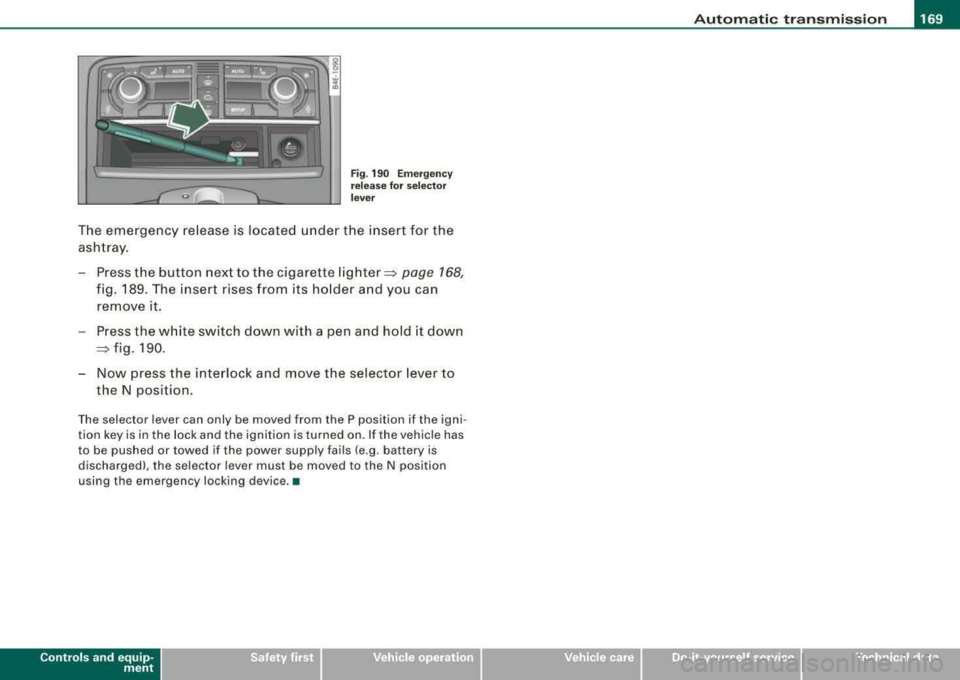
The emergency release is located under the insert for the
ashtray.
- Press the button next to the cigarette
lighter~ page 168,
fig. 189. The insert rises from its holder and you can
remove it.
- Press the white switch down with a pen and hold it down
~ fig. 190.
- Now press the interlock and move the selector lever to
the N position.
The selector lever can only be moved from the P position if the igni
tion key is in the lock and the ignition is turned on. If the vehicle has
to be pushed or towed if the power supply fails (e .g . battery is
discharged), the selector lever must be moved to the N position
using the emergency locking device. •
Controls a nd eq uip
ment Vehicle care I I irechnical data
Page 277 of 404
Intellig ent tec hnol ogy -
------------ -=--=-= '-
vidual components . It regulates consumption, so that more elec
t rical energy is not be ing used than is be ing genera ted and ensures
an optimal state of charge for the battery .
[ i ] Tip s
• But even energy management cannot negate the limits of
physics. Consider that the power and life of a battery are limited.
• If starting ability is threatened, you are informed by a warning
~ page 275, "Driver notification in the instrument cluster
display" .•
What you should know
The highest priority is given to maintaining starting capa
bility.
T he battery is severely taxed in short -distance driving, in city traffic
and during t he co ld time of year . Abundant e lectrica l energy is
required, but on ly a little is generated . It is also critical if the engine
is not running and e lectrical components are turned on. In this
instance energy is being consumed but none is being generated .
I t is in precisely these situations that you wi ll notice energy manage
ment active ly regulating the d istr ibut ion of energy.
Vehicl e stands for an extended period
If you do not drive your vehicle over a per iod of several days or
weeks, electrica l components are gradually cut back or switched off.
This reduces energy consu mpt ion and maintains starting capability
over a longer period .
Be aware t hat when you unlock you r ve hicle, some o f the conve
nience functions may not operate, such as the Advanced Key, the
remote contro l or t he power seat adjustment. T he convenience
functions will be available again when you turn on the ignition and start the engine .
Controls and equip
ment Safety first Vehicle operation With th
e engin e turned off
If you listen to the radio, for examp le, with t he engine tu rned off or
use other MMI functions, the battery is being discharged.
I f starting capabi lity is jeopardized due to energy consumption, the
f o llow ing warn ing appears in t he MMI display:
Ple ase start engine , other wise sy stem will s witch off in 3
minute s.
The warning indicates that the system wi ll be turned off au tomat i
ca lly after 3 minutes. If you wish to continue using the functions,
you have to start the engine .
With the engine running
Although e lectrica l energy is generated when the vehic le is being
driven, the battery can become discharged. This happens mostly
when little energy is being generated and a great deal co nsumed
and the battery's state of charge is not optimal.
To br ing the ene rgy balance bac k into equi librium , cons umers
which require especially large amounts of energy are temporar ily
cu t back or switched off . Heating systems in part icu lar require a
great deal of energy. If you notice, for example, that the heated
seats* o r the heated rear w indow are not heating, they have been
temporari ly cut back or switc hed off. These systems wil l be avai lable
again as soon as the energy balance has been restored.
You wil l also notice t hat engi ne idle speed has been increase d
s lightly . This is norma l and not a cause for concern . By increasing
engine idle speed the addi tiona l energy required is ge nerated a nd
the battery is charged. •
Driver notification in the instrument cluster
display
I f the battery's state of charge is not in the optima l range, this driver
no tificat io n ap pears in the instrument cl uster d isplay:
t:3 Low battery ch arge : battery will be charged while dri ving .,_
Vehicle care Do-it-yourself service Technical data
Page 309 of 404
___________________________________________ C=..:...: h:.:e :.: c:.: k.:.: i.:.: n :3:g ~ a:.:.n .:.: d::......:. f..:..:il ..:..:li .:.:n3g !._ _9I
•
Closing the engine hood
- Pull the hood down until the pressure from the struts is
reduced .
- Let the hood
drop down and latch in place. Do not try to
push it shut;
it may fail to engage =>& .
& WARNING
A hood that is not completely latched could fly up and block your
view while driving.
• When you close the engine hood, check it to make sure the
safety catch has properly engaged. The hood should be flush with
the surrounding vehicle body parts.
• If you notice while driving that the hood is not secured prop
erly, stop at once and close it. •
Working in the engine compartment
Be especially careful whenever you work in the engine
compartment.
Whenever you must perform any work in the engine compartment,
for example checking and filling different fluids, there is a risk of injury, burns and accidents. To prevent personal injury always
observe the following WARNINGS. The engine compartment of any
vehicle is a hazardous area
~ & .
& WARNING
To help avoid injury, before you check anything under the hood :
• Turn off the engine. • Remove the ignition key.
• Apply the parking brake.
• I I • • I
& WARNING (continued)
• Move selector lever to "P" (Park).
• Always let the engine cool down. Hot components will burn
skin on contact.
• To reduce the risk of being burned, never open the hood if you
see or hear steam or coolant escaping from the engine compart
ment. Wait until no steam or coolant can be seen or heard before
carefully opening the hood.
• Keep children away from the engine compartment .
• Never spill fluids on hot engine components. They can cause a
fire.
• Never touch the radiator fan. The auxiliary electric fan is
temperature controlled and can switch on suddenly.
• Never open the coolant reservoir cap when the engine is still
warm. The coolant system is pressurized and hot coolant could spray out.
• Protect your face, hands and arm from steam or hot engine
coolant by placing a thick rag over the cap when you open the
coolant reservoir.
• If work on the fuel system or the electrical system is necessary:
- Always disconnect the battery.
- Never smoke or work near heaters or open flames . Fluids in
the engine compartment could start a fire.
- Keep an approved fire extinguisher immediately available.
• To avoid electrical shock and personal injury while the engine
is running or being started, never touch:
-Ignition cables
- Other components of the high voltage electronic ignition system.
• If you must perform a check or repair with the engine running: -First, fully apply the parking brake, move selector lever to
"P"
(Park). .,_
Vehicle care
Page 321 of 404
_____________________________________________ C_h_ e_ c
_ k_in -= g_a
_ n_d _ f_il _li _n ..;::g ;;.___.IIIII
checked by a service facility. The e lectrolyte level should also be
checked each time the battery is charged =>
page 321.
Have the battery checked when you take your vehicle in for service.
You are well advised to replace a battery that is older than 5 years.
With ce rtain types of airbag deployment, the battery is discon
nected from the vehicle electrical system for safety reasons=>
& in
"Repair, care and disposal of the airbags" on
page 232.
Di sconn ecting the b atte ry terminal s
Some veh ic le functions (power window regulators, for example) are
lost if the battery terminals are disconnected. These functions have
to be relearned after the battery terminals are connected again. To
prevent this, the battery should only be disconnected from the
veh icle electrical sys tem when absolu tely necessary for repairs.
Veh icl es not driv en for lo ng p eriods
If you do not drive your vehicle over a period of several days or
weeks, electrical components are gradually cut back or switched off.
This reduces energy consumpt ion and maintains starting capability
over a longer period
=> page 274 .
Be aware that when you unlock your vehicle, some of the conve
nience functions may not operate, such as the Advanced Key*, the
remote control or the power seat adjustment. The convenience
functions will be ava ilable again when you turn on the ignition and
start the engine.
W int er operati on
During the winter months, battery capacity tends to decrease as
temperatures drop. This is because more power is also consumed
while starting, and the headlights, rear window defogger, etc. , are
used more often .
Avoid unnecessary power consumption, particularly in city traffic or
when trave ling only short distances . Let your authorized Audi dea ler
check the capacity of the vehicle battery before winter sets in
=> page 321. A well charged battery will n ot only prevent starting
problems when the weather is cold, but wi ll also last longer.
[ i ] Tips
If your vehic le is left standing for severa l weeks at extreme ly low
temperatures, the vehicle battery should be removed and stored
where it will not freeze. Th is wil l prevent it from be ing damaged and
having to be replaced.•
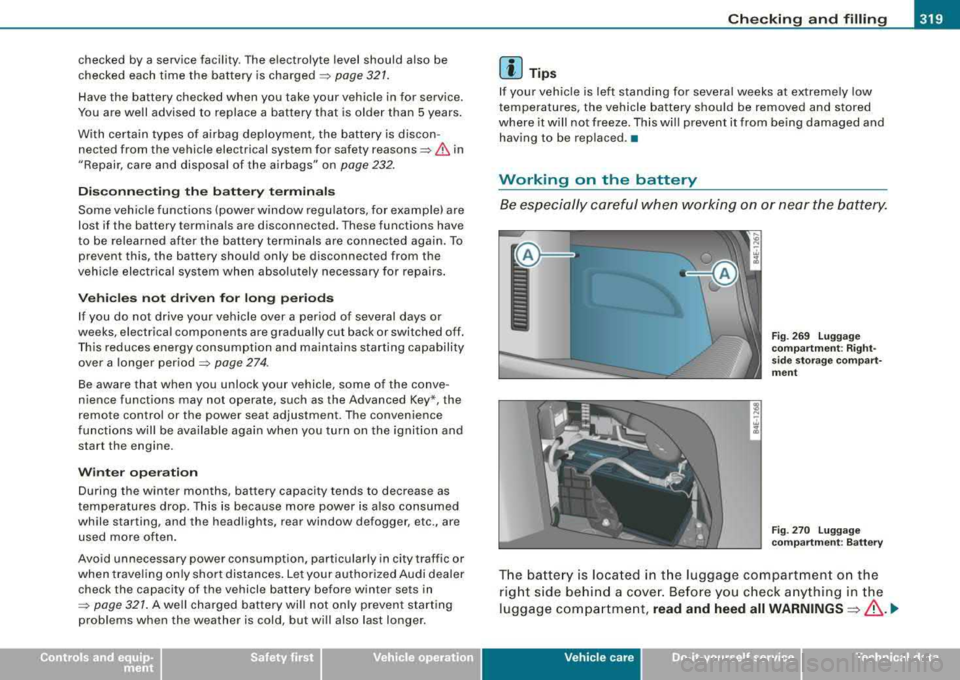
Working on the battery
Be espe cially careful when w orking on or near the battery.
Fig . 2 69 Lugg age
co mpartment : R ight
si de sto ra ge c omp art
m ent
F ig. 2 70 Lugg age
co mp artment : B atte ry
T h e ba tter y is lo ca te d in t he luggage compartm ent on the
r ight side b ehind a c ove r. Before you check a nything in the
luggag e co m partment,
read and heed all WARNINGS =>& . .,.
Vehic le care I I irechnical data
Page 389 of 404
______________________________________________ A_ l.!. p _h_ a_ b_e _ t_i c_ a..:..l ...:.. in :..:..:. d:..:e :..: x_;__ _,n
Kne e airbags ...... ... .. .... ..... 234 ASR
Moni to ring .. ... .... .... ....... .. 229 How the Anti-S lip Regu la tion Sys tem
PASSENGER AIR BAG OFF ligh t .... . 230 works ...... ... .... .... .... .... 270
Repairs ........ .... .... ......... 232
Safety instructions ... .... ... .... . 231
Side airbags ... .. .... .... ... .... . 237
Side curtain air bags (SIDEGUARD) .. 240
Warning/indicator lights ...... .... .. 19
Weight -sens ing mat ...... ... .... . 2 44
When mu st the syst em be insp ected?
229
Aircra ft
T ransporting your v ehicle .. ........ 369
All W hee l Dr ive ...... .... ... .... .... 273
Alloy whee ls ... .... .... .... ... .... .. 293
A ll-whee l drive
W int er tir es . ..... .... ... ... . .... . 34 1
A lternator
See Ge ne ra tor . ....... ... .... .... . 18
An ti-free ze
See Engine coolan t ..... .... .... .. 314
An ti- lock brak e system
How th e ABS syst em works ....... . 272
Wa rning /indi cato r ligh ts .. .. .. .... .. 21
Anti -Sl ip Reg ulat io n System (ASR)
H ow the system works .... .... .... 270
Anti -theft systems
Anti -theft alarm system .. ... .... ... 61
E lectron ic immob ilizer . .... .... .... 49
Ashtray Fron t .. .... ... .. .... ...... .... .. 106 Aud
i Service Repa ir Manua ls and Literatu re
380
A UTO mode
AC climate con tro l .. .. .... .... .... 117
Auto Safety Hotline .... .... .... ... .. . 207
A ut o-C heck Con trol ...... .... ... .... .. 28
Automatic belt retracto r ... .. .... .... . 213
Automati c car wash
See Washing . .............. .... .. 289
A ut om atic Sh ift Loc k (ASU . ...... .... . 165
Automat ic transmission
6 -speed automat ic t rans missio n .... 163
Auto matic S hift Lock (ASU .... .... . 165
Dr iving . ...... .... .... .... .... ... 163
Dynamic sh ift p rogram .. ...... .... 166
Em ergency release fo r selecto r leve r 168
F a il- safe mode . ...... .... .... .... 168
I gnition key s afety lock . ...... .... . 130
K ick -down .... .... .... .... ... .... 166
Manual sh ift program ....... .... .. 167
S ele ctor le ve r ... ........... .... .. 164
Shift buttons ... .... .... .... .... . 168
S teering wheel w ith tiptronic . ...... 168
Average speed . ...... .... .... .... ... . 38
Avo id damaging the ve hicle .. ...... ... 279
B
Rear . ...... .. ...... .... ......... 107 Background lighting . ...... .... ... .. .. 76 Ba
ttery .... ... .. .... .... ...... .... . 318
Ba ttery location ins ide the luggage
compa rtmen t ... .... ... .... .... . 319
Chargi ng .. .... .... ... .... .... ... 321
Impo rtant wa rnings when working on the
battery .. .... .... ... .... ...... . 319
low ...... .... .... .... ... .... .... 274
Replaci ng t he battery .. ... .... ... . 3 22
State of cha rge . ...... .... .... ... . 27 4
Winter operat ion ..... .... .... .. . . 318
Wo rking on the batte ry . ....... ... . 319
Battery vo ltage .. .. .. .... .... .... ..... 35
B efo re driving ... .... .... ...... .... . 199
Blended gasoline ... .. .... .... .... ... 30 1
Body cavity sealing ........ .... .... .. 294
Boos ter seat ... .. .... .... ... .... .... 251
How do I properly install a booster seat in my veh ic le? . .... .... ... .... .... 251
Safety instructions .. ...... .... ... . 251
Brake flu id
Changing the brake fluid ...... .... . 318
Check ing the brake fluid leve l .... .. 317
What is the co rrect brake fluid leve l? 317
What s hould I do i f th e brake fluid warning
l ight com es on? . .... .... .... .... 317
Brake system Ant i- lock brake sys tem .... .... .... . 21
B rake assis ta nt .... .... ... .... .... 272
Brake booster .. ... .... ... .... .... 271
Brake flu id . ... .... .... ... .... .... 317
Brake f luid specifications for ref ill and
replace men t . .... .... .... ...... . 318
Bra ke light de fective . .... . .... .. .. . 26
Brake pads . ...... .... ... .... .... 278
Controls and equip
ment Safety first Vehicle operation
Vehicle care Do-it-yourself service Technical data
Page 392 of 404
lll'ffll_....:..A..:.;l~ p :..;h..:.; a= b..:e :..;t:.:..i c::..:: a.:..l .,;. in :..:..:. d:..;e :..;x..:..,_ ___________________________________________ _
Driver's seat memory . . . . . . . . . . . . . . . . . 94
Activating remote contro l key .. ... .. 95
Recalling a seat position ...... .... . 94
Storing a seat position ............. 94
Driving messages .................... 29
Dr ivingsafely .... .... .... ...... .... 198
Driving time .... ... .. .... .... ...... .. 38
Dup licate key ......... ............... 47
DVD p layer for navigation system . . . . . 112
E
Easy entry feature 129
Electromechanica l parking brake
Emergency braking ............... 136
Malfunction ........ .... .... .... . 136
Operation . . . . . . . . . . . . . . . . . . . . . . . 134
Parking . . . . . . . . . . . . . . . . . . . . . . . . . 135
Re leasing and app lying .... .... ... 134
Starting
off with a trailer . ...... ... 136
Warning/indicator lights ........... 22
Electronic differential lock (EDU
How the system works . . . . . . . . . . . . 269
Warning/indicator lights ........... 21
Electronic immobilizer .. ...... ..... 14, 49
Electron ic power contro l
(EPC) warning/indicator light .. .... .. 18
Electronic speed limiter .. .. .. .... ..... 28
Electronic stabi lization program (ESP)
How the system works . . . . . . . . . . . . 268
Warning/indicator lights ........... 18
Emergency braking .. ....... .. ...... 136 Emergency
closing
Power sunroof ................. 67, 68
Emergency flasher . . . . . . . . . . . . . . . . . . . 73
Warning/indicator lights ..... ...... 19
Emergency locking ....... .... .... .... 54
Emergency locking of doors ........... 54
Emergency starting ........ .... ... .. 364
Emergency towing ..... .. .... .... ... 366
Emergency warning triangle ... ....... 348
Energy management .... .... ... .. ... 274
Battery power . . . . . . . . . . . . . . . . . . . 275
Driver notification ................ 275
Engine 4.2 I, 8-cylinder (350 hp) .... .... ... 308
6 .0 I, 12-cylinder (450 hp) .......... 309
Compartment . .... .... .... .. 308, 309
Coolant ......................... 314
Hood ... .. .... .... .... .... .... .. 306
Starting ...... .............. 129, 130
Starting with jumper cables .. ... .. 364
Stopping ........................ 131
Engine compartment ... .. .... .... ... 308
Safety instructions .......... ..... 307
Working the engine compartment .. 307
Engine coolant ..................... 314
Adding coolant ............. ..... 316
Checking the engine coo lant level .. 315
Expansion tank .................. 315
Malfunction symbo l ...... .... .... . 31
Radiator fan ...... .... .... .... ... 317
Temperature gauge . . . . . . . . . . . . . . . 12
Engine data ........................ 378 Engine hood
Closing ..... .. .... .... ...... ... . 307
How to release the hood . . . . . . . . . . 306
Engine oi l ..... ... .... .... .... ...... 309
Adding ......................... 312
Additives ........................ 312
Changing .. .... .... ..... .. .... .. 313
Checking the engine oil level ....... 311
Indica tions and conditions requiring extra
checking .. ...... .... ...... .... 311
Oil consumption ................. 311
Oil grades .. .... .... ... .... .... .. 309
Oil level symbol .... .... ...... ... .. 35
Pressure ma lfunction ... ... .... .... 32
Recommended oil check intervals .. 311
Sensor defective . . . . . . . . . . . . . . . . . . 35
Specification and viscosity ......... 309
Environment Break -in period .................. 277
Catalytic converter .... .... .... ... 278
Disposing of your vehicle battery ... 322
Driving at high speeds ....... ... .. 279
Driving to minimize pollution and noise .
279
Fuel ...... .... ........... .... ... 303
Fuel economy .......... .... .... .. 279
L eaks under your vehicle .......... 307
Le tting the vehicle stand and warm up ..
280
Proper disposal of drained brake fluid
318
Proper disposal of drained engine coolant . .... .... .... .... ....... 316
Page 393 of 404
______________________________________________ A_ l_,_ p _h_ a_ b_e _t_i c_ a_l _in _ d_e _ x __ lllll
Proper disposal of drained engine oil ...
312,3 13
Recycling used engine oi l ...... .... 312
Un leaded fuel ..... .... ... .... .... 301
What should I do with an old battery?
322
EPC
See Electronic power control ........
18
ESP
See E lectronic stabi lization program
( E SP) ...........................
18
Event Data Recorder (EDR) ... .... .... . 268
Expans io n t ank ...... .... ... .... .... 315
F
Fan
Rad ia tor .. ...... .... .... ... .... .
317
Flat tire changing .. ... .... .... ... .. .. 45
Floor mats ... .. .... .... .... ... .... . 205
Fog lights
Front . ...... .... .... .... ..... .. ..
71
Rear .... ... .. .... .... ... .... .... . 71
Warning/indicator lights ...... .... .. 19
Fo lding master key with remote control .
47
Foot pedals ........................ 204
For the sake of the environment
Gaso line fumes and the enviro nment
303
Letting yo ur engine warm up . ...... 130
Reduc ing eng ine noise by ea rly
upshifting .. .... .... ............
12
Refuel ing .... .... ....... .... .... 303
Saving fuel by early upshifting .. .... 12
Using the rear w indow defogger .... 124
Controls and equip ment Safety first
Front airbags
Description ......... ...... .... ...
222
How they work .... .... .... ....... 227
F ront arm rest
adjusting .........................
93
Storage compartm ,ent .............. 93
Fr ont ash tray .. ...... .... .... .... ... 106
Front fog lights ..... .... .... .... .... . 71
Front seats ...... ...... ... .. .... .... . 86
Adjusting ....................... 201
Child restraints in the front seat . ... 220
Convenience side view ............. 91
Pockets ............. .... .... .... 11 0
Symmetrica l seat positions ......... 91
Fronta l collisions and the laws of phys ics
210
F uel
Additives ..... .... .... .... .......
301
Average consumption ...... .... .... 38
Blended gasoline .... ....... .... .. 301
Fuel filler neck ............. .... .. 302
Fuel gauge .. ....... .... .... .... .. 14
Gaso line .. .... ..... ...... .... ... 301
Gaso line additives .. ....... ....... 302
Instantaneous fuel consumption .. ... 38
Low fue l level sym bol ... .. .... .... . 35
Octane rating ... .. .... .... .... ... 301
Rec ommendat ion ... .... ... .. .... 301
Refuel ling .. ...... .... .... .... ... 303
Reserve ... ....... .... .... ....... . 14
Tank capacity ................. 14,378
Unlocking the fuel filler flap by hand 305
Fuse arrangement . ...... .... ..... .. . 358
G
Garage door opener (HomeLink®) ...... 191
Gas discharge lamps ...... .... .... ... 362
Gauges
Engine coolant temperature . ...... ..
12
Fuel gauge . ...... .... ... .... .... . 14
Speedomete r ..... .... ... .... ..... 14
Tac ho m eter . ... ... .... ... .... .... . 13
Trip odometer ... .. .... .... ...... .. 14
Gene ral il lustration
Instruments a nd controls ... .. .... ..
11
Generator
Warning/indicator lights ...... .... ..
18
G lossa ry of tire and loading te rmin ology . . .
325
Glove compartment ................. 109
cd changer ........... .... .... ...
109
Owner's Literature ................ 109
Gross Vehic le We ight Rating (GVWR) ...
375
H
Head restraints ....... ... .... .... ... 203
Adjusting ...... .... ... .... .... ... 203
Comfort head restraints ............ 91
Front seats ... .... .... .... .... .... 91
Rear seats .... .... .... ...... ... .. .
92
Headlight ra nge co ntrol ...... .... ... .. 36
Headlights .. .. .. .... .... ...... .... .. 69
Adaptive Light .................... 72
Defective .. ........... .... .... .... 26
Front fog l ig hts .................... 71
Vehicle operation Vehicle care Do-it-yourself service Technical data
Page 394 of 404
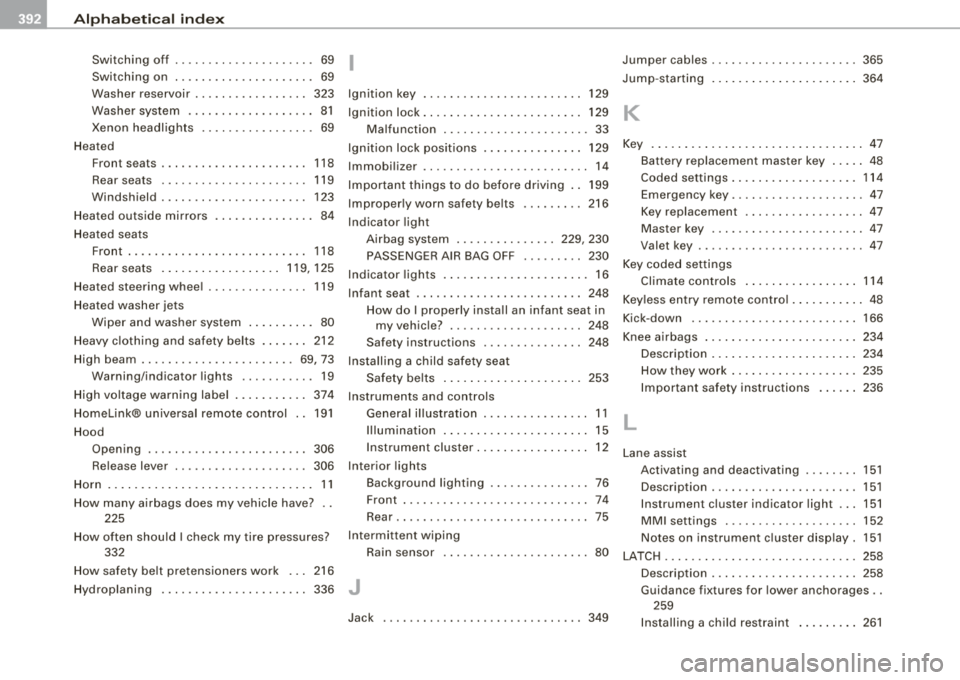
111'1_....:..A..:.;l~ p :..;h..:.; a= b..:e :..;t:.:..i c::..:: a.:..l .,;. in :..:..:. d:..;e :..;x..:..,_ ___________________________________________ _
Switching off ....... .... .... .... .. 69 I
Switching on . .... .... .... ...... .. 69
Washer reservoir . . . . . . . . . . . . . . . . . 323
Washer system . . . . . . . . . . . . . . . . . . . 81
Xenon headl ights . ..... .. .... .... . 69
Heated Fron t seats . . . . . . . . . . . . . . . . . . . . . . 118
Rear seats . . . . . . . . . . . . . . . . . . . . . . 119
Windshield .... ...... .... .... .... 123
Heated outside mirrors . . . . . . . . . . . . . . . 84
Heated seats Front . . . . . . . . . . . . . . . . . . . . . . . . . . . 1 18
Rear seats . . . . . . . . . . . . . . . . . . 11 9, 125
Heated stee ring whee l . . . . . . . . . . . . . . . 119
H eated washer jets
Wiper and washer system . . . . . . . . . . 80
Heavy c lothing and sa fety belts . ...... 212
High beam .. ...... .... .... .... ... 69, 73
Warning/indicator ligh ts .. ... .... .. 19
H igh vo ltage warn ing label .... .. .. ... 374
Ho melink® universal remote control
Hood 191
Opening ........ ... .. .... ...... . 306
Re lease lever .... .... .... .... .... 306
H orn . . . . . . . . . . . . . . . . . . . . . . . . . . . . . . . 11
How many airbags does my vehicle have? ..
225
H ow of ten shoul d I check my tire pressures?
332
H ow safety be lt pre tens io ners work . . . 216 Ignition key
129
Ignition lock ...... .... .... .... .... .. 129
Malfunction .. .... ... .... .... .... . 33
Ig nition lock pos it ions .. ...... .... ... 12 9
Immobi lizer .. ... ....... .... .... .... . 14
Important things to do before dr iving .. 199
Improper ly worn safety be lts ..... .. .. 216
Indicator light
Airbag system . .......... .... 229, 230
PASSENGER AIR BAG OFF ........ . 230
Ind ica tor lights ...... .... .... .... ... . 16
Infant seat ...... ....... .... .... ... . 248
How do I properly insta ll an infant seat in
my vehic le? .. .... .... .... ...... 248
Safety instruct ions .......... .... . 248
Installing a child safe ty seat
Safety be lts ...... ... .... .... .... 253
Instruments and controls General illustration . .... .... .... ... 1 1
Illu mination ...... .... .... .... .... 15
Instrument cluster . . . . . . . . . . . . . . . . . 12
Inte rior lights
Background lighting .. ... .... .... .. 76
F ront . ...... .. ...... .... ... .. .... 74
Rear .. ... .... ....... .... .... .... . 75
Intermitt ent w iping
Rain sensor ... ...... ....... .... .. 80
Hydroplaning ..... .. ...... .... ... .. 336
J
Jack ...... .... .... ........... .... . 349 Jumper cables
.... .... .... ...... .... 365
Jump -star ting 36
4
K
Key ...... .... .... .... ... .... ..... .. 4 7
Battery replacement master key ... .. 4 8
Coded settings ...... ... .... .... .. 114
Emergency key . .... ....... .... .... 47
Key replacement ... .... ...... .... . 47
Mast er key ...... .... .... ... .. .... 47
Valet key .... .... .... .... .... ..... 47
Key c oded setti ngs
Climate controls ...... .... .... ... 114
Key less entry remote co ntro l ... .... .... 48
Kick-down ......... .... .... .... ... . 166
Knee a irbags ...... .... ... ....... .. . 234
Descrip tion ..... ... .... .... .... .. 23 4
H ow they work . . . . . . . . . . . . . . . . . . . 235
I mportant safety instructions
236
L
Lane assist
Activating and deactivating 151
Description ....... ... .. ...... .... 151
I nstrumen t clus ter indicator ligh t .. . 151
MM I settings ... .. .... .... .... ... 152
Notes on instrument c luster disp lay. 15 1
LA TCH .... .... .... ....... .... .... .. 258
Description .... .... .... ...... .... 258
Guidance fix tur es for low er anchorages ..
2 59
I nstalling a ch ild restraint ...... ... 261