towing AUDI S8 2008 User Guide
[x] Cancel search | Manufacturer: AUDI, Model Year: 2008, Model line: S8, Model: AUDI S8 2008Pages: 404, PDF Size: 52.7 MB
Page 192 of 404
![AUDI S8 2008 User Guide ___ A_ d_a_ p_ ti_v _ e_ A_ ir_ S_u_ s_ p_e _n_ s_ io_n ___________________________________________ _
[ i ] Tips
T he veh ic le wil l no t lower to t he dyna mic level w hen ope rat in g i n t](/img/6/57619/w960_57619-191.png "AUDI S8 2008 User Guide ___ A_ d_a_ p_ ti_v _ e_ A_ ir_ S_u_ s_ p_e _n_ s_ io_n ___________________________________________ _
[ i ] Tips
T he veh ic le wil l no t lower to t he dyna mic level w hen ope rat in g i n t")
___ A_ d_a_ p_ ti_v _ e_ A_ ir_ S_u_ s_ p_e _n_ s_ io_n ___________________________________________ _
[ i ] Tips
T he veh ic le wil l no t lower to t he dyna mic level w hen ope rat in g i n t he
trai le r towing mode .•
Page 207 of 404
------------------------------------------------=D:.:.r.:.iv :..:.:. in.:.:g~ S::. a
::.:. fe::.:.! ly~ --
& WARNING
Pedals that cannot move freely can cause loss of vehicle control
and increase the risk of serious injury.
• Never place any objects in the driver's footwell . An object could
get into the pedal area and interfere with pedal function. In case
of sudden braking or an accident, you would not be able to brake
or accelerate!
• Always make sure that nothing can fall or move into the
driver's footwell. •
Floor mats on the driver side
Always use floor mats that can be securely attached to
the floor mat fasteners and do not interfere with the free
movement of the pedals.
-Make sure that the floor mats are properly secured and
cannot move and interfere with the pedals =>& .
Use only floor mats that leave the pedal area unobstructed and that
are firmly secured so that they canno t slip out of position . You can
obtain suitable floor mats from your authorized Audi Dealer.
Floor mat fasteners are installed in your Audi.
Floor mats us ed in your vehicle must be attach ed to these fas teners .
Properly securing the floor mats will prevent them from sliding into
positions that could interfere with the pedals or impair safe opera
tion of your vehicle in other ways.
& WARNING
Pedals that cannot move freely can result in a loss of vehicle
control and increase the risk of serious personal injury.
• Always make sure that floor mats are properly secured.
Controls and equip ment Safety first Vehicle operation
&, WARNING
(continued)
• Never place or install floor mats or other floor coverings in the
vehicle that cannot be properly secured in place to prevent them
from slipping and interfering with the pedals or the ability to
control the vehicle.
• Never place or install floor mats or other floor coverings on top
of already installed floor mats. Additional floor mats and other
coverings will reduce the size of the pedal area and interfere with
the pedals.
• Always properly reinstall and secure floor mats that have been
taken out for cleaning.
• Always make sure that objects cannot fall into the driver foot
well while the vehicle is moving. Objects can become trapped
under the brake pedal and accelerator pedal causing a loss of
vehicle control.
•
Stowing luggage
Loading the luggage compartment
All luggage and other objects must be properly stowed and secured in the luggage compartment.
Loose items in the luggage compartment can shift
suddenly, changing vehicle handling characteristics. Loose
items can also increase the risk of serious personal injury in
a sudden vehicle maneuver or in a collision.
- Distribute the load evenly in the luggage compartment.
- Always place and properly secure heavy items in the
luggage compartment as far forward as possible.
- Secure luggage using the tie-downs provided
=> page 100, "Luggage compartment ".
Vehicle care Do-it-yourself service Technical data
Page 274 of 404
-Intelligent technology
P:V:1--------=-- --=-=-------------
& WARNING
• Never let the vehi cle roll to a stop with the engine shut off .
• If the brake boo ster i s not working, for example when towing
your vehicle , or because the brake booster has so mehow been
damaged, the brake pedal must be pres sed considerably harder to
make up for the la ck of booster as sistan ce . •
Functioning of Anti-Lock Brake System (ABS)
AB S pre vent s th e wh eels fr o m lo ckin g up un der braking .
The ABS contributes effective ly to ve hicle control s ince it prevents
th e whee ls from
lo cking w hen t he brakes are a ppl ied. This mea ns
that the vehicle remains steerable and is less likely to skid.
With ABS you do not need to pump the brake . Just hold the brake
pedal down.
H owever, do not expect the ABS to shorten braking distance under
all cir cum stances. W hen drivin g on g ravel o r on new ly fallen s now
on top of icy surfac es, bra king distance may be even longer, there
fo re, unde r th ese circum stances, i t is especially i mporta nt th a t yo u
drive slow ly and with great care .
How the ABS system works
An automatic check is made when a speed of about 4 mph (6 km/h)
is reac hed . When this ha p pens, a pumping n oise can be hea rd.
If an indiv idua l wheel begins to rotate too s lowly in relation to
vehic le speed and tends to lock, the ABS automatica lly reduces
brake pressure to prevent that whee l from loc king .
T his automat ic adjustment process wil l cause a
slight vibration of
th e br ak e pe dal a nd some noises to ale rt you th at ve hic le sp eed
must be adapted to existing road and traffic conditions.
& WARNING
Although the ABS is very effe ctive , always remember that braking
capability is limited by tire traction. Alway s adjust your driving
speed a ccording to the road and traffi c conditions . Do not let the
extra safety afforded by the ABS tempt you into taking extra risks.
The ABS cannot overcome the laws of physics.
[ i ] Tips
• I f ABS is not funct io ni ng properl y, a wa rn ing li ght will co me o n.
See ~ page 21.
• I f a fault occurs in the A BS, the EDL is also not functioning. This
i s indica ted by the ABS wa rn ing l igh t.•
Brake assistant
The brake assis tant is desig ned to ach ieve the o ptim um
brakin g eff ec t.
The br ake assistan t helps to in cr eas e the effec tive b raki ng pow er
and thus to achieve a shorter stopping distance . If the driver
p re sses the b rake pe dal very q uick ly, the brake assistan t auto mati
ca lly boosts the brakin g force to the maximum level, up to th e point
whe re the a nti-lock b rake functi on (AB S) int ervenes to sto p the
w hee ls from loc king . You s hou ld t hen k eep th e br ake pedal pressed
until t he vehicle ha s braked to the required speed . The brake a ssis
t ant s witches itse lf off as soo n as you re lease t he bra ke pedal.
T he b rake assistant will not be ope rative if there is a malfunction in
th e ABS .
& WARNING
Please remember that the accident risk always increases if you
drive too fast , especially in corners or on a slippery road , or if you
follow the vehicle ahead of you too closely . Increased risk of an
~
Page 284 of 404
llffll.___T_ r_a _il _e_ r_ t_o _w_ i_ n """g"'- ---------------------------------------------------
Trailer towing
Driving with a trailer
General information
Your Audi was designed primarily for passenger transpor
tation.
If you plan to tow a trailer, please remember that the add it ional load
wi ll affect durability, economy and performance.
Tra iler towing not on ly p laces more stress on the vehicle, it a lso ca lls
for more concentration from the driver.
For this reason, always fol low the ope rating and driv ing instruc tions
provided and use common sense.
(D Note
If you are go ing to tow a trai ler, you must activate the trailer opera
tion
mode => page 189, "Towing a Trailer". •
Technical requirements
Traile r hit ch
Use a we ight-carrying hitch conforming to the gross trai ler weight.
The hitch must be suitable for your vehic le and trailer and must be
mounted secure ly on the ve hicle's chass is at a
technically sound
location. Use only a trailer hitch with a removable ball mount.
Always check wit h the trai ler hitch manufacturer to make s ure that
you are using the correct hitch .
Do not use a bumper hit ch.
The hitc h must be installed in such a way t hat it does not interfere
with the impact-absorbing bumper system. No modifications
should be made to the veh ic le exhaust a nd brake systems. F rom time to time, check that all hitch mounting bolts remain secure
ly
fastened .
When yo u are no t towing a trailer, re move the tra ile r hitch ball
mount. This prevents the hitch from causing damage shou ld your
vehic le be struck from
behind =>& .
Traile r br ake s
If your tra iler is equipped with a braking syste m, check to be sure
that it conforms to al l regu lations .
The tra iler hydraul ic brake sys tem must not be di rect ly co nnected to
t he vehic le's hydrau lic brake system .
Safety chains
Always use safety chains between your vehicle and the trailer.
Trailer light s
Trai ler lights must meet a ll regulations. Be sure to check with your
Aud i dea ler for correc t wir ing, sw itch es and relays .
Mirrors
If you are unable to see the traf fic behind you using the regu lar
outside mirrors, then you
must instal l extended mirrors. It is impor
t ant that you
always have c lear v ision to the rear.
& WARNING
After removing the tr ailer hitch , do not store it in your vehi cle . In
ca se of sudden braking , the hitch could fl y forward and injure you
or your p assenger s.•
Page 285 of 404
____________________________________________________ T_r_a _i_l e_ r_t_ o _ w_ i
_ n...; g=- -•
Operating instructions
M ax im um tra iler weig ht
A trailer for your vehicle is limited to a typ ical c lass 1 or class 2
trailer.
T ra ile r l oad d is tributi on
Be sure the load in the trailer is he ld securely in place to prevent it
from shifting forward, backward or s ideways .
Never a llow a pass enger to r ide in a trailer:::::, & in "Driving instruc
t ions" .
Engin e coo lin g sys te m
Tow ing a trai ler makes the engine work harder. It is important that
the cooling system's performance is up to the additiona l load. Make
sure that the coo ling system has enough fluid .
Tire press ure
When towing a trailer, inflate the tires of your veh icle to t he co ld tire
pressure listed under "Full load" on the labe l located either on the
driver's side B -pil lar (visible when the door is open) or inside the fuel
filler flap . Inflate trailer tires to trai ler and tire manufacturers' spec
ifications.
L ig ht s
The head light settings should be checked wit h the trai ler attached
before driving off. Check to make sure both vehicle and trai ler lights
are working properly .
Safe ty c ha in s
Be s ure trailer safe ty chains are properly connected from the trailer
to the hitch on the vehicle. Leave enough slack in the chains to
permit turning corners . When yo u insta ll safety chains, make sure
they will not drag on the road when you are driving.
T he chains should cross under the trailer tongue to prevent it from
dropping in case of separat ion from the hitch.
Controls and equip
ment Safety first
Vehicle operation
0 Note
If you are go ing to tow a trai ler, you must activate the tra iler opera
tion
mode :::::, page 189, "Towing a Trailer". •
Driving instructions
Driving with a trailer always requires extra care and
consideration.
To obtain the best possib le handling of ve hicle and trailer,
p lease note t he following :
- Do not tow a loaded trailer when your car itself is not
loaded.
- Be especia lly careful whe n passing other vehic les .
- Observe speed limits .
- Do not drive at the maximum permiss ible speed .
- Always apply brakes early.
- Monitor t he temperature ga uge .
W eight d istr ibu tion
Towing a loaded trailer with an empty car results in a highly
unstable d istribution of weight. If this cannot be avoided, drive at
very low speeds only to avoid the risk of losing steering control.
A "balanced" rig is easier to operate and control. This means that
t he tow vehicle should be loaded to the extent possible and permis
sib le, while keeping the trailer as light as possib le under the circum
stances . Whenever possible, transfer some cargo to the luggage
compartment of the tow vehicle whi le observing tongue load
requirements and vehicle loading considera tions .
.,,.
Vehicle care Do-it-yourself service Technical data
Page 286 of 404

ffl.___T_ r_a _il _e_ r_ t_o _w_ i_ n """g"'- ---------------------------------------------------
Speed
The higher the speed, the more difficu lt it becomes for the driver to
control the rig. Do not drive at the maximum permissible speed. Reduce your speed even more if load, weather or wind conditions
are unfavorable
-particularly when going downhi ll.
Reduce vehicle speed
i mm edia te ly if the trailer shows the slightest
sign of swaying.
Do not try t o stop the sway ing by accelerating.
Observe speed lim its. In some areas, speeds for vehicles towing
trai lers are lower than for regular ve hicles .
Always apply brakes ear ly. When driving down hill, shift into a lower
gear to use the engine braking effect to slow the vehicle. Use of the
brakes a lone can cause them to overheat and fail.
Cool ant temp era tu re
The coolant temperature gauge=> page 12 must be observed care
ful ly. If the needle moves close to the upper end of the scale, reduce
speed immed iately and/or turn off the air conditioner.
If the coolant temperature warning light in the instrument cluster
starts flas hing
-F- , pul l off the road, stop and let t he engine idle for
about two m inutes to prevent heat build-up.
& WARNING
An yone n ot properl y re str aine d in a mo ving vehi cle is at a mu ch
g re ate r ri sk in an accid ent . N ever let any on e rid e in y our car who
i s not properl y wea rin g th e res tra int s pr ov ided by Audi.
•
Trailer towing tips
Important to know
Your vehicle handles differently when towing a trailer because of
the additional weight and different weight distribution. Safety, performance and economy wi
ll greatly depend on how carefully you
l oad your trailer and opera te your r ig.
Before you actual ly tow your trailer, practice turn ing, stopping and
backing up in an area away from traffic . Keep practicing unti l you
have become comp letely fam iliar with the way your vehicle-trai ler
combination behaves and responds.
Backing up is di fficult and requires practice. Backing up with a
trai ler generally requires steering action opposite to that when
backing up your veh ic le without a tra iler.
Ma inta in a greater distance between your veh ic le and the one in
front of you . You will need more room to stop. To compensate for
the trai ler, you w ill need a larger than norma l turning radius.
When passing, remember that you cannot accelerate as fast as you n or mally wou ld because of t he added load . Make su re you have
enough room to pass . After passing, al low plenty of room for your
t rai ler befo re changing lanes again .
Avo id jerky starts, sharp turns or rapid lane changes.
[ i ] T ips
• Do not tow a tra iler during the break-in period o f your veh ic le.
• I f you tow a trailer, your Audi may require more frequent main te
nance due to t he extra
load=> page 380. •
Parking on a slope
Do n ot park on a slope with a trailer. If it cannot be
avoided, do
so o nly after doing the followi ng:
When p arking :
-Apply the foot b rake.
- Have someone p lace chocks under both the vehicle and
the trailer wheels. _,,,
Page 336 of 404
-Tires and wheels Determining correct load limit
Use the example below to calculate the
total weight of the passengers and
luggage or other things that you plan to
transport so that you can make sure that
your vehicle will not be overloaded.
Steps for Determining Correct
Load Limit
1. Locate the statement "THE COMBINED
WEIGHT OF OCCUPANTS AND CARGO SHOULD NEVER EXCEED XXX KG OR XXX
LBS"on your vehicle's placard (tire infla
tion pressure label) => page 328, fig. 272.
2. Determine the combined weight of the driver and passengers that will be riding in your vehicle.
3. Subtract the combined weight of the driver and passengers from
"XXX" kilo
grams or
"XXX" pounds shown on the
sticker=> page 328, fig. 272. 4. The resulting figure equals the available
amount of cargo and luggage load
capacity. For example, if the
"XXX"
amount equals 1400 lbs. and there will
be five 150 lbs. passengers in your
vehicle, the amount of available cargo
and luggage load capacity is 650 lbs.
(1400-750 (5
X 150) = 650 lbs.)
5. Determine the combined weight of luggage and cargo being loaded on the
vehicle. That weight may not safely
exceed the available cargo and luggage
load capacity calculated in Step 4.
6. If your vehicle will be towing a trailer,
load from your trailer will be transferred
to your vehicle. Consult this manual to
determine how this reduces the avail
able cargo and luggage load capacity of
your vehicle.
- Check the tire sidewall
( => page 336,
fig. 276) to determine the designated
load rating for a specific tire. •
Page 352 of 404
llffl!I What do I do novv?
'---------------------------------------------
Tools
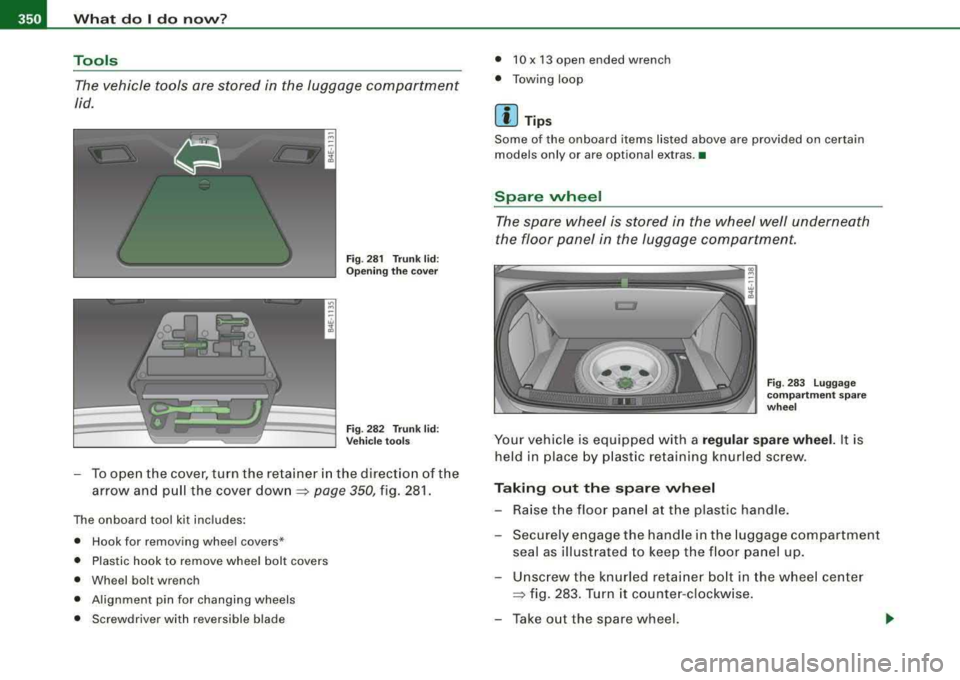
The vehicle tools are stored in the luggage compartment
lid.
Fig . 281 Trunk lid:
Opening the cover
Fig . 282 Trunk lid:
Vehicle tools
-To open the cover, turn the retainer in the direction of the
arrow and pull the cover down
~ page 350, fig. 281.
The onboard tool kit includes:
• Hook for removing wheel covers *
• Plastic hook to remove wheel bolt covers
• Whe el bolt wr ench
• Alignment pin for changing wheels
• Screwdr iv e r with reversible blade •
10 x 13 open ended wrench
• Towing loop
[ i] Tips
Some of the on board items listed above are provided on certain
models only or are optional extras .•
Spare wheel
The spare wheel is stored in the wheel well underneath
the floor panel in the luggage compartment.
Fig . 283 Luggage
compartment spare
wheel
Your vehicle is equipped with a regular spare wheel. It is
held in place by plastic retaining knurled screw.
Taking out the spare wheel
- Raise the floor panel at the plastic handle.
- Securely engage the handle in the luggage compartment
seal as illustrated to keep the floor panel up.
- Unscrew the knurled retainer bolt in the wheel center
~ fig. 283. Turn it counter-clockwise .
- Take out the spare wheel.
Page 353 of 404
What do I do now? Ill
------------------~;___
•
-Disengage and lower the floor panel before you close the
luggage compartment lid again.
Storing the replaced wheel
-Place the replaced wheel inside the spare wheel well in
the luggage compartment.
Tighten the knurled retaining screw clockwise to secure
the wheel in place.
-Disengage and lower the floor panel before you close the
luggage compartment lid again.
& WARNING
Loose items in the passenger compartment can cause serious
personal injury during hard braking or in an accident .
• Never store the spare wheel or jack and tools in the passenger
compartment.
• Always store all jacking equipment, tools, and the spare wheel
in the luggage compartment .
• Tighten the knurled retaining screw for the spare wheel
securely.
[ i] Tips
Check the inflation pressure of the spare tire periodically to keep the
tire ready for use. •
Changing a wheel
Before changing a wheel
Observe the following precautions for your own and your
passenger's safety when changing a wheel.
-After you experience a tire failure, pull the car well away
from moving traffic and try to reach level ground before
you stop
~ &,. .
-All passengers should leave the car and move to a safe
location (for instance, behind the
guardrail) ~&,. .
-Engage the parking brake to prevent your vehicle from
rolling
unintentionally ~&,. .
-Move selector lever to position P ~ &,..
-If you are towing a trailer: unhitch the trailer from your
vehicle.
-Take the jack and the spare tire out of the luggage
compartment~ page 349.
& WARNING
You or your passengers could be injured while changing a wheel if
you do not follow these safety precautions:
• If you have a flat tire, move a safe distance off the road. Turn off
the engine, turn the emergency flashers on and use other warning
devices to alert other motorists.
• Make sure that passengers wait in a safe place away from the
vehicle and well away from the road and traffic.
• To help prevent the vehicle from moving suddenly and possibly
slipping off the jack, always fully set the parking brake and block
the wheel diagonally opposite the wheel being changed. When one _..
Do -it -yourself service
Page 366 of 404
___ E
_ m_ e_r-=g =-e_ n_c ..:y,_ s_ i_ t _u _a_ t_ i_ o _n_ s _______________________________________________ _
Emergency situations
General
This section is intended for trained emergency crews and per sonnel
who have the necessary tools and equipment to perform these operations.
•
Starting by pushing or towing
0 Note
Yo ur vehicle is equipped wi th an auto matic trans mis sio n. C onse
quent ly, the engine cannot be started by pushing or tow ing .•
Starting with jumper cables
If n ece ssar y, the eng in e c an b e star ted by connecting it to
the battery of anoth er veh icle .
If th e engin e shou ld fail to start because of a discharged or weak
ba ttery , the bat te ry can be co nnected to the ba ttery of
another
vehic le, usin g a pair of jumper cables to start the engine.
Jumper cables
Use on/yjumper cabl es of sufficient ly lar gecross section to carry the
s tarte r current safe ly . R efe r to th e manu fac tur er's speci fica tions.
Us e on ly jump er cabl es w it h
insulate d terminal clamps w hic h are
distinct ly marked:
plus (+l cable in m ost c ases c olor ed red
minus
(-l cable in most cases co lored black .
& WARNING
Batteries contain electricity , acid , and gas. Any of these can cause
very serious or fatal injury. Follow the instructions below for safe
handling of your vehicle 's battery.
• Always shield your eyes and avoid leaning over the battery
whenever possible .
• A discharged battery can freeze at temperatures just below
32 °F (0 °C l. Before connecting a jumper cable, you must thaw the
frozen battery completely , otherwise it could explode .
• Do not allow battery a cid to contact eyes or skin . Flush any
contacted area with water immediately .
• Improper use of a booster battery to start a vehicle may cause
an explosion.
• Vehicle batteries generate e xplosive gases . Keep sparks, flame
and lighted cigarettes away from batteries.
• Do not try to jump start any vehicle with a low ac id level in the
battery.
• The voltage of the booster battery must also have a 12-Volt
rating . The capacity (Ahl of the booster battery should not be
lower than that of the discharged battery . Use of batteries of
different voltage or substantially different
" Ah " rating may cause
an explosion and personal injury .
• Never charge a frozen battery. Gas trapped in the ice may cause
an explosion .
• Never charge or use a battery that has been frozen . The battery
case may have be weakened.
• Use of batteries of different voltage or substantially different
capacity (Ah) rating may cause an explosion and injury . The
capacity (Ah l of the booster battery should not be lower than that
of the discharged battery .
...,