ECO mode AUDI S8 2008 Owner's Manual
[x] Cancel search | Manufacturer: AUDI, Model Year: 2008, Model line: S8, Model: AUDI S8 2008Pages: 404, PDF Size: 52.7 MB
Page 129 of 404
Warm and cold -
----------------
the outside air drops, fresh air is supplied to the vehicle interior
again .
In the event that the windows fog up during automatic air recircula
tion, you must press
the® button immediately.
Under certa in operat ing cond it ions, automatic a ir rec ircu lation is
switched off automatically . With outside temperatures below about
-8 °C and in the ECON mode, automatic air rec ircula tion is limited to
15 seconds. •
Synchronization
One climate control setting for all seats.
With synchronization active, the driver's or the passenger's settings
are adopted for the other seats . Al l the other set tings that were
made are transferred to the other seats. This includes all the c limate
control settings right down to the heated seats .
If
a d ifferent setting is selected at a "synchron ized seat", synchroni
zation is cancelled.
•
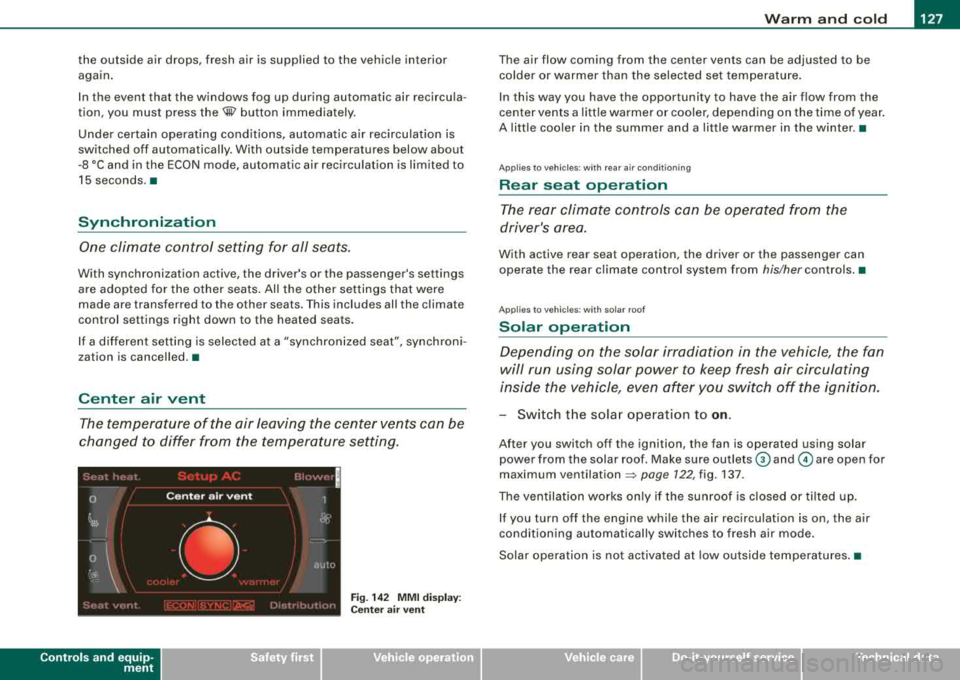
Center air vent
The temperature of the air leaving the center vents can be
changed to differ from the temperature setting.
Controls and equip ment
Fig. 14 2 MMI di spla y:
Ce nter a ir ve nt
The air flow coming from the center vents can be adjusted to be
colder or warmer t han the selected set temperatu re.
In this way you have the opportunity to have the a ir flow from the
center vents a litt le warmer or coo ler, depending on the time of year .
A litt le cooler in the summer and a little warmer in the winter. •
Applies to vehic les : with rear air condition in g
Rear seat operation
The rear climate con trols can be o perated fr om the
driver's area.
With active rear seat operation, the driver or the passenger can
operate the rear climate control system from
his/her contro ls. •
Ap plies to vehicles : w ith so lar roof
Solar operation
Depending on the solar irradiation in the vehicle, the fan
will run using solar power to keep fresh air circulating
inside the vehicle, even af ter you switch off the ignition.
- Switch the solar operation to on .
After you switch off the ignition, the fan is operated using solar
power from the solar roof. Make sure outlets
G) and © are open for
maximum
ventilation => page 722, fig. 137.
The vent ilation works on ly if t he sunroof is closed or t ilted up.
If you turn off the engine whi le the air rec irculation is on, the air
conditioning automatically switches to fresh air mode.
Solar operation is not activated at low outside temperatures .•
Page 132 of 404
___ O_ n_ t_h _e_ r_o _ a_ d ____________________________________________________ _
[ i J Tips
• If you release the ignition key in positions G) ,@ or G) , the key
automatically returns to pos ition @.
• If you open the driver 's door when the ignition is switched on , a
buzzer sounds and the message
Ignition is on appears in the instru
ment cluster display. Please switch the ignition off .•
Ignition key safety lock
The igni tio n key can only be re move d when the selector
lever is in the
"P" (P ark) posi tion.
After turning off the ignition , the igni tion key can only be removed
from the ignition lock when the selec tor lever is in the
"P" (Park)
position . Af ter you have removed the key , the selector lever is locked
and cannot be moved .•
Starting and stopping the engine
Starting the engine
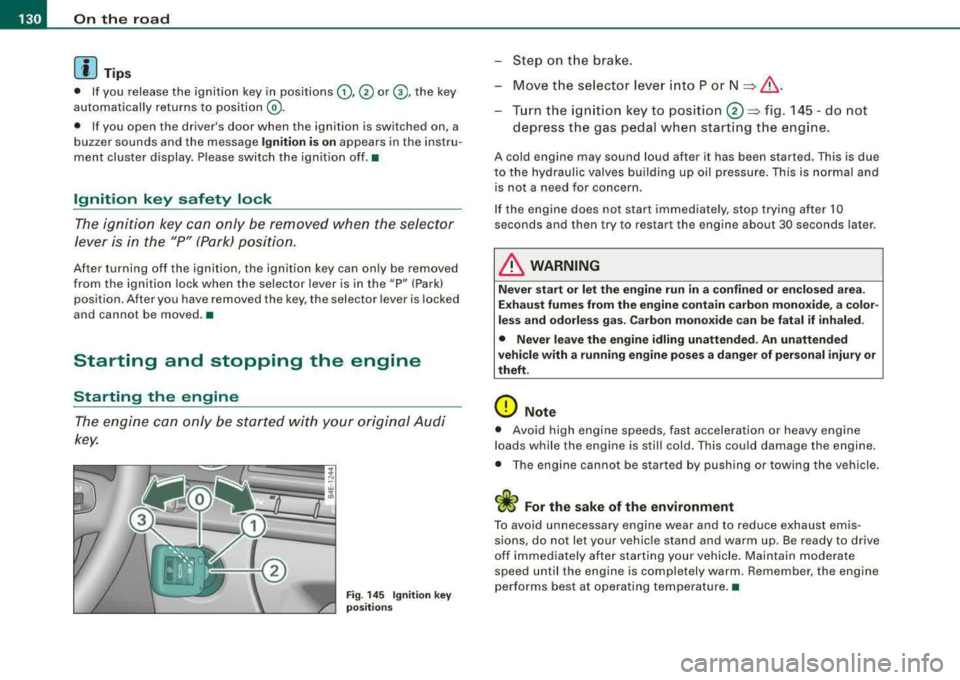
The engine ca n only be st arted with y our or iginal A udi
key.
Fig . 14 5 Ignit ion key
po sitions
-St ep o n the brake.
- Move t he selector lever into P or
N => &, .
-Turn the ign ition key to position 0 => fig . 14 5 -do not
depress the gas pedal when start ing t he engine .
A cold engine may sound loud after it has be en started. This is due
to the hydrau lic valves building up oil pressure. This is normal and
is not a n eed fo r concern .
I f the engine does not start immediately, stop trying after 10
seconds and then try to restart the engine about 30 seconds later .
& WARNING
Never start or let the engine run in a confined or en clo sed are a.
Exhaust fumes from the engine contain carbon monoxide, a color
less and odorle ss gas . Carbon mono xide can be fatal if inhaled.
• Never leave the engine idling unattended. An unattended
vehicle with a running engine po ses a dange r of person al injury or
theft.
0 Note
• Avo id high e ngine speeds, fast accelerati on or heavy eng ine
loads while the engine is still cold. This could damage the engine.
• The eng ine ca nnot be s tarted by push ing or towi ng the ve hicle.
sions, do not let your vehic le stand and warm up. Be ready to drive
off im mediately afte r starting your vehicle . Maintain modera te
speed until the engine is completely warm . Remember , the engine
performs best at operating temperature. •
Page 136 of 404
___ O_ n_t_ h_ e_ ro_ a_d __________________________________________________ _
Electromechanical parking brake
Operation
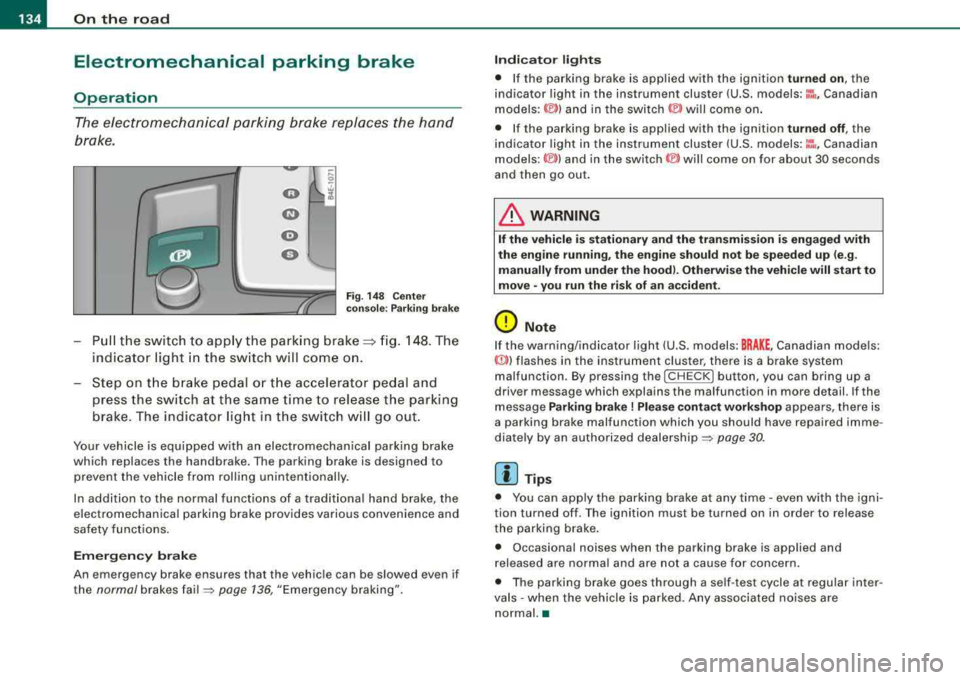
The electromechani ca l parking brake replaces the hand
brake.
F ig. 148 C enter
co nso le: P arki ng b ra ke
Pu ll the switch to app ly the parking brake==> fig. 148. The
indicator light in the sw itch will come on.
Step on t he brake pedal o r th e acce lerator pedal and
press th e switch at the s am e time to rel eas e the parking
brake . The indicator light in t he switch w ill go out .
Your vehicle is equ ipped w ith an electromechanical parking brake
which replaces the handbrake . The parking brake is designed to
prevent the vehicle from rolling unintentionally .
In addition to the norma l functions of a trad itiona l hand brake, the
e lectromechanical parking brake provides various convenience and
safety functions.
Em erg ency brake
An emergency brake ensures that the vehicle can be slowed even if
the
normal brakes fa il=> page 136, "Emergency braking".
Indi cat or light s
• If the pa rking brake is app lied with the ignition turned on , the
indicator light in the instrument cluster (U.S. models:
::i , Canadian
models: ©) and in the switch © will come on .
• If the parking brake is applied with the ignition
tu rn ed off , the
indicator light in the instrument cluster (U .S .
models :~~ . Canadian
models :(®) ) and in the
switch (®) will come on for about 30 seconds
and then go out.
& WARNING
I f the vehicle i s stati onary and the transmis sion i s engaged with
the eng ine runnin g, the engine should n ot b e speeded up (e .g .
manu ally from under the ho od). Otherw ise th e vehi cle w ill start to
mo ve
-you r un the ris k of an ac cident .
0 Note
If the warning/indicator light (U .S . models: BRAKE , Canadian models:
«D>) flashes in the instrument cluster, there is a brake system
malfunction . By pressing the
I CH ECK] button , you can bring up a
driver message which explains the malfunction in more detail. If the
message
Parking brake! Plea se conta ct w ork shop appears, there is
a parking brake malfunction which you should have repaired imme
diate ly by an authorized dealership =>
page 30.
[ i] Tips
• You can app ly the parking brake at any time -even with the igni
tion turned off . T he ignition must be turned on in order to release
the parking brake.
• Occasional noises when the parking brake is applied and
released are norma l and are not a cause for concern .
• The parking brake goes through a se lf -test cycle at regular inter
va ls
-when the vehicle is parked. Any associated no ises are
normal. •
Page 175 of 404
Advanced Parking Sy ste m -
----------------=---=------'
• Keep the sensors in the rear bumper and the rear -view camera
lens clean and free of snow and ice, so that the Audi parking system
can work properly . P lease follow the additional notes on
~ page 183 . •
Applies to ve hicle s: with Ad vanced Par king Sys tem wit h rea r vi ew c am era
Rear-view camera (Rear View)
The rear-vie w camera picture, appearing in the MM!
Dis pla y, shows the are a behind the vehicle.
-'
Ll --
.
-
. -
Fig . 194 T op view :
Park ing mode 1
Fi g. 19 5 Top v iew:
P ark ing mode 2
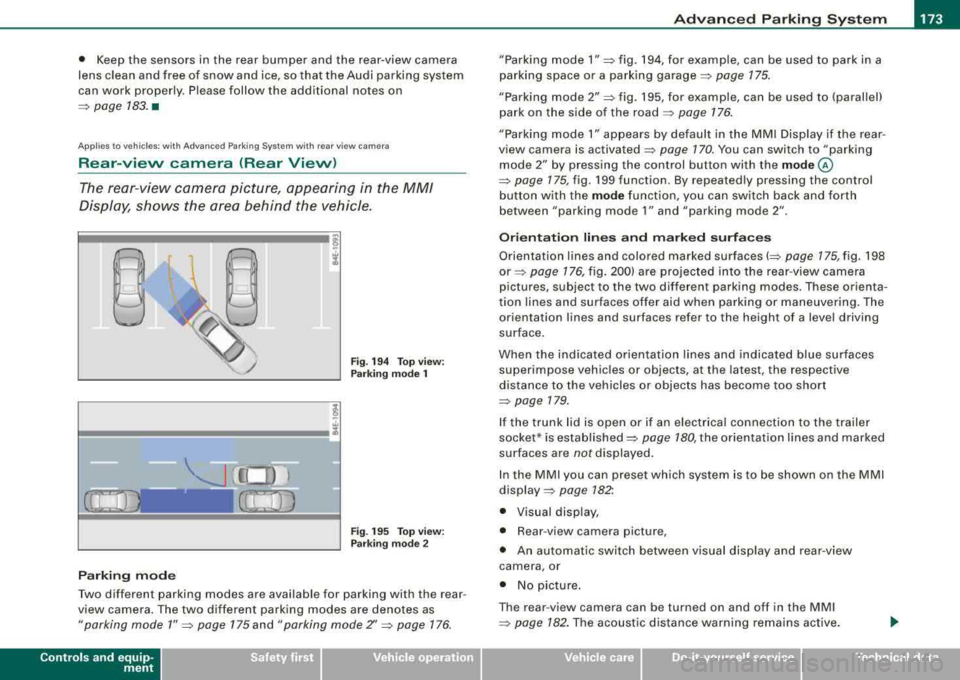
Parki ng mode
Two different parking modes are available for parking with the rear
view camera . The two different park ing modes are denotes as
" parking mode 1 " ~ page 175 and "parking mode Z' ~ page 176.
Controls a nd eq uip
ment
" Parking mode 1" => fig. 194, for examp le, can be used to park in a
parking space or a par king garage ::::>
page 175.
"Parking mode 2" => fig. 195, for examp le , can be used to (parallel)
park on the side of the road
~ page 176.
"Parking mode 1" a ppears by defau lt in the MMI Display if the rear
view camera is activated
=> page 170 . You can switch to "parking
mode
2" b y pressing the control button with the mode @
=> page 175, fig. 199 function . By repeated ly pressing the control
button w ith the
mode function, you can sw itch bac k and forth
between "par king mode
1" and "parking mode 2" .
Orientation lines and marked surfaces
Orientation lines and colored marked surfaces(::::> page 175, fig . 198
or => page 176, fig . 200) are projec ted into the rear -v iew came ra
pictures , subject to the two different parking modes . These orienta
t ion lines and surfaces offer aid when parking o r maneuvering. The
orientation lines and surfaces refer to the height of a leve l driving
surface .
When the indicated orientation lin es and indicated blue surfaces
superimpose vehicles or objects, at the latest , the respective
distance to the vehicles or objects has become too short
=>
page 179.
I f the trunk lid is open or if an e lectrica l connection to the trailer
socket* is established::::>
page 180, the orientation li nes and marked
surfaces are
not displayed.
I n the MMI y ou ca n preset which system is to be shown on the MMI
display => page 182".
• Visual di sp lay,
• Rear -view camera picture,
• An au tomatic switch between v isual disp lay an d rear -view
c amera , or
• No picture .
The rear -view camera can be turned on and off in the MMI
=>
pag e 182 . The acoust ic d istance wa rni ng remains active.
Vehicle care I I irechnical data
Page 177 of 404
Advanced Parking System -
----------------=---=------'
The rear-view camera section appearing in the MMI Display is
approximately the same as the coverage area represented in
=> page 174, fig. 196 or CD in=> page 174, fig. 197. Objects located in
the rear -view camera's uncovered area
0 => page 174, fig. 197 or in
the close vicinity of the bumper are not recognized.
& WARNING
Please note that objects not touching the ground can appear to be
further away than they really are (for example, the bumper of a
parked vehicle, a trailer hitch, or the rear of a truck) . In this case,
you should not use the guide help lines to measure distance
-
danger of accident! •
Applies to vehic les: with Advanced Parking System with rear view camera
Parking mode 1
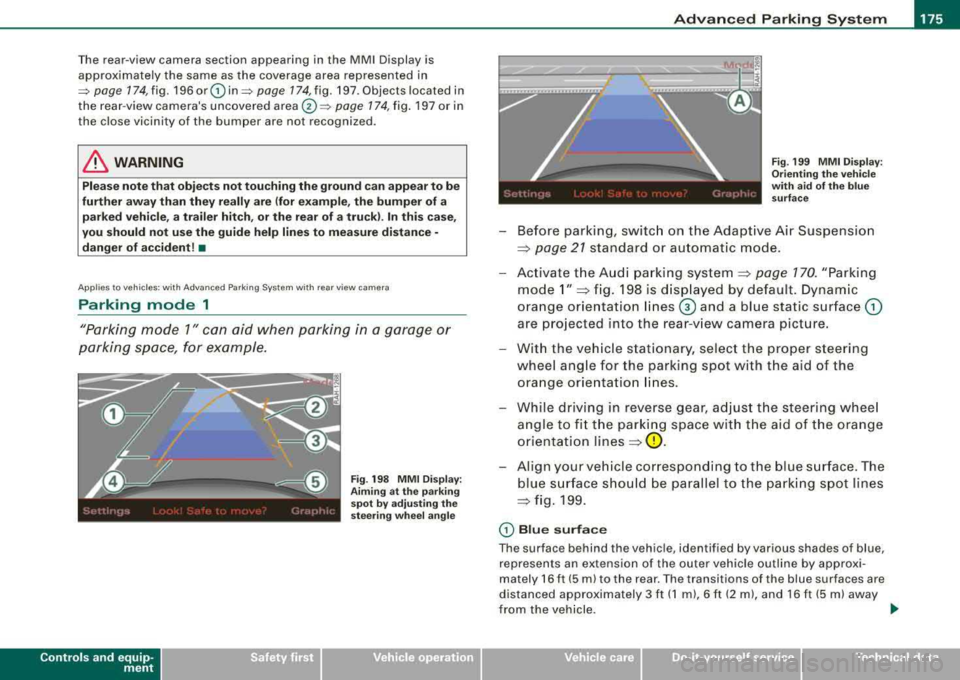
"Parking mode 1" can aid when parking in a garage or
parking space, for example.
Contro ls a nd eq uip
ment
Fig . 198 MMI Display:
Aiming at the parking
spot by adjusting the
steering wheel angle Fig
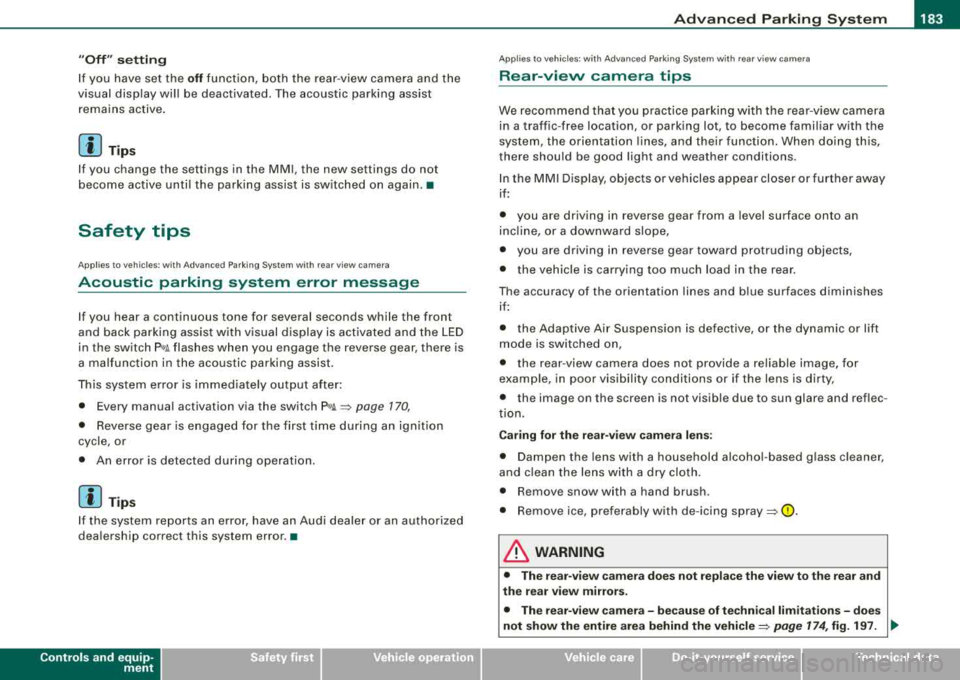
. 199 MMI Display:
Orienting the vehicle
with aid of the blue
surface
-Before parking, switch on the Adaptive Air Suspension
=> page 21 standard or automatic mode.
-Activate the Audi parking system=> page 170. "Parking
mode 1"
=> fig. 198 is displayed by default. Dynamic
orange orientation
lines @ and a blue static surface G)
are projected into the rear-view camera picture.
-With the vehicle stationary, select the proper steering
wheel angle for the parking spot with the aid of the orange orientation lines.
-While driving in reverse gear, adjust the steering wheel
angle to fit the parking space with the aid of the orange
orientation
lines=> 0 .
-Align your vehicle corresponding to the blue surface. The
blue surface should be parallel to the parking spot lines
=> fig. 199.
CD Blue surface
The surface behind the vehicle, identified by various shades of blue,
represents an extension of the outer vehicle outline by approxi
mately 16 ft (5 ml to the rear. The transitions of the blue surfaces are
distanced approximately 3 ft (1
ml, 6 ft (2 ml, and 16 ft (5 ml away
from the vehicle.
._
Vehicle care I I irechnical data
Page 185 of 404
__________________________________________ A_ d_v _a_ n_ c_e _d _ P_a_ r_ k_ i_n ~g _ S_y_ s_ t_ e_ m
___ ffllll
"O ff" se tting
If yo u have set t he off function, both the rear -view camera and the
visual disp lay wi ll be deactivated. The acoustic parking assist
rema ins active .
[ i] Tip s
If you change the settings in the MM I, the new settings do not
become active unti l the parking assis t is sw itched on again .•
Safety tips
Ap plies to vehi cles : w ith Ad vance d Par king Sys tem with re a r view c ame ra
Acoustic parking system error message
If you hear a continuous tone for several seconds while the front
and back parking ass ist w ith visual d isplay is activated and the LED
in the switch
P wA flashes when you engage the reverse gear, there is
a malfunction in the acoustic parking assist.
This system error is immed iate ly output after:
• Every manua l activation via the switch
Pw.o. => page 170,
• Reverse gear is engaged for t he first t ime during an ign it ion
cycle, or
• An error is detected dur ing operation.
[ i ] Tip s
If the system reports an error, have an Audi dealer or an authorized
dea lership correct this system error .•
Controls and equip ment
Applies to vehi cles: w it h Ad vanced Par king Sy stem wit h rea r vie w camera
Rear-view camera tips
We recommend that you pract ice parking with t he rear -v iew ca mera
in a traffic-free location, or parking
lot, to become familiar with the
system, the orien tation lines, and their fu nction . When do ing th is,
there should be good light and weather conditions .
I n the MMI Disp lay, objects or vehicles appear closer or further away
if:
• you are driving in reverse gear from a level surface onto an
inc lin e, or a downward slope,
• you are dr iving in reverse gear toward protruding objects,
• the vehicle is carrying too much load in the rear .
The accuracy of the orientation lines and b lue surfaces diminishes
if :
• the Adaptive Air Suspension is defec tive, or the dynamic or lift
mode is switched on,
• the rear -view camera does not provide a re liable image, for
examp le, in poor vis ibility conditions or if the lens is dirty,
• the image on the screen is not visib le due to sun glare and reflec
t ion.
Caring for the re ar-v iew c amer a len s:
• Dampen the lens with a household a lcoho l- based g lass c leaner,
and c lean the lens with a dry cloth.
• Remove snow with a hand brush.
• Remove ice, preferably with de -icing
spray=> 0.
& WARNING
• The rear -view c amera does not r epla ce the vie w to the re ar a nd
the rear view mirror s.
• The rear-view camer a - be cause of t echn ical lim itations -doe s
not show the entire are a behind the
vehicle => page 174, fig. 197. ~
Page 186 of 404
___ A_ d
_ v_a _ n_ c_ e_d _ P_a _ r_ k _i_n ~g _ S_y _ s_ t_ e_ m _________________________________________ _
&, WARNING (continued)
Be especially careful to check for small children and animals
before backing up. Small children and animals will not always be
shown in the rear-view display .
• The Audi parking system is not a substitute for being careful
and alert when backing up. Be especially careful during parking
and similar maneuvers. Always watch where you are driving and
make sure that nothing is in the way.
• Do not allow yourself to be distracted from traffic by the rear
view camera pictures.
• When maneuvering or parking, do not only use the MMI Display
for orientation . Certain objects
-depending on the screen resolu
tion
-may not, or not entirely, be displayed; for example trailer
hitches, chains, narrow posts, or fences .
• Only use the rear -view camera for aid if it shows a good, clear
picture. The image may be obscured, for example, by the sun
shining into the lens, dirt on the lens, or as the result of a defect -
danger of accident!
• If the image is hazy when the MMI Display is switched on or the
area behind the vehicle is not visible (for example, as the result of
a dirty or defective lens), the rear-view camera must not be used
for aid in maneuvering
-danger of accident!
• The rear-view camera generates two -dimensional images . For
this reason, please note that recesses in the ground and
protruding parts on another vehicle, or protruding objects fixed to
the ground, will be more difficult or impossible to recognize on the
MMI Display, due to the missing spacial depth.
• If the position and the installation angle of the camera has
changed, for example, after a rear end collision, do not continue to
use the system for safety reasons. Have it checked by an autho
rized Audi dealer or qualified workshop.
• Only use the rear-view camera when the rear lid is fully closed.
Make sure that objects mounted on the rear are not obscuring the
camera view .
&, WARNING (continued)
• Remove ice, preferably with de-icing spray.
0 Note
• Never use warm or hot water to remove snow or ice from the
rear-view camera lens
-danger of crack formation on the lens!
• When cleaning the lens, never use care products with an abra
sive effect.
[ i] Tips
The positions of the orientation lines/ surfaces are displaced up or
down if the parking process is carried out with the rear -view camera
in Adaptive Air
Suspension=> page 21 dynamic or lift mode. There
fore, the accuracy is reduced .•
Page 188 of 404
___ A_ d_a_ p_ ti_v _ e_ A_ ir_ S_u_ s_ p_e _n_ s_ io_n ___________________________________________ _
Chassis Controls
Four different driving modes can be set by the driver.
The automatic control processes are speed -and time -dependent.
For example, it is not possible to raise the suspension to the lift
mode above certain speeds .
When a speed of about 75 mph (120 km/h) is exceeded for more than 30 seconds, the vehicle is automatically lowered approximate ly 1
inch (25 mm) to a level suitable for highway speeds, except in the
standard mode . Road holding is optim ized as a result of the lower
center of gravity and fuel consumption is reduced as a result of
reduced wind resistance .
Level adjustment
lift
standard
automatic
dynam ic
automatic Ground
clearan ce
about 5 .7 inches (145 mm)
a bout 4.7 inches ( 120 m m)
about 4 .7 inches (120 mm)
about 3.9 inches (100 mm)
Se lect the automatic mode if you prefer a suspension setting
e m phas izing comfort . Damping characterist ics emphasiz ing
comfort are selected in this mode.
• Lowering : When a speed of abou t 75 mph ( 120 km/h) is excee ded
for more than 30 seconds, the vehic le is automatically lowered by
about 1 inch (25 mm) .
• Raising : The vehic le is automat ical ly raised again if the speed
fa lls bel ow about 44 mph (70 km/h) for a per iod of 120 seconds. The
vehic le is raised immediate ly when speed fa lls below about 22 mph
(35 km/h) .
dynami c
Select the sport mode if you prefer a sporty suspensio n setting . In
this mode, the veh ic le is lowered whi le it is still stationary and sporty damping characteristics are selected
. The warning
light ~
in the instrument cluster will c ome on for a few seconds just to
remind you of the reduced ground clearance .
I f you switch off the engine while the vehic le is in the dynamic mode
and then switc h on the ign it ion once aga in,
t h e ~ warning lig ht
wi ll also come on again for a few seconds.
• Lowering : When a speed of abou t 75 mph (120 km/h) is exceeded
for more than 30 seconds , the vehicle is automatica lly lowered by an
addi tiona l 0 .2 in (5 mm).
• Raising : The vehic le is automatically raised again if the speed
f alls below ab out 44 mph (70 km/ h) for a per iod of 120 seconds . The
vehic le is raised immediate ly when speed fa lls below about 22 mph
(35 km/h) .
sta nd ard
Se lect the s tandard mode if you desire a suspensi on se tt ing with a
special emphasis on comfort . In the standard mode there is
n o
lo wer ing of t he suspension . Even at high speeds, the vehicle stays
at the same level. Damping characteristics with a decided emphasis
on com fort are selected in this mode.
lift
Se lec t t he lif t mode when you have to travel over poor secti ons of
road (e .g . trails). In the lift mode, the vehic le is raised by 1 inch (25
mm ) compared to norma l level wh ile it is st ill stati onary a nd
damping characteristics are ad justed to emphasize comfort.
T he lift mode can be act ivated on ly at speeds below 50 mph (80
k m/h). When a speed of about 62 mph (100 km/h) is exceeded, the
system automatical ly leaves lift mode and the mode set previously
(standard, au tomat ic, dynamic) is activated aga in. •
Page 189 of 404
____________________________________________ A_ d_a_ p_ t_iv _e_ A_ ir_ S_ u_ s_ p_e _ n_ s
_ io_ n __ ffllll
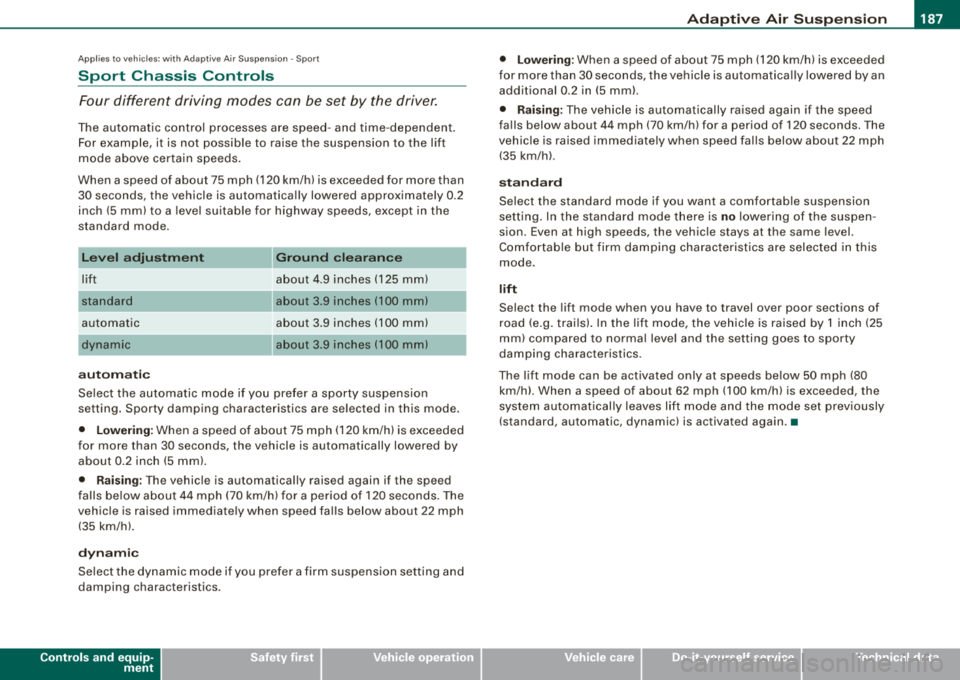
Ap plies to vehi cles: wit h Adapti ve Air S uspension -Sp ort
Sport Chassis Controls
Four different driving modes can be set by the driver.
The au tomat ic contro l processes are speed -and time -dependent .
For example, it is not possib le to raise the suspension to the lift
mode above certa in speeds.
When a speed of about 75 mph (120 km/hl is exceeded for more than 30 seconds, the vehicle is automatica lly lowered approximately 0.2
inc h (5 mm) to a level suitab le for highway speeds, except in the
standard mode.
L ev el a dju stm ent
lift
standard
a utomatic
d ynamic
a utom ati c Gr
ound clea ra nce
about 4 .9 inches (125 mm)
abou t 3.9 inches (100 mml
about 3.9 inches (100 mm)
abou t 3.9 inches (100 mm)
Se lect the automatic mode if you pre fer a sporty suspension
setting. Sporty damping characteristics are se lected in this mode.
• Lowering : When a speed of about 75 mph (120 km/h) is exceeded
for more than 30 seconds, the vehicle is automatically lowered by about 0 .2 inch (5
mml.
• Rais ing : The vehic le is automa tically raised again if the speed
falls be low about 44 mph (70 km/h) for a period of 120 seconds. The
vehicle is raised immediately when speed fa lls below about 22 mph
(35 km/h).
d yn ami c
Select the dynamic mode if you prefer a firm suspe nsion sett ing and
damping characterist ics.
Controls and equip
ment •
Loweri ng:
When a speed of about 75 mph (120 km/h) is exceeded
for more than 30 seconds, the vehicle is automatica lly lowered by an
additional 0 .2 in (5
mml.
• Raising: The vehicle is a utomatically ra ised again if the speed
fa lls below about 44 mph (70 km/hl for a period of 120 seconds . The
veh ic le is raised immediately when speed fal ls below about 22 mph
(35 km/h) .
standard
Select the standard mode if you want a comfortab le suspension
sett ing. In the standard mode t here is
n o lowering of the suspen
sion . Even at high speeds, the veh ic le stays at the same level.
Comfo rtab le but firm damping characteristics are selected in t his
mode .
lift
Select the lift mod e when you hav e to travel over poor sections of
road (e .g. trai ls) . In the l ift mode, the vehicle is raised by 1 inch (25
mml compared to norma l leve l and the setting goes to sporty
damping characteristics.
The lift mode can be activated only at speeds be low 50 mp h (80
km/h). When a speed of about 62 mph (100 km/h) is exceeded, the
system automat ical ly leaves lif t mode and the mode se t previously
(standard , automatic , dynamic) is activated again .•
Page 193 of 404

___________________________________________________ H_ o_m_ e_ L_ i_ n _ k_ ®_ R __ l!III
Homelink ®
Universal remote control
Applies to vehicles: w ith Home link® unive rsa l remo te cont rol
General information
The HomeLink® feature can learn up to three radio
frequency codes for most current transmitters used for
operating garage doors, estate gates, home or outdoor
lighting systems, and other devices.
You must first program the Homelink® transmitter before you can
use the
system=> page 191, "Programming the Homelink® trans
mitter".
In order to program the Homelink® transmitter for devices utilizing
rolling code , a second person on a ladder who can safely reach the
garage door opener motor is recommended. It is also necessary to
locate the
"learn" button on your garage door opener motor . Refer
to the operating instructions for the opener, as the location and
color of this button may
vary by manufacturer.
You can still use the original remote control for the device at any
time.
& WARNING
• Never use the Homelink"" transmitter with any garage door
opener that does have not the safety stop and reverse feature as
required by federal safety standards. This includes any garage
door opener model manufactured before April 1, 1982.
• A garage door opener which cannot detect an object, signaling
the door to stop and reverse does not meet current federal safety standards . Using a garage door opener without these features
increases risk of serious injury or death.
Controls and equip ment
& WARNING (continued)
• For safety reasons never release the parking brake or start the
engine while anyone is standing in front of the vehicle.
• A garage door or an estate gate may sometimes be set in
motion when the Homelink® remote control is being
programmed. If the device is repeatedly activated, this can over
strain motor and damage its electrical components -an over
heated motor is a fire hazard!
• To avoid possible injuries or property damage, please always
make absolutely certain that no persons or objects are located in
the range of motion of any equipment being operated. •
Applies to vehicles : wit h Home link ® uni vers al remote con trol
Programming the Homelink ® transmitter
The transmitter is programmed in two phases. For rolling
code transmitters, a third phase is also necessary.
f ( ~ ~
i
s: 0
,1, .., Cl)
ll
Fig . 213 Overhead
console: Homelink®
keypad
~