change time AUDI S8 2008 Owner's Manual
[x] Cancel search | Manufacturer: AUDI, Model Year: 2008, Model line: S8, Model: AUDI S8 2008Pages: 404, PDF Size: 52.7 MB
Page 323 of 404
Checking and filling Ill
-------------~~~
•
& WARNING (continued )
• When disconnecting the battery, first disconnect the negative
cable and then the positive cable.
• Before reconnecting the battery, make sure all electrical
consumers are switched off. Reconnect the positive cable first and
then the negative cable . Never interchange the cables -this could
start a fire!
• Never charge a frozen or a thawed-out battery . It could
explode! If a battery has frozen, then it must be replaced . A
discharged battery can freeze over at 32 °F (0
°CI.
• Make sure the vent hose is always attached to the opening on
the side of the battery.
• Never use batteries which are damaged. There is the danger of
an explosion
I Always replace a damaged battery .
& WARNING
California Proposition 65 Warning :
• Battery posts , terminals and related accessories contain lead
and lead compounds, chemicals known to the State of California
to cause cancer and reproductive problems . Wash hands after
handling.
0 Note
• Do not disconnect the vehicle battery when the ignition is
switched on or when the engine is running, otherwise, you will
damage electronic components in the electrical system.
• I f your vehicle is going to stand for a long period of time without
being driven, protect the battery from "freezing", otherwise it will
be damaged and will then have to be replaced .•
Battery charging
Starting the engine requires a well charged battery.
Always read and heed all WARNINGS below ~ & and~ &
in "Working on the battery" on page 319.
-Turn off the ignition and all electrical consumers.
- Make sure the area is well ventilated when you charge
the battery.
- Attach the red (positive
8) clamp of the charging equip
ment to the positive terminal of the battery and the black
(negative(:)) clamp to the jumper terminal.
- Only now plug the mains lead for the charging equip
ment into the wall outlet and turn it
on~ &.
-Make sure the charging rate is not over 30 amps/14.8
Volt.
-When the battery is fully charged: Turn the charging
equipment off and remove the mains lead from the wall
outlet.
- Now remove the clamps for the charging equipm ent.
A discharged battery can freeze at temperatures of only O °C . Allow
a frozen battery to thaw completely before attempting to charge it
=> ,&. . However, we recommend not using a thawed battery again
because the battery casing can be cracked due to ice formation and
can leak battery acid.
Battery charging (Maximum charging rate of 30
amps/14.8 Volt)
When charging at low voltages (e.g . with a trickle charger ), the
battery cab les do not have to be disconnected first. The battery caps
should
not be opened when charging a battery. ~
Vehicle care
Page 324 of 404
-Checking and filling PW~---=---=----------------
It is not necessary to remove the battery from the luggage compart
ment, and it is also not necessa ry t o disco nnec t the cab les.
F a st ch arging th e batt ery ( charging rate above 14 .8
V olts )
For technical reasons do not use a battery charger that uses voltage
greater tha n 14.8 Vo lts to charge your veh ic le's battery.
& WARNING
C harging a b attery can be dangerou s.
• Always follow the operating in structions provided by the
battery charger manufacturer when ch arging your b attery .
• Never charge a frozen battery . It may expl ode because of ga s
t rapped in the ice . Allow a frozen batter y to tha w out fir st .
• Do not reu se batteries which were fro zen. The battery hou sing
m ay have cracked and weakened when the battery froze.
• Charge the battery in a well ventilated are a. Keep aw ay from
open flame or electric al spar k. Do not smoke . Hydr ogen gas gener
ated by the battery i s explosive.
• To reduc e the danger of e xplosion , never conne ct or dis conn ect
charger cable s while the charger i s oper ating.
• Fa st charging a batter y is dangerous and should only be
a ttempted by a competent technician with the proper equipment .
• Battery ac id that may spill during charging should be washed
off with a solution of warm water and b aking soda to neutralize
the a cid .
0 Note
Never use a fast charger as a booster to start the engine. This wil l
ser iously damage sens it ive elect ronic compo nents, such as control
units, r elays, radio , etc ., as wel l as the battery charger. •
Battery replacement
The new batte ry mus t have t he s ame s pecificati ons and
dimensions as the original equipment battery.
I ntel ligent energy management in your vehicle is responsible for
distr ibut ing the e lectr ica l energy throughout your veh icle
~ page 274. The inte lligent energy management system will keep
t he engine ba ttery charged be tter than vehicles without t his sys tem.
T o make sure the add it ional electr ical energy is avai lab le once aga in
after you have changed t he battery, we recommend that you ins tall
batteries of the same type and manufacture only (the same as those
insta lled at the time your vehicle was delivered). Specifications are
listed on the battery housing . Your authorized Audi dea ler wi ll then
code the battery management contro l unit .
The new battery must have the same capacity, voltage (12 volts), amperage, construction and p lug sea ling.
When instal ling the battery, make sure the ign ition and all elect rica l
consumers are turned off .
0 Note
Make sure the ventilation hose on the side of the battery is
connected, otherwise fumes or battery acid can leak out.
'£> For the sake of the environment
Because of the problem of proper disposal of a battery, we recom
mend your authorized Audi dealer change the battery for you.
Batteries contain sulfur ic acid and lead and must always be
disposed of proper ly i n compliance with all environmental regula
tions . Disposing of vehicle batteries improper ly is very dangerous to
t he environment .•
Page 328 of 404
_L--_T_ ir_e_ s_ a_ n_d _ w_ h_ e_e _l_s _________________________________________________ _
Groove
means the space between two adjacent tread ribs.
L oa d r atin g (code)
means t he m aximum load that a t ire is rated to carry for a given
inf lation pressure . You may not find this information on a ll tires
because it is not required by law.
M ax imum l oad r ating
means t he load rating for a tire a t the maximum permissib le infla
tion pressure for that tire.
Maximum l oaded v ehi cle wei ght
means the sum of:
(a) Curb weight
(b) Accessory weight
(c) Vehicle capaci ty weight, and
(d) Product ion options weight
M ax imum (p er mis sibl e) infl ati on pr essure
means the maximum cold i nflation pressure to wh ic h a t ire may be
inflated. Also cal led "maximum inflation pressure."
Normal occ upant we ight
means 150 lbs. (68 ki lograms) times the number of occupants
seated in the veh ic le up to the total seating capacity of your vehicle.
Oc cupant distributi on
means distribution of occupants in a vehicle .
Outer di ameter
means the overal l diameter of an inf lated new tire.
O verall width
means the linear distance between the exteriors of the sidewa lls of
an infla ted t ire, includ ing elevat ions due to labe ling, decorat ions, or
protective bands or ribs .
Ply
means a layer of rubber -coated para llel cords.
P rodu cti on opt ion s we ig ht
means the co mbined weight of those insta lled regular product ion
options weighing over 5 lbs. (2.3 kg) in excess of those standard
items which t hey replace, not previously considered in curb weight
or accessory weight, inc luding heavy duty brakes, ride levelers, roof
rack, heavy du ty bat tery, and special trim .
Rad ia l pl y tir e
means a pneumat ic t ire in wh ich t he ply cords that extend to the
beads are laid at substantially 90 degrees to the centerline of the
t read .
Recomm ended infl ation pres su re
see :::::> page 325, "Cold tire inflat ion pressure".
R einforc ed tir e
means a tire des ign to operate at higher loads and at higher infla
tion pressures than the corresponding standard tire. Reinforced
t ires may be iden tified as
"XL", "xi", "EXTRA LOAD", or "RF" on the
sidewa ll.
Rim
means a metal support for a tire or a tire and tube assembly upon
whic h the t ire beads are seated.
Rim di ame ter
means nominal diameter of the bead seat. If you change your whee l
size, you wi ll have to purchase new tires to match the new rim diam
eter.
Rim siz e design ation
means rim diameter and width.
Rim w idth
means nominal distance between rim flanges .
Page 331 of 404
________________________________________________ T_ i
_ r_e _s_ a_n_ d_ w_ h_ e_e _ l_s __ fflll
•
pressure label lists the recommended cold tire inflation pressures
for the vehic le at its maximum capacity weight and tires that were
on your vehicle at the time it was manufactured .
If yo u w is h to impro ve comfo rt when oper ating the vehi cle at
norm al lo ad (up to 3 occup ants), y ou can adju st tire pre ssure s to
tho se spe cified for norm al v ehi cle lo ad . Before oper ating the vehi cle
a t maximum lo ad , you mu st incre as e the tire pre ssure s to tho se
s p ec ified for m aximum vehi cle lo ad ::::>
& .
Bear in m ind that the tire pressure monito ring system can only
monitor the tire pressures you have stored . The system does not
recognize the load condition of your vehicle .
The effect iveness of the t ire pressure mon itoring system will be
impaired if you store normal load pressures but then operate the
veh ic le at its maximum
load ::::>& .
Engin e II Tire design ati on See the i
llustration::::>
page 328, fig . 272 for the location of the label
e it h er o n driver's side 8 -p illar or inside the fue l fil ler flap (color of
the actual label and exact location on the vehicle will vary slight ly!.
Note that the following tab le is accurate at the time of going to
press and is subject to change . In the event o f discrepanc ies, the t ire
pressure label (On USA vehic les, the tire pressure labe l is located on
the driver's s ide 8 -p illar . On Canada vehicles, the tire pressure label
is located either on the driver's side 8 -pi llar or inside the fuel fil ler
fl ap) always takes precedence .
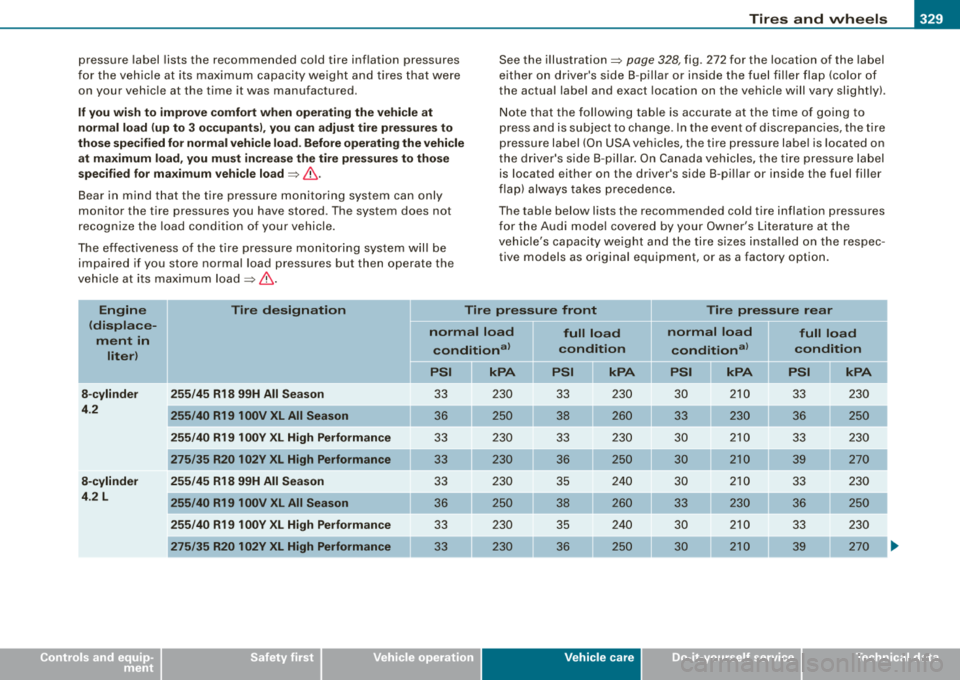
The table below lists the recommended cold tire inflation pressures
for the Audi mode l covered by your Owner's Literature at the
veh ic le's capacity weight and the tire s izes insta lled on the respec
tive models as original equipment, or as a factory option.
Tire pressure front Tire pressure rear
( displa ce-
normal load
II full load norm
al load
full load
ment in
c ondition al condition condition al condition
liter)
PSI II kPA PSI II kPA PSI I I kPA If PSI IT kPA .,
8-c ylinder 255 /45 R1 8 99H All Sea son
33 230 33 230 30 2
10
33 230
4 .2
255/40 R19100V XL All Sea son 36 250 38 260 33 230 36 250
255 /40 R1 9 1 00 Y XL High P erformanc e 33 230 33 230 30 2 10 33 230
275 /35 R20 102V XL High Performance
33 230 36 250 30 2
10
39 270
8-cylinder 2 55/45 R1 8 99H All Sea son
33 230 35 240 30 2
10
33 230
4 .2 L
255/40 R1 9 100V XL All Sea son 36 250 38 260 33 230 36 250
255 /40 R1 9 1 00Y XL High Perfo rman ce
33 230 35 240
30 2
10
33 230
275 /35 R20 102V XL High Performance 33 230 36 250 30 2 10 39 270
Vehicle care
I
Page 361 of 404
_________________________________________________ F_ u_ s_ e_s _ a_n _d_ b_ u
_ lb_ s _ __.11111
[ i J Tips
You are well advised to keep a supply of spare fuses in your vehicle.
Fuses with the proper ampere ratings are available at your Audi
dealer. •
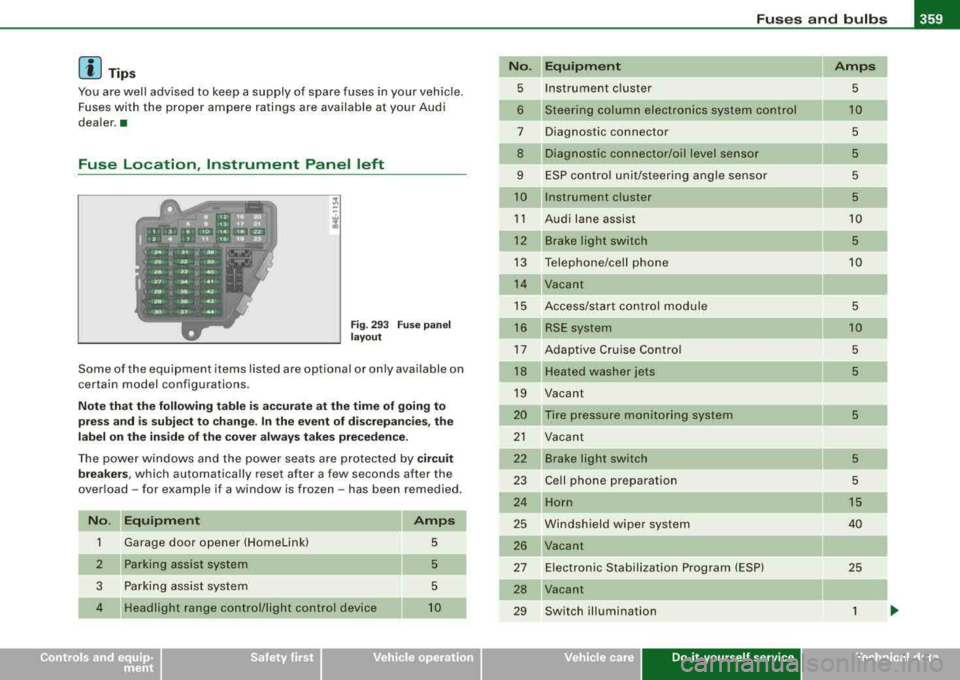
Fuse Location , Instrument Panel left
Fig . 293 Fuse panel
layout
Some of the equipment items listed are optional or only available on
certain model configurations.
Note that the following table is accurate at the time of going to
press and is subject to change. In the event of discrepancies, the
label on the inside of the cover always takes precedence.
The power windows and the power seats are protected by circuit
breakers, which automatically reset after a few seconds after the
overload -for example if a window is frozen -has been remedied.
No. Equipment
1 Garage door opener (Homelinkl 5
2
Parking assist system 5
3
Parking assist system 5
4
Headlight range control/light control device 10
No.
5
6
7
8
9
10
11
12
13
14
15
16
17
18
19
20
21
22
23
24
25
26
27
28
29
Equipment Amps
Instrument cluster 5
Steering column electronics system control 10
Diagnostic connector 5
Diagnostic connector/oil level sensor 5
ESP control unit/steering angle sensor 5
Instrument cluster 5
Audi lane assist 10
Brake light switch 5
Telephone/cell phone 10
Vacant
Access/start control module
5
RSE system 10
Adaptive Cruise Control 5
Heated washer jets 5
Vacant
Tire pressure mon itoring system
5
Vacant
Brake light switch
5
Cell phone preparation 5
Horn 15
Windshield wiper system 40
Vacant Electronic Stabilization Program (ESP)
25
Vacant
Switch illumination
1
Vehicle care Do-it-yourself service irechnical data
Page 403 of 404
It has always been Audi's policy to continuously improve its prod
ucts. Audi, therefore, reserves the right to make changes in design
and specifications, and to make additions or improvements in its
products, without incurring any obligation to install them on prod
ucts previously manufactured.
Text, illustrations and specifications in this manual are based on the
most up -to -date information available at the time of printing.
All rights reserved. May not be reproduced or translated in whole or
in part without the written consent of AUDI AG. Specifications are
subject to change without notice. "Audi", "quattro" and
the four rings emblem are registered trade
marks of AUDI AG .
"AS" is trademark of AUDI AG.
Editorial deadline: 7/13/2007
'£> For the sake of the environment
Printed on environmentally friendly paper (bleached without chlo
rine, recyclable!.
Printed in Germany
© 2007 AUDI AG