warning AUDI S8 2008 Owner's Manual
[x] Cancel search | Manufacturer: AUDI, Model Year: 2008, Model line: S8, Model: AUDI S8 2008Pages: 404, PDF Size: 52.7 MB
Page 32 of 404
Driver inf orma tio n displ ay
Red symbols
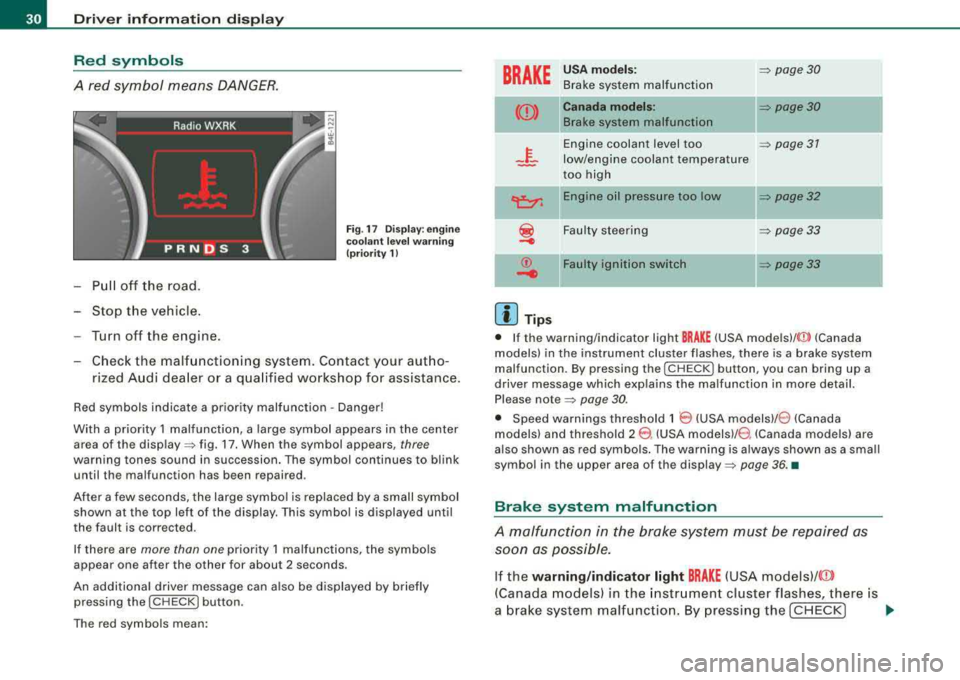
A red symbol means DANGER.
Pull off the road.
-Stop the vehicle .
-Turn off the engine.
Fig . 17 Dis play: en gine
co ola nt leve l warnin g
(pr iori ty 1)
-Check the malfunctioning system. Contact your aut ho-
rized Audi dea ler or a qua lified workshop for assistance.
Red symbols indicate a prio rity malfunction -Danger!
With a priority 1 malfunction, a large symbol appears in the center area of the
disp lay => fig. 17. When the symbol appears, three
warning tones sound in succession . The symbol continues to blink
until the malfunction has been repaired .
After a few seconds, the large symbol is replaced by a small symbol shown at the top left of the display. This symbol is displayed until
the fault is corrected.
If there are more than one priority 1 malfunctions, the symbo ls
appear one after the other for about 2 seconds .
An additional driver message can a lso be d isplayed by briefly
pressing the
( CHECK) button .
The red symbols mean:
BRAKE
-
((l))
©
.....
[ i ] Tips
U SA m od els: => page 30
Brake system malfunction
C anad a mod els:
B rake system malfunction
II=> page 30
Engine coolant level too
=> page 31
low/engine coolant temperature
too high
En gine o il p ress ure too lo w
=> page 32
Faulty steering
=> page 33
Fa ult y ig nition s witch
=> page 33
• If the warning/indicator light
BRAKE (USA mode ls)/ <@ (Canada
models) in the instrument cluster flashes, there is a brake system
malfunction. By pressing the [
CHECK) button, you can bring up a
driver message which exp lains the malfunction in more detail.
Please
note=> page 30.
• Speed warnings threshold 1
8 (USA modelsl /8 (Canada
models) and threshold 2
8 . (USA models)/ 0, (Canada models) are
also shown as red symbo ls . The warning is a lways shown as a small
symbol in the upper area of the
display => page 36 . •
Brake system malfunction
A malfunction in the brake system must be repaired as
soon as possible.
If the warning /indi cator light BRAKE (USA models)/ ((D)
(Canada models) in the instr ument cluster flashes, there is
a brake system malfunction . By pressing the [
CHECK] ~
Page 33 of 404
button, you can bring up a driver message which explains
the malfunction in more detail.
Stop vehicle and check brake fluid level
- Pull off the road.
- Stop the vehicle.
- Turn off the engine.
- Check the brake fluid level ::::>
page 317.
-Contact your nearest authorized repair facility if neces-
sary.
Brake fault ! Drive carefully to nearest workshop
- Drive carefully to the nearest authorized repair facility
and have the malfunction corrected
=> &.
Parking brake ! Please contact workshop
- If the warning/indicator light flashes when the vehicle is
stationary or after the ignition is turned on, check to see
if the parking brake can be released. Drive to an autho
rized repair facility as soon as possible and have the
malfunction corrected. If the parking brake cannot be
released, contact your nearest authorized repair facility.
- If the warning/indicator light flashes while you are
driving, it is possible that the traction control or the
emergency brake has malfunctioned. It is possible that
the parking brake cannot be applied. It is also possible
that the parking brake cannot be released after it has
been applied. Drive to an authorized Audi dealer to have
the malfunction corrected.
Controls and equip
ment
Driver information display
If the ABS, ESP and the brake force distribution fail , the ABS
warning/indicator light and the ESP warning/indicator light come
on along with the brake system malfunction warning/indicator light
=>& .
& WARNING
• Always observe the warnings in => page 299, "Engine compart
ment", before opening the hood and checking the brake fluid.
• Driving with low brake fluid is a safety hazard. Stop the car and
get professional assistance .
• USA models: If the BRAKE warning light, the !';. warning light and
the ABS warning light come on together, the rear wheels could
lock up first under hard braking. Rear wheel lock-up can cause loss
of vehicle control and an accident. Have your vehicle repaired
immediately by your authorized Audi dealer or a qualified work
shop. Drive slowly and avoid sudden, hard brake applications.
• Canada models: If the brake warning light ((D), the 1$ warning
light and the ABS warning light
0 come on together, the rear
wheels could lock up first under hard braking. Rear wheel lock-up can cause loss of vehicle control and an accident . Have your
vehicle repaired immediately by your authorized Audi dealer or a qualified workshop . Drive slowly and avoid sudden, hard brake
applications. •
Engine cooling system malfunction -L
A malfunction in the engine cooling system must be
repaired as soon as possible.
When the -L symbol in the display blinks, then either the
engine coolant
temperature is too high, or the coolant level
is too low. An additional driver message can also be
displayed by pressing the
[CHECK] button:
Switch off engine and check coolant level
Page 34 of 404
Driver information display
-Pull off the road.
-Stop the vehicle.
-Turn off the engine .
-Check coolant level ~ page 315.
-Add coolant if necessary~ page 316.
-Continue dr iv ing only after the eng ine coolant
warning/indicator light goes out.
-Contact your authorized Audi dealer for assistance if
necessary .
If the engine coolant le ve l is correct, then the radiato r fan may be
the cause of the malfunction.
I f the generator warning/indicator light should also illuminate
~ page 18, then the fan belt may be damaged.
& WARNING
• If your vehicle should break down for mechanical or other
reasons, park at a safe distance from moving traffic, turn off the
engine and turn on the hazard warning lights
~ page 73, "Emer
gency flasher
A".
• Never open the hood if you see or hear steam or coolant
escaping from the engine compartment
-you risk being scalded.
Wait until you can no longer see or hear steam or coolant
escaping.
• The engine compartment of any vehicle is a dangerous area.
Before you perform any work in the engine compartment, turn of
the engine and allow it to cool. Follow the warning stickers
~ page 299, "Engine compartment".
0 Note
Do not continue driving if the-~-symbol illuminates. There is a
malfunction in the engine cooling sys tem -you could damage your
engine. •
Engine oil pressure malfunction ~
The red engine oil pressure warning symbol requires
immediate service or repair. Driving with a low -oil -pres
sure indication is likely to inflict severe damage to the engine.
If the ~ symbol appears in the display and blinks, the oil
pressure is too low. An additional driver message can also
be displayed by pressing the !CHECK] button:
Switch off engine and check oil level
Immediate actions
-Pull off the road.
-Stop the vehicle.
-Turn off the engine.
-Check the engine oil level with the dipstick ~ page 311.
Dipstick readings checks too low
-Top off oil to the proper level~ page 312.
-Make sure that the oil pressure warning symbol ~
appears no longer in the display before you start driving
again. ~
Page 35 of 404
Dipstick reading checks OK
-If the oil pressure warning symbol "e::7: starts flashing
again even though the engine oil level checks OK on the
dipstick,
do not continue driving and do not let the
engine run in idle.
Instead, contact your authorized Audi
dealer for assistance.
[ i] Tips
• The engine oil pressure symbol ~ is not an indicator for a low
engine oil level. Do not rely on it . Instead, check the oil level in your
engine at regular intervals, preferably each time you refuel, and
always before going on a long trip.
• The yellow oil level warning indication
~ requires oil refill or
workshop service without delay. Do not wait until the red oil pres
sure warning
~ starts to flash before you respond to the low oil
level warning
~- -By then, your engine may already have suffered
serious damage. •
Steering malfunction i
If there is a malfunction in the electronic steering column
lock, the steering cannot be unlocked.
If the ~ symbol in the display blinks, there is a malfunction
in the electronic steering column lock. An additional driver
message can also be displayed by pressing the [ CHECK]
button :
Do not drive vehicle: Steering defective
-Contact your nearest authorized repair facility.
- Do
not tow your vehicle.
Controls and equip
ment • I I • • I
Driver information display
& WARNING
Your vehicle must not be towed in the event of a malfunction in the
electronic steering column lock because it cannot be steered due
to the locked steering. If it is towed with the steering locked, there
is the risk of an accident. •
Ignition lock malfunction ~
A malfunction in the ignition lock must be repaired imme
diately.
If the ~ symbol in the display blinks, there is a malfunction
in the electronic ignition lock. An additional driver message
can also be displayed by pressing the [ CHECK] button:
Ignition lock defective. Contact workshop !
-Do not turn the engine off.
- Drive immediately to an authorized Audi dealer to have
the malfunct ion corrected.
If there is a malfunction in the electronic ignition lock, the ignition
cannot be turned off. Drive immediately to an authorized Audi
dealer to have the cause of the malfunction corrected.
I f your vehicle has an Advanced Key *, then you should not use the
I STOPI button to shut off the engine. You will not be able to start the
engine again once the ignition is switched off. •
Page 36 of 404
Driver inf orma tio n displ ay
Yellow symbols
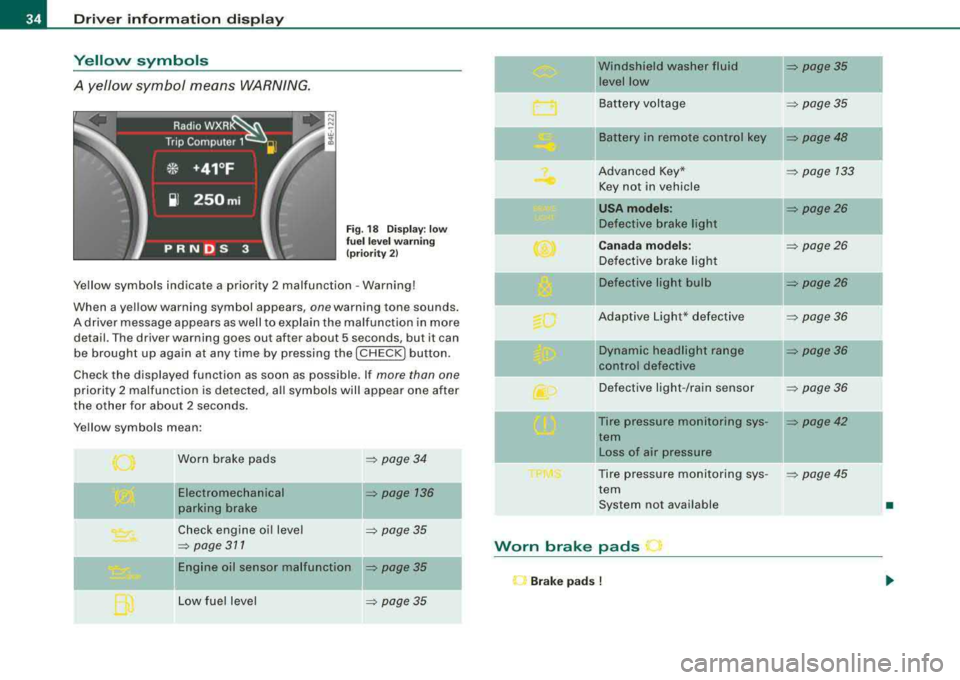
A yellow symbol means WARNING.
Fig . 18 Display: low
fu el l eve l warn in g
(pr iori ty 2)
Yellow symbols indicate a priority 2 malfunction - Warning!
When a yellow warning symbol appears,
one warning tone sounds.
A driver message appears as well to explain the malfunction in more detail . The driver warning goes out after about 5 seconds, but it can
be brought up again at any time by pressing the [ CHECK
I button.
Check the displayed function as soon as possible . If
more than one
priority 2 malfunction is detected, all symbols will appear one after
the other for about 2 seconds .
Yellow symbols mean:
Worn brake pads
Electromechanical
parking brake
Check engine oi l level
=> page 311
= page 34
=> page 136
=> page 35
Engine oil sensor malfunction => page 35
Low fue l level => page 35
-
Windshield washer fluid = page35
level low ~
Battery voltage => page35
-
II Battery in remote control key = page48
Advanced Key* = page 133
Key not in vehicle
USA mod els: = page26
Defective brake light
Canad a m od els: => page26
Defective brake light
Defective light bulb
=> page26
Adaptive Light* defective => page36
-
Dynamic headlight range => page36
ll contro l defective
Defective light -/rain sensor
= page36
--Tire pressure monitoring sys-= page42
tern
II Loss of air pressure
Tire pressure monitoring sys -
= poge45
tern
System not available
•
Worn brake pads
l"J Br ake pad s !
Page 38 of 404
Driver inf ormation displ ay
Ap plies to vehi cles : wi th Ad aptive Li ght
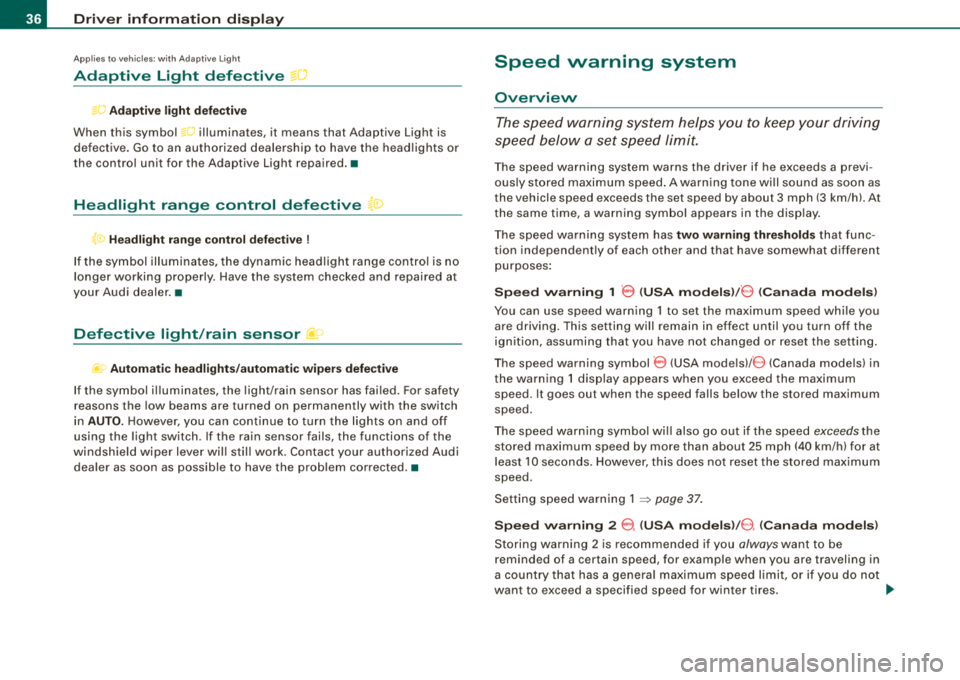
Adaptive Light defective ~O
g(J Adaptiv e lig ht def ecti ve
When this symbol go illuminates, it means that Adaptive Light is
defective. Go to an authorized dealership to have the head lights or
the control unit for the Adaptive Light repaired. •
Headlight range control defective {G>
(0 Headli ght range co ntr ol d efe ct ive !
If the symbol illuminates, the dynamic headlight range contro l is no
longer working properly . Have the system checked and repaired at
your Audi dealer.
•
Defective light /rain sensor @)
~o Autom atic he adlight s/aut om ati c wi pers defe ctive
If the symbol il luminates, the light/rain sensor has fai led. For sa fety
reasons the low beams are turned on permanently with the switch
in
AUTO. H owever, you can continue to tur n the lights on and off
using the light switch . If the rain sensor fails, the functions of the
windshield wiper lever wil l stil l work . Contact your authorized Audi
dea ler as soon as possible to have the problem corrected .•
Speed warning system
Overview
The speed warning syste m hel ps you to keep your driving
speed below a set speed limit.
T he speed warning system warns the driver if he exceeds a previ
ous ly stored maximum speed . A warn ing tone will sound as soon as
the vehicle speed exceeds the set speed by about 3 mph (3 km/hl. At
the same time, a warning symbol appears in the disp lay.
The speed warn ing system has
two w arning thre shold s that func
tion independent ly of each other and that have somewhat d ifferent
purposes :
Speed warning 1 8 {USA mod els l/8 {Canad a m odels)
You can use speed warning 1 to set the maximum speed whi le you
are driving . This setting will remain in effect until you turn off the
ign it ion,
assu ming that you have not changed or reset the setting .
T he speed warning symbol
8 (USA modelsl/ 8 (Canada models) in
t he warn ing 1 disp lay appears when you exceed the maximum
speed . It goes out when the speed falls below the stored maximum
speed.
T he speed warn ing symbol wi ll also go out if the speed
exceeds th e
stored maximum speed by more than about 25 mph ( 40 km/h) for at
l east 10 seconds. However, t his does not reset the stored maximum
speed .
Setting speed warning 1
~ page 37 .
S pe ed wa rning 2
6 {USA m odels l/ 8 {Ca na d a models )
Storing warning 2 is recom mended if you always want to be
reminded of a certain speed, for example when you are traveling in
a co untry that has a general maximum speed l imit, or if you do n ot
want to exceed a specified speed for winter tires.
~
Page 39 of 404
The speed warning 2 symbol, 8, (USA models)/ 8, (Canada models)
appears in the disp lay when you exceed the stored speed limit.
Un like warning 1, it wil l not go out unti l the vehicle speed drops
below the stored speed limit .
Setting speed warning 2
=> page 37.
[ i J T ips
Even though your vehicle is equipped with a speed warning system,
you should still watch the speedometer to make sure you are not
driving faster than the speed limit. •
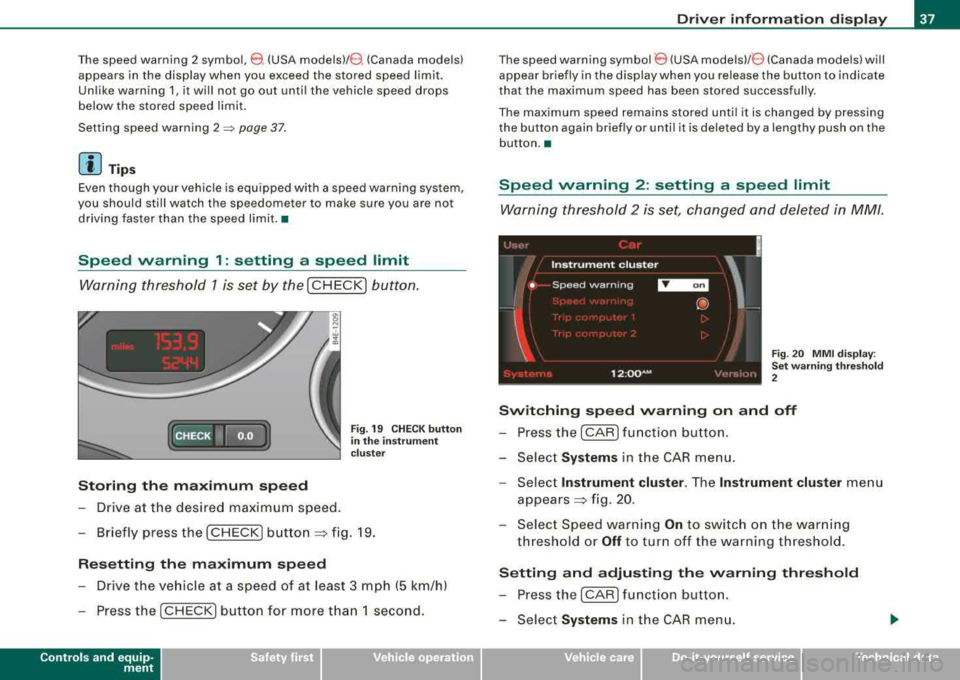
Speed warning 1: setting a speed limit
Warning threshold 1 is set by the I CHECK) button.
(CHECK • fo.o'
Storing the maximum speed
- Drive at the desired maximum speed.
Fig . 19 C HEC K but ton
in th e inst ru m ent
c lu st er
- B riefly press the I CHECK) b utto n ~ fig. 19.
Rese tting the m aximum speed
- Drive the vehicle at a speed of at least 3 mph (5 km/h)
- Press the
I CHECK] button for more t han 1 second .
Controls and eq uip
ment
Dr ive r inf ormati on d ispl ay
The speed warning symbol 8 (USA models)/ 8 (Canada mode ls) will
appear briefly in the display when you release the button to indicate
that the maximum speed has been stored successfully.
The maximum speed remains stored unti l it is changed by pressing
the button again briefly or unti l it is deleted by a lengthy push on the
button. •
Speed warning 2 : setting a speed limit
Warning threshold 2 is set, changed and deleted in MM/.
Fig. 20 MMI d isp lay :
Se t w arni ng thr esho ld
2
Switching spe ed warning on and off
- Press the
I CAR) function button.
- Select
System s in the CAR menu.
- Select
Instrume nt clus ter . The Instrument cluster menu
appea rs~ fig. 20.
- Select Speed warning
On to switch on the warn ing
threshold or
Off to turn off the warning threshold.
Setting and adju sting th e warning threshold
- Press the
I CAR I fu nction button.
Select
Systems in the CAR menu.
Vehicle care I I irechnical data
Page 40 of 404
Driver information display
-Select Instrument cluster. The In strument cluster menu
appears .
Select the second item in the
Speed warning menu. The
submenu
Speed threshold appears ~ page 37, fig. 20.
Set the warning threshold you want .
Warning threshold 2 can only be set in a speed range from 20 to
150 mph (30 to 240 km/h). •
Trip computer
Introduction
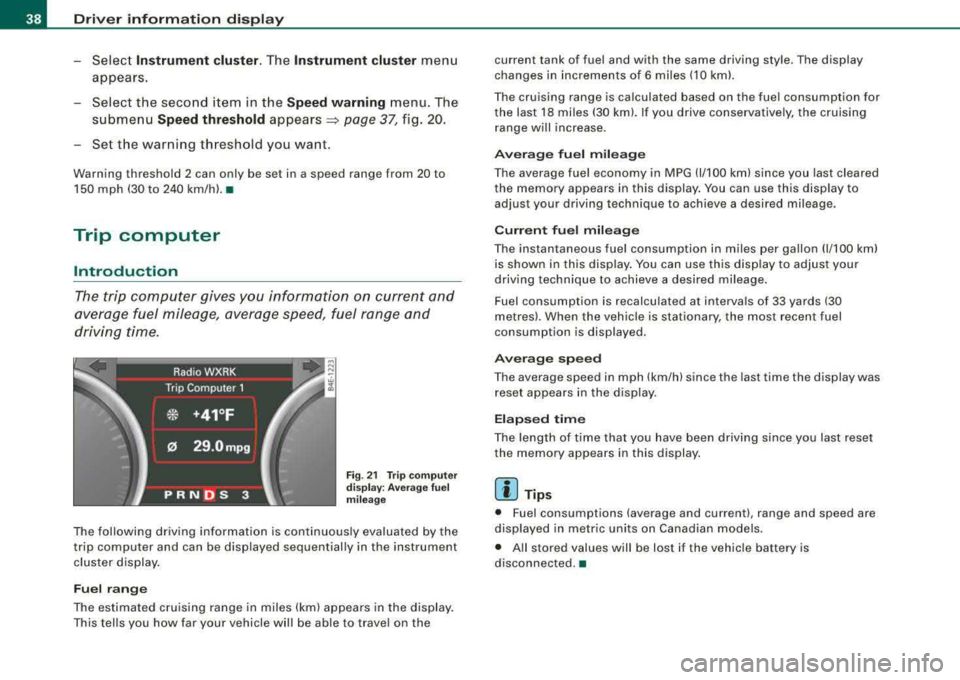
The trip computer gives you information on current and
average fuel mileage, average speed, fuel range and
driving time.
Fig. 21 Trip comput er
di sp lay : Average fuel
mil eage
The following driving information is continuously evaluated by the
trip computer and can be displayed sequential ly in the instrument
cluster display.
Fuel range
The estimated cruising range in miles (km) appears in the display.
This tells you how far your vehicle will be able to travel on the current tank of fuel and with the same driving style. The display
changes in increments of 6 miles (10 kml.
The cruising range is calculated based on the fuel consumption for
the last 18 miles (30 km). If you drive conservative ly, the cruising
range will increase.
Average fuel mileage
The average fuel economy in MPG (1/100 km) since you last cleared
the memory appears in this display . You can use this disp lay to
adjust your driving technique to achieve a desired mileage .
Current fuel mileage
The instantaneous fuel consumption in miles per gallon (1/100 km)
is shown in this display. You can use this display to adjust your
driving technique to achieve a desired mileage.
Fuel consumption is recalculated at interva ls of 33 yards (30
metres). When the vehic le is stationary, the most recent fuel
consumption is displayed.
Average speed
The average speed in mph (km/h) since the last time the display was
reset appears in the display.
Elapsed time
The length of time that you have been driving since you last reset
the memory appears in this display .
[ i] Tips
• Fuel consumptions (average and current), range and speed are
displayed in metr ic units on Canadian models.
• All stored values will be lost if the vehicle battery is
disconnected .•
Page 43 of 404
failure. Under-inflation also reduces fue l efficiency and tire tread
life, and may affect the veh ic le's handling and stopping abi lity.
Please note that the TPMS is not a substitute for proper tire mainte
nance, and it is the driver's responsibi lity to maintain correct tire
pressure, even if under-inflation has not reached the leve l to tr igger
illumination of the TPMS low tire pressure tellta le.
Your veh icle has a lso been equipped with a TPMS malfu nction indi
cator to indicate when the system is not operating properly . The
TPMS malfunction indicator is combined w ith the low tire press ure
telltale . When the system detects a ma lfunction , the telltale wi ll
fl ash for approximately one minute and then remain continuously
illum inated . This sequence will continue upon subsequent vehicle
start -ups as long as the ma lfunction exists.
When the ma lfunctio n indicator is i llum inated, the system may not
be ab le to detect or signa l low tire pressure as intended . TPMS
malfunctions may occ ur for a var iety of reasons, i nclud ing the
installation of replacement or alternate tires or wheels on the
vehic le that prevent the TPMS from f unctioning proper ly . Always
check the TPMS malfunction tellta le after replac ing one or more
t ires or whee ls on yo ur ve hicle to ens ure t hat the replacement or
a lternate tires and wheels allow the T PMS to continue to function
proper ly. •
Introduction
The tire pressure monit oring system m onitors air pressure
in all four road wheels and the spare tire* while the
vehicle is movin g.
As soon as the tire pressure moni toring system se nses a signi ficant
loss of air pressure in one or severa l tires, text messages and yellow
symbo ls appear in the inst rume nt cluster d isplay to aler t t he driver .
T he
(l) warning light in the instrument c luster comes on when the
t ire is sig nificant ly underinflated
=> page 20 .
Controls and equip
ment
Driver information di splay
The warning light U) also i lluminates in the case of a system
mal fu ncti on.
The system continuous ly receives rad io signa ls from sensors
located inside each tire .
Be aware that t ire p ressu re is also dependen t on the tempera ture of
the tire . For every
18 °F (1 O °C) increase in tire temperature, tire pres
sure increases by about 1 .5 psi (0 .1 bar). The tire warms up wh ile the
vehicle is moving and t ire pressure rises . So you should adjust tire
pressure only when the t ires are
cold, when the temperature of the
tires is roughly the same as the ambient air temperature .
I n order to keep the tire pressure monitoring system properly cali
brated, tire pressure on all four tires and on the spare tire* should
be checked at regular intervals, adjusted if n ecessary and saved in
the proper setti ng (recommended
pressure) => page 44.
The tire pressure is shown on the tire pressure label. On USA vehi
cles, the tire pressure labe l is located on the drive r's s ide B -p ill ar. On
Canada vehicles, the tire pressure labe l is located either on the
driver's side B -pillar o r inside the fuel fi ller flap. The t ire press ure
label l ists t he recommended cold tire inflat io n pressures for t he
vehic le at its maximum capacity weight and the tires that were on
your ve hicle at the time it was manufactured . For recommended tire
pressures for normal load condit ions, please see chapter
=> page 328 .
The current temperatures and pressure of your tires can be viewed
in the M MI
=> page 43 .
& WARNING
• When the tire pre ssure monitoring system warning light i s lit ,
one or more of your tires is signifi cantly under -infl ated . You should
stop and check your tires a s soon a s po ssible , and inflate them to
the proper pre ssure a s indi cated on the vehi cle' s tire pre ssure
label
=> page 328 . Driving on a significantly under -inflated tire
ca use s the tire to o verheat and can lead to tire failure. Under -infla -
~
Page 44 of 404
Driver information display
& WARNING (continued)
tion also is likely to impair the vehicle's handling and stopping
ability.
• Do not adjust tire pressure when tire temperature is excessive .
This could lead to serious tire damage and even cause the tire to
burst, with the additional danger of an accident.
W For the sake of the environment
Driving with under -inflated tires reduces fuel efficiency and tire
tread life.
[ i) Tips
• Each tire, including the spare*, should be checked monthly when
cold and set to the recommended inflation pressure as specified on
the tire pressure label
=> page 328.
• The tire pressure monitoring system helps the driver to keep an
eye on tire pressures. But the driver still has the responsibility for
maintaining the correct tire pressure .
• Tire pressure must only be adjusted when the temperature of the
tires is about the same as ambient air temperature.
• When tires are replaced, the sensors and valves should not be
detached or exchanged. Only the valve core needs to be replaced
and, if necessary, the valve and the wheel electronics replaced.
• If you should put different wheels and tires on your vehicle (e .g.
winter wheels and tires), you must be certain that the wheels and
tires are compatible with the tire pressure monitoring system .
Otherwise the system will register a malfunction and a fault
message will be displayed. For more information, contact your
authorized Audi dealer.
• Adjust the tire pressure and store the pressure in the tire pres
sure monitoring system to the load you are
carrying => page 328. •
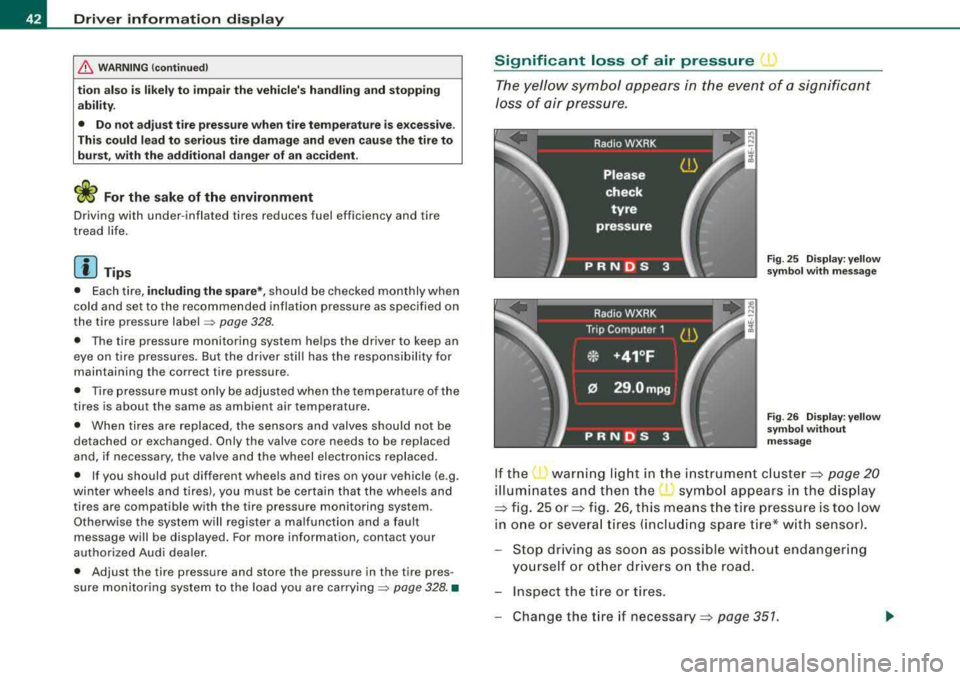
Significant loss of air pressure ( )
The yellow symbol appears in the event of a significant
loss of air pressure.
Fig . 25 Display: yellow
symbol with message
Fig . 26 Display: yellow
symbol without
message
If the warning light in the instrument cluster:::::, page 20
illuminates and then the ( symbol appears in the display
:::::, fig. 25 or:::::, fig. 26, this means the tire pressure is too low
in one or several tires (including spare tire* with sensor).
Stop driving as soon as possible without endangering
yourself or other drivers on the road.
- Inspect the tire or tires.
Change the tire if
necessary:::::, page 351.