steering AUDI S8 2008 Owner's Guide
[x] Cancel search | Manufacturer: AUDI, Model Year: 2008, Model line: S8, Model: AUDI S8 2008Pages: 404, PDF Size: 52.7 MB
Page 227 of 404
Airbag system -
--------------=---=--
& WARNING (continued)
• If you must install a rearward facing child seat on the front
passenger seat because of exceptional circumstances and the
PASSENGER AIR BAG OFF light does not come on and stay on,
immediately install the rear-facing child seat in a rear seating posi
tion and have the airbag system inspected by your Audi dealer.
& WARNING
If, in exceptional circumstances, you must install a forward-facing
child restraint on the front passenger's seat:
• Always make sure the forward-facing seat has been designed
and certified by its manufacturer for use on a front seat with a
passenger front and side airbag.
• Never put the forward-facing child restraint up against or very
near the instrument panel.
• Always move the passenger seat into its rearmost position in
the seat's fore and aft adjustment range, as far away from the
airbag as possible, before installing the forward-facing child
restraint. The backrest must be adjusted to an upright position.
• Make sure that the PASSENGER AIR BAG OFF light comes on
and stays on all the time whenever the ignition is switched on. •
Advanced Airbag System components
The front passenger seat in your vehicle has a lot of very important
parts of the Advanced Airbag System in it. These parts include the
weight -sensing mat, sensors, wiring, brackets, and more. The func
tion of the system in the front passenger seat is checked by the elec
tronic control unit when the ignition is on. The control unit monitors
the Advanced Airbag System and turns the airbag indicator light on
when a malfunction in the system components is detected. The
function of the airbag indicator light is described in greater detail below . Because the front passenger seat contains important parts
Controls and equip
ment Safety first Vehicle operation
of the Advanced Airbag System, you must
take care to prevent it
from being damaged. Damage to the seat may prevent the
Advanced Airbag for the front passenger seat from doing its job in
a crash.
The front Advanced Airbag System consists of the
following:
• Crash sensors in the front of the vehicle that measure vehicle
acceleration/deceleration to provide information to the Advanced
Airbag System about the severity of the crash.
• An electronic control unit, with integrated crash sensors for front
and side impacts. The control unit "decides" whether to fire the
front airbags based on the information received from the crash
sensors. The control unit also "decides" whether the safety belt
pretensioners should be activated.
• An Advanced Airbag with gas generator for the driver inside the
steering wheel hub.
• An Advanced Airbag with gas generator inside the instrument
panel for the front passenger.
• A weight -sensing mat under the upholstery padding of the front
passenger seat cushion that measures the total weight on the seat.
The information registered is sent continuously to the electronic
control unit to regulate deployment of the front Advanced Airbag on
the passenger side .
• An airbag monitoring system and indicator light in the instru
ment
cluster => page 229.
• The PASSENGER AIR BAG OFF light comes on and stays on in the
center of the instrument
panel => page 230, fig. 233 and tells you
when the front Advanced Airbag on the passenger side has been
turned off .
• A sensor below the safety belt latch for the front seat passenger
to measure the tension on the safety belt . The tension on the safety
belt and the weight registered by the weight-sensing mat help the
control unit
"decide" whether the front airbag for the front
passenger seat should be turned off or
not=> page 220, "Child
restraints on the front seat
-some important things to know". .,_
Vehicle care Do-it-yourself service Technical data
Page 230 of 404
__ ....!:,A~i'.!. r !::b :!a ~g:L.: s~ y~ s:!: t::.:: e~ m'..!.!.. ______________________________________________ _
or the low er parts of the body . Front airbags only supplement th e
th re e po int safe ty b elts in som e front al c ollis ions in which the
vehic le dece lerat ion is h igh enou gh to deploy the a irba gs.
Front airbags will not deploy:
• if the ignition is switched off when a crash occurs,
• i n sid e coll is io ns,
• in r ear- e nd collisi ons ,
• in ro llovers,
• when th e cras h de cele ration meas ured b y th e a irba g sys tem is
less than the mini mum threshold needed for a irbag deployme nt as
r egi stere d by th e ele ctr on ic con trol uni t.
The front passenger airbag will also not deploy :
• when th e front p asseng er seat is not occ upi ed ,
• when the weight on the front pas senge r seat a s sensed by the
A dvance d Airb ag Syste m indicates t hat th e fr on t airb ag on the
passenger side has to be t urned off b y the e lectronic control unit
(the PASSENGER AIR BAG OFF li g ht come s on and s tays o nl.
& WARNING
Sitting in the wrong position can increase the risk of serious injury
in crashes .
• To reduce the risk of injury when the airbags inflate , the driver
and passengers must always sit in an upright position , must not
lean against or place any part of their body too close to the area
where the airbags are located.
• Oc cupants who are unbelted , out of position or too close to the
airbag can be seriously injured by an airbag as it unfolds with
great force in the blink of an eye
=> page 220.
& WARNING
A child in a rearward -facing child seat installed on the front
passenger seat will be seriously injured and can be killed if the
front airbag inflates - even with an Advanced Airbag System .
• The inflating airbag will hit the child seat or infant carrier with
great force and will smash the child seat and child against the
backrest , center arm rest , door or roof .
• Always install rear-facing child seats on the rear seat.
• If you must install a rearward facing child seat on the front
passenger seat because of exceptional circumstances and the
PASSENGER AIR BAG OFF light does not come on and stay on ,
immediately install the rear-facing child seat in a rear seating posi
tion and have the airbag system inspected by your Audi dealer.
& WARNING
Objects between you and the a irbag will increase the risk of injury
in a crash by interfering with the way the airbag unfolds or by
being pushed into you as the airbag inflates.
• Never hold things in your hands or on your lap when the vehicle
is in use.
• Never transport items on or in the area of the front passenger
seat. Objects could move into the area of the front airbags during
braking or other sudden maneuver and become dangerous projec
tiles that can cause serious personal injury if the airbags inflate.
• Never place or attach accessories or other objects (such as cup
holders, telephone brackets, large , heavy or bulky objects) on the
doors , over or near the area marked
"AIRBAG " on the steering
wheel , instrument panel , seat backrests or between those areas
and yourself . These objects could cause injury in a crash, espe
cially when the airbags inflate .
• Never recline the front passenger's seat to transport objects .
Items can also move into the area of the side airbag or the front
airbag during braking or in a sudden maneuver. Objects near the .,_
Page 234 of 404
__ .....;.A..;.;.;. ir.;;b ;..; a;;;;. g=... s;;;.!. y.;;s ..;;t ..;;e ;.;.m.;..;... ________________________________________________ _
&, W ARNING (continued )
• A tight tether or other strap on a rearward-facing child restraint
attached to the front passenger seat can put too much pres sure
on the weight-sensing mat in the seat and reg ister more weight
than is actually on the seat. The heavier weight registered can
make the system work as though an adult were on the seat and
deploy the Advanced Airbag when it must be suppressed causing
serious or even fatal injury to the child .
• If, in exceptional circumstances, you must install a forward
facing child restraint on the front passenger seat , always move the
seat into its rearmost position in the seat's fore and aft adjust
ment range , as far away from the a irbag as possible. The backrest
must be adjusted to an upright position. Make sure that the
PASSENGER AIR BAG OFF light comes on and stays on all the time
whenever the ignition is switched on .
& WARNING
• If the PASSENGER AIR BAG OFF light does not go out when an
adult is sitting on the front passenger seat after tak ing the steps
described above, make sure the adult i s properly seated and
restrained at one of the rear seating positions .
• Have the airbag system inspected by your Audi dealer before
transporting anyone on the front passenger seat .
[ i] Tips
If the we ight -sens ing mat in the front passenger seat detects an
e mp ty s eat, th e front air bag o n the pass enge r sid e wil l be tur ned
off, and PASSENGER AIR BAG OFF will stay on.•
Repair, care and disposal of the airbags
Parts of the airbag system are insta lled at many different places o n
yo ur Au di. In stal li n g, r emo vin g, s ervic ing or rep airi ng a part i n an area of the vehicle can damage a part of an airbag system and
p re vent that sys tem from wor king pr operly in a c ollis ion.
Th ere are some important th ings you hav e to know to ma ke sure
that t he effectivenes s of the system will not be impai red and that
discar ded co mponents do not ca use injury o r po llut e the enviro n
ment .
& WARNING
Improper care , servicing and repair procedures can increase the
risk of personal injury and death by preventing an airbag from
deploying when needed or deploying an airbag unexpectedly:
• Never cover , obstruct , or change the steering wheel horn pad
or airbag cover or the instrument panel or modify them in any way .
• Never atta ch any objects su ch as cup holders or telephone
mountings to the surfaces covering the airbag units .
• For cleaning the horn pad or instrument panel, use only a soft,
dry cloth or one moistened with plain water. Solvents or cleaners
could damage the airbag cover or change the stiffness or strength
of the material so that the airbag cannot deploy and protect prop
erly .
• Never repair , adjust, or change any parts of the airbag system .
• All work on the steering wheel, instrument panel , front seats or
electrical system (including the installation of audio equipment ,
cellular telephones and CB radios , etc .I must be performed by a
qualified technician who has the training and special equipment
necessary .
• For any work on the airbag system, we strongly recommend
that you see your authorized Audi dealer or qualified workshop .
• Never modify the front bumper or parts of the vehicle body .
• Always make sure that the side airbag can inflate without inter-
ference :
~
Page 236 of 404
___ A_ ir_b _a_ g;::;_ s-=-- y_s _t _e _m _________________________________________________ _
& WARNING
Changing the vehicle's su spension includ ing use of un approved
tire -rim combinations can change Advanced Airbag performance
and increase the ris k of serious pe rsonal injury in a crash .
• Never install suspen sion components that do not have the
same performance chara cteristi cs as the components or iginally
installed on your vehicle.
• Never use tire-r im combinations that have not been approved
by Audi.
& WARNING
Items stored between the safety belt buckle and the center
c onsole can cause the sensors in the buc kle to send the wrong
information to the electroni c control module and prevent the
Advanced Airbag System from working properly .
• Always make sure that nothing can interfere with the safety
belt buckles and that they are not obstructed .
W For the sake of the environment
Undeployed airbag modules and pretensioners might be c lassified
as Pe rchlora te Mat erial -s pecia l handling may a pply, see
www.dtsc.ca.gov/hazardouswaste/perchlorate. When the vehicle or
par ts o f the res train t syst em inclu ding airbag mod ules sa fety be lts
with pretensioners are scrapped, all applicable laws and regu la
tions must be o bse rved. You r au thor ize d A udi d ealer is fami liar wi th
these requirements and we recommend that you have you r dea ler
perfo rm this service for you. •
Knee airbags
Description of knee airbags
Th e a irba g sys tem ca n prov id e suppl emen tal prot ect ion
t o pro perly res tra ined front s eat occ upa nts.
0
Fig . 2 34 Dri ver' s
airba g
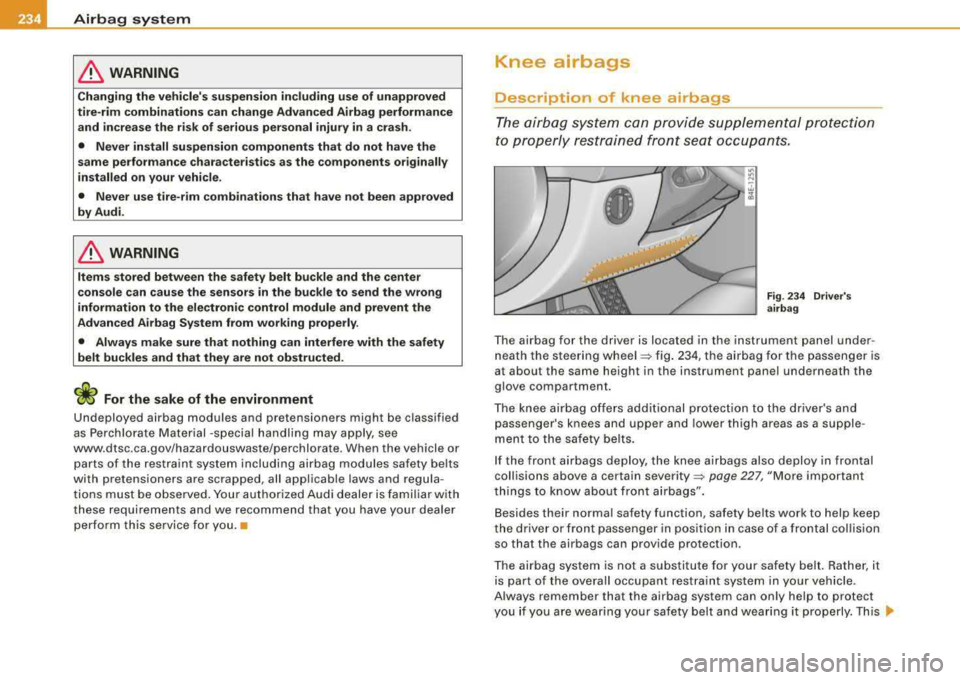
The airbag for the driver is located in the instrument panel under
neath the steering
whee l=> fig . 234 , the airbag for the passenger is
at about the same height in th e instrument panel und erneath the
glove compartment.
T he k nee air bag offer s addi tio nal pr otec tion to the driver 's a nd
passenger 's knees and upper and lower thi gh areas as a supple
me nt to t he safet y belts.
I f the front airbags deploy , the knee airbags also deploy in frontal
collisions above a certain
se verity => page 227, "M ore important
thi ngs to know about fron t a irba gs" .
B esides their normal safety function, safety be lts wor k to help keep
th e drive r o r fr on t pas seng er in pos itio n in case of a fro ntal co llis io n
so that the airbags can provide protection .
T he airbag system is not a su bstitute for your safety belt . Rathe r, it
i s part o f the overa ll occupa nt res traint system i n yo ur veh icl e.
A lwa ys re member that the airbag system can on ly help to protect
you if you a re weari ng your safe ty belt and wea ring it p roperly . T hi s
liJ,,
Page 238 of 404
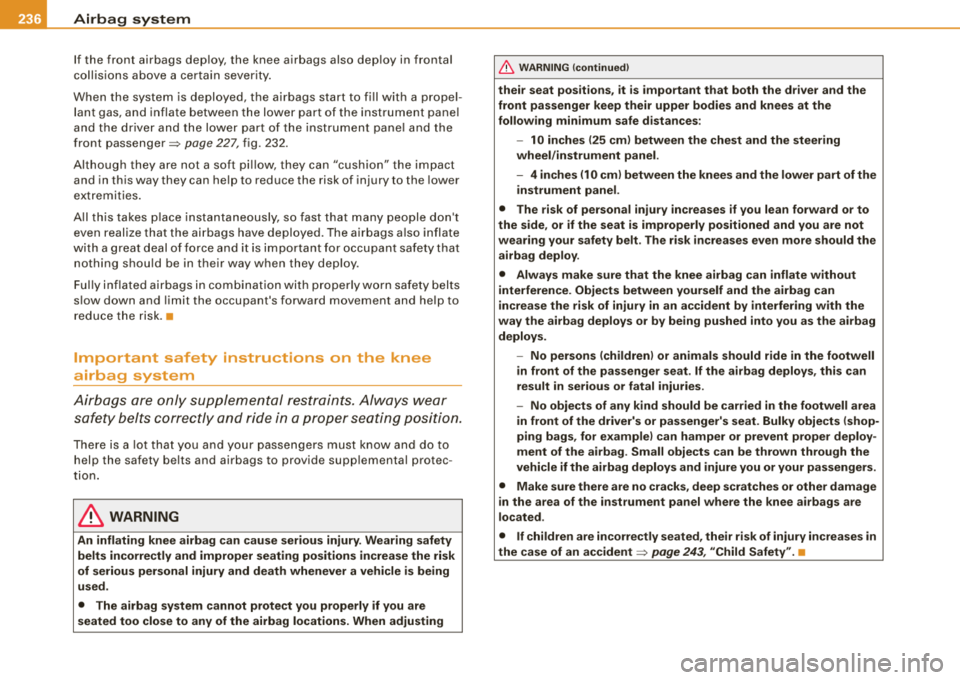
___ A_ ir_b _ a_ g=- s-a. y_s _t _e _m _________________________________________________ _
If the front airbags deploy, the knee airbags also dep loy in frontal
c oll is ions above a ce rtain sever ity.
When the system is deployed, the airbags start to fi ll with a prope l
lant gas, and inflate between the lower part of the inst rument pane l
and t he dr iver a nd t he lowe r part o f th e instrument pane l and t he
front
passenge r=> page 227 , fig. 232 .
Al tho ug h t hey a re not a soft p illow, t hey ca n "cushion" th e im pact
and in th is way they can he lp to r educe th e ris k of injury to the lower
e xtr em it ie s.
A ll thi s takes place insta nta ne ous ly, so fast t hat m any peop le do n't
even rea lize that t he ai rbags have deployed. The ai rbags a ls o inflate
wi th a gre at de al o f fo rc e an d it is impo rta nt for occu pant safet y th at
not hing s hou ld be in t heir wa y when they dep lo y.
Fu lly in flate d ai rb ags in co mbin ati on w ith p ro perly w orn s afety b elt s
s low down and limit the occupant's for ward mov eme nt and he lp to
r e duc e th e risk .•
Important safety instructions on the knee
airbag system
A irbags a re only s uppl emen tal rest raints. A lway s w ear
safety belts co rrectly and rid e in a p rope r seat ing po sition .
There i s a lo t th at you and yo ur pass eng ers m ust kno w and do t o
he lp th e safet y be lts and ai rbags to p rovide supp lemental protec
ti on.
& WARNING
An inflating knee airbag can cause serious injury. Wearing safety
belts incorrectly and improper seating positions increase the risk
of serious personal injury and death whenever a vehicle is being
used .
• The airbag system cannot protect you properly if you are
seated too close to any of the airbag locations . When adjusting
& WARNING (continued)
their seat positions, it is important that both the driver and the
front passenger keep their upper bodies and knees at the
following minimum safe distances :
- 1
O inches (25 cm) between the chest and the steering
wheel/instrument panel .
- 4 inches (10 cm) between the knees and the lower part of the instrument panel.
• The risk of personal injury increases if you lean forward or to
the side, or if the seat is improperly positioned and you are not
wearing your safety belt . The risk increases even more should the
airbag deploy .
• Always make sure that the knee airbag can inflate without
interference . Objects between yourself and the airbag can
increase the risk of injury in an accident by interfering with the
way the airbag deploys or by being pushed into you as the airbag
deploys.
- No persons (children) or animals should ride in the footwell
in front of the passenger seat . If the airbag deploys, this can
result in serious or fatal injuries .
- No objects of any kind should be carried in the footwell area
in front of the driver's or passenger's seat. Bulky objects (shop
ping bags , for example) can hamper or prevent proper deploy
ment of the airbag . Small objects can be thrown through the
vehicle if the airbag deploys and injure you or your passengers .
• Make sure there are no cracks , deep scratches or other damage
in the area of the instrument panel where the knee airbags are
located.
• If children are incorrectly seated , their risk of injury increases in
the case of an accident
=> page 243 , "Child Safety". •
Page 246 of 404
11111 Child Safety
------!....------------------------------
&, W ARNING (continued )
• Alway s inst all rear-facing child safety seats on the rear seat .
• If you mu st in sta ll a rear ward f acing child safet y seat on the
front pa ssenger seat in exceptional circum stan ces and the
PASSENGER AIR BAG OFF light doe s not come on and stay on,
immediately inst all the rear-facing child safety seat in a rear
s eating po sition and ha ve the airbag sy stem inspe cted immedi
atel y by your Audi de aler .
& WARNING
If, in exceptional circumstance s, you mu st in stall a forward -facing
c hild re straint o n the fr ont p assenger 's seat:
• Alway s make sure the forward -fa cing s eat ha s been de signed
a nd cert ified by it s m anufa cturer for use on a front seat w ith a
pa ssenger front and side airbag.
• Always follow the manufacturer's instruct ions provided with
the child safety seat or carrier.
• Alway s move the pa ssenger seat into it s re armost position in
the seat' s fore and aft adju stment range , as far aw ay from the
ai rbag as possibl e befo re installing the ch ild restr aint . The ba ck
rest mu st be adjusted to an upright po sition.
• Alway s m ake sure that the PASSENGER AIR BAG OFF l ight
c ome s on and stays on all the time whenever the ignition is
sw it c hed on . •
Advanced front airbag system and children
Your vehicle is equipped with an "Advanced Airbag System" in
compl iance with U nited States Federa l Motor Vehicle Safety Stan
dard { FMVSSl 208 as applicable at the time your vehicle was manu
factured. T
he Advanced Airbag system in your vehicle has been certified to
meet the " low -risk" requirements for 3 and 6 year -old chi ldre n on
the passenger side and smal l adults on the driver side . The low risk
deployment criteria are intended to reduce the risk of injury through
interaction with the airbag that can occur, for example, by being too
close to the steering wheel and instrument panel when the airbag
inflates. In addition, the system has been certified to comply with
the "suppression" requirements of the Safety Standard, to turn off
the front airbag for infants up to 12 months who are restra ined on
the front passenger seat in child restraints that are listed in the
Standard.
Even though your vehic le is equipped with an Advanced Airbag
system, al l ch ildren, especially those 12 years and you nger, should
a lways ride in the back seat properly restrained for their age and
size . The airbag on the passenger side makes the front seat a poten
tia lly dangerous p lace for a ch ild to ride. The front seat is not the
safest p lace for a child in a forward -facing child safety seat . It can be
a very dangerous p lace for an infant or a larger ch ild in a rearward
facing seat. •
Advanced Airbags and the weight-sensing
mat in the front seat
The Advanced Airbag Sys tem in your vehicle detects the presence
of an infant or child in a chi ld restra int on the front passenger seat
using the weight -sensing mat in the seat cushion and the sensor
below the safety belt latch on the front passenger seat that measures the tension on the safety belt.
T he weigh t-sensing mat measures total weight o f the chi ld and the
child safety seat and a child blanket on the front passenger seat . T he
weig ht o n the fr ont passenger seat is rela ted to the desig n of the
chi ld restraint and its "footprint", the size and shape of the bottom
of the child restraint as it sits on the seat . The weight of a child
restraint and its "footprint" vary for different kinds of child
~
Page 270 of 404
lll.___l_n _t _e _ll _ig=- e_n _ t_ te_ c_h _n_ o_ lo...; g'"'-=- y ___________________________________________ _
Intelligent technology
Notice about data recorded by
vehicle control modules
Your vehicle is not equipped with an Event Data Recorder (EDRl,
installed by some manufacturers for the express purpose of
capturing data for retrieval after an accident or crash event . EDR's
are sometimes called "crash recorders".
Some state laws restrict the retrieva l or downloading of data stored
by EDR's that were insta lled in a vehicle for the express purpose of
retrieving data after an accident or cras h event without the owner's
consent.
Although your vehicle is not equipped with an EDR, it is equipped
with a number of electronic control modules for various vehicle systems such as, for example, engine function, emission contro l, as
we ll
as for the a irbags and safety belts.
These electronic control modules also record vehic le-related data
dur ing norma l ve hicle opera tion for diagnost ic and repair purposes .
The recording capacity of the electronic control modules is limited
t o data (no sound is recorded) and only a small amount of data is
actua lly recorded over a very limited period of time and stored when
a system fault or other condition is sensed by a control unit. Some
of the data then stored may relate to vehic le speed, d irection,
braking as we ll as restraint system use and performance in the
event of a crash o r other condition . Stored data can only be read and
downloaded with special equipment. •
Electronic Stabilization Program (ESP)
General information
The ESP improves the vehicle stability.
I~
" "'
( ~ 1~ IA I 3-)
Fi g. 25 4 Cen ter
co nso le w it h ES P
sw itch
ESP is designed to he lp you maintain vehic le control in situations
where the car approaches the limits of "grip", especia lly when
acce lerating and cornering . ESP reduces the risk of skidding and
improves stabil ity under al l road conditions.
T he system operates across the entire speed range in combination
with the ABS system. If the Ant i-Lock Brake System (ABS) malfunc
tions, the ESP wi ll also shut down .
How the syste m w ork s
The Anti -Lock Brake System (ABS), Electronic Differential Lock (EDU
and the Anti-Sl ip Regulation System (ASR) are integrated in the e lec
tronic stabi lization program. In addition to the data provided by
t hese functions, the ESP control unit requires additional measure
ment data provided by high performance sensors . The rotational
speed of the veh ic le about its vertica l axis, the lateral acce lerat ion
acting on the vehicle, the brake pressure and the steering angle are
a ll measured . _,,,,
Page 271 of 404
____________________________________________ ln_t_ e_ l_ li _,..g "- e_ n
_ t_t_e _ c_ h_ n_o _l_o _....g ,_,y'-_IJIII
T he direction in which the driver wishes to travel is determined with
t he aid of the steering angle and vehicle speed and is con tinua lly
compared with the actual behavior of the vehicle. If the two do not
match, for example, when the vehic le starts hydrop laning on a wet
road, ESP will automatically brake the appropriate whee l to correct
the prob lem.
The vehicle is then stabi lized by the forces act ing on the whee l
during braking. If the vehicle is
oversteering (rear tends to skid out
of the turn), the brakes are mainly app lied on the whee l that is on
the outside of the curve. In the case of a vehicle that is
understeering
(tendency to s lide out of the curve), t he brakes are applied a t the
rear wheel that is on the inside of the curve. An acoustic signal indi
cates when ESP brake app lication cuts in
=> & .
The system operates across t he entire speed range in comb inat ion
with the ABS system
=> page 272 . If the Anti -Lock Brake System
(ABS) malfunctions, the ESP wi ll be out of act ion as well.
Ac tivation
When you turn on the eng ine, ESP will automatically be activated
and wil l perform a self -test.
The system can be activated or deactivated by pressing the but ton
=> page 268, fig. 254 . The warning light comes on when the system
is switched off
=> page 18.
Normally, the ESP s hould always be on, however, it may be advanta
geous to turn off the system in certain special cases when some
degree of wheel spin is des ired such as:
• when driving with snow chains
• whe n driving in deep snow or on a loose surface (to allow the
whee ls to dig in to reach firm ground)
• whe n trying to
"rock" the vehicle free whe n it has become stuck.
T he system should be reactivated once you are no longer in such
situations .
Both the ABS and EDS systems are still functioning even if the ESP
is switched off .
Controls and equip
ment Safety first Vehicle operation
& WARNING
The Ele
ctron ic Stabiliz ation Pr ogram i s ne verthele ss subje ct to the
laws of phy sic s. It is p articularl y important to pay attention to this
fa ct on wet and slipper y ro ad s. It i s therefore important th at you
alway s adapt your dr iving to the condit ion of the road and traffic
c ondition s. Do not allo w the in crea sed safety pro vided by the Ele c
tronic Stabilization Program system to lull you into a ccepting
a ddition al safety ri sk s.
•
Electronic differential lock (EDL)
The elec tronic d ifferen tial lock moni tors the rotation al
s p eed of the drive wheels.
G en era l not es
The elect ronic d ifferential lock (EDU helps the ca r to start mov ing,
accelerate and c limb a grad ient on surfaces providing poor or
a lmost no grip . Without EDL, this would be difficult, if not impos
s ib le.
How the syst em works
The EDL operates automatical ly. It monitors the rotationa l speed of
t he drive wheels on an ax le with the he lp of the ABS senso rs
=> page 272. If a not iceable difference in rotational speed between
the drive wheels on one axle is detected (e.g. on slippery ground
on
one side),
the spinning w heel is bra ked, thereby transferring power
to the other drive wheel or wheels (a ll -whee l drive) . This is done up
t o a speed of ab out 60 mph (100 km/h). N oises from the brake
system signal that wheel spin is being control led .
Dri ving off
When driving off, always be sure to keep road conditions in mind as
you accelerate. I f one drive wheel spins because it is on a sur face
with less grip, gradual ly increase the pressure on the accelerator
pedal unt il the car star ts to move . The whee l less able to t ra nsfer
power spins.
.,,
Vehicle care Do-it-yourself service Technical data
Page 275 of 404

Intellig ent tec hnol ogy -
------------ -=--=-= '-
& WAR NIN G (c onti nued )
acc ident canno t b e co mp ensat ed for even b y th e br ake assis tant,
s o alway s maintain a safe sp eed . •
Servotronic® - advanced power
steering system
The power steering systems uses the power of the
running engine to allow precise s teering with little effor t.
The advanced Servotronic® power steering system senses the road
speed and electronically adjusts power assistance to provide
comfortab le and safe steer ing response exactly matched to the
vehic le speed.
Power s teeri ng will not work if the engine is off . As a result, the
steering whee l wil l be hard to turn .
The power steering fluid level is checked during the scheduled
maintenance serv ices.
0 Note
If there is an electron ic ma lfunction, servotronic will sti ll funct ion
like a conventiona l power steering system, providing a constant
steer ing suppor t force that is no longer proportionate to the vehicle
speed . This is most noticeable when turning the steering wheel at
low speeds (for examp le w hen parking), -more effor t wi ll be
required than usual.
• Be aware of the different than usua l steering response and
adjust your steering force accordingly .
• Have the problem checked and set right by an Aud i dea ler as
soon as possib le.
Controls and equip ment Safety first Vehicle operation
[
i ] Tip s
• When the engine is running, never hold the steer ing whee l
turned all the way to the right or to the left for longer than 15
seconds. The power steer ing pu mp wil l overheat the hydraul ic fluid
if you keep ho lding the steering whee l turned a ll the way. This is
like ly to damage the power steering system.
• I f the power steering system shou ld fail entire ly, or if the engine
is not runn ing ( for examp le, wh ile be ing towed), you w ill st ill be able
to steer the vehicle . However, considerably more effort will be
requ ired to do so.
• I f the power steering system shou ld have a leak, or is not func
tioning properly, contact your author ized Audi dealer im mediately.
• The power stee ring system requires a special ly formulated
hydrau lic fluid . The power steer ing reservo ir is the one located most
forward on the left side of the engine
compartment => page 308. The
correct flu id level in the reservo ir is important for proper func
tioning of the power steering. •
Driving with your quattro®
With All Wheel Drive, all four wheels are driven.
Genera l inf orm ati on
With All Whee l Drive, power is d istributed to all fo ur wheels. This
happens automatically depending on your driving style and the
road condi tions at the time . See
a lso => page 269, "Electronic differ
entia l lock ! EDU" .
Winter tires
When driving in the winter, your vehicle with All Wheel Drive has an
advantage, even with regular tires . In winter road conditions it may
be advisable to mount winter tires (or all-season tires) for improved
driveabi lity and braking: these ti res must be mounted on all four
wheel s. See
also=> page 341, "Winter tires". ~
Vehicle care Do-it-yourself service Technical data
Page 285 of 404
____________________________________________________ T_r_a _i_l e_ r_t_ o _ w_ i
_ n...; g=- -•
Operating instructions
M ax im um tra iler weig ht
A trailer for your vehicle is limited to a typ ical c lass 1 or class 2
trailer.
T ra ile r l oad d is tributi on
Be sure the load in the trailer is he ld securely in place to prevent it
from shifting forward, backward or s ideways .
Never a llow a pass enger to r ide in a trailer:::::, & in "Driving instruc
t ions" .
Engin e coo lin g sys te m
Tow ing a trai ler makes the engine work harder. It is important that
the cooling system's performance is up to the additiona l load. Make
sure that the coo ling system has enough fluid .
Tire press ure
When towing a trailer, inflate the tires of your veh icle to t he co ld tire
pressure listed under "Full load" on the labe l located either on the
driver's side B -pil lar (visible when the door is open) or inside the fuel
filler flap . Inflate trailer tires to trai ler and tire manufacturers' spec
ifications.
L ig ht s
The head light settings should be checked wit h the trai ler attached
before driving off. Check to make sure both vehicle and trai ler lights
are working properly .
Safe ty c ha in s
Be s ure trailer safe ty chains are properly connected from the trailer
to the hitch on the vehicle. Leave enough slack in the chains to
permit turning corners . When yo u insta ll safety chains, make sure
they will not drag on the road when you are driving.
T he chains should cross under the trailer tongue to prevent it from
dropping in case of separat ion from the hitch.
Controls and equip
ment Safety first
Vehicle operation
0 Note
If you are go ing to tow a trai ler, you must activate the tra iler opera
tion
mode :::::, page 189, "Towing a Trailer". •
Driving instructions
Driving with a trailer always requires extra care and
consideration.
To obtain the best possib le handling of ve hicle and trailer,
p lease note t he following :
- Do not tow a loaded trailer when your car itself is not
loaded.
- Be especia lly careful whe n passing other vehic les .
- Observe speed limits .
- Do not drive at the maximum permiss ible speed .
- Always apply brakes early.
- Monitor t he temperature ga uge .
W eight d istr ibu tion
Towing a loaded trailer with an empty car results in a highly
unstable d istribution of weight. If this cannot be avoided, drive at
very low speeds only to avoid the risk of losing steering control.
A "balanced" rig is easier to operate and control. This means that
t he tow vehicle should be loaded to the extent possible and permis
sib le, while keeping the trailer as light as possib le under the circum
stances . Whenever possible, transfer some cargo to the luggage
compartment of the tow vehicle whi le observing tongue load
requirements and vehicle loading considera tions .
.,,.
Vehicle care Do-it-yourself service Technical data