lights AUDI S8 2008 Service Manual
[x] Cancel search | Manufacturer: AUDI, Model Year: 2008, Model line: S8, Model: AUDI S8 2008Pages: 404, PDF Size: 52.7 MB
Page 285 of 404
____________________________________________________ T_r_a _i_l e_ r_t_ o _ w_ i
_ n...; g=- -•
Operating instructions
M ax im um tra iler weig ht
A trailer for your vehicle is limited to a typ ical c lass 1 or class 2
trailer.
T ra ile r l oad d is tributi on
Be sure the load in the trailer is he ld securely in place to prevent it
from shifting forward, backward or s ideways .
Never a llow a pass enger to r ide in a trailer:::::, & in "Driving instruc
t ions" .
Engin e coo lin g sys te m
Tow ing a trai ler makes the engine work harder. It is important that
the cooling system's performance is up to the additiona l load. Make
sure that the coo ling system has enough fluid .
Tire press ure
When towing a trailer, inflate the tires of your veh icle to t he co ld tire
pressure listed under "Full load" on the labe l located either on the
driver's side B -pil lar (visible when the door is open) or inside the fuel
filler flap . Inflate trailer tires to trai ler and tire manufacturers' spec
ifications.
L ig ht s
The head light settings should be checked wit h the trai ler attached
before driving off. Check to make sure both vehicle and trai ler lights
are working properly .
Safe ty c ha in s
Be s ure trailer safe ty chains are properly connected from the trailer
to the hitch on the vehicle. Leave enough slack in the chains to
permit turning corners . When yo u insta ll safety chains, make sure
they will not drag on the road when you are driving.
T he chains should cross under the trailer tongue to prevent it from
dropping in case of separat ion from the hitch.
Controls and equip
ment Safety first
Vehicle operation
0 Note
If you are go ing to tow a trai ler, you must activate the tra iler opera
tion
mode :::::, page 189, "Towing a Trailer". •
Driving instructions
Driving with a trailer always requires extra care and
consideration.
To obtain the best possib le handling of ve hicle and trailer,
p lease note t he following :
- Do not tow a loaded trailer when your car itself is not
loaded.
- Be especia lly careful whe n passing other vehic les .
- Observe speed limits .
- Do not drive at the maximum permiss ible speed .
- Always apply brakes early.
- Monitor t he temperature ga uge .
W eight d istr ibu tion
Towing a loaded trailer with an empty car results in a highly
unstable d istribution of weight. If this cannot be avoided, drive at
very low speeds only to avoid the risk of losing steering control.
A "balanced" rig is easier to operate and control. This means that
t he tow vehicle should be loaded to the extent possible and permis
sib le, while keeping the trailer as light as possib le under the circum
stances . Whenever possible, transfer some cargo to the luggage
compartment of the tow vehicle whi le observing tongue load
requirements and vehicle loading considera tions .
.,,.
Vehicle care Do-it-yourself service Technical data
Page 292 of 404
___ C_ le_ a_n _i_n ~g _ a_ n_ d
__ p_r _o _t _e _c_ t_ i_o _n ___________________________________________ _
0 Note
• Never try to remove dirt, mud or dust if the surface of the vehicle
is dry. Never use a dry cloth or sponge, since this could scratch your
vehicle 's paint or windows.
• Never wash your car in bright sunlight. Drops of water act as
magnifying lenses and may damage your paint.
• When you wash your car in the winter: if you rinse your vehicle
wi th a hose, be ca reful not to aim the stream of wa ter direc tly at
locks, or at door or hatch openings -they can freeze shut.
• Never use sponges designed to remove insects, or any kitchen
scouring sponges or similar products. They can damage your paint
finish .
• Never use a dry cloth or sponge to clean the headlights. Only use
wet cloths or sponges to prevent sc ratches . It is best to use soapy
water .
~ For the sake of the environment
In the interest of the environment, the vehicle should only be
washed in special wash bays. •
Washing your vehicle with a power washer
Cleaning the exterior of your car with a high-pressure
power washer is safe as long as you observe a few simple
rules.
- Before using the power washer, make sure you have read
and understood the WARNINGS :::>
& in "General infor
mation" on
page 288.
- Always follow the operating instructions for the power
washer. - Make
sure that the jet on the spray hose produces a "fan
shaped spray".
- Do
not hold the spray nozzle too close to soft materials.
When cleaning the vehicle w ith a power washer always follow the
operating instructions. This applies particularly to the
operating
pressure
and the spraying distance. Maintain a sufficient distance
to soft materials such as rubber hoses and sound/vibration dead
ening materials (particularly on the underside of the engine hood).
Do not use a jet which sprays water in a
direct stream or one that
has a
rotating jet.
Water temperature should no t exceed 140 °F (60 °Cl.
& WARNING
Never wash tires with a jet that sprays water in a direct stream.
This could cause invisible damage to the tires and weaken them,
even if the spray is from a relatively long distance and for a short
time. Damaged and weakened tires can fail and cause accidents
and personal injury .
0 Note
To avoid damaging your vehicle, always make sure that there is
sufficient distance between the spray head and soft materials like
rubber hoses, plastic parts and sound-deadening materials . Never
aim the spray head at the same point for a long time. This also
applies to cleaning headlights and painted bumpers . Remember:
the closer the nozzle is to the surface of the material , the greater the
stress on the material. •
Page 313 of 404
Checkin g and fillin g 1111
-------------~~~
•
the form of Service or Repair Ord ers that all scheduled maintenance
was perfo rmed in a t imely man ner. •
Engine oil consumption
The engin e in your vehicle d ep ends on an adequate
amount of oil to lubricate and cool all of its moving parts.
In order to provide effect ive lubrication and cool ing of internal
engine components, all internal combustion engines consume a
certain amount of o il. Oil consumption varies from engine to eng ine
and may change significantly over the life of the engine . Typically,
eng ines wi th a specif ied break -in period
(see => page 2771 consume
more oil during the break -in period than they consume after oi l
consumption has stabi lized .
Under normal conditions, the rate of oil consumption depends on
the quality and viscosity of the oil, the RPM (revolutions per minute)
at which the engine is operated, the ambient temperature and road
conditions. Further factors are the amount of oil dilution from water
co ndensation or fue l residue and the oxidation level of the o il. As
any engine is subject to wear as mileage builds up, the oil consump
t io n may increase over time until rep lacement of worn components
may become necessary .
With all these variables coming into play, no standard rate of oil consu mption can be estab lished or specified. T here is no a lternative
to regular and frequent checking of the oil level, see
Note .
If the yellow eng ine o il level warni ng symbol in the instrume nt
cluster ~ lights up, you should check the oil level as soon as
poss ible
with the oil dipstick => page 311 . Top off the oil at your
earliest
convenience=> page 312.
& WARNING
Bef ore you che ck anything in the eng ine comp artment , alw ay s
read and heed all WARNINGS
=> & in "Working in the engine
c ompartment " on
page 307 .
0 Note
Driving with an insuff ic ie n t o il level is l ikely to cause severe damage
to the engine.
[ i ] Tip s
• The oil pr es sure warning displ ay
regular inter vals, preferably ea ch time you refuel , and al ways before
going on a long trip.
• I f you have the impression your engine consumes excessive
amounts of oi l, we reco mmend that you consult your Audi dealer to
have the cause of your concern properly diagnosed . Keep in mind
t hat t he acc urate measureme nt of oil consump tion requ ires g reat
care and may take some time. Your Audi dealer has instructions
about how t o measure oil consumpt ion accurately. •
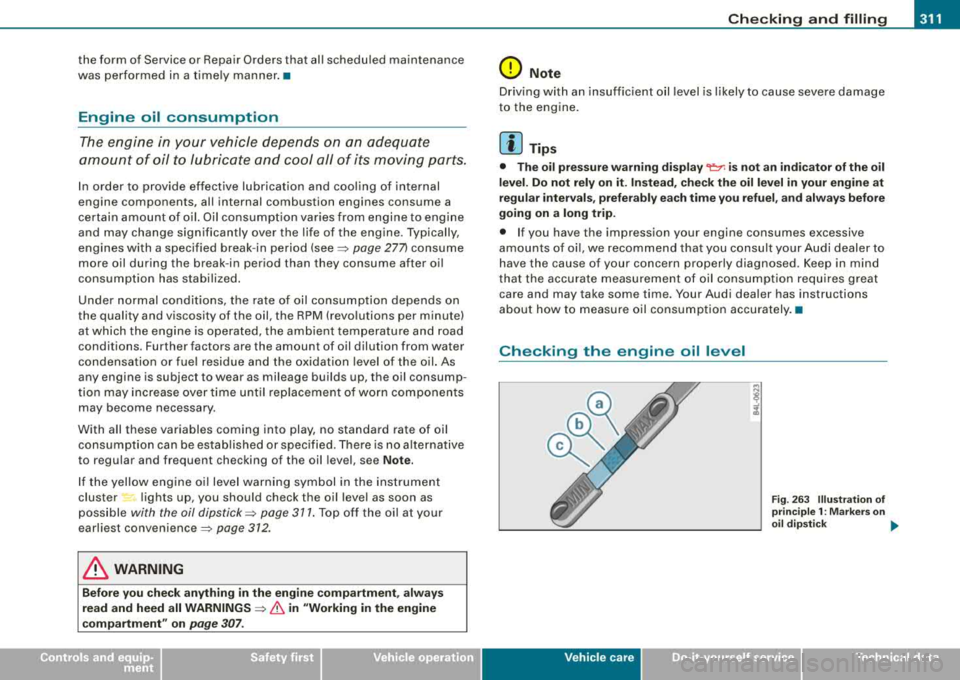
Checking the engine oil level
Vehicle care
Fig. 26 3 Illu stration of
prin cipl e 1: Mar ker s on
o il dip sti ck ...
Page 321 of 404
_____________________________________________ C_h_ e_ c
_ k_in -= g_a
_ n_d _ f_il _li _n ..;::g ;;.___.IIIII
checked by a service facility. The e lectrolyte level should also be
checked each time the battery is charged =>
page 321.
Have the battery checked when you take your vehicle in for service.
You are well advised to replace a battery that is older than 5 years.
With ce rtain types of airbag deployment, the battery is discon
nected from the vehicle electrical system for safety reasons=>
& in
"Repair, care and disposal of the airbags" on
page 232.
Di sconn ecting the b atte ry terminal s
Some veh ic le functions (power window regulators, for example) are
lost if the battery terminals are disconnected. These functions have
to be relearned after the battery terminals are connected again. To
prevent this, the battery should only be disconnected from the
veh icle electrical sys tem when absolu tely necessary for repairs.
Veh icl es not driv en for lo ng p eriods
If you do not drive your vehicle over a period of several days or
weeks, electrical components are gradually cut back or switched off.
This reduces energy consumpt ion and maintains starting capability
over a longer period
=> page 274 .
Be aware that when you unlock your vehicle, some of the conve
nience functions may not operate, such as the Advanced Key*, the
remote control or the power seat adjustment. The convenience
functions will be ava ilable again when you turn on the ignition and
start the engine.
W int er operati on
During the winter months, battery capacity tends to decrease as
temperatures drop. This is because more power is also consumed
while starting, and the headlights, rear window defogger, etc. , are
used more often .
Avoid unnecessary power consumption, particularly in city traffic or
when trave ling only short distances . Let your authorized Audi dea ler
check the capacity of the vehicle battery before winter sets in
=> page 321. A well charged battery will n ot only prevent starting
problems when the weather is cold, but wi ll also last longer.
[ i ] Tips
If your vehic le is left standing for severa l weeks at extreme ly low
temperatures, the vehicle battery should be removed and stored
where it will not freeze. Th is wil l prevent it from be ing damaged and
having to be replaced.•
Working on the battery
Be espe cially careful when w orking on or near the battery.
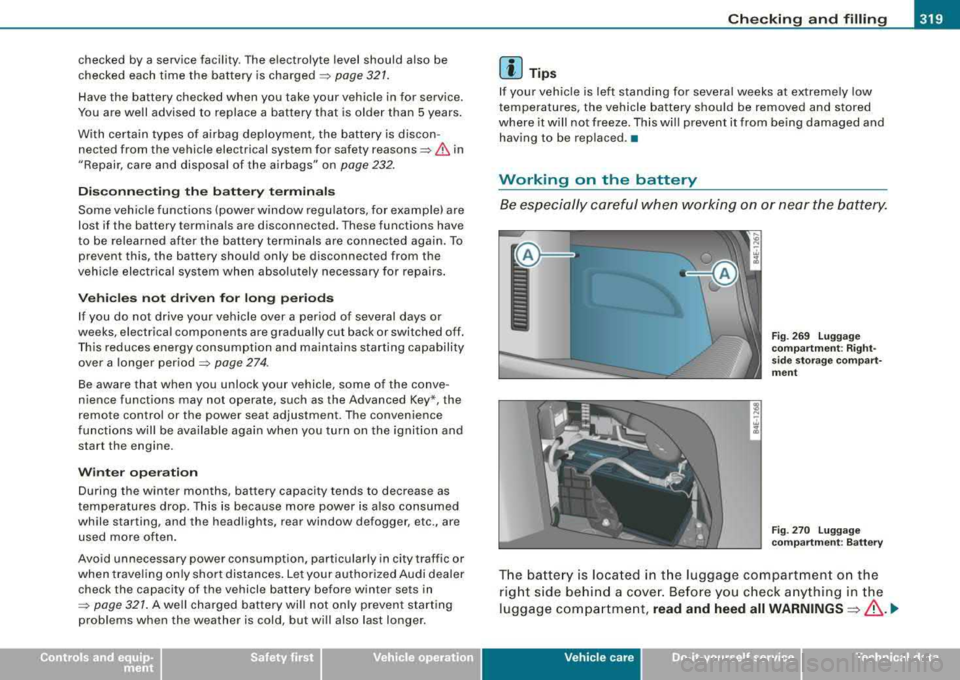
Fig . 2 69 Lugg age
co mpartment : R ight
si de sto ra ge c omp art
m ent
F ig. 2 70 Lugg age
co mp artment : B atte ry
T h e ba tter y is lo ca te d in t he luggage compartm ent on the
r ight side b ehind a c ove r. Before you check a nything in the
luggag e co m partment,
read and heed all WARNINGS =>& . .,.
Vehic le care I I irechnical data
Page 322 of 404
_L--_C_ h_e _c _ k_ i_ n --=g::...._ a_ n_ d_ f_ i_ll _in --'g=-- --------------------------------------------
-To open the side storage compartment, turn the two pins
©~fig. 269 to the vertical position.
The positive (+l battery terminal is protected by a plastic cover . This
cover must be removed to access the positive (+l terminal when
connecting jumper cables to start the engine.
Always heed the safety warnings, when working on the vehicle
battery or the vehicle electrical system to prevent injury.
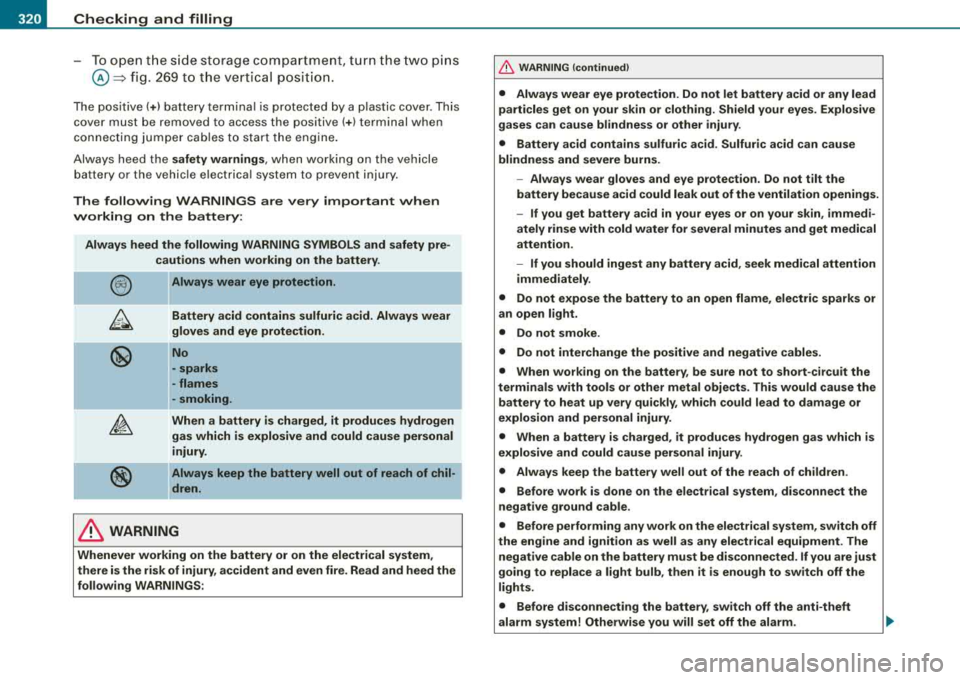
The following WARNINGS are very important when
working on the battery:
Always heed the following WARNING SYMBOLS and safety pre
cautions when working on the battery.
-
@
®
-Always wear eye protection.
Battery acid contains sulfuric acid. Always wear
gloves and eye protection.
No
-sparks
-flames
-smoking.
When a battery is charged, it produces hydrogen
gas which is explosive and could cause personal
injury.
Always keep the battery well out of reach of chil
dren.
& WARNING
Whenever working on the battery or on the electrical system,
there is the risk of injury, accident and even fire. Read and heed the
following WARNINGS:
& WARNING (continued)
• Always wear eye protection. Do not let battery acid or any lead
particles get on your skin or clothing. Shield your eyes. Explosive
gases can cause blindness or other injury.
• Battery acid contains sulfuric acid. Sulfuric acid can cause
blindness and severe burns.
-Always wear gloves and eye protection. Do not tilt the
battery because acid could leak out of the ventilation openings.
- If you get battery acid in your eyes or on your skin, immedi
ately rinse with cold water for several minutes and get medical
attention.
- If you should ingest any battery acid, seek medical attention
immediately.
• Do not expose the battery to an open flame, electric sparks or
an open light.
• Do not smoke.
• Do not interchange the positive and negative cables.
• When working on the battery, be sure not to short-circuit the
terminals with tools or other metal objects. This would cause the battery to heat up very quickly, which could lead to damage or
explosion and personal injury.
• When a battery is charged, it produces hydrogen gas which is
explosive and could cause personal injury.
• Always keep the battery well out of the reach of children .
• Before work is done on the electrical system, disconnect the
negative ground cable.
• Before performing any work on the electrical system, switch off
the engine and ignition as well as any electrical equipment. The
negative cable on the battery must be disconnected. If you are just
going to replace a light bulb, then it is enough to switch off the
lights.
• Before disconnecting the battery, switch off the anti-theft
alarm system! Otherwise you will set off the alarm.
Page 365 of 404
_________________________________________________ F_ u_ s_ e_s _ a_n _ d_ b_ u_lb _ s __ lllll
•
erly put back together to help prevent breakage of parts and long
t erm damage from water t hat can enter housings that have not
been properly resealed .
For your safety, we recommend that you have your authorized Audi
dea ler replace any bu lbs for you, s ince your dealer has the proper
tools, the correct bu lbs and the expertise .
Ga s di scharge lamp s (Xenon light s):
Due to the high e lectrical voltage, have the bu lbs replaced by a qual
ified technician. Headlights with Xenon light can be identified by the
h ig h voltage st icker .
& WARNING
Contact with high -voltage component s of the ele ctric al sys tem
and improper repla cement of ga s di sch arge (Xenon ) headlight
bulb s can cau se ser iou s per son al injury and death .
• Xen on bulbs are pres suri zed and can explode when be ing
c h anged .
• Changing Xenon lamp s require s the special training , in struc
tion s and equipment .
• Only an authorized Audi dealer or othe r qualified work shop
s hould ch ange the bulbs in g as dis charge l amp s.
& WARNING
There are parts with sharp edges on the open ings and on the bulb
holder s th at can c ause seriou s cuts.
• If you are uncert ain about what to do , have the work perform ed
b y a n author ized Audi de aler or other qu alified work shop. Seri ous
personal injur y ma y re sult from improperl y perfo rmed work.
[ i] Tips
• I f you must replace the light bulbs yourself, a lways remember
that t he engine compartment of any vehicle is a hazardous area to work in
. Always read and heed all
WARNINGS=> page 299, "Engine
compartment" =>& .
• I t is best to ask your authorized Audi dealer whenever you need
t o change a bulb. •
Do-it -yourself service
Page 367 of 404
________________________________________________ E=..:.; m:..:.:: e:.:.r.::g ~e::.:..: n:.:c ~y~ s:: i:.:t .=u :.:a:. t:: i:.:o :.:n..:.:: s~_JIIII
fl::. WARNING (continued)
• Before you check anything in the engine compartment, always
read and heed all
WARNINGS~ page 299, "Engine compartment".
0 Note
• Applying a higher voltage booster battery will cause expensive
damage to sensitive electronic components, such as control units,
relays, radio, etc .
• There must be no electrical contact between the vehicles as
otherwise current could already start to flow as soon as the positive
( + ) terminals are connected.
[ i) Tips
• The discharged battery must be properly connected to the
vehicle's electrical system. When jump starting or charging the battery , never connect the negative ground cable to the battery
negative post because the battery manager system must be able to
detect the battery's state of charge. Always connect the negative
ground cable to the negative ground post of the battery manager
control unit .•
Use of jumper cables
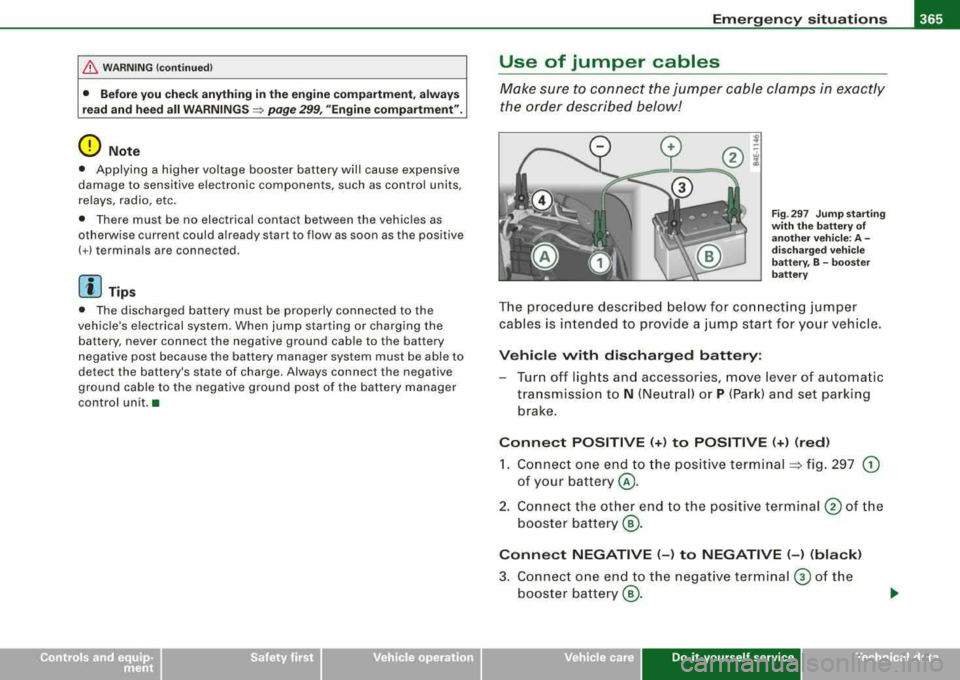
Make sure to connect the jumper cable clamps in exactly
the order described below!
Fig. 297 Jump starting
with the battery of
another vehicle: A -
discharged vehicle
battery, B -booster
battery
The procedure described below for connecting jumper
cables is intended to provide a jump start for your vehicle.
Vehicle with discharged battery:
-Turn off lights and accessories, move lever of automatic
transmission to
N (Neutral) or P (Park) and set parking
brake.
Connect POSITIVE (+) to POSITIVE (+) (red)
1. Connect one end to the positive terminal => fig. 297 G)
of your battery @.
2. Connect the other end to the positive terminal
@ of the
booster battery
@.
Connect NEGATIVE (-) to NEGATIVE (-) (black)
3. Connect one end to the negative terminal @ of the
booster battery
@.
Vehicle care Do-it-yourself service irechnical data
Page 388 of 404
___ A_ l-=- p _ h_ a_ b_e _t_ ic _ a_l _in _ d_e_ x ____________________________________________ _
A
Accessories . . . . . . . . . . . . . . . . . . . . . . . . 382
Adaptive Air Suspension ....... .. .... 185
automatic mode .. .... .... .... ... 186
Description ... .... .... .......... 185
dynamic mode ................... 186
Jacking mode when changing a flat tire .
188
lift mode . . . . . . . . . . . . . . . . . . . . . . . . 186
Setting the driving modes .. .... ... 188
Sport Chassis Controls . . . . . . . . . . . . 187
standard mode ... .... .... ...... . 186
Trailer towing mode ... .... .... ... 189
Warning/indicator lights .. ... ... 20, 21
Adaptive Cruise Control .............. 139
Changing speed ...... .... ...... . 142
Driver information ............... 144
Drivingintraffic .. .... .... ...... . 140
Error messages . . . . . . . . . . . . . . . . . . 147
Open road . . . . . . . . . . . . . . . . . . . . . . 140
Override ........ ... .. ...... .... . 140
Request for driver to assume control 140
Save speed . . . . . . . . . . . . . . . . . . . . . . 141
Setting distance . . . . . . . . . . . . . . . . . 143
Setting time interval . ... .. .... .... 143
Settings . . . . . . . . . . . . . . . . . . . . . . . . 148
Specia l driving situations . ....... . 149
Status messages ................. 147
Switching on and off ... .. .... ... . 141
System limits ...... .... .... ... ... 149
T emporarily turning off ....... .... 142
warning/indicator lights ... .... .... 145 Adaptive
Light .......... .... .... .... . 72
defective ......................... 36
Adding Engine coolant ................... 316
Engine oil . .... .... .... ... .... ... 312
Windshield washer fluid .... .... ... 323
Additiona l accessories .......... ..... 382
Additives Engine oil ... .. ...... ....... ..... 312
Adjustable steering co lumn .. .... .... 128
Adjusting Front seats . . . . . . . . . . . . . . . . . . . . . . . 86
Instrument cluster i llumination ...... 15
Steering column ................. 128
Advanced Key ....................... 59
Driver's messages . . . . . . . . . . . . . . . . 133
Locking the vehicle .. ...... .... .... 60
START button ................... 131
Starting the engine ............... 131
STOP button . . . . . . . . . . . . . . . . . . . . . 132
Stopp ing the engine ......... ..... 132
Switching on the ignition .......... 131
Unlocking the vehicle . .......... ... 60
Advanced Parking System with rear view
camera
Adjusting the chimes -option 1 .... 180
Adjusting the chimes - option 2 .... 181
front and back with visual display and
r ear-view camera . . . . . . . . . . . . . . . 170
General information ... .... ....... 170
Not es on distance information ..... 179
Parking next to obstac les . . . . . . . . . . 178
Rear -view camera -parking mode 1 . 175 Rear-view
camera -parking mode 2 . 176
Rear-view camera (Rear View) ...... 173
Rear-view camera coverage area .... 174
Rear-view camera tips ............ 183
Specia l parking situations .. .... ... 178
Switching the rear-view camera on and
off .. .... .... ...... ... .. .... ... 182
switching the visua l display on and off ..
182
System error message ............ 183
Towing hitch ...... .... ...... .... 180
Air conditioning
See Cl imate controls .... ... .... ... 114
Airbag system .... .... .... ...... 218, 238
Advanced Airbag System ...... .... 222
Advanced Airbag System components ...
225
Care ............................ 232
Child restraints ................ .. 245
Children ... .... .... ... ........ .. 244
Components (front airbags) . ...... . 225
Dang er of fitting a child seat on the front
passenger seat .. ....... .. .... .. 220
Disposal . ...... ..... .. .... .... .. 232
Fron t airbags ...... .... .... .. 222, 223
How do the front airbags work? . ... 227
How many airbags does my vehicle have?
225
How the Advanced Airbag System compo -
nents work together ... .... ...... 226
Impor tant safety instructions on the knee
airbag system .................. 236
Impor tant things to know .. .... .... 218
Indicat or light ........ ........... 229
Page 389 of 404
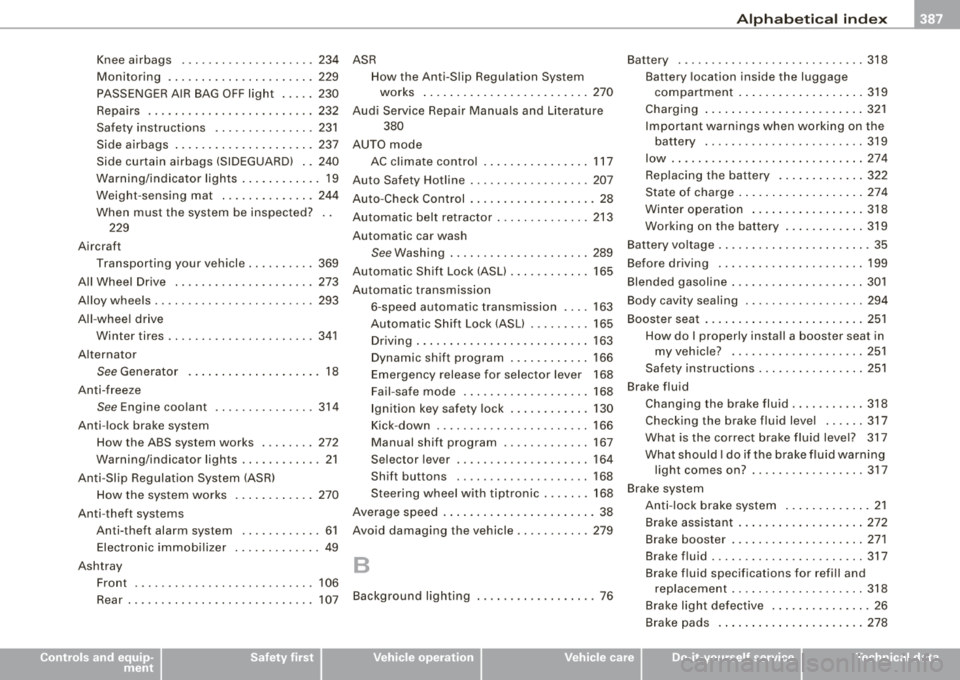
______________________________________________ A_ l.!. p _h_ a_ b_e _ t_i c_ a..:..l ...:.. in :..:..:. d:..:e :..: x_;__ _,n
Kne e airbags ...... ... .. .... ..... 234 ASR
Moni to ring .. ... .... .... ....... .. 229 How the Anti-S lip Regu la tion Sys tem
PASSENGER AIR BAG OFF ligh t .... . 230 works ...... ... .... .... .... .... 270
Repairs ........ .... .... ......... 232
Safety instructions ... .... ... .... . 231
Side airbags ... .. .... .... ... .... . 237
Side curtain air bags (SIDEGUARD) .. 240
Warning/indicator lights ...... .... .. 19
Weight -sens ing mat ...... ... .... . 2 44
When mu st the syst em be insp ected?
229
Aircra ft
T ransporting your v ehicle .. ........ 369
All W hee l Dr ive ...... .... ... .... .... 273
Alloy whee ls ... .... .... .... ... .... .. 293
A ll-whee l drive
W int er tir es . ..... .... ... ... . .... . 34 1
A lternator
See Ge ne ra tor . ....... ... .... .... . 18
An ti-free ze
See Engine coolan t ..... .... .... .. 314
An ti- lock brak e system
How th e ABS syst em works ....... . 272
Wa rning /indi cato r ligh ts .. .. .. .... .. 21
Anti -Sl ip Reg ulat io n System (ASR)
H ow the system works .... .... .... 270
Anti -theft systems
Anti -theft alarm system .. ... .... ... 61
E lectron ic immob ilizer . .... .... .... 49
Ashtray Fron t .. .... ... .. .... ...... .... .. 106 Aud
i Service Repa ir Manua ls and Literatu re
380
A UTO mode
AC climate con tro l .. .. .... .... .... 117
Auto Safety Hotline .... .... .... ... .. . 207
A ut o-C heck Con trol ...... .... ... .... .. 28
Automatic belt retracto r ... .. .... .... . 213
Automati c car wash
See Washing . .............. .... .. 289
A ut om atic Sh ift Loc k (ASU . ...... .... . 165
Automat ic transmission
6 -speed automat ic t rans missio n .... 163
Auto matic S hift Lock (ASU .... .... . 165
Dr iving . ...... .... .... .... .... ... 163
Dynamic sh ift p rogram .. ...... .... 166
Em ergency release fo r selecto r leve r 168
F a il- safe mode . ...... .... .... .... 168
I gnition key s afety lock . ...... .... . 130
K ick -down .... .... .... .... ... .... 166
Manual sh ift program ....... .... .. 167
S ele ctor le ve r ... ........... .... .. 164
Shift buttons ... .... .... .... .... . 168
S teering wheel w ith tiptronic . ...... 168
Average speed . ...... .... .... .... ... . 38
Avo id damaging the ve hicle .. ...... ... 279
B
Rear . ...... .. ...... .... ......... 107 Background lighting . ...... .... ... .. .. 76 Ba
ttery .... ... .. .... .... ...... .... . 318
Ba ttery location ins ide the luggage
compa rtmen t ... .... ... .... .... . 319
Chargi ng .. .... .... ... .... .... ... 321
Impo rtant wa rnings when working on the
battery .. .... .... ... .... ...... . 319
low ...... .... .... .... ... .... .... 274
Replaci ng t he battery .. ... .... ... . 3 22
State of cha rge . ...... .... .... ... . 27 4
Winter operat ion ..... .... .... .. . . 318
Wo rking on the batte ry . ....... ... . 319
Battery vo ltage .. .. .. .... .... .... ..... 35
B efo re driving ... .... .... ...... .... . 199
Blended gasoline ... .. .... .... .... ... 30 1
Body cavity sealing ........ .... .... .. 294
Boos ter seat ... .. .... .... ... .... .... 251
How do I properly install a booster seat in my veh ic le? . .... .... ... .... .... 251
Safety instructions .. ...... .... ... . 251
Brake flu id
Changing the brake fluid ...... .... . 318
Check ing the brake fluid leve l .... .. 317
What is the co rrect brake fluid leve l? 317
What s hould I do i f th e brake fluid warning
l ight com es on? . .... .... .... .... 317
Brake system Ant i- lock brake sys tem .... .... .... . 21
B rake assis ta nt .... .... ... .... .... 272
Brake booster .. ... .... ... .... .... 271
Brake flu id . ... .... .... ... .... .... 317
Brake f luid specifications for ref ill and
replace men t . .... .... .... ...... . 318
Bra ke light de fective . .... . .... .. .. . 26
Brake pads . ...... .... ... .... .... 278
Controls and equip
ment Safety first Vehicle operation
Vehicle care Do-it-yourself service Technical data
Page 390 of 404
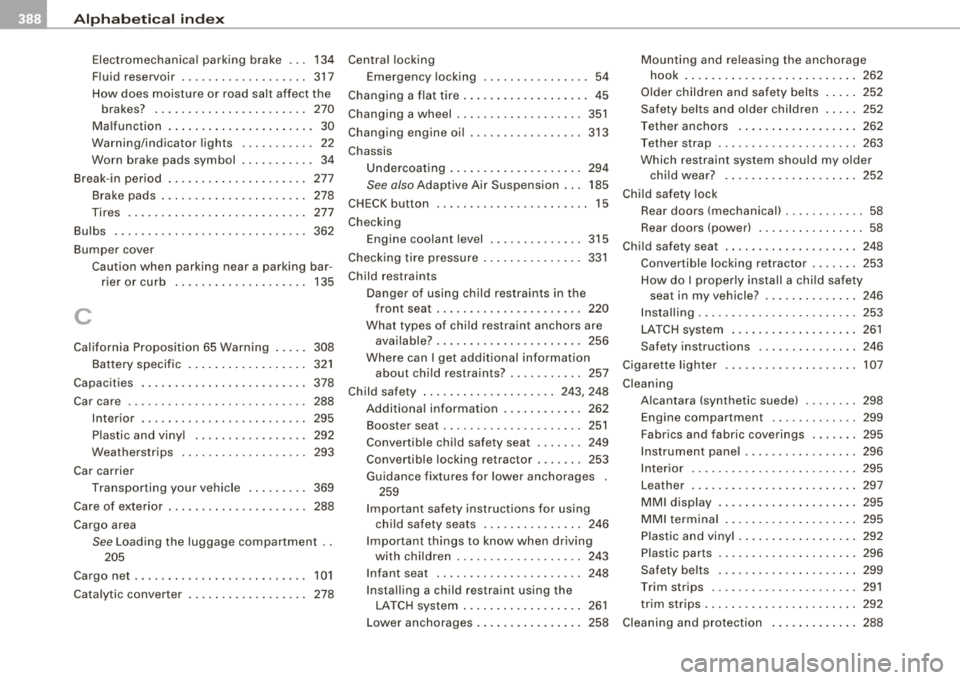
___ A_ l-=- p _ h_ a_ b_e _t_ ic _ a_l _in _ d_e_ x ____________________________________________ _
Electromechanical parking brake ... 134
Fluid reservoir . . . . . . . . . . . . . . . . . . . 317
How does moisture or road sal t affect the
brakes? ....................... 270
Malfunction ..... ... ... .. .... .... . 30
Warning/indicator lights ... .... .... 22
Worn brak e pads symbol ..... .. .... 34
Break -in period . . . . . . . . . . . . . . . . . . . . . 277
B rake pads .. ...... .... ......... . 278
Tires ..... .. .. .... .... ......... . 277
Bu lbs ... .... .... .... ....... .... ... 362
Bumper cover Caution when parking near a parking bar -
rier or curb ...... ... .... .... ... 135
C
Ca lifornia Proposition 65 Warning 308
Battery specific . . . . . . . . . . . . . . . . . . 321
Capacit ies .. .... .... .... .... ... .... 378
Car care . .... .... .... .... .... .... .. 288
Int erior .. .... .... .... .... ...... . 295
P lastic and vinyl .. .... .... ... .... 292
Weatherstrips ...... ... .. ...... .. 293
Car carrier Transporting your vehicle ........ . 369
Care of exterior . .... .... .... .... .... 288
Cargo area
See Loading the luggage compartment ..
205
Cargo net .... .... .... .... ... .... ... 101
Catalyt ic converter . . . . . . . . . . . . . . . . . . 278 Central locking
Emergency locking . . . . . . . . . . . . . . . . 54
Changing a flat tire ...... .... ... .. .... 45
Changing a wheel .... ..... .. .... .... 351
Changing engine oi l .. .... .... .... ... 313
Chassis Undercoating ... .. .... .... .... ... 294
See also Adaptive Aur Suspension . .. 185
CHECK button .... .... .... ..... .. .... 15
Checking Engine coolant level ... .... ..... .. 315
Checking tire pressure ... .. .... .... .. 331
Child restraints Danger of using child restraints in the front seat ... ....... ...... .... .. 220
What types o f child restraint anchors are
avai lable? ... ....... ...... .... .. 256
Where can I get additional information
about child r estraints? ...... ... .. 257
Child safety ...... .. . ... .... ... . 243, 248
Additiona l information ............ 262
Booster seat ... .... ... .... .... ... 251
Convertible child safety seat .... ... 249
Conv ert ible locking r etractor ... .... 253
Guidance fixtures for lower anchorages
259
Important safety instructions for using
child safety seats ..... .. .... .... 246
Important things to know when driving with children . .... .... .... ...... 243
Infant seat .... .... .... .... ... ... 248
Installing a child restrain t using the
LATCH system ...... ...... ..... . 261 Mounting and releasing the anchorage
hook .......................... 262
Older children and safety belts ..... 252
Safety belts and older children .... . 252
Tether anchors .. ...... .... ... .. . 262
Tether strap ........... .... .... .. 263
Which restraint system should my older chi ld wear? .................. .. 252
Child safety lock
Rear doors (mechanical! ...... .... .. 58
Rear doors (power) .... .... .... .... 58
Child safety seat .. .... .... ...... .... 248
Convertible locking r etractor .... ... 253
How do I properly insta ll a chi ld safety
seat in my vehicle? .. ........ .... 246
Installing .. .. .. .... .... ..... .. ... 253
LATCH system ................... 261
Safety instructions .. ...... .... ... 246
Cigarette I ig hter . . . . . . . . . . . . . . . . . . . . 107
Cleaning Alcantara (synthetic suede) .... .... 298
Engine compartment ...... .... ... 299
Fab rics and fabric coverings ... .... 295
Instrument panel ...... ....... .... 296
Interior ... .... .... .... .... .... .. 295
Leather ... .... .... .... ..... .. ... 297
MMI display .............. .... ... 295
MMI terminal ...... .... ..... .. ... 295
Plastic and viny l ... .... .... ....... 292
P lastic parts ..................... 296
Safety belts ... .... .... ... .... ... 299
Trim strips . ....... .... ... .... ... 291
trim strips . ....... .... ....... .... 292
Lower anchorages ........... ..... 258 Cleaning and protection ............. 288