airbag off AUDI S8 2008 Owners Manual
[x] Cancel search | Manufacturer: AUDI, Model Year: 2008, Model line: S8, Model: AUDI S8 2008Pages: 404, PDF Size: 52.7 MB
Page 13 of 404
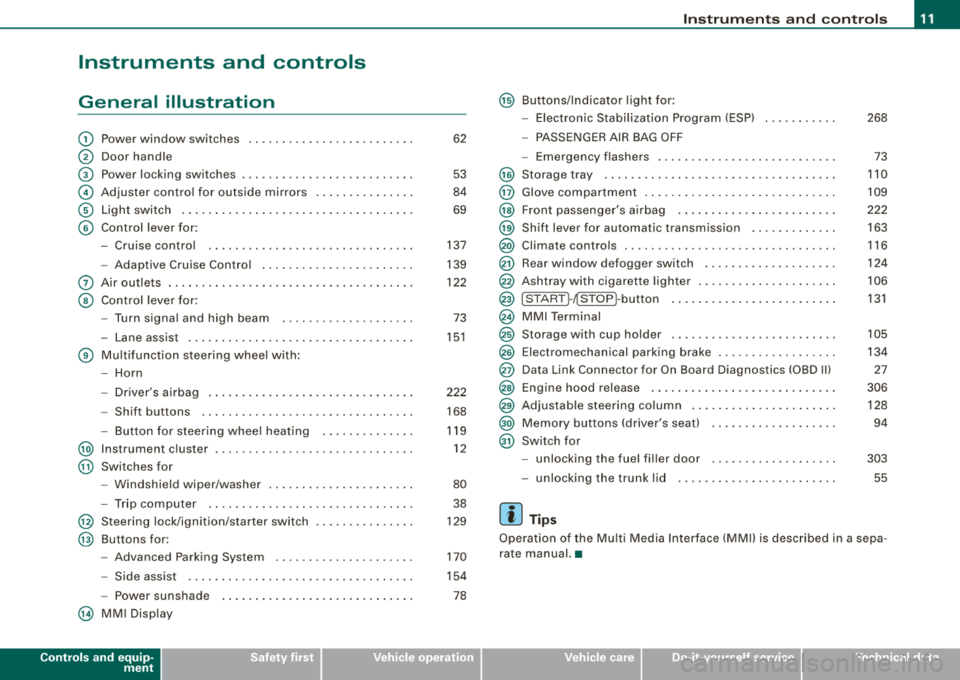
Instruments and controls
General illustration
G) Power window switches ........................ .
@ Door handle
G) Power locking switches ..... .. .... .... .... ...... .
© Adjuster contro l for ou tside mirrors ...... .... .... .
© Light switch .. ...... .... ... .... .... .... ..... .. .
© Contro l lever for:
- Cruise control .... .... ...... ....... ...... ... .
- Adaptive C ru ise Contro l .... .... .... .... .... .. .
0 Air outlets ... .. .... .... .... .... ... .... .... .... .
@ Contro l lever for:
- Turn signal and high beam ....... ... .. .... ... .
- La ne assist .. ...... ... .... .... .... ... .... ... .
© Multi function steering wheel with :
- Horn
- Driver's a irbag .. ...... ... .... .... .... .... ... .
- Shift buttons ............................... .
Button for steer ing whee l heating ........ ... .. .
@ Instrument c luster .. ... .... .... ....... .... .... . .
@ Switches for
- Windshield wiper/washer ............... ...... .
- Trip computer .... ....... .... .... .... .... ... .
@ Steering lock/ignit ion/starter switch
@ Buttons for:
- Advanced Parking System .. .... .... .... .... .. .
- Side assist ................................. .
- Po wer sunshade
@ MM I Disp lay
Controls and equip
ment
62
53
84
69
137
139
122
73
15 1
222
168
119 12
80 38
129
170
154
78
Ins trum ents and controls
@ Buttons/Indicator l ight for :
- Electronic Stabilization Program (ESP) 268
- PASSE NGER AIR BAG OFF
- Emergency flashers . . . . . . . . . . . . . . . . . . . . . . . . . . . 73
@ Storage tray . . . . . . . . . . . . . . . . . . . . . . . . . . . . . . . . . . . 110
@ Glove compartment . . . . . . . . . . . . . . . . . . . . . . . . . . . . . 109
@ Front passe nger's airbag . . . . . . . . . . . . . . . . . . . . . . . . 222
@ Shift lever for automatic transmission . . . . . . . . . . . . . 163
@ Climate controls . . . . . . . . . . . . . . . . . . . . . . . . . . . . . . . . 116
@ Rear window defogger switch . . . . . . . . . . . . . . . . . . . . 124
@ Ashtray with cigarette lighter . . . . . . . . . . . . . . . . . . . . . 106
@ ISTAR T~~ STOP ~butto n . . . . . . . . . . . . . . . . . . . . . . . . . 131
@ MMI Terminal
@ Storage with cup holder . . . . . . . . . . . . . . . . . . . . . . . . . 105
@ Electromechanical parking brake . . . . . . . . . . . . . . . . . . 134
@ Data Link Connector for On Board Diagnostics (OBD Ill 27
@ Engine hood release . . . . . . . . . . . . . . . . . . . . . . . . . . . . 306
@ Adjustable s teering co lumn . . . . . . . . . . . . . . . . . . . . . . 128
@ Me mory buttons (driver's seat) . . . . . . . . . . . . . . . . . . . 94
@ Switch for
- unlocking the fuel fil ler door
- unlocking t he tr unk l id
[ i ] Tips
303
55
Operation of the Mu lt i M edia In terface (MMI) is described in a sepa
rate manual. •
Page 19 of 404
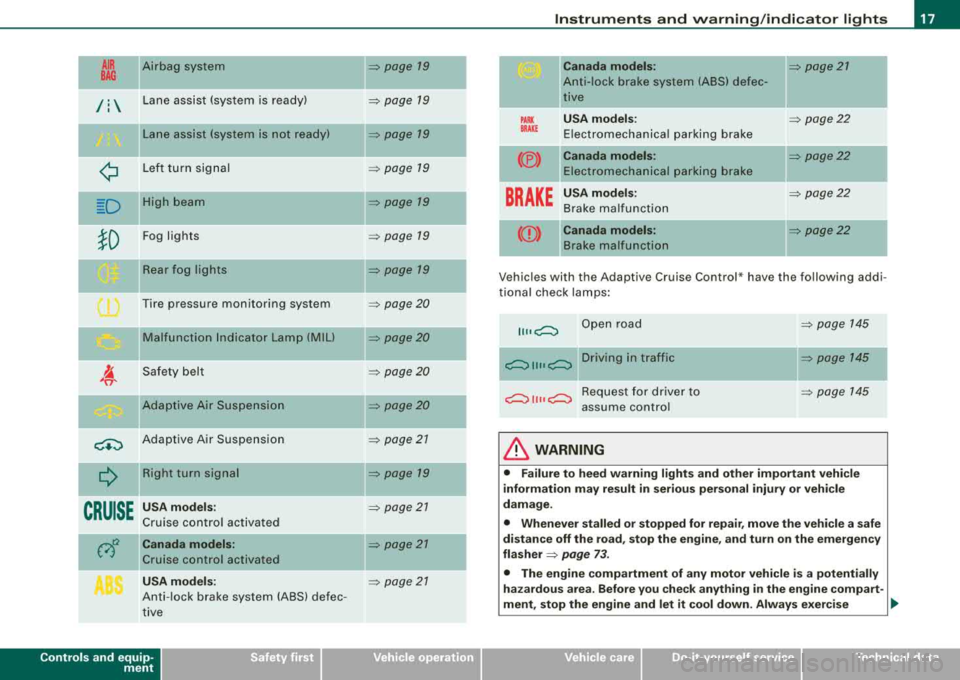
tl~ Airbag system
--
/: Lane assist (system is ready)
Lane assist (system is not ready)
¢ Left turn signal
--D High beam
}D Fog lights
Rear fog lights
Tire pressure monitoring sys tem
Malfunction Indicator Lamp (MIU
Safety belt
Adaptive Air Suspension
<+:) Adaptive Air Suspension Right turn signal
--
CRUISE
--
USA models:
Cruise control activated
Canada models:
Cruise control activated
USA models:
Anti-lock brake system (ABS) defec
tive
Controls and equip ment
=> page 19
-
=> page 19
=> page 19
=> page 79
-=> page 19
=> page 79
=> page 19
=> page 20
=> page 20
=> page 20
=> page20
=> page 21
=> page 79
-
=> page 27
=> page 27
-
=> page 21
Instruments and warning/indicator lights
PARK BRAKE
(®)
----
Canada models:
Anti-lock brake system (ABS) defec
tive
USA models :
Electromechanical parking brake
Canada models: Electromechanical parking brake
-
BRAKE
USA models:
Brake malfunct ion
--((D) Canada models:
Brake malfunction
=> page 27
=> page 22
=> page 22
-
=> page 22
-
=> page22
V ehicl es wi th th e Adaptive Cruis e Control * have the follow ing addi
tional check lamps:
Open road
~ 1111 ~ Driving in traffic
~ 1111 ~ Request for driver to
assume control
& WARNING
=> page 145
=> page 145
=> page 145
• Failure to heed warning lights and other important vehicle
information may result in serious personal injury or vehicle
damage.
• Whenever stalled or stopped for repair, move the vehicle a safe
distance off the road, stop the engine, and turn on the emergency
flasher
=> page 73.
• The engine compartment of any motor vehicle is a potentially
hazardous area. Before you check anything in the engine compart-
ment, stop the engine and let it cool down. Always exercise
~
Page 75 of 404
Emergency flasher ~
The emergency flasher makes other motorists aware that
you or your vehicle are in an emergency situation.
I
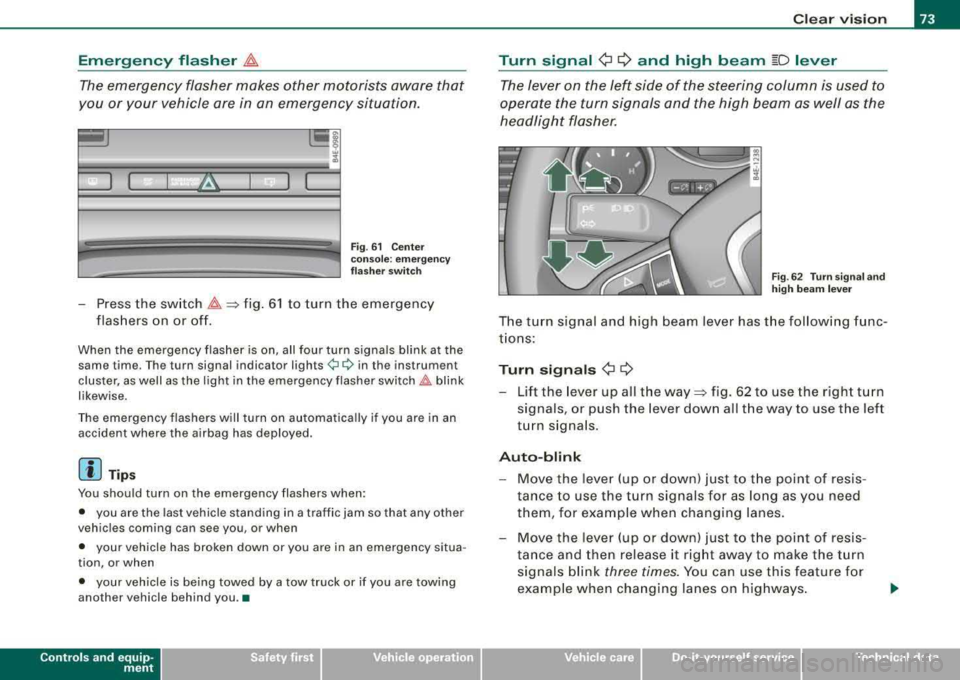
Fig . 61 Center
console : emergency
flasher switch
- Press the switch ~=>fig. 61 to turn the emergency
flashers on or off.
When the emergency flasher is on, all four turn signals blink at the
same time . Th e turn signal indi cator
ligh ts ¢¢ in th e instrum en t
cluster, as well as the light in the emergency flasher
switch~ blink
likewise .
The emergency flashers will turn on automatically if you are in an
accident where the airbag has deployed.
[ i] Tips
You should turn on the emergency flashers when:
• you are the last vehicle standing in a traffic jam so that any other
vehicles coming can see you , or when
• your vehicle has broken down or you are in an emergency situa
tion , or when
• your vehicle is being towed by a tow truck or if you are towing
another vehicle behind you .•
Contro ls a nd eq uip
ment
Clear vision
Turn signal
¢ ¢ and high beam [D lever
The lever on the left side of the steering column is used to
operate the turn signals and the high beam as well as the
headlight flasher.
Fig . 62 Turn signal and
high beam lever
The turn s ignal and high beam lever has the following func
tions:
Turn signals ¢ ¢
- Lift the lever up all the way=> fig. 62 to use the right turn
signals, or push the lever down all the way to use the left
turn signals .
Auto-blink
-Move the lever (up or down) just to the point of resis
tance to use the turn signals for as long as you need
them, for example when chang ing lanes.
- Move the lever (up or down) just to the point of resis
tance and then release it right away to make the turn
signals blink
three times. You can use this feature for
example when changing lanes on highways.
Vehicle care I I irechnical data
Page 88 of 404
Seats and storage
Seats and storage
General recommendations
Why is your seat adjustment so important?
The safety belts and the airbag system can only provide
maximum protection if the front seats are correctly
adjusted.
There are various ways of adjusting the front seats to provide safe and comfortable support for the driver and the front passenger.
Adjust your seat properly so that:
• you can easily and quickly reach all the switches and controls in
the instrument panel
• your body is properly supported thus reducing physical stress
and fatigue
• the safety belts and airbag system can offer maximum protec
tion=> page 218.
In the following sections, you will see exactly how you can best
adjust your seats.
There are special regulations and instructions for installing a child seat on the front passenger's seat. Always follow the information
regarding child safety provided
in=> page 243, "Child Safety".
& WARNING
Incorrect seating position of the driver and all other passengers
can result in serious personal injury.
• Always keep your feet on the floor when the vehicle is in motion
- never put your feet on top of the instrument panel, out of the
window or on top of the seat cushion. This applies especially to
the passengers. If your seating position is incorrect, you increase
the risk of injury in the case of sudden braking or an accident. If
& WARNING (continued)
the airbag inflates and the seating position is incorrect, this could
result in personal injury or even death.
• It is important for both the driver and front passenger to keep
a distance of at least 10 inches (25 cml between themselves and
the steering wheel and/or instrument panel. If you're sitting any
closer than this, the airbag system cannot protect you properly. In
addition, the front seats and head restraints must be adjusted to
your body height so that they can give you maximum protection.
• Always try to keep as much distance as possible between your
self and the steering wheel or instrument panel.
• Do not adjust the driver's or front passenger's seat while the
vehicle is moving. Your seat may move unexpectedly, causing
sudden loss of vehicle control and personal injury. If you adjust
your seat while the vehicle is moving, you are out of position. •
Driver's seat
The correct seat position is important for safe and relaxed
driving.
We recommend that you adjust the driver's seat in the
following manner:
- Adjust the seat in fore and aft direction so that you can
easily push the pedals to the floor while keeping your knees slightly
bent => & in "Why is your seat adjustment
so important?".
- Adjust the seatback so that when you sit with your back
against the seatback, you can still grasp the top of the
steering wheel.
~
Page 92 of 404
Seats and storage
Adjusting the angle of the seat back
Push the switch ~ page 89, fig. 85 forward or to the rear
in the direction of the arrow to adjust the angle of the
seat back
~ & .
Adjusting the angle of upper seatback section
-Push the switch ~ page 89, fig. 86 forward or to the rear
to adjust the angle of upper seatback
section ~& .
& WARNING
• Never adjust the seatback while the vehicle is moving. If you
adjust your seat while the vehicle is moving, you are out of posi
tion. Never adjust the seatback when the vehicle is moving.
• To reduce the risk of injury in the case of sudden braking or
accident, front passengers must never ride in a moving vehicle
with the seatback reclined. Safety belts and the airbag system only offer maximum protection when the seatback is upright and
the safety belts are properly positioned on the body. The more the seatback is reclined, the greater the risk of personal injury from an
incorrect seating position and improperly positioned safety
belts. •
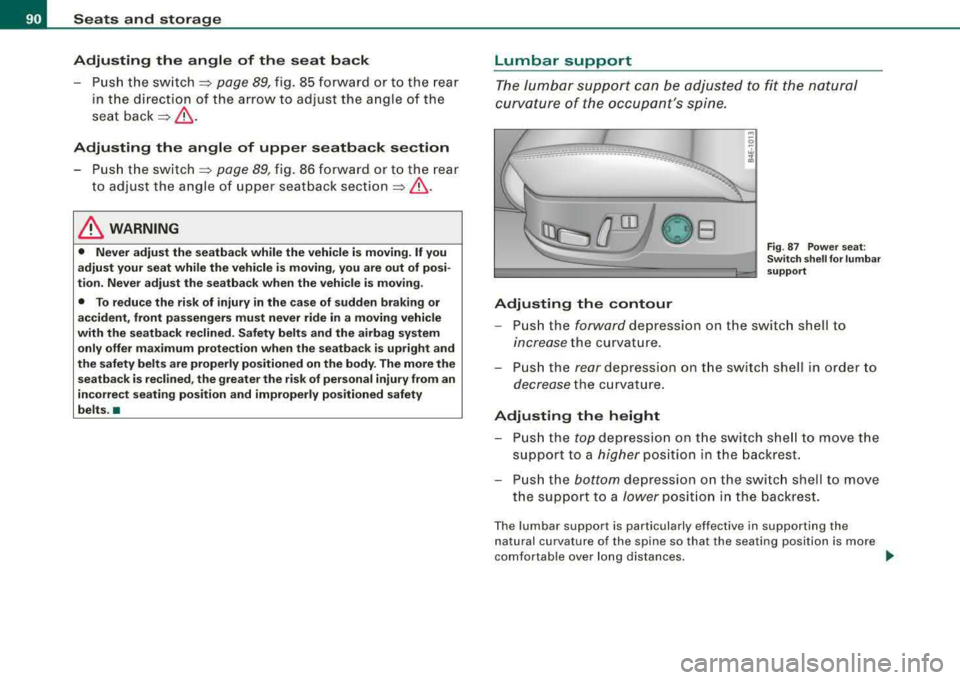
Lumbar support
The lumbar support can be adjusted to fit the natural
curvature of the occupant's spine.
__ ... _,.· _____ ---....... ·--_----... -··--
OB
Adjusting the contour
Fig . 87 Power seat:
Switch shell for lumbar
support
-Push the forward depression on the switch shell to
increase the curvature .
-Push the rear depression on the switch shell in order to
decrease the curvature.
Adjusting the height
-Push the top depression on the switch shell to move the
support to a
higher position in the backrest.
-Push the bottom depression on the switch shell to move
the support to a
lower position in the backrest.
The lumbar support is particularly effective in supporting the
natural curvature of the spine so that the seating position is more
comfortable over long distances.
~
Page 111 of 404
![AUDI S8 2008 Owners Manual ________________________________________________ S_ e_ a_t _
s _a_ n_d _ s_t _o _ r_ a_ g~ e __ fflll
0 Note
To avoid damaging the socket, only use plugs that fit properly.
[ i] Tips
Wh](/img/6/57619/w960_57619-110.png "AUDI S8 2008 Owners Manual ________________________________________________ S_ e_ a_t _
s _a_ n_d _ s_t _o _ r_ a_ g~ e __ fflll
0 Note
To avoid damaging the socket, only use plugs that fit properly.
[ i] Tips
Wh")
________________________________________________ S_ e_ a_t _
s _a_ n_d _ s_t _o _ r_ a_ g~ e __ fflll
0 Note
To avoid damaging the socket, only use plugs that fit properly.
[ i] Tips
When the engine is off and accessories are still plugged in and are
on, the vehicle battery can still be drained. •
Storage
General overview
There are numerous places to store items in your vehicle.
Glove compartment
Storage compartment
Pockets in the front seats*
Compartments in the door trim panels
Compartments in the rear doors*
Coat hooks => page 109
=> page 110
=> page 110
=> page 111
=> page 111
Left side storage compartment in the => page 112
trunk
--Right side storage compartment in the => page 113
trunk
Emergency warning triangle
=> page 348
& WARNING
• Always remove objects from the instrument panel. Any items
not stored could slide around inside the vehicle while driving or
Controls and equip ment
&, WARNING (continued)
when accelerating or when applying the brakes or when driving
around a corner.
• When you are driving make sure that anything you may have
placed in the center console or other storage locations cannot fall
out into the footwells. In case of sudden braking you would not be
able to brake or accelerate.
• Any articles of clothing that you have hung up must not inter
fere with the driver's view. The coat hooks are designed only for
lightweight clothing . Never hang any clothing with hard, pointed
or heavy objects in the pockets on the coat hooks. During sudden
braking or in an accident -especially if the airbag is deployed -
these objects could injure any passengers inside the vehicle. •
Glove compartment
Your Owner's Literature and the media player are stored
in the lockable glove compartment.
t------.-,.---------. l
i
Fig. 117 Glove
compartment
Page 204 of 404
___ D_ r
_ i_v _i_n ..;::g :;_ S_ a_ f_ e_, ly'----------------------------------------------------
&, WARNING (continued)
• Passengers must always sit in an upright position and never
lean against or place any part of their body too close to the area
where the airbags are located.
• Passengers who are unbelted, out of position or too close to the
airbag can be seriously injured by an airbag as it unfolds with
great force in the blink of an eye.
• Always make sure that there are at least 10 inches
125 cm)
between the front passenger's breastbone and the instrument
panel.
• Always make sure that there are at least 4 inches 110 cm)
between the front passenger's knees and the lower part of the
instrument panel.
• Each passenger must always sit on a seat of their own and
properly fasten and wear the safety belt belonging to that seat.
• Before driving, always adjust the front passenger seat and
head restraint properly.
• Always keep your feet on the floor in front of the seat. Never
rest them on the seat, instrument panel, out of the window, etc.
The airbag system and safety belt will not be able to protect you properly and can even increase the risk of injury in a crash.
• Never drive with the backrest reclined or tilted far back! The
farther the backrests are tilted back, the greater the risk of injury
due to incorrect positioning of the safety belt and improper
seating position.
• Children must always ride in child seats
=> page 243. Special
precautions apply when installing a child seat on the front
passenger
seat => page 218. •
Proper seating positions for passengers in
rear seats
Rear seat passengers must sit upright with both feet on
the floor consistent with their physical size and be prop
erly restrained whenever the vehicle is in use.
To reduce the risk of injury caused by an incorrect seating
position in the event of a sudden braking maneuver or an
accident, your passengers on the rear bench seat must
always observe the following :
- Adjust the head restraint so that the upper edge is as
even with the top of your head as possible but no lower
than eye level
=> page 203.
- Keep both feet flat in the footwell in front of the rear seat .
- Fasten and wear safety belts
properly => page 213.
-Make sure that children are always properly restrained in
a child restraint that is appropriate for their size and age
=> page 243.
& WARNING
Passengers who are improperly seated on the rear seat can be
seriously injured in a crash.
• Each passenger must always sit on a seat of their own and
properly fasten and wear the safety belt belonging to that seat.
• Safety belts only offer maximum protection when the safety
belts are properly positioned on the body and securely latched. By
not sitting upright, a rear seat passenger increases the risk of
personal injury from improperly positioned safety belts!
• Always adjust the head restraint properly so that it can give
maximum protection. •
Page 205 of 404
Driving Safely fflll
---------------------------------------------:::....---=--
Proper adjustment of head restraints
Correctly adjusted head restraints are an important part
of your vehicle's occupant restraint system and can help to reduce the risk of injuries in accident situations.
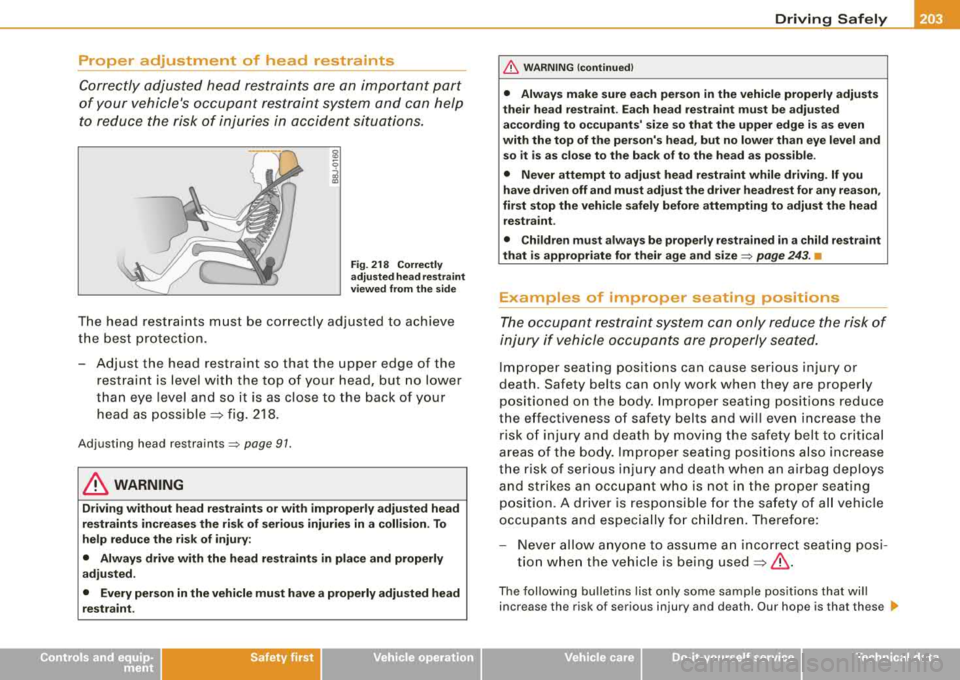
Fig . 218 Correctly
adjusted head restraint
viewed from the side
The head restraints must be correctly adjusted to achieve
the best protection.
- Adjust the head restraint so that the upper edge of the
restraint is level with the top of your head, but no lower
than eye level and so it is as close to the back of your
head as
possible ~ fig. 218.
Adjusting head restraints=> page 91.
& WARNING
Driving without head restraints or with improperly adjusted head
restraints increases the risk of serious injuries in a collision. To
help reduce the risk of injury:
• Always drive with the head restraints in place and properly
adjusted.
• Every person in the vehicle must have a properly adjusted head
restraint.
Controls and equip ment Safety first Vehicle operation
&, WARNING
(continued)
• Always make sure each person in the vehicle properly adjusts
their head restraint. Each head restraint must be adjusted according to occupants' size so that the upper edge is as even
with the top of the person's head, but no lower than eye level and
so it is as close to the back of to the head as possible .
• Never attempt to adjust head restraint while driving. If you
have driven off and must adjust the driver headrest for any reason,
first stop the vehicle safely before attempting to adjust the head
restraint.
• Children must always be properly restrained in a child restraint
that is appropriate for their age and size
=> page 243. •
Examples of improper seating positions
The occupant restraint system can only reduce the risk of
injury if vehicle occupants are properly seated.
Improper seating positions can cause serious injury or
death . Safety belts can only work when they are properly
positioned on the body. Improper seating positions reduce
the effectiveness of safety belts and will even increase the
risk of injury and death by moving the safety belt to critical
areas of the body. Improper seating positions also increase
the risk of serious injury and death when an airbag deploys
and strikes an occupant who is not in the proper seating
position. A driver is responsible for the safety of all vehicle
occupants and especially for children. Therefore:
- Never allow anyone to assume an incorrect seating posi
tion when the vehicle is being
used ~& .
The following bulletins list only some sample positions that will
increase the risk of serious injury and death. Our hope is that these
.,_
Vehicle care Do-it-yourself service Technical data
Page 213 of 404
Because the passengers of this vehicle are not using safety belts
=> page 210, fig. 220, they will keep moving at the same speed the
vehicle was moving just before the crash, un til some thing stops
them
-here, the wall ~ page 210, fig. 221.
The same principles apply to people sitting in a vehicle that is involved in a frontal collision. Even at city speeds of 20 to 30 mph
(30 to 50 km/h), the forces acting on the body can reach one ton
(2,000 lbs, or 1,000 kg) or more . A t grea ter spe eds, these forc es are
even higher.
People who do not use safety bel ts are also no t attached to their
vehicle. In a frontal collision they will also keep moving forward at
the speed their vehicle was travelling just before the crash. Of course, the laws of physics don't just apply to frontal collisions, they
determine what happens in all kinds of accidents and collisions. •
What happens to occupants not wearing
safety belts?
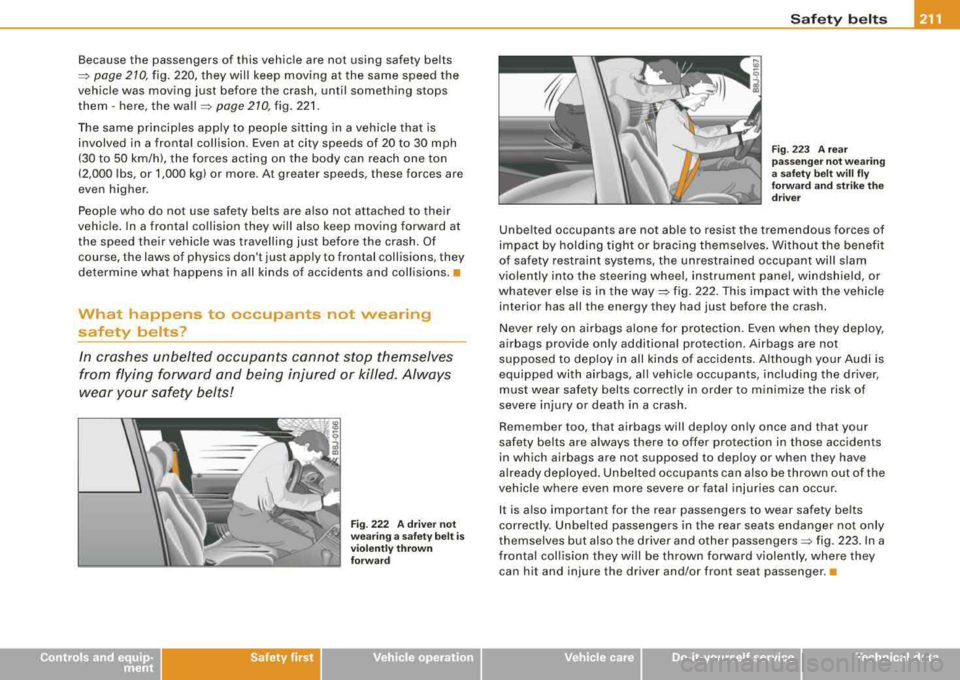
In crashes unbelted occupants cannot stop themselves
from flying forward and being injured or killed. Always
wear your safety belts!
Fig . 222 A driver not
wearing a safety belt is
violently thrown
forward
Safety belts
Fig . 223 A rear
passenger not wearing
a safety belt will fly
forward and strike the
driver
Unbelted occupants are no t able to resist the tremendous forces of
impact by holding tight or bracing themselves. Without the benefit
of safety restraint systems, the unrestrained occupant will slam
violently into the steering wheel, instrument panel, windshield, or
whatever else is in the
way~ fig. 222 . This impact with the vehicle
interior has all th e energy th ey had just before the crash.
Never rely on airbags alone for protection. Even when they deploy,
airbags provide only additional protection. Airbags are not
supposed to deploy in all kinds of accidents. Although your Audi is
equipped with airbags , all vehicle occupants, including the driver,
must wear safety belts correctly in order to minimize the risk of
severe injury or death in a crash .
Remember too , that airbags will deploy only once and that your
safety belts are always there to offer protection in those accidents
in which airbags are not suppos ed to deploy or wh en they have
already deployed. Unbelted occupants can also be thrown out of the
vehicle where even more severe or fatal injuries can occur .
It is also important for the rear passengers to wear safety belts
correctly . Unbelted passengers in the rear seats endanger not only
themselves but also the dr iver and other
passengers => fig. 223. In a
frontal collision they will be thrown forward violently, where they can hit and injure the driver and/or front seat passenger. •
Vehicle care I I Technical data
Page 214 of 404
lfflJ _ ___.:::S:,::a ~f ..::e :..::t Ly _ b~ e:.:.:lt ~s::._ _____________________________________________ _
Safety belts protect
People think it's possible to use the hands to brace the
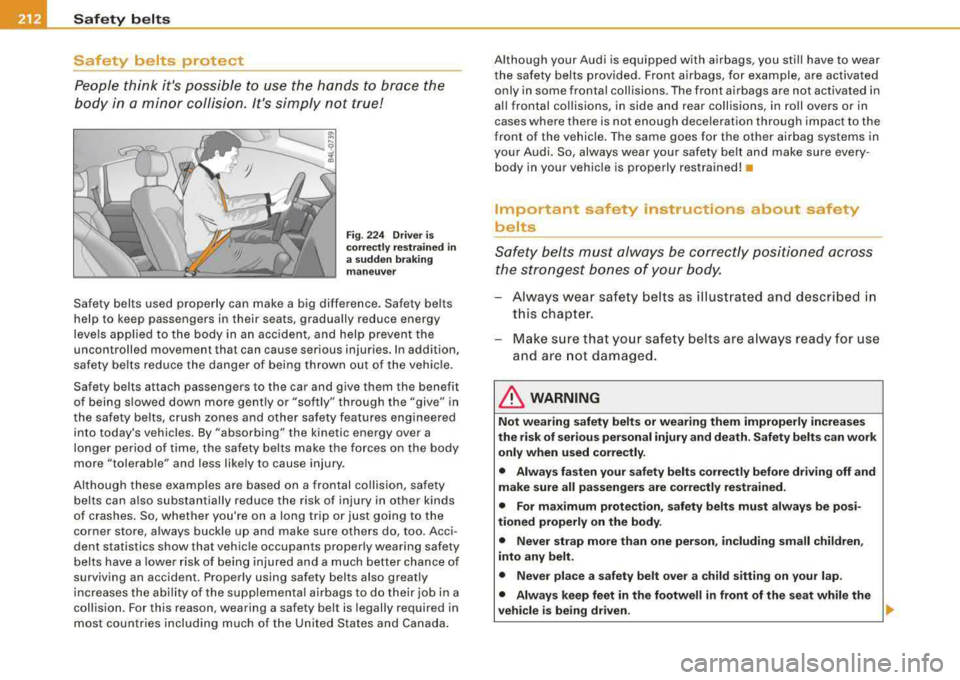
body in a min or c ollision . It's simply not true!
Fig . 22 4 Driv er is
c orr ectly r est rai ned in
a su dd en braki ng
m aneuver
Safety belts used properly can make a big difference. Sa fety belts
help to keep passengers in their seats, gradually reduce energy
levels app lied to the body in an accident, and help prevent the
uncontrolled movement that can cause serious injuries. In addition,
safety be lts re duce the danger of being thrown out of the vehic le .
Safety belts attach passengers to the car and give them the benefit
of being s lowed down more gently or "softly" through the "give" in
the safety belts, crush zones and other sa fety features engineered
into today's vehicles. By "absorbing" the kinetic energy over a
longer pe riod of time, the sa fety belts make the forces on the body
more "tolerable" and less likely to cause injury .
Altho ugh these examples are based on a frontal co llision, safety
belts can a lso substantially reduce the risk of injury in other kinds
of crashes . So, whether you're on a long trip or just going to the
corner store, a lways buckle up and make sure others do, too. Acci
dent statistics show that vehicle occupants properly wearing safety
belts have a lower ris k of being injured and a much better chance of
surviving an accident. Properly using safety belts also greatly
increases the abi lity of the supplementa l airbags to do their job in a
collision . For th is reason, wearing a safety belt is legally required in
most countries including much of the United States and Canada. Although your Audi is equipped with airbags, you sti
ll have to wear
t he safety belts provided . Fron t air bags, for example, are activated
only in some frontal collisions. The front a irbags are not activated in
a ll fro ntal co llisions, in side and rear coll isions, in ro ll ove rs or in
cases where there is not enough dece leration through impact to the
front of the vehicle . The sa me goes for the other airbag systems in
you r Aud i. So, always wear your safety belt and make sure every
body in your vehic le is properly restrained! •
Important safety instructions about safety
belts
Safety belts must always be correctly posi tio ned across
t he strongest bones of your body.
- Al ways wear safety belts as illust rated and described in
th is chapte r.
-Make s ure tha t yo ur sa fety be lts ar e always ready for us e
and are not damage d.
& WARNING
Not wearing safety belts or w earing them improperl y increas es
the risk of serious per sonal injury and death . S afety belts ca n work
onl y when used corre ctl y.
• Alway s fa sten your s afety belt s correctly before driving off and
make sure all p assengers ar e correctly restrain ed.
• For ma ximum protect ion , safet y belts must always be po si
tioned properly on the body .
• Never strap more than one person , including sm all ch ildren ,
into any belt.
• Never pla ce a safety belt ove r a child sitting on your lap .
• Alway s keep feet
in the footwell in front of the seat while the
vehicle is being driven .
.,_