engine overheat AUDI S8 2008 Owners Manual
[x] Cancel search | Manufacturer: AUDI, Model Year: 2008, Model line: S8, Model: AUDI S8 2008Pages: 404, PDF Size: 52.7 MB
Page 15 of 404
If the indicator goes all the way to the right side inside the coolant
temperature gauge, then the engine coolant temperature is too
high.
Pull off the road to safe location, turn off the engine and let it
cool down.
If the warning light comes on again after you have driven
a short distance, contact a qualified workshop.
& WARNING
• Always observe the warning in :::::, page 299, "Engine compart
ment", before opening the hood and checking the engine coolant
level.
• Never open the engine hood if you see or hear steam, or if you
see engine coolant dripping from the engine compartment. You
could burn yourself. Let the engine cool off first so that you cannot
hear or see any steam or engine coolant.
0 Note
• Mounting additional lights or accessories in front of the air inlets
reduces the cooling effect of the radiator. At high outside tempera
tures or high engine load, the engine could overheat.
• The front spoiler has been designed to properly distribute the
cooling air when the vehicle is moving . If the spoiler is damaged,
this could reduce the cooling effect and the engine could then over
heat. Ask your authorized Audi dealer for assistance. •
Tachometer (engine rev counter)
The tachometer indicates the engine RPM (revolutions per
minutes).
The tachometer 0:::::, page 12, fig. 2 is the left of the two large clock
type displays.
The engine turns at a speed
1,000 times the single digit in the
display, e.g. if the needle is pointing at the "2" the engine is turning
at 2,000 RPM.
Controls and equip ment
Instruments and warning/indicator lights
If engine RPM drops below 1,500, you should downshift to the next
lower gear. The red area at the end of the scale indicates maximum
permissible engine RPM after the break-in period . Before reaching
this area, move the selector lever to position "D (Drive)" or ease your
foot off the accelerator pedal.
0 Note
The tachometer needle should not move into the red range . If it
does, then only for a very short period of time. You could damage
your engine by driving at high RPM.
<£> For the sake of the environment
Upshifting early saves fuel and reduces engine noise.•
Digital clock with date display
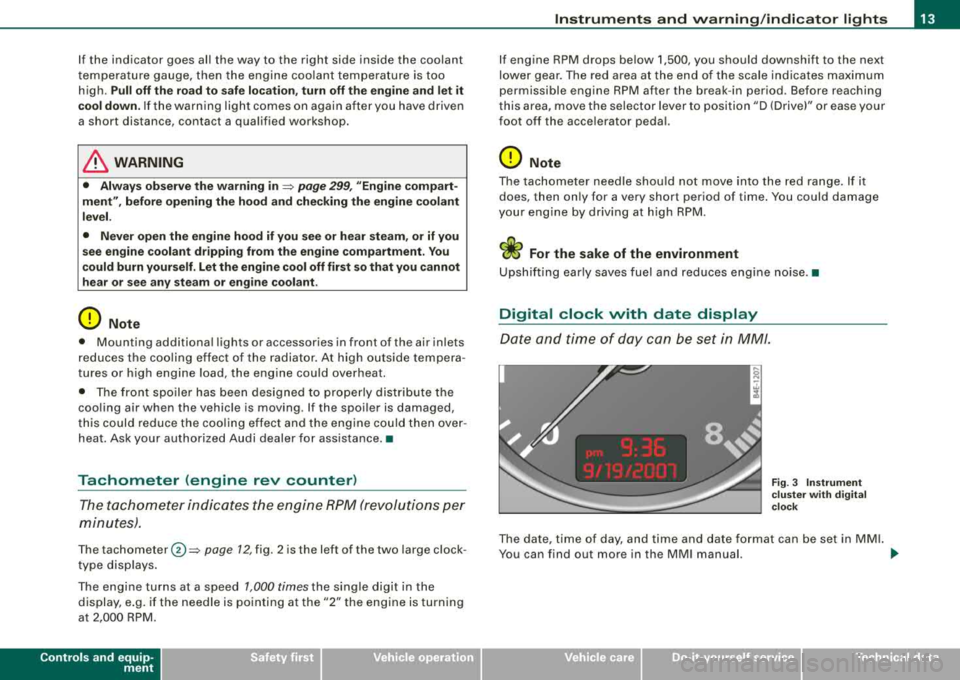
Date and time of day can be set in MM/.
Fig . 3 Instrument
cluster with digital
clock
The date, time of day, and time and date format can be set in MMI.
You can find out more in the MMI manual.
~
Page 17 of 404
There is still approximately 2.4 gallons (9 liters) of fuel left. This message is meant to remind you to
re fuel .
(D Note
Never run the tank completely dry . An irregular supp ly of fuel can
cause engine misfiring and fuel could enter the exhaust system . T he
cata lytic converter could then overheat and be damaged .•
[ C HECK] button
You can perform different functions with this button .
Fig . 5 CHECK butto n in
th e instr um ent clu ste r
The [ CHECK ] button performs the fo llowing functions:
Swi tch ing on th e clock and odom ete r
With the ignition turned off, the odometer reading and the digital
clock with date display can be sw itched on for about 30 seconds by
pressing the
I C HE CK I but ton ~ fig. 5 .
Sta rtin g the Au to-C heck se quen ce
The Auto -Check system ~ page 28 constantly monitors certain indi
vidual functions and components of the vehicle when the ignition is
turned on and when the vehicle is moving.
W ith the ignition turned on, you can start the "Auto -Check
sequ ence" by pr essing the !CH ECK ] bu tton . You can p erform an
Controls and equip
ment
Inst rum ents and warning /indi cator light s
Auto-Che ck sequence when the vehicle is stationary and the ignition
is turned on or when the vehicle is moving no t faster than 3 mph
(5 km/h).
C alling up the dri ver inf ormatio n
A yellow or red symbol appears in the instrument cluster display ,
usually with a driver message. The driver message display disap
pears after about 5 seconds . The driver message can be displayed
again by briefly pressing the
I CHECK ] button .
Setting th e sp eed w arni ng
By pressing the [ CHECK! but ton briefly, you can set threshold 1 of
the speed warning while you are
driving ~ page 37. By maintaining
pressure on the [CHECK ! button, you delete the warning
threshold. •
Instrument cluster illumination
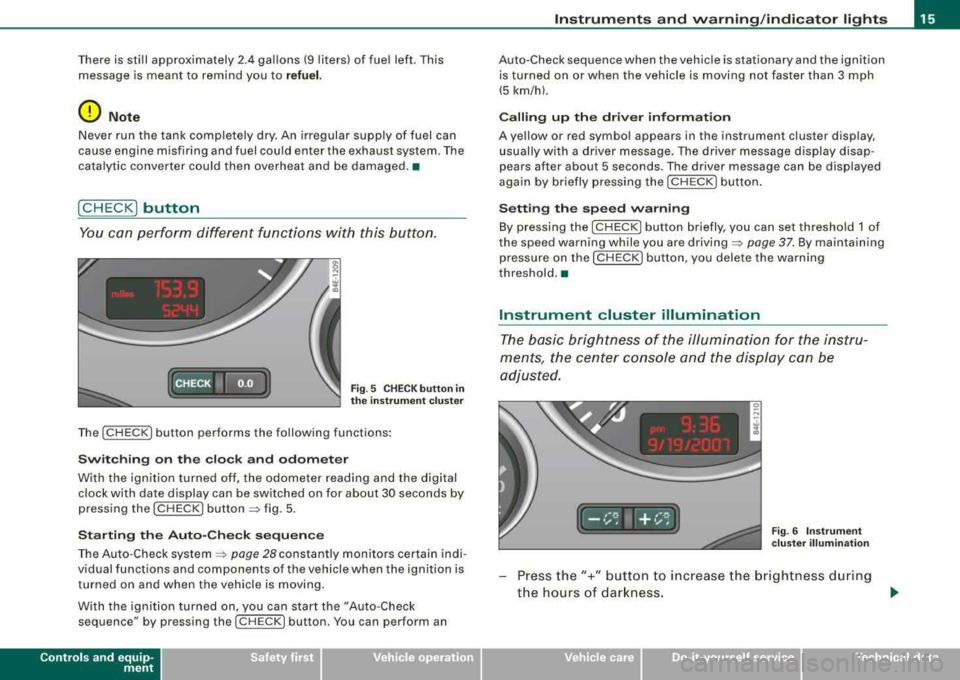
The basic brightness of the illuminati on f or the instru
ments, the center console and the display can be
adjusted .
Ir ,-i:,.-.. I+ ,- i:,.--•/, ,,,,
Fig. 6 Instr ume nt
c lus te r ill umi nation
Press the"+" button to increase the brightness d uring
the hours of dar kness.
~
Vehicle care I I irechnical data
Page 272 of 404

llll.___l_n _t _e _ll _ig=- e_n _ t_ te_ c_h _n_ o_ lo...;g'"'-=- y ___________________________________________ _
Overheating of brakes
To prevent the disc brake of the braked wheel from overheating if
subjected to excessive loads, the EDL cuts out temporarily . The
vehicle remains operational and behaves in the same way as a
vehicle without EDL.
As soon as the brake has cooled down, EDL switches on again auto
matically.
& WARNING
• When accelerating on slippery surfaces, such as on ice or snow,
always be careful when depressing the accelerator pedal. Even
with the EDL working, the drive wheels can spin and reduce your ability to control your car. Risk of crash!
• The increased safety afforded by
EDL does not mean that you
can take safety risks. Always adapt your driving style to the road
conditions and traffic situation.
[ i] Tips
If a fault occurs in the ABS, the EDL is also not functioning. This is
indicated by the ABS warning
light => page 21. •
Anti-Slip Regulation System (ASR)
The Anti-Slip Regulation System prevents the driven
wheels from spinning when the car is accelerating.
General notes
The Anti-Slip Regulation System (ASR) is integrated in the electronic
stabili zation program (ESP) . When the vehicle starts up and acceler
ates, the wheels are prevented from spinning by adjusting the
engine power to match the amount of grip available from the road
surface.
How the system works
ASR performs automatically, i.e. without the driver's intervention.
With the aid of the ABS
sensors=> page 272, ASR monitors the
speed of the driven wheels. If the wheels start to spin, the engine
power is reduced automatically until the tires find enough grip to
lock onto the road surface . The system is active across the entire
speed range.
The ASR works in conjunction with the ABS. If a malfunction should
occur in the ABS, the ASR will also be out of action.
& WARNING
The increased safety afforded by ASR does not mean that you can
take safety risks. Always adapt your driving style to the road
conditions and traffic situation.
[ i] Tips
To ensure that the ASR works properly, all four wheels must be fitted
with identical tires Any differences in rolling radius of the tires can
cause the system to reduce engine power when this is not desired.
See
also=> page 336, "New tires and replacing tires and wheels ".•
Braking
General information
What affects braking efficiency?
Operating conditions and driving habits
The brakes on today's automobiles are still subject to wear,
depending largely on operating conditions and driving
habits=:,& .
On vehicles which are driven mostly in stop-and-go city traffic or
which are driven hard, the brake pads should be checked by your
authorized Audi dealer more often than specified in the
Warranty &
Maintenance booklet. _,,,
Page 273 of 404
_________________________________________ ___..!l~ n ~t ~e :..!.ll ~ig ~ e:.!::n ~t ~ t~ e~ c~ h~ n~o ~l~o ~g !Jy ~ --
•
On steep slo pes, you shou ld use th e braking effect of the engine .
This way, yo u preve nt u nn ecessary wear on the bra ke sys te m. If you
must use your brakes, do not hold the brakes down cont inuous ly .
Pu mp the brakes at in terval s.
Moisture or road salt
U nder ce rtain cond itions, for e xa m ple, w hen drivi ng thro ug h w ate r
or v ery h eavy rain, or even after washing your vehicle, the braking
e ff ect can be red uce d du e to mo is tu re ( or in fr eezin g c ond it ions ice)
on t he b rake pads . A few carefu l brake applicatio ns should dry off
t h e br ake pads o r rem ove a ny ice coatings .
The e ffective ness of t he b ra kes ca n b e red uced wh en th e ve hicle is
driven o n a salt -covered road and t he brakes are not used. Here too,
yo u should cle an off acc umulate d sa lt co atin g from b rake di scs a nd
pads w ith a few careful app lications of th e
brake=>&.
Corrosion
T here may be a tendency for dirt to build up on t he bra ke pads and
c o rr os ion t o form on th e dis cs if t he car is not driven reg ular ly or
only for short trips with little use of the bra kes .
If th e bra ke s are not us ed fr equ ent ly , or if corro sion h as form ed on
th e discs, it is adv isab le to cl ean off the pa ds and discs by braking
firm ly a few times from a moderate ly h igh
speed =>& .
Faults in the brake system
If y ou s ho uld n oti ce a
sud d en inc rea se in b rake pe dal trave l, then
one of the two b rake c ircuits may h ave
fai led =>& .
Low brake fluid level
M alfunctions can occur in the brake system if the b ra ke fluid leve l is
t oo low. Th e br ake fluid level is monitor ed ele ctr onic a lly .
& WARNING
• You should perform braking maneuvers for the purpose of
cleaning the brake system only if road conditions permit. Other
road users must not be put at risk -you may cause an accident!
& WARNING (continued )
• Before descending a steep grade , reduce speed and shift trans
mission into a lower gear or lower driving range . Do not ride the
brakes or hold the pedal down too long or too often . This could
cause the brakes to get hot and diminish braking efficiency .
• Do not "ride the brakes" by resting your foot on the pedal when
you do not intend to brake . This may cause the brakes to overheat ,
premature wear and increased stopping distance .
• Under certain climatic and operating conditions such as
passing through water, driving in heavy rain or after washing the
vehicle , the effectiveness of the brakes can be reduced . In winter,
ice can accumulate on the brake pads , linings , discs and drums .
Carefully apply brakes for a test. Brakes will dry and ice coatings
will be cleaned off after a few careful brake applications .
• Driving for an extended period of time on salt-covered roads
without using your brakes can also affect braking efficiency. Clean
off accumulated salt coating from brake discs and pads with a few
careful brake applications .
• If you damage the front spoiler , or if you install a different
spoiler, be sure the air flow to the front brakes is not obstructed.
Otherwise the brake system could overheat reducing the effective
ness of the entire brake system.
• Failure of one brake circuit will impair the braking capability
resulting in an increased stopping distance. Avoid driv ing the
vehicle and have it towed to the nearest Audi dealer or qualified
workshop. •
Brake booster
Th e brake boo ster adds ex tra braking po wer.
The b ra ke booster works wit h vacuu m press ure which is created
on ly wh en th e e ngi ne is
r un ning => & .
Page 275 of 404

Intellig ent tec hnol ogy -
------------ -=--=-= '-
& WAR NIN G (c onti nued )
acc ident canno t b e co mp ensat ed for even b y th e br ake assis tant,
s o alway s maintain a safe sp eed . •
Servotronic® - advanced power
steering system
The power steering systems uses the power of the
running engine to allow precise s teering with little effor t.
The advanced Servotronic® power steering system senses the road
speed and electronically adjusts power assistance to provide
comfortab le and safe steer ing response exactly matched to the
vehic le speed.
Power s teeri ng will not work if the engine is off . As a result, the
steering whee l wil l be hard to turn .
The power steering fluid level is checked during the scheduled
maintenance serv ices.
0 Note
If there is an electron ic ma lfunction, servotronic will sti ll funct ion
like a conventiona l power steering system, providing a constant
steer ing suppor t force that is no longer proportionate to the vehicle
speed . This is most noticeable when turning the steering wheel at
low speeds (for examp le w hen parking), -more effor t wi ll be
required than usual.
• Be aware of the different than usua l steering response and
adjust your steering force accordingly .
• Have the problem checked and set right by an Aud i dea ler as
soon as possib le.
Controls and equip ment Safety first Vehicle operation
[
i ] Tip s
• When the engine is running, never hold the steer ing whee l
turned all the way to the right or to the left for longer than 15
seconds. The power steer ing pu mp wil l overheat the hydraul ic fluid
if you keep ho lding the steering whee l turned a ll the way. This is
like ly to damage the power steering system.
• I f the power steering system shou ld fail entire ly, or if the engine
is not runn ing ( for examp le, wh ile be ing towed), you w ill st ill be able
to steer the vehicle . However, considerably more effort will be
requ ired to do so.
• I f the power steering system shou ld have a leak, or is not func
tioning properly, contact your author ized Audi dealer im mediately.
• The power stee ring system requires a special ly formulated
hydrau lic fluid . The power steer ing reservo ir is the one located most
forward on the left side of the engine
compartment => page 308. The
correct flu id level in the reservo ir is important for proper func
tioning of the power steering. •
Driving with your quattro®
With All Wheel Drive, all four wheels are driven.
Genera l inf orm ati on
With All Whee l Drive, power is d istributed to all fo ur wheels. This
happens automatically depending on your driving style and the
road condi tions at the time . See
a lso => page 269, "Electronic differ
entia l lock ! EDU" .
Winter tires
When driving in the winter, your vehicle with All Wheel Drive has an
advantage, even with regular tires . In winter road conditions it may
be advisable to mount winter tires (or all-season tires) for improved
driveabi lity and braking: these ti res must be mounted on all four
wheel s. See
also=> page 341, "Winter tires". ~
Vehicle care Do-it-yourself service Technical data
Page 280 of 404
llffll,.__ __ D_r_ iv _ in_.... g,_ a_n_ d __ e_n _v_ ir_o_ n_ m_ e_n_ t _____________________________________________ _
New brake pads
Remember that new brake pads do not have a full braking
effec t during the first 250 miles (400 kilometers) after they
are installed .
New brake pads have to be "burnished in" before they have optimal
grab =>& .
During the break -in period, you s hou ld avoid putting severe loads
on the brakes . Severe loads include, for examp le, sudden hard
braking, in particular at very high speeds or, for example, on moun
t ain passes.
& WARNING
N ew brake p ad s don 't h ave the be st stopping po wer and mu st be
"broken -in " during the initial 100 to 150 mile s (150 to 200 kil ome
t e rs) of norm al c ity dri ving . You can comp en sa te for thi s by
pr ess ing the brake ped al more firmly . Thi s al so appli es later when
ne w pad s a re in sta lled. •
Catalytic converter
It is very important tha t your emission control sys tem
(catalytic converter) is functioning properly to e nsure that
y o ur vehicle is running in an environmentally sound
manner.
-Always use lead-f ree gasoli ne :=> page 301, "Fuel supply".
-Never run the tank down a ll the way to empty.
-Never put too much motor o il in your engine :=> page 312,
"Adding eng ine oil 'l=;r111
•
-Never try to push -or tow -s ta rt yo ur vehic le.
T he catalytic converter is an efficient "clean -up" device built into the
exhaust system of the vehicle. The catalytic converter burns ma ny
of the po llutants in the exhaust gas before they are released into the
atmosphere.
The exclusive use o f un leaded fue l is critica lly important for the l ife
of the cata lytic converter and proper functioning of the engine.
& WARNING
• Do not park or operate th e veh icle in ar ea s where the hot
e x hau st sys tem m ay come in cont act w ith dr y grass, brush , fuel
s pill or other material which can cau se a fire .
• Do not appl y additi ona l u ndercoating or ru stpr oofing on or
near the exhau st manifol d, exhau st pipe s, ca tal ytic converter or
h ea t shield s. Du ring dri ving , the sub sta nce u sed f or under coating
c ould overhe at and cau se a fir e.
0 Note
• Be aware that just one tank filling with leaded fue l wi ll already
seriously degrade the performance of the catalyt ic converter.
• Do not exceed the correct engine oil
level => page 312 .
• Do not drive until the fuel tank becomes comp letely empty . The
engine cou ld misfire. Unburned fuel could also get into the exhaust
system and this could cause the catalytic converter to overheat .
• Do not turn off t he ignition wh ile the vehicle is moving.
• Do not continue to operate your vehicle under these conditions,
as otherwise fuel can reach the cata lyt ic converter . This cou ld result
in overheating of the converter, requiring its rep lacement .
• To assure eff ic ient operat ion of the Emiss ion Contro l System:
- Have your vehicle maintained properly and in accordance with
the service recommendations in your Warranty
& Maintenance
booklet. _,.
Page 282 of 404
ffl.,__ __ D_r_ i_v _i_n _.g..,_ a_ n_d_ e_ n_v _ i
_ r_o _ n_ m_ e_ n_ t _______________________________________________ _
one half. Never drive faster than the posted speed limit and weather
co nditions permit. •
Reducing unnecessary idling
Even when your car is just idling it burns up fuel.
- Shut the eng ine off when you are not driving the vehicle .
- Do not warm up the vehicle by letting the engine run at
id le .
It makes sense to shut off the engine in traff ic jams, when waiting
for trains to pass at rai lroad crossings, or at traffic lights that have
long waits on red. Turning the engine off for just 30 -40 seconds
saves more fue l than is burned starting the engine again .
It takes a long time for the engine to warm up fu lly when it is
running at idle. However, wear and noxious em issions are espec ially
high when the engine is warming up . So you should drive away as
soon as you start the engine and avoid running at high rpms while
the engine is sti ll warming up.
0 Note
Do not leave engine idling unattended after starting . If warning
lights should come on to indicate improper operation, they would
go unheeded. Extended idling also produces heat, which could
result in overheating or other damage to the vehicle or other
property .•
Regular maintenance
A badly tuned engine unnecessarily wastes a lot of fuel.
- H ave your vehicle serviced at regular intervals .
By having your vehicle regularly serviced by an Audi dealer helps to
ensure t hat it runs properly and economical ly . The condit ion of your
vehic le not only affects its safety and abi lity to hold its va lue, it also
affects
fuel con sumpt ion .
C hec k your oil each time you fill your tan k.
The amount of oil used is related to engine load and speed.
I t is norma l for the oi l consumption of a new engine to reach its
lowest va lue after a certain mileage has been driven.
You must drive your vehicle about 3,000 miles (5,000 kilometers) before you can properly assess oil consumption .
T his also applies to fuel consump tion and engine output .
0 Note
• Have your vehicle maintained properly and in accordance with
t he service recommendat ions in your Warranty
& Maintenance
booklet. Lack of proper ma intenance as well as improper use of the
vehic le wi ll impair the function of the emission control system and
cou ld lead to damage.
• Do not alter or remove any component of the Emission Contro l
System unless approved by the manufacturer.
• Do not alte r or remove any device, such as heat sh ields,
switches, ignition wires, valves, which are designed to protect your
vehic le's Emission Control System and other important vehic le
components .•
Fewer short trips
Fuel consumption will always be relatively high on short
trips.
- Try to avoid driving short dista nces with a cold engine. ~
Page 286 of 404

ffl.___T_ r_a _il _e_ r_ t_o _w_ i_ n """g"'- ---------------------------------------------------
Speed
The higher the speed, the more difficu lt it becomes for the driver to
control the rig. Do not drive at the maximum permissible speed. Reduce your speed even more if load, weather or wind conditions
are unfavorable
-particularly when going downhi ll.
Reduce vehicle speed
i mm edia te ly if the trailer shows the slightest
sign of swaying.
Do not try t o stop the sway ing by accelerating.
Observe speed lim its. In some areas, speeds for vehicles towing
trai lers are lower than for regular ve hicles .
Always apply brakes ear ly. When driving down hill, shift into a lower
gear to use the engine braking effect to slow the vehicle. Use of the
brakes a lone can cause them to overheat and fail.
Cool ant temp era tu re
The coolant temperature gauge=> page 12 must be observed care
ful ly. If the needle moves close to the upper end of the scale, reduce
speed immed iately and/or turn off the air conditioner.
If the coolant temperature warning light in the instrument cluster
starts flas hing
-F- , pul l off the road, stop and let t he engine idle for
about two m inutes to prevent heat build-up.
& WARNING
An yone n ot properl y re str aine d in a mo ving vehi cle is at a mu ch
g re ate r ri sk in an accid ent . N ever let any on e rid e in y our car who
i s not properl y wea rin g th e res tra int s pr ov ided by Audi.
•
Trailer towing tips
Important to know
Your vehicle handles differently when towing a trailer because of
the additional weight and different weight distribution. Safety, performance and economy wi
ll greatly depend on how carefully you
l oad your trailer and opera te your r ig.
Before you actual ly tow your trailer, practice turn ing, stopping and
backing up in an area away from traffic . Keep practicing unti l you
have become comp letely fam iliar with the way your vehicle-trai ler
combination behaves and responds.
Backing up is di fficult and requires practice. Backing up with a
trai ler generally requires steering action opposite to that when
backing up your veh ic le without a tra iler.
Ma inta in a greater distance between your veh ic le and the one in
front of you . You will need more room to stop. To compensate for
the trai ler, you w ill need a larger than norma l turning radius.
When passing, remember that you cannot accelerate as fast as you n or mally wou ld because of t he added load . Make su re you have
enough room to pass . After passing, al low plenty of room for your
t rai ler befo re changing lanes again .
Avo id jerky starts, sharp turns or rapid lane changes.
[ i ] T ips
• Do not tow a tra iler during the break-in period o f your veh ic le.
• I f you tow a trailer, your Audi may require more frequent main te
nance due to t he extra
load=> page 380. •
Parking on a slope
Do n ot park on a slope with a trailer. If it cannot be
avoided, do
so o nly after doing the followi ng:
When p arking :
-Apply the foot b rake.
- Have someone p lace chocks under both the vehicle and
the trailer wheels. _,,,
Page 316 of 404
___ C_ h_e _c _ k_ i_ n ~g~ a_ n_ d_ f_ i_ll _in _g~--------------------------------------------
&, WARNING (continued)
• When removing the oil drain plug with your fingers, stay as far
away as possible. Always keep your forearm parallel to the ground
to help prevent hot oil from running down your arm.
• Drain the oil into a container designed for this purpose, one
large enough to hold at least the total amount of oil in your engine.
• Engine oil is poisonous. Keep it well out of the reach of children.
• Continuous contact with used engine oil is harmful to your
skin. Always protect your skin by washing oil off thoroughly with
soap and water.
0 Note
Never mix oil additives with your engine oil. These additives can
damage your engine and adversely affect your Audi Lim ited New
Vehicle Warranty.
<£> For the sake of the environment
• Before changing your oil, first make sure you know where you
can properly dispose of the used oil.
• Always dispose of used engine oil properly. Do not dump it on
garden soil , wooded areas , into open streams or down sewage
drains.
• Recycle used engine oil by taking it to a used engine oil collec
tion facility in your area, or contact a service station. •
Engine cooling system
Coolant
The engine coolant performs two functions: it keeps the
engine from overheating and it protects the engine from
freezing in the winter.
The cooling system is sealed and generally requires little attention.
The cooling system has been filled at the factory with a permanent
coolant which does not need to be changed . The coolant consists of
a mixture of water and the manufacturer's glycol -basedcoolant
additive G12 ++ antifreeze with anti corrosion addi tives (50% for USA
models; 60% for Canadian models). This mixture both assures the
necessary frost protection and protects metal components in the
engine's cooling system from corrosion and scaling. It also raises
the boiling point of the coolant.
Do not reduce the concentration of the coolant in the summer by
adding plain water.
The proportion of coolant additive must be at
least 50% but not more than 60%
to maintain antifree ze protection
and cooling efficiency. If the coolant frost protection is too low, the
coolant could freeze and damage the vehicle heating and engine
cooling system.
For year-round driving, antifreeze is added at the factory for temper
atures down to :
• -31 °F ( -35 °C) USA
•
-40 °F ( -40 °C) Canada .
You can mix the G12 ++ coolant additive with other additives (G12 +
or G12). Always check with your authori zed Audi dealer .
& WARNING
Before you check anything in the engine compartment, always
read and heed all WARNINGS
~ & in "Working in the engine
compartment" on
page 307.
Page 317 of 404
___________________________________________ C;:_:_: h..:e ..:c :..;.k..: i_n ..::g :.._ a_n _d_ f_il _li _n ..::g :.._--JIIIII
0 Note
• Before winter sets in, have the coolant checked to see if the
coolant additive in your vehicle is sufficient to meet the climate
conditions. This is especially important if you live in a region where
the winter is extremely cold. If necessary , increase the proportion of
coolant additive to 60%.
• When adding coolant additive to your cooling system,
remember:
-We recommend using only coolant additive G12+ + (check the
label) for your vehicle. This coolant additive is available at autho
rized Audi dealers. Other types of antifreeze can significantly
reduce corrosion protection . The resulting corrosion can cause a
loss of coolant and serious engine damage .
• Do not add any type of radiator leak sealant to your vehicle's
engine coolant. Adding radiator repair fluid may adversely affect the
function and performance of your cooling system and could result
in damage not covered by your New Vehicle Limited Warranty .•
Checking the engine coolant level
The engine coolant level can be checked with a quick
glance.
Fig . 267 Engine
compartment : Coolant
expansion tank
Before you check anything in the engine compartment,
always read and heed all WARNINGS => & in "Working in
the engine compartment" on
page 307.
Turn off the ignition.
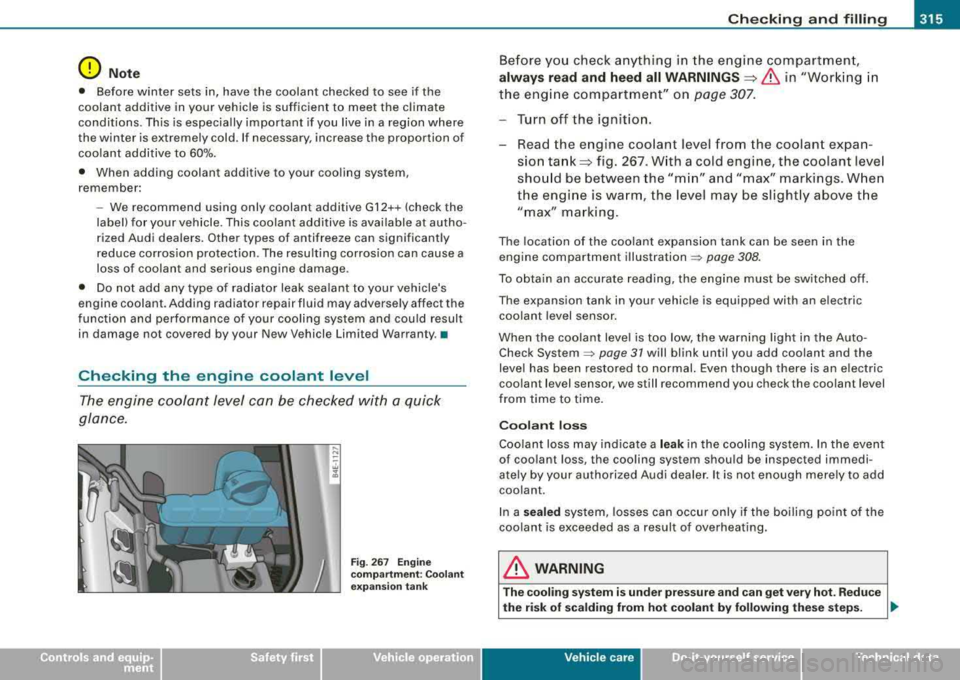
Read the engine coolant level from the coolant expan
sion
tank => fig. 267 . With a cold engine, the coolant level
should be between the "min" and "max" markings. When
the engine is warm, the level may be slightly above the
"max" marking.
The location of the coolant expansion tank can be seen in the
engine compartment illustration =>
page 308.
To obtain an accurate reading, the engine must be switched off.
The expansion tank in your vehicle is equipped with an electric
coolant level sensor.
When the coolant level is too low, the warning light in the Auto
Check
System => page 31 will blink until you add coolant and the
level has been restored to normal. Even though there is an electric
coolant level sensor, we still recommend you check the coolant level
from time to time.
Coolant loss
Coolant loss may indicate a leak in the cooling system. In the event
of coolant loss, the cooling system should be inspected immedi
ately by your authorized Audi dealer . It is not enough merely to add
coolant .
In a
sealed system, losses can occur only if the boiling point of the
coolant is exceeded as a result of overheating.
& WARNING
The cooling system is under pressure and can get very hot. Reduce
the risk of scalding from hot coolant by following these steps.
.,_
Vehic le care I I Technical data