fuel pressure AUDI S8 2008 Owners Manual
[x] Cancel search | Manufacturer: AUDI, Model Year: 2008, Model line: S8, Model: AUDI S8 2008Pages: 404, PDF Size: 52.7 MB
Page 17 of 404
There is still approximately 2.4 gallons (9 liters) of fuel left. This message is meant to remind you to
re fuel .
(D Note
Never run the tank completely dry . An irregular supp ly of fuel can
cause engine misfiring and fuel could enter the exhaust system . T he
cata lytic converter could then overheat and be damaged .•
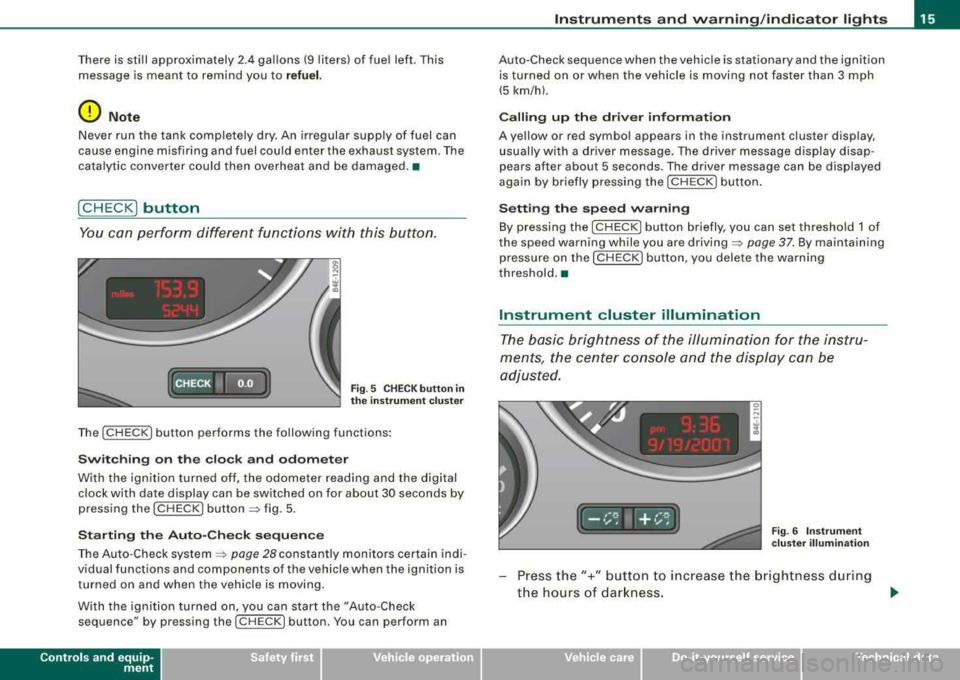
[ C HECK] button
You can perform different functions with this button .
Fig . 5 CHECK butto n in
th e instr um ent clu ste r
The [ CHECK ] button performs the fo llowing functions:
Swi tch ing on th e clock and odom ete r
With the ignition turned off, the odometer reading and the digital
clock with date display can be sw itched on for about 30 seconds by
pressing the
I C HE CK I but ton ~ fig. 5 .
Sta rtin g the Au to-C heck se quen ce
The Auto -Check system ~ page 28 constantly monitors certain indi
vidual functions and components of the vehicle when the ignition is
turned on and when the vehicle is moving.
W ith the ignition turned on, you can start the "Auto -Check
sequ ence" by pr essing the !CH ECK ] bu tton . You can p erform an
Controls and equip
ment
Inst rum ents and warning /indi cator light s
Auto-Che ck sequence when the vehicle is stationary and the ignition
is turned on or when the vehicle is moving no t faster than 3 mph
(5 km/h).
C alling up the dri ver inf ormatio n
A yellow or red symbol appears in the instrument cluster display ,
usually with a driver message. The driver message display disap
pears after about 5 seconds . The driver message can be displayed
again by briefly pressing the
I CHECK ] button .
Setting th e sp eed w arni ng
By pressing the [ CHECK! but ton briefly, you can set threshold 1 of
the speed warning while you are
driving ~ page 37. By maintaining
pressure on the [CHECK ! button, you delete the warning
threshold. •
Instrument cluster illumination
The basic brightness of the illuminati on f or the instru
ments, the center console and the display can be
adjusted .
Ir ,-i:,.-.. I+ ,- i:,.--•/, ,,,,
Fig. 6 Instr ume nt
c lus te r ill umi nation
Press the"+" button to increase the brightness d uring
the hours of dar kness.
~
Vehicle care I I irechnical data
Page 22 of 404
Instrum ents and warnin g/indi cat or li ghts
Significant loss of air pressure (l)
The warning/indicator light appears in the event of a
significant loss of air pressure .
The(!) warning/indicator light il luminates when you switch on the
ignit ion and must go out a fter the eng ine has started.
If the
U) symbo l appears, pressure is too low in at least one tire .
For more information
=> page 42 . •
Malfunction Indicator Lamp (MIL) 0
The Malfunct ion Indicator Lamp (M IU is par t of the On -Board Diag
nostic (OBD II) system . The symbol
O lights up when the ignition is
turned on and wi ll turn off after the engine has started and has
sett led at a constant id le speed. This ind icates that the M IL is
working proper ly .
The warning ligh t illum inates when there is a malfunction in the
engine electronic system . Contact your authorized Audi dealer and
have the mal function corrected.
An improperl y clos ed fuel filler c ap m ay als o cau se the MIL light t o
illuminate
=> page 303 .
For more information => page 27. •
Safety belts~
This warning/indica tor light reminds you to put on your
safety belt.
The t warning/indicator light i lluminates when the ignition is
sw itched on to remind the driver and any front passenger to put on
the safety belt . Add it ionally, an acoust ic warning (go ng) wi ll a lso
sound.
For more Information =>
page 209, "Safety belt warn ing light.(,..". •
Adaptive Air Suspension ~
The warning/indicator light ~ illuminates, when the jack ing mode
has been act ivated => page 188 . This warn ing/ indicator light has the
following functions:
• I t illuminates fo r a few seconds after the ignition is turned on as
function check and then goes out .
• I f the war ning/ indicator l ight illuminates steadi ly, there is a
system fau lt in the Adaptive Air Suspension . A system fault can
r esu lt in limited ride comfort and
low ground clearan ce . The fau lt
should be corrected as soon as possib le by an authorized Audi
dea ler.
• If the warning/indicator light flashes, you should not drive the
vehic le . The flas hing warning/indicator light points to an extreme
High level. A very
pronounced lifting of the vehic le (extreme High
l evel) can resu lt, for examp le, when a heavy load is removed from
the veh ic le. As soon as the level has returned to norma l, the
warning/indicato r light stops f lashing, and you can d rive away.
• If the warning/indicator light flashes in con junction with the c;::.:,
warning/indicator light, you shou ld not drive off immediately in
order to prevent damage to the underbody. The two warn ing/ indi
cator lights flashing together points to an extreme Low level. A very
pronounced lowering of the vehicle (extreme Low level) ca n result,
for example, from a heavy load. As soon as the level has returned to
n ormal, the warning/ind icator lights stop flash ing, and you can
drive away .
0 Note
If the warning/indicator light flashes in conjunction with the c;::.:,
warning/indicator l ight, you shoul d not drive the veh icle because
l ow -lying vehic le parts can bottom out as you drive over uneven
ground and be damaged as a result .•
Page 35 of 404
Dipstick reading checks OK
-If the oil pressure warning symbol "e::7: starts flashing
again even though the engine oil level checks OK on the
dipstick,
do not continue driving and do not let the
engine run in idle.
Instead, contact your authorized Audi
dealer for assistance.
[ i] Tips
• The engine oil pressure symbol ~ is not an indicator for a low
engine oil level. Do not rely on it . Instead, check the oil level in your
engine at regular intervals, preferably each time you refuel, and
always before going on a long trip.
• The yellow oil level warning indication
~ requires oil refill or
workshop service without delay. Do not wait until the red oil pres
sure warning
~ starts to flash before you respond to the low oil
level warning
~- -By then, your engine may already have suffered
serious damage. •
Steering malfunction i
If there is a malfunction in the electronic steering column
lock, the steering cannot be unlocked.
If the ~ symbol in the display blinks, there is a malfunction
in the electronic steering column lock. An additional driver
message can also be displayed by pressing the [ CHECK]
button :
Do not drive vehicle: Steering defective
-Contact your nearest authorized repair facility.
- Do
not tow your vehicle.
Controls and equip
ment • I I • • I
Driver information display
& WARNING
Your vehicle must not be towed in the event of a malfunction in the
electronic steering column lock because it cannot be steered due
to the locked steering. If it is towed with the steering locked, there
is the risk of an accident. •
Ignition lock malfunction ~
A malfunction in the ignition lock must be repaired imme
diately.
If the ~ symbol in the display blinks, there is a malfunction
in the electronic ignition lock. An additional driver message
can also be displayed by pressing the [ CHECK] button:
Ignition lock defective. Contact workshop !
-Do not turn the engine off.
- Drive immediately to an authorized Audi dealer to have
the malfunct ion corrected.
If there is a malfunction in the electronic ignition lock, the ignition
cannot be turned off. Drive immediately to an authorized Audi
dealer to have the cause of the malfunction corrected.
I f your vehicle has an Advanced Key *, then you should not use the
I STOPI button to shut off the engine. You will not be able to start the
engine again once the ignition is switched off. •
Page 43 of 404
failure. Under-inflation also reduces fue l efficiency and tire tread
life, and may affect the veh ic le's handling and stopping abi lity.
Please note that the TPMS is not a substitute for proper tire mainte
nance, and it is the driver's responsibi lity to maintain correct tire
pressure, even if under-inflation has not reached the leve l to tr igger
illumination of the TPMS low tire pressure tellta le.
Your veh icle has a lso been equipped with a TPMS malfu nction indi
cator to indicate when the system is not operating properly . The
TPMS malfunction indicator is combined w ith the low tire press ure
telltale . When the system detects a ma lfunction , the telltale wi ll
fl ash for approximately one minute and then remain continuously
illum inated . This sequence will continue upon subsequent vehicle
start -ups as long as the ma lfunction exists.
When the ma lfunctio n indicator is i llum inated, the system may not
be ab le to detect or signa l low tire pressure as intended . TPMS
malfunctions may occ ur for a var iety of reasons, i nclud ing the
installation of replacement or alternate tires or wheels on the
vehic le that prevent the TPMS from f unctioning proper ly . Always
check the TPMS malfunction tellta le after replac ing one or more
t ires or whee ls on yo ur ve hicle to ens ure t hat the replacement or
a lternate tires and wheels allow the T PMS to continue to function
proper ly. •
Introduction
The tire pressure monit oring system m onitors air pressure
in all four road wheels and the spare tire* while the
vehicle is movin g.
As soon as the tire pressure moni toring system se nses a signi ficant
loss of air pressure in one or severa l tires, text messages and yellow
symbo ls appear in the inst rume nt cluster d isplay to aler t t he driver .
T he
(l) warning light in the instrument c luster comes on when the
t ire is sig nificant ly underinflated
=> page 20 .
Controls and equip
ment
Driver information di splay
The warning light U) also i lluminates in the case of a system
mal fu ncti on.
The system continuous ly receives rad io signa ls from sensors
located inside each tire .
Be aware that t ire p ressu re is also dependen t on the tempera ture of
the tire . For every
18 °F (1 O °C) increase in tire temperature, tire pres
sure increases by about 1 .5 psi (0 .1 bar). The tire warms up wh ile the
vehicle is moving and t ire pressure rises . So you should adjust tire
pressure only when the t ires are
cold, when the temperature of the
tires is roughly the same as the ambient air temperature .
I n order to keep the tire pressure monitoring system properly cali
brated, tire pressure on all four tires and on the spare tire* should
be checked at regular intervals, adjusted if n ecessary and saved in
the proper setti ng (recommended
pressure) => page 44.
The tire pressure is shown on the tire pressure label. On USA vehi
cles, the tire pressure labe l is located on the drive r's s ide B -p ill ar. On
Canada vehicles, the tire pressure labe l is located either on the
driver's side B -pillar o r inside the fuel fi ller flap. The t ire press ure
label l ists t he recommended cold tire inflat io n pressures for t he
vehic le at its maximum capacity weight and the tires that were on
your ve hicle at the time it was manufactured . For recommended tire
pressures for normal load condit ions, please see chapter
=> page 328 .
The current temperatures and pressure of your tires can be viewed
in the M MI
=> page 43 .
& WARNING
• When the tire pre ssure monitoring system warning light i s lit ,
one or more of your tires is signifi cantly under -infl ated . You should
stop and check your tires a s soon a s po ssible , and inflate them to
the proper pre ssure a s indi cated on the vehi cle' s tire pre ssure
label
=> page 328 . Driving on a significantly under -inflated tire
ca use s the tire to o verheat and can lead to tire failure. Under -infla -
~
Page 44 of 404
Driver information display
& WARNING (continued)
tion also is likely to impair the vehicle's handling and stopping
ability.
• Do not adjust tire pressure when tire temperature is excessive .
This could lead to serious tire damage and even cause the tire to
burst, with the additional danger of an accident.
W For the sake of the environment
Driving with under -inflated tires reduces fuel efficiency and tire
tread life.
[ i) Tips
• Each tire, including the spare*, should be checked monthly when
cold and set to the recommended inflation pressure as specified on
the tire pressure label
=> page 328.
• The tire pressure monitoring system helps the driver to keep an
eye on tire pressures. But the driver still has the responsibility for
maintaining the correct tire pressure .
• Tire pressure must only be adjusted when the temperature of the
tires is about the same as ambient air temperature.
• When tires are replaced, the sensors and valves should not be
detached or exchanged. Only the valve core needs to be replaced
and, if necessary, the valve and the wheel electronics replaced.
• If you should put different wheels and tires on your vehicle (e .g.
winter wheels and tires), you must be certain that the wheels and
tires are compatible with the tire pressure monitoring system .
Otherwise the system will register a malfunction and a fault
message will be displayed. For more information, contact your
authorized Audi dealer.
• Adjust the tire pressure and store the pressure in the tire pres
sure monitoring system to the load you are
carrying => page 328. •
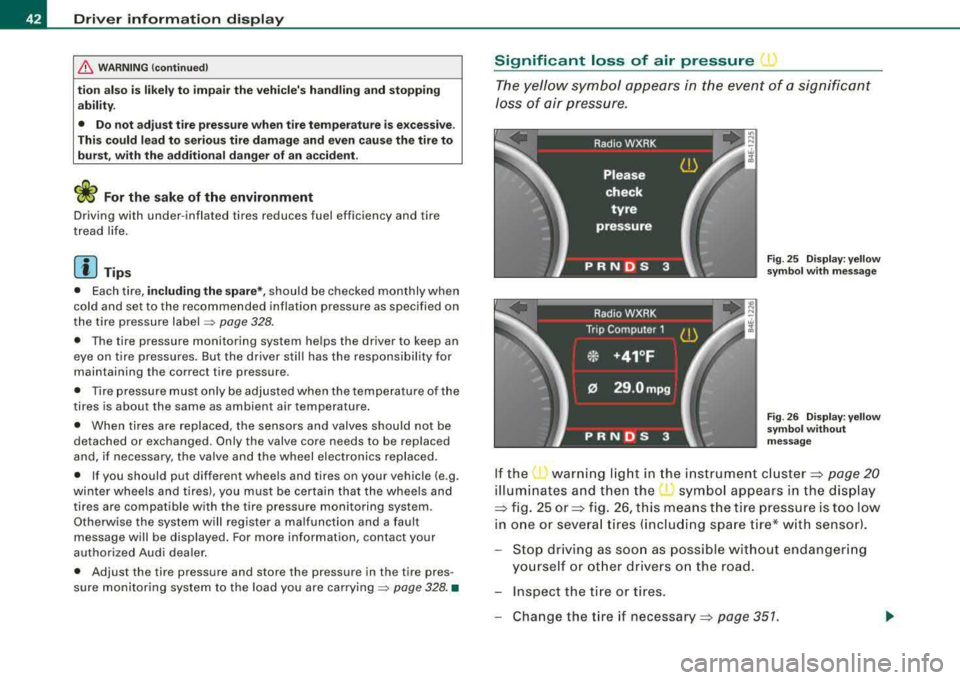
Significant loss of air pressure ( )
The yellow symbol appears in the event of a significant
loss of air pressure.
Fig . 25 Display: yellow
symbol with message
Fig . 26 Display: yellow
symbol without
message
If the warning light in the instrument cluster:::::, page 20
illuminates and then the ( symbol appears in the display
:::::, fig. 25 or:::::, fig. 26, this means the tire pressure is too low
in one or several tires (including spare tire* with sensor).
Stop driving as soon as possible without endangering
yourself or other drivers on the road.
- Inspect the tire or tires.
Change the tire if
necessary:::::, page 351.
Page 46 of 404
Driver inf ormation displ ay
• Green: If current tire pressure and the spec ified pressure are
approximate ly the same, t he tire pressure is shown in green.
• Yellow : If current tire pressure is too low with respect to specified
pressure, the tire pressure is shown in yellow.
[ i ] Tips
• During the learn ing period, t ire pressure and t ire temperature
are not displayed . Horizontal lines--,-- are displayed for pressure
and temperature.
• The tire pressure is shown on the label located either on the
driver's side B-pi llar (visible when the door is open) or ins ide the fuel
filler flap .
• The tire pressure monitor ing system he lps the driver to keep an
eye on tire pressures . But the driver stil l has the responsibility for
maintaining the correct t ire pressu re .•
Storing tire pressures
Correct storage of specified pressure is the basic require
ment for reli able tire pressure moni toring .
In order for the tire pressure monitor ing system to o perate
appropr iately, you have to re-save the specified p ressures
whenever you adjust tire pressure, for example when the load condition of your vehicle changes . Proceed as fo llows :
Correcting tire pressure
-Check t he pressure in the tires ( includin g the spare tire*).
-Ad just air pressure as needed in accordance with the
informat io n on the label loca ted either on the d river 's
side B- pillar (visible whe n the do or is ope n), ins ide the
f u el fill er flap a nd a ddit ionally in the manua l.
Saving tire pressur es
-Tur n on the ignition .
-Press the I CAR] fu nct ion button .
-Select Systems in the CAR me nu.
-Selec t Tire pressure monitoring .
-Select Store curr. tire pressures=> page 43, fig. 27.
A ll pressure warning indicators in the display wi ll be cance led .
Following each intentional cha nge in speci fied pressures, tire pres
sures must be resaved.
Afte r the pressures are saved, the tire pressure monitoring system
measures the current t ire pressures and saves them as the new
specified pressures .
[ i] Tip s
• T he tire pressure is shown on the tire pressure label. On USA
veh ic les, the tire pressure label is loca ted on the driver's side B
pillar . On Canada vehicles, the tire pressure labe l is located either on
t he dr iver's side B -p illar or i nside the fuel filler flap . The t ire pressure
label lists the recommended cold tire inflation pressures for the
vehic le at its maximum capacity weight and the tires tha t were on
your vehicle at the time it was manufactured . For recommended tire
pressures for normal load conditions, please see chapter
=> page 328.
• The tire pressure monitoring system he lps the driver to keep an
eye on tire pressures. But the driver still has the responsibility for
maintaining the correct tire pressure.
• If your vehic le is equipped with a standard spare tire *, it must be
inflated to the maximum pressure spec ified for the vehicle. •
Page 285 of 404
____________________________________________________ T_r_a _i_l e_ r_t_ o _ w_ i
_ n...; g=- -•
Operating instructions
M ax im um tra iler weig ht
A trailer for your vehicle is limited to a typ ical c lass 1 or class 2
trailer.
T ra ile r l oad d is tributi on
Be sure the load in the trailer is he ld securely in place to prevent it
from shifting forward, backward or s ideways .
Never a llow a pass enger to r ide in a trailer:::::, & in "Driving instruc
t ions" .
Engin e coo lin g sys te m
Tow ing a trai ler makes the engine work harder. It is important that
the cooling system's performance is up to the additiona l load. Make
sure that the coo ling system has enough fluid .
Tire press ure
When towing a trailer, inflate the tires of your veh icle to t he co ld tire
pressure listed under "Full load" on the labe l located either on the
driver's side B -pil lar (visible when the door is open) or inside the fuel
filler flap . Inflate trailer tires to trai ler and tire manufacturers' spec
ifications.
L ig ht s
The head light settings should be checked wit h the trai ler attached
before driving off. Check to make sure both vehicle and trai ler lights
are working properly .
Safe ty c ha in s
Be s ure trailer safe ty chains are properly connected from the trailer
to the hitch on the vehicle. Leave enough slack in the chains to
permit turning corners . When yo u insta ll safety chains, make sure
they will not drag on the road when you are driving.
T he chains should cross under the trailer tongue to prevent it from
dropping in case of separat ion from the hitch.
Controls and equip
ment Safety first
Vehicle operation
0 Note
If you are go ing to tow a trai ler, you must activate the tra iler opera
tion
mode :::::, page 189, "Towing a Trailer". •
Driving instructions
Driving with a trailer always requires extra care and
consideration.
To obtain the best possib le handling of ve hicle and trailer,
p lease note t he following :
- Do not tow a loaded trailer when your car itself is not
loaded.
- Be especia lly careful whe n passing other vehic les .
- Observe speed limits .
- Do not drive at the maximum permiss ible speed .
- Always apply brakes early.
- Monitor t he temperature ga uge .
W eight d istr ibu tion
Towing a loaded trailer with an empty car results in a highly
unstable d istribution of weight. If this cannot be avoided, drive at
very low speeds only to avoid the risk of losing steering control.
A "balanced" rig is easier to operate and control. This means that
t he tow vehicle should be loaded to the extent possible and permis
sib le, while keeping the trailer as light as possib le under the circum
stances . Whenever possible, transfer some cargo to the luggage
compartment of the tow vehicle whi le observing tongue load
requirements and vehicle loading considera tions .
.,,.
Vehicle care Do-it-yourself service Technical data
Page 309 of 404
___________________________________________ C=..:...: h:.:e :.: c:.: k.:.: i.:.: n :3:g ~ a:.:.n .:.: d::......:. f..:..:il ..:..:li .:.:n3g !._ _9I
•
Closing the engine hood
- Pull the hood down until the pressure from the struts is
reduced .
- Let the hood
drop down and latch in place. Do not try to
push it shut;
it may fail to engage =>& .
& WARNING
A hood that is not completely latched could fly up and block your
view while driving.
• When you close the engine hood, check it to make sure the
safety catch has properly engaged. The hood should be flush with
the surrounding vehicle body parts.
• If you notice while driving that the hood is not secured prop
erly, stop at once and close it. •
Working in the engine compartment
Be especially careful whenever you work in the engine
compartment.
Whenever you must perform any work in the engine compartment,
for example checking and filling different fluids, there is a risk of injury, burns and accidents. To prevent personal injury always
observe the following WARNINGS. The engine compartment of any
vehicle is a hazardous area
~ & .
& WARNING
To help avoid injury, before you check anything under the hood :
• Turn off the engine. • Remove the ignition key.
• Apply the parking brake.
• I I • • I
& WARNING (continued)
• Move selector lever to "P" (Park).
• Always let the engine cool down. Hot components will burn
skin on contact.
• To reduce the risk of being burned, never open the hood if you
see or hear steam or coolant escaping from the engine compart
ment. Wait until no steam or coolant can be seen or heard before
carefully opening the hood.
• Keep children away from the engine compartment .
• Never spill fluids on hot engine components. They can cause a
fire.
• Never touch the radiator fan. The auxiliary electric fan is
temperature controlled and can switch on suddenly.
• Never open the coolant reservoir cap when the engine is still
warm. The coolant system is pressurized and hot coolant could spray out.
• Protect your face, hands and arm from steam or hot engine
coolant by placing a thick rag over the cap when you open the
coolant reservoir.
• If work on the fuel system or the electrical system is necessary:
- Always disconnect the battery.
- Never smoke or work near heaters or open flames . Fluids in
the engine compartment could start a fire.
- Keep an approved fire extinguisher immediately available.
• To avoid electrical shock and personal injury while the engine
is running or being started, never touch:
-Ignition cables
- Other components of the high voltage electronic ignition system.
• If you must perform a check or repair with the engine running: -First, fully apply the parking brake, move selector lever to
"P"
(Park). .,_
Vehicle care
Page 327 of 404
Tires and wheels -
----------------
•
& WARNING (continued)
crashes and serious personal injuries . Have worn or damaged tires
replaced immediately.
• Tires age even if they are not being used and can fail suddenly,
especially at high speeds. Tires that are more than 6 years old can
only be used in an emergency and then with special care and at
low speed.
Glossary of tire and loading terminology
Accessory weight
means the combined weight (in excess of those standard items
which may be replaced) of automatic transmission, power steering,
power brakes, power windows, power seats, radio, and heater, to
the extent that these items are available as factory-installed equip
ment (whether installed or not).
Aspect ratio means the ratio of the height to the width of the tire in percent.
Numb ers of 55 or lower indicate a low sidewall for improved
steering response and better overall handling on dry pavement.
Bead
means the part of the tire that is made of steel wires, wrapped or
reinforced by ply cords and that is shaped to fit the rim.
Bead separation
means a breakdown of the bond between components in the bead.
Cord
means the strands forming the plies in the tire.
& WARNING (continued)
• Never mount used tires on your vehicle if you are not sure of
their
"previous history." Old used tires may have been damaged
even though the damage cannot be seen that can lead to sudden
tire failure and loss of vehicle control.
• If you notice unusual vibration or if the vehicle pulls to one side
when driving, always stop as soon as it is safe to do so and check
the wheels and tires for damage.
•
Cold tire inflation pressure
means the tire pressure recommended by the vehicle manufacturer
for a tire of a designated size that has not been driven for more than
a couple of miles (kilometers) at low speeds in the three hour period
before the tire pressure is measured or adjusted.
Curb weight
means the weight of a motor vehicle with standard equipment
including the maximum capacity of fuel, oil, and coolant, air condi
tioning and additional weight of optional equipment.
Extra load tire
means a tire design to operate at higher loads and at higher infla
tion pressures than the corresponding standard tire. Extra load tires
may be identified as
"XL", "xi", "EXTRA LOAD", or "RF" on the side
wall.
Gross Axle Weight Rating
("GAWR")
means the load-carrying capacity of a single axle system, measured
at the tire -ground interfaces.
Gross Vehicle Weight Rating
( " GVWR")
means the maximum total loaded weight of the vehicle.
Vehicle care
Page 329 of 404
Tires and wheels -
-----------------------------
•
Sidewall
means that portion of a tire between the tread and bead.
Speed rating
extended periods of time. The ratings range from 93 mph (150 km/h)
to 186 mph (298
km/h)=> page 338. You may not find this informa
tion on all tires because it is not required by law.
The speed rating letter code, where applicable, is molded on the tire
sidewall and indicates the maximum permissible road
speeds=> &
in "Winter tires" on page 341.
Tire pressure monitoring system
means a system that detects when one or more of a vehicle's tires
are underinflated and illuminates a low tire pressure warning tell
tale.
Tread
means that portion of a tire that comes into contact with the road.
Tread separation
means pulling away of the tread from the tire carcass.
Treadwear indicators (TWI)
means the projections within the principal grooves designed to give
a visual indication of the degrees of wear of the tread . See
=> page 335, "Tread Wear Indicator (TWI)" for more information on
measuring tire wear .
Uniform Tire Quality Grading
is a tire information system developed by the United States National
Highway Traffic Safety Administration (NHTSA) that is designed to
help buyers make relative comparisons among tires. The UTQG is
not a safety rating and not a guarantee that a tire will last for a
prescribed number of miles (kilometers) or perform in a certain way.
It simply gives tire buyers additional information to combine with
other considerations, such as price, brand loyalty and dealer recom- mendations
. Under UTQG, tires are graded by the tire manufac
turers in three areas: treadwear, traction, and temperature resis
tance . The UTQG information on the tires, molded into the
sidewalls.
U.S. DOT Tire Identification Number (TIN)
This is the tire's "serial number" It begins with the letters "DOT" and
indicates that the tire meets all federal standards . The next two
numbers or letters indicate the plant where it was manufactured,
and the last four numbers represent the week and year of manufac
ture. For example,
DOT ... 2207 ...
means that the tire was produced in the 22th week of 2007 . The
other numbers are marketing codes that may or may not be used by
the tire manufacturer . This information is used to contact
consumers if a tire defect requires a recall.
Vehicle capacity weight
means the rated cargo and luggage load plus 150 lbs. (68 kilograms)
times the vehicle's total seating capacity as listed on the label located either on the driver's side 8-pillar or on the inside of the fuel
filler flap.
Vehicle maximum load on the tire
means that load on an individual tire that is determined by dis trib
uting to each axle its share of the maximum loaded vehicle weight
and dividing by two.
Vehicle normal load on the tire
means that load on an individual tire that is determined by dis trib
uting to each axle its share of the curb weight, accessory weight,
and normal occupant weight (distributed in accordance with table
below => page 328) and dividing by two. ..,.
Vehicle care