wheel size AUDI S8 2008 Owners Manual
[x] Cancel search | Manufacturer: AUDI, Model Year: 2008, Model line: S8, Model: AUDI S8 2008Pages: 404, PDF Size: 52.7 MB
Page 225 of 404
Airbag system -
--------------=---=--
& WARNING (continued)
• Airbag work most effectively when used with properly worn
safety belts.
• Therefore, always wear your safety belts and make sure that
everybody in your vehicle is properly restrained.
& WARNING
A person on the front passenger seat, especially infants and small
children, will receive serious injuries and can even be killed by
being too close to the airbag when it inflates.
• Although the Advanced Airbag System in your vehicle is
designed to turn off the front passenger airbag if an infant or a
small child is on the front passenger seat, nobody can absolutely
guarantee that deployment under these special conditions is
impossible in all conceivable situations that may happen during
the useful life of your vehicle.
• The Advanced Airbag System can deploy in accordance with
the
"low risk" option under the U.S. Federal Standard if a child that
is heavier than the typical one-year old child is on the front
passenger seat and the other conditions for airbag deployment
are met.
• Accident statistics have shown that children are generally safer
in the rear seat area than in the front seating position.
• For their own safety, all children, especially 12 years and
younger, should always ride in the back properly restrained for
their age and size. •
Advanced front airbag system
Your vehicle is equipped with a front Advanced Airbag System in
compliance with United States Federal Motor Vehicle Safety Stan
dard 208 as applicable at the time your vehicle was manufactured.
Controls and equip ment Safety first Vehicle operation
The
front Advanced Airbag System supplements the safety belts to
provide additional protection for the driver's and front passenger's
heads and upper bodies in frontal crashes . The airbags inflate only
in frontal impacts when the vehicle deceleration is high enough.
The front Advanced Airbag System for the front seat occupants is
not a substitute for your safety belts . Rather, it is part of the overall
occupant restraint system in your vehicle. Always remember that
the airbag system can only help to protect you, if you are sitting
upright, wearing your safety belt and wearing it properly. This is why
you and your passengers must always be properly restrained, not
just because the law requires you to be.
The Advanced Airbag System in your vehicle has been certified to
meet the "low risk" requirements for 3 and 6 year -old children on the
passenger side and very small adults on the driver side. The low risk
deployment criteria are intended to help reduce the risk of injury
through interaction with the front airbag that can occur, for
example, by being too close to the steering wheel and instrument
panel when the airbag inflates.
In addition, the system has been certified to comply with the
"suppression" requirements of the Safety Standard, to turn off the
front airbag for infants 12 months old and younger who are
restrained on the front passenger seat in child restraints that are
listed in the
Standard=> page 245, "Child restraints and Advanced
Airbags".
"Suppression" requires the front airbag on the passenger side to be
turned off if:
• a child up to about one year of age is restrained on the front
passenger seat in one of the rear-facing or forward-facing infant
restraints listed in Federal Motor Vehicle Safety Standard 208 with
which the Advanced Airbag System in your vehicle was certified. For
a listing of the child restraints that were used to certify your
vehicle's compliance with the US Safety
Standard => page 245,
• weight less than a threshold level stored in the control unit is
detected on the front passenger seat.
~
Vehicle care Do-it-yourself service Technical data
Page 246 of 404
11111 Child Safety
------!....------------------------------
&, W ARNING (continued )
• Alway s inst all rear-facing child safety seats on the rear seat .
• If you mu st in sta ll a rear ward f acing child safet y seat on the
front pa ssenger seat in exceptional circum stan ces and the
PASSENGER AIR BAG OFF light doe s not come on and stay on,
immediately inst all the rear-facing child safety seat in a rear
s eating po sition and ha ve the airbag sy stem inspe cted immedi
atel y by your Audi de aler .
& WARNING
If, in exceptional circumstance s, you mu st in stall a forward -facing
c hild re straint o n the fr ont p assenger 's seat:
• Alway s make sure the forward -fa cing s eat ha s been de signed
a nd cert ified by it s m anufa cturer for use on a front seat w ith a
pa ssenger front and side airbag.
• Always follow the manufacturer's instruct ions provided with
the child safety seat or carrier.
• Alway s move the pa ssenger seat into it s re armost position in
the seat' s fore and aft adju stment range , as far aw ay from the
ai rbag as possibl e befo re installing the ch ild restr aint . The ba ck
rest mu st be adjusted to an upright po sition.
• Alway s m ake sure that the PASSENGER AIR BAG OFF l ight
c ome s on and stays on all the time whenever the ignition is
sw it c hed on . •
Advanced front airbag system and children
Your vehicle is equipped with an "Advanced Airbag System" in
compl iance with U nited States Federa l Motor Vehicle Safety Stan
dard { FMVSSl 208 as applicable at the time your vehicle was manu
factured. T
he Advanced Airbag system in your vehicle has been certified to
meet the " low -risk" requirements for 3 and 6 year -old chi ldre n on
the passenger side and smal l adults on the driver side . The low risk
deployment criteria are intended to reduce the risk of injury through
interaction with the airbag that can occur, for example, by being too
close to the steering wheel and instrument panel when the airbag
inflates. In addition, the system has been certified to comply with
the "suppression" requirements of the Safety Standard, to turn off
the front airbag for infants up to 12 months who are restra ined on
the front passenger seat in child restraints that are listed in the
Standard.
Even though your vehic le is equipped with an Advanced Airbag
system, al l ch ildren, especially those 12 years and you nger, should
a lways ride in the back seat properly restrained for their age and
size . The airbag on the passenger side makes the front seat a poten
tia lly dangerous p lace for a ch ild to ride. The front seat is not the
safest p lace for a child in a forward -facing child safety seat . It can be
a very dangerous p lace for an infant or a larger ch ild in a rearward
facing seat. •
Advanced Airbags and the weight-sensing
mat in the front seat
The Advanced Airbag Sys tem in your vehicle detects the presence
of an infant or child in a chi ld restra int on the front passenger seat
using the weight -sensing mat in the seat cushion and the sensor
below the safety belt latch on the front passenger seat that measures the tension on the safety belt.
T he weigh t-sensing mat measures total weight o f the chi ld and the
child safety seat and a child blanket on the front passenger seat . T he
weig ht o n the fr ont passenger seat is rela ted to the desig n of the
chi ld restraint and its "footprint", the size and shape of the bottom
of the child restraint as it sits on the seat . The weight of a child
restraint and its "footprint" vary for different kinds of child
~
Page 276 of 404
lllffl.___l_n _t _e _ll _ig=- e_n _ t_ te_ c_h _n_ o_ lo...;g'"'-=- y ___________________________________________ _
Tire chains
Where tire chains are mandatory on certain roads, this normally
also applies to vehicles with All Wheel
Drive:::::, page 342, "Snow
chains".
Replacing wheels/tires
Vehicles with All Wheel Drive must always have tires of the same
size . Also avoid tires with different tread depths. For details see
page :::::, page 336, "New tires and replacing tires and wheels".
Off-Road driving?
Your Audi does not have enough ground clearance to be used as an
off-road vehicle. It is therefore best to avoid rough tracks and
uneven terrain as much as possible. Also refer
to:::::, page 279.
& WARNING
Always adjust your driving to road and traffic conditions. Do not
let the extra safety afforded by All Wheel Drive tempt you into
taking extra risks.
• Although the All Wheel Drive is very effective, always
remember that braking capacity is limited by tire traction. You
should therefore not drive at excessive speeds on icy or slippery
road surfaces.
• On wet road surfaces, be careful not to drive too fast because
the front wheels could begin to slide on top of the water (aqua planing).
If this should occur, you will have no warning from a
sudden increase in engine speed as with a front-wheel drive
vehicle. Always drive at speeds which are suited to the road condi
tions -risk of crash. •
Energy management
Starting ability is optimized
Energy management controls the distribution of electrical
energy and thus optimizes the availability of electrical
energy for starting the engine.
If a vehicle with a conventional energy system is not driven for a
long period of time, the battery is discharged by idling current
consumers (e.g . immobilizer) . In certain circumstances it can result
in there being insufficient energy available to start the engine.
Intelligent energy management in your vehicle handles the distribu
tion of electrical energy. Starting ability is markedly improved and
the life of the battery is extended.
Basically, energy management consists of
battery diagnosis, idling
current management
and dynamic energy management.
Battery diagnosis
Battery diagnosis continuously determines the state of the battery.
Sensors determine battery voltage, battery current and battery
temperature. This determines the current state of charge and the
power of the battery .
Idling current management
Idling current management reduces energy consumption while the
vehicle is standing. With the ignition switched off, it controls the
energy supply to the various electrical components . Data from
battery diagnosis is considered.
Depending on the battery's state of charge, individual consumers
are gradually turned off to prevent excessive discharge of the
battery and thus maintain starting capability.
Dynamic energy management
While the vehicle is being driven , dynamic energy management
distributes the energy generated according to the needs of the indi -_,,,
Page 327 of 404
Tires and wheels -
----------------
•
& WARNING (continued)
crashes and serious personal injuries . Have worn or damaged tires
replaced immediately.
• Tires age even if they are not being used and can fail suddenly,
especially at high speeds. Tires that are more than 6 years old can
only be used in an emergency and then with special care and at
low speed.
Glossary of tire and loading terminology
Accessory weight
means the combined weight (in excess of those standard items
which may be replaced) of automatic transmission, power steering,
power brakes, power windows, power seats, radio, and heater, to
the extent that these items are available as factory-installed equip
ment (whether installed or not).
Aspect ratio means the ratio of the height to the width of the tire in percent.
Numb ers of 55 or lower indicate a low sidewall for improved
steering response and better overall handling on dry pavement.
Bead
means the part of the tire that is made of steel wires, wrapped or
reinforced by ply cords and that is shaped to fit the rim.
Bead separation
means a breakdown of the bond between components in the bead.
Cord
means the strands forming the plies in the tire.
& WARNING (continued)
• Never mount used tires on your vehicle if you are not sure of
their
"previous history." Old used tires may have been damaged
even though the damage cannot be seen that can lead to sudden
tire failure and loss of vehicle control.
• If you notice unusual vibration or if the vehicle pulls to one side
when driving, always stop as soon as it is safe to do so and check
the wheels and tires for damage.
•
Cold tire inflation pressure
means the tire pressure recommended by the vehicle manufacturer
for a tire of a designated size that has not been driven for more than
a couple of miles (kilometers) at low speeds in the three hour period
before the tire pressure is measured or adjusted.
Curb weight
means the weight of a motor vehicle with standard equipment
including the maximum capacity of fuel, oil, and coolant, air condi
tioning and additional weight of optional equipment.
Extra load tire
means a tire design to operate at higher loads and at higher infla
tion pressures than the corresponding standard tire. Extra load tires
may be identified as
"XL", "xi", "EXTRA LOAD", or "RF" on the side
wall.
Gross Axle Weight Rating
("GAWR")
means the load-carrying capacity of a single axle system, measured
at the tire -ground interfaces.
Gross Vehicle Weight Rating
( " GVWR")
means the maximum total loaded weight of the vehicle.
Vehicle care
Page 332 of 404
___ T_ ir_e _s_ a_n_ d_ w_ h
_ e_e_ l_ s _______________________________________________ _
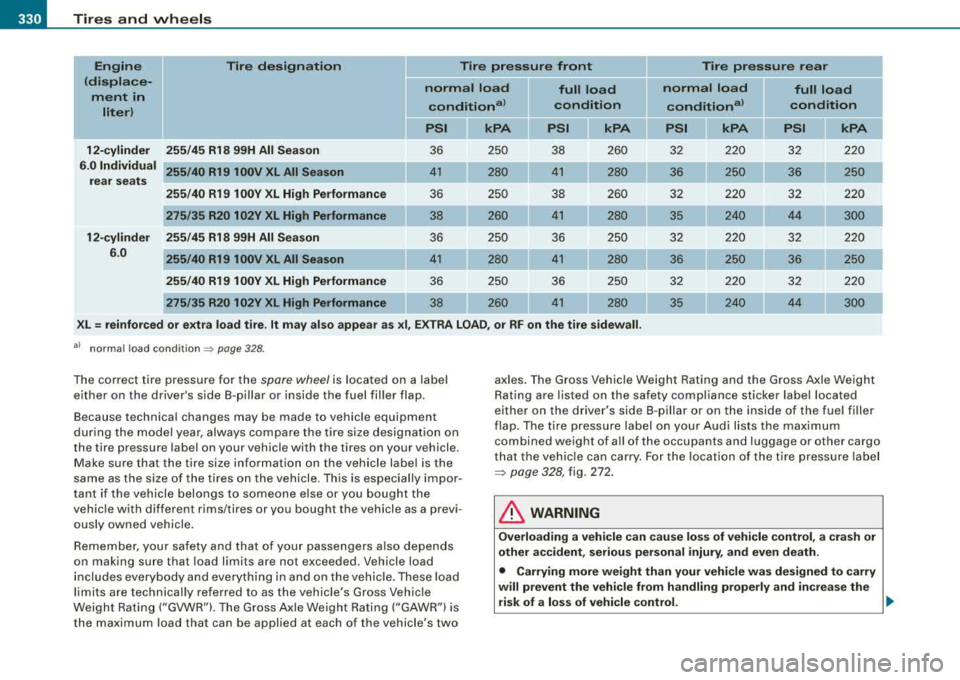
Engine Tire designation Tire pressure front Tire pressure rear
( displace-
normal load full load normal load
full load
ment in
liter)
condition al condition conditiona l condition
kPA PSI kPA PSI kPA PSI
12-cylinder
255/45 R18 99H All Season 36 250 38 260 32 220 32 220
6.0 Individual
255 /40 R19 100V XL All Season 41 280 4 1 280 36 250 36 250
rear seats
255/40 R19 100V
XL High Performance
36 2
50
38 260 3
2 220 32 2 20
275 /35 R20 102Y
XL High Performance 38 41 280 35 2 40 44 300
12 -cylinder 255 /45 R18 99H All Season 36 250 36 250 32 220 32 220
6 .0
255 /40 R19 100V XL All Season 4 1
280 4
1
280 36 250 36 250
255 /40 R19 100V
XL High Performance
36 250 36 250 32 2 20 32 220
275 /35 R20 102Y XL High Performance 38 260 4 1 280 35 240 44 300
XL = reinforced or extra load tire . It may also appear as xi , EXTRA LOAD , or RF on the tire sidewall .
al norma l load cond ition => page 328.
The co rrect tire pressure for the spare wheel is located on a label
either on the driver 's s ide 8-pillar or inside t he fue l fil ler flap.
Because technica l changes may be made to vehicle equipment
du ring t he mode l year, always co mpare the tire si ze desig nati on on
the tire pressure label on your vehicle with the tires on your vehicle .
M ake s ure t hat the tire si ze info rmat ion o n the ve hicle labe l is the
same as the size of the tires on the vehicle . T his is especial ly impor
t an t if t he vehicle bel ongs t o so me one e lse o r yo u boug ht the
vehic le with different rims/tires or you bought the vehicle as a previ
ously owned ve hicle.
Reme mber, you r safety and that of y our passengers a ls o depe nds
on making su re that load limits are not exceeded. Vehicle load
i nc ludes every body and everyt hin g in and o n th e veh icle . T hese load
limits are technically referred to as the vehicle's Gross Veh ic le
Weig ht Ratin g ("GVWR"). T he Gro ss Axle Weigh t Ra tin g ("GAWR") is
the maximum load that can be applied at each of the vehicle's two axles
. The Gross Vehic le We ight Rating and the Gross Axle Weight
Rating are l isted on the safety compl iance sticker labe l located
either on the driver's side 8 -pillar or on the inside of the fuel filler
fl ap . T he t ire p ressure label on you r A ud i lists t he m axi mum
combined weight of a ll of the occupants and luggage or other cargo
th at the v ehicle can carry . Fo r the locati on of the t ire press ure la be l
=> page 328, fig . 27 2.
& WARNING
Overloading a vehicle can cause loss of vehicle control , a crash or
other accident, serious per sonal injury , and even death .
• Carrying more weight than your vehicle was designed to carry
will prevent the vehicle from handling properly and increase the risk of a loss of vehicle control. ...,
Page 338 of 404
1119...__T_ ir_e _ s_ a_ n
_ d_ w_ h_ e_ e_ls _________________________________________________ _
Incorrect wheel alignment
Incorrect wheel alignment can cause excess ive tire wea r, impairi ng
the safety of the vehic le. If tires show excessive wear, have the
whee l alignment c hecked by an au th o rize d Audi deale r or qualifie d
wo rkshop.
All Wheel Drive
Vehicles with quattro® must always have tires of the same size, construc tion and tread type. F or details see
~ p age 273 .
& WARNING
Sudden tire failure can lead to los s of control, a crash and serious
personal injury !
• Never drive a vehicle when the tread on any tire is worn down
to the wear indi cators .
• Worn tires are a safety hazard, they do not grip well on wet
roads and increase your risk of "hydroplaning " and loss of control.
• Always keep chemicals that can cause tire damage , such as
grease, oil , gasoline and brake fluid aw ay from tires .
• Tires age even if they are not being used and can fail suddenly ,
especially at high speeds. Tires that are more than 6 years old can
only be used in an emergency and then with special care and at
lower speed s.
• Never mount used tires on your vehicle if you are not sure of
their "previous history." Old used tires may have been damaged
even though the damage cannot be seen that can lead to sudden
tire failure and los s of veh icle control. •
New tires and replacing tires and wheels
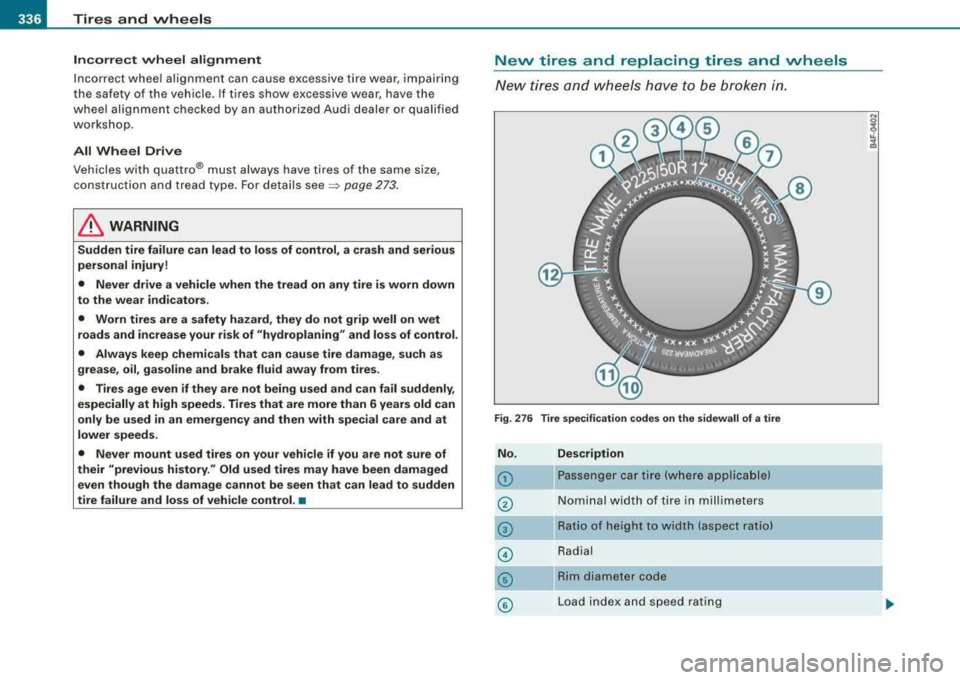
N ew t ires and wheels h ave t o be broke n in.
Fig . 2 76 T ir e specification code s on the sidewall of a tire
No .
G)
0
©
©
©
©
Description
Passenger car tire (where applicable)
Nominal width of tire in millimeters
Ratio of height to width (aspect ratio)
Radial
Rim diameter code
L o ad in dex and s peed rat ing
Page 341 of 404
________________________________________________ T_ i
_ r_e _s_ a_n_ d_ w_ h_ e_e _ l_s __ l'III
•
• T he batt ery inside of the tire pressure sensor has a l imited
s er vice l ife.
• Al ways drive with the va lve stem ca ps sec ure ly m ounted. We
r ec om mend u sin g fa ctor y in sta lle d v alv e stem caps. Ask your autho
rized Audi d ealer to replac e lost valve stem caps .
T he in stalla tio n of replacement ti res with steel cord body plies i n
th e tire s id ewal l may cause malfunct ion of the tire pressure moni
toring sy ste m, and is not recommended (c ord mate ria l infor mation
i n mo lded on the tire s idewa ll).
Al ways check your tir e pressure monitor ing system indicator after
r eplac ing on e o r m ore tire s on y our vehi cle. If the tire pressu re
monitorin g system indicator flashes, or is on, your system is not
w orki ng pr ope rly. You r rep lace ment tir e mi ght be in co m pati ble w ith
your t ire pr essure monitoring system, or some component of the
t ir e pr ess ure m oni to ring sys te m m ay be damaged .
& WARNING
• Using incorrect or unmatched tires and / or wheels or improper
tire and wheel combinations can lead to loss of control , collision
and serious personal injury .
• Always use tires , rims and wheel bolts that meet the specifica
tions of original factory -installed tires or other combinations that
have been specifically approved by the vehi cle manufacturer .
• Tires age even if they are not being used and can fail suddenly,
espe cially at high speeds . Tires that are more than 6 years old can
only be used in an emergency and then with special care and at
lower speeds .
• Never mount used tires on your vehicle if you are not sure of
their "previous history ." Old used tires may have been damaged
even though the damage cannot be seen that can lead to sudden
tire failure and loss of vehicle control.
• All four wheels must be fitted with radial tires of the same type ,
size (rolling cir cumference ) and the same tread pattern . Driving
&, WARNING (continued )
with different tires reduces vehicle handling and can lead to a loss
of control.
• If the spare tire is not the same as the tires that are mounted
on the vehicle
-for example with winter tires -only use the spare
tire for a short period of time and drive with extra care . Refit the
normal road wheel as soon as safely possible.
• Never drive faster than the maximum speed for which the tires
on your vehicle are rated because tires that are driven faster than
their rated speed can fail suddenly.
• Overloading tires cause heat build -up , sudden tire failure,
including a blowout and sudden deflation and loss of control.
• Temperature grades apply to tires that are properly inflated and
not over or underinflated.
• For techni cal reasons it is not always possible to use wheels
from other vehicles -in some cases not even wheels from the
same vehicle model.
• If you install wheel trim discs on the vehicle wheels , make sure
that the air flow to the brakes is not blocked . Reduced airflow to
the brakes can them to overheat , increasing stopping distances
and causing a collision.
• Run flat tires may only be used on vehicles that were equipped
with them at the factory . The vehicle must have a chassis designed
for run flat tires and a factory-installed tire pressure monitoring
system that indicates a loss of tire pressure. Incorrect use of run
flat tires can lead to vehicle damage or accidents . Check with an
authorized Audi dealer or tire specialist to see if your vehicle can
be equipped with run flat tires . If run flat tires are used , they must
be installed on all four wheels . Mixing tire types is not permitted.
0 Note
• Fo r tec hnica l reaso ns, i t is not gene rally p oss ibl e to use the
whee l rims from other vehicles . T his can hold true for wheels of t he
sa me v ehicl e typ e.
Vehicle care
Page 343 of 404
__________________________________________________ T_ ir_e_ s_ a_ n_d _ w_ h_ e_ e_l_s __ 9II
•
& WARNING
The tr action grade assigned to this tire i s ba sed on straight -ahead
braking traction tests, and does not include acceleration,
c ornering , hydroplaning or peak tra ction chara cteristic s.
& WARNING
The temperature grade for this tire is established for a tire that is
properly inflated and not overloaded. Excessive speed , underinfla
tion , or ex cessive loading , either separately or in combination , can
c ause heat buildup and po ssible tire failure . •
Winter tires
Winter tires c an im prove vehicle handlin g on snow and
i ce. At tem pera tures belo w 4 5 °F (7 °C ) we re commend
changi ng to w inte r tires.
In some heavy snow areas, loca l governments may require true
winter or "s now" tire s, those with very deeply cut tread. These tires
s h ou ld on ly be used in pairs and be i nstalled on all four wheels .
M ake sure you purchase snow tires that a re the same size and
co nstruct io n type as t he othe r tires on your ve hicle.
I f your vehicle is equipped with all -wheel drive *, this will improve
t raction d uring winte r dr iving , eve n wit h th e sta n dar d tir es .
However, we strongly recommend that you always equip a ll four
w hee ls on you r vehic le wi th co rrectl y fi tted w inte r tires or all-season
t ir es, w hen w inter road condi tions are expec ted . T his also improves
the vehicle 's br aking perfo rma nce a nd reduces stopping distances .
Summe r tires p rov ide less gr ip on ice a nd s now.
Wint er tires (snow tires) must a lways be fitted on all four whee ls .
Compatible ti re p ressu re m oni to ring sen so rs must be instal led on
a ll four w inte r tires for t he ti re pr essur e moni tor ing s yste m to fu nc
tion
proper ly => page 33 8.
Ask your authorized Audi dealer or qualifi ed workshop for permitted
winter tire sizes. Use only ra di al winter tires .
W inter tires lose their eff ectiveness when the tr ead is worn down to
a depth of 0 .157 inc h (4 mm).
O nly d rive wi th winte r ti res under w inter cond itio ns. S um mer tire s
handle better when there is no snow or ice on the roads and the
te mpera ture i s abov e 45 °F ( 7 °C) .
I f you have a f lat tire, se e notes on spar e whee l
=> page 336.
Please a lways remember that winter tires may have a lower speed
r ati ng t han th e tires orig in ally ins talled o n you r ve hicle at t he time
it was manufactu red . P lease
see => page 338, "Speed rating (letter
co de)" for a l is tin g of th e sp eed ratin g letter code s an d th e
maximum speed at which the tires can b e driven .
The speed ra ti ng le tter
co de( => page 327) is on the side wa ll of the
t ire
=> page 336.
& WARNING
Winter tires have ma ximum speed limits that may be lower than
your vehicle's maximum speed . Always know the maximum speed
before driving off . Never drive faster than the speed permitted for
your specific winter tires. This will cause damage to the tires leading to an accident and serious personal injury to you and your
passengers .
& WARNING
Driving faster than the maximum speed for which the winter tires
on your vehicle were designed can cause tire failure including a
blowout and sudden deflation, loss of control , crashes and serious
per sonal injuries . Have worn or damaged tires replaced immedi
ately.
• Winter tires have maximum speed rating that may be lower
than your vehicle's maximum speed.
Vehicle care
Page 344 of 404
lllftl __ T_ ir_e _s_ a_n_ d_ w_ h
_ e_e_ l_ s _______________________________________________ _
&, WARNING (continued )
• Never drive faster than the speed for which the winter or other
tires in stalled on your vehicle are rated.
& WARNING
Always adjust your driving to the road and traffic condit ions .
Never let the good acceleration of the winter tires and all -wheel
dri ve tempt you into taking extra risks. Always remember :
• When braking , an all -wheel drive vehicle handles in the same
way as a front drive vehicle .
• Drive carefully and reduce your speed on icy and slippery roads ,
even winter tires cannot help under bla ck ice conditions.
c£> For the sake of the environment
Use summer tires when weather conditions permit. They are
q uiete r, d o not wear as qui ckly a nd r educe fuel cons ump tion.•
Snow chains
Sn ow c hain s may be fitte d only to the fron t w heel s, an d on ly to
certain tire sizes. Ask your authorized Audi dealer on which tire
s iz es snow c hains can be used.
If you are going to use snow cha ins, then you must instal l them on
the front wheels at least.
Th e sn ow c hains mus t h ave low-pro file l inks and mus t n ot be t hic ke r
than 0. 53 inch ( 13. 5 mm), including the lock.
Remove wheel ce nter c ove rs a nd tr im dis cs be fore putti ng sn ow
c h ains on your
veh ic le:::::, 0. For safety reasons cover caps must
then be fitted ove r the wheel bo lts . These are avai lable from autho
rized Audi dealers.
& WARNING
Using the wrong snow chains for your vehicle or installing them
incorrectly can in crease the risk of loss of control leading to
serious personal injury .
• Snow chains are available in different sizes. Alway s make sure
to follo w the instructions provided by the snow chain manufac
turer.
• When driving with snow cha ins never drive faster than the
speed permitted for your specific snow chains .
• Always observe local regulations .
0 Note
• Remove snow chains before driving on roads not covered with
snow to av oid da magi ng t ires a nd weari ng th e snow cha ins dow n
unnecessari ly .
• Snow c hains, w hich
come int o direct co ntact w it h the w heel r im,
can scratch or damage it. Th erefore, make sure that the snow chains
are suitab ly cov ere d.
• I f the Adaptive Air Suspension should malfunction, do not
mo unt or use snow cha ins because t he veh icle w ill be ext re me ly
l ow. If you do drive with snow chains on while the vehicle is at this
l ev el, the s now c hai ns mig ht sev erely da mag e th e wheel house an d
other parts of the vehicle .
[ i ] Tips
Where snow chains are mandatory on certain roads, this norma lly
a lso ap plies t o veh icle s wi th All Wheel D rive .•
Page 345 of 404
Tires and wheels 11111 --------------------------------------------
•
Wheel bolts
Wheel bolts must al wa ys be tightened to the correc t
tor que .
The design of wheel bo lts is matched to the factory installed rims. If
di fferent r ims a re fitted, t he co rrect w heel bo lts wi th the rig ht len gth
and correct ly shaped bolt heads m ust be used. This ensures that
w he els a re fitt ed se cu rel y and that t he bra ke syste m functi on s
correctly.
In certa in ci rc ums ta nces, yo u may no t use wheel bo lts fr om a
differ ent vehicle - eve n if it is the sa me
model=:> page 382.
& WARNING
Improperly tightened or maintained wheel bolts can become loose
causing loss of control, a collision and serious personal injury.
• Always keep the wheel bolts and the threads in the wheel hubs
clean so the wheel bolts can turn easily and be properly tightened .
• Never grease or oil the wheel bolts and the threads in the wheel
hubs. They can become loose while driving if greased or oiled,
even if tightened to the specified torque .
• Only use wheel bolts that belong to the rim being installed .
• Never use different wheels bolts on your vehicle.
• Always maintain the correct tightening torque for the wheel
bolts to reduce the risk of a wheel loss .
If the tightening torque of
the wheel bolts is too low, they can loosen and come out when the
vehicle is moving . If the tightening torque is too high, the wheel
bolts and threads can be damaged and the wheel can become
loose .
0 Note
The specified torque for the wheel bo lts is 9 0 ft lb (12 0 N m) with a
t olerance o f± 7,4 ft lb(± 10 Nm). T orque whee l bolts diago nally.
After changing a whee l, the torque must be checked as soon as possible with a torque wrench
-preferably by an authorized Audi
dea ler o r qua lif ied wo rksho p.•
Low aspect ratio tires
You r Aud i is fact ory- eq uip pe d w it h lo w aspect rati o tire s. T hese tir es
hav e been thorough ly t ested and been se lect ed specifical ly for your
mod el for thei r supe rb pe rf or manc e, r oad f eel an d ha nd ling under
a variety of driving conditions. As k your authorized Audi d ealer for
m or e de tails.
The low aspect rat io o f th ese t ires is indicat ed by a nume ra l of 55 or
less in the tire's size designatio n. The numeral represents the ratio
o f t he tir e's s idewa ll he ig ht in r ela ti on to it s tread w idt h ex pressed
in percentage . Conventiona l tires have a height/width ratio of 60 or
more.
The performan ce of low -aspe ct-ratio tires is particularly sensitive to
improper inflation pressure . It is therefore important that low
aspect ratio tires are inflated to the specified pressure and that the
inflation pressure is regularly checked and maintained . Tire pres
sures should be checked at least once a month and alway s before a
long
trip :::::, page 331, "Checking tire pressure" .
What you can do to avoid tire and rim damage L ow a spect ratio tires can be damaged mo re easily by impact with
pot ho les, cu rbs, gull ies o r ridge s o n th e road, part icular ly if th e tire
is underinf lated .
I n or der to mini mize th e occurren ce of i mpac t da mag e to the tires
of your vehicle, we recommend that you observe the fol lowing
pr ecaut ions :
• Alwa ys m aint ain recom mended inflatio n pressu res . C he ck you r
t ire p res su re eve ry 2,000 mi les (3, 000 k m) and add ai r if neces sary .
• D rive carefully on roads with potho les, deep gullies or ridges .
The impac t from d riving th rough or ove r such o bstacles can
da mage you r tir es . Imp act with a curb may a lso caus e damage to
your tire s. .,_
Vehicle care