warning AUDI S8 2009 Owners Manual
[x] Cancel search | Manufacturer: AUDI, Model Year: 2009, Model line: S8, Model: AUDI S8 2009Pages: 408, PDF Size: 91.63 MB
Page 264 of 408
-L~C~h~ i~ ld ~ S~ a~ f~ e~ t:1Y :._ ___________________________________________ _
In stalling th e guidan ce fixtures
- Push down on the seat cushion so that the lower ancho r
ages are vis ible.
- Hold the guidance fixture with t he part number facing
downward and push it in the direction of the arrow onto
the anchorage =>
page 261, fig. 250.
- Make sure that each of the two guidance fixtures per seat snaps into place.
Removing the guidan ce fixtures
- Re move the child restrain t according the child res tra int
ma nufactur er's instr uct ions.
- Push down on the seat cushion so that the lower anchor
ages are visib le.
- Pu ll off the guidance fixtures from the lower a nch orages.
- Always remove the gu idance fixtures and keep them in a
safe p lace when not in use .
You may find it easier to insta ll child restraints equipped with hooks
attached to straps without the guidance fixtures in place . If this is
the case, remove the guidance fixtures by pu lling them off the
anchorages. However, the guidance fixtures can he lp you to locate
the LATCH anchorages.
& WARNING
Improp er use of tether anchorage s or lower anchorages can cau se
s erio us persona l inj ury i n a cra sh .
• Alway s carefully foll ow the child restraint manuf acturer's
in stru ction s fo r prope r inst allati on and use of child re str aint
sy stems .
& WARN ING (continued )
• Never use the LATCH or tether anchor ages to attach safety
belt s or ot her kinds of occupant re st raint s.
• Child restra int tether attachments and lower attachment s are
only de signed to se cure a child re straint that ha s been equipped
to use the se anchorages .
• Tether a nchorages and lower a nchorage s are desig ned t o with
s tand only those load s imposed by correctly fitted child re straint s.
Under no cir cum sta nce s ca n they be used safel y for adu lt or ch ild
s afety belts or harne sse s.
• Never mount more than one child r estraint to a single tether o r
to a lower an chorage point. Att aching two child restraints to a
s ingle anchorage point can ca use the anchor age to fail and cau se
s eri ous per sonal injury in a c rash .
0 Note
• Remove the guidance fixtures before fo lding the rear seatback to
prevent damaging the seat cushion.
• If you leave the guidance fixtures installed for several days, they
cou ld leave a mark on the upholstery on the seat cushion and back
rest in the area that the guidance fixtures were installed. The uphol
stery would also be permanent ly stretched around the guidance
fixtures . This applies especial ly to leather seats .
[ i ] Tip s
• Always remove the guidance fixtures when not in use.
• Please keep the guidance fixtures in a safe place with the vehicle
when not in use. •
Page 265 of 408
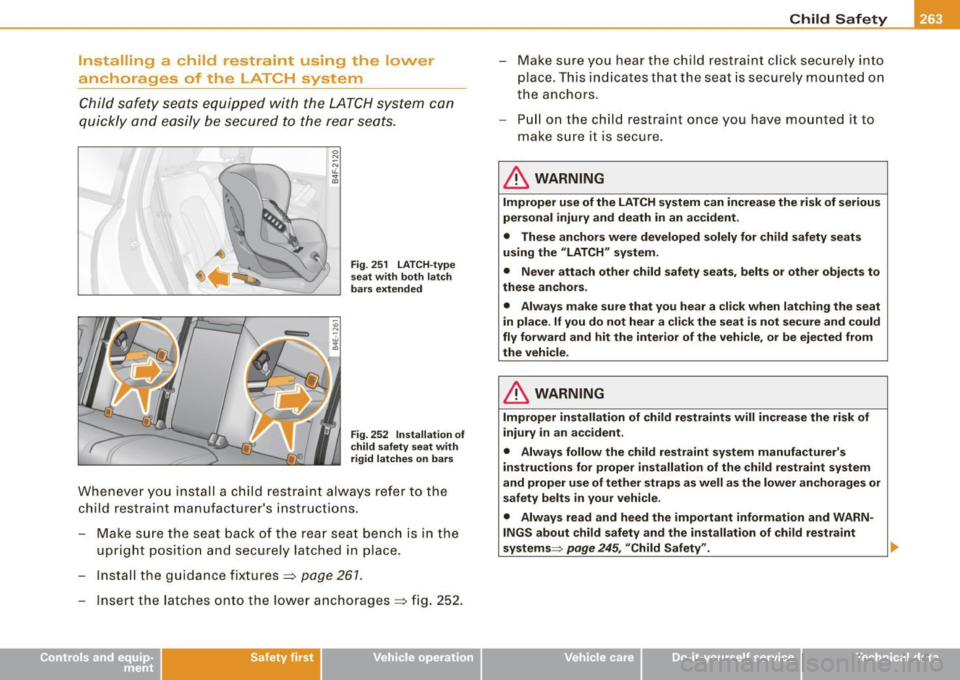
Installing a child restraint using the lower
anchorages of the LATC H system
Child safety seats equipped with the LATCH system can
quickly and easily be secured to the rear
seats.
0 N ;;; t1. ;g
Fig . 251 LATCH-type
seat with both latch
bars extended
Fig. 252 Installation of
child safety seat with
rigid latches on bars
Whenever you install a child restraint always refer to the
child restraint manufacturer's instructions.
- Make sure the seat back of the rear seat bench is in the
upright position and securely latched in place.
- Install the guidance fixtures=:>
page 261 .
-Insert the latches onto the lower anchorages==> fig. 252.
Safety first
Child Safety
- Make sure you hear the child restraint click securely into
place. This indicates that the seat is securely mounted on
the anchors.
- Pull on the child restraint once you have mounted it to
make sure it is secure.
& WARNING
Improper use of the LATCH system can increase the risk of serious
personal injury and death in an accident.
• These anchors were developed solely for child safety seats
using the "LATCH" system.
• Never attach other child safety seats, belts or other objects to
these anchors.
• Always make sure that you hear a click when latching the seat
in place . If you do not hear a click the seat is not secure and could
fly forward and hit the interior of the vehicle, or be ejected from
the vehicle .
& WARNING
Improper installation of child restraints will increase the risk of
injury in an accident .
• Always follow the child restraint system manufacturer's
instructions for proper installation of the child restraint system
and proper use of tether straps as well as the lower anchorages or
safety belts in your vehicle .
• Always read and heed the important information and WARN
INGS about child safety and the installation of child restraint
systems ~
page 245, "Child Safety". ...
I .
Vehicle care I • irechnical data
Page 266 of 408
1111 Child Safety
---------..!...--------------------------------------
0 Note
On vehicles with power individual rear seats* some criteria must be
observed when attaching the child restraint using the
LATCH
system :
• To attach the child restraint securely, the seat must be moved to
the farthest rear position, the seat height set to the lowest position
and the head restraint must be adjusted to the ver tical position
~ page 97.
• If a child safety seat is attached to one of the rear seats, this seat
must not be adjusted using the power controls under any circum
stances. The easy entry function for this seat must also be deacti
vated in the
MMI ~ page 700. The child safety seat as well as the
rear seat can be damaged by the adjustment process .•
Mounting and releasing the anchorage hook
If you use a child restraint system with hooks or other
latches attached to adjustable straps.
Mounting
-Press the anchorage hook with the spring catch release
onto the lower anchorage so that the anchorage hook
locks into place .
- Pull on the anchorage hook to make sure that it has
securely engaged the lower anchorage.
- Tighten the strap following the child restraint manufac
turer's instructions.
Releasing
- Loosen the tension on the strap following the child
restraint manufacturer's instructions .
- Depress the spring catch on the hook. -
Hold the spring catch in depressed position.
- Move the hook in the direction of the vehicle floor so that
there is enough space to release the anchorage hook
from the lower anchorage.
& WARNING
• Improper installation of child restraints will increase the risk of
injuries in a crash.
• Always refer to the child restraints manufacturer's instructions
for proper installation of the child restraint and proper use of the
lower anchorages or safety belts
in your vehicle. •
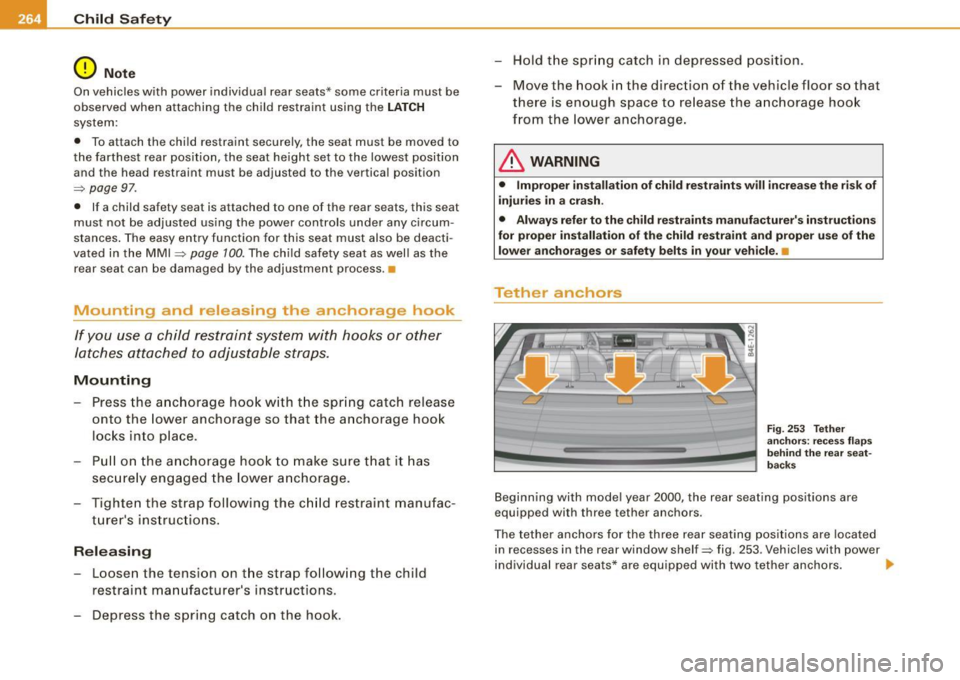
Tether anchors
Fig. 253 Tether
anchors: recess flaps
behind the rear seat
backs
Beginning wi th model year 2000 , the rear seating positions are
equipped with three tether anchors .
The tether anchors for the three rear seating positions are located
in recesses in the rear window shelf~ fig. 253 . Vehicles with power
individual rear seats* are equipped with two tether anchors. .,.
Page 267 of 408
& WARNING
Improper installation of child restraints will increa se the r is k of
injury and death in a crash .
• Improper use of child restraint anchors (tether anchors) could
lead to injury in a colli sion. The anchor s are designed to withstand
only tho se load s impo sed by correctly fitted child restraints .
• Never mount two child restraint systems on one LATCH lower
anchor point .
• Never attach two child restraint sy stems to one tether strap or
tether anchorage .
• Always follow the instructions provided by the manufacturer of
the child restraint you intend to install in your Audi .
• Never use child restraint tether anchorages to secure safety
belts or other kinds of occupant restraint s.
• Never atta ch a tether strap to a tie -down hook in the luggage
compartment.
• Never secure or attach any luggage or other items to the LATCH
lower anchorages or to the tether anchors .
• If a tether or other strap is used to attach a child restraint to the
front passenger seat , make sure that it is not so tight , that it
c auses the weight -sensing mat to measure more weight than is
actually on the seat.
• The heavier weight registered can make the system work as
though an adult were on the seat and deploy the Advanced Airbag
when it must be suppressed causing serious or even fatal injury to
the child. •
Safety first
Child Safety
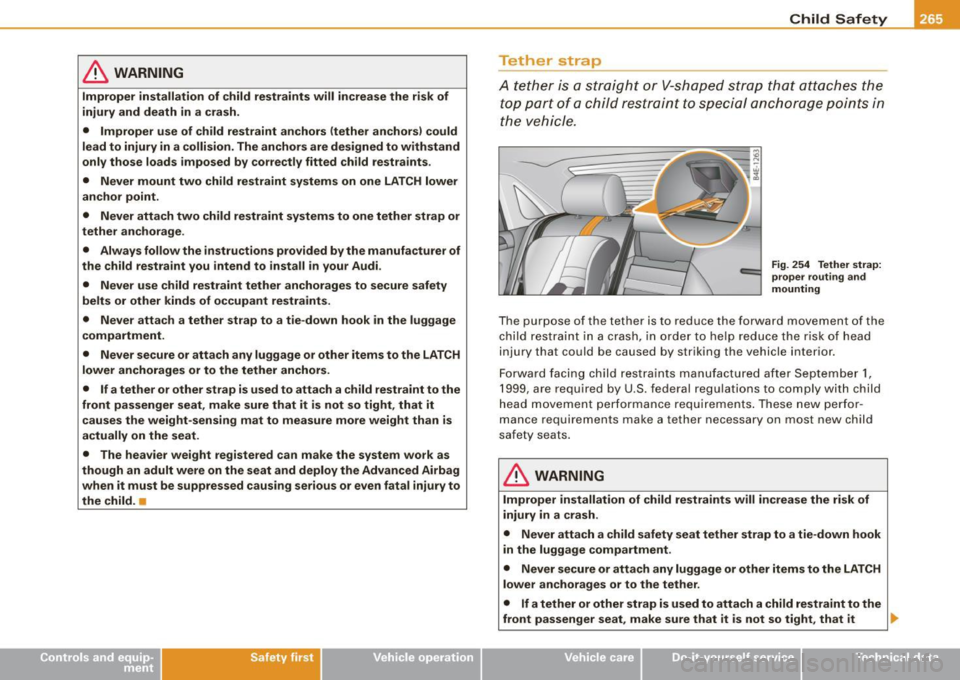
Tether strap
A tethe r is a straight or V-sh aped s trap t hat at taches the
top part of a chil d re str aint to s peci al anc ho ra ge poin ts in
t h e vehicle.
Fig . 254 Tether strap:
prope r routing and
mounting
The p urpose of the tether is to reduce the forward movement of the
c hi ld r estraint in a crash, in orde r to he lp redu ce th e risk o f head
injury that could be caused by striking the vehicle interior.
F o rw ard facing c hild res train ts manufact ure d after Sep te mb er 1,
1999, are required by U.S . federal re gulations to comply with child
head m ovement performance requ iremen ts . These new pe rfo r
mance requirements make a tether necessary on most new child
safety seats .
& WARNING
Improper installation of child restraints will increase the risk of
injury in a crash .
• Never attach a child safety seat tether strap to a tie -down hook
in the luggage compartment .
• Never secure or attach any luggage or other items to the LATCH
lower anchorages or to the tether .
• If a tether or other strap is used to attach a child restraint to the
front passenger seat, m ake sure that it is not so tight , that it •
I .
Vehicle care I I irechnical data
Page 268 of 408
___ C_h_ i_ld _ S_ a_ f_ e_ t-= y'------------------------------------------------
& W ARNING (continued )
causes the weight-sensing mat to measure more weight than is
actually on the seat.
• The heavier weight registered can make the system work as
though an adult were on the seat and deploy the Advanced Airbag
when it must be suppressed causing serious or even fatal injury to
the child .•
Using tethers on rear-facing child restraint
systems
Currently, few rear -facing child restraint systems come with a tether.
Please read and heed the child rest raint sy stem manufactu rer's
instruct ions ca reful ly to determine how to properly insta ll the
tether .
& WARNING
A child in a rearward -facing child safety seat installed on the front
passenger seat will be ser iously injured and can be killed if the
front airbag inflates - even with an Advanced Airbag System .
• The inflating airbag will hit the child safety seat or infant
carrier with great force and will smash the child safety seat and
child against the backrest , center arm rest , or door .
• A tight tether or other strap on a rearward -facing child restraint
attached to the front passenger seat can put too much pressure
on the weight -mat in the seat and register a heavier weight in the
Advanced Airbag System. The heavier weight registered can make
the system work as though an adult were on the seat and deploy
the Advanced Airbag when it must be suppressed caus ing serious
or even fatal injury to the child .
• If you must install a rearward facing child safety seat on the
front passenger seat because of exceptional circumstances and
the PASSENGER AIR BAG OFF l ight does not come on and stay on,
& WARNING (continued)
immediately install the rear-facing child safety seat in a rear
seating po sition and have the airbag system inspected by your
Audi dealer . •
Secur ing the upper tether strap to the anchor
bracket
F ig . 255 Tether strap:
proper routing and
mounting
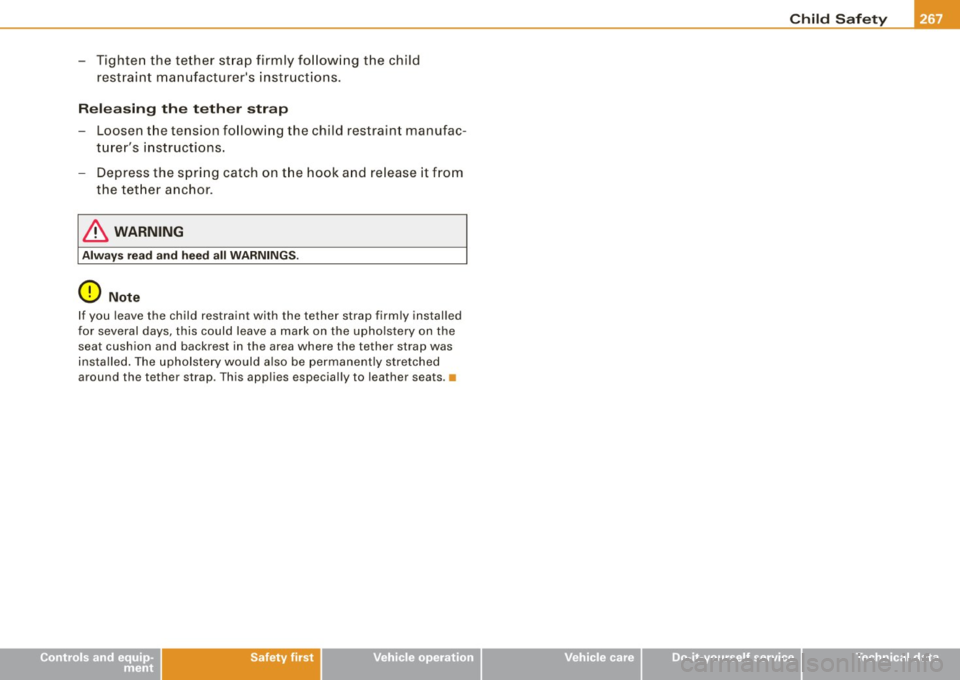
Securing the child restraint tether strap to the
tether anchor
Re lease or dep loy the tether strap o n the chil d restraint
acco rdin g to th e ch ild restraint manufacturer 's usage
inst ructio ns.
Gu ide th e u pper tether stra p
under th e r ear he ad
rest rai nt=> fig. 255 (r ais e t he hea d rest raint if nece ssa ry).
- Tilt th e re cess flap -detail view- => fig . 255 up to exp ose
t he anch or b rack et.
Slide t he tet her strap h ook ove r th e an ch o r br acket .
Pull on the te the r st ra p h ook so that the sp rin g ca tc h of
th e ho o k e ngag es . .,.
Page 269 of 408
_____________________________________________ C_ h _ il_d _S_ a _ fe_t---= y'----"'
- Tighte n the te th e r st rap firml y fo llow ing t he child
r e st raint ma nufactur er's instr uct ions.
Releasing th e tether strap
- Loosen t he tension fo llowing the child restra int manufac
t u re r's instructions.
- Depress the spr ing catch on t he hook a nd re lease it f rom
the tet her anchor .
& WARNING
Always read a nd heed all WARNINGS .
0 Note
If you leave the child restraint with the tether strap firm ly instal led
for several days, this could leave a mark o n the upho lstery on t he
seat cushion and backrest in the area where the tether strap was
installed . The upholste ry would a lso be permanen tly s tretched
around the tether strap . This applies especially to leather seats .•
Controls and equip
ment Safety first Vehicle operation
Vehicle care Do-it-yourself service Technical data
Page 273 of 408
The direction in which the driver wishes to travel is determined with
t he aid of the steering angle and vehicle speed and is continua lly
compared with the actual behavior of the vehicle. If the two do not
match, for example, when the vehic le starts hydrop laning on a wet
road, ESP will automatically brake the appropriate whee l to correct
the prob lem.
The vehicle is then stab ilized by the forces acting on the whee l
during braking. If the vehicle is oversteering (rear tends to skid out
of the turn), the brakes are mainly app lied on the wheel that is on
the outside of the curve. In the case of a vehicle that is understeering
(tendency to sl ide out of the curve), the brakes are applied at the
rear wheel that is on the inside of the curve . An acoustic signal indi
cates when ESP brake application cuts in
~ & .
The system operates across the entire speed range in combination
with the ABS system
~ page 274 . If the Anti -Lock Brake System
(ABS) malfunctions, the ESP wi ll be out of action as well.
Ac tivat ion
When you turn on the eng ine, ESP will automatically be activated
and will perform a self -test.
The system can be activated or deactiva ted by pressing the button
~ page 270, fig. 256. The warning light comes on when the system
is switched off
~ page 18.
Normally , the ESP should always be on, however, it may be advanta
geous to turn off the system in certain special cases when some
degree of wheel spin is desired such as :
• when driving with snow chains
• when driving in deep snow or on a loose surface (to allow the
wheels to dig in to reach firm ground)
• when trying to "rock" the vehicle free when it has beco me stuck.
T he system should be reactivated once you are no longer in such
situations .
Both the ABS and EDS systems are still functioning even if the ESP
is switched off .
Controls and equip
ment Safety first Vehicle operation
In
te llig ent tec hn olo gy
& WARNING
The Ele ctron ic St abiliz ation Progr am i s ne ve rt h el ess s ubject to the
laws of ph ysics. It i s particularl y important t o pay attention t o th is
f ac t on wet an d slipp ery road s. It i s th ere fore important that you
alway s adapt your driving to the condition of the road and traffic
c onditio ns. Do n ot allow the in crease d sa fety p ro vi ded by t he El ec
tronic Stabiliz ation Program sy stem to lu ll you into a ccepting
a dditional safety ri sk s.
c
Electronic differential lock (EDL)
The electronic differential lock monitors the rotation al
s p eed of the drive wheels.
G en era l not es
The elect ronic differential lock (EDU helps the car to start moving,
accelerate and c limb a gradient on surfaces providing poor or
a lmost no grip . Without EDL , this would be difficult, if not impos
s ib le.
How the system works
The EDL operates automatical ly. It monitors the rotational speed of
the drive wheels on an axle with the he lp of the ABS sensors
~ page 274. If a noticeable difference in rotational speed between
the drive wheels on one axle is detected (e.g. on slippery ground on
one side), the spinning w heel is braked, thereby transferring power
to the other drive wheel or wheels (all -whee l drivel. This is done up
to a speed of about 60 mph (100 km/h) . Noises from the brake
system signal that wheel spin is being control led .
Dri ving off
When driving off, always be sur e to ke ep road conditions in mind as
you accelerate. I f one drive wheel spins because it is on a surface
with less grip, gradual ly increase the pressure on the accelera tor
pedal unt il the car star ts to
move . The whee l less able to t ra nsfer
power spins. _.,
Vehicle care Do-it-yourself service Technical data
Page 274 of 408
-Intelligent technology --=---=-=-------------
Overheating
of brakes
To prevent the disc brake of the braked wheel from overheating if
subjected to excessive loads, the EDL cuts out temporarily . The
vehicle remains operational and behaves in the same way as a
vehicle without EDL.
As soon as the brake has cooled down, EDL switches on again auto
matically.
& WARNING
• When accelerating on slippery surfaces, such as on ice or snow,
always be careful when depressing the accelerator pedal. Even
with the EDL working, the drive wheels can spin and reduce your ability to control your car. Risk of crash!
• The increased safety afforded by EDL does not mean that you
can take safety risks . Always adapt your driving style to the road
conditions and traffic situation.
[ i] Tips
If a fault occurs in the ABS, the EDL is also not functioning. This is
indicated by the ABS warning light=>
page 21. •
Anti-Slip Regulation System (ASR)
The Anti-Slip Regulation System prevents the driven
wheels from spinning when the car is accelerating.
General notes
The Anti-Slip Regulation System (ASR) is integrated in the electronic
stabilization program (ESP). When the vehicle starts up and acceler
ates, the wheels are prevented from spinning by adjusting the
engine power to match the amount of grip available from the road
surface.
How the system works
ASR performs automatically, i.e. without the driver's intervention.
With the aid of the ABS sensors=>
page 274, ASR monitors the
speed of the driven wheels. If the wheels start to spin, the engine
power is reduced automatically until the tires find enough grip to
lock onto the road surface. The system is active across the entire
speed range.
The ASR works in conjunction with the ABS. If a malfunction should
occur in the ABS, the ASR will also be out of action.
& WARNING
The increased safety afforded by ASR does not mean that you can
take safety risks. Always adapt your driving style to the road
conditions and traffic situation.
[ i] Tips
To ensure that the ASR works properly, all four wheels must be fitted
with identical tires Any differences in rolling radius of the tires can
cause the system to reduce engine power when this is not desired.
See also=>
page 338, "New tires and replacing tires and wheels".
Braking
General information
What affects braking efficiency?
Operating conditions and driving habits
The brakes on today's automobiles are still subject to wear,
depending largely on operating conditions and driving habits=>& .
On vehicles that are either driven mostly in stop-and-go city traffic
or are driven hard, the brake pads should be checked by your autho
rized Audi dealer more often than specified in the
Warranty & Main- ~
Page 275 of 408
tenance boo klet. Failure to have your brake pads inspected can
r esult i n reduce d brake pe rfor mance .
On steep slopes , you s hou ld use the braking effect of the engine .
T his way, you prevent unnecessary wear on the bra ke system . If you
must use your brakes, do not hold the brakes down con tinuo usly.
P ump the brakes at intervals.
Moisture or road salt
U nder ce rtain conditions, for example, when driving through water
or very heavy rain, or even after washing your vehicle, the brak ing
effect can be reduced due to moisture (or in freezing conditions ice)
on the b rake pads. A few carefu l brake appl icat io n s sh ould d ry o ff
the brake pads or remove any ice coatings.
Th e eff ectiveness of the b rakes ca n b e re d uce d whe n the ve hicle is
driven on a salt -covered road and the brakes are not used . Here too,
you sh ould clean off acc umulated sa lt coat ing from brake d iscs and
pads with a few careful app lications of the brake~&.
Corrosion
T here may be a tendency for dirt to build up on the brake pads and
co rrosion to form o n the discs if the car is not d rive n regu lar ly or
only for short trips with little use of the brakes .
I f the brakes are not used frequently, or if corrosion has fo rmed on
t he d iscs, i t is a dv isab le to clea n off th e pads an d discs by braking
firmly a few times from a moderate ly high speed~& .
Faults in the brake system
I f you shou ld notice a sudden increase in brake pedal trave l, then
one of the two brak e circu its may have failed~ &.
Low brake fluid level
Ma lfunctions can occur in the brake system if the brake fluid leve l is
t oo low. T he b rake fl uid level is mon ito red e lect ro nica lly .
Controls and equip ment Safety first
Vehicle operation
Intelligent technology
Brake lining wear status
Brake l ini ng w ear may be checke d by visua l ins pec tion of the co nd i
tion of the brake pads throu gh the open ings in the wheel. If neces
sa ry, the wheel may be removed for this i nspectio n
~ page 353,
"Changin g a whee l".
& WARNING
• You should perform braking maneuvers for the purpose of
cleaning the brake system only if road conditions permit . Other
road use rs must not be put at r isk -you may cause an accident !
• Before descending a steep grade , reduce speed and shift trans
mi ssion into a lower gear or lower driving range . Do not ride the
brakes or hold the pedal down too long or too often . This could
cau se the brakes to get hot and diminish braking efficiency .
• Do not "ride the brakes" by resting your foot on the pedal when
you do not intend to brake. This may cause the brakes to overheat ,
premature wear and increased stopping distance.
• Under certain climati c and operating conditions such as
passing through water , driving in heavy rain or after washing the
vehi cle , the effectiveness of the brakes can be reduced. In winter ,
ice can accumulate on the brake pads , linings , discs and drums .
Carefully apply brakes for a test. Brakes will dry and ice coatings
will be cleaned off after a few careful brake applications .
• Driving for an extended period of time on salt -covered roads
without using your brakes can also affect braking efficiency. Clean off accumulated salt coating from brake disc s and pads with a few
careful brake applications .
• If you damage the front spo iler , or if you install a different
spoiler, be sure the air flow to the front brakes is not obstructed.
Otherwise the brake sy stem could overheat reducing the effective
ness of the entire brake system.
• Failure of one brake cir cuit will impair the braking capability
resulting in an increased stopping distance. Avoid driving the
Vehicle care Do-it-yourself service Technical data
Page 276 of 408
___ ln_ t _e_ ll-'"ig ...,_ e_ n_t _t_ e_ c_ h _ n_o _ l_o _,.g= y,_ __________________________________________ _
& WARN ING (continued )
vehicle and have it towed to the nearest Aud i dealer or qualified
workshop.
;:a
Brake booster
The brake booster a dds ex tra braking power.
The bra ke booster works wit h vacuu m pressure w hich is created
only when the engine is running =>& .
& WARNING
• Never let the vehicle roll to a stop with the engine shut off .
• If the brake boo ster i s not wor king , for e xample when towing
your vehicle, or because the brake booster has somehow been
damaged , the brake pedal must be pre ssed considerably harder to
make up for the lack of booster as sistance. •
Functioning of Anti-Lock Brake System {ABS)
A BS prevents the wheels from l ocking up under braking.
The ABS contributes effective ly to vehicle contr ol since i t preven ts
t he whee ls from
locking whe n the brakes are appl ied. This mea ns
that the vehicle remains steerable and is less likely to skid .
With ABS you do not need to pump the brake. Ju st hold the brake
pedal down .
However, do no t ex pect the ABS to sho rten braking distance u nder
all circumstances. When drivin g on gravel or on new ly fallen snow
on top of icy surfaces, bra king distance may be even longer, there
f ore, under these c ircu msta nces, it is especially importa nt that you
drive slow ly and with great care.
How the ABS system works
An au toma tic c heck is made when a s peed of about 4 mph (6 km/h)
is reached. When this happens, a pumping no ise can be heard.
I f an individual wheel begins to rotate too slowly in relation to
veh ic le speed and tends to lock, the ABS au tomat ically reduces
brake pressure to prevent that whee l from locking.
Th is au tomatic a djust ment pr oces s wi ll cause a
slight vibration o f
the brake peda l and some noises to alert you that vehicle speed
m ust be ada pted to e xisting road and traff ic conditio ns.
& WARNING
Although the ABS is very effective , alway s remember that braking
capability is limited by tire traction . Always adjust your driving
speed according to the road and traffi c conditions. Do not let the
extra safety afforded by the ABS tempt you into tak ing extra risks.
The ABS cannot overcome the laws of physics.
[ i ] Tips
• I f ABS is not functioning properly, a wa rning light will come on .
See=>
page 27.
• I f a faul t occurs in t he ABS, t he EDL is also n ot fu nctio ning . Th is
is indicated by the ABS warning light. •
Brake assistant
T he brak e assi stant i s designe d to ac hie ve th e optimu m
bra kin g eff ec t.
The bra ke assistant helps to increase the effective braking power
an d th us to achieve a shorter s top ping dis tan ce. If the dr iver
presses the brake pedal very quic kly, the brake assistant automati
c a lly bo osts t he braking force to the max imum level, up to th e point
where the anti -lock brake function (ABS) intervenes to stop the
whee ls from locking. You shou ld then keep the brake peda l pressed .,