cooling AUDI S8 2009 User Guide
[x] Cancel search | Manufacturer: AUDI, Model Year: 2009, Model line: S8, Model: AUDI S8 2009Pages: 408, PDF Size: 91.63 MB
Page 318 of 408
-~_C_ h_e _c _ k_ i_n ...:::g::;...._ a_n_ d_ f_ i_ll _in -'g:::;.._ ___________________________________________ _
& WARNING
To reduce the risk of personal inju ry if you mu st change the engine
oil in your vehicle your self:
• Wear eye prote ction .
• To reduce the ri sk of bu rn s from hot engine oil , let the engine
c ool down to the tou ch .
• When remo ving th e oil dr ain pl ug w ith your fing ers, s tay a s fa r
a w ay as po ssibl e. Alw ays keep your forearm p arallel to the grou nd
to help prevent hot oil from running down your arm .
• Drai n the oil into a container de signed for th is purpose , one
l a rg e enough to hold at le ast the tot al a mount of oil in your eng ine .
• Engine oil is poi sonou s. Keep it well out of the rea ch of children .
• Continuous contact with used engine oil i s harmful to your
skin. Always prote ct your skin by wa shin g oil off thoroughly with
s oap and water .
0 Note
Never mix oil additives with your engine oil. These additives can
damage you r engine and adve rsely affect you r Audi Limited New
Vehicle Warranty .
~ For the sake of the environment
• Before changing your oil, first make sure you know where you
can proper ly dispose of the used oil.
• Always dispose of used engine oil properly . Do not dump it on
garden soil, wooded areas, into open st reams or down sewage
drains .
• Recycle used engine oi l by taking it to a used engine oi l collec
tion facility in your area, or contact a service station .•
Engine cooling system
Coolant
The engine coolan t perf orms two func tions: it keeps t he
engine from overheating an d it protects the engine from
freezing in the winter.
The cooling system is sealed and general ly requires litt le attention.
The coo ling system has been fi lled at the factory with a permanent
coo lant which does not need to be changed. The coolant consists of
a mixture of water and the manufacturer's glycol -basedcoolant
additive G12+ + antifreeze with anti corrosion additives (50% for USA
models; 60% for Canadian mode ls) . This mixture both assures the
necessary frost protection and protects metal components in the
engine's cooling system from corrosion and scaling. It also raises
the boil ing point o f the coolant.
D o not reduce the concentration of the coo lant in the summer by
adding pla in water.
Th e proporti on of coolant additive must b e at
l e as t 50 % but not more than 60 %
to maintain antifreeze protection
and cooling efficiency . If the coolant frost protect ion is too low, the
coo lant could freeze and damage the vehicle heating and engine
coo ling system.
For year-round driving, antifreeze is added at the factory for temper
atures down to :
• -31 °F ( -35 °C) USA
• - 40 °F ( - 40 °C) Canada .
You can mix the G 12 + + coolant additive wit h other additives (G12 +
or G12). A lways check with your authorized Audi dealer .
& WARNING
Before you che ck anything in the engine compartment , alwa ys
read and heed all WARNING S
~ & in "Working in the engine
c ompartment " on
page 30 9.
Page 319 of 408
Checking and filling -
------------------------------------------- -=----- =------
0 Note
• Before winter sets in, have the coolant checked to see if the
coolant additive in your vehicle is sufficient to meet the climate
conditions. This is especially important if you live in a region where
the winter is extremely cold. If necessary, increase the proportion of
coolant additive to 60%.
• When adding coolant additive to your cooling system,
remember:
-We recommend using only coolant additive G12+ + (check the
label) for your vehicle. This coolant additive is available at autho
rized Audi dealers. Other types of antifreeze can significantly
reduce corrosion protection . The resulting corrosion can cause a
loss of coolant and serious engine damage .
• Do not add any type of radiator leak sealant to your vehicle's
engine coolant. Adding radiator repair fluid may adversely affect the
function and performance of your cooling system and cou ld result
in damage not covered by your New Vehicle Limited Warranty .•
Checking the engine coolant level
The engine coolant level can be checked with a quick
glance.
Fig . 269 Engine
compartment : Coolant
expansion tank
Before you check anything in the engine compartment,
always read and heed all WARNINGS==> & in "Working in
the engine compartment" on
page 309.
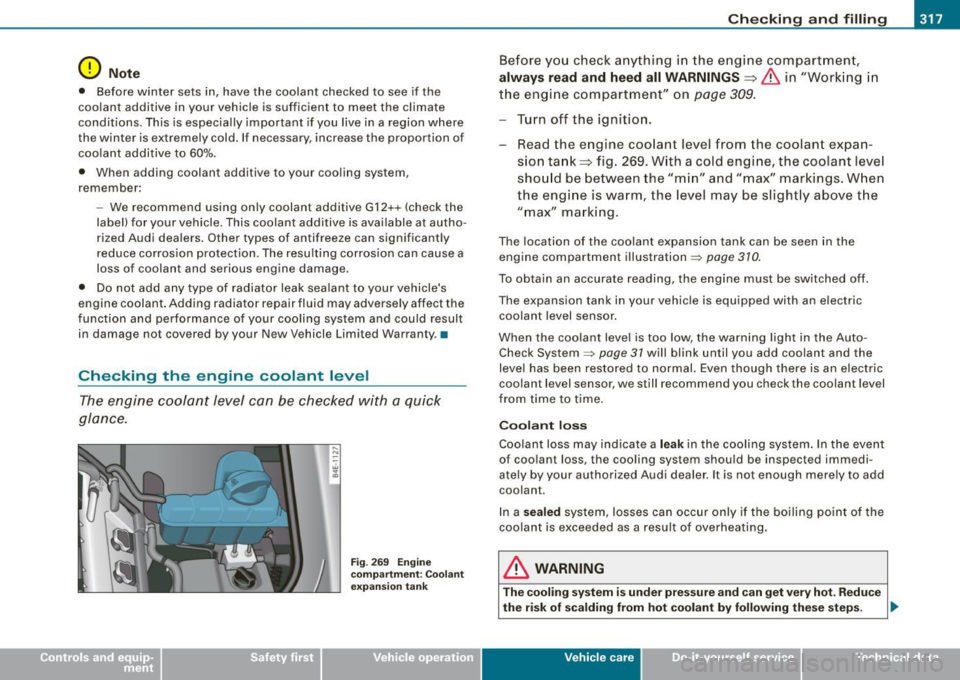
Turn off the ignition .
Read the engine coolant level from the coolant expan
sion tank==> fig. 269. With a cold engine, the coolant level
should be between the "min" and "max" markings. When
the engine is warm, the level may be slightly above the
" max" marking .
The location of the coolant expansion tank can be seen in the
engine compartment illustration=>
page 310.
To obtain an accurate reading, the engine must be switched off .
The expansion tank in your vehicle is equipped with an electric
coolant level sensor.
When the coolant level is too low, the warning light in the Auto
Check System =>
page 31 will blink until you add coolant and the
level has been restored to normal. Even though there is an electric
coolant level sensor, we still recommend you check the coolant level
from time to time.
Coolant loss
Coolant loss may indicate a leak in the cooling system. In the event
of coolant loss, the cooling system should be inspected immedi
ately by your authorized Audi dealer. It is not enough merely to add
coolant.
In a
sealed system, losses can occur only if the boiling point of the
coolant is exceeded as a result of overheating.
& WARNING
The cooling system is under pressure and can get very hot. Reduce
the risk of scalding from hot coolant
by following these steps. ~
Vehic le care I I Technical data
Page 320 of 408
-~_C_ h_e _c _ k_ i_n ...:::g::;...._ a_n_ d_ f_ i_ll _in -'g:::;.._ ___________________________________________ _
& WARN ING (c o ntinued )
• Turn off the engine and all ow it to c ool down .
• Protect your f ace, hand s and arms from e scaping flu id and
s te am by covering the cap w ith a large , thick rag .
• Turn the cap slowly a nd ve ry ca re fu lly
in a c ounter -clockw ise
dire ction while applying light , downward pres sure on the top of
the cap.
• To avoid being burned , do not spill antifree ze or coolant on the
e x hau st sy stem or hot eng ine parts . U nde r certain conditions , the
ethylene glycol in engine coolant can cat ch fire .
0 Note
Do not add any type of radiator leak sealan t to your vehic le's engine
coolant. Adding radiator repair fluid may adversely affect the func
tio n and performance of your coo ling system and could resu lt in
damage not covered by your New Vehicle Limited Warranty .
[ i J Tips
On vehicles with the 12 -cylinder engine, the expansion tank is
located under a cover .•
Adding coolant
Be very careful when adding engine coolant.
Before you check a nything in the e ngine compartment,
alway s read and heed all WARNINGS=:> & in "Working in
the engine compartment" on
page 309.
Turn off the engine.
Let the engine coo l down. -
Pla ce a t hick rag over t he co ola nt expansio n tank
=:> page 317, fig . 269 and carefully tw ist the cap cou nter
clockw ise
=:> & .
- Add cool ant.
Twist the cap on again
tightly .
Replacement engine coolant mus t conform to exact specifications
=> page 316, "Coolan t". Even in an emergency, if coolant additive
G 12+ +, G12 + or G12 is not availab le, do
not use a different additive.
Use plain water instead until you can get the correct additive and
can restore the correct ratio . This should be done as soon as
possible.
I f you have lost a cons iderable amount of coolant, then you should
add cold antifreeze and cold water only when the engine is cold .
A lways use
new engine coolant when refil ling .
Do not fi ll coo lant above the "MAX" mark . Excess coolant wil l be
f orced out through the p ressure relief valve in the cap when the
eng ine becomes hot.
& WARNING
• The cooling system i s under pre ssure and can g et very hot .
Redu ce th e risk of scalding from hot coolant by following these
s tep s.
- Turn off the e ngine a nd allo w it t o cool down .
- Protect your fac e, hand s and arms from e sc a ping fluid and
steam by covering the cap with a large, thi ck rag .
- Turn the cap slo w ly and very caref ully in a counter -clockwi se
dire ction while applying light , downward pres sure on the top
of the cap .
- To avoid being burned , do not sp ill antifreeze or cool ant on
the e xhau st sy stem o r hot e ngine part s. Under ce rtain condi -
tions , the ethylene glycol in engine cool ant can catch fire. _.,,
Page 405 of 408
______________________________________________ A_ l_,_ p _h_ a_ b_e _t_i c_ a _ l _in _ d_e _ x __ lllll
When must the airbag system be inspected? Wiper blades
231
See Windsh ield wipers ............ . 82
When should I adjust the tire pressures? ...
334
X
When should I check the t ire pressures? 334
Where can I find the tire pressures for my Xenon-Lights · · · · · · · · · · · · · · · · · · · · · · . 364
car? ... ... .. .... .... .... ....... 333
Why safety belts? ... .... ...... .. 211, 212
Y
Windows
I • Yellow symbols ..
..... .. .... .... .... . 34
C eaning ... .. ...... ............. 294
Convenience open feature ... .. .... . 64
Defogging ....................... 120
Defrosting ....................... 120
Rapid defrosting/defogging ........ 122
Windshield defogger/defroster . ....... 123
Windshield washer fluid Low level ......... ....... ..... ... . 35
Windshield wipers Installing new wiper blades ... ... ... 82
Intermittent wiping .. .............. 80
One -tap wiping ................ ... 80
Rain sensor ....................... 80
Service position .. .... .... ... .... .. 82
Washer reservoir ................. 325
Winter driving Windows ........................ 294
Winter operation Battery . .... ... .. .... .... ...... .. 320
Cooling system ... ....... ........ 316
Steering wheel heating .... ...... .. 119
Tir es .... .... ... ..... .......... . 275
Winter tires ... .. .... .... ..... ... ... 343
All -wheel drive . ...... .... ...... .. 343
Controls and equip
ment Safety first Vehicle operation
Vehicle care Do-it-yourself service Technical data