key battery AUDI S8 2009 User Guide
[x] Cancel search | Manufacturer: AUDI, Model Year: 2009, Model line: S8, Model: AUDI S8 2009Pages: 408, PDF Size: 91.63 MB
Page 116 of 408
• .___w_ a_ rm __ a_ n_ d_ c_o _l_d ________________________________________________ _
Warm and cold
Climate controls
Description
The air conditioner is fully automatic and is designed to
maintain a comfortable and uniform climate inside the
vehicle.
We recommend the follow ing settings:
- Set the temperature to 75 °F (+23 °C).
- Press the !AUTO
I button.
With this setting, you attain maximum comfort in the least amount
of time. Change this setting, as desired, to meet your personal needs.
The climate controls are a combination of heating, ventilation and cooling systems, which automatically reduce humidity and cool the
air inside your vehicle.
The air temperature, air flow and air distribution are automatically
regulated to achieve and maintain the desired passenger compart
ment temperature as quickly as possible.
The system automatically compensates for changes in outside
temperature and for the intensity of the sunlight entering the
vehicle. We recommend you use the
Automatic mode=> page 117
for year-round comfort.
Please note the following:
Turn on the air conditioner to reduce humidity in the vehicle. This also prevents the windows from fogging up.
When the outside temperature is high and the air is very humid,
condensation from the evaporator may drip under the vehicle. This
is normal and does not indicate a leak. If the outside temperature is low,
the fan normally only switches to
a higher speed once the engine coolant has warmed up sufficiently.
The air conditioner temporarily switches off when you drive off from
a standstill using full throttle to save engine power.
The compressor also switches off if the coolant temperature is too
high, so that the engine can be adequately cooled under extreme
loads.
Air pollutants filter
The air pollutants filter (a combined particle filter and activated
charcoal filter) reduces or prevents outside air pollution (dust, or
pollen) from entering the vehicle.
The air pollutants filter must be changed at the intervals specified
in your Warranty
& Maintenance booklet, so that the air conditioner
can properly work.
If you drive your vehicle in an area with high air pollution, the filter
may need to be changed more frequently than specified in your
Audi Warranty
& Maintenance booklet. If in doubt, ask your autho
rized Audi Service Advisor for advice.
Key coded settings
The air conditioner settings selected are automatically stored and
assigned to the key being used. When the vehicle is started, the air
conditioner automatically selects the settings assigned to that key.
This way every driver will maintain his/her own personal settings
and does not have to reset them manually.
If a different driver uses your key and changes the air conditioner
settings, the latest adjustments will erase and replace the settings
you have stored.
Energy management
To prevent the battery from being discharged and to restore the
balance of energy, components which require large amounts of
Page 174 of 408
-Autom
atic tran smi ssi on
..__ ______________ _
Fig. 192 E merge ncy
re lease for sel ecto r
l ever
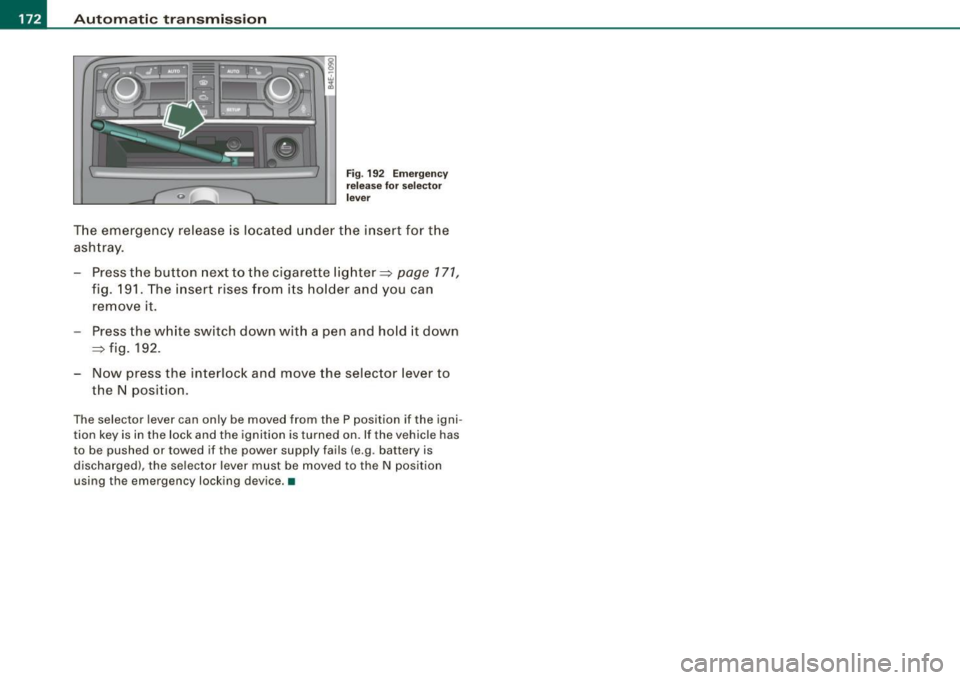
T he emergency release is located under the insert for the
ashtray.
- Press t he button next to the cigarette lighter=>
page 171,
fig. 191 . The insert rises from its holder and you can
remove it .
Press the white switch down with a pen and hold it down
=> fig . 192.
- Now press the interlock and move the selector lever to
the N position.
The selector lever can only be moved from the P position if the igni
tion key is in the lock and the ignition is turned on. If the vehicle has
to be pushed or towed if the power supply fails (e.g . battery is
discharged), the selector lever must be moved to the N position
using the emergency locking device. •
Page 279 of 408
vidual components. It regulates consumption, so that more elec
trical energy is not being used than is being genera ted and ensures
an optimal state of charge for the battery.
[ i ] Tips
• But even energy management cannot negate the limits of
physics. Consider that the power and life of a battery are limited.
• If starting ability is threatened, you are informed by a warning
~ page 277, "Driver notification in the instrument cluster
display". •
What you should know
The highest priority is given to maintaining starting capa
bility.
The battery is severely taxed in short -distance driving, in city traffic
and during the cold time of year . Abundant electrical energy is
required, but only a little is generated . It is also critical if the engine
is not running and e lectrical components are turned on. In this
instance energy is being consumed but none is being generated .
It is in precisely these situations that you wi ll notice energy manage
ment actively regulating the distribution of energy.
Vehicle stands for an extended period
If you do not drive your vehicle over a period of several days or
weeks, electrical components are gradually cut back or switched off.
This reduces energy consumption and maintains starting capability
over a longer period.
Be aware that when you unlock your vehicle, some of the conve
nience functions may not operate, such as the Convenience key, the
remote control or the power seat adjustment. The convenience
functions will be available again when you turn on the ignition and start the engine.
Controls and equip ment Safety first Vehicle operation
Intelligent technology
With the
engine turned off
If you listen to the radio, for examp le, with the engine turned off or
use other MMI functions, the battery is being discharged.
If starting capability is jeopardized due to energy consumption, the
following warning appears in the MMI display:
Please start engine, otherwise system will switch off in 3
minutes .
The warning indicates that the system wi ll be turned off automati
cal ly after 3 minutes. If you wish to continue using the functions,
you have to start the engine .
With the engine running
Although e lectrica l energy is generated when the vehicle is being
driven, the battery can become discharged. This happens mostly
when little energy is being generated and a great deal consumed
and the battery's state of charge is not optimal.
To bring the energy balance back into equi librium , consumers
which require especia lly large amounts of energy are temporarily
cut back or switched off. Heating systems in particular require a
great deal of energy. If you notice, for example, that the heated
seats* or the heated rear window are not heating, they have been
temporarily cut back or switched off. These systems will be available
again as soon as the energy balance has been restored.
You wil l also notice that engine idle speed has been increased
s lightly . This is norma l and not a cause for concern . By increasing
engine idle speed the additiona l energy required is generated and
the battery is charged. •
Driver notification in the instrument cluster
display
If the battery's state of charge is not in the optimal range, this driver
notification appears in the instrument cluster display:
Low battery charge: battery will be charged while driving ~
Vehicle care Do-it-yourself service Technical data
Page 311 of 408
_____________________________________________ C_ h_ e .=....= c..:..k :..:.in :....:..:= g:.....= a..:..n .:....:d::......:. f.:..:il .:..:li ..:..n ::.:g:!....-_11111
•
Closing the engine hood
- Pull the hood down until the pressure from the struts is
reduced .
- Let the hood
drop down and latch in place. Do not try to
push it shut;
it may fail to engage => &.
& WARNING
A hood that is not completely latched could fly up and block your
view while driving.
• When you close the engine hood, check it to make sure the
safety catch has properly engaged. The hood should be flush with
the surrounding vehicle body parts.
• If you notice while driving that the hood is not secured prop
erly, stop at once and close it. •
Working in the engine compartment
Be especially careful whenever you work in the engine
compartment.
Whenever you must perform any work in the engine compartment,
for example checking and filling different fluids, there is a risk of injury, burns and accidents. To prevent personal injury always
observe the following WARNINGS. The engine compartment of any
vehicle is a hazardous area
~ & .
& WARNING
To help avoid injury, before you check anything under the hood :
• Turn off the engine.
• Remove the ignition key.
• Apply the parking brake .
& WARNING (continued)
• Move selector lever to "P" (Park).
• Always let the engine cool down. Hot components will burn
skin on contact.
• To reduce the risk of being burned, never open the hood if you
see or hear steam or coolant escaping from the engine compart
ment. Wait until no steam or coolant can be seen or heard before
carefully opening the hood.
• Keep children away from the engine compartment .
• Never spill fluids on hot engine components. They can cause a
fire.
• Never touch the radiator fan. The auxiliary electric fan is
temperature controlled and can switch on suddenly.
• Never open the coolant reservoir cap when the engine is still
warm . The coolant system is pressurized and hot coolant could
spray out.
• Protect your face, hands and arm from steam or hot engine
coolant by placing a thick rag over the cap when you open the
coolant reservoir.
• If work on the fuel system or the electrical system is necessary :
- Always disconnect the battery.
- Never smoke or work near heaters or open flames . Fluids in
the engine compartment could start a fire.
- Keep an approved fire extinguisher immediately available.
• To avoid electrical shock and personal injury while the engine
is running or being started, never touch:
- Ignition cables
- Other components of the high voltage electronic ignition system.
• If you must perform a check or repair with the engine running: -First, fully apply the parking brake, move selector lever to "P"
(Park). .,
Vehicle care
I t •
Page 323 of 408
Checking and filling -
---------------------=----"=---------
checked by a service facility. The electrolyte level should also be
checked each time the battery is charged =>
page 323.
Have the battery checked when you take your vehicle in for service.
You are well advised to replace a battery that is older than 5 years.
With certain types of airbag deployment, the battery is discon
nected from the vehicle electrical system for safety reasons=>.& in
"Repair, care and disposal of the airbags" on
page 234.
Disconnecting the battery terminals
Some vehicle functions (power window regulators, for example) are
lost if the battery terminals are disconnected. These functions have
to be relearned after the battery terminals are connected again. To
prevent this, the battery should only be disconnected from the
vehicle electrical system when absolutely necessary for repairs .
Vehicles not driven for long periods If you do not drive your vehicle over a period of several days or
weeks, electrical components are gradually cut back or switched off.
This reduces energy consumption and maintains starting capability
over a longer period
=> page 276.
Be aware that when you unlock your vehicle, some of the conve
nience functions may not operate, such as the Convenience key*,
the remote control or the power seat adjustment. The convenience
functions will be available again when you turn on the ignition and
start the engine.
Winter operation During the winter months, battery capacity tends to decrease as
temperatures drop. This is because more power is also consumed
while starting, and the headlights, rear window defogger, etc., are
used more often.
Avoid unnecessary power consump tion, particularly in city traffic or
when traveling only short distances. Let your authorized Audi dealer
check the capacity of the vehicle battery before winter sets in
=> page 323. A well charged battery will not only prevent starting
problems when the weather is cold, but will also last longer.
[ i] Tips
If your vehicle is left standing for several weeks at extremely low
temperatures, the vehicle battery should be removed and stored
where it will not freeze. This will prevent it from being damaged and
having to be replaced.•
Working on the battery
Be especially careful when working on or near the battery.
Fig . 271 Luggage
compartment: Right·
side storage compart
ment
Fig . 272 Luggage
compartment : Battery
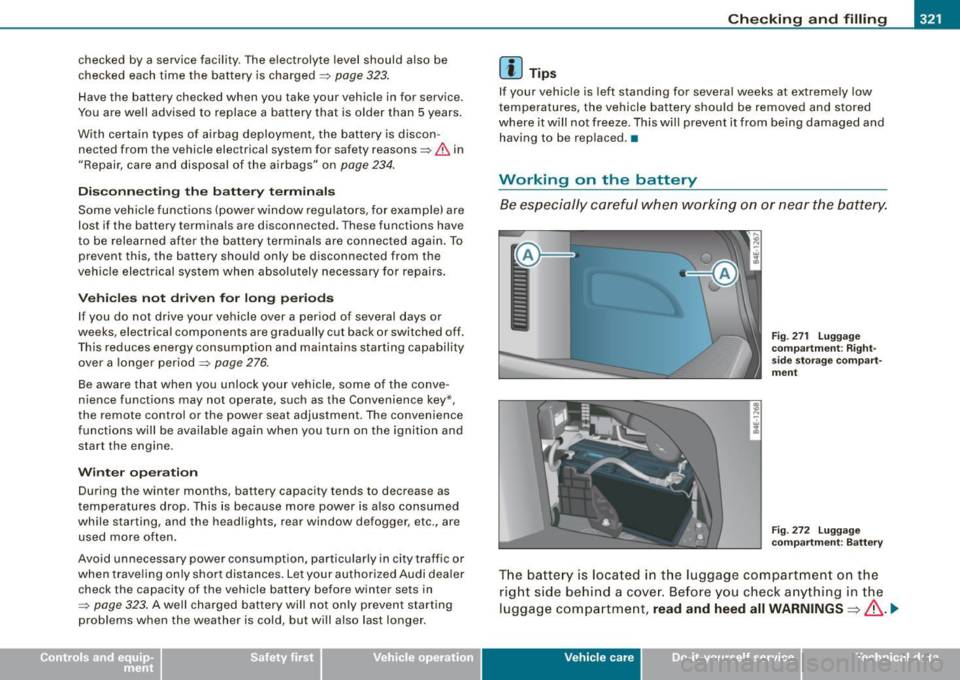
The battery is located in the luggage compartment on the
right side behind a cover. Before you check anything in the
luggage compartment,
read and heed all WARNINGS=>& . .,_
Vehic le care I I irechnical data
Page 393 of 408
______________________________________________ A_ l_,_ p _h_ a_ b_e _t_i c_ a _ l _in _ d_e _ x __ _
Weight-sensing mat .... .... . ... .. 246
When must the system be inspected?
231
Aircraft Transporting your vehicle .. .... .... 371
All Wheel Drive .. .... ....... .... .... 275
Alloy wheels ... .... .... .... ... .... .. 295
All -whee l drive
Winter tires .. ..... ... .... ..... .. . 343
A lternator
See Generator .... .... ... ..... ... . 18
Anti-freeze
See Engine coolant . ...... ..... .. . 316
Anti-lock brake system How the ABS system works . .... ... 274
Warning/indicator lights ... ... .... .. 21
Anti -Slip Regulation System (ASR)
How the system works ............ 272
An ti-t heft systems
Anti -theft ala rm system ...... .... .. 60
Electronic immob ilizer ... .. .... .... 49
Ashtray Front ... ...... ...... .... ..... ... 106
Rear .... ... .. .... .... ... .... .... 107
ASR How the Anti-Slip Regulation System works .. .... .... .... ... .... .... 272
Audi Service Repair Manua ls and Literature
382
AUTO mode AC climate con tro l .. .. .... ... .... . 1 17
Auto Safety Hotline . .... ........ .... . 209
Auto -Check Contro l .... ... .. .... .... .. 28
Controls and equip
ment Safety first
Automatic belt
retractor ... .. ...... ... 215
Automatic car wash
See Washing ..... .... .... .... .... 291
Au tomatic Shift Lock (ASU .... .... .... 168
Automatic transmission 6-speed automatic transmission .... 166
Automatic Shift Lock (ASU .... ... .. 168
Driving ............. ............ . 166
Dynamic sh ift program .... ........ 169
Emergency release for selector lever 171
Fa il- safe mode . ...... .... .... .... 171
I gnition key safety lock . ...... .... . 130
Kick -d ow n .... .... .... .... ... .... 169
Manual shift program ... .. .... .... 170
Selector lever .... .... .... .... .... 1 67
Shift buttons ... .. .... .... .... ... 1 71
Steering wheel with tiptronic .. .... . 171
Average speed . ...... .... .... .... ... . 38
Avoid damaging the vehicle .. ..... ... . 28 1
B
Background ligh ting . .... ...... ... .... 76
Battery ... .. .... ... .... .... .... .... 320
Battery location inside the luggage compartment ...... .... ... .. .... 32 1
Charging ........................ 323
I mpo rta nt warn ings when work ing o n the
battery . .... .... .... ........ ... 32 1
low ............................. 276
Replacing the battery ....... .... .. 324
State of charge ... .... .... .... .... 276
Winter operation . .... .... .... .... 320
Working on the battery .... .... .... 321 Battery vo
ltage . ... .... .. .... .... .... . 36
Before driving ... .... .... ..... .. .... 201
Blended gasoline . .... .... .... ...... . 303
Body cavity sealing .. .... .... .... ... . 296
Boos ter seat ... .. .... .... ... .... .... 253
How do I properly insta ll a b ooster sea t in
my vehic le? ............... ..... 253
Safety instructions .... .......... .. 253
Brake fluid Changing the brake fluid ... .... .... 320
Checking the brake fluid level .. ... . 319
What is the correct brake fluid level? 319
What should I do if the brake f luid warning
light comes on? ... .. .... .... .... 319
Brake system Ant i-lock brake system . ..... .. .... . 21
Brake assistant .... .... .... ....... 27 4
Brake booster ..... .... ... .... .... 274
Brake fluid .... .... .... ... .... .... 319
Brake f luid specificat ions for re fill and
replacement . .... .... .... ...... . 320
Brake light defective ... ...... ...... 26
Brake pads ....... .... .... .... ... 280
Electromechanica l parking brake .... 134
Fluid reservoir .. ...... ..... .. .... 319
How does m oisture or road salt affec t the
brakes? . .... .... .... ....... .... 272
Malfunction ............ ... .. ..... 30
Warning/indicator lights .... .... .... 22
Worn brake pads symbol ........... 34
Break -in period .. .... .... .... .... ... 279
Brake pads ... .... .... .... ...... . 280
Tires . .... .... .... .... ... .... .... 279
Bu lbs . ... .... .... .... ... .... ...... . 36 4
Vehicle operation Vehicle care Do-it-yourself service Technical data
Page 396 of 408

___ A_l.:,. p _h_ a_ b_e _t _i c_ a_l _i n_ d_e _x ____________________________________________ _
Driver information display
Driver information messages .. .... . 29
Introduction . ....... ... .. .... .... . 24
Open door or rear lid warning .. .... . 26
Outs ide temperature disp lay .... .... 25
Sound system display ... .. .. . .... . 25
Driver In forma tion Sys tem
Digital speedometer . . . . . . . . . . . . . . . 25
Driver's seat . . . . . . . . . . . . . . . . . . . . . . . . 87
Driver's seat memory . . . . . . . . . . . . . . . . . 94
Activating remote contro l key . ..... . 95
Recalling a seat position ...... .... . 94
Storing a seat position . ...... ..... . 94
Driving messages .................... 29
Driving safely ... .... ... .... ... .. ... 200
Driving time . .... .... .... .... .... .... 38
Dupl icate key . ........ ... .... .... ....
47
DVD player for navigation system . . . . . 112
E
Easy entry feature 129
Elect romechanica l parking brake
Emergency braking .... .... ... .... 136
Malfunction .. .... .... .... ... .... 136
Operation . . . . . . . . . . . . . . . . . . . . . . . 134
Parking . . . . . . . . . . . . . . . . . . . . . . . . . 135
Releasing and app lying .. .... ..... 134
Starting off with a trailer . .... ..... 136
Warning /indicator lights . .......... 22
Electronic differential lock (EDU How the system works . . . . . . . . . . . . 271
Warning/indicator lights . .... ..... . 21 Electronic immobili
ze r .. .. .... ..... 14 , 49
Electronic power control (EPC) warning/indicator light ... ..... 18
Electronic speed limiter .... .... .... ... 28
Electronic stabi li z ation program (ESP)
How the system works ....... .... . 270
Wa rning/indicator ligh ts ........... 18
Emergency braking . .......... .. ... . 136
Emergency closing Power sunroof . ... .... .... .... . 66 , 67
Emergency flasher . . . . . . . . . . . . . . . . . . . 73
Warning/indicator ligh ts ........... 19
Emergency locking . . . . . . . . . . . . . . . . . . . 54
Emergency locking of doors .. ... ... .. . 54
Emerg ency starting . ...... .. ... .... . 366
Emergency towing .. ... .. ... .. .. .... 368
Emergency warning triangle .. ... .... . 350
Energy management ... .. ..... ... ... 276
Battery power . . . . . . . . . . . . . . . . . . . 277
Driver no tification . . . . . . . . . . . . . . . . 277
Engine 4.2 1, 8-cylinder (350 hp) .... ... .... 310
6.0 I, 12 -cylinder (450 hp) . ...... ... 311
Compartment ... .... .... .... 3 10,311
Coolant . .. ...... ... ........ .. ... 316
Hood . .... .... .... .... ........ .. 308
Starting .. .... ... ..... ... ... 129, 130
Starting wi th jumper cables ... .... 366
Stopping ............ .... .... .... 131
Engine compartment ... .... .... ..... 310
Safety instructions .......... .... . 309
Working the engine compartment .. 309 Engine coolant
.. .. .. .. .. .... .... ... 316
Adding coolant ... .... .... .... ... 318
Checking the engine coolant level .. 317
Expans ion tank .... ... .... .... ... 317
Malfunction symbol ... .... .... .... 31
Radiator fan .... . ...... .... .. ... . 319
Temperature gauge ... .... .... .. .. 12
Engine data .. ..... .. . ... ... . .. .. .. . 380
Engine hood Closing ... .. .... .... .. .. . ... ... . 309
How to release the hood . . . . . . . . . . 308
Engine oil ... ..... .... .... .. . ... ... . 311
Adding ..... .... .... .. .. . ... ... . 314
Additives . ... .... .... .. .. . ... .... 314
Changing .... .... .... ... . ... .... 315
Checking the engine oil leve l ....... 313
Indications and conditions requir ing extra
checking .... .... .... ... .... ... 313
Oil consumption . ...... .. .. ... .. . 313
Oil grades ..... ... ... ...... ... .. . 311
Oil level symbol .. ........ .... ... .. 35
Pressure malfunction ...... .... .. . . 32
Recommended oil check intervals . . 313
Sensor defec tive . . . . . . . . . . . . . . . . . . 35
Speci fication and viscosity .. .... ... 311
Engine speed limitation . ... .. ... .... .. 35
Environment Break -in period ....... ........... 279
Catalytic converter .... ..... ...... 280
Disposing of your vehic le battery ... 324
Driving at high speeds ... .... ... .. 281
Driving to minimize pollution and noise . 281
Fuel .. ...... ....... ...... .... ... 305
Page 397 of 408
______________________________________________ A_ l_,_ p _h_ a_ b_e _t_i c_ a _ l _in _ d_e _ x __ _
Fuel economy ...... .... .... .... .. 281
Leaks under your vehicle ... .. .... . 309
Lettin g the vehicle s tand and warm up .
28 2
Pr oper disposal of drained brake fluid
320
Proper disposal of dra ined e ngine
coolant ........................ 318
Proper disposal of drained engine oil ...
314,3 15
Recycling used engine oi l ........ .. 314
Un leaded fuel ... .. ... .. ...... .... 303
What should I do with an old battery? 324
EPC
See Electronic power control ........ 18
ESP
See Electronic stabilization program
(ESP) ... ..... ......... ....... ... 18
Event Data Recorder (EDR) ... .... ..... 270
Expans ion tank ...... ... .. ........ .. 317
F
Fan
Radia tor .. ...... ........ ..... .. . 319
Flat tire changing .................... 45
Floor mats ..... .... .... .... ... .... . 207
Fog lights Front .. ... .. .... .... .... ...... ... 71
Rear .... ... .. ....... .. ....... ... . 71
Warning/indicator lights ...... .... .. 19
Fo lding master key with remote control . 47
Foot pedals ... ... .. .... .... .... .... 206
Controls and equip
ment Safety first
For the sake of the environment
Gaso line fumes and the environment 305
L etting your engine warm up .. .... . 130
Reducing engine noise by ear ly
upshifting . ...... .... .... ... .... . 12
Refueling . .... ... .... .... .... .... 305
Saving fuel by early upshifting .... .. 12
Using the rear window defogger .... 124
F ront a irbags
Description ... .... .... .... .... ... 224
How they work ................... 229
Front arm rest adjusting ..... ... .... .... .... .... . 93
Storage compartment ... ...... .... . 93
Front ashtray .... ..... .. ..... .... ... 106
Front fog lights ... .. .... .... .... .... . 71
Front seats ...... .... ........ ....... . 86
Adjusting .. ...... .... .... .... ... 203
Ch ild restra ints in the front seat ... . 222
Convenie nce side v iew .. ...... .... . 91
Poc kets ... .. .... .... .... .... .... 1 10
Symmetrica l seat positions . ...... .. 91
Fronta l collisions and the laws of physics
212
Fuel Additives ... .. ..... .. .... .... .... 303
Average c onsumption .... ...... ... . 38
Blended gasoline ... .. .... .... .... 303
F uel filler neck . ...... .... .... .... 304
Fuel gauge .. ....... .... .... .... .. 14
Gasoline ...... ... .... .... .... ... 303
Gaso line additives ................ 304
I nstantaneous fuel consumption ..... 38 Low
fuel level symbol .... ... .. ..... 35
Octane rating .... .... .... .... .... 303
Recommendation . .... .... .... .... 303
Refuelling . ... .... .... ...... ..... 305
Reserve .......................... 14
Tank capacity .. ...... .... .... . 14, 380
Un lock ing the fue l filler flap by hand 307
Fuse arrangement ... ....... ... .. .... 360
G
Garage door opener (Homelink®) ...... 194
Gas discharge lamps ...... .... .... ... 364
Gauges Engine coolant temperature . ...... .. 12
Fuel gauge ... .... .... ... .... .... . 14
Speedomete r ..... .... ... .... ..... 1 4
Tac hometer . ... ... .... ... .... .... . 13
Trip odometer ... .. .... .... ...... .. 14
General illustration Instruments and controls ......... .. 11
Generator Warning/indicator lights .... .... .... 18
G lossary of t ire and loading terminology . . .
327
G love compartment .. ....... .... .... 109
cd changer ... .... .... .... .... ... 109
Owner's Literature .... .... .... .... 109
Gross Vehic le Weight Ra ting (GVWR) ... 377
Vehicle operation Vehicle care Do-it-yourself service Technical data
Page 398 of 408

___ A_l.:,. p _h_ a_ b_e _t _ic _ a_l _in _ d_e _x ____________________________________________ _
H
Head restraints . . . . . . . . . . . . . . . . . . . . . 205
Adjusting ....................... 205
Comfort head restraints ....... .... . 91
Front seats . . . . . . . . . . . . . . . . . . . . . . . 91
Rear seats . . . . . . . . . . . . . . . . . . . . . . . 92
Headlight range control . . . . . . . . . . . . . . . 36
Headlights ... .... ... .... .... ...... .. 69
Adaptive Light .... .... .... ...... .. 72 Hood
Opening 308
Release lever . . . . . . . . . . . . . . . . . . . . 308
Horn .. ...... ............ ....... .... 11
How many a irbags does my vehicle have? ..
227
How often should I check my tire pressures?
334
How safety belt pretensioners work .... 218
Hydroplaning ........ .... .... ...... 338 Instrumen
ts and controls
General illustration ................ 11
Illumination ...................... 15
Instrument cluster .. .... ..... .. .... 12
Int erior lights
Background lighting .... ... ........ 76
Front ............................ 74
Rear ...... .... ... ..... .. . .. .. .... 75
Intermittent wiping
Rain sensor ... .... .... ...... .... . 80
Defective . . . . . . . . . . . . . . . . . . . . . . . . 26
Front fog lights . . . . . . . . . . . . . . . . . . . 71
I J
Switching off ..................... 69
Switching on ...... ....... ........ 69
Washer reservoir . . . . . . . . . . . . . . . . . 325
Washer system . . . . . . . . . . . . . . . . . . . 81
Xenon headlights . . . . . . . . . . . . . . . . . 69
Heated Front seats . . . . . . . . . . . . . . . . . . . . . . 118
Rear seats . . . . . . . . . . . . . . . . . . . . . . 119
Windshield ...................... 123
Heated outside mirrors . . . . . . . . . . . . . . . 84
Heated seats Front . . . . . . . . . . . . . . . . . . . . . . . . . . . 118
Rear seats . . . . . . . . . . . . . . . . . . 119, 125
Heated steering wheel ............... 119
Heated washer jets
Wiper and washer system . . . . . . . . . . 80
Heavy clothing and safety belts ....... 214
High beam . . . . . . . . . . . . . . . . . . . . . . . 69, 73
Warning/indicator lights . .... . ... .. 19
High voltage warning label ... .... .... 376
Homelink® universal remote control .. 194 Ignition key
129 Jack
351
Ignition lock .. .... .... .... .... .... .. 129 Jumper cables .. ...... .... .... .... .. 367
Malfunction .. .... .... ... .... ..... 33 Jump-starting .... .... .... .... ...... 366
Ignition lock posit ions .......... ..... 129
Immobilizer ......................... 14 K
Important things to do before driving .. 201
Improperly worn safety be lts ......... 218
Indicator light
Airbag system ............... 231, 232
PASSENGER AIR BAG OFF ......... 232
Key ...... .... .... .... ... ....... .... 47
Battery replacement master key ... .. 48
Coded settings ................... 114
Emergency key .................... 47
Key replacement .................. 47
Indicator lights ....... ... ........ .... 16
Master key ....................... 47
Infant seat ........... ........ .... .. 250
Valet key ...... .... ............... 47
How do I properly install an infant seat in Key coded settings
my vehicle? .. ...... ....... .. ... 250
Climate controls .. .......... ..... 114
Safety instructions .............. . 250
Installing a child safety seat Safety belts . . . . . . . . . . . . . . . . . . . . . 255 Keyless
entry remote control . .......... 48
Kick-down .... ....... .... ... .... ... 169