spare tire AUDI S8 2009 User Guide
[x] Cancel search | Manufacturer: AUDI, Model Year: 2009, Model line: S8, Model: AUDI S8 2009Pages: 408, PDF Size: 91.63 MB
Page 344 of 408
-~_T_ ir_e_ s_ a_ n_d _ w_ h_ e_e _l_s _________________________________________________ _
• If the spare tire is different from the tires that you have mounted
o n your vehi cle (for e xample winter tires or wide profile tires), then
use the spare tire for a short period of time on ly and drive with extra
care . Replace the f lat tire with the tire matching the others on your
vehicle as soon as possible.
• If you should put different wheels and tires on your vehicle (e.g.
winter wheels and tires), you must be certain that the wheels and
tires are compatible with the tire pressure monitoring system* .
Otherwise the system will register a ma lfunction and a fault
message will be displayed . For more information, contact your Audi
dea ler.
0 Note
• When installing new tires, be careful not to damage the valves or
tire pressure monitoring system* sensors.
• Never drive without the va lve stem cap. The valves could get
damaged.
• If the sensors must be replaced, then the valve must also be
replaced at the same time.
c£> For the sake of the environment
Dispose of old tires in accordance with the loca l requirements. •
Uniform tire quality grading
• Tread wear
• Traction AA A B C
• Temperature A B C
Qua lity grades can be found where applicable on the tire side wal l
between tread shoulder and maximum section width
=> page 338,
fig. 278.
For e xample: Tread wear 200 , Traction AA, Temperature A.
All passenger car tires must conform to Federal Safety Require
ments in addit ion to these grades.
Tread w ea r
The tread wear grade is a comparative rating based on the wear rate
of the tire when tested under contro lled conditions on a specified
government test course.
For example, a tire graded 150 wou ld wear one and one half (1 1/2)
times as well on the government course as a tire graded 100.
The relative performance of tires depends upo n the actua l condi
tions of their use, however, and may depart significantly from the
n orm due to variations in d riving habi ts, service practices and differ
ences in road characteristics and climate.
Tra ction
The traction grades, from highest to lowest, are AA, A, Band C.
Those grades represent the tire's ability to stop on wet pavement as
measured under contro lled conditions on specified government
t est surfaces of asphalt and concrete . A tire marked C may have
poor traction performance => & .
Temperature
The temperature grades are A (the highest), 8, and C, representing
the tire's resistance to the generation o f heat and its abi lity to dissi
pate heat when tested under control led conditions on a specified
indoor laboratory test wheel.
Sustained high temperature can cause the mater ial of the tire to
degenerate and reduce tire life, and excessive temperature can lead
to sudden tire failure=>&.
T he grade C corresponds to a leve l of performance which a ll
passenger car tires must meet under the Federal Motor Vehicle
Safety Standard No. 109. Grades Band A represent higher levels of
p er formance on the la b ora tory test whee l than t he mi nimum
required by law.
~
Page 345 of 408
________________________________________________ T_ i _r_e _s_ a_n_ d_ w_ h_ e_e _ l_s __ lllll
•
& WARNING
The tr action grade ass igned to this t ire i s based on straight -ahead
braking traction tests, and does not include acceleration,
c ornering , hydroplaning or peak tra ction chara cteristic s.
& WARNING
The temperature grade for this t ire is established for a tire that is
properly inflated and not overloaded. Excessive speed , underinfla
tion , or ex ces sive loading , either separately or in combination , can
c ause heat buildup and possible tire failure . •
Winter tires
W inter tires c an im prove vehicle handli ng on snow and
ice. At t emperatures belo w 45 °F (7 ° C) we re comme nd
cha ngi ng to wint er tires.
In some heavy snow areas, local governments may require true
winter o r "snow" tires, those with very deeply cut tread. These tires
shou ld on ly be used in pairs and be i nstalled on all four wheels .
M ake sure you purchase snow tires that are the same size and
co nstruction type as t he o the r tires on your vehicle .
I f your vehicle is equipped with all -wheel drive *, this will improve
t raction d uring win te r dr iving, eve n with the s ta n dard ti res .
However, we strongly recommend that you always equip a ll four
w hee ls on you r vehic le wi th cor rec tly fit ted w inter tires o r all-season
t ir es, when w inter road co nditions ar e expected . T his also improves
the vehicle 's br aking perfo rmance and reduces stopping distances.
Summer tires p rov ide less gr ip on ice a nd sno w.
Winter tires (snow tires) must a lways be fitted on all four whee ls .
Compatible ti re pres sure monito ring sensors * must be insta lled on
all four wi nte r tires fo r the t ire pressu re mon ito ring system* to fu n c
tion proper ly ~
page 34 0.
Ask your authorized Audi dealer or qualified workshop for permitted
winter tire sizes. Use only ra d ial winter tires .
Winter tires lose their effectiveness when the tread is worn down to
a depth of 0 .157 inch ( 4 mm).
Only d rive wi th winter tires und er w inter cond itio ns. Summer t ires
handle better when there is no snow or ice on the roads and the
t empe ra tu re i s above 4 5 °F (7 °C) .
I f you have a f lat tire, see notes on spare whee l
~ page 338.
Please a lways remember that winter tires may have a lower speed
r ati ng tha n the ti res orig in ally installed o n yo ur veh icl e at the time
it was manufactured . P lease see~
page 340, "Speed rating (letter
c od e)" for a l isti ng of th e speed ratin g le tter codes a nd the
maximum speed at which the tires can be driven.
The s peed ra ting letter code( ~
page 329) is on the side wa ll of the
t ir e ~
page 338 .
& WARNING
Winter tires have ma ximum speed limits that may be lower than
your vehicle's maximum speed . Always know the maximum speed
before driving off . Never drive faster than the speed permitted for
your specifi c winter tires. This will cause damage to the tires
leading to an accident and serious personal injury to you and your
passengers .
& WARNING
Driving faster than the maximum speed for which the winter tires
on your vehicle were designed can cause tire failure including a
blowout and sudden deflation , loss of control , crashes and serious
personal injuries. Have worn or damaged tires replaced immedi
ately.
• Winter tires have maximum speed rating that may be lower
than your vehicle's maximum speed.
Vehicle care
I t •
Page 353 of 408
What do I do now? -
------------------
[ i J Tips
If you no longer have your original warning triang le and need to
equip your vehicle with a new one, contact your authorized Audi
dealer for a replacement .•
Jack, tools and spare wheel
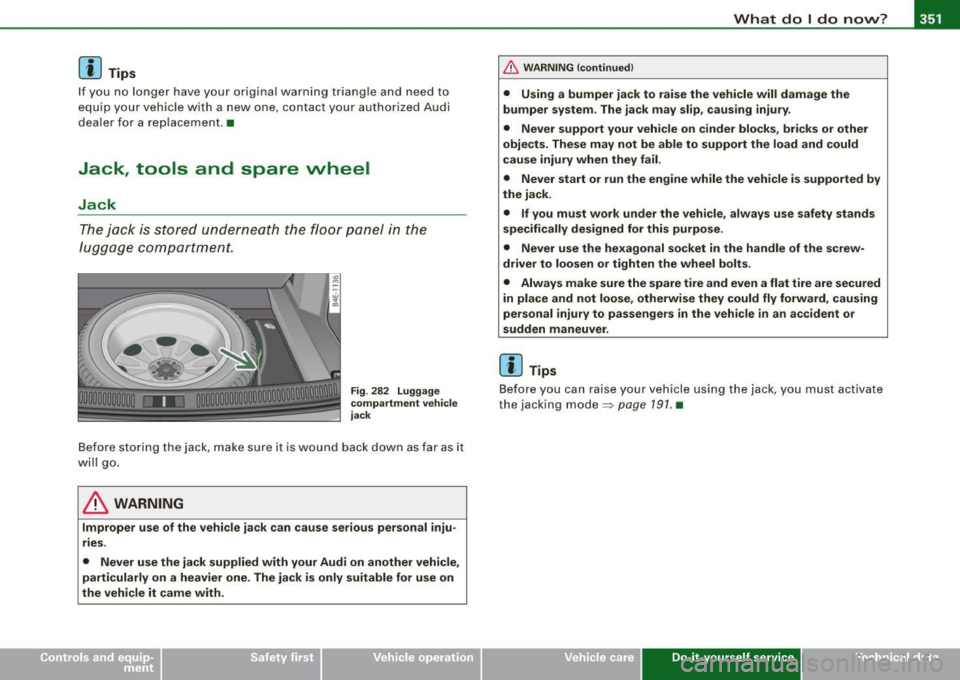
Jack
The jack is stored underneath the floor panel in the
luggage compartment.
Fig . 282 Luggage
compartment vehicle
jack
Before stori ng the jack, make sure it is wound back down as far as it
will go.
& WARNING
Improper use of the vehicle jack can cause serious personal inju
ries.
• Never use the jack supplied with your Audi on another vehicle,
particularly on a heavier one. The jack is only suitable for use on
the vehicle it came with.
& WARNING (continued)
• Using a bumper jack to raise the vehicle will damage the
bumper system. The jack may slip, causing injury.
• Never support your vehicle on cinder blocks, bricks or other
objects. These may not be able to support the load and could
cause injury when they fail.
• Never start or run the engine while the vehicle is supported by
the jack.
• If you must work under the vehicle, always use safety stands
specifically designed for this purpose .
• Never use the hexagonal socket in the handle of the screw
driver to loosen or tighten the wheel bolts.
• Always make sure the spare tire and even a flat tire are secured
in place and not loose, otherwise they could fly forward , causing
personal injury to passengers in the vehicle in an accident or
sudden maneuver .
[ i J Tips
Before you can raise your vehicle using the jack, you must activate
the jacking mode~
page 191. •
Vehicle care Do-it-yourself service irechnical data
Page 355 of 408

What do I do now? Ill
---------------~.;______
•
-Disengage and lower the floor panel before you close the
luggage compartment lid again.
Storing the replaced wheel
-Place the replaced wheel inside the spare wheel well in
the luggage compartment.
Tighten the knurled retaining screw clockwise to secure
the wheel in place.
- Disengage and lower the floor panel before you close the
luggage compartment lid again.
& WARNING
Loose items in the passenger compartment can cause serious
personal injury during hard braking or in an accident .
• Never store the spare wheel or jack and tools in the passenger
compartment.
• Always store all jacking equipment, tools, and the spare wheel
in the luggage compartment.
• Tighten the knurled retaining screw for the spare wheel
securely.
[ i] Tips
Check the inflation pressure of the spare tire periodically to keep the
tire ready for use. •
Changing a wheel
Before changing a wheel
Observe the following precautions for your own and your
passenger's safety when changing a wheel.
- After you experience a tire failure, pull the car well away
from moving traffic and try to reach level ground before
you stop
~ & .
- All passengers should leave the car and move to a safe
location (for instance, behind the guardrail) ~& .
- Engage the parking brake to prevent your vehicle from
rolling unintentionally ~& .
- Move selector lever to position P
~ &.
-If you are towing a trailer: unhitch the trailer from your
vehicle.
- Take the jack and the spare tire out of the luggage
compartment~
page 351.
& WARNING
You or your passengers could be injured while changing a wheel if
you do not follow these safety precautions:
• If you have a flat tire, move a safe distance off the road. Turn off
the engine, turn the emergency flashers on and use other warning
devices to alert other motorists.
• Make sure that passengers wait in a safe place away from the
vehicle and well away from the road and traffic.
• To help prevent the vehicle from moving suddenly and possibly
slipping off the jack, always fully set the parking brake and block
the wheel diagonally opposite the wheel being changed. When one ..,
Do-it -yourself service
Page 356 of 408
1111 What do I do now? ..._ __________________________________________ _
& WARNING (continued )
front wheel is lifted off the ground , placing the Automatic Trans
mission in "P" (Park) will
not prevent the vehicle from moving.
• Before you change a wheel, be sure the ground is level and firm.
If necessary , use a sturdy board under the jack.
• After installing the spare wheel, make sure that you replace the
flat tire/wheel in its storage area properly and tighten the knurled
retaining screw securely.
[ i J Tips
Before changing the wheel, you must activate the jacking mode, so
that the automatic controls for the Adaptive Air Suspension do not
make it more difficult to lift the vehicle with the jack =>
page 791. •
Changing a wheel
When you change a wheel, follow the sequence described
below step-by-step and in exactly that order.
1. Activate the vehicle jacking mode~ page 191.
2. Remove the decorative wheel cover*. For more details
see also
~ page 355, "Decorative wheel covers" or
~ page 355, "Wheels with wheel bolt caps" .
3. Loosen the
wheel bolts ~ page 356.
4. Locate the proper mounting point for the jack and align
the jack below that point~
page 356.
5. Lift the car with the jack~ page 356.
6. Remove the wheel with the flat tire and then install the
spare
~ page 358 .
7. Tighten all wheel bolts lightly. 8.
Lower the vehicle with the
jack.
9. Use the wheel bolt wrench and
firmly tighten all wheel
bolts
~ page 356.
10. Replace the decorative wheel cover*.
11. Deactivate the vehicle jacking mode~ page 191.
& WARNING
Always read and follow all WARNINGS and information :::::> 6 in
" Raising the vehicle" on
page 356 and => page 359. •
After changing a vvheel
A wheel change is not complete without the doing the
following.
- Store and secure the wheel you replaced in the spare
wheel well.
- Replace the tools and the jack in their proper location.
- Check the
tire pressure on the spare wheel immediately
after mounting it.
- As soon as possible , have the
tightening torques on all
wheel bolts checked with a torque wrench. The correct tightening torque is 90 ft lb (120 Nm) .
- Have the flat tire
replaced as soon as possible.
[ i J Tips
• If you notice that the wheel bolts are corroded and difficult to
turn while changing a tire, they should be replaced before you check
the tightening torque. .,_
Page 360 of 408

IIIIIL--____:W:...:....:. h.:..: a::.. t:....: d.:..:o:....:. l...: d::.. o ..:.... n:..:..:: o...:w ...:...;. ? ____________________________________________ _
Taking the wheel off/installing the spare
Follow these instructions step-by-step for changing the
wheel
Fig . 291 Changing a
wheel: using the
screwdriver handle
!with the blade
removed) to turn the
bolts
Fig . 292 Changing a
wheel: alignment pin
inside the top hole
After you have loosened all wheel bolts and raised the
vehicle off the ground, remove and replace the wheel as
follows:
Removing the wheel
-Use the hexagonal socket in the screwdriver handle to
completely remove the topmost wheel bolt and set it
aside on a
clean surface => fig. 291. -
Screw the threaded end of the
alignment pin from the
tool kit hand-tight into the empty bolt hole=> fig. 292.
- Then remove the other wheel bolts as described above .
- Take off the wheel leaving the alignment pin in the bolt
hole.
Putting on the spare wheel
- Lift the spare wheel and carefully slide it over the align
ment pin to guide it in place.
- Use the hexagonal socket in the screwdriver handle to
screw in and tighten all wheel bolts
slightly.
- Remove the alignment pin and insert and tighten the
remaining wheel bolt slightly like the rest.
Turn the jack handle counter-clockwise to lower the
vehicle until the jack is fully released.
- Use the wheel bolt wrench to tighten all wheel bolts
firmly=>
page 356. Tighten them crosswise, from one
bolt to the (approximately) opposite one, to keep the
wheel centered.
[ i ] Tips
Never use the hexagonal socket in the handle of the screwdriver to
loosen or tighten the wheel bolts.
• Pull the reversible blade from the screwdriver before you use the
hexagonal socket in the handle to turn the wheel bolts.
• When mounting tires with
unidirectional tread design make sure
the tread pattern is pointed the right way=>
page 359.
• The wheel bolts should be clean and easy to turn. Check for dirt
and corrosion on the mating surfaces of both the wheel and the .,,_
Page 361 of 408

_______________________________________________ W_ h_ a_t _ d_ o_ l _d _o_ n_ o _ w_ ? __ fflll
•
hub. Remove all dirt from these surfaces before remounting the
whee l.•
Tires with unidirectional tread design
Tires with unidirectional tread design must be mounted
with their tread pa ttern pointed in the ri ght direction.
Using a spar e tire with a tread pattern intended for u se
in a sp ecific di rec tion
When using a spare tire with a tread pattern intended fo r use in a
specific direction, p lease note the following:
• The direction of rotation is ma rked by an arrow on the side of the
tire .
• I f the spare tire has to be insta lled in the incorrect direction, use
the spare tire only temporarily since the tire wi ll not be able to
achieve its optimum performance characteristics with regard to
aquaplaning, noise and wear.
• We recommend that you pay particular attention to this fact
during wet weather and that you adjust you r speed to match road
conditions .
• Replace the flat tire with a new one and have it installed on your
veh ic le as soon as possible to restore the handling advantages of a
un idirectional tire. •
Notes on wheel changing
Please read the information :::::, page 338, "New tires and replacing
tires and whee ls" if you are going to use a spare tire which is
di fferent from the t ires on your veh ic le.
After you change a tire :
• Check the tire pre ssure on the spare immediately after installa
tion . • Have the wheel bolt t
ighten ing torque che cked with a torque
wrench as soon as possible by your authorized Audi dealer or a qualified service station .
• With steel and alloy wheel rim s, the wheel bolts are correctly
tighte ned at a torque of 90 ft lb (120 Nm ).
• If you noti ce that the wheel bolt s are corroded and difficult to
turn while changing a ti re , they should be replaced before you che ck
the tightening torque .
• Replace the flat t ire with a new one and have it installed on your
vehicle as soon a s possible . Remount the whee l cover.
Until then , dri ve with extra care and at reduced speed s.
& WARNING
• If you are going to equip your vehi cle w ith tires or r ims which
differ from those which were factory in stalled , then be sure to read
the information :::::,
page 338, uNew tires and repla cing tires and
wheel s".
• Always mak e sure the d am aged wheel or e ven a flat t ire and
the jack and tool kit are properl y secured in the luggage compart
ment and are not loose in the pass enger compartment .
• In an a ccident or sudden maneuver they could fly forward ,
injur ing anyone in the vehicle .
• Alway s store damaged wheel , ja ck and tools securely in the
luggage comp artment . Otherwise , in an accident or sudden
m aneuv er they could fly forward , cau sing injury to pas senger s in
the veh icle .
• Do not use commercially available ti re sea lants. Othe rwise, the
ele ctri cal component s of t he tire pres sure mon itor ing system * will
no longer wo rk properly and the sen sor for the tire pre ssure moni
tor ing s ystem* w ill have to be replaced by a qualified workshop . •
Do-it -yourself service
Page 363 of 408
_________________________________________________ F_ u_ s_ e_s _ a_n _d_ b_ u _ lb_ s _ __._
[ i J Tip s
You are wel l advised to keep a supply of spare fuses in your vehic le.
Fuses with the proper ampere ratings are available at your Audi
dealer. •
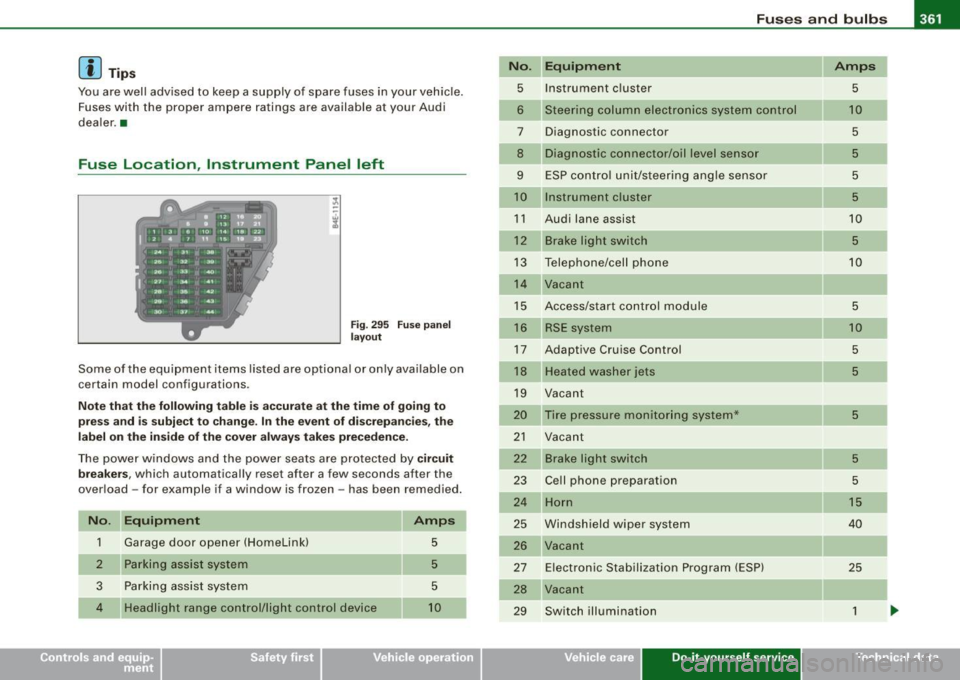
Fuse Location , Instrument Panel left
F ig. 295 Fuse pan el
l ayout
Some of the equipment items listed are optiona l or only available on
certain model configurations.
No te t hat th e fo llow ing t able is acc urate a t the time o f goin g to
p re ss an d is s ubject to c hang e. In the e vent of di screpancies, the
lab el on the insi de of th e cover alwa ys ta kes prece dence .
The power windows and the power seats are protected by cir cui t
bre akers,
which automatically reset after a few seconds after the
over load -for example if a window is frozen -has been remedied .
N o. Equipm ent
1 Garage door opener (HomeLinkl 5
Parking assist system 5
3
Parking assist system 5
4
Headlight range control/light control device 10
No .
5
6
7
8
9
10
11
12
13
14
15
16
17
18
19
20
21
22
23
24
25
26
27
28
29
Equipm ent Amps
Instrument c luster
5
Steering column electronics system control 1 0
Diagnostic connector 5
Diagnostic connector/oil level sensor 5
ESP contro l unit/steering angle sensor 5
Instrument cluster 5
Audi lane assist 10
Brake light switch 5
Telephone/cell phone 10
Vacant
Access/start control module
5
RSE system 10
Adaptive Cruise Control 5
Heate d washer jets 5
Vacant
Tire pressure monitoring system*
5
Vacant
Brake light switch
5
Ce ll phone preparation 5
Horn 1 5
Windshield wiper system 40
Vacant
E lectronic Stabilization Program (ESP)
25
Vacant
Switch illumination
1
Vehicle care Do-it-yourself service irechnical data
Page 386 of 408
___ C_ o_n_ s_ u_m _ e_ r_ ln_ f_o _r_m _ a_ t_ i_o _n ______________________________________________ _
& WARN ING (continued )
• The engine compartment of any motor vehicle is a potentially
hazardous area . Never rea ch into the area around or to uch the
radiator fan . It is temperature controlled and can sw itch on
suddenly -even when the engine is off and the ignition key has
been removed . The radiator fan switches on automatically when
the coolant reaches a certain temperature and will continue to run until the coolant tempe rature drops .
• Always remove the ignition key before anyone gets under the
vehi cle .
• Always support your vehicle with safety stands if it is neces
sary to work underneath the vehicle . The jack suppl ied with the
vehicle is not adequate for this purpose and could collap se
causing serious personal injury .
• If you must work underneath the vehicle with the wheels on
the ground, always make sure the veh icle is on level ground , that
the wheels are always securely blocked and that the engine
cannot be sta rted .
• Always make sure the tr ansmission selector lever (automatic
transmission) is in "P" (Park position ) and the p ark brake is firmly
applied.
W For the sake of the environment
• Cha ng ing the e ngin e sett ings will a dverse ly aff ect em iss ion
levels. This is detrimenta l to the environment and increases fuel
co nsump tion .
• Always observe environmenta l regu lations when disposing of
o ld eng ine oil, u sed bra ke flu id, d irty eng ine coo la nt, spent batter ies
or worn out tires.
• Undeployed airbag modul es and pretensioners might be classi
fied as Perchlorate Material -specia l handling may apply, see
www .d tsc.ca .gov/ hazardouswaste/pe rc h lora te . W hen t he vehicle or
parts of the restraint s ystem including airbag modules safety be lts
with pre tensio ners are sc ra p pe d, a ll ap pl ica ble laws and reg ula- tions must be observed. Your authorized Audi dea
ler is familiar with
t hese requi reme nts and we reco mmend th at you h ave your dealer
perform th is serv ice for you. •
Additional accessories,
modifications and parts replacement
Additional accessories and parts
replacement
A lways consult an author ized Audi dea ler before
pur chasin g access orie s.
Y our vehicle incorporates the latest safety design featu res ensuring
a hi gh standa rd of active a nd passive sa fety .
T his saf ety could be com promised by non -approved changes to th e
vehic le . Fo r thi s reason, i f parts have to be replaced, p lease obse rve
th e fo llow ing po ints wh en insta lling add it io na l acc essories:
Approved Audi accessories and genuine Audi parts are avai lable
from autho rized Audi dea lers .
T hese dealers also have the necessary faci lities, tools and trained
spec ia lists to ins tal l the part s and accessorie s prope rly.
& WARNING
Using the wrong spare parts or using non -approved accessories
can cause serious personal injury.
• Use only accessorie s expressly approved by Audi and genuine
Audi spare parts
• These parts and accessories have been specially designed to
be used on your vehicle .
• Never install accessories such as telephone cradles or
beverage holders on airbag covers or within the airbag deploy-