suspension AUDI S8 2009 User Guide
[x] Cancel search | Manufacturer: AUDI, Model Year: 2009, Model line: S8, Model: AUDI S8 2009Pages: 408, PDF Size: 91.63 MB
Page 190 of 408
-L~A~d~a~ p~ t~iv~ e~A~ ir~ S~u~ s ~p~ e~n~ s~io~n ~-------------------------------------------
Adaptive Air Suspension
Adaptive Air Suspension and
Damping
Description
Adaptive Air Suspension and damping can be regulated and they adapt automatically t o a request from the driver
and the driving situation at the time.
Adaptive Air Suspension is an electronica lly controlled springing
and damping system. This chassis system makes it easier on the
driver by adapting to the particular situation through imperceptible
control processes.
The
Ad aptiv e Ai r Suspen sion component regulates ground clear
ance depending on vehic le speed, load condition and driver input.
Accelerating to a speed above a predetermined limit wil l make the
vehic le lower itself. On the other hand, driving more slowly results
in the vehicle raising aga in at specific speeds.
The
damping component provides individual control of the
damping forces . For example, with damping c haracteristics set to
provide greater comfort, damping is set somewhat harder for a brief period only as required, for example, when going around a curve or
over rough road surfaces as well as when braking.
Settings
Adaptive Air Suspension provides the driver w ith the opportunity to
set the chassis characteristics also to their individual preference .
With the driving modes
standard, automatic and dynamic the driver
has three chassis settings available, ranging from comfort to sporty.
In addition,
lift provides a fourth mode which can be selecting for
driving over poor stretches of road=>
page 189, "Chassis Controls".
The modes are set in MMI =>
page 191.
On vehicles equipped with the s port su spen sio n Adaptive Air
Suspension -Sport*, there is generally more emphasis on a sporty
chassis setting. Settings range from comfortable to firm
=>
page 190, "Sport Chassis Contro ls".
0 Note
• Whenever you park your vehicle, always make sure there is
adequate c learance
above and below the vehic le . The height of the
parked vehicle can change as the result of temperature fluctuations,
changes in load conditi on and changes in the driving m ode (gro und
clearance).
• Mount the tie -down chains/cables over the running surface
(circumference) of the tires . Never secure the vehicle by the axle, the
suspension stru ts or the front or rear towline eye. For technical
reasons, the pressure in the suspension struts may change during
the transport and this wi ll adversely affect vehicle handling.
• To prevent damage to the vehicle underbody, remember that
you r veh ic le is not an off -road vehicle, even in the lift mode. The
ground c learance is insufficient for this type of operation.
• If you are going to tow a trai ler, you must activa te the trai ler oper
ation mode=>
page 792.
[ i ] T ip s
Before you can raise your vehic le using the vehicle jack (for
example, when changing a flat tire) you must activate the jacking
mode=>
page 191 . •
Page 191 of 408
____________________________________________ A_ d_a--' p=-- t_iv _e_ A_ ir_ S_u_ s-=- p_e _ n_ s _ io_ n __ JIIII
Chassis Controls
Four different driving modes can be set by the driver.
The automatic control processes are speed -and time -dependent.
For example, it is not possib le to raise the suspension to the lift
mode above certain speeds .
When a speed of about 75 mph ( 120 km/h) is exceeded for more than
30 seconds, the vehicle is automatically lowered approximately 1
inch (25 mm) to a level suitable for highway speeds, except in the
standard mode . Road holding is optim ized as a result of the lower
center of gravity and fue l consumption is reduced as a result of
reduced wind resistance .
Level adjustment
lift
automatic
dynamic
a utomati c Ground
clear ance
about 5 .7 inches (145 mm)
a bout 4.7 inches ( 120 mm)
about 4 .7 inches (120 mm)
about 3 .9 inches (100 mm)
Select the automatic mode if you prefer a suspension setting
e m phasizing comfort. Damping characteristics emphasizing
comfort are selected in this mode.
• Lower ing : When a speed of about 75 mph (120 km/h) is exceeded
for more than 30 seconds, the vehicle is automatically lowered by about 1 inch (25 mm) .
• Rais ing : The vehicle is automatically raised again if the speed
falls be low about 44 mph (70 km/h) for a period of 120 seconds. The
vehicle is raised immediately when speed falls below about 22 mph (35 km/h) .
dynami c
Select the sport mode if you prefer a sporty suspension setting. In
this mode, the vehic le is lowered whi le it is still stationary and
Controls and equip
ment
sporty damping characteristics are selected. The warning light ~
in the instrument cluster will come on for a few seconds just to
remind you of the reduced ground clearance .
I f you switch off the engine while the vehicle is in the dynamic mode
and then switch on the ignition once again, the~ warning light
wi ll also come on again for a few seconds.
• Lowering : When a speed of abou t 75 mph (120 km/h) is exceeded
for more than 30 seconds, the vehicle is automatically lowered by an addi tional 0 .2 in (5 mml.
• Raising : The vehicle is automatically raised again if the speed
falls bel ow about 44 mph (70 km/h) for a period o f 120 seconds . The
vehic le is raised immediately when speed falls below about 22 mph
(35 km/h).
s ta nd ard
Select the standard mode if you desire a suspension setting with a
special emphasis on comfort . In the standard mode there is
no
lowering o f the suspension. Even at high speeds, the veh icle stays
at the same level. Damping characteristics with a decided emphasis
on comfort are selected in this mode .
lift
Select the lift mode when you have to travel over poo r sections of
road (e .g . trai ls). In the lift mode, the vehic le is raised by 1 inch (25
mm) compared to norma l leve l while it is still stationary and
damping characteristics are adjusted to emphasize comfort.
The lift mode can be act ivated only at speeds be low 50 mph (80
km/h). When a speed of about 62 mph (100 km/h) is exceeded, the
system automatically leaves lift mode and the mode set previously
(standard, automa tic, dynamic) is activated again. •
I • •
Page 192 of 408
• .___A_ d_ a --=- p_t_ i_v _e _ A_ ir_ S_u_ s_,_ p_e_ n_ s_i o_ n _____________________________________________ _
Applies to vehi cles : wi th Ad aptive Air Sus pension -Sport
Sport Chassis Controls
Four different driving modes can be set by the driver.
The automatic control processes are speed -and time -dependent .
For example, it is not possible to raise the suspension to the lift
mode above certain speeds.
When a speed of about 75 mph (120 km/h) is exceeded for more than 30 seconds, the vehicle is automatically lowered approximately 0.2
inch (5 mm) to a level suitable for highway speeds, except in the
standard mode.
L e v el ad justm ent
lift
standard
automatic
aut om ati c Gr
ound clea ra nce
about 4 .9 inches (125 mm)
about 3 .9 inches (100 mm)
about 3.9 inches (100 mm)
about 3.9 inches (100 mm)
Select the automat ic mode if you prefer a sporty suspension
setting. Sporty damping characteristics are selected in this mode.
• Low erin g: When a speed of about 75 mph (120 km/h) is exceeded
for more than 30 seconds, the vehicle is automatically lowered by
about 0 .2 inch (5 mm) .
• Rais ing : The vehicle is automatically raised again if the speed
falls below about 44 mph (70 km/h) for a period of 120 seconds. The
vehic le is raised immediate ly when speed fa lls below about 22 mph
(35 km/h).
dy nami c
Select the dynamic mode if you prefer a firm suspension setting and
damping characteristics.
• Lo we ring : When a speed of about 75 mph (120 km/h) is exceeded
for more than 30 seconds, the vehicle is automatica lly lowered by an
additiona l 0.2 in (5 mm) .
• Rais ing: The vehic le is au tomatically raised again if the speed
falls below about 44 mph (70 km/h) for a period of 120 seconds. The
vehic le is ra ised immediate ly when speed fa lls below about 22 mph
(35 km/h) .
stand ard
Select the standard mode if you want a comfortab le suspension
setting. In the standard mode there is
no lowering of the suspen
sion. Even at high speeds, the vehicle stays at the same level.
Comfor table but firm damping characteristics are selected in this
mode.
lift
Select the lift mode when you have to travel over poor sections of
road (e.g. trails). In the lif t mode, the vehic le is raised by 1 inch (25
mm) compared to normal level and the setting goes to sporty
damping characteristics .
The lift mode can be activated only at speeds below 50 mph (80
km/h). When a speed of about 62 mph (100 km/h) is exceeded, the
system automatical ly leaves lift mode and the mode set previously
(standard, automatic, dynamic) is activated again. •
Page 193 of 408
____________________________________________ A_ d_a--' p'-- t·_ ,v _e_ A_ ir_ S_u_ s_,_ p_e _n_ s_ io_ n _ __._
Setting the Driving Modes
The driving modes are set in MM/.
Fig . 212 MMI display:
Settings
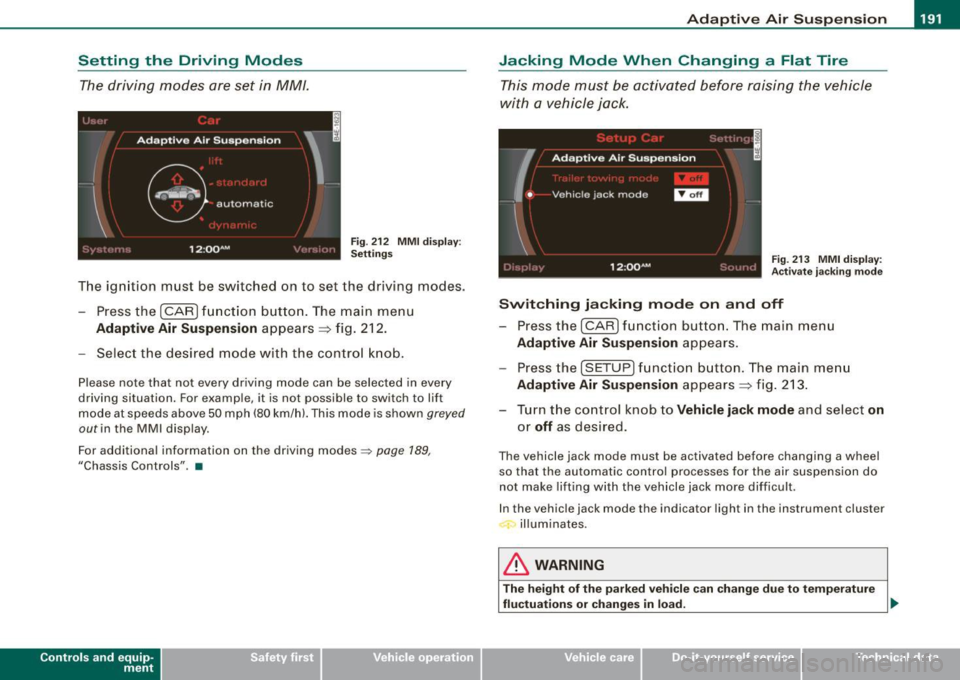
The ignition must be switched on to set the driv ing modes.
- Pressthe(CAR]fu nction button. The main menu
Adaptive Air Suspension appears => fig. 212.
- Select the desired mode with the control knob.
Please note that not every driving mode can be selected in every
driving situation. For example, it is not possible to switch to lift
mode at speeds above 50 mph (80 km/h). This mode is shown
greyed
out in the MMI display.
For additional information on the driving modes::;>
page 189,
"Chassis Controls" . •
Con tro ls and eq uip
ment
Jacking Mode When Changing a Flat Tire
This mode must be activated before raising the vehicle
with a vehicle jack.
Fig. 213 MMI display:
Activate jacking mode
Switching jacking mode on and off
- Press the (CAR] function button. The main menu
Adaptive Air Suspension appears.
Press the (SETUP) function button. The main menu
Adaptive Air Suspension appears => fig. 213.
- Turn the control knob to
Vehicle jack mode and select on
or off as desired.
The vehicle jack mode must be activated before changing a wheel
so that the automatic control processes for the air suspension do
not make lifting with the vehicle jack more difficult .
In the vehicle jack mode the indicator light in the instrument cluster
illuminates.
& WARNING
The height of the parked vehicle can change due to temperature
fluctuations or changes in load. _,,
Vehicle care I I irechnical data
Page 194 of 408
![AUDI S8 2009 User Guide ....... _A_ d_ a --=- p_t_ i_v _e_ A_ ir_ S_u_ s_,_ p_e_ n_ s_io _ n _____________________________________________ _
[ i] Tips
The vehicle jack mode is switched off automatically at speeds](/img/6/57618/w960_57618-193.png "AUDI S8 2009 User Guide ....... _A_ d_ a --=- p_t_ i_v _e_ A_ ir_ S_u_ s_,_ p_e_ n_ s_io _ n _____________________________________________ _
[ i] Tips
The vehicle jack mode is switched off automatically at speeds")
....... _A_ d_ a --=- p_t_ i_v _e_ A_ ir_ S_u_ s_,_ p_e_ n_ s_io _ n _____________________________________________ _
[ i] Tips
The vehicle jack mode is switched off automatically at speeds above
9 mph (15 km/h). •
Towing a Trailer
Automatic lowering is not desirable when towing a trailer.
Fig. 214 MMI display :
Activate towing opera
tion
If you are going to tow a trailer, you must activate the trailer
towing mode.
Switching the trailer towing mode on and off
manually
- Press the ICAR)function button. The main menu
Adaptive Air Suspension appears.
- Press the !SETUP] function button. The menu
Adaptive
Air Suspension
appears ~ fig. 214.
- Select
Trailer towing mode on or off as desired.
Level Adjustment when Towing a Trailer
The following applies to vehicles with Adaptive Air Suspension: • Before
hitching up the trailer
and before adjusting the tongue
weight at the trailer, the automatic or standard mode
must be
selected, so that the vehicle is at normal level=>
page 191, "Setting
the Driving Modes".
• If driving in dynamic mode is desired, this mode
must be
selected before hitching up the trailer and before adjusting the
tongue weight . However, note that your vehicle is lowered and
ground clearance is reduced.
• If you have to drive under difficult road conditions, you can
select lift mode after hitching up the trailer or after adjusting the
tongue weight .
The following applies to vehicles with
sport suspension Adaptive Air
Suspension -Sport*:
• Before hitching up the trailer
and before adjusting the tongue
weight at the trailer, the automatic, standard or dynamic mode
must
be selected, so that the vehicle is at normal level=> page 191,
"Setting the Driving Modes".
• If you have to drive under difficult road conditions , you can
select lift mode after hitching up the trailer or after adjusting the
tongue weight .
Restrictions when Operating with a Trailer
When operating with a trailer, the lift mode can only be selected up
to about 25 mph (40 km/h). The system automatically goes out of lift
mode when speed exceeds about 31 mph (50 km/hl.
If the vehicle is in automatic, standard or lift mode before the trailer
towing mode is activated, the dynamic mode cannot be activated -
except on vehicles with
sport suspension Adaptive Air Suspension -
Sport*.
If the vehicle is in dynamic mode before towing operation is acti
vated, it can be driven in this mode. If the suspension is shifted from
this mode to automatic mode, dynamic mode cannot be re-selected.~
Page 237 of 408
Airbag system -----------------=~-
& WARNING (continued )
-Never install seat covers or replacement upholstery over the
front seatbacks that ha ve not been specifically approved by
Audi .
- Never use additional seat cush ions that cover the areas
where the side airbags inflate.
- Damage to the or iginal seat covers or to the seam in the area
of the s ide airbag module must always be repaired immedi
ately by an authorized Audi dealer .
• The airbag system can be activated only once. After an airbag
has inflated , it must be replaced by an authorized Audi dealer or
qualified technician who has the technical information , training
and special equipment nece ssary .
• The airbag system can be deployed only once . After an airbag
has been deployed , it must be replaced with new replacement
parts designed and approved especially for your Audi model
version . Replacement of complete airbag systems or airbag
components must be performed by qualified workshops only .
Make sure that any airbag service action is entered in you r Audi
Warranty
& Maintenance booklet under AIRBAG REPLACEMENT
RECORD .
• For safety reasons in severe accidents , the alternator and
starter are separated from the vehicle battery with a pyrotechnic
c ircuit interrupter .
- Work on the pyrotechnic circuit interrupter must only be
performed by a qualified dealer -risk of an accident!
- If the vehi cle or the circuit interrupter is scrapped , all appli
cable safety precautions must be followed .
For the sake of the environment
Undepl oyed airbag m odu les a nd preten sioners m ig ht b e class if ied
as Perchlorate Material -specia l handling may apply, see
www .dtsc.ca.gov/hazardouswaste/perchlorate. When the vehicle or
Controls and equip
ment Safety first Vehicle operation
parts of the restraint system inc
luding a irbag modules and safety
be lts with p re tensione rs are sc rapped, a ll a ppl icable laws an d regu
lations must be observed . Your authorized Audi dea ler is fami liar
wi th the se requi rements and we recomme nd that you have y our
dea ler perform this service for you. •
Other things that can affect Advanced Airbag
performance
Changing the veh ic le 's suspens ion s ystem can change th e way that
t he Adva nced Air bag Sys tem perfo rm s in a crash. F or e xam ple,
using tire -r im combinations not approv ed by Audi, lower ing the
ve hic le, c hangi ng th e st iffne ss of the su spen sion , inclu ding the
springs, suspension struts, shock absorbers e tc . can change the
forc es that are measu re d b y th e a irbag sens ors and sent to the elec
t ron ic control u nit. Some sus pensio n chan ges can , for examp le ,
inc rea se the f orce le v els mea sured by the senso rs and make the
a irb ag sys te m de plo y in cras hes in whi ch it wo uld not de p loy i f the
changes had not been made . Other kinds of changes may reduce
t he force le v e ls measured by t he se nso rs a nd preve nt t he a irba g
from deploying when it should .
T he se nsor s in th e safe ty bel t buckl e f or th e d river a nd front
passen ger seat te ll the e lectronic control module if the safety belt is
l a tc h e d or n ot. If t he safety belt i s being use d, th e fr ont ai rbag w ill
dep loy at a s lightly h ig her rate of v eh ic le dec elerat ion t han if the
safet y belt is not being used . Ther efore, in a partic ular collision, it is
poss ible that an airba g w ill not deplo y at a seati ng pos itio n wh ere
the safety be lt is be ing used but wi ll inflate at the position where the
sa fe ty be lt is no t being used . It i s im porta nt that n othi ng i nterfe re
with the safety belt b uckles so that the sensors can send the correct
i n fo rm ati on about sa fety belt use t o th e el ectronic con trol unit. _..
Vehicle care Do-it-yourself service Technical data
Page 339 of 408
Tires and wheels -_______________ _____.
Tire service life
The service life of tires depends on a lot of different things
including proper installation and balancing, correct tire
pressure and driving style.
_/l
l '-------- ,)
Tread Wear Indicator (TWI)
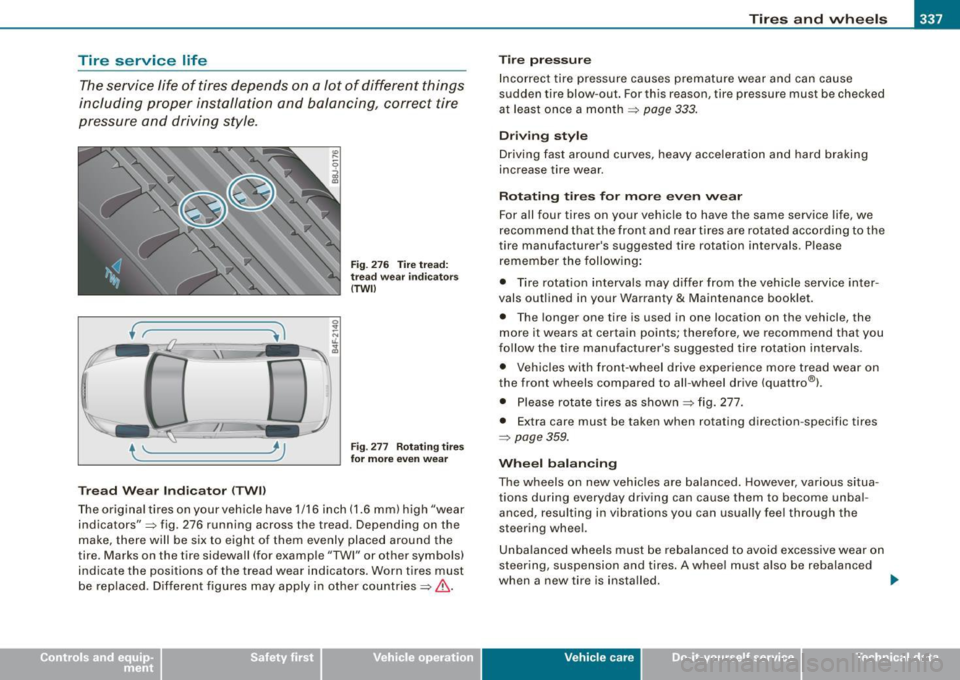
Fig. 276 Tire tread:
tread wear indicators
(TWI)
Fig . 277 Rotating tires
for more even wear
The original tires on your vehicle have 1/16 inch (1.6 mm) high "wear
indicators":::::, fig. 276 running across the tread. Depending on the
make, there will be six to eight of them evenly placed around the
tire. Marks on the tire sidewall (for example "TWI" or other symbols)
indicate the positions of the tread wear indicators. Worn tires must
be replaced. Different figures may apply in other countries.:::::,&.
Tire pressure
Incorrect tire pressure causes premature wear and can cause
sudden tire blow-out. For this reason, tire pressure must be checked
at least once a month .:::::,
page 333.
Driving style
Driving fast around curves, heavy acceleration and hard braking
increase tire wear.
Rotating tires for more even wear
For all four tires on your vehicle to have the same service life, we
recommend that the front and rear tires are rotated according to the
tire manufacturer's suggested tire rotation intervals. Please
remember the following:
• Tire rotation intervals may differ from the vehicle service inter
vals outlined in your Warranty
& Maintenance booklet.
• The longer one tire is used in one location on the vehicle, the
more it wears at certain points; therefore, we recommend that you
follow the tire manufacturer 's suggested tire rotation intervals .
• Vehicles with front-wheel drive experience more tread wear on
the front wheels compared to all-wheel drive (quattro®l .
• Please rotate tires as shown .:::::, fig. 277.
• Extra care must be taken when rotating direction -specific tires
:::::, page 359.
Wheel balancing
The wheels on new vehicles are balanced. However, various situa
tions during everyday driving can cause them to become unbal
anced, resulting in vibrations you can usually feel through the
steering wheel.
Unbalanced wheels must be rebalanced to avoid excessive wear on
steering, suspension and tires. A wheel must also be rebalanced
when a new tire is installed. _,,
Vehicle care I I Technical data
Page 346 of 408
-~_T_ ir_e_ s_ a_ n_d _ w_ h_ e_e _l_s _________________________________________________ _
& WARN ING (continued )
• Never drive fa ster than the speed for which the winter or other
tires in stalled on your vehi cle a re rated.
& WARNING
Always adjust your driving to the road and t raffic condit ions .
Never let the good acceleration of the winter tires and all -wheel
drive tempt you into tak ing extra risks. Always remember :
• When braking , an all -wheel drive vehicle handles in the same
way as a front drive vehicle .
• Drive carefully and reduce your speed on icy and slippery ro ads ,
even winter tires cannot help under bla ck ice conditions.
c£> For the sake of the environment
Use summer tires when weather conditions permit. They are
quieter, d o not wea r as qu ick ly a nd r educe fuel cons ump tio n.•
Snow chains
Sn ow chains may be fitte d only to th e fron t w hee ls, and o nly t o
certain tire sizes . Ask your authorized Audi dealer on which tire
s iz es snow c hains can be used .
If you are going to use snow cha ins , then you must instal l them on
the front wheels at least.
The snow chains must have low-pro file l inks and mus t n ot be thicker
than 0.53 inch ( 13.5 mm), including the lock.
Remove wheel cen ter c ove rs a nd trim discs be fore putti ng snow
chains on your vehic le~
0 . For safety reasons cover caps must
then be fitted ove r the wheel bo lts . These are avai lable from autho
rized Audi dealers.
& WARNING
Using the wrong snow chain s for your vehicle or installing them
incorrectly can in crease the risk of loss of control leading to
serious personal injury .
• Snow chains are available in different size s. Alway s make sure
to follo w the instructions pro vided by the snow chain manufac
turer.
• When dr iving with snow ch ains never drive faster than the
speed permitted for your specific snow chains .
• Always observe local regulations .
0 Note
• Remove snow chains before driving on roads not covered with
snow to av oid da maging t ires a nd weari ng the snow cha ins dow n
unnecessari ly.
• Snow cha ins, wh ic h come into d irect contact wit h the wheel rim ,
can scratch or damage it. Therefore, make sure that the snow chains
a re suitab ly cove red. Check the p osit io n of the snow cha ins a fter
driving a few yards and correct if neccessary. Follow the instructions
from t he s now cha in manufac turer w he n do ing so .
• I f the Adaptive Air Suspension should malfunction , do not
mo unt or us e snow chains becaus e th e veh icle will be extre m ely
l ow . If you do drive with snow chains on while the vehicle is at this
l evel, the s now c hai ns mig ht s ever ely da mag e th e wheel house and
other parts of the vehicle.
[ i ] Tips
Where snow chains are mandatory on certain roads, this norma lly
a lso app lies to veh ic les wi th A ll Wheel Drive .•
Page 356 of 408
1111 What do I do now? ..._ __________________________________________ _
& WARNING (continued )
front wheel is lifted off the ground , placing the Automatic Trans
mission in "P" (Park) will
not prevent the vehicle from moving.
• Before you change a wheel, be sure the ground is level and firm.
If necessary , use a sturdy board under the jack.
• After installing the spare wheel, make sure that you replace the
flat tire/wheel in its storage area properly and tighten the knurled
retaining screw securely.
[ i J Tips
Before changing the wheel, you must activate the jacking mode, so
that the automatic controls for the Adaptive Air Suspension do not
make it more difficult to lift the vehicle with the jack =>
page 791. •
Changing a wheel
When you change a wheel, follow the sequence described
below step-by-step and in exactly that order.
1. Activate the vehicle jacking mode~ page 191.
2. Remove the decorative wheel cover*. For more details
see also
~ page 355, "Decorative wheel covers" or
~ page 355, "Wheels with wheel bolt caps" .
3. Loosen the
wheel bolts ~ page 356.
4. Locate the proper mounting point for the jack and align
the jack below that point~
page 356.
5. Lift the car with the jack~ page 356.
6. Remove the wheel with the flat tire and then install the
spare
~ page 358 .
7. Tighten all wheel bolts lightly. 8.
Lower the vehicle with the
jack.
9. Use the wheel bolt wrench and
firmly tighten all wheel
bolts
~ page 356.
10. Replace the decorative wheel cover*.
11. Deactivate the vehicle jacking mode~ page 191.
& WARNING
Always read and follow all WARNINGS and information :::::> 6 in
" Raising the vehicle" on
page 356 and => page 359. •
After changing a vvheel
A wheel change is not complete without the doing the
following.
- Store and secure the wheel you replaced in the spare
wheel well.
- Replace the tools and the jack in their proper location.
- Check the
tire pressure on the spare wheel immediately
after mounting it.
- As soon as possible , have the
tightening torques on all
wheel bolts checked with a torque wrench. The correct tightening torque is 90 ft lb (120 Nm) .
- Have the flat tire
replaced as soon as possible.
[ i J Tips
• If you notice that the wheel bolts are corroded and difficult to
turn while changing a tire, they should be replaced before you check
the tightening torque. .,_
Page 359 of 408
_____________________________________________ W_ h_ a_t _d_ o_l _ d_o _ n_o_ w_ ? _ __._
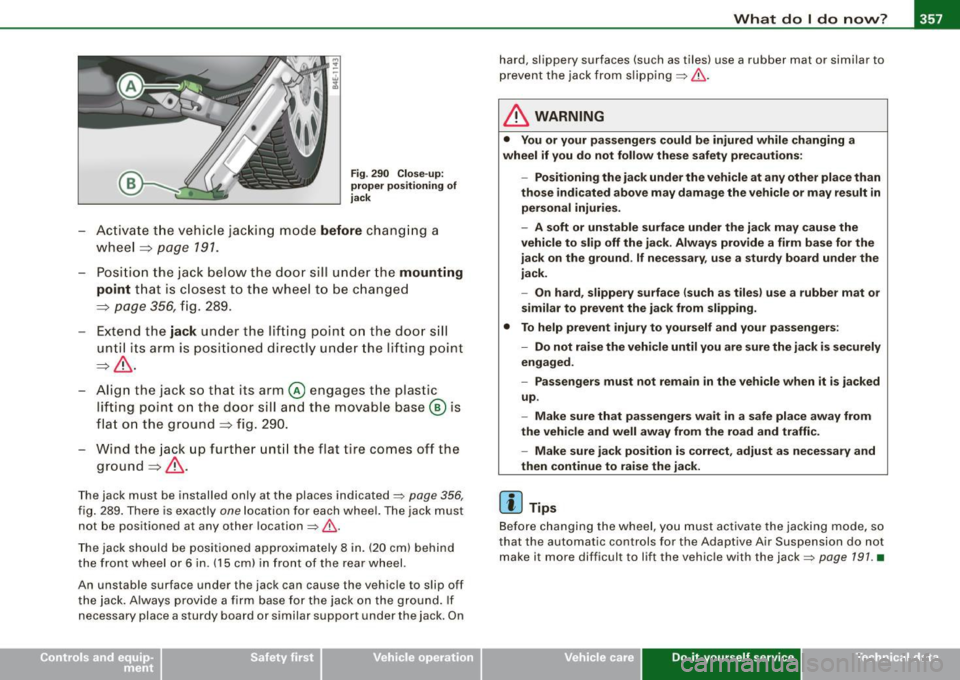
Fig . 290 Close-up :
proper positioning of
jack
- Act iva te the ve hicle ja cking mode before c ha ngin g a
wheel ==>
page 19 1.
- Posi tio n th e jack below th e doo r sill und er t he mounting
point
that is clos est to the w hee l to be cha nged
==>
p age 356 , fig. 289.
- Exten d the
jack und er the li fting po int on the doo r sill
un til it s arm is po sitio ned d irect ly und er t he l if tin g p oint
==> & .
- Align the j ack so th at its a rm
@ en gag es th e plastic
lif ting point on the door si ll and th e mova ble base ® is
flat on the groun d==> fig. 290 .
- Wind th e jack up furt her u ntil the flat tir e co mes off the
gr oun d==> & .
The jack must be installed only at the places indicated~ page 356,
fig. 289 . Th ere is e xactly on e loca tion for e ach w heel. The jack m ust
not b e positioned at any oth er locatio n~ & .
T he jac k should be pos it ioned ap pro xim ately 8 in . (2 0 cm) be hind
the front wh eel or 6 i n. (1 5 c m) in fr ont o f the r ear w heel.
A n unstab le su rface unde r th e jac k can cause the vehicle to slip off
the jack. A lw ay s pro vi de a firm bas e for th e ja ck on the grou nd. If
necessary place a sturdy board or similar s up port under the jack. On ha
rd, sl ippery surfaces (suc h as til es) us e a ru bber mat or similar to
prevent th e ja ck fr om slippin g~ & .
& WARNING
• You or your passengers could be injured while changing a
wheel if you do not follow these safety precautions:
-Positioning the jack under the vehicle at any other place than
those indicated above may damage the vehicle or may result in
personal injuries.
- A soft or unstable surface under the jack may cause the
vehicle to slip off the jack . Always provide a firm base for the
jack on the ground . If necessary , use a sturdy board under the
jack .
- On hard , slippery surface (such as tiles ) use a rubber mat or
similar to prevent the jack from slipping.
• To help prevent injury to yourself and your passengers :
- Do not raise the vehicle until you are sure the jack is securely
engaged .
- Passengers must not remain in the vehicle when it is jacked
up .
- Make sure that passengers wait in a safe place away from
the vehicle and well away from the road and traffic .
- Make sure jack position is correct, adjust as necessary and
then continue to raise the jack.
[ i ] Tips
Be for e changi ng th e whee l, yo u m ust ac tiv ate the jac king mode , so
that the automat ic controls for t he Adapt ive Air Suspension do not
make it more diffic ult to lift the vehi cle with the jack~
page 191. •
Vehicle care Do-it-yourself service irechnical data