child restraint AUDI S8 2009 Owner's Manual
[x] Cancel search | Manufacturer: AUDI, Model Year: 2009, Model line: S8, Model: AUDI S8 2009Pages: 408, PDF Size: 91.63 MB
Page 230 of 408
___ A_ ir_ b_ a-g _ s_y _ s_ t_ e_ m _________________________________________________ _
• A sensor in the safety belt latch for the driver and for the front
s e at passenge r that s enses whether th at sa fe ty bel t i s la tc h ed or n ot
and transmits this information to t he electronic control unit.
& WARNING
Damage to the front passenger seat can prevent the front airbag
from working properly .
• Improper repair or disassembly of the front passenger and
driver seat will prevent the Advanced Airbag System from func
tioning properly.
• Repairs to the front passenger seat must be performed by qual
ified and properly trained workshop personnel .
• Never remove the front passenger or driver seat from the
vehicle.
• Never remove the upholstery from the front passenger seat.
• Never disassemble or remove parts from the seat or disconnect
wires from it .
• Never carry sharp objects in your pockets or place them on the
seat .
If the weight-sensing mat in the passenger seat is punctured
it cannot work properly.
• Never carry things on your lap or carry objects on the
passenger seat. Such items can increase the weight registered by
the weight-sensing mat and send the wrong information to the
airbag control unit .
• Never store items under the front passenger seat . Parts of the
Advanced Airbag Sy stem under the passenger seat could be
damaged , preventing them and the airbag system from working
properly.
• Never place seat covers or replacement upholstery that have
not been specifically approved by Audi on the front seats.
• Seat covers can prevent the Advanced Airbag System from
recognizing child restraints or occupants on the front pa ssenger
seat and prevent the side airbag in the seat backrest from
deploying properly .
& WARNING (continued)
• Never use cushions, pillows, blankets or similar items on the
front passenger seat. The additional padding will prevent the
weight-sensing mat in the seat from accurately registering the
child restraint or person on the seat and prevent the Advanced
Airbag System from functioning properly .
• If you must use a child restraint on the front passenger seat
and the child restraint manufacturer's instructions require the use
of a towel , foam cushion or something el se to properly position
the child restraint , make certain that the PASSENGER AIR BAG OFF
light comes on and stays on whenever the child restraint is
i nstalled on the front passenger seat .
• If the PASSENGER AIR BAG OFF light does not come on and stay
on , immediately install child restraint in a rear seating position
and have the airbag system inspected by your Audi dealer. •
How the Advanced Airbag System
components work together
The front Advanced Airbag System and the side airbags supp lement
the protection offered by the front three -point safety be lts with
pretensioners and load limiters and t he adjustab le head restraints
to help reduce the risk of injury in a w ide range of accident and
crash si tuat ions. Be sure to read t he im po rta nt i nformation ab out
safety and heed the WARN INGS in this chapter.
Depl oyment of the Adva nc ed A irbag Syst em and the acti vatio n of
the safety belt pretensioners depend on the deceleration measured
b y th e c ra sh sen so rs and regi stered by the elec tro nic c ontrol u nit.
C rash severity depends on speed and dece lerat ion as well as the
m ass a nd st iffness of t he vehicle o r object invo lve d i n the c ra s h .
Wh en t he elec tron ic control u nit registe rs a low sever ity c rash and
the safety belt is be ing used, the airbag wi ll not deploy . If the safety
bel t is no t being used, the first s tage d eploys, fo ll o wed by the
second stage after a much later time in the crash sequence . ..
Page 231 of 408
If the electronic control unit registers a crash of medium severity,
the first stage of the airbag deploys followed by the second stage at a much later time in the crash sequence -regardless of whether the
safety be lt is being used or not . In higher severity crashes as regis
tered by the e lectronic control unit , both the first and second stages
deploy almost at the same time .
On the passenger side, regardless of sa fety belt use, the airbag w ill
be turned off if the weight on the passenger seat is less than the
amoun t program med in the electronic control unit . The front airbag
on the passenger side will also be turned off if one of the chi ld seats
that has been cer tified under Federal Motor Vehicle Safety Standard
208 has been recognized on the seat . The
PASSENGER AIR BAG OFF
light comes on and stays on to tell you when the front Adva nced
Airbag on the passenger side has been turned off~
page 222,
"Child restraints on the front seat -some important things to
know ".
,& WARNING
T o reduce the ri sk of injury when an airbag inflate s, always w ear
safety belt s properly.
• If you are unrestra ined , leaning forward , sitting sideway s or out
of position in any way , your ris k of injury is much higher .
• You will also re ce ive se rious injurie s and could even be killed if
you are up again st the airbag or too close to it when it inflat es -
ev en with an Advan ced Airbag
~ page 2 20. •
Safety first
Airb ag sy ste m
More important things to know about front
airbags
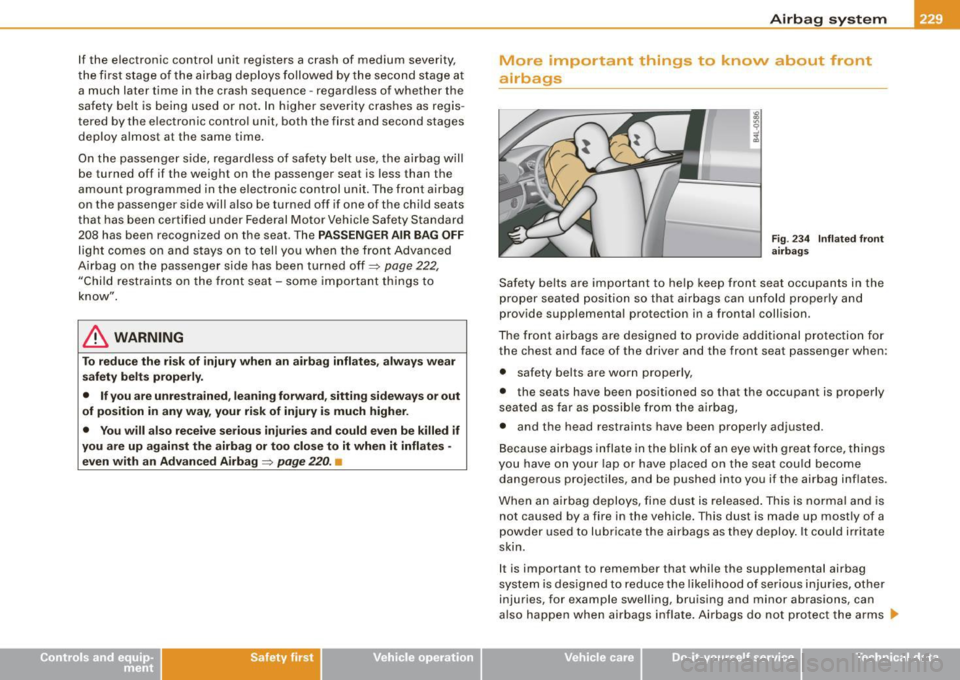
F ig . 23 4 I nfl at ed front
airba gs
Safety belts are important to he lp keep front seat occupants in the
proper seated position so tha t airbags can unfold proper ly and
provide supplementa l prot ection in a fronta l collision.
The fron t airbags are designed to provide addit ional p rotection for
the chest and face of the driver and the front seat passenger when :
• safety belts are worn properly ,
• the seats have been positioned so that the occupant is properly
seated as far as p ossib le from the a irbag,
• and the head restraints have been properly adjusted .
Because airbags inflate in the blink of an eye with grea t force , things
you have on your lap or have p laced on the seat cou ld become
dangerous projectiles, and be pushed into you if the airbag inflates .
When a n airbag depl oys, fine d ust is released . This is norma l and is
not caused by a fire in the vehicle. This dust is made up mostly of a
powder used to lubrica te the airbags as they d eploy . It could irri tate
skin .
I t is important to remember that while the supplemental airbag
system is designed to reduce the likel ihood of serious injuries , othe r
injuries, for example swelling , bruising and minor abrasions, can
a ls o happen when airbags inflate . Airbags do no t pro tect the arms •
•
Vehicle care I I irechnical data
Page 234 of 408
-Airbag system PW,._____ -=--=-----------------
PASSENGER AIR BAG OFF light
1~ J,
i
( ~ I :."!l.t.~ A I ~ )
Fig. 235 Sectio n fr om
th e i nstrument panel:
PAS SENGER AIR BAG
OFF light
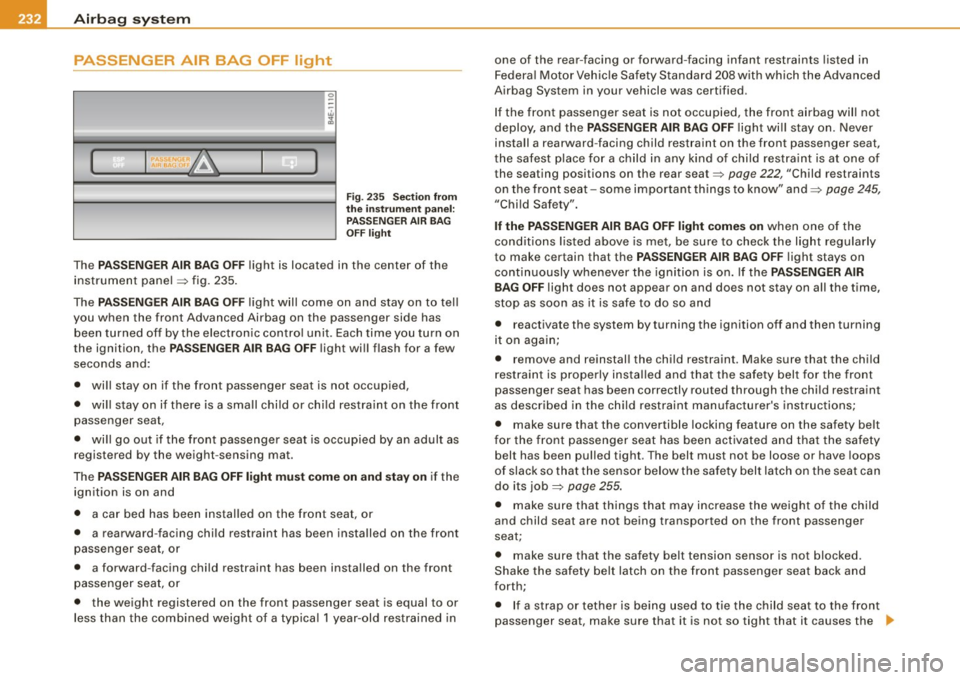
The PASSENGER AIR BAG OFF light is located in the center of the
instrument pane l => fig.
235 .
The PASSENGER AIR BAG OFF light will come on and stay on to tel l
you when the front Advanced Airbag on the passenger side has
been turned off by the electronic contro l unit . Each time you turn on
the ignition, the
PAS SENGER AIR BAG OFF light wi ll flash for a few
seconds and :
• will stay on if the front passenger seat is not occupied,
• will stay on if there is a small chi ld or chi ld restraint on the front
passenger seat ,
• will go out if the front passenger seat is occupied by an adult as
registered by the weight -sensing mat .
The
PASSENGER AIR BAG OFF light must come on and stay on if the
ignition is on and
• a car bed has been installed on the front seat, or
• a rearward-facing child restraint has been installed on the front
passenger seat, or
• a forward-facing child restraint has been insta lled on the front
passenger seat, or
• the weight registered on the front passenger seat is equal to or
less than the combined weight of a typical 1 year-old restrained in one of the rear
-facing or forward-facing infant restraints listed in
Federa l Motor Vehicle Safety Standard 208 with which the Advanced
Airbag System in your vehicle was certified .
I f the front passenger seat is not occupied, the front airbag wil l not
deploy, and the
PASSENGER AIR BAG OFF li ght wi ll stay on. Never
install a rearward -facing child restraint on the front passenger seat,
the safest place for a child in any kind of child restraint is at one o f
the seating posi tions on the rear seat=>
page 222, "Child restraints
o n the front seat -some important things to know" and=>
page 245,
"Chi ld Safety".
If the PASSENGER AIR BAG OFF light comes on when one of the
conditions listed above is met , be sure to check the light regularly
to make certain that the
PASSENGER AIR BAG OFF light stays on
continuously whenever the ignition is on. If the
PASSENGER AIR
BAG OFF
light does not appear on and does not stay on all the time,
stop as soon as it is safe to do so and
• reactivate the system by turning the ignition off and then turning
it on again;
• remove and reinstal l the child restraint. Make sure that the child
restraint is properly insta lled and that the safety belt for the front
passenger seat has been correctly routed through the child restraint
as described in the child restraint manufacturer's instructions;
• make sure that the convertible locking feature on the safety belt
for the front passenger seat has been activated and that the safety
belt has been pulled tight . The belt must not be loose or have loops
of slack so that the sensor below the safety belt latch on the seat can
do its job =>
page 255.
• make sure that things that may increase the weight of the child
and child seat are not being transported on the front passenger
seat;
• make sure that the safety belt tension sensor is not blocked .
Shake the safety belt latch on the front passenger seat back and
forth;
• If a strap or tether is being used to tie the child seat to the front
passenger seat, make sure that it is not so tight that it causes the .,_
Page 235 of 408
Airbag syst em -----------------=~-
weight -sensing mat to measure more weight than is actually on the
seat .
If th e PA SSENGER AIR BAG OFF light still d oes not come on and does
not stay on continuously (when the ignition is switched on),
• t ake the child r estraint off the front passenger seat and install it
properly at one of the rear seat positions. Have the airbag system
inspected by your Audi dealer immediately.
• move the child to a rear seat position and make sure that the
child is proper ly restrained in a child restraint that is appropria te for
its size and age .
The
PA SSENGER AIR BAG OFF light shou ld NOT come on when the
ignition is on and an adult is sitting in a proper seating posi tion on
the front passenger seat . If the
PASSENGER AIR BAG OFF light
comes on and stays on or flashes for about 5 seconds whi le driving,
under these circumstances, make sure that :
• the adu lt on the front passenger sea t is properly seated on the
center of the seat cushion w ith his or her back up against the back
res t and the backrest is not reclined => page 202, "Proper occupant
sea ting positions" ,
• the adult is not taking weight of f the sea t by holding on to the
passenger assist handle above the front passenger door or
supporting their we ight on the armrest,
• the safety belt is being proper ly worn and that there is not a lot
of slack in the safety belt webbing,
• accessory seat covers or cushions or other things that may cause
an incorrect reading or impression on the weight -sensing mat
under the upho lstery of the seat have been removed from the front
passenger sea t,
• a safety belt extender has not been left in the safety be lt latch for
t he front passenger seat .
In addition to the
PASSENGER AIR BAG OFF light in the center of the
instrument pane l, the message
PASSENGER AIR BAG O FF o r
PAS SEN GER AIR BA G ON will briefly appear in the instrument c luster
Controls and equip
ment Safety first Vehicle operation
display. This is to inform the driver of the current front passenger
a
irbag status .•
Important safety instructions on monitoring
the Advanced Airbag System
& WARNING
An airbag sy stem that is not functioning properly cannot provide
supplemental protection in a front al cra sh .
• If the airbag ind icator li ght come s on , it means that there may
be something wrong with the Advanced Airbag S ystem . It is
po ssible that the airbag will inflate when it is not suppo sed to , or
w ill not infl ate when it should .
• Have the airb ag system inspe cted immediatel y by you r Audi
dealer.
& WARNING
If the front airba g inflates , a child with out a child re straint , or in a
re arw ard -fa cing chi ld safety seat , or
in a forward-fa cing child
r e str aint that has not been properly installed will be seriously
inj ured and can be killed .
• Even though your vehicle i s equipped with an Adv anced Airbag
Sy stem , m ake cert ain that all children , e speci ally 12 year s and
younger , always ride on the bac k seat prope rly re strain ed for their
a ge and siz e .
• Alway s install forw ard or rear -facing child seat s on the rear
se at - ev en with an Ad vanced Airbag Sy stem .
• If you mu st install a rearward -fa cing child se at o n th e front
p ass enger sea t be cau se of e xceptional circumstan ce s and the
PASSENGER AIR BAG OFF light doe s not appear and stay on , imme
diately in stall the rear -fac ing child seat in a r ear sea ting pos itio n
and have the airbag system inspect ed b y your Audi dealer . .,,
Vehicle care Do-it-yourself service Technical data
Page 236 of 408
llffll,___A_ ir_ b_ a.::g <-- s--
• A tight tether or other strap on a rearward-facing child restraint
attached to the front passenger seat c an put too much p res su re
on the weight-sensing mat in the seat and reg ister more weight
than is actually on the seat . The heavier weight registered can
make the system work as though an adult were on the seat and
deploy the Advanced Airbag when it mu st be suppre ssed causing
serious or even fatal injury to the child .
• If, in exceptional circumstances , you must install a forward
f ac ing child restraint on the front passenger seat , always move the
seat into its rearmost position in the seat's fore and aft adjust
ment range , as far away from the airbag as possible . The ba ckrest
must be adju sted to an upright position. Make sure that the
PASSENGER AIR BAG OFF light comes on and stays on all the time
whenever the ignition is switched on .
& WARNING
• If the PASSENGER AIR BAG OFF light does not go out when an
adult is sitting on the front passenger seat after tak ing the steps
described above, make sure the adult i s properly seated and
restrained at one of the rear seat ing positions .
• Have the airbag system inspected by your Audi dealer before
transporting anyone on the front passenger seat .
[ i ] Tips
If the we ight -sens ing mat in the front passenger seat detects an
e m pty s eat, th e front airbag on the passenge r side wil l be tur ned
off , and the PASSENGER AIR BAG OFF li ght wil l stay on .•
Repair, care and disposal of the airbags
Parts of the airbag system are insta lled at many different places on
yo ur Audi. Ins tal li n g, r em oving, s ervicing o r rep airi ng a part in an area of the vehicle can damage a part of an airbag system and
p revent that sys tem from wo rking pr operly in a c ollisi on.
Th ere are some important th ings you have to know to ma ke sure
that the effectiveness of the system will not be impai red and that
discarded co mponents do no t cause i njury or po llute the enviro n
ment.
& WARNING
Improper care , servicing and repair procedures can increase the
risk of personal injury and death by preventing an airbag from
deploying when needed or deploying an airbag unexpectedly :
• Never cover , obstruct , or change the steering wheel horn pad
or airbag cover or the instrument panel or modify them in any way.
• Never atta ch any objects su ch as cup holders or telephone
mountings to the surfaces covering the airbag units .
• For cleaning the horn pad or instrument panel , use only a soft ,
dry cloth or one moistened with plain water . Solvents or cleaners
could damage the airbag cover or change the stiffness or strength
of the material so that the airbag cannot deploy and protect prop
erly .
• Never repair , adjust, or change any parts of the airbag system .
• All work on the steering wheel , instrument panel , front seats or
electrical system (including the installation of audio equipment ,
cellular telephones and CB radios , etc .I must be performed by a
qualified technician who has the train ing and special equipment
necessary .
• For any work on the airbag system, we strongly recommend
that you see your author ized Audi dealer or qualified workshop .
• Never modify the front bumper or parts of the vehicle body .
• Always make sure that the side airbag can inflate without inter-
ference :
~
Page 242 of 408
___ A_ ir_b _a_ g;:::;_ s--:.. y_s _t _e _m _________________________________________________ _
• in side collisions when the acceleration measured by the sensor
is too low
• in front -end collisions
• in rear -end collisions
• in rollovers.
In some types of accidents the front airbags, side curtain airbags
and side airbags may be triggered together.
& WARNING
• Safety belts and the airbag system will only provide protection
when occupants are in the proper seating position
~ page 240.
• If the airbag indicator light comes on when the vehicle is being
used , have the system inspected immediately by your authorized
Audi dealer . The airbag may not work properly when the vehicle
acceleration in a side collision is high enough to activate the
airbag .•
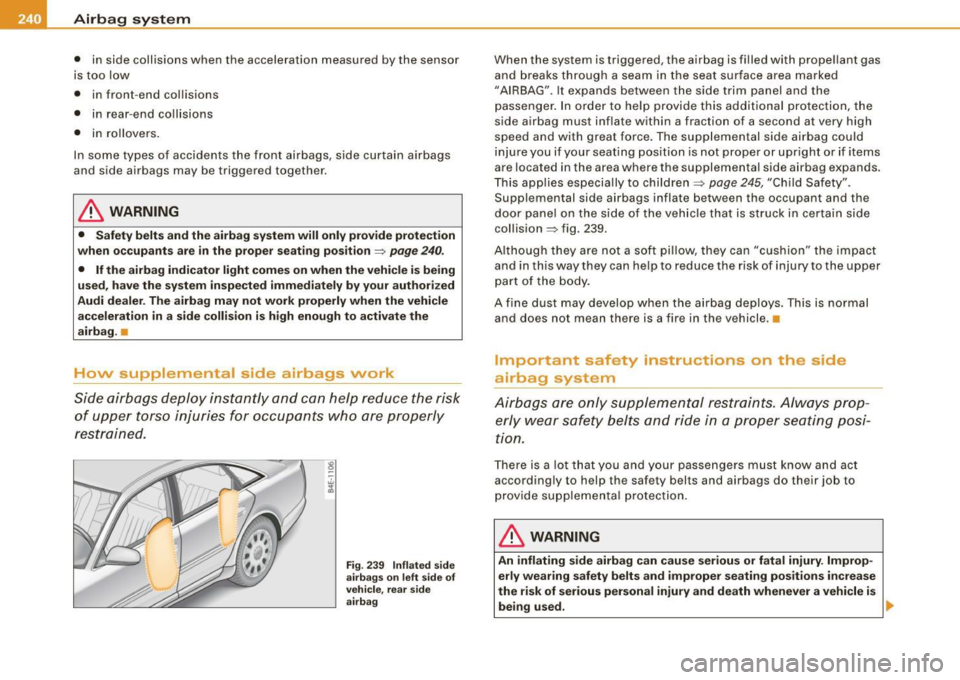
How supplemental side airbags work
Side airbags deploy instantly and can help reduce the risk
of upper torso injuries for occupants who are properly
restrained.
Fig. 239 Inflated side
airbags on left side of
vehicle, rear s ide
airbag
When the system is triggered, the airbag is filled with propellant gas
and breaks through a seam in the seat surface area marked
"AIRBAG" . It expands between the side trim panel and the
passenger. In order to he lp provide this additional protection, the
side airbag must inflate within a fraction of a second at very high
speed and with great force . The supplemental side airbag could
injure you if your seating position is not proper or upright or if items
are located in the area where the supplemental side airbag expands.
This applies especially to children~
page 245, "Child Safety".
Supplem ental side airbags inflate between the occupant and the
door panel on the side of the vehic le that is struck in certain side
collision~ fig. 239.
Although they are not a soft pillow, they can "cushion" the impact and in this way they can he lp to reduce the risk of injury to the upper
part of the body.
A fine dust may develop when the airbag deploys. This is normal
and does not mean there is a fire in the vehicle. •
Important safety instructions on the side
airbag system
Airbags are only supplemental restraints. Always prop
erly wear safety belts and ride in a proper seating posi
tion .
There is a lot that you and your passengers must know and act
accordingly to help the safety belts and airbags do their job to
provide supplementa l protection.
& WARNING
An inflating side airbag can cause serious or fatal injury. Improp
erly wearing safety belts and improper seating positions increase
the risk of serious personal injury and death whenever a vehicle is
being used . _.,
Page 245 of 408
• in side collisions when the acceleration measured by the sensor
is too low,
• in front -end collisions,
• in rear-end collisions,
• in rollovers.
& WARNING
• Safety belts and the airbag system will only provide protection
when occupants are in the proper seating position
=> page 86,
"General recommendations" .
• If the airbag indicator light comes on when the vehicle is being
used, have the system inspected immediately by your authorized
Audi dealer . The side curtain airbag may not work properly even
when the vehicle acceleration in a side collision is high enough to
activate the airbag.
c:J
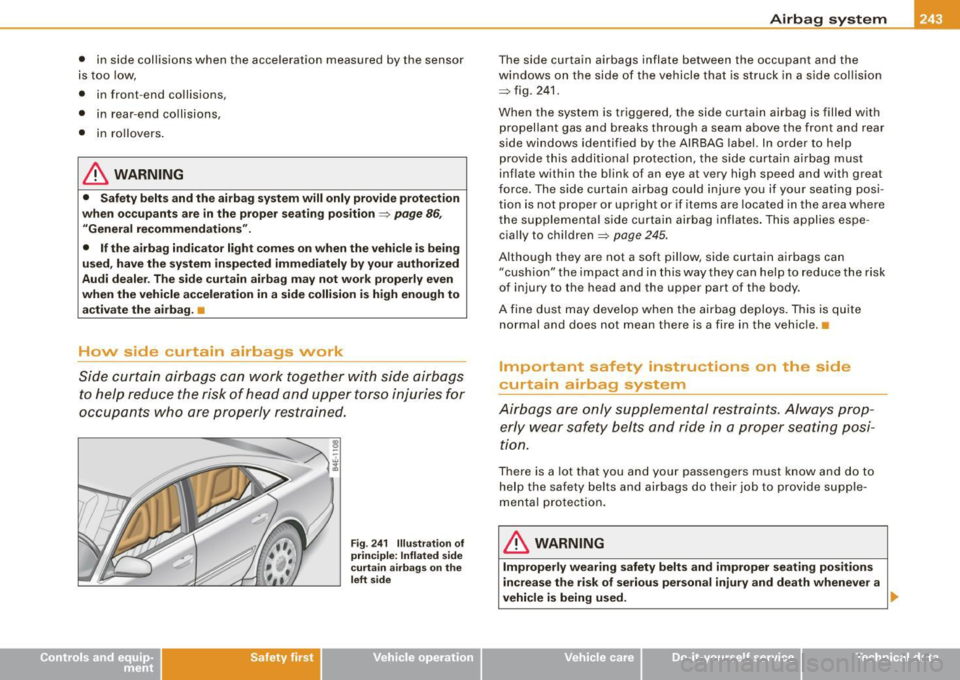
How s ide curtain airbags work
Side curtain airbags can work together with side airbags
to help reduce the risk of head and upper torso injuries for
occupants who are properly restrained.
Safety first
Fig. 241 Illustration o f
prin ciple: Inflated side
c urtain airbags on the
left side
Airbag system
The side curtain airbags inflate between the occupant and the
windows on the side of the vehicle that is struck in a side collision
=> fig. 241 .
When the system is triggered, the side curtain airbag is filled with
propellant gas and breaks through a seam above the front and rear
side windows identified by the AIRBAG label. In order to help
provide this additional protection, the side curtain airbag must
inf late within the blink of an eye at very high speed and with great
f orce . The side curtain airbag could injure you if your seating posi
tion is not proper or upright or if items are located in the area where
the supplementa l side curtain airbag inflates . This applies espe
cially to children=>
page 245.
Although they are not a soft pil low, side curtain airbags can
"cushion" the impact and in this way they can help to reduce the risk
of injury to the head and the upper part of the body.
A fine dust may develop when the airbag deploys. This is quite
normal and does not mean there is a fire in the vehic le .•
Important safety instructions on the side
curtain airbag system
Airbags are only supplemental restraints. Always prop
erly wear safety belts and ride in a proper seating posi
tion.
There is a lot that you and your passengers must know and do to
help the safety belts and airbags do the ir job to provide supple
mental protection.
& WARNING
Improperly wearing safety belts and improper seating positions
increase the risk of serious personal injury and death whenever a
vehicle is being used. •
Vehicle care I I irechnical data
Page 247 of 408
_______________________________________________ C_h _ i_ld _ S_ a_ f_ e_ t..,:c y __ lftlll
Child Safety
Important things to know
Introduction
The rear seat is generally the safes t place in a collision.
The p hysica l pr inciples of what happens when you r veh ic le is in a
crash apply also to children=>
page 213, "What happens to occu
pa nts not wearing safety bel ts?" . But un like adults and teenagers,
their musc les and bones are not fully developed. In many respects
children a re a t greater ris k of serious injury in cras hes than a dults .
B ecause chi ldren's bodies are no t fully deve loped, they require
restraint systems especial ly designed for their size, weight, and
body structu re. Ma ny countries and al l sta tes of the U nited States
and provinces of Canada have laws requiring the use of approved
chil d restraint sys te m s for infa nts and smal l children .
I n a frontal crash at a speed of 20 -35 mph (30 -56 km/h) the forces
acting on a 13-pou nd (6 kg) infant wi ll be mo re than 20 times the
weight of the child. This means the weight of the child would
suddenly be more than 260 pounds ( 120 kg). Under these condi
t ions, only an appropriate child restraint proper ly used can reduce
the risk of serious injury. Child restraints, like adult safety belts,
must be used properly t o be effective. Used impro perly, they can
increase the risk of serious injury in an accident.
Co nsul t the c hild safety seat man ufacture r's ins truc tions to be su re
the seat is right for your child's size=>
page 248, "Important safety
instructions for using child safety seats" . Please be sure to read and
heed a ll of the important information and WARNI NGS about child
safety, Advanced Airbags, and the insta llation of child restraints in
this chapter.
T here is a lot you need to know about the Advanced Airbags in your
veh ic le and how they work whe n inf an ts and ch ild ren in c hild
restraints are on the front passenger seat. Because of the large
Controls and equip ment Safety first Vehicle operation amoun
t of important informat ion, we cannot repeat it all here. We
urge you to read the detai led information in this owner's manua l
about a irbags and the Advanced Airbag Sys tem in your ve hic le and
the very important information about transporting children on the
fr ont passenger sea t. Please b e sure to hee d th e WAR NINGS -th ey
are extreme ly important for your safety and the safety of your
p asse ngers, es pecia lly inf ant s and s mall ch ildren .
& WARNING
• Accident statistics have shown that children are generally safer
in the rear seat area than in the front seating position . Always
restrain any child age 12 and under in the rear.
• All vehicle o ccupants and especially children must be
restrained properly whenever riding in a vehicle . An unrestrained
or improperly restrained child could be injured by striking the inte
rior or by being ejected from the vehicle during a sudden
maneuver o r impact . An unrestrained or improperly restrained
c hild is also at greater risk of injury or death through conta ct with
an inflating a irbag .
• A suitable child restraint properly installed and used at one of
the rear seating positions provides the highest degree of protec
tion for infants and small children in most ac cident situations .
& WARNING
Children on the front seat of any car even with Advanced Airb ag s
c an be seriously injured or even killed when an airbag inflates . A
child in a rearward -fa cing child safety seat installed on the front
pas senger seat will be seriously injured and can be killed if the
front airbag inflates.
• The inflating airbag will hit the ch ild safety seat or infant
carrier with great force and will sma sh the child safety seat and
child against the backrest , center arm rest , or door. •
Vehicle care Do-it-yourself service Technical data
Page 248 of 408
-Child Safety -------=---------------------------------------
& WAR NIN G (co ntinued )
• Alw ays in sta ll re ar-facin g child safety s eats on the r ear seat .
• If you m us t in sta ll a rear ward f acing child saf ety s eat on th e
fr ont pa ssenger seat in exceptional circum stan ces and the
PA SSEN GER AIR BAG OFF light do es not come on and sta y on ,
immediately in sta ll the re ar-facing child safety s eat in a rear
s eating po sit ion and ha ve th e airb ag s ystem insp ected immedi
atel y by your Audi dea ler .
& WARNING
If, in exceptional circum stance s, you mu st in sta ll a forward -f a cing
c hild re str ain t on th e fr ont p assenger's s eat:
• Always mak e sure the forward -fac ing seat ha s been de signed
a nd ce rt ified by it s m anufa cturer for u se on a fr ont se at w ith a
pa ssenger front and side airbag.
• Always follow the m anufacturer's instru ctions provided w ith
the child safety seat or carr ier.
• Alwa ys mo ve the pa ssenger seat into it s rea rmost positi on in
the seat' s fore and aft adju stment range , as far aw ay from the
ai rbag as possib le bef ore installing the ch ild r estr aint . The ba ck
re st mu st b e adjusted to an upright po sition.
• Alway s m ake sure that the PASSENGER AIR BAG OFF l ight
c om es on and sta y s on all the time whenever the ignition is
s w it c hed on . •
Advanced front airbag system and children
Your vehicle is equipped with an "Advanced Airbag System" in
complia nce with United States Federa l Motor Vehicle Safety Stan
dard (FMVSS) 208 as applicable at the time your vehicle was manu
factu red. T
he Advanced Airbag system in your vehicle has been certified to
meet the " low -risk" requirements for 3 and 6 year -old chi ldren on
the passenger side and smal l adults on the driver side . The low risk
deployment criteria are intended to reduce the risk of injury through
interaction with the airbag that can occur, for example, by being too
close to the steering wheel and instrument panel when the airbag
inflates. In addition, the system has been certified to comply with
the "suppression" requirements of the Safety Standard, to turn off
the front airbag for infants up to 12 months who are restrained on
the front passenger seat in child restraints that are listed in the
S tandard.
Even though your vehicle is equipped with an Advanced Airbag
system, all ch ildren, especially those 12 years and younger, should
always ride in the back seat properly restrained for their age and
size . The airbag on the passenger side makes the front seat a poten
tially dangerous p lace for a child to ride. The front seat is not the
safest p lace for a child in a forward -facing child safety seat. It can be
a very dangerous p lace for an infant or a larger ch ild in a rearward
facing seat. •
Advanced Airbags and the weight-sensing
mat in the front seat
The Advanced Airbag System in your vehicle detects the presence
of an infant or child in a chi ld restraint on the front passenger seat
using the weight -sensing mat in the seat cushion and the sensor
below the safety belt latch on the front passenger seat that
measures the tension on the safety belt.
The weight -sensing mat measures total weight of the chi ld and the
child safety seat and a child blanket on the front passenger seat . The
weight on the front passenger seat is related to the design of the
child restraint and its "footprint", the size and shape of the bottom
of the child restraint as it sits on the seat . The weight of a child
restraint and its "footprint" vary for different kinds of child ..,.
Page 249 of 408
-----------------------------------------~C::_! h~ i~ ld ~ S~a !_!f ~e _!;tY L _ffllll
restraints and for the different models of the same kind of child
restraint offered by child restraint manufacturers.
The weight ranges for the individual types, makes and models of
child restraints that the NHTSA has specified in the Safety Standard
together with the weight ranges of typ ical infants and typical 1 year
old child have been stored in the control unit of the Advanced
Airbag System. When a child restraint is being used on the front
passenger seat with a typical 1 year -old child, the Advanced Airbag
System compares the weight measured by the weight sensing mat
with the information stored in the electronic control unit.
The electronic control unit also registers the tension on the front
passenger safety belt. The tension on the safety belt for the front
passenger seat will be different for an adult who is properly using
the safety belt as compared to the tension on the belt when it is
used to attach a child restraint to the seat. The sensor below the
latch for the safety belt for the front seat passenger measures the
tension on the belt . The input from this sensor is then used with the
weight to "decide" , whether there is a child restraint with a typical 1
year-old child on the front passenger seat and whether or not the airbag must be turned off.•
Child restraints and Advanced Airbags
Regardless of the child restraint that you use, make sure that it has
been certified to meet United States Federal Motor Vehicle Safety
Standards and has been certified by its manufacturer for use with
an airbag. Always be sure that the chi ld restraint is properly
installed at one of the rear seating positions. If in exceptiona l
circumstances you must use it on the front passenger seat, carefully
read all of the information on child safety and Advanced Airbags
and heed a ll of the applicable WARNINGS. Make certain that the
child restraint is correctly recognized by the weight -sensing mat
inside the front passenger seat, that the front passenger airbag is
turned off and that the airbag status is always correctly signaled by
th e
PASSENGER AIR BAG OFF light .
Controls and equip
ment Safety first Vehicle operation
Many
types and models of child restraints have been available over
the years, new mode ls are introduced regularly incorporating new
and improved designs and older mode ls are taken out of produc
tion. Child restraints are not standardized . Child restraints of the
same type typically have different weights and sizes and different
'footprints,' the size and shape of the bottom of the chi ld restraint
that sits on the seat, when they are installed on a vehicle sea t. These
differences make it virtual ly impossible to certify comp liance with
the requirements for advanced airbags with each and every child
restraint that has ever been sold in the past or will be sold over the
course of the usefu l life of your vehic le.
For this reason, the United States National Highway Traffic Safety
Administration has pub lished a list of specific type, makes and
models of child restraints that must be used to certify compliance
of the Advanced Airbag System in your vehicle with the suppression
requirements of Federal Motor Vehicle Safety Standard 208. These
child restraints are:
A. Car beds, manufactured on or after September 1,
2004:
• Cosco Dream Ride 02-719
B. Rear facing child restraint systems, manufactured
on or after September 1, 2004:
(When the restraint system comes equipped with a removable base,
compliance has to be certified with or without the base) .
• Britax Handle with Care 191
• Century Assura 4553
• Century Smart Fit 4543
• Cosco Arriva 02727
• Evenflo Discovery Adjust Right 212
• Evenflo First Choice 204
• Graco lnfant8457
Vehicle care Do-it-yourself service Technical data