parking brake AUDI S8 2009 Owner's Manual
[x] Cancel search | Manufacturer: AUDI, Model Year: 2009, Model line: S8, Model: AUDI S8 2009Pages: 408, PDF Size: 91.63 MB
Page 335 of 408
Tires and wheels -
----------------
•
& WARNING (continued)
• The brakes on a vehicle that has been overloaded may not be
able to stop the vehicle within a safe distance.
• Tires on a vehicle that has been overloaded can fail suddenly
causing loss of control and a crash.
• Always make sure that the total load being transported -
including the weight of a trailer hitch and the tongue weight of a
loaded trailer -does not make the vehicle heavier than the
vehicle's Gross Vehicle Weight Rating.
& WARNING
• Incorrect tire pressures and/or underinflation can lead to a
serious or fatal accident.
• Incorrect tire pressures and/or underinflation cause increased
tire wear and can affect the handling of the vehicle.
• Incorrect tire pressures and/or underinflation can also lead to
sudden tire failure, including a blowout and sudden deflation,
causing loss of vehicle control. •
Checking tire pressure
The correct tire pressure for the tires originally installed
on your vehicle is listed on the tire pressure label located
either on driver's side 8-pillar or inside the fuel filler flap.
The recommended tire pressures are on the tire pressure label and
in the table~
page 330, "Cold tire inflation pressure".This means
that the pressure must be checked and adjusted when the tire has
not been driven for more than a couple of miles (kilometers) at low
speeds during the previous three hours. Air in the tires expands
when the tire heats up as a result of internal friction as it flexes in
use. The tire pressure is higher when the tire has warmed up than
when it is "cold ." It
is the inflation pressure in a "cold" tire that counts. Therefore, you
should never let air out of a warm tire to match "Cold tire inflation
pressure" recommendations~
page 330. The tires would then be
underinflated and could fail suddenly.
The tire pressure label on your Audi lists the recommended cold tire
inflation pressures at maximum capacity for the new, original equip
ment tires that were on your vehicle at the time it was manufac
tured. For the location of the label
~ page 330, fig. 274.
Most tires lose air naturally over time. They can also lose some air if
you drive over a pothole or hit a curb while parking. It is usually not possible to see whether the radial tires used today are underinflated
just by looking at them.
Therefore, be sure to check tire pressures at least once a month and
always before going on a long trip. Make sure to take the number of
people and the amount of luggage into account when adjusting tire
pressure for a trip -even one that you would not consider to be
"long ." See~
page 335, "Tires and vehicle load limits" for more
important information.
Always use an accurate tire pressure gauge when checking and
adjusting inflation pressures . Check all of the tires and be sure not
to forget the spare tire . If the pressure in any tire is too high when
the tire is "cold," let air out of the tire slowly with the edge of the tire
gauge and keep checking the pressure until you reach the pressure
that is correct for the load (passengers and luggage) and kind of
driving you plan to do.
If the pressure in any tire is too low, note the difference between the
pressure in the cold tire and the pressure you need and add the air
that you need to reach the correct pressure for the vehicle load
(passengers and luggage) for the tires on your vehicle as listed on
the on your vehicle and in this manual and the kind of driving you
plan to do.
Never exceed the maximum inflation pressure listed on the tire
sidewall for any reason.
Remember that the vehicle manufacturer, not the tire manufacturer,
determines the correct tire pressure for the tires on your vehicle. .,,_
Vehicle care I t •
Page 355 of 408

What do I do now? Ill
---------------~.;______
•
-Disengage and lower the floor panel before you close the
luggage compartment lid again.
Storing the replaced wheel
-Place the replaced wheel inside the spare wheel well in
the luggage compartment.
Tighten the knurled retaining screw clockwise to secure
the wheel in place.
- Disengage and lower the floor panel before you close the
luggage compartment lid again.
& WARNING
Loose items in the passenger compartment can cause serious
personal injury during hard braking or in an accident .
• Never store the spare wheel or jack and tools in the passenger
compartment.
• Always store all jacking equipment, tools, and the spare wheel
in the luggage compartment.
• Tighten the knurled retaining screw for the spare wheel
securely.
[ i] Tips
Check the inflation pressure of the spare tire periodically to keep the
tire ready for use. •
Changing a wheel
Before changing a wheel
Observe the following precautions for your own and your
passenger's safety when changing a wheel.
- After you experience a tire failure, pull the car well away
from moving traffic and try to reach level ground before
you stop
~ & .
- All passengers should leave the car and move to a safe
location (for instance, behind the guardrail) ~& .
- Engage the parking brake to prevent your vehicle from
rolling unintentionally ~& .
- Move selector lever to position P
~ &.
-If you are towing a trailer: unhitch the trailer from your
vehicle.
- Take the jack and the spare tire out of the luggage
compartment~
page 351.
& WARNING
You or your passengers could be injured while changing a wheel if
you do not follow these safety precautions:
• If you have a flat tire, move a safe distance off the road. Turn off
the engine, turn the emergency flashers on and use other warning
devices to alert other motorists.
• Make sure that passengers wait in a safe place away from the
vehicle and well away from the road and traffic.
• To help prevent the vehicle from moving suddenly and possibly
slipping off the jack, always fully set the parking brake and block
the wheel diagonally opposite the wheel being changed. When one ..,
Do-it -yourself service
Page 363 of 408
_________________________________________________ F_ u_ s_ e_s _ a_n _d_ b_ u _ lb_ s _ __._
[ i J Tip s
You are wel l advised to keep a supply of spare fuses in your vehic le.
Fuses with the proper ampere ratings are available at your Audi
dealer. •
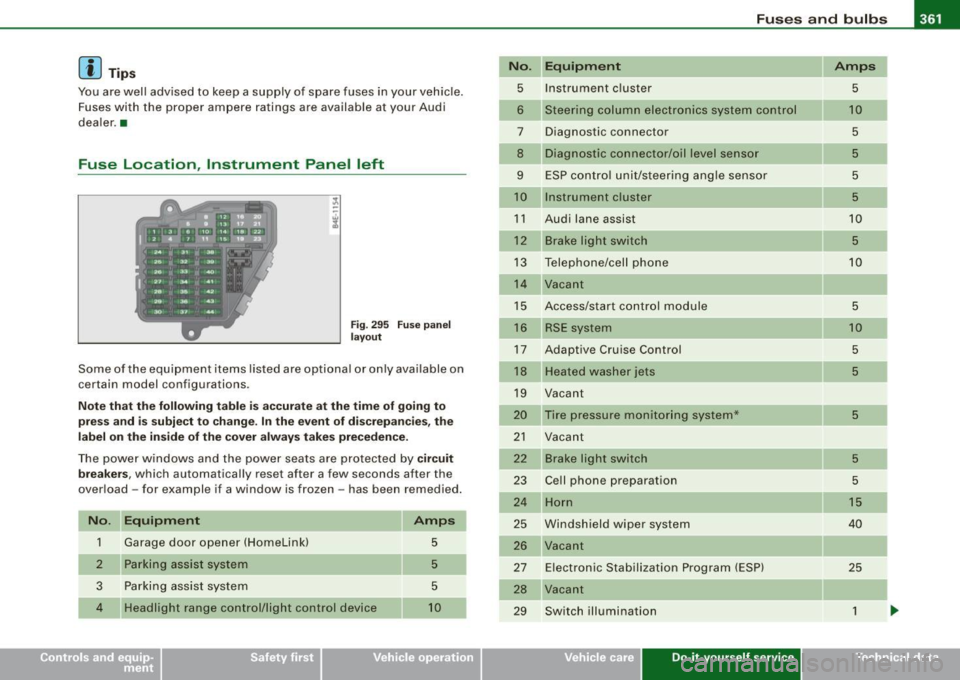
Fuse Location , Instrument Panel left
F ig. 295 Fuse pan el
l ayout
Some of the equipment items listed are optiona l or only available on
certain model configurations.
No te t hat th e fo llow ing t able is acc urate a t the time o f goin g to
p re ss an d is s ubject to c hang e. In the e vent of di screpancies, the
lab el on the insi de of th e cover alwa ys ta kes prece dence .
The power windows and the power seats are protected by cir cui t
bre akers,
which automatically reset after a few seconds after the
over load -for example if a window is frozen -has been remedied .
N o. Equipm ent
1 Garage door opener (HomeLinkl 5
Parking assist system 5
3
Parking assist system 5
4
Headlight range control/light control device 10
No .
5
6
7
8
9
10
11
12
13
14
15
16
17
18
19
20
21
22
23
24
25
26
27
28
29
Equipm ent Amps
Instrument c luster
5
Steering column electronics system control 1 0
Diagnostic connector 5
Diagnostic connector/oil level sensor 5
ESP contro l unit/steering angle sensor 5
Instrument cluster 5
Audi lane assist 10
Brake light switch 5
Telephone/cell phone 10
Vacant
Access/start control module
5
RSE system 10
Adaptive Cruise Control 5
Heate d washer jets 5
Vacant
Tire pressure monitoring system*
5
Vacant
Brake light switch
5
Ce ll phone preparation 5
Horn 1 5
Windshield wiper system 40
Vacant
E lectronic Stabilization Program (ESP)
25
Vacant
Switch illumination
1
Vehicle care Do-it-yourself service irechnical data
Page 364 of 408
11111...__F_ u_ s_ e_s _ a_n _ d_ b_ u_lb _ s _______________________________________________ _
No. Equipm ent
30 Vacant
31 On board power supply, light control (right
headlight)
32 Vacant
33 Left rear footwell heater
35 Vacant
36
37
38
39
40 Audi side assis
t
Cooler
On board po wer supply, light cont rol (left head
light)
Door contro l unit, driver 's side
Power ste ering column adjus tment
41 Door contro l unit, rear left
42 Access/start control module
43 Adaptive Light, left
--44 Adaptive Light, right
Amps
30
25
5
15
30
7.5
25
7.5
25
10
10 •
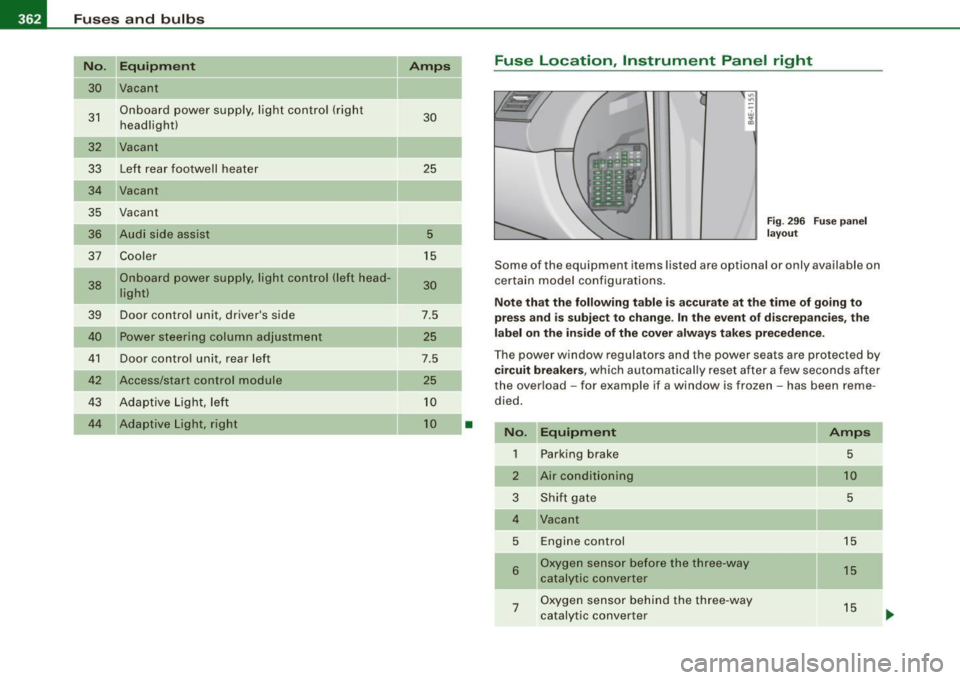
Fuse Location , Instrument Panel right
Fig . 296 F use pa nel
l ay ou t
Some of the equipment items listed are optional or only available on
certain model configura tions.
Note that the following t able is accurate at th e tim e of go ing to
pr es s an d is subje ct to change . In the eve nt of di screp ancies, th e
l a bel on the in side of the cov er a lways ta k es prece dence .
The power window regulators and the power seats are protected by
cir cuit br eak ers, which automatically reset after a few seconds after
the over load - for example if a window is frozen - has been reme
died .
No. Equipm ent
1 Parking brake
2
3
5
6
7
Air conditioning
Shi ft gate
Engine control
Oxygen sensor before the three-way
catalytic converter
Oxygen sensor behind the three-way
catalytic converter
Amp s
5
10
5
15
15
15
-
Page 365 of 408
_________________________________________________ F_ u_ s_ e_s _ a_n _d_ b_ u _ lb_ s _ __.11111
No. II Equipment
8 Engine control, auxiliary water pump
9
10
11
12
13
Climate control front /rear, dash panel buttons
Suspension leve l control system
(Adaptive Air Suspension)
Light and rain sensor
Display-/control unit
Roof electronics control unit
CD/DVD drive
15 Energy managemen t
16 Vacant
17 Radiator fan electronics
18 Airbag front passenger recognition
(weight sensor)
19 Vacant
20 Heated/ventilated seats
21 Engine control module
22 Vacant
23 Parking brake (switch)
24 Vehicle electrical system
25
26
27
Automatic transmission Air conditioning water valves water pump, rear climate control
Sunroof
28 Engine control module
29 Fuel injectors
30 Ignition coils Amps
10
5
10
5
5
10
5
5
5
5
5
5
5
10
15
10
20
5
15
30 No. Equipment
31 Fuel pump, right/fuel pump electronics
32 Automatic transmission
33 Right rear footwell heater
34 Heated/ventilated seats, rear
35 Heated/ventilated seats, front
36 Cigarette l ighter, front
37 Cigarette lighte r, rear/socket, rear
38 Auxiliary cooler fan
39 Door control unit, front right
40 Brake booster
41 Door control unit, rear right
42 Vacant
43 Headlight washer system
44 Air conditioning heater fan Amps
20/40
5
25
20
20
20
20/25 20
7.5
15
7.5
30
30
•
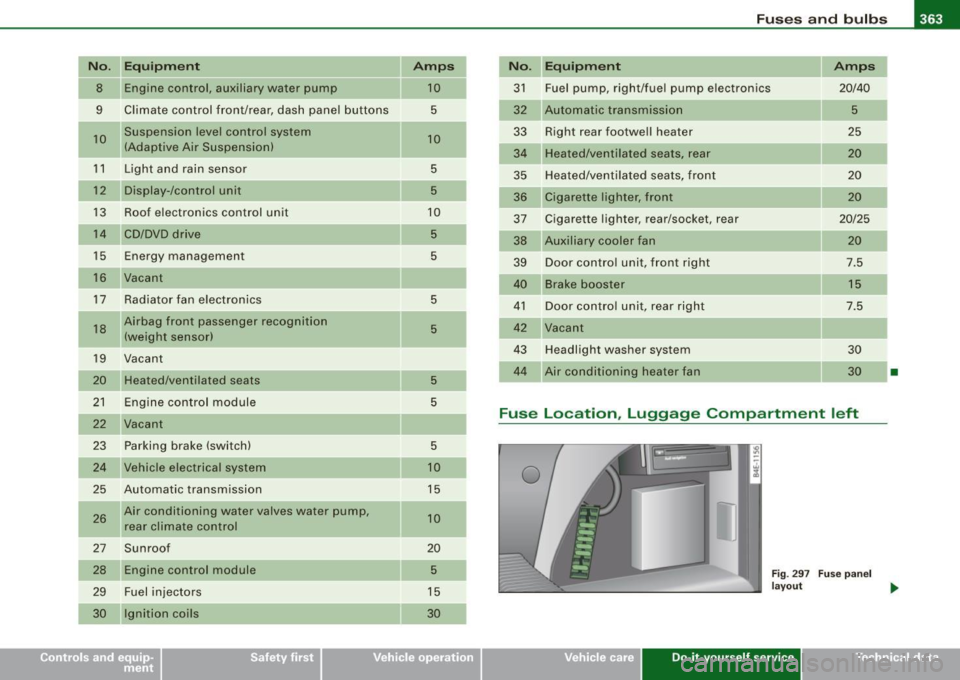
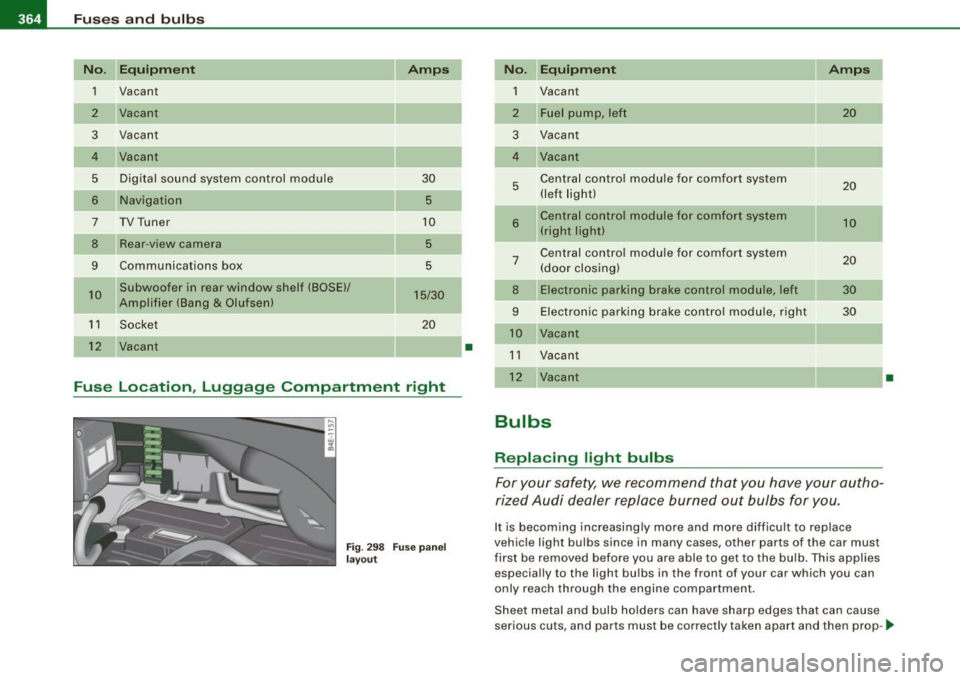
Fuse Location , Luggage Compa rtment left
0
Fig . 297 Fuse panel
layout _.
Vehicle care Do-it-yourself service irechnical data
Page 366 of 408
111'1...__F_ u_ s_ e_s _ a_n _ d_ b_ u_lb _ s _______________________________________________ _
No. Equipment Amps
1 Vacant
2 Vacant
3 Vacant
4 Vacant
5 Digital sound system control module 30
6 Navigation 5
7
TV Tuner 10
8 Rear -view camera 5
9 Communications box 5
10 Subwoofer in rear window shelf (BOSE)/ 15/30 Amplifier (Bang & Olufsen)
--
1 1 Socket 20
12 Vacant
Fuse Location, Luggage Compartment right
Fig. 298 Fuse panel
layout
I
•
No. Equipment Amps
1 Vacant
2 Fuel pump, left 20
3 Vacant
4 Vacant
5 Central control module for comfort system 20 (left light)
-
6 Central control module for comfort system 10 (right light)
Central control module for comfort system
7 (door closing) 20
8 Electronic parking brake control module, left 30
9 Electronic parking brake control module, right 30
10 Vacant
11 Vacant
12 Vacant
Bulbs
Replacing light bulbs
For your safety, we recommend that you have your autho
rized Audi dealer replace burned out bulbs for you.
It is becoming increasingly more and more difficult to replace
vehicle light bulbs since in many cases, other parts of the car must
first be removed before you are able to get to the bulb. This applies
especially to the light bulbs in the front of your car which you can
only reach through the engine compartment.
•
Sheet metal and bulb holders can have sharp edges that can cause
serious cuts, and parts must be correctly taken apart and then prop-.,
Page 369 of 408

________________________________________________ E_ m ___ e_r.::g ~e ___ n_c ~y:.- s;_ i_t _u :...:a:..:. t.:.: i...:o :...:n...:..:. s _ __,J_
& WARNING !continued)
• Before you check anything in the engine compartment, always
read and heed all WARNINGS~ page 301, "Engine compartment".
0 Note
• Applying a higher voltage booster battery will cause expensive
damage to sensitive electronic components, such as control units,
relays, radio, etc .
• There must be no electrical contact between the vehicles as
otherwise current could already start to flow as soon as the positive
(+) terminals are connected.
[ i) Tips
• The discharged battery must be properly connected to the
vehicle's electrical system. When jump starting or charging the
battery , never connect the negative ground cable to the battery
negative post because the battery manager system must be able to
detect the battery's state of charge. Always connect the negative
ground cable to the negative ground post of the battery manager
control unit .•
Use of jumper cables
Make sure to connect the jumper cable clamps in exactly
the order described below!
Fig. 299 Jump starting
with the battery of
another vehicle: A -
discharged vehicle
battery, B -booster
battery
The procedure described below for connecting jumper
cables is intended to provide a jump start for your vehicle.
Vehicle with discharged battery:
-Turn off lights and accessories, move lever of automatic
transmission to
N (Neutral) or P (Park) and set parking
brake.
Connect POSITIVE (+) to POSITIVE (+) (red)
1. Connect one end to the positive terminal~ fig . 299 G)
of your battery @.
2. Connect the other end to the positive terminal
@ of the
booster battery
@.
Connect NEGATIVE (-) to NEGATIVE (-) (black)
3. Connect one end to the negative terminal @ of the
booster battery
@.
Vehicle care Do-it-yourself service irechnical data
Page 393 of 408
______________________________________________ A_ l_,_ p _h_ a_ b_e _t_i c_ a _ l _in _ d_e _ x __ _
Weight-sensing mat .... .... . ... .. 246
When must the system be inspected?
231
Aircraft Transporting your vehicle .. .... .... 371
All Wheel Drive .. .... ....... .... .... 275
Alloy wheels ... .... .... .... ... .... .. 295
All -whee l drive
Winter tires .. ..... ... .... ..... .. . 343
A lternator
See Generator .... .... ... ..... ... . 18
Anti-freeze
See Engine coolant . ...... ..... .. . 316
Anti-lock brake system How the ABS system works . .... ... 274
Warning/indicator lights ... ... .... .. 21
Anti -Slip Regulation System (ASR)
How the system works ............ 272
An ti-t heft systems
Anti -theft ala rm system ...... .... .. 60
Electronic immob ilizer ... .. .... .... 49
Ashtray Front ... ...... ...... .... ..... ... 106
Rear .... ... .. .... .... ... .... .... 107
ASR How the Anti-Slip Regulation System works .. .... .... .... ... .... .... 272
Audi Service Repair Manua ls and Literature
382
AUTO mode AC climate con tro l .. .. .... ... .... . 1 17
Auto Safety Hotline . .... ........ .... . 209
Auto -Check Contro l .... ... .. .... .... .. 28
Controls and equip
ment Safety first
Automatic belt
retractor ... .. ...... ... 215
Automatic car wash
See Washing ..... .... .... .... .... 291
Au tomatic Shift Lock (ASU .... .... .... 168
Automatic transmission 6-speed automatic transmission .... 166
Automatic Shift Lock (ASU .... ... .. 168
Driving ............. ............ . 166
Dynamic sh ift program .... ........ 169
Emergency release for selector lever 171
Fa il- safe mode . ...... .... .... .... 171
I gnition key safety lock . ...... .... . 130
Kick -d ow n .... .... .... .... ... .... 169
Manual shift program ... .. .... .... 170
Selector lever .... .... .... .... .... 1 67
Shift buttons ... .. .... .... .... ... 1 71
Steering wheel with tiptronic .. .... . 171
Average speed . ...... .... .... .... ... . 38
Avoid damaging the vehicle .. ..... ... . 28 1
B
Background ligh ting . .... ...... ... .... 76
Battery ... .. .... ... .... .... .... .... 320
Battery location inside the luggage compartment ...... .... ... .. .... 32 1
Charging ........................ 323
I mpo rta nt warn ings when work ing o n the
battery . .... .... .... ........ ... 32 1
low ............................. 276
Replacing the battery ....... .... .. 324
State of charge ... .... .... .... .... 276
Winter operation . .... .... .... .... 320
Working on the battery .... .... .... 321 Battery vo
ltage . ... .... .. .... .... .... . 36
Before driving ... .... .... ..... .. .... 201
Blended gasoline . .... .... .... ...... . 303
Body cavity sealing .. .... .... .... ... . 296
Boos ter seat ... .. .... .... ... .... .... 253
How do I properly insta ll a b ooster sea t in
my vehic le? ............... ..... 253
Safety instructions .... .......... .. 253
Brake fluid Changing the brake fluid ... .... .... 320
Checking the brake fluid level .. ... . 319
What is the correct brake fluid level? 319
What should I do if the brake f luid warning
light comes on? ... .. .... .... .... 319
Brake system Ant i-lock brake system . ..... .. .... . 21
Brake assistant .... .... .... ....... 27 4
Brake booster ..... .... ... .... .... 274
Brake fluid .... .... .... ... .... .... 319
Brake f luid specificat ions for re fill and
replacement . .... .... .... ...... . 320
Brake light defective ... ...... ...... 26
Brake pads ....... .... .... .... ... 280
Electromechanica l parking brake .... 134
Fluid reservoir .. ...... ..... .. .... 319
How does m oisture or road salt affec t the
brakes? . .... .... .... ....... .... 272
Malfunction ............ ... .. ..... 30
Warning/indicator lights .... .... .... 22
Worn brake pads symbol ........... 34
Break -in period .. .... .... .... .... ... 279
Brake pads ... .... .... .... ...... . 280
Tires . .... .... .... .... ... .... .... 279
Bu lbs . ... .... .... .... ... .... ...... . 36 4
Vehicle operation Vehicle care Do-it-yourself service Technical data
Page 396 of 408

___ A_l.:,. p _h_ a_ b_e _t _i c_ a_l _i n_ d_e _x ____________________________________________ _
Driver information display
Driver information messages .. .... . 29
Introduction . ....... ... .. .... .... . 24
Open door or rear lid warning .. .... . 26
Outs ide temperature disp lay .... .... 25
Sound system display ... .. .. . .... . 25
Driver In forma tion Sys tem
Digital speedometer . . . . . . . . . . . . . . . 25
Driver's seat . . . . . . . . . . . . . . . . . . . . . . . . 87
Driver's seat memory . . . . . . . . . . . . . . . . . 94
Activating remote contro l key . ..... . 95
Recalling a seat position ...... .... . 94
Storing a seat position . ...... ..... . 94
Driving messages .................... 29
Driving safely ... .... ... .... ... .. ... 200
Driving time . .... .... .... .... .... .... 38
Dupl icate key . ........ ... .... .... ....
47
DVD player for navigation system . . . . . 112
E
Easy entry feature 129
Elect romechanica l parking brake
Emergency braking .... .... ... .... 136
Malfunction .. .... .... .... ... .... 136
Operation . . . . . . . . . . . . . . . . . . . . . . . 134
Parking . . . . . . . . . . . . . . . . . . . . . . . . . 135
Releasing and app lying .. .... ..... 134
Starting off with a trailer . .... ..... 136
Warning /indicator lights . .......... 22
Electronic differential lock (EDU How the system works . . . . . . . . . . . . 271
Warning/indicator lights . .... ..... . 21 Electronic immobili
ze r .. .. .... ..... 14 , 49
Electronic power control (EPC) warning/indicator light ... ..... 18
Electronic speed limiter .... .... .... ... 28
Electronic stabi li z ation program (ESP)
How the system works ....... .... . 270
Wa rning/indicator ligh ts ........... 18
Emergency braking . .......... .. ... . 136
Emergency closing Power sunroof . ... .... .... .... . 66 , 67
Emergency flasher . . . . . . . . . . . . . . . . . . . 73
Warning/indicator ligh ts ........... 19
Emergency locking . . . . . . . . . . . . . . . . . . . 54
Emergency locking of doors .. ... ... .. . 54
Emerg ency starting . ...... .. ... .... . 366
Emergency towing .. ... .. ... .. .. .... 368
Emergency warning triangle .. ... .... . 350
Energy management ... .. ..... ... ... 276
Battery power . . . . . . . . . . . . . . . . . . . 277
Driver no tification . . . . . . . . . . . . . . . . 277
Engine 4.2 1, 8-cylinder (350 hp) .... ... .... 310
6.0 I, 12 -cylinder (450 hp) . ...... ... 311
Compartment ... .... .... .... 3 10,311
Coolant . .. ...... ... ........ .. ... 316
Hood . .... .... .... .... ........ .. 308
Starting .. .... ... ..... ... ... 129, 130
Starting wi th jumper cables ... .... 366
Stopping ............ .... .... .... 131
Engine compartment ... .... .... ..... 310
Safety instructions .......... .... . 309
Working the engine compartment .. 309 Engine coolant
.. .. .. .. .. .... .... ... 316
Adding coolant ... .... .... .... ... 318
Checking the engine coolant level .. 317
Expans ion tank .... ... .... .... ... 317
Malfunction symbol ... .... .... .... 31
Radiator fan .... . ...... .... .. ... . 319
Temperature gauge ... .... .... .. .. 12
Engine data .. ..... .. . ... ... . .. .. .. . 380
Engine hood Closing ... .. .... .... .. .. . ... ... . 309
How to release the hood . . . . . . . . . . 308
Engine oil ... ..... .... .... .. . ... ... . 311
Adding ..... .... .... .. .. . ... ... . 314
Additives . ... .... .... .. .. . ... .... 314
Changing .... .... .... ... . ... .... 315
Checking the engine oil leve l ....... 313
Indications and conditions requir ing extra
checking .... .... .... ... .... ... 313
Oil consumption . ...... .. .. ... .. . 313
Oil grades ..... ... ... ...... ... .. . 311
Oil level symbol .. ........ .... ... .. 35
Pressure malfunction ...... .... .. . . 32
Recommended oil check intervals . . 313
Sensor defec tive . . . . . . . . . . . . . . . . . . 35
Speci fication and viscosity .. .... ... 311
Engine speed limitation . ... .. ... .... .. 35
Environment Break -in period ....... ........... 279
Catalytic converter .... ..... ...... 280
Disposing of your vehic le battery ... 324
Driving at high speeds ... .... ... .. 281
Driving to minimize pollution and noise . 281
Fuel .. ...... ....... ...... .... ... 305
Page 400 of 408

-Alphabetical index
---=------------------------------------------------
Oil
See Engine oil .... .... ....... .... 311
Older children and safety belts . . . . . . . . 254
On-Board Diagnostic System (OBD) Data Link Connector (DLC) .. .... .... 28
Electronic speed lim iter ... .... .... . 28
Malfunction Indicator Lamp (Mill . ... 27
Open door or rear lid warning ......... 26
Opening Power sunroof . .... .... ... .... .... 65
Operate your vehicle economically and mini-
mize pollution ... ..... ... .... ... 281
Outside air pollution
How to prevent from entering the vehicle
121
Outside mi rrors . ... .. .... .... ...... .. 84
Outside temperature display ........ .. 25
p
Paint
Touch -up
294
Paint No. . . . . . . . . . . . . . . . . . . . . . . . . . . 376
Parking . . . . . . . . . . . . . . . . . . . . . . . . . . . . 135
Automatic transmission . ...... .... 166
Caution when parking near a parking bar -
rier or curb ...... ... .... .... ... 135
Low bumper cover, spoilers and
suspension ......... ....... .... 135
Parking brake
See Electromechanical parking brake 134
Parking on a dec line (downhill) ....... 135
Parking on an incline (uphill) ..... .... 135 Parts replacement
.... ........ .. .. .. 384
PASSENGER A IR BAG OFF light ........ 232
Passenger's seat . . . . . . . . . . . . . . . . . . . . . 87
Pass enger 's seat memory .. .... ....... 95
Passive safety system . . . . . . . . . . . . . . . 200
Pedals ... ..... .. ...... ............ 206
Physica l principles of a frontal collision 212
Pockets . . . . . . . . . . . . . . . . . . . . . . . . . . . . 11
o
Polish ing ... ...... ... .... .... .... .. 293
Power locking switch ........ .... .... . 53
Power locking system ................ 49
Convenience open feature ....... ... 64
Locking and unlock ing the vehicle from
inside ............. ...... .... ... 53
Opening and closing the windows ... 64
Rear lid/trunk lid .. .... .... .... .... 54
Remote control . . . . . . . . . . . . . . . . . . . 48
Selective unlock feature ... .. .. ... .. 52
Settings . . . . . . . . . . . . . . . . . . . . . . . . . 52
Un locking and locking vehic le ... .... 51
Power roof . . . . . . . . . . . . . . . . . . . . . . . . . . 65
Power seat Contro ls .. ....... .... ........ .... 87
Massage function ....... ...... .... 89
Seat adjustment ........ ....... ... 88
Upper th igh support .... .... ....... 88
Power side door closer . . . . . . . . . . . . . . . 53
Pow er steering ... .......... ........ 275
Power sunroof Emergency c losing ............. 66, 67 Power
window switches .. .. .. .... .... . 61
In the driver's door ................ 62
In the front passenger's door ... .... 63
Reactivating the system .... ..... .. . 64
Power windows
Settings ... .... .... ... .... ....... 64
Pregnant women Special considerations when wearing a
safety belt ... .... .... ...... .... 217
Programming the HomeLink® universal re -
mote control .... .... .... ....... 194
Proper occupant seating positions .. ... 202
Proper safety belt position
Proper seating position 216
Front passenger ................ . 203
Occupants .... .... .... ..... .. ... 202
Rear passengers ... .... ... .... ... 204
a
Quartz clock . . . . . . . . . . . . . . . . . . . . . . . . . 13
quattro®
S ee All Whee l Drive .... .... .... ... 275
Question
R
What happens to unbelted occupants? . .
213
Why safety belts? .. ... .... .... ... 211
Radiator fan ......... ... .... .... .... 319
Rain sensor .. .. .. ........ .... ...... . 80
Rain sensor defective ...... ... .... .... 36