weight AUDI S8 2009 Workshop Manual
[x] Cancel search | Manufacturer: AUDI, Model Year: 2009, Model line: S8, Model: AUDI S8 2009Pages: 408, PDF Size: 91.63 MB
Page 338 of 408
-Tires and wheels
Determining correct load limit
Use the example below to calculate the
total weight of the passengers and
luggage or other things that you plan to
transport so that you can make sure that
your vehicle will not be overloaded.
Steps for Determining Correct
Load Limit
1. Locate the statement "THE COMBINED
WEIGHT OF OCCUPANTS AND CARGO
SHOULD NEVER EXCEED XXX KG OR XXX
LBS"on your vehicle's placard (tire infla
tion pressure label)=> page 330, fig. 274.
2. Determine the combined weight of the driver and passengers that will be riding
in your vehicle.
3. Subtract the combined weight of the driver and passengers from "XXX" kilo
grams or "XXX" pounds shown on the
sticker=> page
330, fig. 274. 4. The resulting figure equals the available
amount of cargo and luggage load
capacity. For example, if the "XXX"
amount equals 1400 lbs. and there will be five 150 lbs. passengers in your
vehicle, the amount of available cargo
and luggage load capacity is 650 lbs.
(1400-750 (5
X 150) = 650 lbs.)
5. Determine the combined weight of luggage and cargo being loaded on the
vehicle. That weight may not safely
exceed the available cargo and luggage
load capacity calculated in Step 4.
6. If your vehicle will be towing a trailer,
load from your trailer will be transferred
to your vehicle. Consult this manual to
determine how this reduces the avail
able cargo and luggage load capacity of
your vehicle.
- Check the tire sidewall (=> page
338,
fig. 278) to determine the designated
load rating for a specific tire. •
Page 342 of 408
-~_T_ ir_e_ s_ a_ n_d _ w_ h_ e_e _l_s _________________________________________________ _
Tire manuf acturin g date
The manufacturing date is a lso indicated on the tire sidewall
(possibly only on the
inner side of the wheel):
"DOT ... 2207 ... " means, for example, the tire was produced in th e
22nd week of 2007.
Sp eed rating (l ett er code )
The speed rating letter code on the wheels indicates the maximum
permissible road speeds=>
& in "Winter tires" on page 343.
P up to 93 mph (150 km/h)
Q up to 99 mph (158 km/h)
R upto 106mph(170km /h)
S upto110mph(180km/h)
T upto118mph(190km/h)
U up to 124 mph (200 km /h)
H up to 130 mph (2 10 km/h)
V up to 149 mph (240 km/h)3>
Z over 149 mph (240 km/h)3>
W up to 168 mph (270 km/h)3
l
Y up to 186 mph (298 km/h)3>
Your vehicle is normally factory equipped with tires, which possess
excellent driving characteristics and give your Audi optimum
driving comfort . An e lectronic speed limiter=>
page 28will normally
prevent your vehicle from going faster than the t ire speed rating
=> & .
U.S . D OT T ire Identifi cation Number (TIN ) an d tire
m anuf actur e date
This is the tire's "seria l number" . It begins with the letters "DOT"
and indicates that the tire meets all federal standards . The next two
numbers or letters indicate the plant where it was manufactured,
and the last four numbers represent the week and year of manufac-
31 F or tires with a maximum speed capab il ity over 149 mph (240 km/h), t ire
manufactur ers som etimes use the lett ers "ZR."
ture. For example, the numbers 2207 mean the tire was produced in
the 22nd week of 2007. The other numbers are marketing codes that
may or may not be used by the tire manufacturer. This information
is used to contact consumers if a tire defect requires a recall.
T ire ply co mpositio n a nd m ate ria ls used
The number of p lies indicates the number of layers of rubber -coated
fabric in the tire. In genera l, the greater the number of p lies, the
more weight a tire can support. Tire manu facturers also must indi
cate the materials in the tire, which include steel, ny lon, polyester,
and others.
M ax im um Load R ating
This number indicates the maximum load in kilograms and pounds
that can be carried by the tire.
Tire quali ty grading f or tr eadwe ar, trac tion , and
t e mp era tu re resis ta nce
Tread wear, traction and temperature grades=> page 342.
Max imum P ermi ssibl e Infl ation Press ure
This number is the greatest amount of air pressure that should ever
be put in the tire under norma l driving conditions.
Repl acin g tir es o r rim s on vehicles e quippe d with t ire
pr ess ure m onit orin g syste m*
The wheels on your vehicle are equipped with a sensor which
constantly monitors the a ir pressure inside the tire, and then trans
m its this in formation to the tire pressure mon itoring system*. If you
are going to replace the wheel rims on your vehicle , make sure the
new rims also have these sensors. The sensors must be compa tib le
with the tire pressure monitoring system * on your vehic le.
If you install rims, which do not have the sensors, or have sensors
which are not compatible, then the tire pressure monitoring system* will not work prope rly. In this case, the tire pressure moni
tor ing system * would not be able to monitor the tire pressu re or
warn you if it is necessary . .,_
Page 365 of 408
_________________________________________________ F_ u_ s_ e_s _ a_n _d_ b_ u _ lb_ s _ __.11111
No. II Equipment
8 Engine control, auxiliary water pump
9
10
11
12
13
Climate control front /rear, dash panel buttons
Suspension leve l control system
(Adaptive Air Suspension)
Light and rain sensor
Display-/control unit
Roof electronics control unit
CD/DVD drive
15 Energy managemen t
16 Vacant
17 Radiator fan electronics
18 Airbag front passenger recognition
(weight sensor)
19 Vacant
20 Heated/ventilated seats
21 Engine control module
22 Vacant
23 Parking brake (switch)
24 Vehicle electrical system
25
26
27
Automatic transmission Air conditioning water valves water pump, rear climate control
Sunroof
28 Engine control module
29 Fuel injectors
30 Ignition coils Amps
10
5
10
5
5
10
5
5
5
5
5
5
5
10
15
10
20
5
15
30 No. Equipment
31 Fuel pump, right/fuel pump electronics
32 Automatic transmission
33 Right rear footwell heater
34 Heated/ventilated seats, rear
35 Heated/ventilated seats, front
36 Cigarette l ighter, front
37 Cigarette lighte r, rear/socket, rear
38 Auxiliary cooler fan
39 Door control unit, front right
40 Brake booster
41 Door control unit, rear right
42 Vacant
43 Headlight washer system
44 Air conditioning heater fan Amps
20/40
5
25
20
20
20
20/25 20
7.5
15
7.5
30
30
•
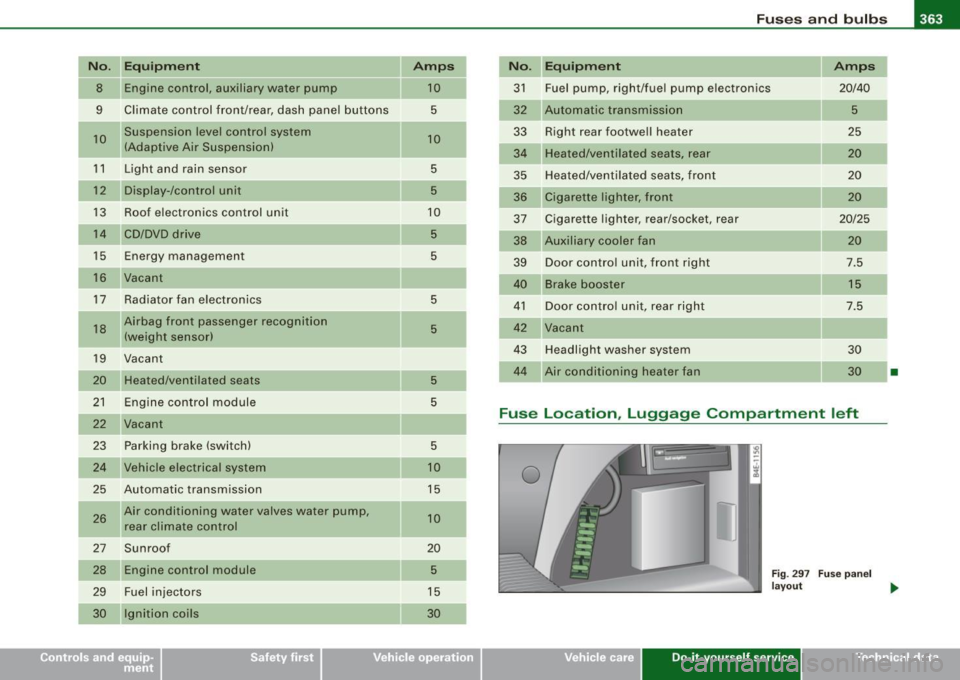
Fuse Location , Luggage Compa rtment left
0
Fig . 297 Fuse panel
layout _.
Vehicle care Do-it-yourself service irechnical data
Page 374 of 408
-Emergency situations PV:f...__---=---=---------------
-Read and hee d W ARNI NG =:> & .
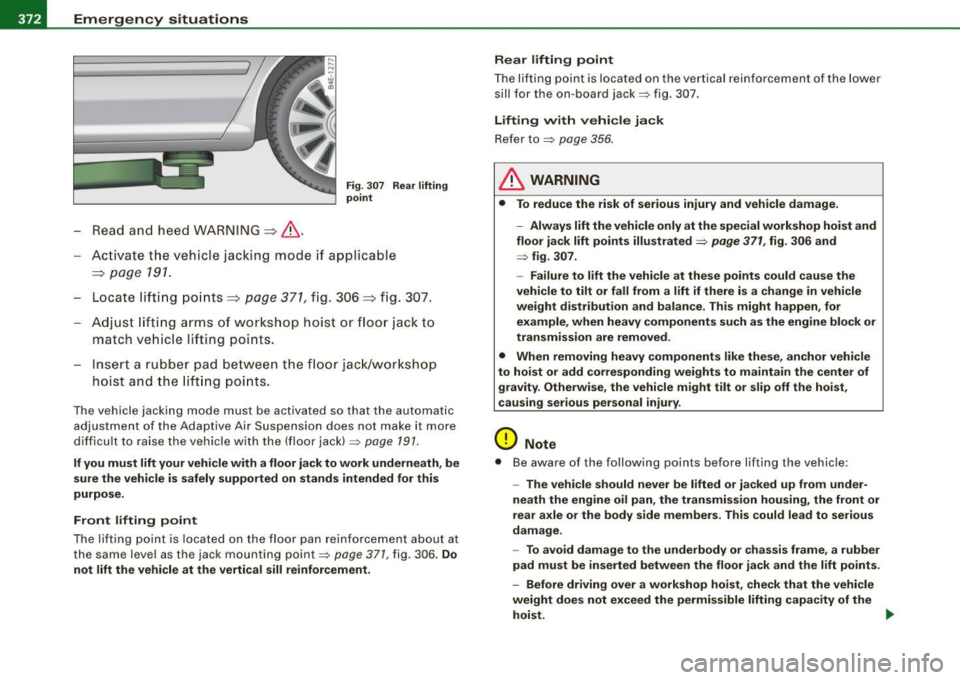
Fig. 30 7 Re ar lifting
point
Ac tiv ate t he vehicle jackin g mode if a pp licable
=:>
p age 19 1.
-Locat e lifting po in ts =:> page 371, fig. 3 06 =:> fig . 3 07 .
Ad ju st li ftin g a rms of works hop hoi st or floor jack t o
m atch v ehicle li ftin g poi nts.
In sert a r ub be r pad between the floor jack /wo rk sh op
h o ist and t he li ftin g poin ts.
The vehicle jac kin g m ode m ust be ac tiva ted so that the a utomatic
adjustment of the Adaptive Air Suspension does not make it more
d iffic ult to ra ise the vehic le w ith the ( floor jack) => page 19 1.
If you must lift your vehicle with a floor jack to work underneath , be
sure the vehicle is safely supported on stands intended for this
purpose.
Front lifting point
Th e lif ti ng po int is locat ed o n th e floo r pan re inf orc emen t abou t at
the same leve l as t he jack mounting point => page 371, fig. 306 . Do
not lift the vehicle at the vertical sill reinforcement. Rear lifting point
Th e lif tin g po int is loc ated on t he ver tical re infor ce ment o f the lo wer
s ill for t he on -boa rd jack=> fig . 3 07 .
Lifting with vehicle jack
R efer to => page
356 .
& WARNING
• To reduce the risk of serious injury and vehicle damage .
- Always lift the vehicle only at the special workshop hoist and
floor jack lift points illustrated
=> page 371 , fig . 306 and
=> fig. 307.
- Failure to lift the vehicle at these points could cause the
vehicle to tilt or fall from a lift if there is a change in vehicle
weight distribution and balance. This might happen , for
example, when heavy components such as the engine block or
transmission are removed .
• When removing heavy components like these, anchor vehicle
to hoist or add corresponding weights to maintain the center of gravity. Otherwise , the vehicle might tilt or slip off the hoist,
causing serious personal injury .
0 Note
• Be awar e of the following points be fore liftin g the vehicle :
- The vehicle should never be lifted or jacked up from under
neath the engine oil pan , the transmission housing , the front or
rear axle or the body side members . This could lead to serious
damage .
- To avoid damage to the underbody or chassis frame, a rubber
pad must be inserted between the floor jack and the lift points .
- Before driving over a workshop hoist, check that the vehicle
weight does not exceed the permissible lifting capacity of the hoist . _..
Page 379 of 408
_________________________________________________ G_ e_ n_ e_r _a _l_ i_n _f_o _ r_ m_ a_ t _i _o _ n __ PII
vehicle identification number of your vehicle (perforation) as well as
the Gross Vehicle Weight Rating (GVWR) and the Gross Axle Weight
Rating (GAWRl.
The high voltage warning label is located on the lock carrier.
The spark ignition system complies with the Canadian standard ICES-002. •
Displaying Vehicle Identification
Number in MMI
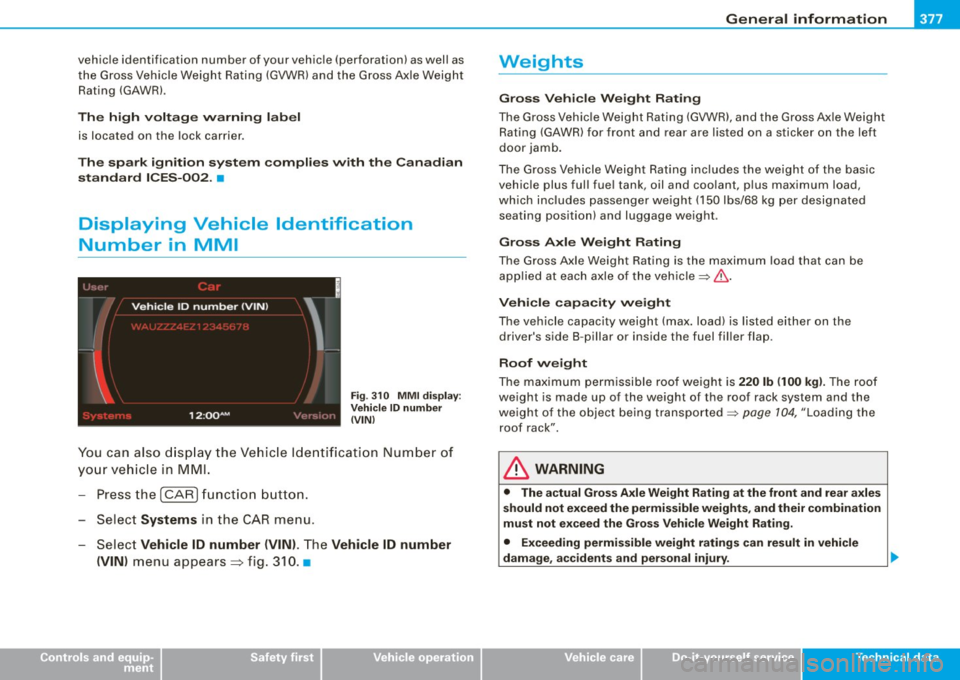
Fig. 310 MMI display:
Vehicle ID number
(VIN)
You can also display the Vehicle Identification Number of
your vehicle in MMI.
- Press the
(CARI function button.
- Select Systems in the CAR menu.
- Select Vehicle ID number (VIN). The Vehicle ID number
(VIN) menu appears ~ fig. 310. •
Controls and equip
ment Safety first Vehicle operation
Weights
Gross Vehicle Weight Rating
The Gross Vehicle Weight Rating (GVWR), and the Gross Axle Weight
Rating (GAWR) for front and rear are listed on a sticker on the left
door jamb.
The Gross Vehicle Weight Rating includes the weight of the basic
vehicle plus full fuel tank, oil and coolant, plus maximum load,
which includes passenger weight (150 lbs/68 kg per designated
seating position) and luggage w eight .
Gross Axle Weight Rating
The Gross Axle Weight Rating is the maximum load that can be
applied at each axle of the vehicle~& .
Vehicle capacity weight
The vehicle capacity weight (max. load) is listed either on the
driver's side B -pillar or inside the fuel fill er flap .
Roof weight
The maximum permissible roof weight is 220 lb (100 kg). The roof
weight is made up of the weight of the roof rack system and the
weight of the object being transported~ page 104, "Loading the
roof rack".
& WARNING
• The actual Gross Axle Weight Rating at the front and rear axles
should not exceed the permissible weights, and their combination
must not exceed the Gross Vehicle Weight Rating.
• Exceeding permissible weight ratings can result in vehicle
damage, accidents and personal injury.
Vehicle care Do-it-yourself service Tec hn ica l da ta
Page 380 of 408
lllffl __ G_ e_n_ e_ r_ a _l _i_n _f _o _ r_ m_ a_ t_ i_ o _ n ________________________________________________ _
0 Note
• The vehicle capacity weight figures apply when the load is
distributed evenly in the vehicle (passengers and luggage). When
transporting a heavy load in the luggage compartment, carry the
load as near to the rear axle as possible so that the vehicle's
handling is not impaired.
• Do not exceed the maximum permissible axle loads or the
maximum gross vehic le weight. Always remember that the vehic le's
handling will be affected by the extra load. Therefore, adjust your
speed accordingly .
• Always observe local regulations. •
Dimensions
The specifications refer to the basic model. Differences may occur
depending on the mode l type and options ordered, for example, tire
sizes.
0 Note
When driving up steep ramps, on rough roads, over curbs, etc. it is
important to remember that some parts of your vehicle, such as
spoilers or exhaust system components, may be close to the
ground. Be careful not to damage them. •
Page 393 of 408
______________________________________________ A_ l_,_ p _h_ a_ b_e _t_i c_ a _ l _in _ d_e _ x __ _
Weight-sensing mat .... .... . ... .. 246
When must the system be inspected?
231
Aircraft Transporting your vehicle .. .... .... 371
All Wheel Drive .. .... ....... .... .... 275
Alloy wheels ... .... .... .... ... .... .. 295
All -whee l drive
Winter tires .. ..... ... .... ..... .. . 343
A lternator
See Generator .... .... ... ..... ... . 18
Anti-freeze
See Engine coolant . ...... ..... .. . 316
Anti-lock brake system How the ABS system works . .... ... 274
Warning/indicator lights ... ... .... .. 21
Anti -Slip Regulation System (ASR)
How the system works ............ 272
An ti-t heft systems
Anti -theft ala rm system ...... .... .. 60
Electronic immob ilizer ... .. .... .... 49
Ashtray Front ... ...... ...... .... ..... ... 106
Rear .... ... .. .... .... ... .... .... 107
ASR How the Anti-Slip Regulation System works .. .... .... .... ... .... .... 272
Audi Service Repair Manua ls and Literature
382
AUTO mode AC climate con tro l .. .. .... ... .... . 1 17
Auto Safety Hotline . .... ........ .... . 209
Auto -Check Contro l .... ... .. .... .... .. 28
Controls and equip
ment Safety first
Automatic belt
retractor ... .. ...... ... 215
Automatic car wash
See Washing ..... .... .... .... .... 291
Au tomatic Shift Lock (ASU .... .... .... 168
Automatic transmission 6-speed automatic transmission .... 166
Automatic Shift Lock (ASU .... ... .. 168
Driving ............. ............ . 166
Dynamic sh ift program .... ........ 169
Emergency release for selector lever 171
Fa il- safe mode . ...... .... .... .... 171
I gnition key safety lock . ...... .... . 130
Kick -d ow n .... .... .... .... ... .... 169
Manual shift program ... .. .... .... 170
Selector lever .... .... .... .... .... 1 67
Shift buttons ... .. .... .... .... ... 1 71
Steering wheel with tiptronic .. .... . 171
Average speed . ...... .... .... .... ... . 38
Avoid damaging the vehicle .. ..... ... . 28 1
B
Background ligh ting . .... ...... ... .... 76
Battery ... .. .... ... .... .... .... .... 320
Battery location inside the luggage compartment ...... .... ... .. .... 32 1
Charging ........................ 323
I mpo rta nt warn ings when work ing o n the
battery . .... .... .... ........ ... 32 1
low ............................. 276
Replacing the battery ....... .... .. 324
State of charge ... .... .... .... .... 276
Winter operation . .... .... .... .... 320
Working on the battery .... .... .... 321 Battery vo
ltage . ... .... .. .... .... .... . 36
Before driving ... .... .... ..... .. .... 201
Blended gasoline . .... .... .... ...... . 303
Body cavity sealing .. .... .... .... ... . 296
Boos ter seat ... .. .... .... ... .... .... 253
How do I properly insta ll a b ooster sea t in
my vehic le? ............... ..... 253
Safety instructions .... .......... .. 253
Brake fluid Changing the brake fluid ... .... .... 320
Checking the brake fluid level .. ... . 319
What is the correct brake fluid level? 319
What should I do if the brake f luid warning
light comes on? ... .. .... .... .... 319
Brake system Ant i-lock brake system . ..... .. .... . 21
Brake assistant .... .... .... ....... 27 4
Brake booster ..... .... ... .... .... 274
Brake fluid .... .... .... ... .... .... 319
Brake f luid specificat ions for re fill and
replacement . .... .... .... ...... . 320
Brake light defective ... ...... ...... 26
Brake pads ....... .... .... .... ... 280
Electromechanica l parking brake .... 134
Fluid reservoir .. ...... ..... .. .... 319
How does m oisture or road salt affec t the
brakes? . .... .... .... ....... .... 272
Malfunction ............ ... .. ..... 30
Warning/indicator lights .... .... .... 22
Worn brake pads symbol ........... 34
Break -in period .. .... .... .... .... ... 279
Brake pads ... .... .... .... ...... . 280
Tires . .... .... .... .... ... .... .... 279
Bu lbs . ... .... .... .... ... .... ...... . 36 4
Vehicle operation Vehicle care Do-it-yourself service Technical data
Page 397 of 408
______________________________________________ A_ l_,_ p _h_ a_ b_e _t_i c_ a _ l _in _ d_e _ x __ _
Fuel economy ...... .... .... .... .. 281
Leaks under your vehicle ... .. .... . 309
Lettin g the vehicle s tand and warm up .
28 2
Pr oper disposal of drained brake fluid
320
Proper disposal of dra ined e ngine
coolant ........................ 318
Proper disposal of drained engine oil ...
314,3 15
Recycling used engine oi l ........ .. 314
Un leaded fuel ... .. ... .. ...... .... 303
What should I do with an old battery? 324
EPC
See Electronic power control ........ 18
ESP
See Electronic stabilization program
(ESP) ... ..... ......... ....... ... 18
Event Data Recorder (EDR) ... .... ..... 270
Expans ion tank ...... ... .. ........ .. 317
F
Fan
Radia tor .. ...... ........ ..... .. . 319
Flat tire changing .................... 45
Floor mats ..... .... .... .... ... .... . 207
Fog lights Front .. ... .. .... .... .... ...... ... 71
Rear .... ... .. ....... .. ....... ... . 71
Warning/indicator lights ...... .... .. 19
Fo lding master key with remote control . 47
Foot pedals ... ... .. .... .... .... .... 206
Controls and equip
ment Safety first
For the sake of the environment
Gaso line fumes and the environment 305
L etting your engine warm up .. .... . 130
Reducing engine noise by ear ly
upshifting . ...... .... .... ... .... . 12
Refueling . .... ... .... .... .... .... 305
Saving fuel by early upshifting .... .. 12
Using the rear window defogger .... 124
F ront a irbags
Description ... .... .... .... .... ... 224
How they work ................... 229
Front arm rest adjusting ..... ... .... .... .... .... . 93
Storage compartment ... ...... .... . 93
Front ashtray .... ..... .. ..... .... ... 106
Front fog lights ... .. .... .... .... .... . 71
Front seats ...... .... ........ ....... . 86
Adjusting .. ...... .... .... .... ... 203
Ch ild restra ints in the front seat ... . 222
Convenie nce side v iew .. ...... .... . 91
Poc kets ... .. .... .... .... .... .... 1 10
Symmetrica l seat positions . ...... .. 91
Fronta l collisions and the laws of physics
212
Fuel Additives ... .. ..... .. .... .... .... 303
Average c onsumption .... ...... ... . 38
Blended gasoline ... .. .... .... .... 303
F uel filler neck . ...... .... .... .... 304
Fuel gauge .. ....... .... .... .... .. 14
Gasoline ...... ... .... .... .... ... 303
Gaso line additives ................ 304
I nstantaneous fuel consumption ..... 38 Low
fuel level symbol .... ... .. ..... 35
Octane rating .... .... .... .... .... 303
Recommendation . .... .... .... .... 303
Refuelling . ... .... .... ...... ..... 305
Reserve .......................... 14
Tank capacity .. ...... .... .... . 14, 380
Un lock ing the fue l filler flap by hand 307
Fuse arrangement ... ....... ... .. .... 360
G
Garage door opener (Homelink®) ...... 194
Gas discharge lamps ...... .... .... ... 364
Gauges Engine coolant temperature . ...... .. 12
Fuel gauge ... .... .... ... .... .... . 14
Speedomete r ..... .... ... .... ..... 1 4
Tac hometer . ... ... .... ... .... .... . 13
Trip odometer ... .. .... .... ...... .. 14
General illustration Instruments and controls ......... .. 11
Generator Warning/indicator lights .... .... .... 18
G lossary of t ire and loading terminology . . .
327
G love compartment .. ....... .... .... 109
cd changer ... .... .... .... .... ... 109
Owner's Literature .... .... .... .... 109
Gross Vehic le Weight Ra ting (GVWR) ... 377
Vehicle operation Vehicle care Do-it-yourself service Technical data
Page 401 of 408
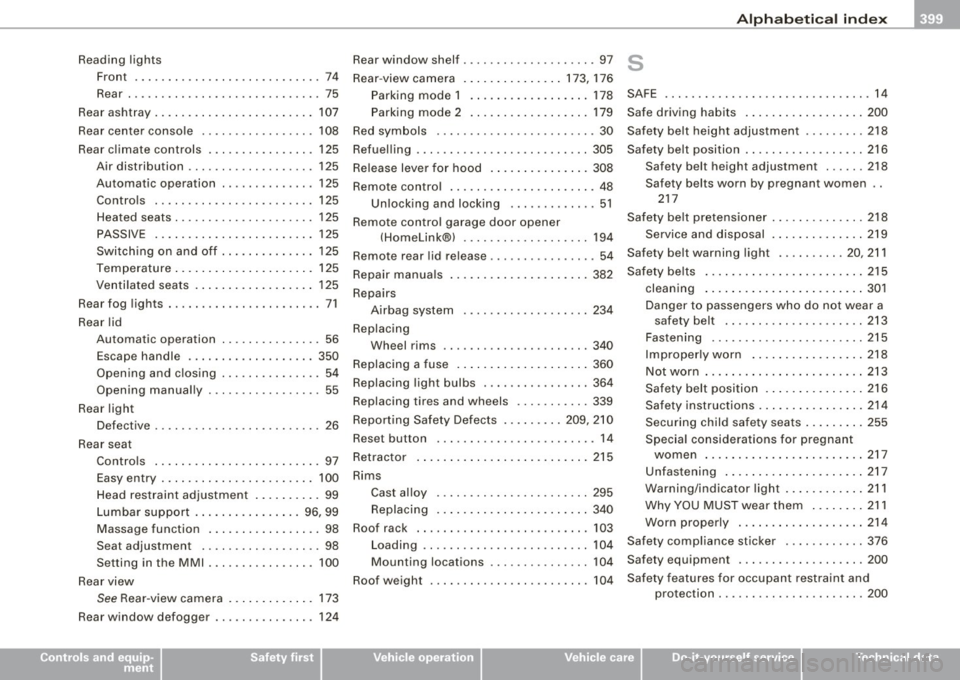
______________________________________________ A_ l_,_ p _h_ a_ b_e _t_ic _ a _ l _in _ d_e _ x __ lll
Reading lights
Front ... ... ... .. .... .... ..... .. ..
74
Rear .. ..... ... ... ....... .... ... .. 75
Rear ashtray ......... .... ........ ... 107
Rear center console ..... ............ 108
Rear c limate controls ................ 125
Air distribution ................. .. 125
Automatic operation ...... ...... .. 125
Controls ......... .... ... .... .... 125
Heated seats . . . . . . . . . . . . . . . . . . . . . 125
PASSIVE ........................ 125
Switching on and off .............. 125
Temperature ... .. .... .... ...... .. 125
Venti lated seats ....... ........ ... 125
Rear fog lights ....................... 71
Rear lid
Automatic operation .......... .... .
56
Escape handle ............ ....... 350
Opening and closing ...... ..... .. .. 54
Opening manually ................. 55
Rear light
Defective . .... .... ....... ..... ... .
26
Rear seat
Contro ls ... .. .... .... ......... ...
97
Easy entry . . . . . . . . . . . . . . . . . . . . . . . 100
Head restraint adjustment ... ....... 99
Lumbar support ....... .... .... . 96, 99
Massage function ..... ...... .... .. 98
Seat adjustment ..... ....... .... .. 98
Setting in the MMI ................ 100
Rear view
See Rear-view camera .. ...... .... . 173
Rear window defogger ............... 124
Controls and equip ment Safety first
Rear window shelf
...... ... ... .. . .... . 97
Rear -view camera ........ ....... 173, 176
Parking mode 1 ...... ............ 178
Parking mode 2 .................. 179
Red symbols .............. ...... ... . 30
Refuel ling ...... ....... ...... .... ... 305
Release lever for hood ........... ... . 308
Remote control .. .... ... .... .... .... . 48
Unlocking and locking ............. 51
Remote control garage door opener
(HomeLink®) ...................
194
Remote rear lid releas ,e ............. ... 54
Repair manuals ........ .... ... .. .... 382
Repairs
Airbag system .... .... .... .... ...
234
Replacing
Wheel rims .......... ... .... ... ..
340
Replacing a fuse ................ .... 360
Replacing light bulbs .... .... .... .... 364
Replacing tires and wheels ........... 339
Reporting Safety Defects ......... 209, 210
Reset button ..... .. .... ........ .... . 14
Retractor ..........................
215
Rims Cast alloy .......................
295
Replacing .. ...... .... ...... ... .. 340
Roof rack ... ....... ........ .... .... 103
Loading ......................... 104
Mounting locations ......... .. .... 104
Roof weight ........................
104
s
SAFE ... ...... .......... ....... .... . 14
Safe driving habits ....... ....... .... 200
Safety belt height adjustment . .... .... 218
Safety belt position ... .... ...... ..... 216
Safety belt height adjustment ...... 218
Safety belts worn by pregnant women ..
217
Safety belt pretensioner .............. 218
Service and disposal ..... ......... 219
Safety belt warning light . .... .... . 20, 211
Safety be lts ... .. .... ....... .... .... 215
cleaning ...... .... ..... .. .... ... 301
Danger to passengers who do not wear a
safety belt ...... .... .... .... ...
213
Fastening ....................... 215
Improperly worn .................
218
Not worn ... .. .... .... .... ...... . 213
Safety belt position . ...... .... .... 216
Safety instructions .... .... .... .... 214
Securing child safety seats .........
255
Special considerations for pregnant
women ...... ....... .... .... ...
217
Unfastening ...... .... ...... .... . 217
Warning/indicator light ............
211
Why YOU MUST wear them ..... ... 211
Worn properly ........ ...... .... . 214
Safety comp liance sticker ............
376
Safety equipment .... ....... .... .... 200
Safety features for occupant restraint and
protection ... ... ........ .... ....
200
Vehicle operation Vehicle care Do-it-yourself service Technical data
Page 404 of 408
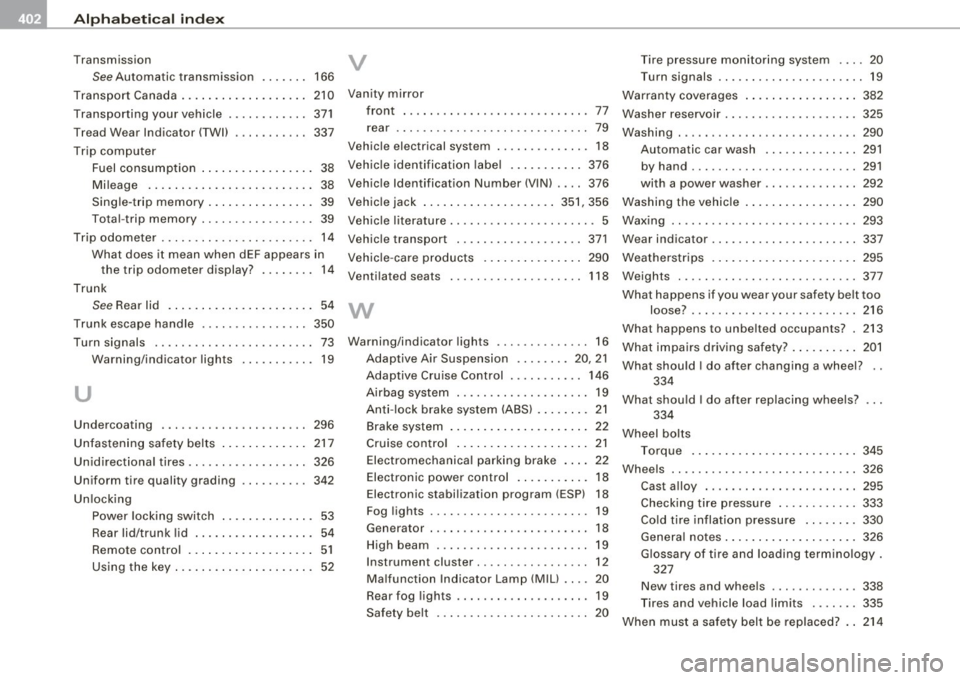
___ A_l.:. p _h_ a_ b_e _t _ic _ a_l _in _ d_e _x ____________________________________________ _
Transmission
See Automatic transmission . . . . . . . 166
Transport Canada . . . . . . . . . . . . . . . . . . . 210
Transporting your vehicle . . . . . . . . . . . . 371
Tr ead Wear Indicator (TWll ........... 337
Trip computer
V
Vanity mirror front ... ... .... ................ .. 77
rear . . . . . . . . . . . . . . . . . . . . . . . . . . . . . 79
Vehicle electrical system .. ..... .. .... . 18 Ti
re pressure monitoring system .... 20
Turn signals ... .... .... ... .... .... 19
Warranty coverages .... .... .. .... ... 382
Washer reservoir ... .... ..... .. ...... 325
Washing . .... .... .... .... ... .... ... 290
Automatic car wash ... ... ... .. ... 291
Fuel consumption ...... .... ... ... . 38
Vehic le ide ntification labe l .... ... .... 376
by hand .................... .. ... 291
Mi leage ...... ............ ....... 38
Sing le -trip memory .. ...... ...... .. 39
Total -trip memory .. .... ... .... .... 39
Trip odometer . . . . . . . . . . . . . . . . . . . . . . . 14
What does it mean when dEF appears in the trip odometer display? ....... . 14
Trunk
See Rear lid . .............. ....... 54
Trunk escape handle ................ 350
furn signals ........................
73
Warning/indicator lights ........... 19
u
Undercoating . . . . . . . . . . . . . . . . . . . . . . 296
Unfastening safety belts ...... ...... . 217
Un idirectiona l tires ..... ... ... ... .... 326
Uniform tire quality grading .......... 342
Un locking
Power locking switch . . . . . . . . . . . . . . 53
Rear lid/trunk lid ...... .... ...... .. 54
Remote control .. ...... ...... .... . 51
Using the key ..... .... .... ...... .. 52 Vehic
le Identification Number (VIN) .... 376
Vehic le jack .......... .... .... .. 351, 356
Vehic le literature .......... ... .... .... . 5
Vehic le transport . .................. 371
Vehic le -care products . . . . . . . . . . . . . . . 290
Venti lated seats .................... 118
w
Warning/indicator ligh ts . .... ....... .. 16
Adaptive Air Suspension ........ 20, 21
Adaptive Cruise Control . . . . . . . . . . . 146
Airbag system . . . . . . . . . . . . . . . . . . . . 19
Anti- lock brake system (ABS) . . . . . . . . 21
Brake system . . . . . . . . . . . . . . . . . . . . . 22
Cruise con tro l . . . . . . . . . . . . . . . . . . . . 21
Electromechanica l parking brake .... 22
Electronic power control ...... .... . 18
Electronic stabilization program (ESP) 18
Fog lights ........................ 19
Generator . . . . . . . . . . . . . . . . . . . . . . . . 18
High beam . . . . . . . . . . . . . . . . . . . . . . . 19
Instrument cluster. . . . . . . . . . . . . . . . . 12
Malfunction Indicator Lamp (MIU .. .. 20 with a power washer
... ... ....... . 292
Washing the vehicle ....... ... ... ... . 290
Waxing .. .... .... .... .... ... .... ... 293
Wear indicator ......... ............ . 337
Weatherstrips .... .... .... ... .... ... 295
Weights ....................... .... 377
What happens if you wear your safety belt too loose? ........... .... ..... .. ... 216
What happens to unbelted occupants? . 213
What impairs driving safety? .......... 201
What should I do after changing a wheel?
334
What should I do after replacing wheels?
334
Wheel bolts Torque ..... ...... .... ....... ... 345
Wheels .. .... .... .... .... ... .... ... 326
Cast alloy ....................... 295
Checking tire pressure .. .... ...... 333
Co ld tire inflation pressure ........ 330
General notes ... ........... .... .. 326
G lossary of tire and loading termino logy .
327
New tires and wheels ............. 338
Rear fog lights .... .... ...... ... · · · 19 T" d h. I I d
1· ·t 335
ires an ve Ic e oa Im1 s ... ... .
Safety be lt . . . . . . . . . . . . . . . . . . . . . . . 20 .,
214
When must a safety belt be replacedr . .