spare wheel AUDI S8 2010 User Guide
[x] Cancel search | Manufacturer: AUDI, Model Year: 2010, Model line: S8, Model: AUDI S8 2010Pages: 384, PDF Size: 90.95 MB
Page 335 of 384
![AUDI S8 2010 User Guide What do I do now? -_______________ __.EWII
(]] Tips
If you no longer have your or iginal warn ing triangle and need to equip
your vehicle with a new one, contact your authori](/img/6/57617/w960_57617-334.png "AUDI S8 2010 User Guide What do I do now? -_______________ __.EWII
(]] Tips
If you no longer have your or iginal warn ing triangle and need to equip
your vehicle with a new one, contact your authori")
What do I do now? -_______________ __.EWII
(]] Tips
If you no longer have your or iginal warn ing triangle and need to equip
your vehicle with a new one, contact your authorized Aud i dealer for
a rep lacement. •
Jack, tools and spare wheel
Jack
The jack is stored underneath the floor panel in the
luggage compartment.
Fig. 26 5 Luggag e
c ompart ment vehicl e
jack
Be fore stori ng the jack, ma ke sure it is wound back down as far as it
w ill go .
& WARNING
Improper use of the vehicle jack can cause serious personal inju
ries.
• Never use the jack suppl ied with your Audi on another vehicle ,
particularly on a heavier one . The jack is only suitable for use on
the vehicle it came with .
Vehicle OP-eration
& WARNI NG (continued )
• Using a bumper jack to raise the veh icle will dam age the
bumper system . The ja ck may slip, causing injury .
• Never support your vehicle on cinder blocks , bricks or other
objects . These may not be able to support the load and could cause
injury when they fail.
• Never sta rt or run the engine while the vehicle is suppo rted by
the jack.
• If you must work under the vehicle , always use safety stands
specifically designed for this purpo se.
• Never use the he xagonal so cket in the handle of the screw
driver to loosen or tight en the wheel bolts .
• Always make sure the sp are tire and even a flat tire are secured
in pla ce and not loose, otherwis e they could fly forward, causing
personal injury to passengers in the vehicle in an accident or
sudden maneuver .
(]] Tips
Before you c an raise your vehi cle us ing t he jack, you mus t activate the
jack ing mode~
page 179 . •
Vehicle care Do-it-yourself service iTechnical data
Page 336 of 384
-What do I do now? ..._ __________________________________________ _
Tools
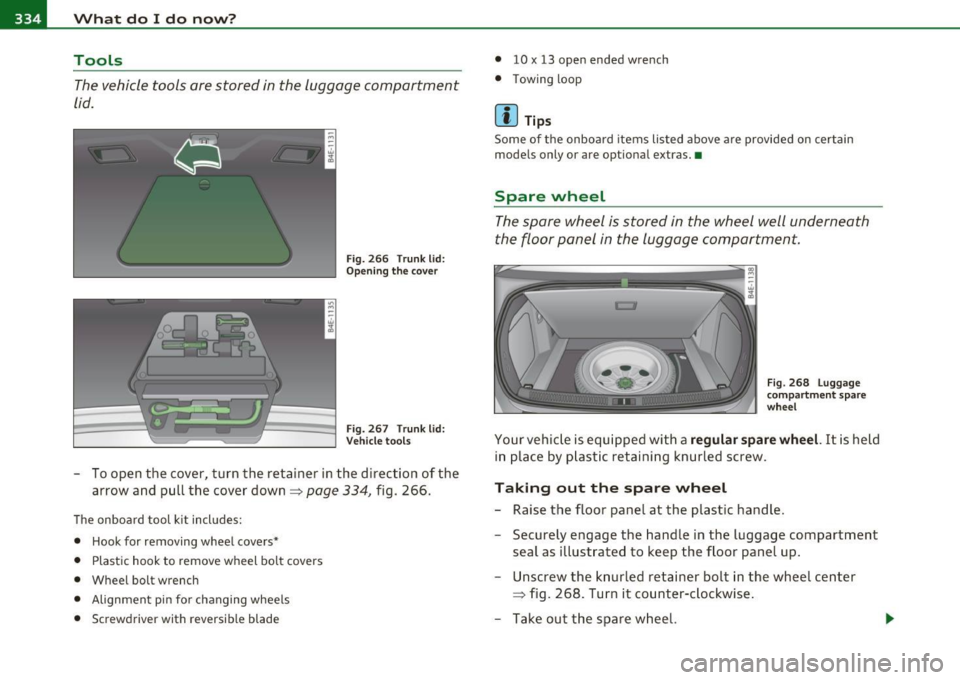
The vehicle tools are stored in the luggage compartment
lid.
Fig. 266 Trunk lid:
Opening the cover
Fig. 267 Trunk lid:
Vehicle tools
-To open the cover, turn the retainer in the direction of the
arrow and pull the cover down==>
page 334, fig. 266 .
The onboard tool kit includes:
• Hook for removing wheel covers*
• Plastic hook to remove wheel bolt covers
• Wheel bolt wrench
• Alignment pin for changing wheels
• Screwdriver with reversible blade •
10 x 13 open ended wrench
• Towing loop
(I) Tips
Some of the on board items listed above are provided on certain
models only or are optional extras. •
Spare wheel
The spare wheel is stored in the wheel well underneath
the floor panel in the luggage compartment.
Fig. 268 Luggage
compartment spare
wheel
Your vehicle is equipped with a regular spare wheel. It is held
in place by plastic retaining knurled screw.
Taking out the spare wheel
-Raise the floor panel at the plastic handle.
- Securely engage the handle in the luggage compartment
seal as illustrated to keep the floor panel up.
- Unscrew the knurled retainer bolt in the wheel center
==> fig. 268. Turn it counter-clockwise.
- Take out the spare wheel.
Page 337 of 384
What do I do now? -____________________ .:..::......:..:...___Wi'.'11
- Disengage and lower the floor panel before you close the
luggage compartment lid again.
Storing the replaced wheel
-Place the replaced wheel inside the spare wheel well in the
luggage compartment.
Tighten the knurled retaining screw clockwise to secure
the wheel in place.
- Disengage and lower the floor panel before you close the luggage compartment lid again.
& WARNING
Loose items in the passenger compartment can cause serious
personal injury during hard braking or in an accident.
• Never store the spare wheel or jack and tools in the passenger
compartment.
• Always store all jacking equipment, tools, and the spare wheel
in the luggage compartment.
• Tighten the knurled retaining screw for the spare wheel
securely.
[I] Tips
Check the inflation pressure of the spare tire periodically to keep the
tire ready for use .•
Safety first
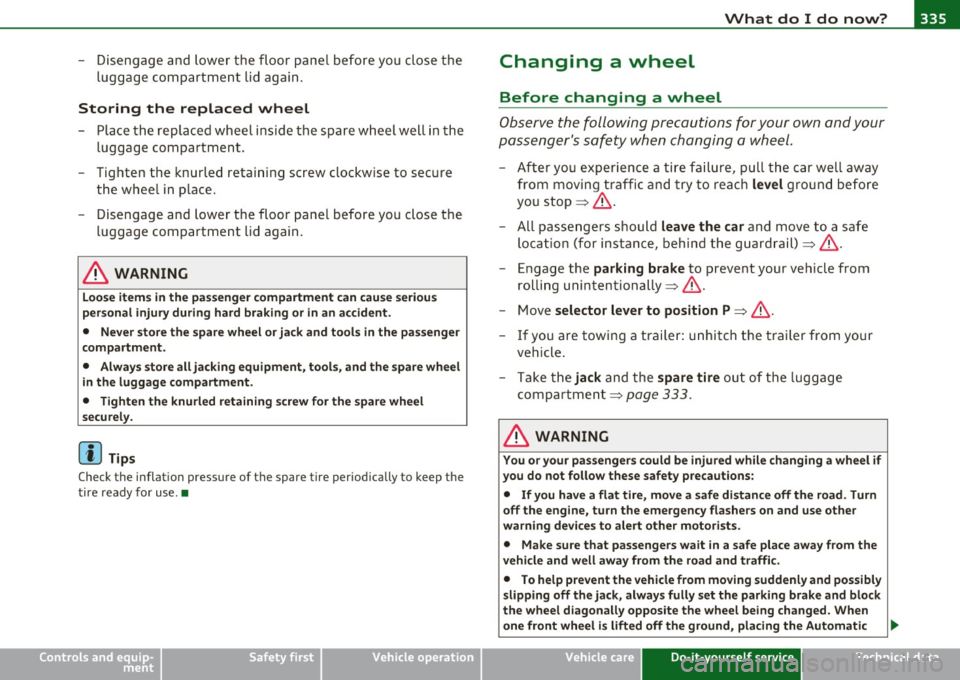
Changing a wheel
Before changing a wheel
Observe the following precautions for your own and your
passenger's safety when changing a wheel.
- After you experience a tire failure, pull the car well away
from moving traffic and try to reach
level ground before
you stop ~& .
- All passengers should
leave the car and move to a safe
location (for instance, behind the guardrail)~& .
- Engage the
parking brake to prevent your vehicle from
rolling unintentionally~ &.
- Move
selector lever to position P ~ & .
- If you are towing a trailer: unhitch the trailer from your
vehicle.
- Take the
jack and the spare tire out of the luggage
compartment~
page 333 .
& WARNING
You or your passengers could be injured while changing a wheel if
you do not follow these safety precautions:
• If you have a flat tire, move a safe distance off the road. Turn
off the engine, turn the emergency flashers on and use other
warning devices to alert other motorists.
• Make sure that passengers wait in a safe place away from the
vehicle and well away from the road and traffic.
• To help prevent the vehicle from moving suddenly and possibly
slipping off the jack, always fully set the parking brake and block
the wheel diagonally opposite the wheel being changed. When
one front wheel is lifted off the ground, placing the Automatic ..,
Vehicle care Do-it-yourself service Technical data
Page 338 of 384

-What do I do now? ..._ __________________________________________ _
& WARNING (conti nued)
Tra nsmissi on i n " P" ( Park) wi ll not preve nt th e vehicle from
m ov ing.
• Befor e you chan ge a wh eel, be s ure th e grou nd i s lev el and
firm . If n ece ssa ry , us e a s turdy board under th e j ack .
• Afte r in stalling the sp are whee l, make su re that you r eplace
the flat tire /wh ee l i n it s storage are a properly and t ight en th e
knu rled ret ain in g sc rew s ecu rely .
[ i J Tips
Before changing the wheel, you must activate the jacking mode, so
that the automatic contro ls for the Adaptive A ir Suspension do not
make it more difficult to
lift the vehicle with the jack=> page 179. •
Changing a wheel
When you change a wheel, follow the sequence described
below step-by-step and in exactly that order.
1. Activate the vehicle jacking mode==> page 179.
2 . Remove the decorati ve wheel cover* . For more details see
also ==>
page 33 7, "Decorative wheel covers" or
==>
page 337, "Wheels with wheel bolt caps".
3 . Loosen the
wh eel bolts ==> page 338.
4. L ocate the proper mounting point for the jack and align
the jack below that point==>
page 338 .
5. Lift the car with the jack==> page 338.
6. Remove the wheel with the flat tire and then install the
spare ==>
page 340.
7. Tighten all wheel bolts lightly . 8
.
Lower the vehicle with the jack.
9. Use the wheel bolt wrench and
firmly tighten all wheel
bolts==>
page 338.
10. Replace the decorative wheel cov er*.
11. Deactivate the vehicle jacking mode==> page 179.
& WARNING
A lw ays rea d and f ollow all W ARNING S and inf ormation => & in
" Rai sing th e vehicl e" on
page 33 8 and => pag e 341. •
After changing a wheel
A wheel change is not complete without the doing the
following .
-Store and secure the whe el you rep laced in the spare
wheel well.
- Replace the tools and the jack in their proper location.
- Check the
tire pre ssure on the spare wheel immediately
after mounting it .
- As soon as possible, have the
tighten ing torques on all
wheel bolts checked with a torque wrench . The correct
tightening torque is 90 ft lb (120 Nm).
- Have the flat tire
re placed as soon as possible .
[ i J Tips
• If you notice that the wheel bolts are corroded and diff icult to turn
wh ile chang ing a tire, they shou ld be rep laced before you check the
tightening torque. .,_
Page 342 of 384

.,.___W_ h_ a_t _ d _ o_ I_ d_ o_ n_o _w_ ? ___________________________________________ _
Taking the wheel off/installing the spare
Follow these instructions step-by-step for changing the
wheel
Fig. 274 Changing a
wheel: using the
screwdriver handle
(with the blade
removed ) to turn the
bolts
Fig . 275 Changing a
wheel: alignment pin
inside the top hole
After you have loosened all wheel bolts and raised the vehicle
off the ground, remove and replace the wheel as follows:
Removing the wheel
-Use the hexagonal socket in the screwdriver handle to
completely remove the topmost wheel bolt and set it
aside on a
clean surface => fig. 274 .
- Screw the threaded end of the
alignment pin from the
tool kit hand-tight into the empty bolt hole=> fig. 275 . -
Then remove the other wheel bolts as described above.
- Take off the wheel leaving the alignment pin in the bolt
hole.
Putting on the spare wheel
Lift the spare wheel and carefully slide it over the align
ment pin to guide it in place.
- Use the hexagonal socket in the screwdriver handle to
screw in and tighten all wheel bolts
slightly.
- Remove the alignment pin and insert and tighten the
remaining wheel bolt slightly like the rest.
- Turn the jack handle counter-clockwise to lower the
vehicle until the jack is fully released .
Use the wheel bolt wrench to tighten all wheel bolts firmly
=> page 338. Tighten them crosswise, from one bolt to
the (approximately) opposite one, to keep the wheel
centered .
(I) Tips
Never use the hexagonal socket in the handle of the screwdriver to
loosen or tighten the wheel bolts.
• Pull the reversible blade from the screwdriver before you use the
hexagonal socket in the handle to turn the wheel bolts .
• When mounting tires with
unidirectional tread design make sure
the tread pattern is pointed the right way~
page 341.
• The wheel bolts should be clean and easy to turn. Check for dirt
and corrosion on the mating surfaces of both the wheel and the hub.
Remove all dirt from these surfa ces before remounting the wheel. •
Page 343 of 384

_______________________________________________ W __ h_a _ t_ d_o_ I_ d_o_ n_ o_w _ ? __ _
Tires with unidirectional tread design
Tires with unidirectional tread design must be mounted
w ith their tread pattern pointed in the right direction .
Using a spare tire w ith a tread pattern intended for
u se in a specific direction
When using a spare tire w ith a tread pattern intended for use in a
spec ific direction, please note the fo llow ing:
• The d irect ion of rotation is marked by an arrow on the side of the
tire.
• If the spare tire has to be installed in the incorrect direct ion, use
t he spare t ire only temporar ily since the tire w ill no t be ab le to
achieve its optimum pe rformance character istics with rega rd to
aquap lan ing, no ise and wear.
• We recommend that you pay particular attent ion to t his fact
during wet wea ther and that you adjust you r speed to match road
conditions .
• Rep lace the flat tire w it h a new one and have it ins talled on your
vehicle as soon as poss ible to resto re the handling advantages of a
unidirectio na l tire .•
Notes on wheel changing
Please read the in forma tion => page 318, "New t ires and replacing
tires and wheels" if you are going to use a spare t ire which is different
from the tires on yo ur vehi cle.
After you change a t ire:
• Check the tire pressure on the spare immediately after installa
tion.
• Have the wheel bolt t ightening torque checked with a torque
wren ch as soon a s possible by your authorized Audi dealer or a qua l
i fied serv ice stat ion.
Safety first • With steel and alloy wheel rims
, the wheel bolts are correctly
tightened at a torque of 90
ft lb (120 Nm ).
• If you notice that the wheel bolts are corroded and difficult to
turn while changing a tire, they should be replac ed before you check
the tightening torque.
• R epla ce the flat tire with a new one and have it install ed on your
vehicle as soon as possible. Remount the wheel cover.
Until then, drive with extra care and at reduced speed s.
& WARNING
• If you are going to equip your vehicle with tires or rims which
differ from those which were factory installed, then be sure to
read the information =>
page 318, "New tires and replacing tire s
and whe els ".
• Always make sure the damaged whe el or ev en a flat tire and
the jack and tool kit are prope rly secured in the luggage compart ·
ment and are not loo se in the pa ssenger compartment.
• In an accident or sudden maneu ver they could fly forward ,
injuring anyone in the vehicle .
• Always store dam aged wheel , jack and tools secu rely in the
luggage compartment. Otherwi se, in an accident or sudden
maneuver they could fly fo rward , caus ing inju ry to passengers in
the vehicle .
• Do not u se commercially available tire sealants . Otherwi se, the
electrical component s of the tire pre ssure monitoring system * will
no longer work properly and the sensor for the t ire pressure moni ·
toring sy stem* will have to be replaced b y a qualified work shop .•
Vehicle care Do-it-yourself service Technical data
Page 358 of 384

___ G_ e_n_ e_r _a _ l_ in_ f_o _r_ m_ a_ t_io _ n _______________________________________________ _
General information
Explanation of technical data
Some of the technical data listed in this manual requires
further explanation.
The technical data for your vehicle is listed in the charts starting on
~ page 360. This section provides general information, notes and
restrictions which apply to this data.•
Vehicle identification
The key data is given on the vehicle identification number
(VIN) plate and the vehicle data sticker.
Fig . 291 Vehicle Iden
tification Number
(V IN) plate: location
on driver's side dash
panel Fig.
292 The vehicle
identification label -
inside the luggage
compartment
The Vehicle Identification Number (VlN)
is locat ed on the driver's sid e so that it is visible from the outside
through the windshield ~ fig . 291. You can also display the Vehicle
Identification Number of your vehicle in the MMI. Select: Function
button [CAR]>
Systems> Vehicle ID number (VIN) .
The vehicle identification label
is located in the luggage compartment in the spare wheel well.
The label ~ fig . 292 shows the following vehicle data:
© Production control No.
@ Vehicle identification No.
® Type code number
@ Type designation/engine output in Kilowatts
© Engine and transmission code letter
© Paint No./lnterior
(j) Optional equipment No.'s
Vehicle data 2 to 7 are also found in your Warranty
& Maintenance
booklet . .,,
Page 365 of 384

______________________________________________ C _o_ n _ s_u_ m_ e_r_ I_n _f_ o_ r_m _ a_t_ i_ o _ n __ _
& WARNING (co ntinued )
• The engine compartment of any motor vehicle is a potentially
hazardous are a. Nev er reach into the area around or touch the
radiator fan. It is temperature controlled and can switch on
suddenly -even when the engine i s off and the ignition key has
been remo ved. The radiator fan switches on automatically when
the coolant reache s a certain temperature and will continue to run
until the coolant temperature drops.
• Always remove the ignition key before anyone gets under the
vehicle.
• Alway s support your vehicle with safety stands if it i s nece ssary
to work underneath the vehicle. The jack supplied with the vehicle
is not adequate for this purpose and could collapse causing
serious personal inju ry.
• If you must work underneath the vehicle with the wheels on
the ground, always make sure the vehicle is on level ground , that
the whe els are always securely block ed and that the engine cannot
be started.
• Always make sure the transmi ssion selector lever (automatic
transmiss ion) is in "P" (Park position ) and the park brake is firmly
app lied .
c£> For the sake of the environment
• C ha ng ing the engine settings will a dversely affe ct emiss ion levels.
Th is is det rimenta l to the environment and increases fuel consump
t ion.
• Always observe environmental regulations when dispos ing of o ld
eng ine oi l, u se d brake fl uid, d irty engine coo lant, s pen t batter ies or
worn out t ires .
• Undeployed a irbag modules and prete ns ione rs m ight be classified
as Perchlorate Materia l -spec ia l hand ling may apply, see
www.dt sc.ca .gov/h azardousw aste/pe rc hl or ate. When the vehi cle or
parts of the rest raint system including airbag modu les safety belts
wit h pre tens io ner s are sc rappe d, a ll applicable laws an d reg ulat io ns
Safety first
must be observed. Your author ized Aud i dealer is familiar with these
req uirements and we re commen d that yo u have yo ur d eale r perfo rm
t his service for you. •
Additional accessories,
modifications and parts
replacement
Additional accessories and parts
replacement
A lways c onsul t an au thori zed Audi dealer before
purchasing acces so ries .
Your vehicle incorporates the latest safety des ign feat ures ens uring a
high s tand ard of active and pas sive s afe ty.
T hi s safety could be compromised by non-app roved changes to the
vehicle. Fo r th is reaso n, if pa rts have to be re place d, ple ase obse rve
t he following poin ts when ins talling addit ional accessories:
Approved Audi accessories and genuine Audi parts are available from au thor ized Au di deal ers .
These dea lers a lso have the necessary facilities, tools and tra ined
s pecialists to install t he p arts and ac cesso ries p roper ly .
& WARNING
Using the wrong spare parts or u sing non-approved acces sories
can cause damage to the vehicle and serious personal injury.
• Use only accessorie s expressly approved by Audi and genuine
Audi spare parts
• These parts and accessories have been specially designed to be
used on your vehicle . ..,_
Do-it,yourself service Technical data
Page 378 of 384

___ A_ l_. p_ h _ a_b_ e_ t_ic _a_ l_ in_ d_e _ x ____________________________________________ _
Driver's seat memory .. ... ..... ... . 84 Side airbags
Front passenger's seat . .. ... ... .... 77 Description . .................... 225
Front seats .................. .... 76 How they work .................. 226
Head restraints . .. .. .. .. .. .... 81, 191 Side assist
Lumba r support .. .. .............. 80 Activating and deactivating . .. ..... 145
Power seat . .. .. .. .. .. .. .......... 77 Description . .. .... ......... .... . 145
Safety guidelines . ...... .......... 76 Informational and alert stage signals 147
Seat belts Messages in instrument cluster display . .
Why YOU MUST wear them ........ 197 152
Seat memory . . . . . . . . . . . . . . . . . . . . . . . 84
Seat position Inco rrect seat position . .. ......... 191
Seating capacity . .. .. .. .. .. ...... .. . 197
Seating position Driver ............. ...... .... ... 188
Front passenger ................. 189
How to adjust the front seats .. ..... 189
Occupants . ................... .. 188
Rear passengers
Seats Number of seats 190
197
Selective unlock feature ...............
44
Selector lever ... ................... 155
Service and disposal Safety belt pretensioner ........... 205
Service interval display .. .. .... ........ 25
Service position Windshield wipers ............. ... 72
Servotronic MMI
settings ............. .. .. .. . 150
Operation .. ............. .... .. . 147
Safety tips .... ........... .. ..... 152
Sensor detection area ...... .. .... . 146
Side curtain airbags ... .............. 228
Description ... ................. . 228
How they work ...... ...... ..... . 229
Safety instructions ... ..... .. .. ... 229
Side marker l ights ........... .. .. .. .. 60
Ski sack . .. .... ............. ...... .. 91
Snow chains ....................... 324
Sockets ......................... 97, 98
So lar blower fan/solar roof .... .. .... . 112
Sound system disp lay
Dr iver information display ...... .. .. 23
Sources of in formation about child restraints
and their use ................... 251
Spare wheel . ............. .. ... ... . 334
Speed control system
See Adaptive Cruise Control . .. .. .. . 128
Power steering .................. 257 Speed rating letter code ........ .. .. . 320
Shift buttons . .. ..... ... ........ ... 159 Speed warning system .............. .. 35
Ship Speedometer ....
................ ... 12
Transporting you r vehicle ........ .. 353 Sport Suspension
See Adaptive A
ir Suspension ....... 176
Starting off with a trai ler .......... ... 125
Starting the engine ............. 118, 119
What should I do if the engine does not start? .... .... .. .. .. .. .. .. .. .. 119
Steering . .. .. .. ................. .. 117
Adjusting steering column .. ..... .. 117
Easy entry feature ......... ... .. .. 118
Locking the steering .............. 118
Malfunction . ... .. .. .............. 31
Steering wheel heating ...... .. .. .. .. 108
Steps for determining correc t load limit 315
Stopping the engine .... ............. 120
Storage .. .. .. .. ...... ............. . 98
Compartments in the door trim panels ...
100
Compartments in the rear doors .. .. 100
(upholder . .. ...... .............. 94
(upholder rear center armrest ....... 95
Glove compartment .......... ... .. 99
Luggage compartment . .. ... .... .. 102
Ski sack ....... ... .... .. .. .. .. .. . 91
Small objects ....... ...... .... .. 100
Sun shade ................ .... ... ... 68
Sun visors .................. ... .. .. . 68
Switches Emergency flashers . . . . . . . . . . . . . . . 63
Power sunroof ............. .. .. .. . 57
Rear window defogger ...... .... .. 113
Symbols Red ..... ............. .......... 28
Yellow .................. ... ... .. 32