hood release AUDI S8 2010 Owners Manual
[x] Cancel search | Manufacturer: AUDI, Model Year: 2010, Model line: S8, Model: AUDI S8 2010Pages: 384, PDF Size: 90.95 MB
Page 11 of 384
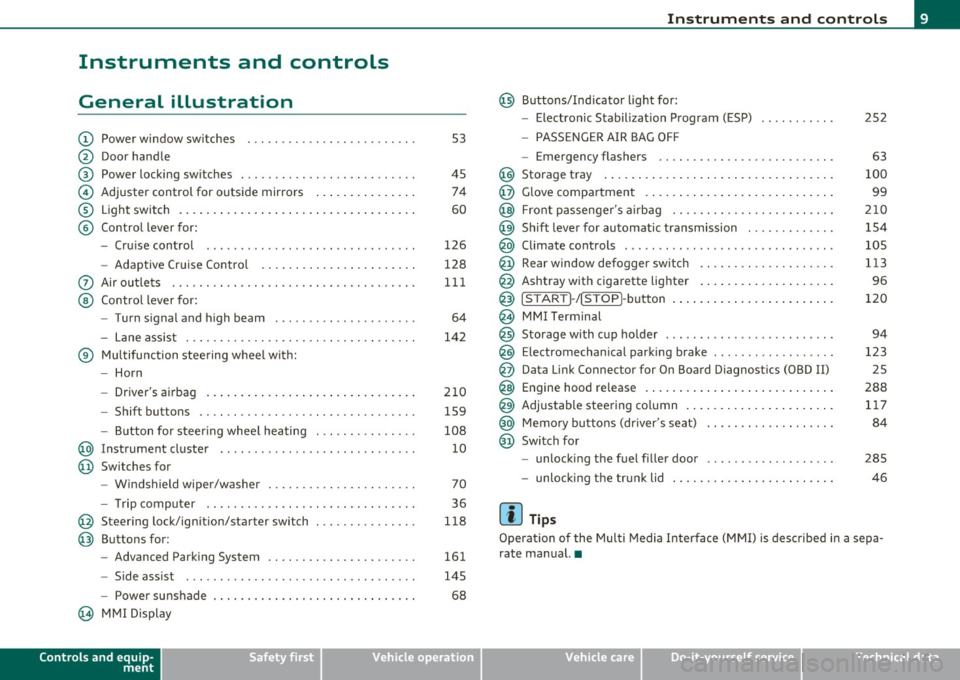
Instruments and controls
General illustration
(D Power window switches . .. .. .. ... .. ... .. ... ... . .
@ Door handle
@ Power locking switches . .. .. ......... .. .. .... ... .
© Adjuster control for outside mirrors .............. .
® Light switch ............... . ... ..... ....... ... .
© Control lever for:
- Cruise contro l ............ .... ... . ... ....... .
- Adaptive Cruise Control . ................... .. .
0 Air outlets .... .... .. .. .. ... ... ............. .. .
@ Control lever for:
- Turn signal and high beam .................... .
- Lane assist ................ ...... .. .. .. .. ... .
® Multifunction steering wheel with:
- Horn
- Driver's airbag ....................... ....... .
- Shift buttons .... .. .. .. .. .... ............... .
- Button for steer ing whee l heating . .. .. ... ...... .
@ Instrument cluster .................. .... ... ... .
@ Switches for
- Windshield wiper/washer ................ .. ... .
- Tr ip computer .. .......... . .. .... .. .. .... ... .
@ Steering lock/ignition/starter switch .............. .
@ Buttons for:
- Advanced Parking System .... .. .... .. ...... ... .
- Side ass ist ........... ........ ... ..... ... ... .
- Power sunshade
@ MMI Display
Controls and equip
ment Safety first
53
45 74
60
126
128
111
64
142
210 159
108 10
70
36
118
161
145
68
Instruments and controls
@ Buttons/Indicator light for:
- Electronic Stabilization Program (ESP)
- PASSENGER AIR BAG OFF
- Emergency flashers .. .. .. .. .. .... .. ......... .
@ Storage tray .................. .. .. .. ......... .
@ Glove compartment .... .... .. .. .... ........... .
@ Front passenger 's airbag .................... .. . .
@ Sh ift lever for automatic transmission ........... . .
@ Climate controls . .. .................... .... ... .
@ Rear window defogger switch .. .. .. .. .. .... ..... .
@ Ashtray with cigarette lighter ................... .
@ IS TART ]-/IS TOP]-button . ... ................ ... .
@ MMI Terminal
@ Storage with cup holder ..... .. .. .. ............. .
@ Electromechanical parking brake ... .. ...... ..... . .
@ Da ta Link Connector for On Board Diagnostics (OBD II)
@ Engine hood release ........................... .
@ Adjustable steering column ..................... .
@ Memory buttons (driver's seat) .................. .
@ Switch for
- unlock ing the fuel filler door ....... ....... .... .
- unlock ing the trunk lid
[ i ] Tips
252
63
100
99
210
154
105
113
96
120
94
123 25
288 117
84
285
46
Operation of the Multi Media Interface (MMI) is described in a sepa
rate manual. •
Vehicle care Technical data
Page 28 of 384
Driver information display
If the light illuminates, the electronic speed limiter may also be
malfunctioning. For more information~
page 26, "Electron ic speed
limiter".
An improperly closed fuel filler cap may also cause the MIL light to
illuminate ~
page 285. •
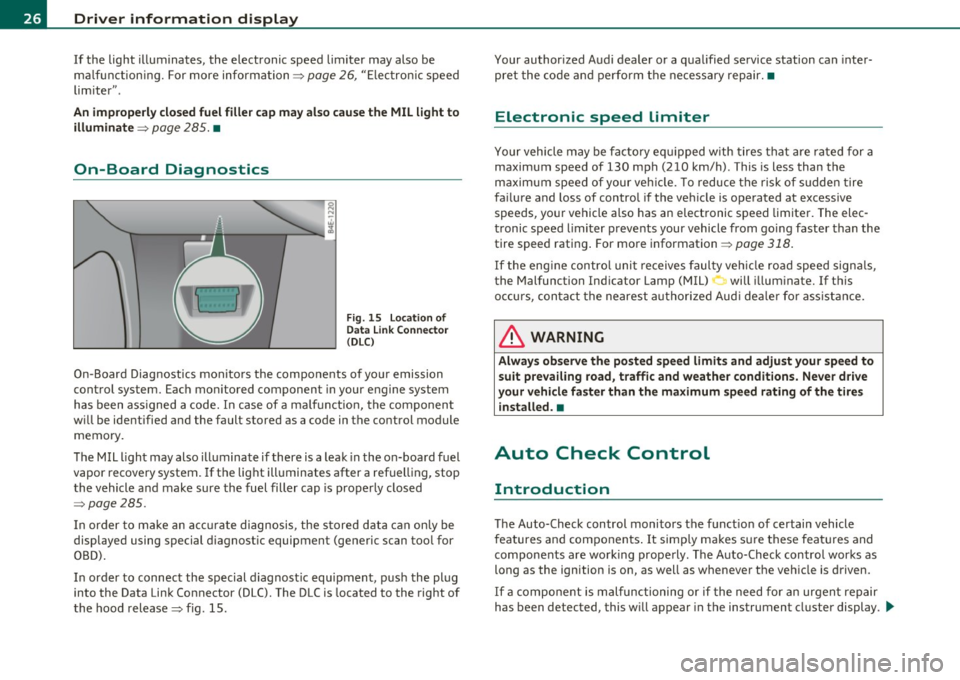
On-Board Diagnostics
Fig. 15 Location of
Data Link Connector
(OLC)
On-Board Diagnostics monitors the components of your emission
control system. Each mon itored component in your engine system
has been assigned a code. In case of a malfunction, the component
will be identified and the fault stored as a code in the control module
memory.
The MIL light may also illum inate if there is a leak i n the on-board fuel
vapor recovery system.
If the light illuminates after a refuelling, stop
the vehicle and make sure the fuel filler cap is properly closed
~page 285.
In order to make an accurate diagnosis, the stored data can only be
displayed using special d iagnostic equipment (generic scan too l for
OBD).
In order to connect the special diagnostic equipment, push the plug
into the Data Link Connector (DLC). The DLC is located to the right of
the hood release~ fig. 15. Your authorized
Audi dealer or a qualified service station can inter
pret the code and perform the necessary repair.•
Electronic speed limiter
Your vehicle may be factory equipp ed w ith tires that are rated for a
maximum speed of 130 mph (210 km/h) . This is less than the
maximum speed of your vehicle. To reduce the risk of sudden tire
failure and loss of control if the vehicle is operated at excessive
speeds, your vehicle a lso has an electronic speed limiter. The elec
tronic speed limiter prevents your vehicle from going faster than the
tire speed rating . For more information ~
page 318.
If the eng ine control unit receives faulty vehicle road speed signals ,
the Malfunction Indicator Lamp (MIL) will illuminate. If this
occurs, contact the nearest a uthorized Aud i dealer for assistance.
& WARNING
Always observe the posted speed limits and adjust your speed to
suit prevailing road , traffic and weather conditions. Never drive
your vehicle faster than the maximum speed rating of the tires
i nstalled. •
Auto Check Control
Introduction
The Auto-Check control monitors the funct io n of certain vehicle
features and components . It simply makes sure these features and
components are working properly. The Auto-Check control works as
long as the ignition is on, as well as whenever the vehicle is driven.
If a component is malfunctioning or if the need for an urgent repair
has been detected, this w ill appear in the instrument cluster display . .,,_
Page 31 of 384
you can bring up a driver message which explains the malfunction in more detail.
Stop vehicle and check brake fluid Level
- Pull off the road .
- Stop the vehicle.
- Turn off the engine.
- Check the brake fluid level~
page 299.
-Contact your nearest authorized repair facility if neces-
sary.
Brake fault ! Drive carefully to nearest
workshop
- Drive carefully to the nearest authorized repair facility and
have the malfunction corrected~& .
Parking brake ! Please contact workshop
- If the warning/indicator light flashes when the vehicle is
stationary or after the ignition is turned on , check to see if
the parking brake can be released . Drive to an authorized
repair facility as soon as possible and have the malfunc
tion corrected. If the parking brake cannot be released,
contact your nearest authorized repair facility.
- If the warning/indicator light flashes while you are driving, it is possible that the traction control or the emer
gency brake has malfunctioned. It is possible that the parking brake cannot be applied . It is also possible that
the parking brake cannot be released after it has been
applied. Drive to an authorized Audi dealer to have the malfunction corrected.
Controls and equip
ment Safety first
Driver information display
I
f the ABS , ESP and the brake for ce distribution fail, the ABS
warning/indicator light and the ESP warning/indicator light come on
along with the brake system malfunction warning/indicator light
~ & -
& WARNING
• Always observe the warnings in ::::> page 281, "Engine compart
ment", before opening the hood and checking the brake fluid.
• Driving with low brake fluid is a safety hazard. Stop the car and
get professional assistance.
• USA models: If the BRAKE warning light, the ~ warning light
and the warning light come on together, the rear wheels
could lock up first under hard braking. Rear wheel lock-up can
cause loss of vehicle control and an accident. Have your vehicle
repaired immediately by your authorized Audi dealer or a qualified
workshop. Drive slowly and avoid sudden, hard brake applica
tions.
• Canada models: If the brake warning light(())), the r-warning
light and the ABS warning light come on together, the rear
wheels could lock up first under hard braking. Rear wheel lock-up
can cause loss of vehicle control and an accident. Have your vehicle
repaired immediately by your authorized Audi dealer or a qualified
workshop. Drive slowly and avoid sudden, hard brake
applications. •
Engine cooling system malfunction -1-
A malfunction in the engine cooling system must be
repaired as soon as possible.
When the - L symbol in the display blinks, then either the
engine coolant
temperature is too high, or the coolant level ~
Vehicle care Technical data
Page 125 of 384

On the road -
----------------
Electromechanical parking brake
Operation
The electromechanical parking brake replaces the hand
brake.
Fig. 135 Center
console: Parking brake
- Pull the switch to apply the parking brake~ fig. 135. The
indicator light in the switch will come on.
- Step on the brake pedal or the accelerator pedal and press
the switch at the same time to release the parking brake.
The indicator light in the switch will go out.
Your vehicle is equipped with an electromechanical parking brake
which replaces the handbrake. The parking brake is designed to
prevent the vehicle from rolling unintentionally.
In addition to the normal functions of a traditional hand brake, the
electromechanical parking brake provides various convenience and
safety functions.
Emergency brake
An emergency brake ensures that the vehicle can be slowed even if
the normal brakes fail~ page 125, "Emergency braking".
Controls and equip
ment Safety first
Indicator lights
•
If the parking brake is applied with the ignition turned on, the
indicator light in the instrument cluster (U.S. models:=.., Canadian
models: ©) and in the switch
«el) will come on.
• If the parking brake is applied with the ignition turned off, the
indicator light in the instrument cluster (U.S. models:=., Canadian
models: ©) and in the switch
«fl) will come on for about 30 seconds
and then go out.
& WARNING
If the vehicle is stationary and the transmission is engaged with
the engine running, the engine should not be speeded up (e.g.
manually from under the hood). Otherwise the vehicle will start to
move -you run the risk of an accident.
0 Note
If the warning/indicator light (U.S . models: BRAKE, Canadian models:
«I» ) flashes in the instrument cluster, there is a brake system
malfunction . By pressing the [CHECK! button, you can bring up a
driver message which explains the malfunction in more detail. If the
message
Parking brake ! Please contact workshop appears, there is
a parking brake malfunction which you should have repaired immedi
ately by an authorized dealership~ page 28.
[ i] Tips
• You can apply the parking brake at any time -even with the igni
tion turned off . The ignition must be turned on in order to release the
parking brake.
• Occasional noises when the parking brake is applied and released
are normal and are not a cause for concern.
• The parking brake goes through a self-test cycle at regular inter
vals -when the vehicle is parked. Any associated noises are normal. •
Vehicle care Technical data
Page 157 of 384

Automatic transmission Ill
----------------
The selector lever must be in Nor P . If one o f the dr iv in g positions is
e n gag ed a saf ety s witch will prev ent th e engin e from b eing sta rt e d.
S ee also~
page 119.
Be fore you move t he se lecto r lever from t he P position , yo u m ust
a lw ay s a ppl y the b rake pedal before and while depr ess ing the bu tton
in t he handle of the selector lever.
_& WARNING
• Unintended vehicle movement can cause serious injury.
- When the selector lever is
in a driving position, the vehicle
may creep, even at idle speed. Therefore do not release the
parking brake or foot brake until you are ready to move,
because power is transmitted to the wheels as soon as a driving
position is engaged.
- Do not accelerate while selecting a driving position. At this
time the engine must be at idle speed so that undue stress is
not placed on the clutches in the transmission.
- Remember : · even when stopped briefly with the automatic
transmission in "D" or "R", engine power is being transmitted
to the wheels. Your vehicle could "creep " forward or backward.
When stopped, keep the brake pedal fully depressed and use
the parking brake if necessary to keep the vehicle from rolling.
• If the selector lever is unintentionally moved into N while you
are driving, take your foot off the accelerator pedal and wait for
the engine to return to idle speed before selecting a driving posi
tion .
• Never shift into "R" or "P" when the vehicle is in motion.
• Never get out of the driver's seat when the engine is running.
• If you must get out of the vehicle , move the selector lever
securely into the P position and apply the parking brake firmly.
• If the engine must remain running, never have any driving
position engaged when checking under the hood. Make sure the
selector lever has securely engaged and is locked in "P" with the
parking brake firmly set~
page 281, "Engine compartment ".
Controls and equip
ment Safety first
& WARNING
(cont inued)
Otherwise, any increase in engine speed may set the vehicle in
motion, even with the parking brake applied. •
Selector lever positions
This section descr ibes the select or lever posi tions and
dr iv ing ranges .
Fig. 169 Display in
the instrument cl uster :
selector lever
in posi
tion D
Th e sele cto r lever p osition eng ag ed a ppe ars n ext to t he se le cto r lever
as well as in the i nstr ument cluster display. A lso, the cur rent gear
en gage d is s hown i n positions D a nd 5.
P -Park
In t his se le cto r lever p osit io n th e tran smi ssion i s m ec hanicall y
loc ked. Engage
P o nly when the vehicle is completely stopped~ &
in "Driving the autom ati c transmis sion " on page 154.
To shift in o r o ut of position P , yo u must first pre ss and hold the brake
peda l
and then press t he release button in t he se lecto r leve r hand le
while moving the sel ecto r le v e r to or fro m
P. Y ou ca n shift out of this
posit ion on ly with t he i gnit io n on .
R -Reverse
Th e transm ission wi ll automat ica lly se lect t he lowest gear ratio w hen
you s hift in to reverse . ..,_
Vehicle care Technical data
Page 217 of 384

If the electronic control unit reg isters a crash of medium severity, the
first stage of the airbag deploys follo wed by the second stage at a
much later t ime in the crash sequence -regardless of whether the
safety belt is being used or not. In higher severity crashes as regis
tered by the electronic control unit, both the first and second stages
deploy almost at the same time .
On the passenger side, regardless of safety belt use, the airbag will
be turned off if the weight on the passenger seat is less than the
amount programmed in the electronic control unit. The front airbag
on the passenger side w ill also be turned off if one of the child seats
that has been certified under Federal Motor Vehicle Safety Standard
208 has been recognized on the seat . The
PASSENGER AIR BAG OFF
light comes on and stays on to tell you when the front Advanced
Airbag on the passenger side has been turned off~
page 208, "Child
restraints on the front seat -some important things to know".
& WARNING
To reduce the risk of injury when an airbag inflates, always wear
safety belts properly .
• If you are unrestrained, leaning forward, sitting sideways or
out of position in any way, your risk of injury is much higher.
• You will also receive serious injuries and could even be killed if
you are up against the airbag or too close to it when it inflates -
even with an Advanced Airbag~
page 206. •
Safety first Vehicle OP-eration
Airbag system
More important things to know about front
airbags
Fig. 214 Inflated
front airbags
Safety belts are important to help keep front seat occupants in the
proper seated position so that airbags can unfold properly and
prov ide supplemental protection in a frontal collision.
Th e front airbags are designed to provide additiona l protection for
the chest and face of the driver and the front seat passenger when:
• safety belts are worn properly ,
• the seats have been positioned so that the occupant is properly
seated as far as possible from the airbag ,
• and the head restraints have been properly adjusted .
Because airbags inflate in the blink of an eye with great force, things
you have on your lap o r have placed on the seat could become
dangerous projectiles, and be pushed into you if the airbag inflates .
When an airbag deploys, fine dust is released. This is normal and is
not caused by a fire in the vehicle. This dust is made up mostly of a
powder used to lubricate the airbags as they deploy . It could irritate
skin .
It is important to remember that while the supplemental airbag
system is desig ned to reduce the likelihood of serious injur ies, other
injuries, for example swell ing, bruising and m inor abrasions, can also
happen when airbags inflate. Airbags do not protect the arms or the •
Vehicle care Do-it-yourselt service iTechnical data
Page 290 of 384
___ C_h_ e_c _k _i_n -=g :a,__ a_n_ d_ f_ i_ l _li _n _,g;._ __________________________________________ _
Checking and filling
Engine hood
Releasing the engine hood
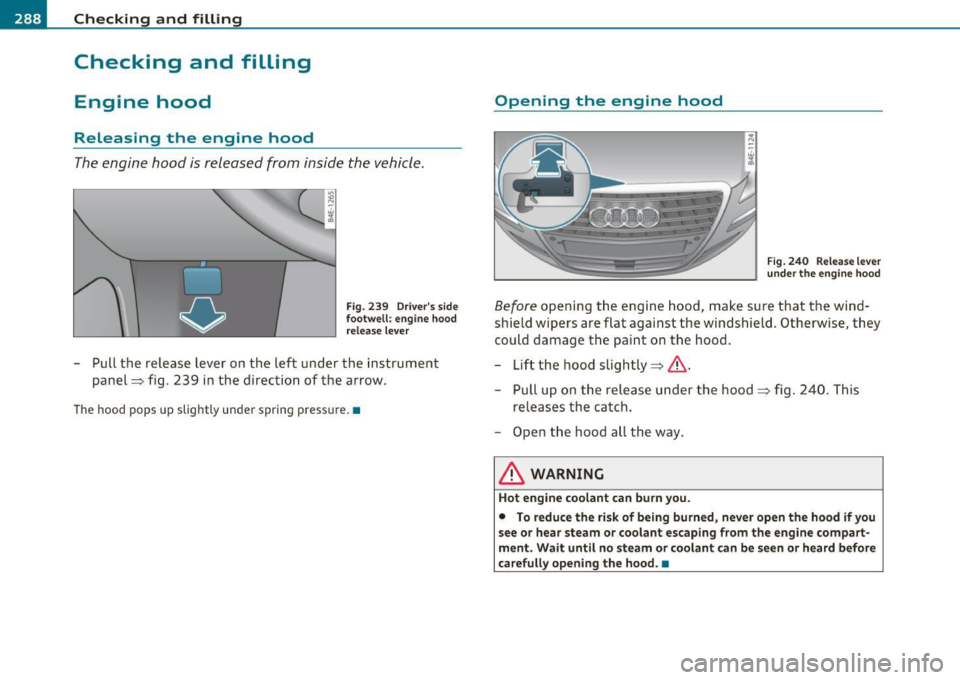
The engine hood is released from inside the vehicle.
Fig . 2 39 Dr iver 's sid e
f oo twell : e ng in e ho od
r elease leve r
-Pull the release lever on the left under the instrument
panel ~ fig. 239 in the dir ect ion of th e arrow .
The hood pops up slightly under spring pressure. •
Opening the engine hood
Fig. 24 0 Rel ease le v er
under the eng ine h ood
Before opening the eng ine hood, make sure that the wi nd
sh ield wipers are flat against the windshield . Otherwise, t hey
cou ld damage the pa int on the hood.
Lif t the hood slightly~ &.
- Pull u p on t he rel ease un der the hood ~ fig . 240. This
releases the c atch .
- Open t he hood a ll the way.
& WARNING
Hot eng ine coolant can burn you.
• To reduce the risk of being burned , never open the hood if you
see or hear steam or coolant escaping from the engine compart
ment . Wait until no ste am or coolant can be seen or heard before
c arefull y opening the hood .•
Page 372 of 384

__ _::_A:!: l~ p::_ h :....:..:: a:.:b::: e::..::. t:.:ic ::a::.: l:....:..: i n~ d:.:e ~ x::.._ ___________________________________________ _
Outside temperature display .... .... 23 Electronic speed limiter .. ...... .... ... 26 Malf u nction symbo l ....... ... . ... . 29
Sound system d isplay .............. 23
Electronic stabili zation prog ram ( ES P) Radiator fan
.................... 299
Dr iver Information System How the system works ...... .... .. 252 T
emperatu re gauge .......... ..... 10
Digita l speedometer .... ... ... .. ... 23 Wa rning/indicator l ights .. . .. .... .. 16 Engine data .. .. .. ...... ... .. .. .. .. 360
Dr ive r's seat .. .. .. .. .. .. .. ... ....... 77 Eme rgency braking . ............... . 12 5 Engine hood
Dr iver 's sea t memory ................. 84 Emergency closing Clos
ing ......................... 289
Act ivat ing remote control key ....... 85 Power su nroof ................. 58, 59 How to release the
hood ........ .. 288
Recalling a seat position ............ 84
Emergency flasher .. ..... ..... .. ... .. 63 Engine oil
.......... .......... ..... 291
Storing a seat position ... .. .. .. .... 84
Warning/indicator l ights .. . .. .... .. 17 Add
ing .... .... .... .. . .. .. .. .. .. 29 4
Dr iv ing messages .................... 27
Eme rgency locking ................. .. 46 Add
itives .... ....... ...... .... .. 294
Dr iv ing safely ... .. .. ............. .. 186
Driving through water . .......... ... . 263
Dr iv ing time . ... .. .. .. .. .. ..... ..... 36
Duplicate key ....................... 39
DVD playe r for navigat ion system ...... 102 Emergency
locking of doors ... .. ...... 46
Emergency st arting .... ..... ... .. .. . 3 48
Emergency towing .................. 350
E me rgency warning triang le ... .. .. .. . 332
E nergy managemen t .. ............. . 258 Cha
nging .... ....... .... .. .. .. .. 295
C hecking the engine oil leve l ... .. .. 293
I n dicat io ns and condi tions requiring ex tra
check ing . .. .. .. .. ............. 293
Oi l co nsumpt ion .. .. ... ... ..... .. 293
Oil grades ...................... 291
E
Battery power ................... 259
Dr ive r no tifica tion . .... ..... ... .. . 259 Oi
l level symbo l ................... 33
Pressu re malfunction .............. 30
Eas y entry feature
118 Engine
4.2 l, 8-cylinder (350 hp) ........ .. 290 Recommended oil check
inte rv a ls . .. 293
Sen sor defective .. .. .. .. .......... 33
Electrome chanical pa rking bra ke
Emergency br aki ng .. .. .. .. .... .. . 12 5
Ma lf u nct ion . .... .... ..... ... . .. . 12 5
Operation ... .. .. .. ... ... .... ... 1 23
Parking ... .. ..... ....... ... . ... 1 24
Releasing and app ly ing . .. .... ..... 123
Sta rting off w ith a trailer .. .. .. .... 125
Warning/ind icator lights . .......... 20
Electroni c dif feren tial loc k (EDL) 6
.0 l , 12-cylinde r (450 hp) ... ... .. . 291
Compa rtme nt .. .. .. .. .. .... . 2 9 0, 29 1
Coolan t ........................ 296
Hood .. ................. .. .. .. . 288
St art ing .. . .. .... .. .. .... .. . 1 18 , 119
Sta rting with jumpeir cab les ... .. .. . 3 48
Stopp ing . .. .. ... .. .. .... .. .. .. . 120
E ngine comp artment ................ 290
Safety ins truct ions .... .. .. .. .. ... 289 Spe
cifica tion and vis cosi ty .. ... .. .. 2 91
Engine speed lim itation ....... ... ... .. 33
Environment Break-in pe riod . ...... ......... .. 261
Catalytic converter .. .... ......... 262
Disposing of your veh icle battery .. .. 304
Dr iv ing at hig h speeds ............ 264
Dr iv ing to mi nimize pollution and noise ..
263
How the system wor ks ... ..... .... 253
Wa rning/indicator lights ... .. ... ... 19
Electron ic immobili ze r ... .. .... .. .. 12, 41 Wor
king the e ng ine compar tment .. 289
Engine coolant ... ... ... ...... .... .. 296
Add ing coolant .................. 298 Fuel
.... ...... ........... .... .. 285
Fuel economy .. .... ....... .... .. 263
Leaks under your vehicle . ......... 289
Electronic power contro l
Checking the engine coo la nt level ... 297
Letting the vehicle stand and warm up
(EPC) warning/ indicator light ........ 16
Expa nsio n tank .................. 297 264
Page 374 of 384

-Alphabetical inde x Plff ___,__ ______________ _
Headlight range control ... .. .. .. .. .. .. 34
Headlights ... .. ... .... ..... .. .. . ... 60
Adaptiv e Light ... .... ..... ... .. ... 63
Def ect iv e . . . . . . . . . . . . . . . . . . . . . . . . 24
Fr ont fog lights . .. .. .. .. .... .. ... . 62
Sw itch ing off .. .......... .... .. ... 60
Sw itch ing on . . . . . . . . . . . . . . . . . . . . . 60
Washer reservo ir .. .. .. .. .. .. .. ... 305
Washer system ................... 72
Xe non headlights ... .............. 60
He ated
Fr ont seats ... ...... .... .... .... 10 7
Rear sea ts ... .. .... ...... .... ... 108
Wind shield ... .... .... .. ...... .. 112
Heat ed outside mirro rs ..... .. .. .. ... . 74
Heated seats Front . .. ... ... .... ..... ...... .. 107
Rea r se ats . ... ...... .... .... 1 08, 114
He ated s tee ring wheel .. ...... ... .. .. 108
Heated wash er jets
Wip er and washer syst em .. ... . ... . 70
Heavy clothing and safety belts . .. .. .. . 200
H igh beam . ......... .. .. .. .. .. .. 60 , 64
Warn ing/ ind ic a to r ligh ts . .. .. ... ... 17
High vo ltage wa rni ng labe l .. .. .. .. . .. 356
Homeli nk® un ive rsal remote cont rol ... 181
Hood Opening . .. ... .... ..... .. ... .. .. 288
Release lever . .. .... ..... ...... .. 288
Ho rn ... .... ..... .. ... .. .. .. .... .. .. 9
How are child restrain t system anchors related
t o chi ld safety ..... .. .. ... .... .. 244 How many airbags does my vehicle have?
. . . I ntermittent wipi ng
213 Rain sensor .... .................. 70
How often shou ld I check my tire p ressu res? .
314
How safety be lt pretensione rs wo rk . .. . 20 4
J
Hydroplaning .. .. .. .... ..... .... .. . 318 Jack
333
J u mpe r cab les ... .. .. .. .. .. ... ..... . 349
I Jump-sta rting ... .. .. .. .. .. .. ..... .. 348
I gn it ion key . ........... ... . .. .. .. . 118
K
Igni tion lock . ..... .... .. .. . ... .. .. . 118
Ma lfunct io n . . . . . . . . . . . . . . . . . . . . . . 31 Key
.............. .... .. .. .. .... ... 39
Igni tion lock positions .......... ... .. 118 Batte
ry rep lacement maste r key .. .. . 40
I mmob ilizer .. .... .. .... .. .. .. .. .. .. 12 Coded se
ttings . .. .. .. ..... ... . .. 103
Importa nt things to do before d riving .. 18 7
I mproperly wor n safety belts .... .. .. . 2 04
Indicato r light
A irbag system .. .. .. ... ... .. . 217,218
PASSENGER AIR BAG OF F ..... .... . 218 E
mergency key .. .. .. .. .... .. .. .. . 39
Key replacement . ... ...... ... . ... . 39
M ast er key ..... .. .. .. .. ... .. ... .. 39
Val et key .. .. ... ..... ... .... .. .. . 39
Key code d se tti ngs
Clim ate cont rols .. .. .... ...... ... 103
Indi cato r lights . .. .... ...... ....... .. 1 4
I nfant seats ..... .... ... .. .. ..... .. 2 36 Keyless entry remote contro
l . . . . . . . . . . 40
Kick -down . ... .. .. .. .. .. ..... .... .. 157
Insta lling a child safety seat
Safety belts .. ... ... .. .. . ... .. .. . 24 1
Installing the upper tether strap on the ancho rage . .. .. ..... .... ...... . 250
Inst ruments and co ntro ls Knee airbags
.. .. .. .. .. .. ... .. .. .. .. 222
Des cription .. .. .. .. ..... .... .. .. 222
How they wo rk . ..... ...... .. .. .. 223
Importa nt sa fe ty inst ruc tions ..... . 224
General illustra tion . .. .... ..... .. .. . 9
Il lum ination .... ... .. .. .. .. .. .. .. 13
L
Instrument cluster .... .... ... . .. .. 10
Lane ass ist
Interior lights Activat ing and deact ivat ing . .. .. ... 14 2
Ba ckground lighting ... ..... ..... .. 67
Description . ... .. .. ..... ..... .. . 142
F ront .. .. .. .. .. .... ..... .. .. .. .. 65
Inst ru ment cluste r indicator light ... 142
Rea r ... .. .. .. .. .... .. .. . .. .. .. .. 66
Page 377 of 384

Alphabetical index -________________ fWI
Rear fog lights ..... ....... ... .. .. .. .. 62
Rear lid Automatic operation .............. . 48
Escape handle ... .. .............. 332
Opening and closing .. .. ........... 46
Opening manually ....... .. .... .. .. 47
Rear light
Defective ............... .... ... .. 24
Rear seat Controls .. .. ................. .. .. 87
Easy entry .... ...... .... .. .... .. .. 89
Head restraint adjustment .......... 88
Lumbar support . . . . . . . . . . . . . . . 86, 89
Massage function ....... .... .. .. .. 88
Seat adjustment ........ ....... ... 87
Setting in the MMI ............ ... .. 89
Rear view
See Rear-view camera .......... .. . 161
Rear window defogger .......... .. .. . 113
Rear window shelf .................... 86
Rear-v iew camera .. ...... ...... 161, 164
Park ing mode 1 .. ................ 166
Park ing mode 2 .. ................ 167
Red symbols .............. ...... .. .. 28
Refuelling ... .................. ... . 285
Release lever for hood ....... ... .. .. . 288
Remote control ... .... ... .. .. .... .... 40
Unlocking and locking ... .. .. ....... 43
Remote cont rol garage door opener
(Homelink ®) .......... .. .... .. . 181
Remote rear lid release ............... 46
Repair manua ls ............. ... ..... 361
Controls and equip
ment Safety first
Repairs
Airbag system ................... 220
Replacing Wheel rims . ................. ... 320
Replacing a fuse . .. ............... .. 342
Replacing light bulbs ... .. .... .. .. ... 346
Replacing tires and wheels ............ 319
Reporting Safety Defects ........ ... .. 195
Reset button .. ...... ...... .......... 12
Retractor . ...... ........... ...... .. 201
Rims Cast alloy .. .. ... ... .. ... .... .... 275
Replacing ....... ... .. .. ..... .... 320
Roof rack . .... .. ........... .. .... .. . 92
Loading ..... ........... .. .. .. .. . 94
Mounting locations .... .. .......... 93
Roof weight ................. ... .. .. . 94
s
SAFE ................. ...... ... .. .. . 12
Safe driving habits .. .. ... .. .. .. .. ... 186
Safety belt height adjUJstment ......... 204
Safety belt position .. ...... ......... 202
Safety belt height adjustment .. .. .. 204
Safety belts worn by pregnant women ...
203
Safety belt pretensioner ........... ... 204
Service and disposal .............. 205
Safety belt warn ing light .. .... .. . 18, 197 Safety belts ......
... ... . .. .. .. .. .. . 201
cleaning ............ ... .. .. .. ... 281
Danger to passengers who do not wear a safety belt ......... ... .. .... ... 199
Fastening ....................... 201
Improperly worn . .. .............. 204
Not worn ................ .... .. . 199
Safety belt position .............. . 202
Safety instructions ... . .. .. .. .. .. . 200
Securing child safety seats ... ... .. . 241
Special considerations for pregnant women ...... ...... ... ... ... ... 203
Unfastening .......... .... .... ... 203
Warning/indicator light ...... .... . 197
Why YOU MUST wear them .. .... .. . 197
Worn properly ... ..... ... ... .. .. . 200
Safety compliance sticker ... . ......... 356
Safety equipment ...... ...... .... .. . 186
Safety features for occupant restraint and protection . .. .. .. .... .......... 186
Safety guidelines Seat adjustment .................. 76
Safety instructions
Engine compartment ..... ..... .. . 289
for side curtain airbags .. .......... 229
for using child safety seats ...... .. . 234
for using safety belts ...... .. .. .. . 200
Monitoring the Advanced Airbag System .
219
Safety lock Ignition key, automatic transmission 119
Seat adjustment Adjusting the seatback ............. 79 Driver 's seat .................. .. .. 76
Vehicle operation Vehicle care Do-it-yourself service Technical data