door lock AUDI S8 2011 Owner's Manual
[x] Cancel search | Manufacturer: AUDI, Model Year: 2011, Model line: S8, Model: AUDI S8 2011Pages: 302, PDF Size: 76.07 MB
Page 81 of 302

the stored position as soon as you switch on
the ignition.
Starting and stopping
the engine
Starting the engine
This button switches on the ignition and
starts the engine.
Fig. 80 Center console: S TART ENGINE S TOP b utton
" Step on the brake pedal¢&_ .
.. Press on the !START ENGINE STOP I button
¢ fig. 80 -the engine w ill start .
By pressing the
I START ENGINE STOP I button
without depressing the brake pedal, the igni tion is on and switched off by pressing it
again.
After a cold engine is started, there may be a
brief period of increased noise because oil
pressure must first build up in the hydraulic
valve adjusters. This is normal and not a cause
for concern.
If the engine should not start immediately,
the starting process is automatically stopped
after a short time. Repeat starting procedure.
Driver message in the instrument cluster
display
Press brake pedal to start engine
This message appears if you press the
I START ENGINE S TOP I button to start the en
gine and do not depress the brake pedal. The
engine can only be started if the brake pedal is depressed.
!! Convenience key: Is key not in the vehi
cle?
On the road 79
This message appears along with thee sym
bol if the master key is removed from the ve
hicle with the eng ine running.
It is intended
to remind you (e.g . when changing drivers)
not to continue the journey without the mas
ter key.
If the master key is no longer in the veh icle,
you cannot switch on the ignition after stop
ping the engine and you also cannot start the
engine again . Moreover, you cannot lock the
vehicle from the outside with the key.
Shift to P, otherwise vehicle can roll away.
Doors do not lock if lever is not in
P.
This message appears for safety reasons
along with an audible warning tone if the
P
selector lever position is not engaged when
stopping the engine with the
I START ENGINE STOP I button. Select the P se
lector lever position . Otherwise the vehicle
cou ld roll and it cannot be locked .
Key not recognised. Hold back of key against
marked area . See owner's manual.
If the indicator light turns on and this mes
sage appears, there is a malfunction
¢ page 80.
Steering lock
The steering locks when you turn the engine
off using the
I START ENGINE STOP I button
and open the driver's door. The locked steer ing helps prevent vehicle theft.
A WARNING
- Never allow the engine to run in confined
spaces - danger of asphyx iation.
- Never turn off the engine until the vehi
cle has come to a complete stop.
- The brake booster and power steering
only work when the engine is running. If
the engine is off, you have to use more
force when steering or braking. Because
you cannot steer and brake as you usual
ly would, this could lead to crashes and
serious injuries.
Page 84 of 302

82 On the road
-Occasiona l noises when the parking
brake is applied and re leased are norma l
and are not a cause for concern .
- When the vehicle is parked, the parking
brake goes through a se lf-test cycle at
regular intervals. Any assoc iated noises
are norma l.
Parking
Various rules apply to prevent the parked ve
hicle from rolling away accidentally.
P ar king
,. Stop the vehicle w ith the foot brake.
,. Pull the switch© to apply the parking
brake.
,. Se lect the
P se lector lever position
9 page 112.
,. Turn the eng ine off q _&. .
In addition on incline s and grad es
,. Turn the steering whee l so that your vehicle
wi ll ro ll against the curb in case it should
start to move .
A WARNING
-When you leave your veh icle -even if on
ly briefly -always take the ignition key
with you. This applies particularly when children remain in the veh icle. Otherw ise
the ch ildren could sta rt t he engine, re
lease the p arking brake or operate e lec
trical equipment (e .g. power windows) .
T he re is the risk of an accident.
- When the vehicle is loc ked, no one -par
t icu la rly not children sho uld remain in
the vehicle . Locked doors make it more
difficult for emergency workers to get in
to the vehicle -putt ing lives at risk.
Start ing from rest
The starting assist function ensures that the
parking brake is released automatically upon starting.
Stopping and appl ying par kin g brake
,. Pull the switch© to apply the parking
brake.
St arting and automatic ally rel easi ng the
parking b rake
,. When you start to dr ive as usual, the park
ing brake is automat ically released and your
veh icle beg ins to move.
When stopping at a traffic signal or stopping in city traffic, the parking brake can be ap
plied . The vehicle does not have to be held
with the footbrake . The parking brake elimi
nates the tendency to creep w ith a dr ive range
engaged. As soo n as you d rive off as usual,
the pa rking brake is re leased automatically
and the vehicle s tarts to move.
Sta rting on slopes
When starting on inclines, the starting assist
prevents the veh icle from u nintent ionally roll
i ng back. The braking fo rce of the par kin g
brake is not re leased unti l su ff ic ient d riving
f orce has been built up a t the wheels.
(D Tips
Fo r safety reasons, the pa rking bra ke is re
l eased automatically o nly when t he d riv
er's safety belt is engaged in the buckle.
Starting off with a trailer
To prevent rolling back unintentionally on an
incline, do the following:
,. Keep the sw itch(®) pulled and depress the
accelerator. The pa rking brake stays applied
and p revents the vehicle from roll ing back
ward .
,. You can release the switch© once you are
sure that you are developing enough for
ward momentum at the whee ls as you de
press the acce lerator.
Page 136 of 302
134 Driving Safely
-Always distribute the load as evenly as
possible.
- Place heavy objects as far forward in
the luggage compartment as possible.
- Never exceed the Gross Axle Weight Rat
ing or the Gross Vehicle Weight Rating
specified on the safety compliance stick
er on the left door jamb. Exceeding per
missible weight standards can cause the
vehicle to slide and handle differently.
- Please observe information on safe driv
ing
r:::> page 12 7.
A WARNING
-
To help prevent poisonous exhaust gas
from being drawn into the vehicle, always keep the rear lid closed while driving.
- Never transport objects larger than those fitting completely into the luggage
area because the rear lid cannot be fully
closed.
- If you absolutely must drive with the rear
lid open , observe the following notes to
reduce the risk of poisoning:
- Close all windows,
- Close the power roof,
- Open all air outlets in the instrument
panel,
- Switch off the air recirculation,
- Set the fresh air fan to the highest
speed.
A WARNING
Always make sure that the doors, all win
dows, the power roof and the rear lid are
securely closed and locked to reduce the
risk of injury when the vehicle is not being
used.
- After closing the rear lid, always make
sure that it is properly closed and locked.
- Never leave your vehicle unattended es pecially with the rear lid left open. A
child could crawl into the vehicle through
the luggage compartment and close the
rear lid becoming trapped and unable to
get out . Being trapped in a vehicle can
Lead to serious personal injury .
-
-Never let children play in or around the
vehicle.
- Never let passengers ride in the luggage
compartment. Vehicle occupants must
always be properly restrained in one of
the vehicle's seating positions .
(D Tips
-Air circulation helps to reduce window
fogging. Stale air escapes to the outside
through vents in the trim panel, on the
Left side of the Luggage compartment.
Be sure to keep these slots free and
open .
- The tire pressure must correspond to the
load . The tire pressure is shown on the
tire pressure label. The tire pressure la
bel is located on the driver's side B-pillar.
The tire pressure Label lists the recom
mended cold tire inflation pressures for
the vehicle at its maximum capacity
weight and the tires that were on your
vehicle at the time it was manufactured.
For recommended tire pressures for nor
mal Load conditions, please see chapter
r:> page 242.
Tie-downs
The luggage compartmen t is equipped wi th
four tie-downs to secure luggage and o ther
items.
Use the tie-downs to secure your cargo p rop
erly
c> page 133, Loading the luggage com
partment.
In a collision, the laws of physics mean that
even smaller items that are loose in the vehi
cle will become heavy missiles that can cause
serious injury. Items in the vehicle possess en
ergy which vary with vehicle speed and the
weight of the item. Vehicle speed is the most significant factor.
For example, in a frontal collision at a speed
of 30 mph (48 km/h), the forces acting on a 10-lb (4 .5 kg) object are about 20 times the
normal weight of the item. This means that
the weight of the item would suddenly be
Page 159 of 302
restrained in one of the rear-facing or for
ward-facing infant restraints listed in Feder al Motor Vehicle Safety Standard 208 with
which the Advanced Airbag System in your
vehicle was certified.
If the front passenger seat is not occupied,
the front airbag will not deploy, and the
PAS ·
S ENGER AIR BA G OFF
light will stay on. Nev
er install a rearward-fac ing ch ild restra int on
the front passenger seat, the safest place for
a child in any k ind of child restraint is at one
of the seating positions on the rear seat
¢ page 147, Child restraints on the front seat
- some important things to know
and
¢ page 169, Child Safety.
If th e PASSENGER AIR BAG OFF light c ome s
on
when one of the conditions listed above is
met, be sure to check the light regularly to
make certa in that the
PASSENGER AIR BA G
OF F
light stays on continuous ly whenever the
ignition is on . If the
PASSENGER AIR BAG
OF F
light does not appear on and does not
stay on all the time, stop as soon as it is safe
to do so and
- reactivate the system by switc hing the igni
t ion off and then sw itch ing it on again;
- remove and reinstall the child restraint .
Make sure that the child restraint is properly
insta lled and that the safety be lt for the
front passenger seat has been correctly
routed through the child restraint as descri
bed in the chi ld restraint manufacturer's in
structions;
- make sure that the convertible locking fea
ture on the safety belt fo r the front passen
ger seat has been activated and that the
safety be lt has been pulled tight. The belt
mus t not be loose or have loops of slack so
that the sensor below the safety belt latch
on the seat can do its job
¢ page 178 .
-make su re that th ings that may increase the
weight of the chi ld and child seat a re not be
ing transported on the front passenger seat;
- make su re that the safety bel t tension sen
sor is not b locked . Shake t he safety belt
l atch on the front passenger seatback and
forth;
A irbag system 157
-If a strap or tether is be ing used to tie the
child seat to the front passenger seat, make
sure that it is not so t ight that it causes the
weight-sensing mat to measure more
weight than is actua lly on the seat .
If the PASSENGER AIR BAG OFF light still
does not come on
and does not stay on con
tin uously (when the ignition is switched on),
- take the child restraint off the front passen -
ger seat and install it proper ly at o ne of the
rear seat positions. Have the airbag system
inspected by yo ur Audi dealer immed iate ly.
- move the child to a rear seat position and
make sure that the child is properly restra in
ed in a ch ild restraint that is appropriate for
its size and age.
The
PA SS ENGER AIR BAG OFF light should
NOT come on when the ignit ion is on and an
adult is s itting in a proper seating position on
the front passenger seat. If the
PASSENGER
AIR BAG OFF
light comes on and stays on or
flashes fo r about 5 seconds wh ile driving, un
der these cir cumstances, make sure that;
-the adult on the front passenger seat is
properly seated on the center of the seat
cushion with his or he r back up aga inst the
backrest and the backrest is not recl ined
¢ page 128, Proper o ccupant seating posi
tions,
- t he adult is not tak ing weight off the sea t by
holding on to the passenger assist handle
above the fron t passenger door or s upport
ing their weight on the armrest,
- t he safe ty be lt is be ing proper ly wo rn and
tha t the re is not a lot o f slack in the safety
be lt webbing,
- accesso ry sea t covers or cushions or o ther
things tha t may cause an incorrec t reading
or impression on the weight-sensing mat
under the upho lstery of the seat have been
removed from the front passenger seat,
- a safety belt extender has not been left in
the safety be lt latch for the front passenger
seat.
In addition to the
PASSENGER AIR BAG OFF
li ght in the center of the instrument panel, ll-
•
•
Page 177 of 302
_& WARNING
Not using a child safety seat, using the
wrong child safety seat or improperly in stalling a child restraint increases the risk
of serious personal injury and death in a
crash.
- Never install rear-facing child safety
seats or infant carriers on the front pas
senger seat - even with an Advanced Air
bag System. A child wilt be seriously in
jured and can be killed when the inflat
ing airbag hits the child safety seat or in
fant carrier with great force and smashes
the child safety seat and child against
the backrest, center armrest, door or
roof¢
page 147, Child restraints on the
front seat -some important things to
know.
- Always install rear-facing child safety
seats or infant carriers on the rear seat.
- Never install a rear-facing child restraint
in the forward-facing direction. Such re
straints are designed for the special needs of infants and very small children
and cannot protect them properly if the
seat is forward-facing.
- If you must install a rearward facing
child safety seat on the front passenger
seat because of exceptional circumstan
ces and the
PASSENGER AIR BAG OFF
light does not come on and stay on, im
mediately install the rear-facing child
safety seat in a rear seating position and
have the a irbag system inspected by your
Audi dealer.
- Always read and heed all WARNINGS
whenever using a child restrained in ave
hicle is being used
¢page 137, Safety
belts,¢ page 145, Airbag system
and
¢ page 169, Important things to know.
Child Safety 175
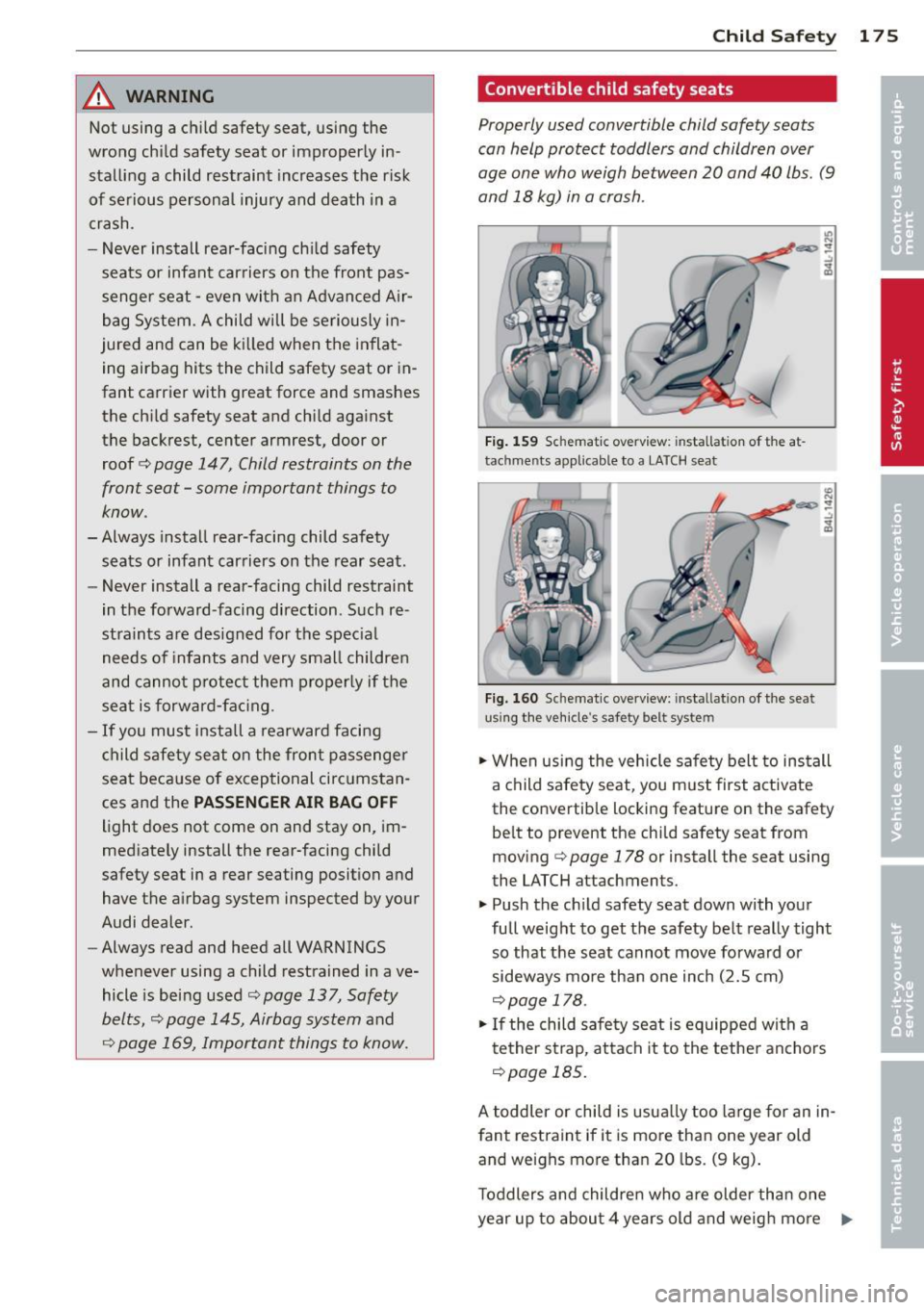
Convertible child safety seats
Properly used convertible child safety seats
can help protect toddlers and children over
age one who weigh between 20 and 40 lbs. (9
and 18 kg) in a crash .
Fig. 159 Schematic overview: installat ion of the at
tachments applicable to a LATCH seat
Fig. 160 Schematic overview: instal latio n of the seat
using the vehicl e's safety belt system
.,. When using the vehicle safety belt to install
a child safety seat, you must first activate
the convertible locking feature on the safety
belt to prevent the child safety seat from
moving <=>
page 178 or install the seat using
the LATCH attachments.
.,. Push the child safety seat down with your
full weight to get the safety belt realty tight
so that the seat cannot move forward or
sideways more than one inch (2.5 cm)
¢page 178.
.,. If the child safety seat is equipped with a
tether strap, attach it to the tether anchors
¢page 185.
A toddler or child is usually too large for an in
fant restraint if it is more than one year old
and weighs more than 20 lbs. (9 kg).
Toddlers and children who are older than one
year up to about 4 years old and weigh more
~
Page 181 of 302
-Always make sure that the safety belt re
tractor is locked when installing a child
safety seat. An unlocked safety belt re
tractor cannot hold the child safety seat
in place during normal driving or in a
crash .
- Always buckle the child safety seat firmly
in place even if a child is not sitting in it.
A loose child safety seat can fly around
during a sudden stop or in a collision.
- Always make sure that the rear seat
backrest to which the center rear safety
belt is attached is securely latched when
ever the rear center safety belt is being
used to secure a child restraint.
- If the backrest is not securely latched,
the child and the child restraint will be
thrown forward together with the back
rest and will strike parts of the vehicle
interior. The child can be seriously in
jured or killed.
- Never install rear-facing child safety
seats or infant carriers on the front pas
senger seat. A child will be seriously in
jured and can be killed when the passen ger airbag inflates .
- The inflating airbag will hit the child
safety seat or infant carrier with great
force and will smash the child safety seat
and child against the backrest, center
armrest, door or roof.
- Always install rear-facing child safety
seats or infant carriers on the rear seat.
- Forward-facing child safety seats or in
fant carriers installed on the front pas
senger's seat may interfere with the de
ployment of the airbag and cause serious
injury to the child.
- It is safer to install a forward-facing
child safety seat on the rear seat.
- Always read and heed all WARNINGS
whenever using a child restrained in ave
hicle is being used
¢page 169. Special
precautions apply when installing a child
safety seat on the front passenger seat
¢ page 147, Child restraints on the front
seat -some important things to know.
Child Safety 1 79
A WARNING
-
Always take special precautions if you
must install a forward or rearward -facing
child restraint on the front passenger's
seat in exceptional situations:
- Whenever a forward or rearward -facing
child restraint is installed on the front
passenger seat, the
PASSENGER AIR
BAG OFF
light must come on and stay on
whenever the ignition is switched on.
- If the
PASSENGER AIR BAG OFF light
does not come on and stay on, perform
the checks described
¢page 156, Moni
toring the Advanced Airbag System.
- Take the child restraint off the front pas
senger seat and install it properly at one
of the rear seat positions if the
PASSEN
GER AIR BAG OFF
light does not stay on
whenever the ignition is switched on.
- Improper installation of child restraints
can reduce their effectiveness or even
prevent them from providing any protec
tion.
- An improperly installed child restraint
can interfere with the airbag as it de
ploys and seriously injure or even kill the
child .
- Always carefully follow the manufactur
er's instructions provided with the child
safety seat or carrier .
- Never place additional items on the seat
that can increase the total weight regis
tered by the weight-sensing mat and can
cause injury in a crash.
A WARNING
Forward-facing child restraints:
- Always make sure the forward-facing
seat has been designed and certified by
its manufacturer for use on a front seat
with a passenger front and side airbag.
- Never put the forward-facing child re
straint up, against or very near the in
strument panel.
- Always move the passenger seat into its
rearmost position in the seat's fore and
aft adjustment range, as far away from •
•
Page 182 of 302
180 Child Safety
the airbag as possible before installing
the forward-facing child restraint. The backrest must be adjusted to an upr ight
posit ion.
- Make sure that the
PAS SENGER AIR BAG
OFF
light comes on and stays on all the
t ime whenever the ignition is switched
on.
A WARNING , _
Rearward-fac ing ch ild restra ints:
- A ch ild in a rearward-facing child safety
seat installed on the front passenge r
seat will be ser iously injured and can be
killed if the front airbag inflates -even
with an Advanced Airbag System.
- T he inflating a irbag will hit the child
safety seat or infant carrier with g reat
force and w ill smash the ch ild safety seat
and child against the backrest, center
armrest, door or roof .
- Always be especially caref ul if you must
install a rearward facing child safety seat
on the front passenge r seat in exception ·
al circumstances .
- A tight tether strap on a rearward-facing
child restraint attached to the front pas
senger seat can put too much pressure
on the weight-mat in the seat and reg is
ter a heavier weight in the Advanced A ir
bag System. The heav ier we ight regis
tered can make the system work as
though an adult were on the seat and de ploy the Advanced Airbag when it must
be s uppressed causing ser ious or even
fatal injury to the child.
- Make sure that the
PASSENGER AIR BA G
OFF
light comes on and stays on all the
time whenever the ignition is switched on.
- If the
PA SSENGER AIR BAG OFF light
does not come on and stay on, immedi
ately install the rea r-facing chi ld safety
seat in a rear seating position and have
the a irbag system inspected by your Audi
dealer.
Act ivating the convertible locking
retractor
Use the convertible locking retractor to se
cure a child restraint.
Always heed the ch ild safety seat manufactur
er's instructions when installing a child re
st ra int in your vehicle. To activate the conve r
t ible lock ing ret ractor:
.,. Place the ch ild restraint on a seat, prefera
bly on the rear seat .
.,. Slowly pu ll the belt
all the wa y out .
.,. Route it around or through the child re
straint belt path
¢ _& .
.,. Push the chi ld safety seat down with yo ur
full weight to get the safety be lt really tight.
.. Insert the belt tongue into the buck le for
that seating position.
.,. Guide the safety belt back into the retractor
until t he belt lies flat and snug on the child
safety seat.
.,. You should hear a "clicking" noise as the
be lt winds back into the inertia ree l. Test the
convert ible lock ing retractor by pulling on
the belt . You shou ld no longer be able to
pull the be lt out of the retractor. The con
vertible locking retractor is now activated .
.. Make sure that the red release button is fac
ing away from the child restraint so that it
can be unbuckled quickly.
.,. Pull on the belt to make sure the safety belt
is properly tight and fastened so that the
seat cannot move forward or sideways mo re
than one inch (2.5 cm).
A WARNING
-
Using the wrong child restraint or an im
p roperly installed chi ld restraint can cause
serious personal injury or death in a crash.
- Always ma ke sure that the safety belt re-
tractor is locked when insta lling a child
safety seat . An un locked safety belt re
tractor cannot hold the child safety seat in place dur ing norma l dr iving or in a
crash.
Page 210 of 302
208 Cleaning and protection
-Never wash your car in bright sunlight.
Drops of water act as magnifying lenses
and may damage your paint.
- When you wash your car in the winter: if
you rinse your vehicle with a hose, be
careful not to aim the stream of water
directly at locks, or at door or hatch
openings - they can freeze shut.
- Never use sponges des igned to remove
i nsects, or any kitchen scouring sponges
or similar products . They can damage
your paint finish .
- Never use a dry cloth or sponge to clean
the headlights. Only use wet cloths or
sponges to prevent scratches .
It is best
to use soapy water.
- You should remove debris (such as in
sects) from the headlight lenses on a
regular basis, fo r example when refuel
ing your vehicle. Never clean the head
lig hts w ith a dry cloth or sponge. Use a
wet cloth or sponge . It is best to use
soapy water.
@ For the sake of the environment
I n the interest of the environment, the ve
hicle should only be washed in special
wash bays.
Washing your vehicle with a power
washer
Cleaning the exterior of your car with a high
pressure power washer is safe as long as you observe a few simple rules.
• Before using the power washer, make sure
you have read and understood the WARN
INGS
c:> A in General information on
page 206 .
• Always follow the operating instructions for
the power washer .
• Make sure that the jet on the spray hose pro
duces a "fan shaped spray".
• Do
not hold the spray nozzle too close to
soft materia ls.
When cleaning the vehicle wit h a power wash
er
always follow the operating instructions. T
his applies particu larly to the
operating
pressure
and the spraying distance. Keep a
distance from soft materials such as rubber
hoses or insulating material as well as sensors
and camera lenses.
Do not use a jet which sprays water in a
di rect
stream
or one that has a rotating jet .
Water temperature should not exceed 140 °F
(60 °().
A WARNING
Never wash tires with a jet that sprays wa
ter in a direct stream . This could cause in
v is ible damage to the t ires and weaken
them, even if the spray is from
a relatively
long distance and for a short time. Dam
aged and weakened tires can fail and cause
accidents and personal injury .
(D Note
To avoid damaging your vehicle, always
make sure that there is suffic ient d istance
between the spray head and soft materials
like rubber hoses, plast ic parts and sound
deadening materials as well as sensors
and camera lenses. Never aim the sp ray
head at the same point for a long time.
This also applies to cleaning headlights
and painted bumpers. Remember: the
closer the nozzle is to the surface of the
mater ia l, the greater the stress on the ma
terial.
Sensors and camera lenses
- Remove snow with a hand brush and remove
ice with a de-icing spray that does not con
tain solvents .
- Clean the sensors (adaptive cruise control*,
pa rking system*) w ith a cleaning so lution
that does not contain so lvents and a soft
cloth.
- The camera lens or the area in front of the
camera lens is normally cleaned by the
w indshie ld w ipers (Audi lane assist*) or
headlight wipers (night vision system*) . If
the lens or the area is exceptionally dirty,
111-
Page 214 of 302
212 Cleaning and protection
tem pera ture is high, it can be removed with a
p lastic scraper and a suitable solvent.
A WARNING
So lvents can be dangerous.
- Benzine is flammable and toxic. If you
use benzine for removing the wax, keep
sparks, f lame and lighted cigarettes
away. Never dump benzine on the
ground, into ope n streams or down sew
age drains .
- Be sure to observe all safety and env iron
menta l regulations. Follow all instruc
t ions on the container.
- Always read and heed all WARNINGS and
ot her information ¢
page 206.
Chassis
Have the undercoating checked for damage
from time to time.
The lower body shell of your Audi is a lso thor
ough ly protected against corrosion.
Any damage to the under coating caused by
road hazards shou ld be repaired promptly.
A WARNING
Too much undercoating in the wrong pla
ces can cause a f ire.
- Do not apply additional undercoating or
rustproofing on o r near the exha ust
man ifold, exhaust p ipes, catalytic con
verter or heat shie lds. W hile driving, the
substance used for undercoating cou ld
over heat and cause a fire .
- Always read and heed all WARNINGS and
ot her information ¢
page 206.
Exhaust tail pipes
Road salt and other cor ros ive ma ter ials wi ll
damage th e material in the exha ust ta il p ipes
if they are no t cleaned reg ula rly. Do no t clean
the tail p ipes with whee l cleaner, p aint po lish ,
ch rome polish or ot her abrasive cleaners .
C lean the tail p ipes with car care prod ucts
that are s uita ble for stain less stee l. Your a
uthorized Audi dea ler can provide clean
ing products that have been tested and ap
proved for yo ur vehicle.
Care of interior
Infotainment components
T he M MI/RS E* display may be cleaned wit h a
soft clot h and commerci ally-available " LCD
cl eaner". The clot h should be co ated lightly
whe n the cleaning solution when clea ning t he
display.
T he M MI/RS E* con trols m ust be cleaned first
with a b rush so tha t d irt does not en ter the
u nit or enter between the buttons and the
ho using. T hen wiping the cont ro ls with a cloth
dampened with dish detergent and water is
recommended.
(D Note
To prevent scratches, only clean the dis
p lay when it is dry.
- To prevent damage, make sure fluids do
not enter the contro ls .
· Aluminum trim
U se only neutral -pH products to remove spots
and deposits from a luminum surfaces.
Chrome care products and a lkaline cleaners
will attack a luminum surfaces and can dam
age t hem over t ime.
A WARNING
A lways rea d and heed all WAR NIN GS an d
o ther in fo rmation
¢page 206 .
Fabrics and fabric coverings
Fabr ics and fab ric cover ings (e.g . seats, door
trim pa ne ls, etc.) sho uld be cleaned at regular
intervals wit h a vacuum cleaner . This removes
s ur face dirt particles which cou ld become em
bedded in the fabric throug h use. Steam
cleaners should not be used, because the
steam tends to push the dir t deeper into the
fabric a nd lock it the re . ..,_
Page 218 of 302

216 Cleaning and protecti on
- To avoid damage, have stubborn stains
removed by a commercial cleaning spe
cialist.
- Do not use br ushes, stiff sponges or sim
ilarly abrasive cleaning aids.
Safety belts
Only well-maintained safety belts work relia
bly when needed .
> Keep belts clean.
> For cleaning, use a mild soap and wate r sol
ution . Let be lts dry thoroughly and away
from direct sunlight .
> Do not allow inertia reel safety be lts to re
tract before they are completely dry.
> Check the condition of your safety belts reg
ularly .
Heavily soiled safety belts may not retract
properly.
.&_ WARNING
Damaged safety belts can break in a crash.
- Anything that might damage your safety
belts could mean that you and your pas
sengers would not be adequately pro
tected in an acc ident.
- Safety belt performance depends on cor
rect installation. Never remove belts
from the vehicle to clean them.
- Do not use chemical cleani ng agents,
bleach or dyes. They have corrosive prop
ert ies which weaken the webbi ng.
- When cleani ng your safety belts, inspect
them for damage.
If you discove r dam
age, see you r A udi dealer.
- Always read and heed all WARNI NGS and
other information
c:> page 206.
Cooler
A ppl ies to vehicles: with cooler
A layer of ice or frost in the cooler interferes
with its cooling performance .
Clean ing
The refr igerator sho uld be cleaned reg ularly.
> Wash the coo ler with lukewarm wate r and a
mild cleaning solution, if necessary.
> Then wipe the cooler dry.
> Dust and d irt will accumulate near the venti
lation openings in the luggage compart
ment due to normal cooler usage. This
should be cleaned regularly.
D ef rosting
> Switch the coo ler off c:> page 72.
> Remove any food or beverages and allow the
coo ler to defrost with the door open.
> W ipe the inside of the cooler dry and clea n
the cooler, if necessary .
Defrost the cooler if you will not be us ing it
for extended periods of time .
(D Note
- Do not try to speed up the defrosting
process by apply ing heat.
- To reduce the risk of persona l injury or
damage to the refr igerator,
- do not use any abrasive cleaners, sol
vents, wax, agg ress ive clean ing solu
tions, solut io ns w it h strong frag rances,
etc.,
- d o no t clean the co oler w ith cleaning
tools su ch as s teel woo l.
Engine compartment
Be especially careful when cleaning the en
gine comportment.
Alway s switch off the ignit ion b efor e cle an
ing the engine
c:> ,&. .
Plenum panel
Remove leaves from the plenum panel in front
of the w indshield under the eng ine compart
ment . This prevents the wate r drain holes
from becom ing b locked, and it preve nts de
br is from entering the vehicle inte rior through
the heat ing and ven tilat ion duc ts.
Corrosion protection
The eng ine compartment and transmission
have been corrosion-protected at the factory .
ll-