airbag AUDI S8 2013 Workshop Manual
[x] Cancel search | Manufacturer: AUDI, Model Year: 2013, Model line: S8, Model: AUDI S8 2013Pages: 318, PDF Size: 79.34 MB
Page 186 of 318
184 Child Safet y
to the backrest on the veh icle seat. Ad
just the rear seat head restraint if it is difficult to install the child seat w ith the
head restraint in place <=>
page 138. Driv
ing with head restraints that are not
properly ad justed increases the risk of
serious o r fa tal neck injury dramatically.
- Always read and heed all WARNINGS
whenever using a child restrained in ave
hicle is being use d
¢page 144, Safety
belts,
¢ page 152, Airbag system and
¢ page 176, Important things to know.
_& WARNING
If except ional circumstances requ ire the
use of a forward-facing child restraint on
the front passenger's seat, the ch ild's safe
ty and well -being require that the follow
ing special precautions be taken :
- Make sure the forward-facing seat has
been designed and certif ied by its manu
facturer for use on a front seat with a
passenger front and side a irbag.
- Always follow the manufacturer's in
struct ions provided with the child safety
seat or infant carrier .
- Always move the front passenger seat in
to the rearmost posit ion of the passen
ger seat's fore and aft adjustment range,
and as far away from the airbag as possi ble before installing the child restraint .
- Always make su re that noth ing prevents
the front passenger's seat from being
moved to the rearmost position in its
fore and aft adjustment range.
- Always make sure the backrest is in an
upr ight position .
- Make sure that the
PASSENGER AIR BAG
OFF
light comes on and stays on all the
t ime whenever the ignition is switc hed
on.
- If the light does no t stay on, pe rform the
chec ks
¢ page 163, Monitoring the Ad
vanced Airbag System.
- T ake the child restraint off the front pas
senger seat and install it properly at one
of the rear seat positions if the
PASSEN· GER AIR BA
G OF F
light does not stay on
whenever the ignit ion is switched on.
Booster seats and safety belts
Properly used booster seats can help protect
children weighing between about 40 lbs. and
80 lbs. (18 kg and 36 kg) who are less than 4
ft. 9 in . (57 in ches/1.45 meters) tall.
:e N 0 ±
i'il
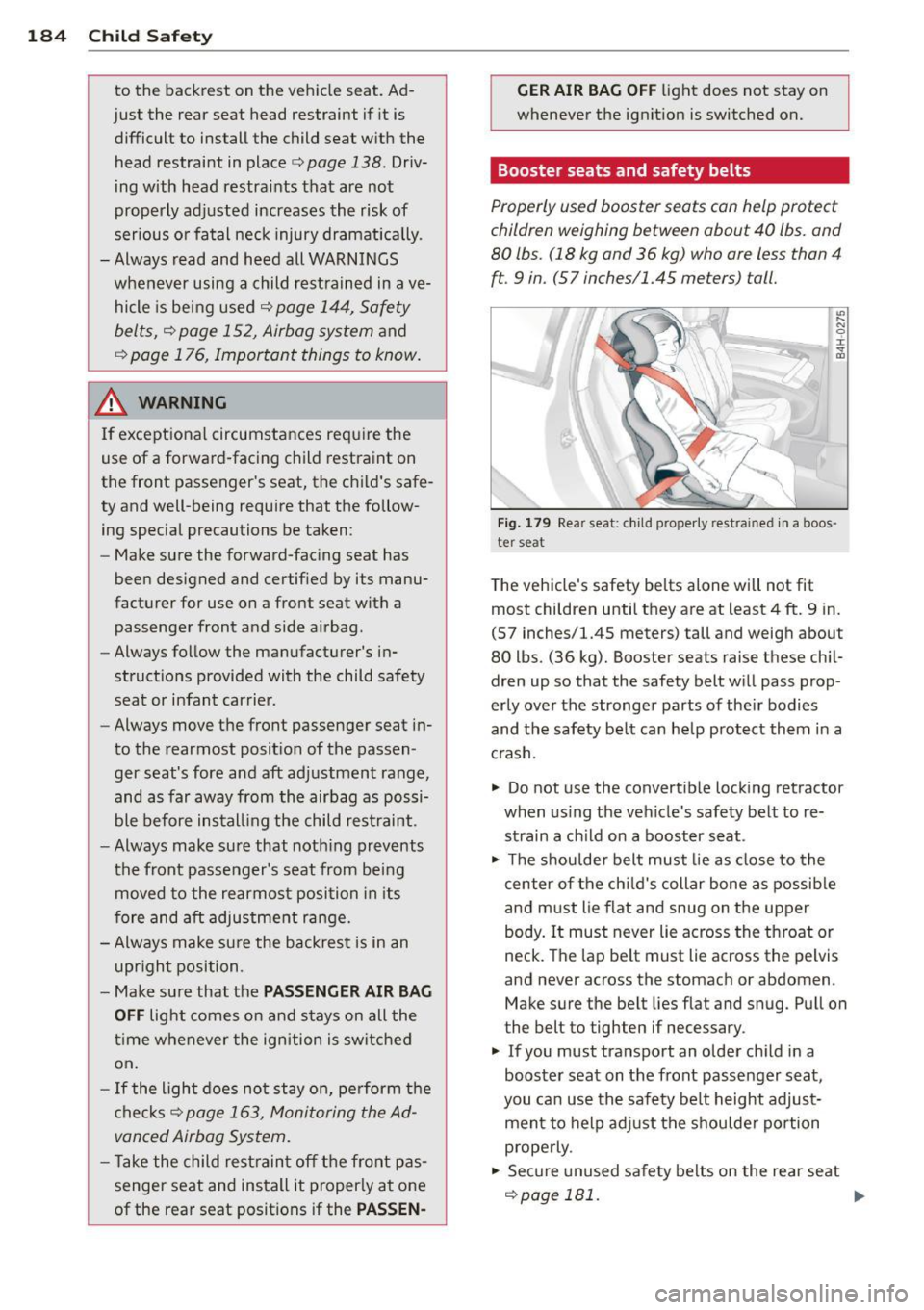
F ig. 179 Rea r seat: c hild p roperly rest rai ned in a boos
ter se at
T he vehicle 's safety belts a lone will not fit
most children until they are at least 4 ft. 9 in.
(57 inches/1.45 meters) tall and weigh about
80 lbs. (36 kg). Booster seats raise these chil
dren up so that the safety belt will pass prop
erly over the stronger parts of the ir bodies
and the safety be lt can he lp protect them in a
c rash .
.,. Do not use the convertible lock ing retractor
when us ing the vehicle's safety belt to re
strain a ch ild on a booster seat .
.,. The shou lde r belt must lie as close to the
center of the ch ild's collar bone as possible
and must lie flat and snug on the upper
body. It must never lie across the throat or
neck. The lap be lt must lie across the pelvis
and never across the stomach or abdomen .
Make sure the belt lies flat and snug. Pull on
the belt to tighten if necessary .
.,. If you must transport an older child in a
booster seat on the front passenger seat,
you can use the safety be lt height adjust
ment to help adj ust the shou lder portion
properly .
.. Secure unused safety belts on the rear seat
¢page 181. ..,_
Page 187 of 318
Children up to at least 8 years old (over 40 lbs
or 18 kg) are best protected in child safety
seats designed for their age and weight. Experts say that the skeletal structure, particu
larly the pelvis, of these children is no t fully
developed, and they must not use the vehicle
safety belts without a suitable child restraint .
It is usually best to put these children in ap
propriate booster seats. Be sure the booster
seat meets all applicable safety standards .
Booster seats raise the seating position of the
child and reposition both the lap and shoulder par ts o f the safety belt so that they pass
across the child 's body in the right places . The
routing of the belt over the child's body is very
important for the child's protection, whether
or not a booster seat is used . Children age 12
and under must always ride in the rear seat.
Children who are at least 4
ft . 9 in. (57 in
ches/1.45 meters) tall can generally use the
vehicle's three point lap and shoulder belts.
Never use the lap belt portion of the vehicle's
safety belt alone to restrain any child, regard
less of how big the child is. Always remember
that children do not have the pronounced pel
vic structure required for the proper function of lap belt portion of the vehicle's three point
lap and shoulder bel ts. The child's safety ab
solutely requires that a lap belt portion of the
safety belt be fastened snugly and as low as possible around the pelvis. Never let the lap
belt portion of the safety belt pass over the
child's stomach or abdomen.
In a crash, airbags must inflate within a blink
of an eye and with considerable force. In order
to do its job, the airbag needs room to inflate
so that it will be there to protect the occupant
as the occupant moves forward into the air
bag.
A vehicle occupant who is out of position and
too close to the airbag gets in the way of an
inflating airbag. When an occupant is too
close, he or she will be struck violently and
will receive serious or possibly even fatal in
jury.
Child Safety 185
In order for the airbag to offer protection, it is
important that all vehicle occupants , especial
ly any children, who must be in the front seat
because of exceptional circumstances, be
properly restrained and as far away from the
airbag as possible . By keeping room between
the child's body and the front of the passen
ger compartment, the airbag can inflate com
pletely and provide supplemental protection
in certain frontal collisions.
A WARNING
Not using a booster seat, using the boos
ter seat improperly, incorrectly installing a booster seat or using the vehicle safety
belt improperly increases the risk of seri
ous personal injury and death in a collision
or other emergency situation. To help re
duce the risk of serious personal injury
and/or death:
- The shoulder belt must lie as close to the
center of the child's collar bone as possi
ble and must lie flat and snug on the up
per body.
It must never lie across the
throat or neck. The lap belt must lie
across the pelvis and never across the
stomach or abdomen. Make sure that the
belt lies flat and snug. Pull on the belt to
tighten if necessary.
- Failure to properly route safety belts
over a child's body will cause severe inju
ries in an accident or other emergency
situation
c:> page 144.
- The rear side of the child safety seat
should be positioned as close as possible
to the backrest on the vehicle seat. Ad
just the rear seat head restraint if it is difficult to install the child seat with the
head restraint in place
c:>page 138. Driv
ing with head restraints that are not
properly adjusted increases the risk of
serious or fatal neck injury dramatically.
- Children on the front seat of any car,
even with Advanced Airbags, can be seri
ously injured or even killed when an air
bag inflates.
- Never let a child stand or kneel on any
seat, for example the front seat. •
•
Page 188 of 318
186 Child Saf ety
- Never let a child ride in the cargo area of
your vehicle .
- Always remember that a chi ld leaning
forward, sitt ing s ideways or out of posi
t ion in any way during an acc ident can be
struck by a deploying airbag . This will re
sult in serious personal injury or death .
- If you must install a booster seat on the
front passenger seat because of excep
t ional circumstances the
PASSENGER
AIR BAG OFF
light must come on and
stay on, whenever the ignition is sw itch
ed on.
- If the PASSENGER AIR BAG OFF light
does not come on and s tay on, perform
the chec ks described
¢ page 163, Moni
toring the Advanced Airbag System.
- T ake the child rest raint off the front p as
senger seat and install it properly at one
of the rea r seat positions if the
PASS EN·
GER AIR BAG OFF
light does not stay on
whenever the ignition is switched on .
- Always read and heed all WARNINGS whenever using a child rest rained in ave
hicle is being used
¢ page 144, Safety
belts,¢ page 152 , Airbag system
and
¢ page 176, Important things to know.
Installing a child safety
seat
Securing a child safety seat using a
safety belt
Safety belts for the rear seats and the front
passenger can be locked with the convertible
locking re tractor to properly secure child
safety seats.
The safety belts emergency locking retractors
for the rear seats safety belts and for the
fro nt passenger's seat safety belt have a con
vertible locking retracto r for child restra ints .
The safety belt must be locke d so that belt
webbing can not unreel. The ret ractor ca n be
activ ated to lock the safety be lt and p revent
the safety belt webbing from loosening up
d ur ing normal driv ing . A child sa fe ty seat can
on ly be proper ly installed whe n the safety belt is loc
ked so that the chi ld and child sa fety
seat wi ll stay in place.
Alw ays remember: Even tho ugh yo ur vehicle is
equipped wi th an A dvan ced Airbag system, all
c hi ldren, especially those 1 2 years and young
er, sho uld always ride in the back seat prope r
l y restra ined fo r the ir age and size.
A WARNING
Improperly installed ch ild safety seats in
crease the risk of serious personal injury
and death in a co llision.
- Always make sure that the safety belt re
tractor is locked when insta lling a child
safety seat. A n un locked safety belt re
trac to r cannot hold the child safety seat
in place dur ing norma l driving o r in a
crash.
- Always buckle the child safety seat firmly
in place even if a ch ild is not si tt ing in it.
A loose child sa fe ty se at can fly aroun d
du ring a s udden stop or in a collision .
- Always make sure that the rear seat
backres t to wh ich the center rear safety
belt is attached is securely latched when
eve r the rea r center safety belt is being
used to secure a ch il d restra int .
- If the backrest is not securely la tc h ed,
the child and the child restraint will be
thrown forward together with the back
rest and will strike parts of the vehicle
interior. The child can be seriously in
jured or killed.
- Never install rear-facing child safety
seats or infant ca rr ie rs o n the front pas
senger seat . A child will be serious ly in
jured and can be killed when the passen
ge r airbag inflates.
- The infla ting airbag will h it the ch ild
safety seat or infant carrie r w ith gr eat
for ce and will smas h the child safe ty seat
a nd child ag ai nst t he back res t, cen ter
a rmrest, doo r or roof.
- Always inst all rear-fa cing ch ild safety
se ats or in fa nt c arrie rs on the re ar se at.
Page 189 of 318
-Forward-facing child safety seats or in
fant carriers installed on the front pas
senger's seat may interfere with the de ployment of the airbag and cause serious
injury to the child.
- It is safer to install a forward-facing
child safety seat on the rear seat .
- Always read and heed all WARNINGS
whenever using a child restrained in ave
hicle is being used
c:::;, page 176 . Special
precautions apply when installing a child
safety seat on the front passenger seat
c:::;, page 154, Child restraints on the front
seat -some important things to know.
A WARNING
-
Always take special precautions if you
must install a forward or rearward-facing
child restraint on the front passenger's
seat in exceptional situations:
- Whenever a forward or rearward-facing
child restraint is installed on the front
passenger seat, the
PASSENGER AIR
BAG OFF light must come on and stay on
whenever the ignition is switched on.
- If the
PASSENGER AIR BAG OFF light
does not come on and stay on, perform
the checks described
c> page 163, Moni
toring the Advanced Airbag System .
-Take the child restraint off the front pas
senger seat and install it properly at one
of the rear seat positions if the
PASSEN
GER AIR BAG OFF
light does not stay on
whenever the ignition is switched on.
- Improper installation of child restraints
can reduce their effectiveness or even
prevent them from providing any protec
tion.
- An improperly installed child restraint
can interfere with the airbag as it de
ploys and seriously injure or even kill the
child.
- Always carefully follow the manufactur
er's instructions provided with the child
safety seat or carrier.
- Never place additional items on the seat
that can increase the total weight regis-
Child Safety 187
tered by the weight-sensing mat and can
cause injury in a crash.
A WARNING
Forward-facing child restraints:
- Always make sure the forward-facing
seat has been designed and certified by
its manufacturer for use on a front seat
with a passenger front and side airbag.
- Never put the forward-facing child re
straint up, against or
very near the in
strument panel.
- Always
move the passenger seat into its
rearmost position in the seat 's fore and
aft adjustment range, as far away from
the airbag as possible before installing
the forward-facing child restraint . The
backrest must be adjusted to an upright
position.
- Make sure that the
PASSENGER AIR BAG
OFF
light comes on and stays on all the
time whenever the ignition is switched
on.
A WARNING ...==-
Rearward-facing child restraints:
-A child in a rearward-facing child safety
seat installed on the front passenger
seat will be seriously injured and can be
killed if the front airbag inflates -
even
with an Advanced Airbag System.
- The inflating airbag will hit the child
safety seat or infant carrier with great
force and will smash the child safety seat
and child against the backrest, center
armrest, door or roof .
- Always be especially careful if you must
install a rearward facing child safety seat
on the front passenger seat in exception
al circumstances .
- A tight tether strap on a rearward-facing
child restraint attached to the front pas
senger seat can put too much pressure
on the weight-mat in the seat and regis
ter a heavier weight in the Advanced Air
bag System. The heavier weight regis
tered can make the system work as •
•
Page 190 of 318
188 Child Safety
though an adult were on the seat and deploy the Advanced Airbag when it must
be suppressed causing serious or even
fatal injury to the child .
- Make sure that the
PASSENGER AIR BAG
OFF
light comes on and stays on all the
time whenever the ignition is switched
on.
- If the
PASSENGER AIR BAG OFF light
does not come on and stay on, immedi
ately install the rear-facing child safety
seat in a rear seating position and have
the airbag system inspected by your Audi dealer.
Activating the convertible locking retractor
Use the convertible locking retractor to se
cure a child restraint.
Always heed the child safety seat manufactur
er's instructions when installing a child re
straint in your vehicle. To activate the conver
tible locking retractor:
"" Place the child restraint on a seat, prefera
bly on the rear seat.
"" Slowly pull the belt
all the way out.
"" Route it around or through the child re
straint belt path¢&_ .
"" Push the child safety seat down with your
full weight to get the safety belt really tight.
"" Insert the belt tongue into the buckle for
that seating position.
"" Guide the safety belt back into the retractor
until the belt lies flat and snug on the child
safety seat.
"" You should hear a "clicking" noise as the
belt winds back into the inertia reel. Test the
convertible locking retractor by pulling on
the belt. You should no longer be able to
pull the belt out of the retractor. The con
vertible locking retractor is now activated.
"" Make sure that the red release button is fac
ing away from the child restraint so that it
can be unbuckled quickly .
"" Pull on the belt to make sure the safety belt
is properly tight and fastened so that the seat cannot move forward or sideways more
than one inch (2.5 cm).
A WARNING ....__ -
Using the wrong child restraint or an im
properly installed child restraint can cause
serious personal injury or death in a crash.
- Always make sure that the safety belt re- tractor is locked when installing a child
safety seat. An unlocked safety belt re
tractor cannot hold the child safety seat
in place during normal driving or in a
crash.
- Always buckle the child safety seat firmly
in place even if a child is not sitting in it.
A loose child safety seat can fly around
during a sudden stop or in a crash.
- Always make sure the seat backrest to
which the child restraint is installed is in
an upright position and securely latched
into place and cannot fold forward. Oth
erwise, the seatback with the child safety
seat attached to it could fly forward in
the event of an accident or other emer
gency situation.
- Always read and heed all WARNINGS whenever using a child restrained in ave
hicle is being used
¢ page 176. Special
precautions apply when installing a child
safety seat on the front passenger seat
¢ page 154, Child restraints on the front
seat -some important things to know.
Deactivating the convertible locking
retractor
The convertible locking retractor for child re
straints will be deactivated automatically when the belt is wound all the way back into
the retractor.
"" Press the red button on the safety belt
buckle. The belt tongue will pop out of the
buckle.
"" Guide the safety belt all the way back into
its stowed position .
Always let the safety belt retract completely
into its stowed position. The safety belt can
1J1-
Page 195 of 318
-Always read and heed the important in
formation and WARNINGS about child
safety and the installation of child re
straint systems
c:> page 176, Child Safe
ty.
(D Note
On vehicles with power adjustable rear
seats* some criteria must be observed
when attaching the child restraint using the
LATCH system:
- To attach the child restraint securely, the
seat must be moved to the farthest rear
position, the seat height set to the low
est position and the head restraint must be adjusted to the vertical position
¢ page 60.
-If a child safety seat is attached to one of
the rear seats, this seat must not be ad
justed using the power controls under
any circumstances. The
Entry assistance
for this seat must also be deactivated in
the MMI
¢ page 63. The child safety seat
as well as the rear seat can be damaged by the adjustment process.
Tether anchors and tether straps
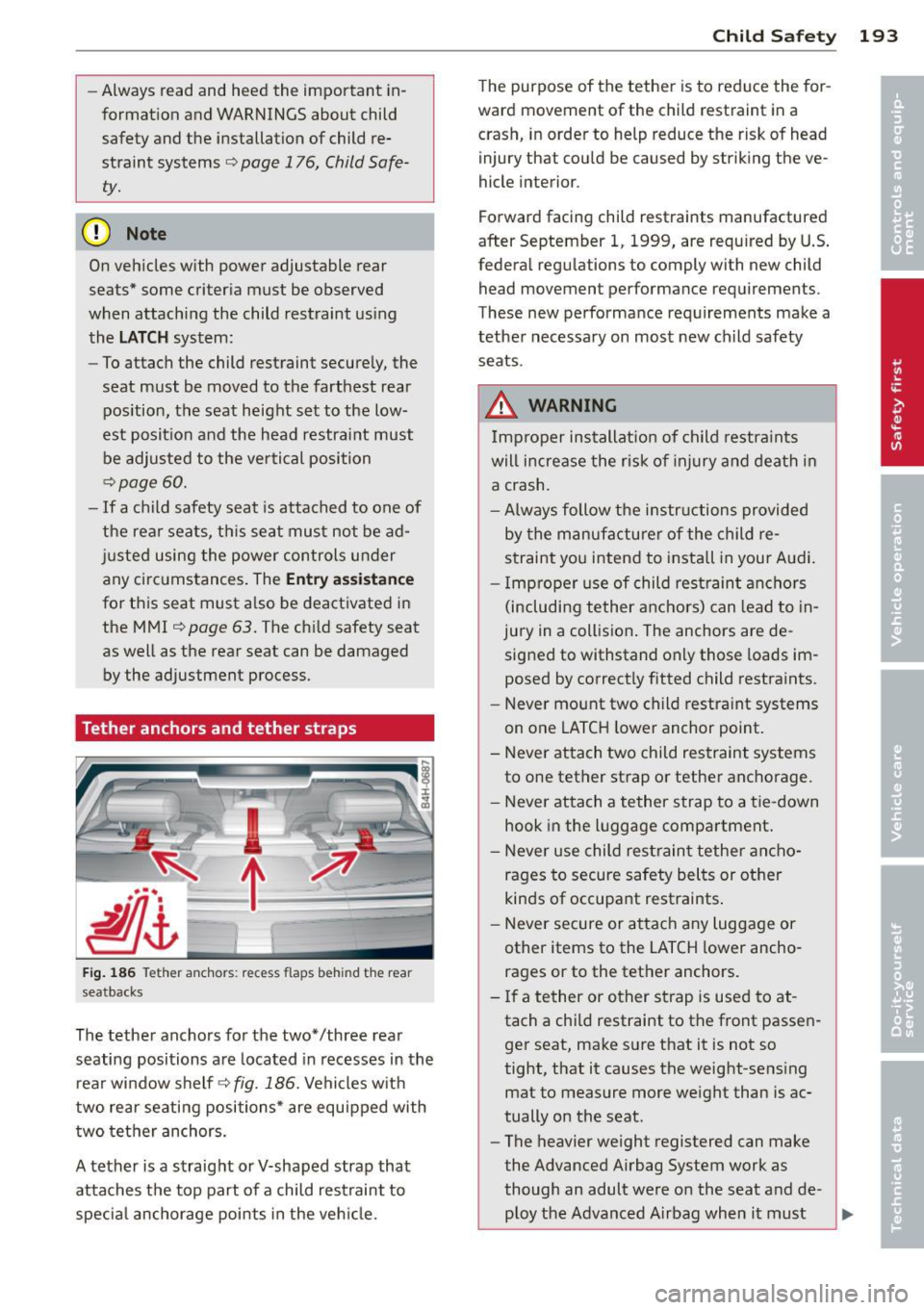
Fig. 186 Tether an cho rs: reces s fl ap s b ehin d th e re ar
seatbacks
The tether anchors for the two* /three rear
seating positions are located in recesses in the
rear window shelf ¢
fig. 186. Vehicles with
two rear seating positions* are equipped with two tether anchors .
A tether is a straight orV-shaped strap that
attaches the top part of a child restraint to
special anchorage points in the vehicle.
Child Safety 193
The purpose of the tether is to reduce the for
ward movement of the child restraint in a
crash, in order to help reduce the risk of head
injury that could be caused by striking the ve
hicle interior .
Forward facing child restra ints manufactured
after September 1, 1999, are required by U.S.
federal regulations to comply with new child
head movement performance requirements.
These new performance requirements make a
tether necessary on most new child safety
seats .
.&_ WARNING
Improper installation of child restraints
will increase the risk of injury and death in
a crash.
- Always follow the instructions provided
by the manufacturer of the child re
straint you intend to install in your Audi.
- Improper use of child restraint anchors
(including tether anchors) can lead to in
jury in a collision . The anchors are de
signed to withstand only those loads im
posed by correctly fitted child restraints .
- Never mount two child restraint systems
on one LATCH lower anchor point.
- Never attach two child restraint systems to one tether strap or tether anchorage.
- Never attach a tether strap to a tie-down
hook in the luggage compartment.
- Never use child restraint tether ancho
rages to secure safety belts or other
kinds of occupant restraints.
- Never secure or attach any luggage or
other items to the LATCH lower ancho rages or to the tether anchors .
- If a tether or other strap is used to at
tach a child restraint to the front passen ger seat, make sure that it is not so
tight, that it causes the weight -sensing
mat to measure more weight than is ac
tually on the seat .
- The heavier weight registered can make
the Advanced Airbag System work as
though an adult were on the seat and de -
ploy the Advanced Airbag when it must ..,
Page 196 of 318
194 Child Safe ty
be suppressed causing ser ious or even
fatal injury to the child .
- If you must install a rearward facing
child safety seat on the front passenger
seat because of exceptional circumstan
ces and the
P ASS ENGER AIR BA G OFF
light does not come on and stay on, im
med iately install the rear-facing child
safety seat in a rear seating position and
have the a irbag system inspected by your
Audi dealer.
Installing the upper tether strap on the
anchorage
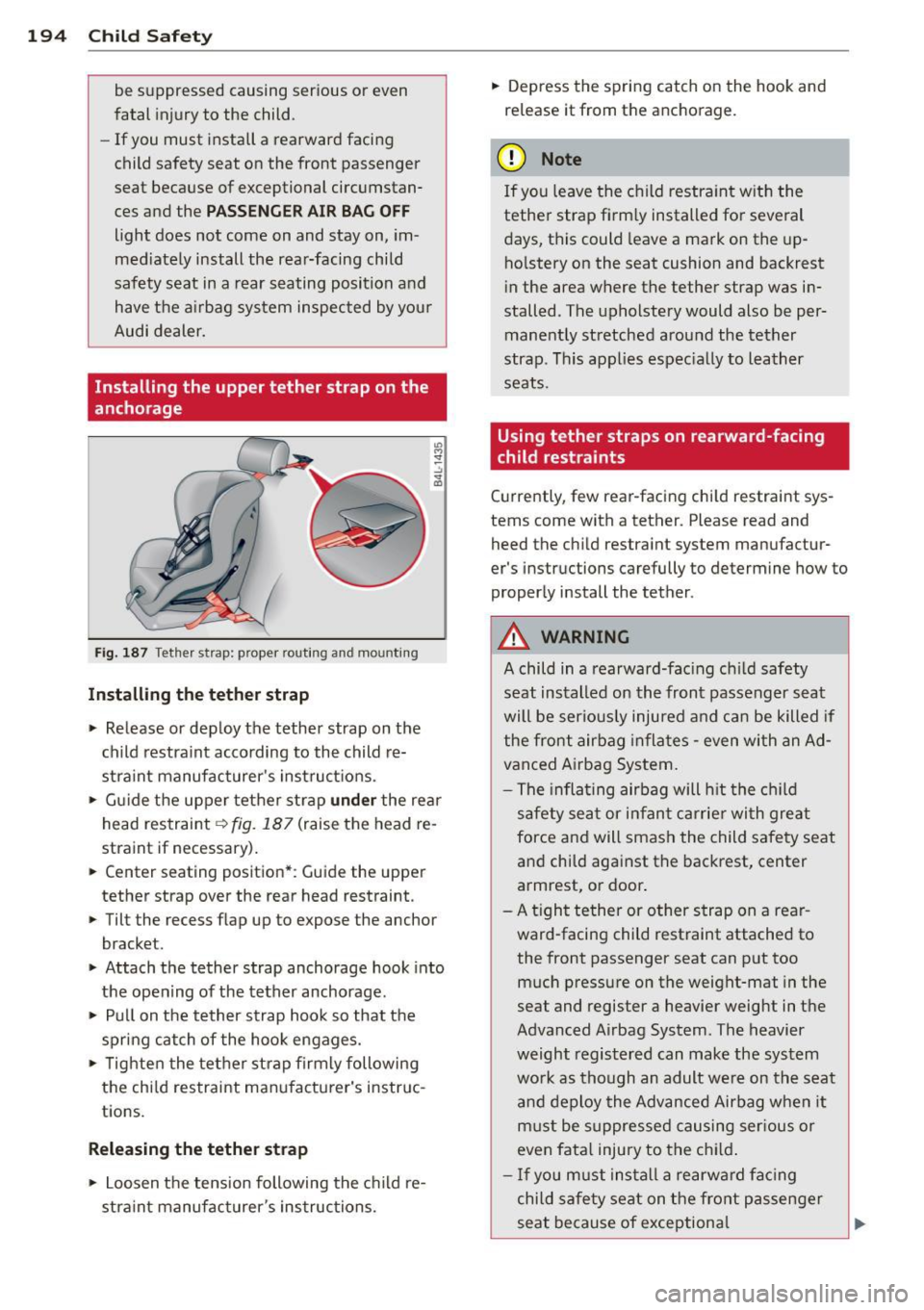
Fig. 187 Tet her st rap : proper ro uting a nd mountin g
Inst all ing th e teth er strap
.,. Release or deploy the tether strap on the
child restra int according to the child re
stra int manufac turer's instructions .
.,. Gu ide the upper tether strap
under the rear
head restraint ~
fig. 187 (raise the head re
straint if necessary).
.,. Center seating position* : Guid e the upper
tether strap over the rear head restraint.
.,. Til t the recess flap up to expose the anchor
br acke t.
.,. Attach the tether strap anchorage hook into
the opening of the tether anchorage .
.,. Pull on the tether strap hook so that the
spring catch of the hoo k engages.
.,. Tighten the tether strap firmly following
the chi ld restraint manufacturer's instr uc
tions.
Releasing the tether strap
.,. Loosen the tens ion following the c hild re
stra int manufacturer 's instructions. .,.
Depress the spring catch on the hook and
re lease it from the anchorag e.
(D Note
If you leave the child restra int w ith the
tether strap firm ly installed for several
days, this could leave a mark on the up
ho lstery on the seat cushion and backrest
i n the area where the tether strap was in
stalled . The upholstery would also be per
manently stretched around the tether
strap. This applies espec ia lly to leather
seats .
Using tether straps on rearward-facing
child restraints
Currently, few rear-facing chi ld restrai nt sys
tems come with a tether. Please read and heed the child rest raint system manufactur
er' s in structions carefully to determine how to
properly install the tether .
8.. WARNING
-A child in a rearward-facing ch ild safety
seat installed on the front passenger seat
will be serious ly injured a nd can be killed if
the front airbag inflates -even with an Ad
vanced Airbag System.
- The infla ting airbag will h it the ch ild
safety seat or infant carrie r wi th great
force and will smash the child safe ty seat
and child against the backrest, center
armrest, or door .
- A t ight tether or other strap on a rear
ward-facing child restraint attached to
the front passenger seat can p ut too
much pressure on the weight-mat in the
seat and register a heavier weight in the
Advanced Airbag System . The heavier
weight registered can make the system work as though an adult we re on the seat
and deploy the Advanced Airbag when it
m ust be suppressed causing ser ious or
even fata l injury to the chi ld .
- If you m ust insta ll a rearward fac ing
child safety seat on the front passenger
seat because of exceptiona l
Page 197 of 318
circumstances and the PASSENGER AIR
BAG OFF
li gh t does not come o n an d
stay on, immediately install the rear-fac
ing child safety seat in a rear seating po
sit ion and have the airbag system i n
spected by your Aud i deale r.
Additional Information
Sources of information about child
restraints and their use
There are a number of sources of additional
information about ch ild restraint select ion, in
stallat io n and use:
NHTSA advises that t he best child safety seat
is the one that fits your child and fits in your
ve hicle, and that you wi ll use correctly and
consisten tly.
Try before you buy!
U.S National Highway Traffic Safety Admin
i s tration
T e l. : 1 -888-327 -4236 (T TY : 1-800-424-9153)
www.nhtsa .gov
National SAFE KIDS Campaign
Te l.: (202) 662-0600
www.safekids.org
Safety BeltSafe U.S .A
Te l.: (800) 745 -SA FE (English)
Te l.: (800) 747 -SANO (Spanish)
www .carseat.org
Transpo rt Canada Info rm ation Cent re
Te l.: 1- 800 -333 -037 1 or call
1-613-998 -8616 if you are in the Ottawa area
http ://www.tc.gc.ca/eng/roadsafety/
menu .htm
Audi Customer Relations
Te l.: (800) 822 -2834
Child Sa fet y 195
•
•
Page 199 of 318
(D Note
The sensors can be displaced by impacts or damage to the bumper , whee l housing and
underbody. This can affect the function of
the Audi pre sense system. Have your au
thor ized Audi dealer check to make sure
that the system is working properly .
(D Tips
-Certain Audi pre sense functions are not
available when ASR is sw itched off (sport
mode) or when driving in reverse .
- The Audi pre sense functions may not be
ava ilable if there is a malfunction in the
ESC system or the airbag control mod
u le.
- The Audi pre sense front/plus functions
are not available if there is a ma lfunction
i n the adapt ive cru ise control* system
¢ page 100.
- The Audi pre sense rear/plus functions
are not available if there is a ma lfunction
i n the Audi side assist* system
¢ page 100 .
Audi pr e sense 197
•
•
Page 200 of 318
198 Intellige nt tec hno logy
Intelligent technology
Notice about data
recorded by veh ic le
control modules
Your vehicle is not equipped with an Event Da
ta Recorder (EDR), installed by some manu
facturers fo r the express purpose of capturing
data for retrieval after an accident or crash
event . EDR's are sometimes called "crash re
corders".
Some state laws restrict the retrieval or down
loading of data stored by EDR's that were in
stalled in a vehicle for the express purpose of
retrieving data after an accident or crash
event without the owner's consent.
A lthough your vehicle is not equipped with an
EDR, it is equipped with a number of electron
ic control modules for various vehicle systems
such as, for example, engine function, emis
sion control, as well as for the airbags and
safety belts.
These electronic control modules also record
vehicle-related data during normal vehicle op
eration for diagnostic and repair purposes.
The recording capacity of the electronic con
trol modules is limited to data (no sound is re
corded) and only a small amount of data is ac
tually recorded over a very limited period of
time and stored when a system fault or other
condition is sensed by a control unit. Some of
the data then stored may relate to vehicle
speed, direction, braking as well as restraint
system use and performance in the event of a
crash or other condition. Stored data can only
be read and downloaded with special equip
ment.
Electronic Stab ilization
Control (ESC)
Description
ESC helps to improve road holding and vehicle
dynamics to help reduce the probability of
skidding and loss of vehicle control. It works
only when the engine is running. ESC detects certain difficult driving situations, including
when the vehicle is beginning to spin (yaw)
out of control and helps you to get the vehicle back under control by selectively braking the
wheels, and/or reducing engine power and
providing steering assistance to help hold the
vehicle on the driver's intended course. The in
dicator light
G) in the instrument cluster
blinks when ESC is taking action to help you
control the vehicle.
ESC has limitations.
It is important to remem
ber that ESC cannot overcome the laws of
physics. It will not always be able to help out
under a ll cond itions you may come up against.
For example, ESC may not always be able to
help you master situations where there is a
sudden change in the coefficient of friction of
the road surface. When there is a section of
dry road that is suddenly covered with water,
slush or snow, ESC cannot perform the same
way it would on the dry surface . If the vehicle
hydroplanes (rides on a cushion of water in
stead of the road surface), ESC will not be
able to help you steer the vehicle because con
tact with the pavement has been interrupted
and the vehicle cannot be braked or steered.
During fast cornering, particularly on winding
roads, ESC cannot always deal as effectively
with difficult driving situations than at lower
speeds. When towing a trailer, ESC is not able
to help you regain control as it would if you
were not towing a trailer.
Always adjust your speed and driving style to road, traffic; and weather conditions. ESC can
not override the vehicle's physical limits, in
crease the available traction, or keep a vehicle
on the road if road departure is a result of
driver inattent ion. Instead, ESC improves the
possibility of keeping the vehicle under con
trol and on the road during extreme maneu
vers by using the driver's steering inputs to
help keep the vehicle going in the intended di
rection . If you are traveling at a speed that
causes you to run off the road before ESC can
provide any assistance, you may not experi
ence the benefits of ESC.