air condition AUDI S8 2014 User Guide
[x] Cancel search | Manufacturer: AUDI, Model Year: 2014, Model line: S8, Model: AUDI S8 2014Pages: 314, PDF Size: 78.47 MB
Page 201 of 314
Intelligent technology Notice about data
recorded by vehicle
control modules
Your vehicle is not equipped with an Event Da
ta Recorder (EDR), installed by some manu
facturers for the express purpose of capturing
data for retrieval after an accident or crash
event. EDR's are sometimes called "crash re
corders".
Some state laws restrict the retr ieval or down
loading of data stored by EDR's that were in
stalled in a vehicle for the express purpose of
retrieving data after an accident or crash
event without the owner's consent.
Although your vehicle is not equipped with an
EDR, it is equipped with a number of electron
ic control modules for various vehicle systems
such as, for examp le, engine function, emis
sion control, as well as for the airbags and
safety belts.
These electronic control modules also record
vehicle-related data during norma l vehicle op
eration for diagnostic and repair purposes.
The recording capacity of the electronic con
trol modules is limited to data (no sound is re
corded) and only a small amount of data is ac
tually recorded over a very limited period of
time and stored when a system fault or other
condition is sensed by a control unit. Some of
the data then stored may relate to vehicle
speed, direction, braking as we ll as restraint
system use and performance in the event of a
crash or other condition. Stored data can only be read and downloaded with special equip
ment.
Electronic Stabilization
Control (ESC)
Description
ESC helps to improve road holding and vehicle
dynamics to help reduce the probability of
skidding and loss of veh icle control. It works
only when the engine is running. ESC detects
Intelligent technology 199
certain difficult driving situations, including
when the vehicle is beginning to spin (yaw)
out of control and helps you to get the veh icle
back under control by se lectively braking the
wheels, and/or reducing engine power and
providing steering ass istance to help hold the
vehicle on the driver's intended course. The in
dicator light
JjJ in the instrument cluster
blinks when ESC is taking action to help you
control the vehicle.
ESC has limitations .
It is important to remem
ber that ESC cannot overcome the laws of
physics.
It will not always be able to help out
under all conditions you may come up against.
For example, ESC may not always be able to
help you master situations where there is a
sudden change in the coefficient of friction of
the road surface. When there is a section of dry road that is suddenly covered with water,
slush or snow, ESC cannot perform the same
way it would on the dry surface. If the vehicle
hydroplanes (rides on a cushion of water in
stead of the road surface), ESC will not be
able to help you steer the vehicle because con
tact with the pavement has been interrupted
and the vehicle cannot be braked or steered .
During fast cornering, particularly on winding
roads, ESC cannot always deal as effectively
with difficult driving situations than at lower
speeds. When towing a trailer, ESC is not able
to help you regain control as it would if you
were not tow ing a trailer.
A lways adjust your speed and driving style to
road, traffic and weather conditions. ESC can
not override the vehicle's physical limits, in
crease the available traction, or keep a vehicle
on the road if road departure is a result of
driver inattention. Instead, ESC improves the
poss ibility of keeping the vehicle under con
trol and on the road dur ing extreme maneu
vers by using the driver's steering inputs to
help keep the vehicle going in the intended di
rection. If you are traveling at a speed that
causes you to run off the road before ESC can
provide any assistance, you may not experi
ence the benefits of ESC.
•
•
Page 210 of 314
208 Driving and en vir onm ent
Catalytic converter
Appl ies to vehicles: with gasoline e ngin e
It is very important that your emission con
trol system (catalytic converter) is function
ing properly to ensure that your vehicle is run
ning in an environmentally sound manner .
.. Always use lead-free gasoline i=> page 222,
Fuel supply .
.. Never run the tank down all the way to emp-
ty .
.. Never put too much motor oil in your engine
¢ page 23 7, Adding engine oil
The catalytic converter is an eff ic ient "clean
up" device built into the exhaust system of
the vehicle. The catalyti c converter burns
many of the pollutants in the exhaust gas be
fore they are released into the atmosphere.
The exclus ive use of unleaded fuel is cr itically
important for the l ife of the cata lytic convert
e r and proper functioning of the engine.
A WARNING
T he temperature of the exhaust system is
high, both when driving and after stopping
the engine .
- Never touch the exhaust tail pipes once
they have become hot. This could result
in burns.
- Do not park or operate the vehicle in
areas where the hot exhaust system may
come in contact with dry grass, brush,
fuel spill or other material which can
cause a fire.
- Do not apply additional undercoating or
rustproofing on or near the exhaust
man ifold, exhaust p ipes, catalytic con
verter or heat shields . During driving, the
substance used for undercoating cou ld
overheat and cause a fire.
@) Note
- Be aware that just one tank f illing with
leaded fuel will already seriously de
grade the performance of the cata lytic
conve rter. -
Do not exceed the correct engine oil level
i=>page 237.
-Do not drive until the fue l tank becomes
completely empty . The engine co uld mis
fire . Unburned fuel could also get into
the exhaust system and this cou ld cause
the catalytic converter to overheat.
- Do not switch off the ignition while the
vehicle is mov ing.
- Do not continue to operate your vehicle
under these conditions, as otherwise fuel
can reach the catalyt ic converter. Th is
cou ld result in overheating of the con
verter, requir ing its replacement .
- To assure efficient operation of the Emis
sion Control System:
- Have you r vehicle maintained p roperly
and in accordance w ith the service rec
ommendations in your Warranty & Maintenance book let.
- Lack of prope r maintenance as we ll as
improper use of the vehicle wi ll impair
the function of the em ission contro l
system and could lead to damage.
@) For the sa ke of the en vironment
Even when the Emission Control System is
ope rat ing properly, the exhaust gas can
have a sulfur-like exhaust gas smell under
some operat ing states. This depends on
the sulfur content of the fuel being used .
Using a different brand of fuel may help,
or f illing the tank with lead-free super
grade gasoline.
Diesel particulate filter
Applies to vehicles: with diese l eng ine
The diesel part icu late filter filters nearly all of
the soot pa rticles out of the exhaust . T he fil
ter cleans itself automat ica lly unde r no rma l
dr iv ing cond itions . If the filte r cannot clean it
self (for example, because you are on ly driving
short distances), the filter becomes clogged
with soot and the
II symbol for the diesel
particulate filter i lluminates
i=> page 21. ..,.
Page 226 of 314
224 Fuel supply and filling your fuel tank
Winter operation
At temperatures below 20° F (-7° C), Diesel
fuel No.
2 loses its fluidity due to wax separa
tion, which may clog the fuel filter or tank fil
ter and keep the engine from running .
To help the filter from being clogged by wax,
the fue l filter in your vehicle is automatically
preheated. Preheating the fuel filter makes
operation of your vehicle possible with Diesel
fuel No. 2 down to -10° F (-24° C).
If you expect temperatures below
5° F
(-15° C)
ask your fuel dealer whether their
Diese l fuel No.
2 is sufficiently winterized for
the prevailing and expected temperatures.
If not winterized or insufficiently winterized
Diesel fuel has already thickened to the extent
that the engine will not start, warm the vehi
cle up by leaving it in a heated garage.
It is normal that the engine noise leve l (die
seling) is louder during the warm-up period in
winter. It is also norma l when whitish-blue
smoke comes out of the tailpipe after starting
and during warm-up . The amount of smoke
depends on the outs ide temperature.
Do not let your Diese l engine idle unnecessari
ly after a cold start. Driving off slowly will
shorten the warm-up period.
A WARNING
- Never use "starting assist fluids." They
may be potent ially explosive or cause a
"run-away" engine condition. This could
result in ser ious engine damage and per
sonal injur y.
- Never use fuel line anti-freeze offered for
gasoline engines.
(D Note
- Your Diesel engine has been specifically designed to operate only on Ultra Low
Sulfur Diesel fuel. Therefore, never use
home heating oil or regular gasoline. The
properties of these fuels may cause seri
ous damage to the fuel injection system
and to the engine. Using these fuels can
-
cause expensive engine repairs and will
also adversely affect your New Vehicle
Limited Warranty.
- If Diesel fuel sho uld get on any rubber
hose, it must be wiped off immediately.
Then wash the contaminated hose por
tion with soap and warm water. Do not allow D iesel fuel to remain on connect
ing hoses . They may develop leaks and
cause serious damage.
Fuel tank
Fuel filler neck
The fuel filler neck is located on the right rear
side panel behind the fuel filler flap.
If the power locking system shou ld fail, you
can still open the flap manua lly -for detailed
instructions see ¢
page 22 7.
You can find the fuel tank capacity of your ve
hicle in ¢
page 290.
The label on the inside of the fuel filler flap
te lls you the correct fuel for your vehicle. For
more information about fuel specifications,
see ¢
page 222.
Your vehicle fuel tank has an on board refuel
ling vapo r recovery system. This feature helps
to prevent fue l vapors from escaping from the
tank and polluting the environment while you refuel your vehicle. In order to fi ll the tank
proper ly while protecting the environment,
please fo llow this refueling procedure careful
ly.
A WARNING
-Under normal operating conditions, never
carry addit ional fuel conta iners in your car .
Gas canisters and other conta iners used to
transport fuel can be dangerous. Such con
tainers, full or empty, may leak and could
cause a fire in a collision.
If you must
transport fuel to use for your lawn mower,
snow blower, etc., be very careful and al
ways observe loca l and state laws regard
ing the use, transportation and storage of
such fuel containers. Make certain the ..,.
Page 241 of 314
@ For the sake of the environment
-Before changing your oil, first make sure
you know where you can properly dispose
of the used o il.
- Always dispose of used engine oil proper
l y. Do not dump it on garden soi l, wood
ed areas, into open streams or down
sewage dra ins.
- Recycle used engine oil by taking it to a
used engine oil collection facility in your
area, or contact a service station .
Engine cooling system
Coolant
The engine coolant performs two functions: it
keeps the engine from overheating and it pro tects the engine from freezing in the winter.
The cooling system is sea led and generally re
q uir es lit tle atten tion .
The cooling system has been filled at the fac
tory with a pe rmanent coo lant which does not
need to be c hanged. The coolant consists of a
mixture o f spec ial ly conditioned water and the
manuf acturer 's glyco l-based cool ant ad di-
tiv e G13 antifreeze with ant icorros ion addi
tives (50% for USA models ; 60% for Canadian
mod els) . This mixture both assures the neces
sary frost protection and p rotect s metal com
ponents in the engine's coo ling system from
corrosion and scaling . It a lso raises the boil
i ng point of the coolant .
Do not reduce the concentration o f the coo l
ant in the summer by adding plain water.
The
proportion of coolant add it ive must be at
l e a st 50 % but not mor e than 60 %
to main
tain antifreeze protection and coo ling efficien
cy .
If the coolant frost protect io n is too low,
the coolant cou ld free ze and dam age the veh i
cle heating and eng ine cooling system.
For yea r-round driving, antifreeze is added at
the fac to ry for tempera tures down to:
-- 31°F( -35°C)USA
- -40 °F ( -40 °C) Canada.
Checkin g and fillin g 239
If you must add coo lant, use a mixture of wa
ter and coolant additive . Mix ing the coo lant
additive with distilled water is recommended.
_& WARNING
Before you c heck anything in the engine
compartment, always read and heed a ll
WARNINGS
c> .& in Working in the engine
comportment on page 231.
Q) Note
- Before winter sets in, have the coo lant
checked to see if the coolant additive in
your vehicle is sufficient to meet the cli mate condi tions. This is especi ally impor
tan t if you live i n a region wher e th e win
ter is ex treme ly co ld. If necessary, i n
crease t he p ropo rtion of coo lant add itive
to 60% .
- Whe n ad ding coolant additive t o yo ur
c ooling sys tem, reme mbe r:
- We recommend using on ly coolant ad
d itive G12++ or Gl3 for your vehicle .
This coolant additive is availab le at au
thor ized Audi dealers . O ther types of
a ntifreeze can s ignifica ntly reduc e cor
rosion prote ction. The result ing cor ro
sion can cau se a loss o f coolan t and se
rio us engine d amage .
- Do not add any ty pe of rad iator leak seal
a nt to yo ur vehicle 's engine c oolant .
A dd ing radia tor repair fl uid may adverse
ly affect the f unction and pe rformance of
your cooling system and co uld resu lt in
damage not covered by your New Ve hicle
L imited Warranty.
-
•
•
Page 245 of 314
long. This can seriously affect the effi
ciency of the brakes as well as yo ur
safety. This could result in an acc ident.
0 Note
Brake f luid will damage the paint of your
vehicle.
@ For the sake of the environment
Because of the problem of proper d isposa l
of brake fl uid as we ll as the special tools
req uired and the necessa ry expert ise, we
recommend that you have the brake fluid
changed by your author ized Audi dealer.
Battery
General information
Under normal operating conditions, the bat
tery in your A udi does not need any mainte
nance . With
high outside temperatures or
long dai ly dr ives we recommend that you have
the electro lyte level checked by a service fa
cility. T he electrolyte level shou ld also be
checked each time the battery is charged
-:;, page 245.
Have the battery checked when you take your
ve hicle in for service. You are well adv ised to
replace a battery that is older than 5 years.
W ith certa in types o f airbag deployment, the
battery is d isconnected from the vehicle elec
tr ica l system for safety reasons¢
& in Re
pair, care and disposal of the airbags on
page 167.
Disconnect ing the battery terminals
Some vehicle functions (power w indow regu
lators, for example) are lost if the battery ter
minals a re d isconnected. These functions have
to be relearned after the battery terminals a re
connected again . To prevent this, the battery
should only be d isconnected from the vehicle
e lec trica l system whe n absolu tely ne cessa ry
f or repairs.
Checkin g and fillin g 243
Vehicles not driven for long periods
If you do no t drive your vehicle over a period
of seve ra l days o r weeks, e lectr ica l compo
nents are g radually cut back or switched off .
This reduces energy consumption and main
ta ins starting capability over a longer period
¢
page 204. Some of the convenience func
tions may not operate, such as the inter ior
l igh ts or the power seat adjus tment. The con
venience functions will be ava ilab le aga in
whe n you swi tch on the ignition and sta rt the
engine.
Winter operation
During the winte r months, battery capacity
tends to dec rease as temperatures drop. This
i s because more power is a lso consumed wh ile
s ta rt ing, and the headlight s, rea r window de
fogger, e tc., are used more ofte n.
Avoid unnecessary powe r consumpt ion, par
ticu larly in city traffic o r when traveling only
sho rt distances. Let yo ur au thoriz ed Aud i
de aler check the cap acity of the vehicle b at
tery before winter sets in~ page 245. A well
charged bat tery will not on ly prevent starting
problems w hen the weather is cold, but w ill
a lso last longer.
{!) Tips
If yo ur vehicle is left s tandin g for seve ral
weeks at extreme ly low tem peratures, the
vehicle battery sho uld be removed and
stored w here it w ill not freeze . T his will
prevent it from be ing damaged and having
to be replaced.
Working on the battery
Be especially careful when working on or near
the battery.
The battery is located in the luggage compart
ment under the floor. Before you check any
th ing in the luggage compartment,
read and
heed all WARNINGS
¢ .&_ .
Always heed the safety warnings , when work
ing on the vehicle battery or the vehicle e lec
trical system to prevent injury. •
•
Page 255 of 314
Tires an d wheel s 253
Bear in mind that the ti re press ure monitoring
system* can only monitor the tire pressures
you have stored. The system does not recog
n ize the load condit ion of your vehicle.
The effectiveness of the tire pressure monitor
ing system* will be impaired if you store nor
mal load pressures but then operate the vehi
cle at its maximum load
c;, &.
See the i llustration c;, fig. 208 for the location
of the label on driver's side B-pillar (co lor of
the actua l labe l and exact location on the ve
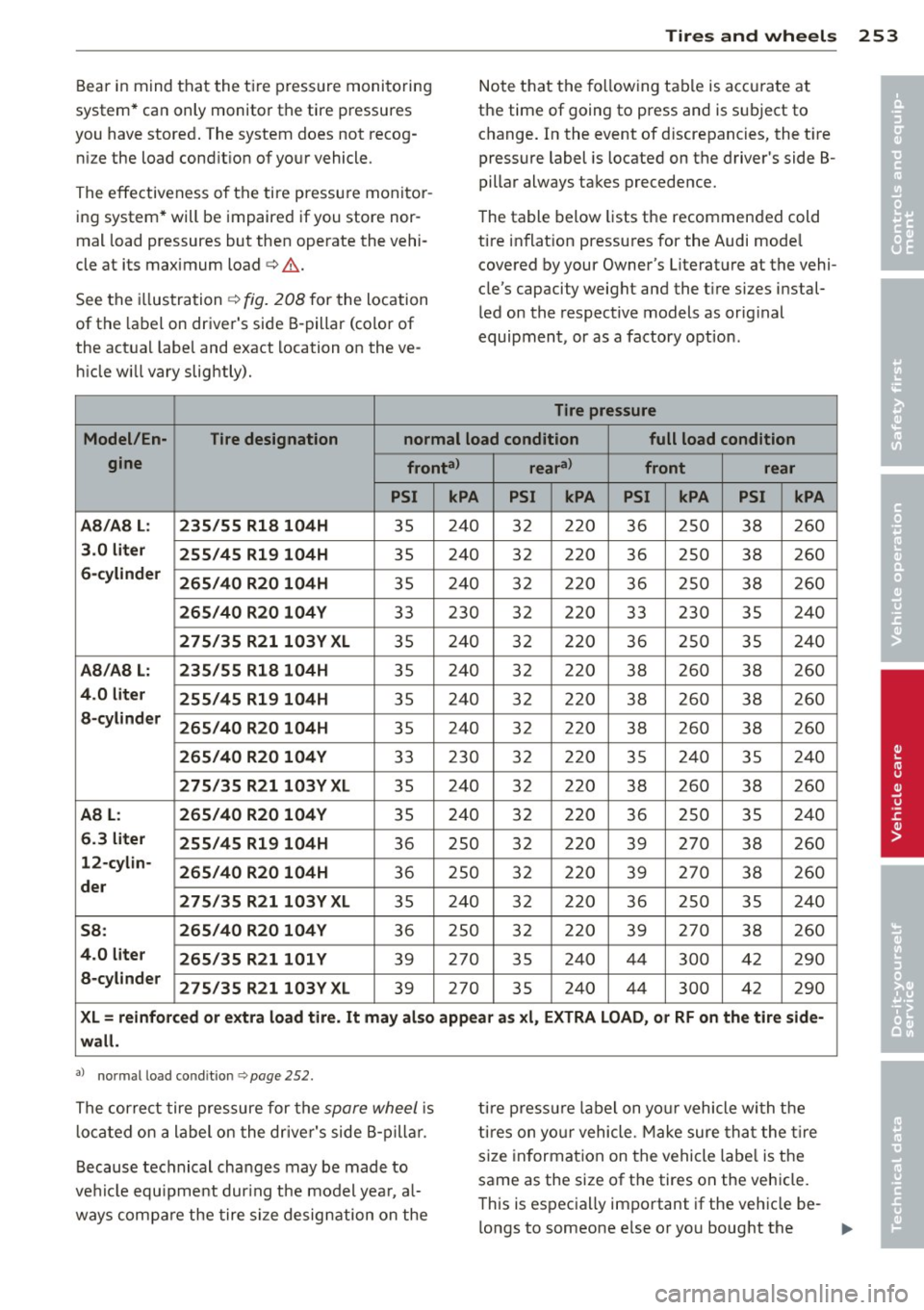
h icle wi ll vary slightly). Note that the
following table is accurate at
the time of going to press and is subject to
change. In the event of d iscrepancies, the tire
pressure label is located on the driver's side B
pillar always takes precedence.
The table below lists the recommended cold
tire inflat ion pressures for the Audi mode l
covered by your Owner's Literature at the vehi
cle's capacity weight and the t ire sizes instal
led on the respective models as orig inal
equipment, or as a factory option.
Tire pressure
Model /En-
Tire design ation normal load condition
full load condition
gine fronta> reara>
front rear
PSI kPA PSI kPA PSI kPA PSI kPA
AB /AB L: 235/55 R18 104H
35 240 32 220 36 250 38 260
3 .0 lit er
255/45 R1 9 104H 35 240
32 220 36 250 38 260
6-cy lind er
26 5/40 R2 0 104H 35 240 32 220 36 250 38 260
265 /40 R20 104 V 33 230 32 220 33 230 35 240
275
/35 R 2110 3Y XL 35 240 32 220 36 250 35 240
A8/A8 L: 235 /55 R1 8 104H 35 240
32 220 38 260 38 260
4.0 l it e r
255/4 5 R19 104H 35 240 32 220 38 260 38 260
a-cy lind er
26 5/ 40 R 20 104H 35 240
32 220
38 260
38 260
2
6 5/40 R 20 104V 33 230 32 220 35 240 35 240
27
5/35 R2 110 3Y XL 35 240 32
220
38 260
38 260
AB L
: 265/40 R20 104 V 35 240 32 220 36 250 35 240
6.3 liter
255 /45 R1 9 104H 36 250 32 220
39 270
38 260
12
-cy lin-
26 5/40 R 20 104H 36 250 32 220 39 270 38 260
der
275/35 R 21 103 YXL
35 240 32 220 36 250
35 240
58
: 2 65/40 R 20 10 4V 36 250 32 220 39 270 38 260
4.0 liter
265 /35 R21101 Y 39 270 35 240 44 300 42 290
a-cy lind er
275/35 R 2110 3Y XL 39 270 35 240
44
300 42
290
XL= reinf orce d or extra lo ad tir e. It ma y als o appe ar a s x l, E XTRA LOAD, or RF on th e tire s ide-
w all .
al no rmal load co ndit ion c:> page 252.
The correct tire pressure for the spare wheel is
l ocated on a label on the dr iver's side B-pilla r.
Because technical changes may be made to
ve hicle equ ipment dur ing the model yea r, a l
ways compa re the tire size designation on the tire pressu
re label on you r vehicle with the
t ires on you r vehicle. Make sure that the t ire
size in formation on the vehicle labe l is the
same as the size of the tires on the vehicle.
This is especially important if the vehicle be-
l ongs to someone else or yo u bought the ...,
•
•
Page 261 of 314
Incorrect wheel alignment
Incorrect wheel alignment can cause exces
sive tire wear, impairing the safety of the vehi
cle. If tires show excessive wear, have the
wheel alignment checked by an authorized
Audi dealer or qualified workshop .
All Wheel Drive
Vehicles with quattro must always have tires
of the same size, construction and tread type. For details see ~page 204.
_& WARNING
Sudden tire failure can lead to loss of con
trol, a crash and serious personal injury!
- Never drive a vehicle when the tread on
any tire is worn down to the wear indica
tors.
- Worn tires are a safety hazard, they do
not grip well on wet roads and increase
your risk of "hydroplaning" and loss of
control.
- Always keep chemicals that can cause
tire damage, such as grease, oil, gasoline
and brake fluid away from tires.
- Tires age even if they are not being used
and can fail suddenly, especially at high
speeds . Tires that are more than 6 years
old can only be used in an emergency
and then with special care and at lower
speeds .
- Never mount used tires on your vehicle if
you are not sure of their "previous histo
ry." Old used tires may have been dam
aged even though the damage cannot be
seen that can lead to sudden tire failure
and toss of vehicle control. Tires and wheels 259
New tires and replacing tires and wheels
New tires and wheels have to be broken in
.
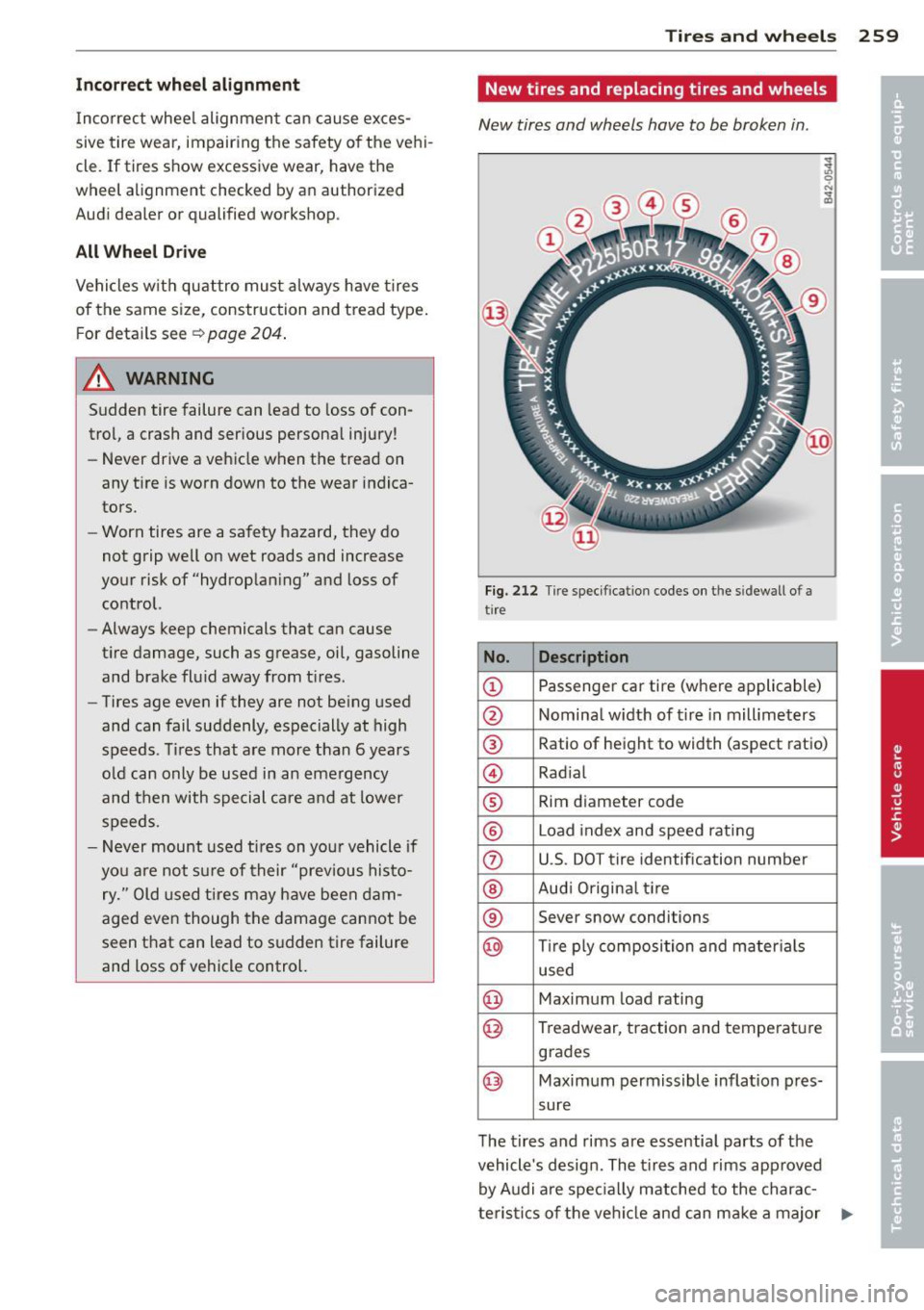
Fig. 212 Tire specificat ion codes on t he s idewall o f a
tire
No. Description
@ Passenger car tire (where applicable)
@ Nominal width of tire in millimeters
@ Ratio of height to width (aspect ratio)
© Radial
® Rim diameter code
® Load index and speed rating
0 U.S. DOT tire identification number
® Audi Original tire
® Sever snow conditions
@ Tire ply composition and materials
used
@ Maximum load rating
@ Treadwear, traction and temperature
grades
@ Maximum permissible inflation pres-
sure
The tires and rims are essential parts of the
vehicle's design . The tires and rims approved
by Audi are specialty matched to the charac
teristics of the vehicle and can make a major .,.
Page 262 of 314
260 Tire s and wheel s
contribution to good road ho lding and safe
handling when in good condition and properly
inflated
¢ ,& .
We recommend that all work on tires and
wheels be perfo rmed by an authorized Audi
dea ler. They are familiar with recommended
proced ures and have the necessary spec ial
too ls and spare parts as well as the proper fa
cilities for disposing of the old tires.
Authorized Audi dealers have the necessary information about techn ica l requ irements for
installing or changing tires and r ims.
R eplacing t ires and whe els
Tires sho uld be rep laced at least in pairs and
not individua lly (for examp le both front tires
or both rear tires together).
Be sure to read and heed the information to
the tire pressure monitoring system*
¢page 266.
A lways buy rep lacement radial tires that have
the same specifications as the tires approved
for your vehicle by Audi. Replacement t ires
must always have the same load rating speci
fication as the original equipment or approved
optional tires listed in the table
¢ page 252.
Aud i-approved specification ti res are specially
matched to your vehicle and its load limits,
and can contribute to the important road ho ld
ing, driving characteristics, and safety of the
vehicle. The table
(¢page 252) lists spec ifica
tions of the tires approved for the Audi mod
els covered by your Owner's Literature .
The tire pressure labe l located on driver's side
B-pillar
( ¢ page 252, fig. 209) lists the speci
f ications of the orig inal equipment tires in
stalled on your veh icle at the time it was man
ufactured.
Federal law requires t ire manufacturers to
p lace standard ized information on the s ide
wall of all tires
¢ fig. 212 . This information
i dent ifies and describes the fundamental
characterist ics, the quality grade of the tire
and a lso provides a tire ident ificat ion number f
or sa fety standard ce rtification and in case of
a reca ll.
Tire specifications
Knowledge of ti re specificat ions makes it eas
ier to choose the correct tires. Radial ti res
have the tire specifications marked on the
sidewa ll, for examp le:
255 /45 R 19 104 H
This co nta ins the following information:
P Indicates the t ire is for passenger cars
(where app licab le)
2 55 Nominal tire width in mm of the tire
from sidewall edge to sidewa ll edge. In
general, the larger the number, the wider
the tire
45 Height/w idth ratio in percent (aspect ra-
t io)
R Tire construction: Radial
19 Rim diameter code (in inches)
104 Load rating code
H Speed rat ing letter code
X L (or "xl", "EXTRA LOAD" or "RF") Indicates
t h at the t ire is a "Reinforced" or an "E xt ra
Load " tir e
M+S (or "M/S") Indicates that the tire has
some mud and snow capabi lity
The tires could also have the information of
direction of rotatio n ¢
page 248 .
Tire manufacturing date
The manufact uring date is also indicated on
the tire sidewall (possibly on ly on the
inner
s ide of the wheel) :
"DOT ... 2213 ... " means, for example, the tire
was produced in the 22nd week of 2013.
Speed rating (letter cod e)
The speed rating letter code on the whee ls in
dicates the maximum permissible road speeds
¢ .&. in Winter tires on page 264.
P up to 93 mp h (150 km/h)
Q up to 99 mph (158 km/h)
R up to 106 mph (170 km/h)
S up to 110 mph (180 km/h)
Page 264 of 314
26 2 T ire s and wheel s
Driving with different tires reduces vehi
cle handling and can lead to a loss of
co ntrol.
- I f the spare tire is not the same as the
t ires that are mounted on the veh icle -
for example with winter tires - only use
the spare tire for a short period of time
and dr ive with extra care . Refit the nor
ma l road wheel as soon as safely possi
ble.
- Never drive faste r than the maximum
speed for which the tires on your veh icle
are rated because ti res that a re driven
faster than their rated speed can fail
sudden ly .
- Overloading t ires cause heat build- up,
sudden tire failure, including a blowout
and sudden deflation and loss of control.
- T emperature grades app ly to tires that
are properly inflated and not over o r un
derinflated .
- For technical reasons it is not a lways
possible to use wheels from other
vehicles -in some cases not even wheels
from the same vehicle model.
- If you insta ll wheel trim discs on the ve
hicle whee ls, make sure that the air f low
to the brakes is not blocked. Reduced air
flow to the brakes can them to overheat, increasing stopping distances and caus
ing a collision .
- Run flat t ires may on ly be used on
vehicles that were equ ipped w ith them
at the facto ry . The vehicle must have a
chassis des igned for run f lat t ires . Incor
rect use of run flat tires can lead to vehi
cle damage or acc idents. Check with an
au thorized Aud i dealer or ti re specia list
to see if your vehicle can be equipped
with run f lat tires. If run flat tires are
used, they must be installed on all four
wheels . Mix ing tire types is not permit
ted .
(D Note
-For technica l reasons, it is not generally
possib le to use the whee l rims from oth- er veh
icles. This can hold true for wheels
of the same vehicle type.
- If the spare tire is d iffe rent from the
tires that yo u have mounted on your ve
hicle (for example winter tires o r wide
profi le tires), then use the spare tire for a
short period of time only and drive w ith
extra care. Replace the flat tire w ith the
tire matching the others on your vehicle as soon as possible .
- Never drive without the valve stem cap .
T he valves could get damaged .
® For the sake of the environment
Dispose of o ld tires in accordance with the
l ocal requirements.
Uniform tire quality grading
- Tread wear
- Traction AA A B C
- Temperature ABC
Quality grades can be found where applicab le
on the t ire s ide wall between tread shou lder
and maximum section width
c> page 259,
fig. 212 .
For example : Tread wear 200, Traction AA,
Temperature A.
All passenger ca r tires must conform to Feder
al Safety Requirements in addition to these
grades.
Tread wear
T he tread wear grade is a comparative rating
based on the wear rate of the t ire when tested
u nder contro lled conditions o n a specified
government test course .
For example, a tire graded 1S0 would wear
one and o ne ha lf ( 11/2) times as well on the
gover nment course as a t ire g raded 100 .
The relative performance of tires depends upon the actual conditions of their use, how
ever, and may depa rt s ignificantly from the
norm due to va ria tions in d riving hab its, se rv
ice practices and differences in road character-
istics and climate.
ll-
Page 265 of 314
Traction
The traction grades, from highest to lowest,
a re AA, A, Band
C. Those grades represent the
tire's ability to stop on wet pavement as
measured under controlled conditions on
specified government test surfaces of asphalt
and concrete . A tire marked C may have poor
traction performance¢ .&..
Temp eratu re
The temperature grades are A (the highest),
B, and
C, representing the tire 's resistance to
the generat ion of heat and its ability to dissi
pate heat when tested under controlled condi
tions on a specified indoor laboratory test
wheel.
Sustained high temperature can cause the
material of the tire to degenerate and reduce
tire life, and excessive temperature can lead
to sudden tire failu re ¢ .&. .
The grade C corresponds to a level of perform
ance which all passenger car tires m ust meet
u nder the Federa l Motor Ve hicle Safety Stand
ard No.
1 09. Grades Band A represent higher
l eve ls of pe rformance on the laboratory test
wheel than the m inimum required by law.
_& WARNING
Th e traction grade assigned to this tire is
based on stra ight-ahead b raking t raction
tests, and does not include acceleration,
cornering , hydrop laning or peak traction
character istics.
A WARNING
The temperature grade for this t ire is es
tablished for a t ire that is properly inflated
and not overloaded. Excessive speed, un
derinflation, or excessive loading, either
separate ly or in combination, can cause
heat buildup and possibl e tire fa ilu re.
-
Tire s an d wheel s 263
Winter tires
Winter tires can improve vehicle handling on
snow and ice . At temperatures below 45 °F
(7 °C) we recommend changing to winter
tires.
In some heavy snow areas, local governments
may require true w inter o r "snow" tir es, those
with very deeply cut t read. These tires should
o nl y be used in pairs and be installed o n all
f o ur wheels . Make sure you p urchase snow
ti res that are the same size and cons truc tion
type as the other tires on yo ur vehicle .
I f your veh icle is eq uipped w ith all-whee l
drive *, t his w ill improve trac tion durin g w in ter
driv ing, even wi th the s tanda rd tires. Howev
er, we strongly recommend that you always
equip all four wheels on your veh icle w ith cor
rect ly fitted winter tires or all-season t ires,
when winter road condit ions are expected.
This also improves the veh icle 's b rak ing per
fo rmance and reduces stoppi ng d ista nces .
Summer tires provide less grip on ice and
snow.
Winter tires (snow tires) must always be fitted
o n all fo ur whee ls .
As k your au thori zed A udi d ealer or qualified
workshop for permit ted
winter tire size s. Use
o nl y radial winter ti res .
Win ter tires lose their effec tiveness whe n the
tread is worn down to a depth o f
0.15 7 inch
(4 mm) .
Only d rive w it h w inte r tir es under w inte r con
di tions. S umme r tir es handle bette r whe n
t h e re is no s now o r ice on the ro ad s an d the
temperature is above 45 ° F (7 °C) .
I f you have a flat t ire, see notes on spare
whee l
¢page 259.
Please a lways remember that winter tires may
have a lowe r sp eed rating than the tires o rig i
nally i nstalled on your veh icle at t he time it
was ma nufactu red. Please see ¢
page 260,
Speed ra ting (letter code)
for a lis ting o f th e
speed ra ting lette r codes and the max imum
speed at which the tires can be driven .
111>-
•
•