height AUDI S8 2014 User Guide
[x] Cancel search | Manufacturer: AUDI, Model Year: 2014, Model line: S8, Model: AUDI S8 2014Pages: 314, PDF Size: 78.47 MB
Page 170 of 314
168 Airbag system
and safety belts with pretensioners are
scrapped, al l applicable laws and regula·
tions must be observed. Your authorized
Audi dea ler is familiar with these require·
ments and we recommend that you have
your dealer perform this service for you .
Other things that can affect Advanced
Airbag performance
Changing the vehicle's suspension system can
change the way that the Advanced Airbag Sys
tem performs in a crash. For example, using
tire-rim combinations not approved by Audi, lowering the vehicle, chang ing the stiffness of
the suspension, including the spring s, suspen
sion struts, shock absorbers etc. can change
the forces that are measured by the a irbag
sensors and sent to the electronic control
unit . Some suspension changes can, for exam
ple, increase the force levels measured by the
sensors and make the airbag system deploy in
crashes in which it would not deploy if the
changes had not been made. Other kinds of
changes may reduce the force levels meas
ured by the sensors and prevent the airbag
from deploying when it should.
The sensors in the safety belt buckle for the
driver and front passenger seat tell the elec
tronic control module if the safety belt is
latched or not. If the safety belt is being used,
the front airbag will deploy at a slightly high
er rate of vehicle deceleration than if the safe
ty belt is not being used . Therefore, in a par
ticular collision, it is possible that an airbag
will not deploy at a seating position where the
safety belt is being used but will inflate at the
position where the safety belt is not being
used . It is important that nothing interfere
with the safety belt buckles so that the sen
sors can send the correct information about
safety belt use to the electronic control unit.
A WARNING
Changing the vehicle's suspension includ
ing use of unapproved tire-rim combina
tions can change Advanced Airbag per-formance and increase the risk of serious
personal injury in a crash.
- Never install suspension components
that do not have the same performance
characteristics as the components origi nally installed on your vehicle.
- Never use tire-rim combinations that
have not been approved by Audi.
A WARNING
--
Items stored between the safety belt buckle and the center console can cause
the sensors in the buckle to send the
wrong information to the e lectronic con
trol module and prevent the Advanced Air
bag System from working properly.
- Always make sure that nothing can inter
fere with the safety belt buckles and that
they are not obstructed .
Knee airbags
Description of knee airbags
The knee airbag system con provide supple
mental protection to properly restrained
front seat occupants.
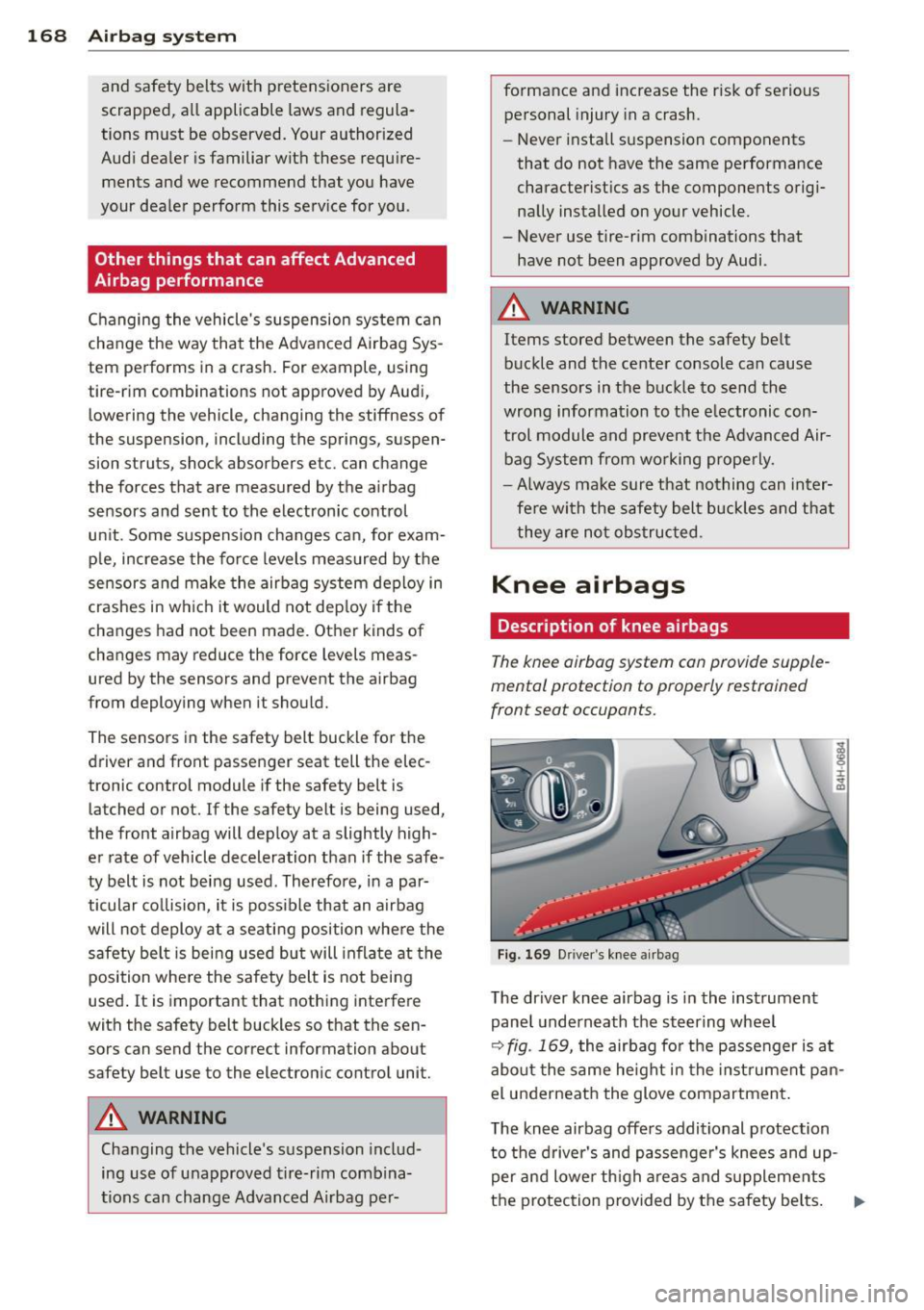
Fig. 169 Driver 's knee airbag
The driver knee airbag is in the instrument
panel underneath the steering wheel
¢ fig . 169, the airbag for the passenger is at
about the same height in the instrument pan
el underneath the glove compartment.
The knee airbag offers additional protection
to the driver's and passenger's knees and up
per and lowe r th igh areas and supplements
the protection provided by the safety belts. ..,.
Page 187 of 314
to the backrest on the vehicle seat. Ad
just the rear seat head restraint if it is
difficult to install the child seat with the
head restraint in place
c::> page 139. Driv
ing with head restraints that are not
properly adjusted increases the risk of
serious or fatal neck injury dramatically.
- Always read and heed all WARNINGS
whenever using a child restrained in ave
hicle is being used
c::> page 145, Safety
belts,
c::> page 153, Airbag system and
c::> page 177, Important things to know.
_& WARNING
If exceptional circumstances require the
use of a forward-facing child restraint on
the front passenger's seat, the child's safe
ty and well-being require that the follow
ing special precautions be taken:
- Make sure the forward-facing seat has
been designed and certified by its manu
facturer for use on a front seat with a
passenger front and side airbag.
- Always follow the manufacturer's in
struct ions provided with the child safety
seat or infant carrier.
- Always move the front passenger seat in
to the rearmost position of the passen
ger seat's fore and aft adjustment range,
and as far away from the airbag as possi ble before installing the child restraint.
-A lways make sure that nothing prevents
the front passenger's seat from being
moved to the rearmost position in its
fore and aft adjustment range.
- Always make sure the backrest is in an
upright position.
- Make sure that the
PASSENGER AIR BAG
OFF
light comes on and stays on all the
time whenever the ignition is switched
on.
- If the light does not stay on, perform the
checks
c::> page 164, Monitoring the Ad
vanced Airbag System.
- Take the child restraint off the front pas
senger seat and install it properly at one
of the rear seat positions if the
PASS EN-
Child Safety 185
GER AIR BAG OFF light does not stay on
whenever the ignition is switched on.
Booster seats and safety belts
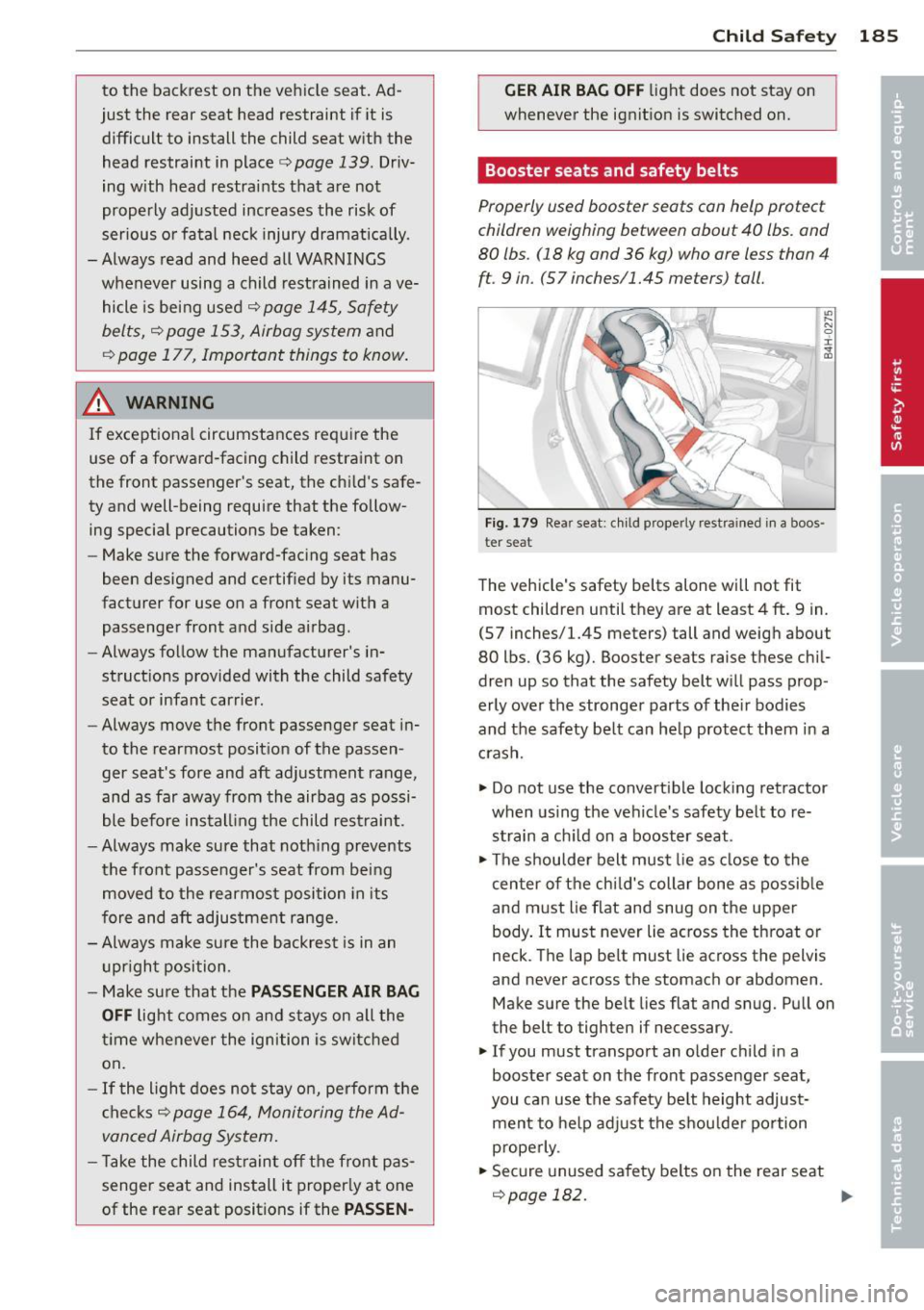
Properly used booster seats con help protect
children weighing between about 40 lbs. and
80 lbs. (18 kg and 36 kg) who ore less than 4
ft. 9 in. (57 inches/1.45 meters) toll.
l!! N 0 ± i,l;
Fig. 179 Rear seat: c hild properly restrained in a boos
ter seat
The vehicle's safety belts alone will not fit
most children until they are at least 4
ft. 9 in.
(57 inches/1.45 meters) tall and weigh about
80 lbs. (36 kg). Booster seats raise these chil
dren up so that the safety belt will pass prop
erly over the stronger parts of their bodies
and the safety belt can help protect them in a
crash.
.. Do not use the convertible locking retractor
when using the vehicle's safety belt to re strain a child on a booster seat.
.. The shoulder belt must lie as close to the
center of the child's collar bone as possible
and must lie flat and snug on the upper
body.
It must never lie across the throat or
neck. The lap belt must lie across the pelvis
and never across the stomach or abdomen.
Make sure the belt lies flat and snug . Pull on
the belt to tighten if necessary .
.. If you must transport an older child in a
booster seat on the front passenger seat,
you can use the safety belt height adjust ment to help adjust the shoulder portion
properly.
.. Secure unused safety belts on the rear seat
c::>poge 182. ...
Page 195 of 314
-Never mount more than one child re
straint to a sing le tether or to a lower an
chorage point. Attaching two child re
straints to a single anchorage point can cause the anchorage to fail and cause se
rious persona l injury in a crash.
(D Note
- Remove the guidance fixtures before
fo lding the rear seatback to prevent
damag ing the seat cushion .
- To attach the child restraint secure ly, the
seat must be moved to the farthest rear pos ition, the seat height set to the low
est posit ion and the head restraint must
be adjusted to the vertical position
¢page 61.
-If you leave the guidance fixtu res instal
l ed for seve ral days, they could leave a
mark on the upholstery on the seat cush
i on and backrest in the area that the
guidance fixtures were insta lled . The up
ho lstery would also be permanently
stretched around the guidance fixtures.
This applies especially to leather seats.
Installing a child restraint with LATCH
lower anchorages
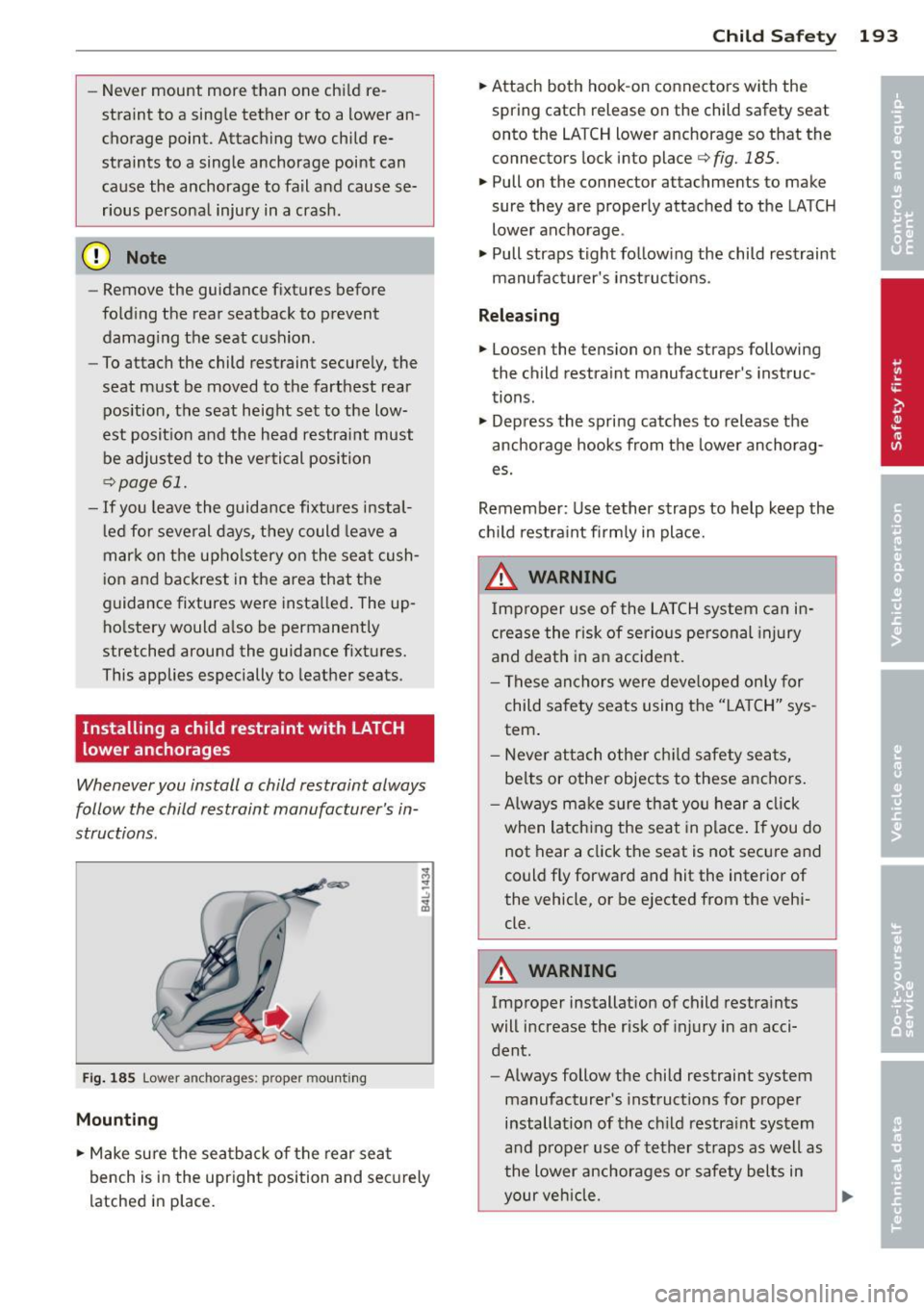
Whenever you install a child restraint always
follow the child restraint manufacturer's in
structions.
Fig . 18 5 Lower anchorages: proper mounting
Mounting
.,. Make su re the seatback of the rear seat
bench is in the upright position and sec urely
latched in place.
Child S afety 193
.,. Attach both hook -on connectors with the
spring catch release on the child safety seat
onto the LATCH lower anchorage so that the
connectors lock into place¢
fig. 185.
.,. Pull on the connector attachments to make
sure they are proper ly attached to the LATCH
lower anchorage .
.,. Pull straps tight fo llow ing the child restraint
manufac ture r's instruct ions .
Releasing
.,. Loosen the tension on the straps following
the child restra int manufacturer's inst ruc
tions.
.,. Depress the spring catches to release the
anchorage hooks from the lower ancho rag
es.
Remember: Use tether straps to help keep the
c hi ld restra int firmly in place.
.&, WARNING
I mproper use of the LATCH system can i n
crease the risk of serious pe rsonal injury
and death in a n accide nt.
- These an chors were deve loped on ly for
child safety seats using the " LA T CH" sys
tem .
- Never at tach o ther ch ild safety sea ts,
be lts or o ther objects to these anchors.
- Always ma ke s ure that you hear a click
when latch ing the sea t in place . If you do
not hear a click the seat is not sec ure and
could fly forward and hit the interior of
the vehicle, or be e jected from the vehi
cle.
A WARNING
Improper installat ion of child restra ints
will increase the risk of injury in an acci
dent.
- Always follow the child restraint system
manufacturer's instruct ions for proper
installation of the ch ild restra int system
and p roper use of tether straps as well as
the lower anchorages or safety belts in
your veh icle.
~
Page 196 of 314
194 Child Safety
-Always read and heed the important in
formation and WARNINGS about child
safety and the installation of child re
straint systems ~
page 177, Child Safe
ty.
d) Note
On vehicles with power adjustable rear
seats* some criteria must be observed
when attaching the child restraint using
the
LATCH system:
- To attach the child restraint securely, the
seat must be moved to the farthest rear
position, the seat height set to the low
est position and the head restraint must be adjusted to the vertical position
~ page 61.
-If a child safety seat is attached to one of
the rear seats, this seat must not be ad
justed using the power controls under
any circumstances . The
Entry assistance
for this seat must a lso be deactivated in
the MMI
r¢ page 64. The child safety seat
as well as the rear seat can be damaged by the adjustment process.
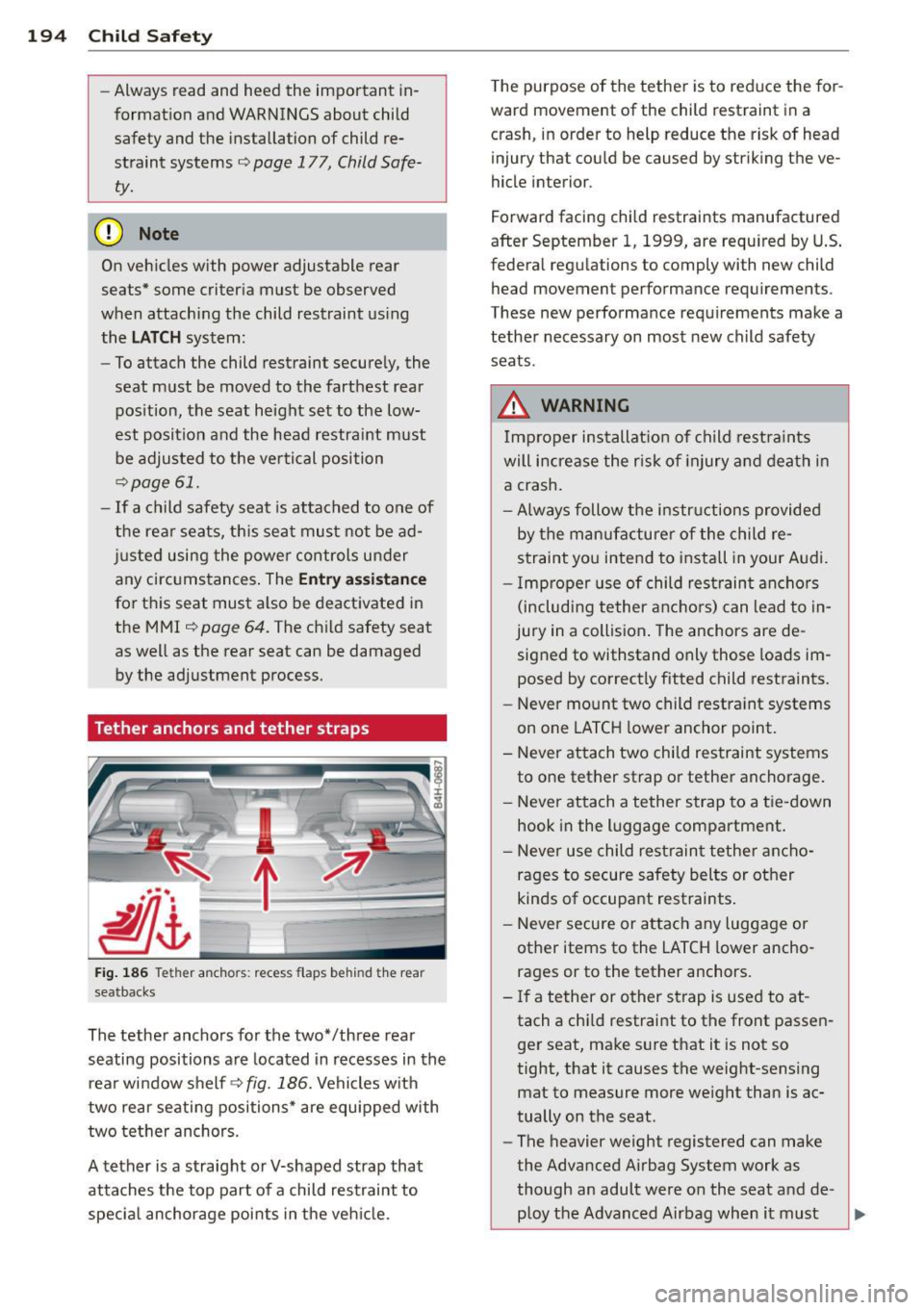
Tether anchors and tether straps
Fig. 186 Tet her ancho rs: r ece ss fla ps b ehin d th e re ar
sea tback s
The tether anchors for the two* /three rear
seating positions are located in recesses in the
rear window shelf~
fig. 186. Vehicles with
two rear seating positions* are equipped with two tether anchors .
A tether is a straight or V-shaped strap that attaches the top part of a child restraint to
special anchorage points in the vehicle. The
purpose of the tether is to reduce the for
ward movement of the child restraint in a crash, in order to help reduce the risk of head
injury that could be caused by st riking the ve
hicle in ter ior.
Forwa rd facing child restra ints manufactured
after September 1 , 1999, are required by U.S .
federal regulations to comply with new child
head movement performance requirements.
These new performance requirements make a
tether necessary on most new child safety
seats .
_&. WARNING
Improper installation of child restraints
will increase the risk of injury and death in
a crash.
- Always follow the instructions provided
by the manufacturer of the child re
straint you intend to install in your Audi.
- Improper use of child restraint anchors
(including tether anchors) can lead to in
jury in a collision. The anchors are de
signed to withstand only those loads im
posed by correctly fitted child restraints.
- Never mount two child restraint systems
on one LATCH lower anchor point.
- Never attach two child restraint systems to one tether strap or tether anchorage.
- Never attach a tether strap to a tie-down
hook in the luggage compartment.
- Never use child restraint tether ancho
rages to secure safety belts or other
kinds of occupant restraints.
- Never secure or attach any luggage or
other items to the LATCH lower ancho
rages or to the tether anchors.
- If a tether or other strap is used to at
tach a child restraint to the front passen
ger seat, make sure that it is not so
tight, that it causes the weight-sensing mat to measure more weight than is ac
tually on the seat .
- The heavier weight registered can make
the Advanced Airbag System work as though an adult were on the seat and de -
-
ploy the Advanced Airbag when it must ~
Page 215 of 314
Trailer load distribution Be sure the load in the trailer is held securely
in place to prevent it from shifting forward,
backward or sideways.
Never allow a passenger to ride in a trailer
¢ .&. in Driving instructions on page 214.
Engine cooling system
Towing a trailer makes the engine work hard
er . It is important that the cooling system's
performance is up to the additional load .
Make sure that the cooling system has enough
fluid.
Tire pressure
When towing a trailer, inflate the tires of your
vehicle to the cold tire pressure listed under
"Full load" on the label located on the driver's
side B-pillar (visible when the door is open).
Inflate trailer tires to trailer and tire manufac
turers' specifications.
Lights
Check to make sure both vehicle and trailer
lights are working properly.
Safety chains Be sure trailer safety chains are properly con
nected from the trailer to the hitch on the ve
hicle . Leave enough slack in the chains to per
mit turning corners . When you install safety
chains, make sure they will not drag on the
road when you are driving.
The chains should cross under the trailer
tongue to prevent it from dropping in case of
separation from the hitch .
Adjusting the Audi drive select Make sure the vehicle is on a level surface
be
fore
hitching up the trailer and before adjust
ing the tongue weight. The vehicle must be in
auto or comfort driving mode and not raised
¢page 110, ~CD .
Make sure that the vehicle is lowered. In Info
tainment, select:
ICARI function button> low
er control button .
Trailer towing 213
If you must drive under poor road conditions,
you can raise the vehicle
after coupling the
trailer or
after adjusting the tongue weight
¢ page 112.
@ Note
- Changes in temperature or load can af
fect the height of the vehicle.
- Always select auto or comfort mode.
Otherwise, the tongue load specified for
your vehicle will no longer be applicable.
Driving instructions
Driving with a trailer always requires extra
core and consideration.
To obtain the best possible handling of vehicle
and trailer, please note the following:
.,. Do not tow a loaded trailer when your car it
self is not loaded .
.,. Be especially careful when passing other
vehicles.
.,. Observe speed limits.
.,. Do not drive at the maximum permissible
speed .
.,. Always apply brakes early .
.,. Monitor the temperature gauge.
Weight distribution
Towing a loaded trailer with an empty car re
sults in a highly unstable distribution of
weight. If this cannot be avoided, drive at very
low speeds only to avoid the risk of losing
steering control.
A "balanced" rig is easier to operate and con
trol. This means that the tow vehicle should be loaded to the extent possible and permissi
ble, while keeping the trailer as light as possi
ble under the circumstances . Whenever possi
ble , transfer some cargo to the luggage com
partment of the tow vehicle while observing
tongue load requirements and vehicle loading
considerations.
Speed
The higher the speed, the more difficult it be
comes for the driver to control the rig. Do not .,.
•
•
Page 251 of 314
-Never mount used tires on yo ur vehicle if
yo u are not sure of their "previous histo
ry." Old used tires may have been dam
aged even though the damage cannot be
seen that can lead to sudden tire failure
and loss of vehicle control.
- If you notice unusual vibration or if the
vehicle pulls to one side when d riving, al
ways stop as soon as it is safe to do so
and check the wheels and tires for dam
age .
(D Note
Please note that summe r and wi nte r tires
are designed for the cond itions that are
Glossary of tire and loading terminology
Accessory weight means the comb ined weight (in excess of
those sta ndard items which may be rep laced)
of au toma tic transmission, power steer ing ,
power brakes, power windows, power seats,
radio, and heater, to the extent that these
items are availab le as factory-installed equip
ment (whether installed or not) .
Aspect ratio
means the rat io o f the height to the w idth of
the tire in percent . Numbers of 55 or lower in
dicate a low sidewall for improved steering re
sponse and better overa ll handling on dry
pavement .
Bead
means the part of the t ire t hat is made o f
steel wires, wrapped or reinforced by ply cords
and that is shaped to fit the r im.
Bead separation
means a b reakdown of the bond between
components in the bead .
Cord means the strands forming the plies in the
tire.
Tire s an d wheel s 249
typica l in those seasons . Aud i recommends
using winter tires during the winter
months . Low temperatures signif icant ly
dec rease the e lasticity of summer t ires,
which affects tract ion and brak ing ability.
If summer t ires are used i n very co ld tem
peratures, cracks ca n form o n the tread
bars , res ulting in perma nen t tire damage
that can cause loud driving noise and un
bala nced ti re s. Audi i s not respon sible for
th is type of damage .
Cold tire inflation pressure
means the t ire p ress ure recommended by t he
vehicle manufacture r fo r a tire o f a des ignated
s ize t hat has not bee n driven for more than a
coup le o f miles (k ilometers) at low speeds in
the three hour period before the tire press ure
is m easured or adjusted.
Curb weight
me ans the we ight of a motor ve hicle with
st andard equipmen t incl ud ing the max imum
capacity of fuel, oi l, and coolant, air condi
tioning and additional weig ht of optiona l
equipment.
Extra load tire
means a t ire design to oper ate a t higher load s
and at higher inflation pressures than the cor
responding standa rd tire . Extra load tires may
be identified as "XL", "x l", "EXTRA LOAD", o r
"RF" on the sidewal l.
Gross Axle Weight Rating ("GAWR")
me ans the load-ca rry ing capac ity of a single
axle system , measured at the tire -ground in
te rfaces.
Gross Vehicle Weight Rating ( "GVWR ")
mea ns the maximum total loaded we ight of
the ve hicl e. .,..
•
•
Page 261 of 314
Incorrect wheel alignment
Incorrect wheel alignment can cause exces
sive tire wear, impairing the safety of the vehi
cle. If tires show excessive wear, have the
wheel alignment checked by an authorized
Audi dealer or qualified workshop .
All Wheel Drive
Vehicles with quattro must always have tires
of the same size, construction and tread type. For details see ~page 204.
_& WARNING
Sudden tire failure can lead to loss of con
trol, a crash and serious personal injury!
- Never drive a vehicle when the tread on
any tire is worn down to the wear indica
tors.
- Worn tires are a safety hazard, they do
not grip well on wet roads and increase
your risk of "hydroplaning" and loss of
control.
- Always keep chemicals that can cause
tire damage, such as grease, oil, gasoline
and brake fluid away from tires.
- Tires age even if they are not being used
and can fail suddenly, especially at high
speeds . Tires that are more than 6 years
old can only be used in an emergency
and then with special care and at lower
speeds .
- Never mount used tires on your vehicle if
you are not sure of their "previous histo
ry." Old used tires may have been dam
aged even though the damage cannot be
seen that can lead to sudden tire failure
and toss of vehicle control. Tires and wheels 259
New tires and replacing tires and wheels
New tires and wheels have to be broken in
.
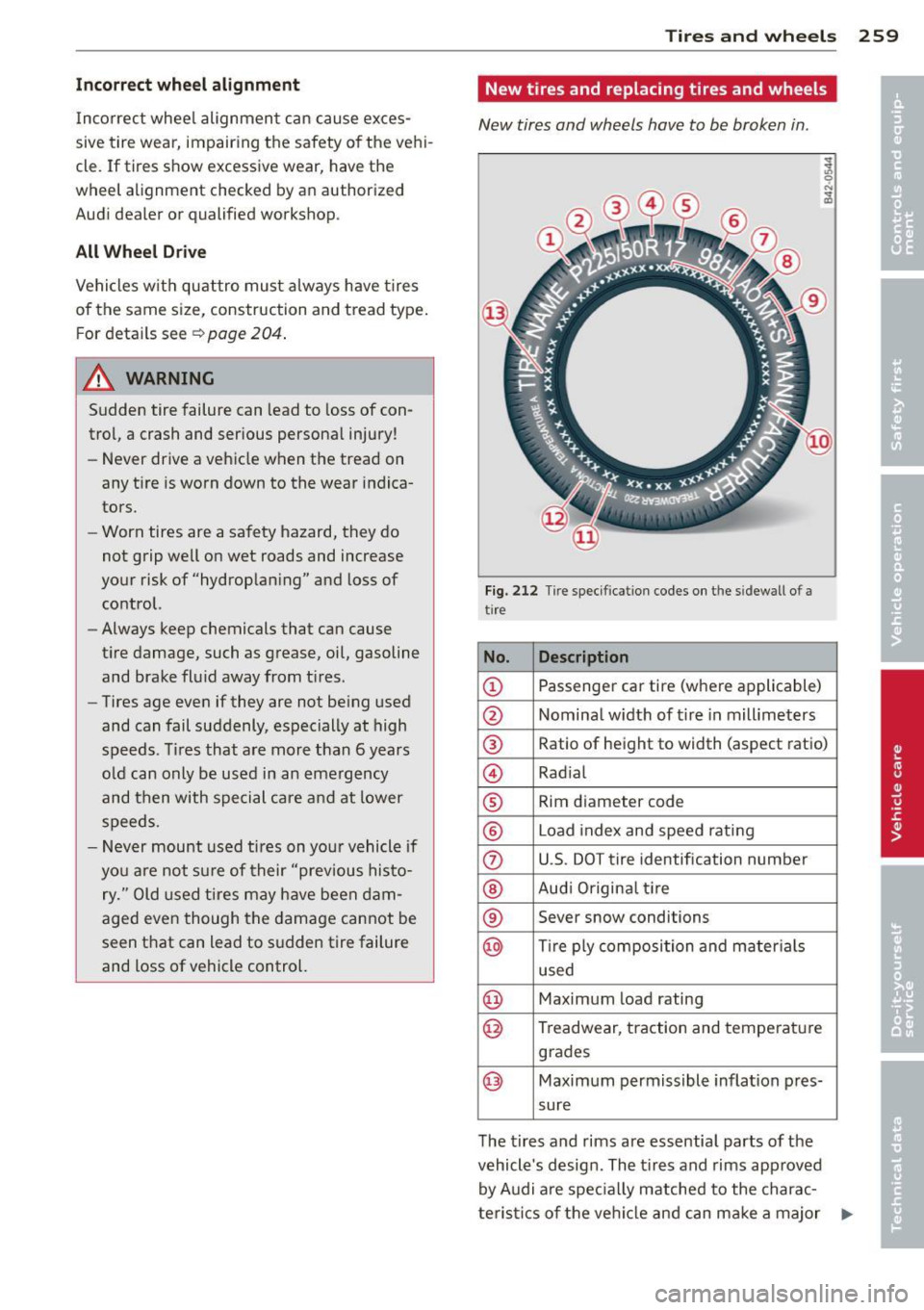
Fig. 212 Tire specificat ion codes on t he s idewall o f a
tire
No. Description
@ Passenger car tire (where applicable)
@ Nominal width of tire in millimeters
@ Ratio of height to width (aspect ratio)
© Radial
® Rim diameter code
® Load index and speed rating
0 U.S. DOT tire identification number
® Audi Original tire
® Sever snow conditions
@ Tire ply composition and materials
used
@ Maximum load rating
@ Treadwear, traction and temperature
grades
@ Maximum permissible inflation pres-
sure
The tires and rims are essential parts of the
vehicle's design . The tires and rims approved
by Audi are specialty matched to the charac
teristics of the vehicle and can make a major .,.
Page 262 of 314
260 Tire s and wheel s
contribution to good road ho lding and safe
handling when in good condition and properly
inflated
¢ ,& .
We recommend that all work on tires and
wheels be perfo rmed by an authorized Audi
dea ler. They are familiar with recommended
proced ures and have the necessary spec ial
too ls and spare parts as well as the proper fa
cilities for disposing of the old tires.
Authorized Audi dealers have the necessary information about techn ica l requ irements for
installing or changing tires and r ims.
R eplacing t ires and whe els
Tires sho uld be rep laced at least in pairs and
not individua lly (for examp le both front tires
or both rear tires together).
Be sure to read and heed the information to
the tire pressure monitoring system*
¢page 266.
A lways buy rep lacement radial tires that have
the same specifications as the tires approved
for your vehicle by Audi. Replacement t ires
must always have the same load rating speci
fication as the original equipment or approved
optional tires listed in the table
¢ page 252.
Aud i-approved specification ti res are specially
matched to your vehicle and its load limits,
and can contribute to the important road ho ld
ing, driving characteristics, and safety of the
vehicle. The table
(¢page 252) lists spec ifica
tions of the tires approved for the Audi mod
els covered by your Owner's Literature .
The tire pressure labe l located on driver's side
B-pillar
( ¢ page 252, fig. 209) lists the speci
f ications of the orig inal equipment tires in
stalled on your veh icle at the time it was man
ufactured.
Federal law requires t ire manufacturers to
p lace standard ized information on the s ide
wall of all tires
¢ fig. 212 . This information
i dent ifies and describes the fundamental
characterist ics, the quality grade of the tire
and a lso provides a tire ident ificat ion number f
or sa fety standard ce rtification and in case of
a reca ll.
Tire specifications
Knowledge of ti re specificat ions makes it eas
ier to choose the correct tires. Radial ti res
have the tire specifications marked on the
sidewa ll, for examp le:
255 /45 R 19 104 H
This co nta ins the following information:
P Indicates the t ire is for passenger cars
(where app licab le)
2 55 Nominal tire width in mm of the tire
from sidewall edge to sidewa ll edge. In
general, the larger the number, the wider
the tire
45 Height/w idth ratio in percent (aspect ra-
t io)
R Tire construction: Radial
19 Rim diameter code (in inches)
104 Load rating code
H Speed rat ing letter code
X L (or "xl", "EXTRA LOAD" or "RF") Indicates
t h at the t ire is a "Reinforced" or an "E xt ra
Load " tir e
M+S (or "M/S") Indicates that the tire has
some mud and snow capabi lity
The tires could also have the information of
direction of rotatio n ¢
page 248 .
Tire manufacturing date
The manufact uring date is also indicated on
the tire sidewall (possibly on ly on the
inner
s ide of the wheel) :
"DOT ... 2213 ... " means, for example, the tire
was produced in the 22nd week of 2013.
Speed rating (letter cod e)
The speed rating letter code on the whee ls in
dicates the maximum permissible road speeds
¢ .&. in Winter tires on page 264.
P up to 93 mp h (150 km/h)
Q up to 99 mph (158 km/h)
R up to 106 mph (170 km/h)
S up to 110 mph (180 km/h)
Page 267 of 314

chains because the vehicle will be ex
tremely low. If you do drive with snow
chains on while the vehicle is at this lev
el, the snow chains might severe ly dam
age the wheelhouse and other parts of
the veh icle .
@ Tips
Where snow cha ins are mandatory oncer
tain roads, this normally also applies to
veh icles with All Wheel Drive.
Wheel bolts
Wheel bolts mu st always be tigh tened to the
correc t torque .
The design of whee l bolts is matched to the
factory in sta lled r ims. If different rims are fit
ted, the correct wheel bolts with the right
length and correctly shaped bolt heads must
be used . This ensures that wheels are f itted
secure ly and that the brake system f unctions
correctly .
In certain circumstances, you may not use
wheel bolts from a d iffe rent vehicle -even if it
i s the same mode l
¢page 294.
A WARNING
Imprope rly tig hte ned or maintained whee l
bolts can be come loose causin g loss of
contro l, a co llision and serious persona l in
jury .
- Alw ays keep the w heel bolts and the
th reads in the wheel hubs clea n so the
wheel bolts can turn easily and be prop
er ly tightened .
- Never grease or oil the wheel bo lts and
the threads in the w heel h ubs. They can
become loose while driving if greased or
o iled, even if tightened to the specif ied
torque.
- Only use wheel bolts that belong to the rim being installed.
- Never use different whee ls bolts on your
vehicle .
- Always maintain the co rrect tightening
torq ue for the wheel bo lts to reduce the
Tire s an d wheel s 265
risk of a wheel loss. If the tighte ning tor
que of t he wheel bolts is too low, they
can loosen and come out when the vehi
cle is mov ing . If the tighte ning torque is
too h igh, the wheel bol ts and threads
can be damaged and the whee l can be
come loose.
(I) Note
The specified torque for the whee l bolts is
90 ft lb ( 120 Nm) with a tole ranc e of± 7,4
ft lb(± 10 Nm). Torq ue whee l bolts diago
nally. Afte r cha nging a whee l, the torq ue
must be checked as soon as possible wi th a
torque w rench -prefe rably by an au thor
i z ed Audi dealer or qualif ied workshop .
Low aspect ratio tires
Your Audi is facto ry-eq uipped with low aspect
ratio tires. These tires have been thoro ughly
tested and been se lected specifically for your
model for their superb performance , road fee l
and handling under a variety of driving cond i
tions . Ask your authorized Audi dealer for
more details.
The low aspect ratio of these t ires is ind icated
by a numeral of
55 or less in the tire's size
designation . The numera l rep resents the ratio
of the t ire's sidewall height in relation to its
t read width ex pressed in perce ntage. Conven
tion al tires have a he igh t/w idth ratio of 60 or
more.
The performance of low-aspe ct-ratio tire s is
particularly sensitiv e to improper infla tion
pres sure. It is therefore important that l ow
a spect ratio tires are inflated to the specified
pre ssure and that the inflation pressure is
regularly checked and maintained. Tire pres·
sures should be checked at least once a
month and always before a long trip
¢ page 254 , Checking tire pressure .
What you can do to avoid tire and rim
damage
Low aspect ratio tires can be damaged more
easily by impact w it h potholes , curbs, gul lies ..,.
•
•
Page 277 of 314
hold on to the car to keep your ba lance
and take care not to slip.
Raising the vehicle
Th e ve hicl e must be li~ed with the jack first
before the wheel can be removed.
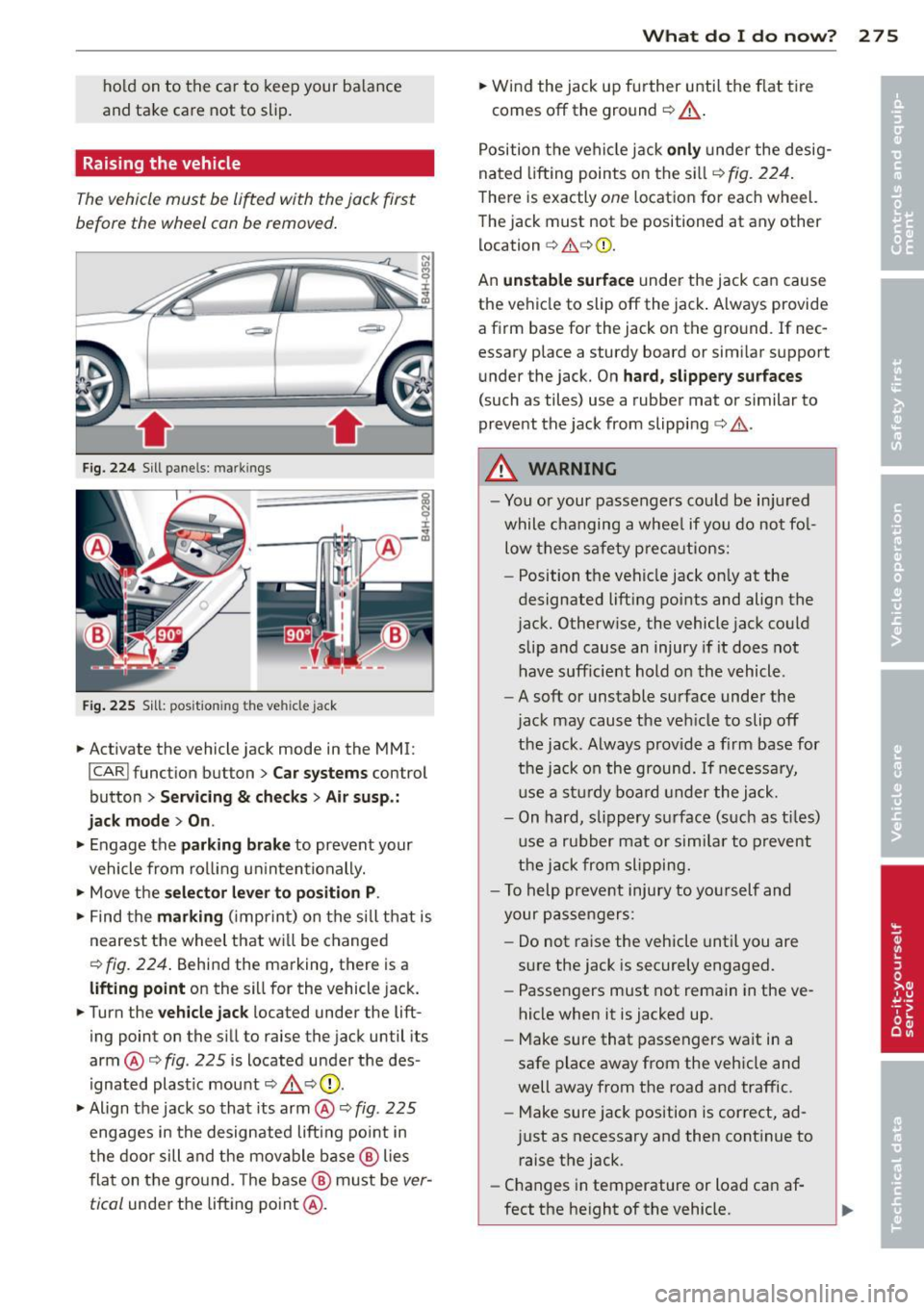
F ig. 224 Sill p anels : m arkin gs
Fig. 225 Sill: posi tioning th e vehicle jack
.. Activate the vehicle jack mode in the MMI:
I CAR I function button > Car sy stem s control
button
> Se rvicing & ch ecks > Air susp .:
jack mod e
> On.
.. Engage the par kin g brake to prevent your
vehicle from roll ing un intentionally.
.,. Move the
se lector lev er to p osition P .
.. Find the marking (imprin t) on the sill that is
nearest the wheel that w ill be changed
c::> fig. 224 . Behind the marking, there is a
lifting point on the si ll for the vehicle jack.
.. Turn the
veh icle jack located under the lift
ing point on the sill to raise the jack until its
arm @i:>
fig. 225 is located under the des
ignated plast ic mount
c::> _&.. c::>(D .
.. Align the jack so that its arm @ c::> fig. 225
engages in the designated lifting point in
the door sill and the movable base @ lies
flat on the ground. The base @ must be
ver
tical
under the lifting point @.
What do I d o now ? 275
.. Wind the jack up fu rther unti l the flat tire
comes off the ground
c::> _A .
Position the veh icle jack o nly under the desig
nated lifting points on the si ll
¢fig. 224.
There is exactly one locat ion for eac h wheel.
The jack must not be positioned at any other location
c::, .&, i:>0 .
An un stable surface under the jack can cause
the ve hicle to slip off the jack . Always provide
a firm base for the jack on the ground . If nec
essary place a sturdy board or simi lar s upport
under the jack. On
hard , sl ipper y su rf a ces
(such as tiles) use a rubber mat or similar to
prevent the jack from slipping
c::> .&, .
A WARNING
-You or your passengers co uld be in jured
while changing a wheel if you do not fo l
low these safety pre cautions:
- Position the vehicle jack on ly at the
designated lifting points and align the
jack. Otherwise, the vehicle jack could s lip a nd cause an injury if it does not
have sufficient hold o n the vehicle.
- A soft or unstable surface under the
jack may cause the ve hicle to slip off
the jack . Always provide a firm base for
the jack on the ground. If necessa ry,
use a stu rdy board under the jack.
- On hard, slippery su rface (such as t iles)
use a rubber mat or simi la r to prevent
the jack from slipping.
- To help prevent injury to yo urself and
your passengers:
- Do not raise the vehicle until you are
sure the jack is securely engaged.
- Passengers must not remain in the ve
hicle when it is jacked up.
- Make sure that passengers wait in a
safe place away from the veh icle and
well away from the road and traffic .
- Make sure jack position is correct, ad
j ust as necessary and then cont inue to
raise the jack .
- Changes in temperature or load can af
fect the height of the vehicle.