sport mode AUDI S8 2014 User Guide
[x] Cancel search | Manufacturer: AUDI, Model Year: 2014, Model line: S8, Model: AUDI S8 2014Pages: 314, PDF Size: 78.47 MB
Page 182 of 314
180 Child Saf ety
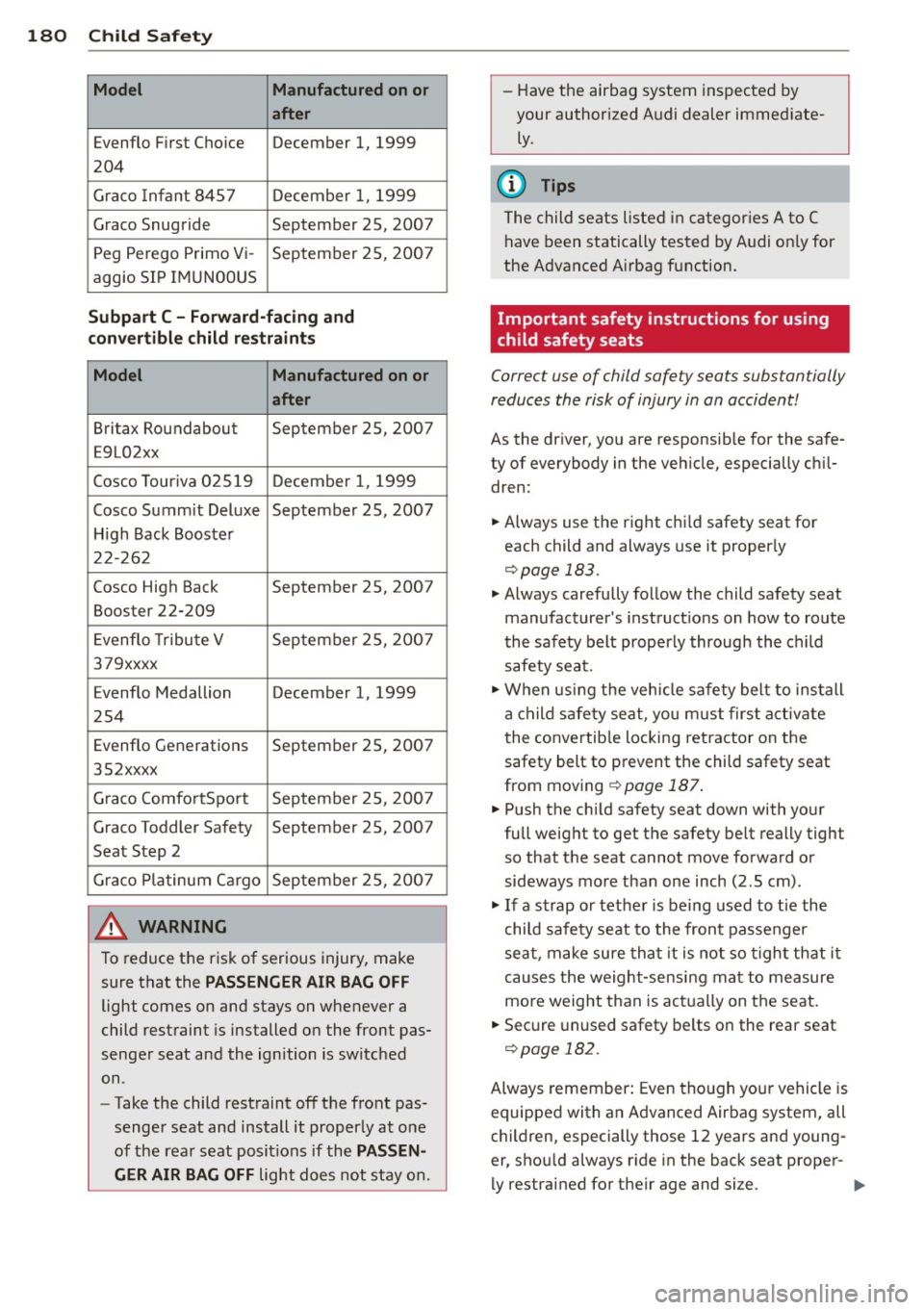
Model Manufactured on or
after
Evenflo F irst Cho ice December 1, 1999
204
Graco Infant 8457 December 1, 1999
Graco Snugride September 25, 2007
Peg Perego Primo Vi -September 25, 200 7
aggio SIP IMUN00US
Subpart C - Forward-facin g and
con vert ible c hild re stra int s
Model Manuf actured on or
after
Britax Roundabout September 25, 2007
E9L02xx
Cosco Touriva 02519 December 1, 1999
Cosco Summit Deluxe September 25, 2007
High Back Booster
22-262
Cosco High Back September 25, 2007 Booster 22-209
Evenflo Tribute V September 25, 2007
379xxxx
Evenflo Medallion December 1, 1999
254
Evenflo Generations September 25, 2007
352xxxx
Graco Comfo rtSport September 25, 2007
Graco Toddler Safety September 25, 2007
Seat Step 2
Graco P latinum Ca rgo September 25, 2007
A WARNING
T o reduce the risk of serious injury, make
sure that the
PASSENGER A IR BAG OFF
light comes on and stays on whenever a
child restraint is installed on the front pas
senger seat and the ignition is switched
on.
- Take the child restraint off the front pas
senger seat and install it properly at one
of the rear seat positions if the
PASSEN
GER AIR BAG OFF
light does not stay on. -
Have the airbag system inspected by
your author ized Audi dealer immed iate
ly.
@ Tips
The child seats listed in categories A to C have been statically tested by Audi on ly for
the Advanced A irbag function.
Important safety instructions for using
child safety seats
Correct use of child safety seats substantially
reduces the risk of injury in an accident!
As the driver, you are responsib le for the safe
ty of everybody in the veh icle, especially ch il
dren:
.. Always use the right chi ld safety seat for
each child and always use it properly
¢page 183.
.. Always carefully follow the child safety seat
manufacturer's instruct ions on how to route
the safety belt properly through the ch ild
safety seat .
.. When using the vehicle safety belt to install
a child safety seat, you m ust first a ctivate
the convertib le locking retractor on the
safety belt to prevent the child safety seat
from moving
¢ page 187.
.. Push the ch ild safety seat down with your
full weight to get the safety belt really tight so that the seat cannot move forward or
sideways more than one inch (2 .5 cm) .
.,. If a strap or tether is be ing used to tie the
child safety seat to the front passenger
seat , m ake sure tha t it is not so tight that i t
causes the weight-sensing ma t to measure
more weight than is act ually on the seat.
.. Sec ure unused safety belts on the rear seat
¢ page 182.
Always remember : Even though your vehicle is
equipped with an Advanced Airbag system, all
children, especially those 12 years and young
er, shou ld always r ide in the back seat proper-
ly restrained for their age and size . .,.
Page 200 of 314

198 Audi pre sense
The sensors can be displaced by impacts or
damage to the bumper, whee l housing and
underbody. This can affect the function of
the Audi pre sense system. Have your au
thorized Audi dealer check to make sure
that the system is working properly .
@ Tips
-Certain Audi pre sense functions are not
available when ASR is sw itched off (sport
mode) or w hen driv ing in reverse.
- The Audi pre sense functions may not be
available if there is a malfunction in the
ESC system or the airbag control mod
ule.
- The Audi pre sense front/plus f unctions
are not available if the re is a ma lfunction
i n the adapt ive cru ise control* system
¢page 101.
- The Audi pre sense rear/plus functions
are not available if there is a ma lfunction
i n the Aud i side assis t* system
¢ page 101 .
Page 203 of 314
@ Tips
-ABS and AS R on ly wor k co rrectly when
a ll fo ur wheels are eq uipped w ith identi
ca l tires . Different tire s izes can lead to a
r educt io n in eng ine power.
- You may hear noises when the sys tems
desc ribed are working.
Switching on and off
Intelligent technology 201
- If the ind ica tor li ght DJ o r til1 (U SA
mo dels)/ [!] (Canada models) appea rs,
there may be a malfunc tion
r:::> page 19,
¢page 18.
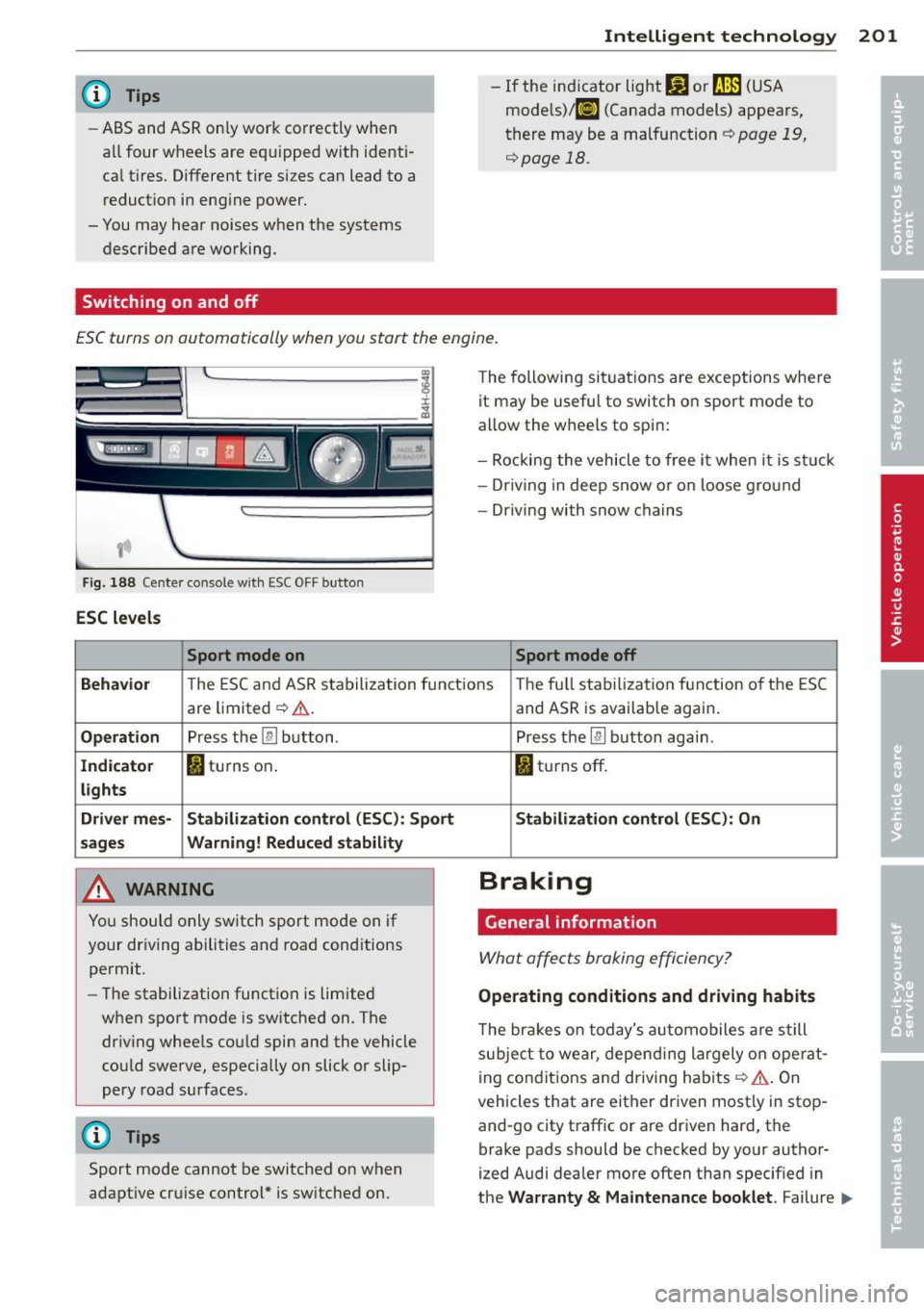
ESC turns on automatically when you start the engine.
Fig . 188 Center co nsole with ESC O FF bu tton
ESC levels
Sport mode on
The following si tua tions are exceptions whe re
it may be usefu l to switch o n sport mo de to
allow the w heels to spi n:
- Rockin g the vehicle to free it when i t is st uck
- Dr iv ing in deep s now o r on loose g ro un d
- Dr iving with snow chains
Sport mode off
Behavior
T he E SC and AS R sta bilization f unct io ns The fu ll sta biliz ati on f uncti on o f the ES C
are limited¢ ,&.
Operation Press the [ru button .
Indicator II turns on .
lights
Driver mes· Stabilization control (ESC): Sport
sages Warning! Reduced stability
A WARNING
Yo u should o nly sw itch sport mo de on i f
your dr iv ing abili ties and road cond itions
permit.
- The stabilization function is limited
when sport mode is sw itched on. The
dr iv ing whee ls co uld spin and the vehicle
cou ld swe rve , especially on slick or slip
pery road surfaces.
(D Tips
Sport mode cannot be switched o n when
adapt ive cr uise c ontrol* is sw itched on.
-
and AS R is availab le again .
Press the
[ru button again .
II tur ns off.
Stabilization control (ESC): On
Braking
General information
What affects braking efficiency?
Operating conditions and driving habits
The bra ke s on today's au to m obiles a re s till
sub ject t o wear, depe nding la rgely o n ope rat
i ng con dit ions and d riving habits¢
A . On
vehicles that are either driven most ly in stop
and-go city traff ic or are driven hard , the
brake pads should be checked by your author
ized Audi dealer more often than specif ied in
t h e
Warranty & Maintenance booklet . Failure .,..
Page 212 of 314

210 Driving and environment
The consumption estimates as published
by ENVIRONMENTAL PROTECTION AGENCY
(EPA) and Transport Canada may not corre
spond to your actual consumption on the
road, which will vary depending upon vehi
cle load and speed, road and weather con
ditions, trip length, etc.
Drive smoothly and keep a lookout
ahead
Vehicles use the most fuel when they are ac
celerating.
• Avoid unnecessary accelerating and braking.
Vehicles use the mo st fuel when they are ac
celerating. If you anticipate what is going to happen next, you will need to brake less and,
thus , accelerate less. Let the vehicle coast
whenever possible -for example when you see
that the next traffic light is red.
Avoid full throttle
Driving at moderate speeds saves fuel and
improves your mileage.
• Try and keep well below your car's maximum
speed .
Accelerating gently reduces fuel consump
tion, engine wear, and does not disturb the
environment .
Fuel consumption, exhaust emissions and en
gine noise increase disproportionately at high
speeds. If you drive at approximately three
quarters of top speed, fuel consumption will
be reduced by one half. Never drive faster
than the posted speed limit and weather con
ditions permit.
Reducing unnecessary idling
Even when your car is just idling it burns up
fuel.
• Shut the engine off when you are not driving
the vehicle. •
Do not warm up the vehicle by letting the
engine run at idle.
The idling phase is automatically reduced for
vehicles with the Start/Stop system. It is effi
cient to switch off the engine in vehicles with
out the Start-Stop-System when stopped at
railroad crossings and long red lights. Turning
the engine off for jus t 30-40 seconds saves
more fuel than is burned by starting the en-
. . gme again.
It takes a long time for the engine to warm up
fully when it is running at idle. However, wear
and noxious emissions are especially high
when the engine is warming up . So you should
drive away as soon as you start the engine and
avoid running at high rpms while the engine is
still warming up.
W Note
Do not leave engine idling unattended af
ter starting . If warning lights should come
on to indicate improper operation, they
would go unheeded. Extended idling also
produces heat, which could result in over
heating or other damage to the vehicle or
other property.
Regular maintenance
A badly tuned engine unnecessarily wastes a lot of fuel.
• Have your vehicle serviced at regular inter-
vals.
By having your vehicle regularly serviced by an
Audi dealer helps to ensure that it runs prop
erly and economically. The condition of your
vehicle not only affects its safety and ability to
hold its value, it also affects
fuel consump
tion.
Check your oil each time you
fill your tank.
The amount of oil used is related to engine
load and speed.
It is normal for the oil consumption of a new
engine to reach its lowest value after a certain
mileage has been driven . ..,.
Page 214 of 314

212 Trailertowing
Trailer towing Driving with a trailer
General information
Your Audi was designed primarily for passen
ger transportation .
If you plan to tow a trai ler, please remember
that the additional load will affect durability,
economy and performance .
Trailer towing not only places more stress on the vehicle, it also calls for more concentra
tion from the driver.
For this reason, always follow the operating
and driving instructions provided and use
common sense.
(D Note
If you are going to tow a trai ler, you must
activate the trailer operation mode
i::> page 212, Operating instructions .
Technical requirements
Trailer hitch
Use a weight-carrying hitch conforming to the
gross trailer weight. The hitch must be suita ble for your vehicle and trailer and must be
mounted securely on the veh icle 's chassis at a
technically sound location . Use only a trailer
hitch with a removable ball mount. A lways
check with the trai le r hitch manufacturer to
make sure that you are using the cor rect
hitch.
Do not use a bumper hitch.
The hitch must be installed in such a way that
it does not interfere with the impact-absorb
ing bumper system. No modifications should
be made to the vehicle exhaust and brake sys
tems. From time to time, check that all hitch
mounting bo lts remain securely fastened.
When you are not towing a trailer, remove the
trailer hitch ball mount. This prevents the
h itch from causing damage should your veh i
cle be struck from behind~ &.
Trailer brakes
If your trailer is equipped with a brak ing sys
tem, check to be sure that it conforms to all
regulations.
T he trailer hydraulic brake system must not be
direc tly connected to the vehicle's hydraulic
brake system .
Safety chains
Always use safety chains between your veh icle
and the tra iler.
Trailer lights
Trailer lights must meet all regulations. Be
sure to check with your Audi dealer for correct
wiring, switches and relays.
Mirrors
If you are unable to see the traffic behind you
using the regular outside mirrors, then you
must install extended mirrors. It is important
that you
always have clear v is ion to the rear .
A WARNING ,~ -
After removing the trailer hitch, do not
store it in your vehicl e. In case of sudden
braking, the hitch could fly forward and in
jure you or your passengers.
Operating instructions
Fig. 189 MMI display : tow ing mode on
Maximum traile r weight
A trai ler for your vehicle is limited to a typical
class 1 or class 2 trailer. .,.
Page 289 of 314
@ Tips
Check carefully to make sure the hook-up
is secure before moving the car up the flat
bed truck ramp .
Vehicle transport
Whenever you hov e your vehicle transported,
be sure to note the following :
(D Note
Mount the tie-down chains/cables over the
running surface (circumference) of the
tires. Never secure the vehicle by the axle,
the suspension struts or the front or rear
towline eye . For technical reasons, the
pressure in the suspension struts may
change du ring the transport and this will
adve rsely affect vehicle handling.
Lifting vehicle
Lifting with workshop hoist and with
floor jack
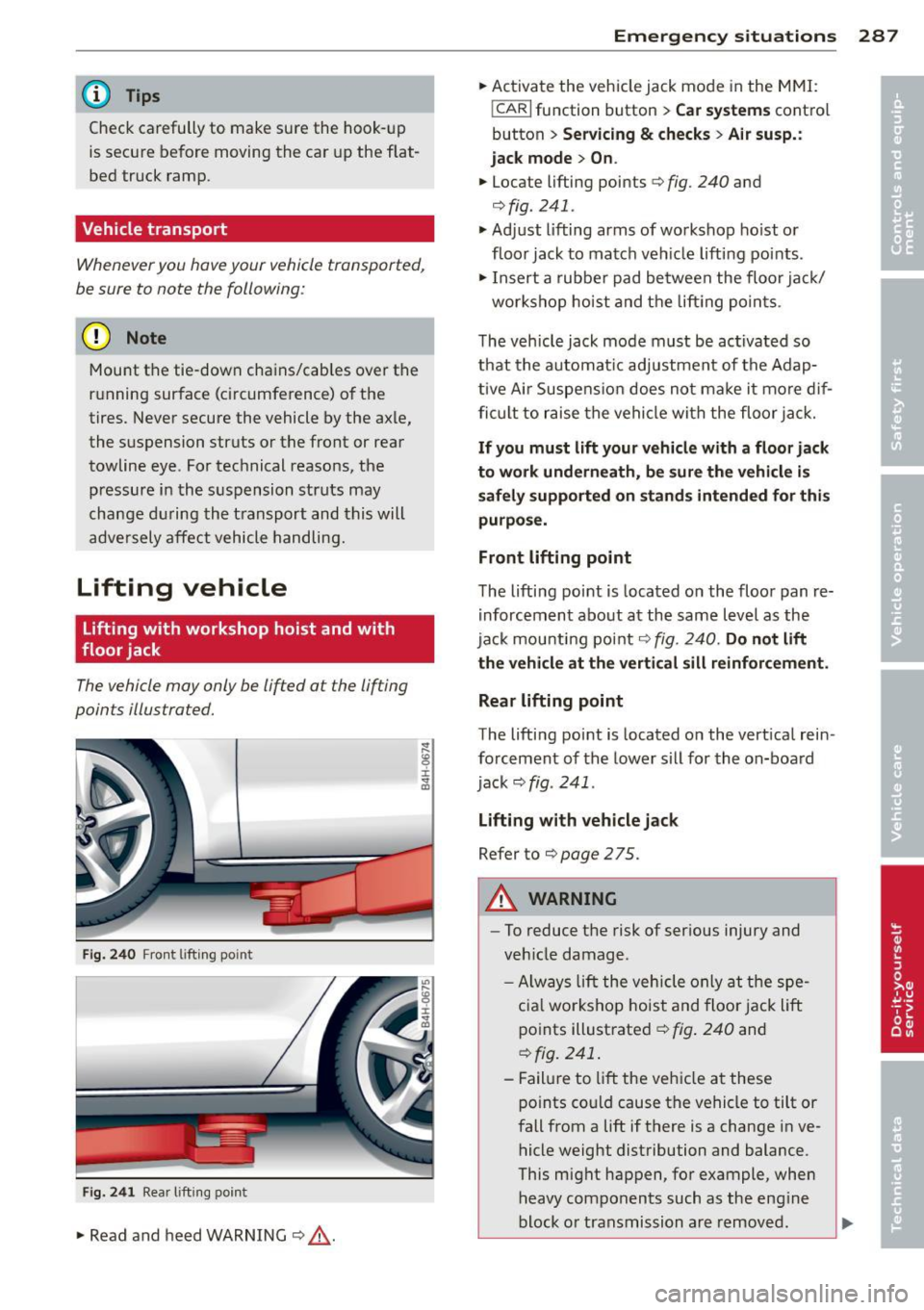
The vehicle may onl y be li~ed at the lif ting
points illu stra ted.
Fi g. 2 40 Front l ift ing po int
Fig. 2 41 Rea r lifti ng poin t
• Read and heed WARNING Q ,&. .
Emergenc y situ ation s 287
• Activate the vehicle jack mode in the MMI :
!CAR I function button > Ca r system s control
button>
Ser vici ng & ch ecks > Air su sp. :
jack mo de > On .
• Locate lifting poin ts Q fig . 240 and
¢ fig . 241 .
• Adjust lifting arms of wo rkshop hoist o r
floor jack to match veh icle lifting points.
• Insert a rubber pad be tween the floo r jack/
workshop hoist and the lift ing po ints .
The vehicle jack mode must be activated so
that the automat ic adjustment of the Adap
tive Ai r Suspens ion does not make it more dif
fic ult to raise the vehicle with the floor ja ck.
If you mu st l ift your vehicle with a fl oor jack
t o wo rk underneath , be sure the vehi cle i s
s af ely s upported on stand s intended for thi s
purpose.
Front lifting point
The lifting point is located on the floor pan re
i nforcement about at the same leve l as the
jac k mounting point
c:> fig . 240 . Do not lift
t h e v ehi cle at the verti cal sill reinf orcement .
Rear lifting point
The lifting point is located o n the vert ical rein
forcement of the lower sill for the on-board
jack ¢
fig. 241 .
Lifting with vehicle jack
Refer to ¢ page 275.
&_ WARNING ,-~
-To reduce the risk of serious injury and
vehicle damage .
- Always lift the vehicle only at the spe
c ia l workshop ho ist and floor jack lift
points illustrated
c:> fig . 240 and
c:> fig. 241 .
- Failure to lift the vehicle at these
po ints could cause the vehicle to tilt or
fall from a lift if there is a change in ve
hicle weight distribution and balance .
This might happen, for example, when h eavy components such as the eng ine
block or transmission are removed.
Page 300 of 314
298 Index
Operation . . . . . . . . . . . . . . . . . . . . . . . . . 80
Setup ..... ................ ..... .. 82
Automatic climate control system
synchron izing .......... .. .. .. .. .. .. 81
Automatic transmission . .. .. .. .. .. .. . 116
Automatic transmission (tiptronic) Emergency mode . . . . . . . . . . . . . . . . . . 120
Kick -down . . . . . . . . . . . . . . . . . . . . . . . . 119
Manual shifting .......... .. .. .. .. . 119
Parking lock emergency release . .. .. . 121
Selector lever positions . . . . . . . . . . . . . 116
Automatic wipers .................. .. S3
Auto Safety Hotline . . . . . . . . . . . . . . . . . 143
Average consumption ........... .. .. .. 25
Average speed . . . . . . . . . . . . . . . . . . . . . . . 25
Avoid damaging the vehicle ...... .. .. . 209
B
Battery . . . . . . . . . . . . . . . . . . . . . . . . . . . 243
Charging . .. ................ ... .. . 245
I mportant warnings .......... .. .. . 243
L ocat ion . . . . . . . . . . . . . . . . . . . . . . . . . 243
low ... .. .. .. . .......... .. .. .. .. . 204
Replacing the battery . . . . . . . . . . . . . . 246
State of charge ............ ... .... . 204
Winter operation .......... ... .... . 243
Working on the battery .... .. .. .. .. . 243
Before driving ........... .. .. .. .. .. . 135
Blended gasoline . ...... ... .... .. .. . 222
Blower (automatic climate control) . ... .. 81
Booster seats .............. ... .. ... 185
Brake fluid Changing the brake fluid ... .. .. .. .. . 242
Check ing the brake fluid level ... .. .. . 242
What is the correct brake fluid level? .. 242
What should I do if the brake fluid warn-
ing light comes on? ..... .. .. .. .. .. . 242
Brake system Anti-lock braking system ... .. .. .. .. . . 19
Brake assist system ......... .. .. ... 199
Brake booster . .. ...... .... ... .. .. . 203
Brake fluid .............. .... ..... 242
Brake fluid spec ificat ions for refill and re
p la cement . . . . . . . . . . . . . . . . . . . . . . . 242
Brake light defective ....... ... .... . . 22
Brake pads ............... ... .... . 207
Electromechanica l parking brake .. .. . . 86 Fluid
reservoir ... ................ . 242
How does moisture or road salt affect the
brakes? .......................... 201
Warning/indicator lights ........ .... . 14
Worn brake pads symbol . . . . . . . . . . . . . 20
braking guard Messages ..... .. ............. .... 101
Braking guard . .. .. ... .......... .. .. . 94
Settings .. .... ............... .... 101
Break-in period .. .. ... .......... .. .. 207
Brake pads .. .. .. .......... ... .. .. 207
Tires ...... ... .. .. ........ ... .. .. 207
Bul bs .. .... .... ................... 282
C
California Proposition 65 Warning ..... 232
Battery specific . . . . . . . . . . . . . . . . . . . 24S
Capacities .. .. .. . .............. .. .. 290
Engine oil ..... .. ... .......... .. .. 234
Carbon parts Cleaning . . . . . . . . . . . . . . . . . . . . 218,219
Car carrier Transporting your vehicle ....... .... 287
Care ... .... .... ............... .... 216
Cargo area
refer to Luggage compartment . .. .. .. 141
Catalytic converter . ................. 208
Center armrest
Cockpit ........................... 61
Rear ............................. 68
Central locking .. .. ... ........... ... . 33
Emergency locking .. ........... .... . 37
Certification .. .. .. ............. .. .. 29S
Changing a wheel .. ............. .... 272
Chang ing engine oil ....... ...... .. .. 238
Checking Engine coolant level . ........... .. .. 240
Tire pressure .................... .. 254
Child restraints Danger of using child restraints in the
front seat . ................... .... 15S
Where can I get additional information
about child restraints and their use? .. 196
Child restraint system anchors ..... ... 190