transmission AUDI S8 2014 User Guide
[x] Cancel search | Manufacturer: AUDI, Model Year: 2014, Model line: S8, Model: AUDI S8 2014Pages: 314, PDF Size: 78.47 MB
Page 122 of 314
![AUDI S8 2014 User Guide 120 Automatic Transmission
8_ WARNING
Please note that the wheels could spin on
slick or slippery roads when kick-down is
active .
Transmission malfunction
[O] Transmission: plea se](/img/6/57613/w960_57613-121.png "AUDI S8 2014 User Guide 120 Automatic Transmission
8_ WARNING
Please note that the wheels could spin on
slick or slippery roads when kick-down is
active .
Transmission malfunction
[O] Transmission: plea se")
120 Automatic Transmission
8_ WARNING
Please note that the wheels could spin on
slick or slippery roads when kick-down is
active .
Transmission malfunction
[O] Transmission: plea se press the brake ped
al and select the position again
Press the brake pedal and select the des ired
selector lever posit ion again . You can then
continue dr iving .
[O] Transmission hot: please modify driving
style
The transmission temperature has increased
significantly due to the sporty driving manner.
Drive in a less sporty manner until the tem
perature returns to the normal range and the
indicator light switches of.
[O] Gearbox malfunction: you can continue
driving
There is a system ma lfunction in the transmis
sion. You may continue driving. Drive to your
authorized Audi dealer or qualified repair fa
cility soon to have the malfunction corrected.
l'i]Jffl Gearbox malfunction: you can contin
ue driving in D only until engine is off
There is a system ma lfunction in the transmis
sion. The transmission is switching to emer
gency mode. If you turn the engine off, you
will not be able to select any other selector
lever positions after starting the engine again.
Drive to your authorized Aud i dealer or quali
fied repair facility immediately to have the
malfunction corrected.
[O] Gearbox malfunction: you can continue
driving (limited functionality)
There is a system ma lf u nction in the transmis
sion. The transmission is switching to emer
gency mode. Th is mode only shifts into cer
tain gears or will not longer shift at all. The
engine may stall. Dr ive to your authorized
Aud i dealer or qualified repair facility immedi
ately to have the malfunction corrected.
[O]/jj'j Gearbox malfunction: no reverse gear
(y ou can continue driving)
The re is a system malfunction in the transmis
s ion. The transm ission is swi tching to emer
gency mode. This mode on ly shifts into cer
tain gears or will not longer shift at al l. You
cannot engage the reverse gear . Dr ive to your
authorized Aud i dea ler immediately to have
the malfunction corrected.
[O] Vehicle may roll! Cannot shift to P. Please
apply parking brake
-The parking lock was re leased using the
emergency release
¢page 121. Or
- The parking brake cannot engage automati
cally. Drive to your authorized Audi dea ler or
qualified repair facility immediately to have
the malfunction corrected.
[O] Gearbox malfunction: Stop and shift to P
Do not continue dr iving . Select the P selector
lever position and see your author ized A udi
dealer or qualified repair faci lity for assis
tance.
Page 123 of 314
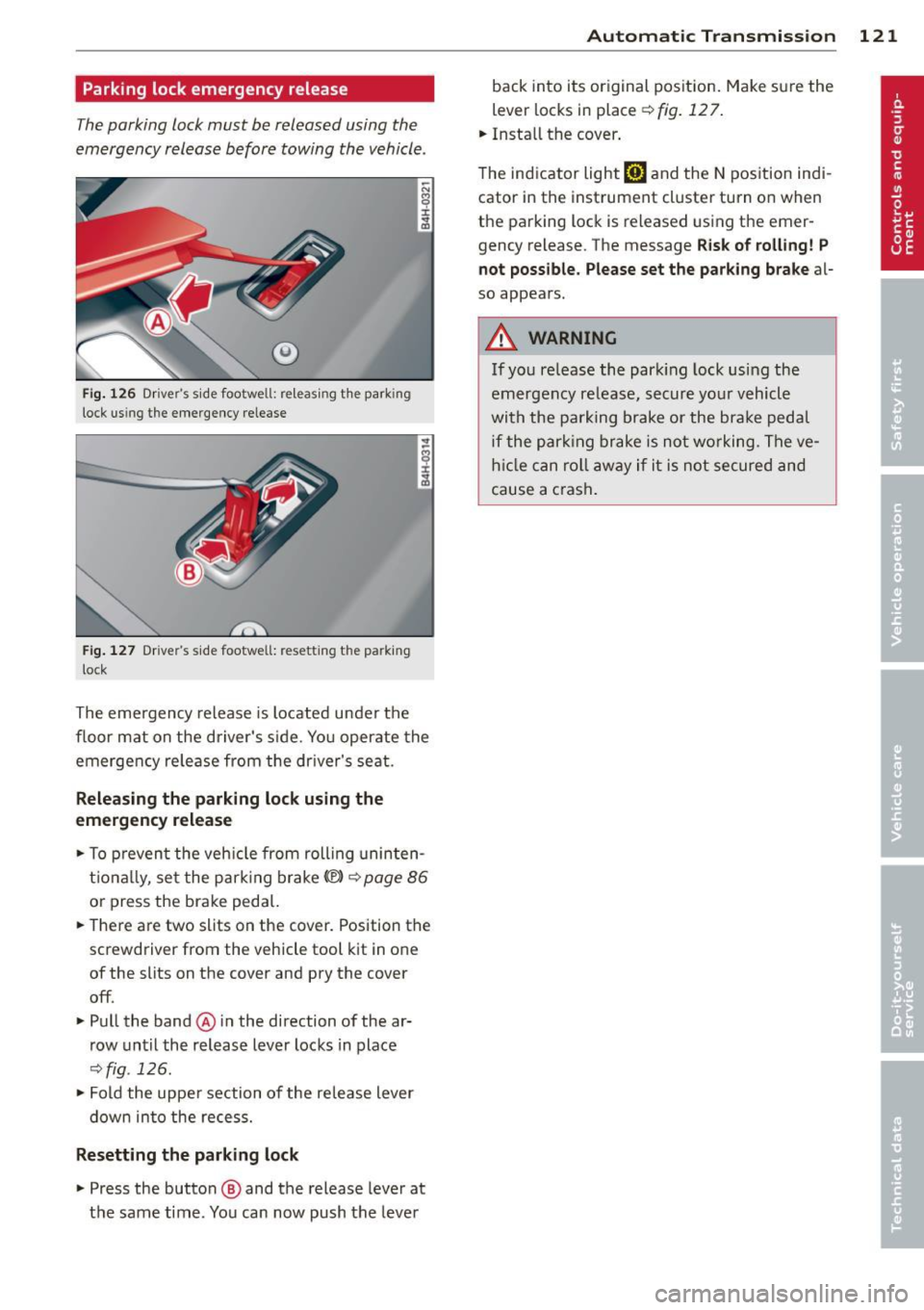
Parking lock emergency release
The parking lock must be released using the
emergency release before towing the vehicle .
®
Fig. 126 Driver's s ide footwell: re lea sing t he park ing
lock us ing the emergency release
Fig. 127 Drive r's s ide footwell: resettin g th e pa rk ing
lock
The emergency release is located under the
f loor mat on the driver's s ide. You operate the
emergency re lease from the driver's seat.
Releasing the parking lock using the
emergency release
.,. To prevent the vehicle from rolling uninten
tionally, set the parking brake
«e)) q page 86
or press the brake peda l.
.,. There are two slits on the cover. Position the
screwdriver from the vehicle tool kit in one
of the slits on the cover and pry the cover
off .
.,. Pull the band@ in the direction of the ar
row until the release lever locks in place
qfig . 126 .
.,. Fold the uppe r section of the re lease lever
down into the recess.
Resetting the parking lock
.,. Press the button @ and the release lever at
t h e same time. You can now push the lever
Automatic Transmission 121
back into its original position. Make sure the
lever locks in place ~
fig. 12 7.
.,. Install the cover .
T he indicator light
[O] and the N position indi
cator in the instrument cluster turn on when
the parking lock is released using the emer
gency release. The message
Risk of rolling! P
not possible. Please set the parking brake
al
so appears .
.&_ WARNING
If you release the park ing lock using the
emergency release, secure your vehicle
with the parking brake or the brake pedal
i f the parking brake is not working. The ve
hicle can roll away if it is not secured and
cause a crash .
Page 204 of 314

202 Intellig ent technol ogy
to have your brake pads inspected can result
in reduced brake performance.
On steep slopes, yo u shou ld use the b rak ing
effect of the engine. Th is way, you prevent un
necessary wear on the brake system. If you
must use your brakes, do not hold the brakes
down continuously. P ump the brakes at inter
vals.
Operating nois e
Noises may occur when braking depending on
the speed, braking force and outside condi
tions such as temperature and humidity.
E ff ect of water and road salt
In certain situat ions, for example after driving
through water , in heavy ra in , after overn ight
condensation or after washing your car, the braking effect can be reduced by moisture or
ice on the brake rotors and brake pads. The
brakes must be dried first with a few careful
brake applications.
At higher speeds and with the windshield wip
ers turned on, the brake pads press against
the brake rotors for a short amount of time.
This occurs at regular intervals without the
driver noticing and provides for bet ter brake
response time under wet condit ions .
The effectiveness of the brakes can be reduced
when the vehicle is dr iven on a salt-covered
road and the brakes are not used . Likew ise,
you clean off accumulated salt coating from
brake discs and pads with a few caut ious ap
plications of the brake
9 .&, .
Cor ro sion
There may be a tendency for dirt to build up
on the brake pads and corrosion to form on
the discs if the car is not dr iven regularly or
only for short t rips with little use of the
b rakes .
If the brakes are not used frequently , or if cor
rosion has formed on the discs, it is advisable
to clean off the pads and discs by braking
firm ly a few times from a mode rately high
speed
9 .&, .
Faults in the brake syste m
If you shou ld notice a sudden increase in
brake pedal trave l, then one of the two brake
circuits may have fai led
9 & .
Low bra ke fluid lev el
Malfunctions can occu r in the bra ke system if
the b rake fluid level is too low. The brake flu id
level is monitored electro nica lly.
Brake lining we ar statu s
Brake lining wear may be checked by visual in
spect ion of the condition of the brake pads
th rough the open ings in the wheel. If neces
sary, the wheel may be removed for t his i n
spect ion
9 page 2 72, Changing a wheel.
A WARNING
- You shou ld perform braking maneuvers
for the purpose of cleaning the brake system only if road conditions permit.
Other road users must not be put at risk -
you may cause an accident!
- Before descending a steep grade, reduce
speed and sh ift transmission into a lower
gear or lower dr iving range. Do not ride
the brakes or hold the pedal down too
long or too often . This could cause the
b rakes to get hot and diminish braking
efficiency.
- Do not "ride the brakes" by rest ing your
foo t on the pedal when you do not intend
to brake. This may cause the brakes to
overheat, premature wear and increased
stopping distance.
- Unde r certain cl imatic and operat ing
conditions such as passing thro ugh wa
ter, driving in heavy rain or after washing
the vehicle, the effectiveness of the brakes can be reduced. In winter, ice can
accumu late on the brake pads, linings,
d iscs and drums. Carefully app ly brakes
for a test. Brakes will dry and ice coat ings will be cleaned off after a few care
fu l brake applicat ions.
- Driving for an extended period of t ime on
salt-covered roads without using your brakes can a lso affect bra king efficiency.
~
Page 209 of 314
Driving and
environment
The first 1
1000
miles
(11500 km) and
afterwards
New engine
The engine needs to be run-in during the first
1,000 miles (1 ,500 km) .
For the first 600 mile s (1,000
kilometers ):
.,. Do not use full throttle.
.,. Do not drive at engine speeds that are more
than 2/3 of the max imum permitted RPM .
.. Avoid high engine speeds .
From 600 to 1,000 mile s (1 ,000 to
1,500 kilometers):
.. Speeds can gradually be increased to the
maximum pe rm iss ib le road or eng ine speed .
During and after break-in per iod
.,. Do not rev the engine up to high speeds
when it is cold. This applies whether the
transmission is i n N (Neutra l) or in gear.
After the break- in peri od
.. Do not exceed maximum engine speed un
der any circumstances.
.,. Upshift into the next higher gear
before
reaching the red area at the end of the tach
ometer scale
¢page 10.
During the first few hours of driving, the en
g ine's interna l friction is higher than later
when all the moving parts have been broken
i n. How well this break-in p rocess is done de
pends to a considerable extent on the way the
ve hicl e is driven du ring the first 1,000 miles
(1,500 ki lome ters).
(D Note
Extremely h igh engine speeds are auto
mat ica lly reduced. However, t hese rpm
lim its are progr amme d for an eng ine well
r u n- in, not a new engine .
Driving and environment 207
@) For the sake of the environment
Do not drive with unnecessarily high en
g ine speeds -upshifting ear ly saves f uel,
reduces noise and protects the environ
ment.
New tires
If your vehicle is running on new tires, drive
particularly caref ul for the first 350 miles
(500 kilomete rs) afte r fitt ing.
.&, WARNING
N ew tires tend to be sl ippery and mus t al
so be "b roken -in" . Be sure to remember
this dur ing the f irst 350 m iles (500 kilo
meters) . Brake gently . Avoid fo llowing
closely behind other vehicles or other sit
uations that m ight require sudden, hard
b raking .
New brake pads
Remember that new brake pads do not have a
full brak ing effect dur ing the first 250 m iles
(400 ki lomete rs) afte r they are installed.
New brake pads have to be "broken in" before
they have optima l grab ¢,&. .
D uring the brea k-in period, yo u should avo id
putting severe loads on the brakes. Severe
l oads include , for example, sudden hard brak
i ng, in particular at very h igh speeds or, for
example, on mounta in passes .
.&, WARNING
New b rake pads don't have the best stop
p ing power and must be "broken-i n" dur
ing the initi al 100 to 150 miles (150 to
2 00 kilometers) o f no rma l ci ty driving . You
can compensate for this by pressing the b rake peda l more fi rm ly . This also applies
later when new pads are installed.
•
•
Page 211 of 314
A WARNING ,~
- Do not park your vehicle over flammable
materials such as grass or leaves because
the high temperature of the diesel par
t icu late filter cou ld start a fire .
- Do not apply an underbody protectant in the exhaust system area or a fire could start .
Shutting down vehicle
If you would like your veh icle to remain inop
erat ive for a longer period of time, contact an
Aud i or other specia lized dealer. They can ad
vise you on necessary precautions e.g . corro
sion prevention, ma intenance and storage.
Pay attention to additiona l information con
cerning the battery. Refer to~
page 243.
Avoid damaging the
vehicle
When you a re driving on poor roads, or over
curbs, steep ramps, etc., make certain that low-lying parts such as spoilers and exhaust
system parts do not bottom out and get dam
aged.
This is especially true for vehicles with low
slung chassis (sports chassis)* and fully load
ed vehicles.
Driving through water
on roads
Note the following to avoid vehicle damage
when driving through water, for example on
flooded roads :
- The water must not be any higher than the
bottom of the veh icle body.
- Do not drive faster than wa lking speed.
A WARNING
After driving through water, mud, slush,
etc., the brakes may be slow to take effect
because of wet brake rotors and pads. Dry
-
Drivin g and environment 209
the brakes first by braking carefully to re
store the full braking effect.
(D Note
- Vehicle components such as the engine,
transmission, suspension or electrical
system can be severely damaged by driv
ing through water.
- Always switch off the Start-Stop-System
when driving through water~
page 88.
(D Tips
-Check the depth of the water before driv
ing through it .
- Do not stop the vehicle, drive in reverse
or switch the engine off when driving
through water.
- Keep in mind that oncoming vehicles may create waves that raise the water
level and make it too deep for your vehi
cle to drive through safely .
- Avoid driving through salt water because
it can cause corrosion.
Operate your vehicle
economically and minimize pollution
General
Your personal style of driving will determine
t he economy of your vehicle , as well as ex
haus t and noise levels.
Fuel economy, environmental impact, and
wear on your engine, brakes and tires largely
depend on three factors:
- your personal driving style
- operating conditions
- technical limitations
If you ant icipate what you need to do next and
drive econom ically, you can easily cut your
fuel consumpt ion by 10-15 percent . Th is sec
tion w ill give you some tips on how you can
help the env ironment and your pocketbook. •
•
Page 251 of 314
-Never mount used tires on yo ur vehicle if
yo u are not sure of their "previous histo
ry." Old used tires may have been dam
aged even though the damage cannot be
seen that can lead to sudden tire failure
and loss of vehicle control.
- If you notice unusual vibration or if the
vehicle pulls to one side when d riving, al
ways stop as soon as it is safe to do so
and check the wheels and tires for dam
age .
(D Note
Please note that summe r and wi nte r tires
are designed for the cond itions that are
Glossary of tire and loading terminology
Accessory weight means the comb ined weight (in excess of
those sta ndard items which may be rep laced)
of au toma tic transmission, power steer ing ,
power brakes, power windows, power seats,
radio, and heater, to the extent that these
items are availab le as factory-installed equip
ment (whether installed or not) .
Aspect ratio
means the rat io o f the height to the w idth of
the tire in percent . Numbers of 55 or lower in
dicate a low sidewall for improved steering re
sponse and better overa ll handling on dry
pavement .
Bead
means the part of the t ire t hat is made o f
steel wires, wrapped or reinforced by ply cords
and that is shaped to fit the r im.
Bead separation
means a b reakdown of the bond between
components in the bead .
Cord means the strands forming the plies in the
tire.
Tire s an d wheel s 249
typica l in those seasons . Aud i recommends
using winter tires during the winter
months . Low temperatures signif icant ly
dec rease the e lasticity of summer t ires,
which affects tract ion and brak ing ability.
If summer t ires are used i n very co ld tem
peratures, cracks ca n form o n the tread
bars , res ulting in perma nen t tire damage
that can cause loud driving noise and un
bala nced ti re s. Audi i s not respon sible for
th is type of damage .
Cold tire inflation pressure
means the t ire p ress ure recommended by t he
vehicle manufacture r fo r a tire o f a des ignated
s ize t hat has not bee n driven for more than a
coup le o f miles (k ilometers) at low speeds in
the three hour period before the tire press ure
is m easured or adjusted.
Curb weight
me ans the we ight of a motor ve hicle with
st andard equipmen t incl ud ing the max imum
capacity of fuel, oi l, and coolant, air condi
tioning and additional weig ht of optiona l
equipment.
Extra load tire
means a t ire design to oper ate a t higher load s
and at higher inflation pressures than the cor
responding standa rd tire . Extra load tires may
be identified as "XL", "x l", "EXTRA LOAD", o r
"RF" on the sidewal l.
Gross Axle Weight Rating ("GAWR")
me ans the load-ca rry ing capac ity of a single
axle system , measured at the tire -ground in
te rfaces.
Gross Vehicle Weight Rating ( "GVWR ")
mea ns the maximum total loaded we ight of
the ve hicl e. .,..
•
•
Page 274 of 314
272 What do I do now ?
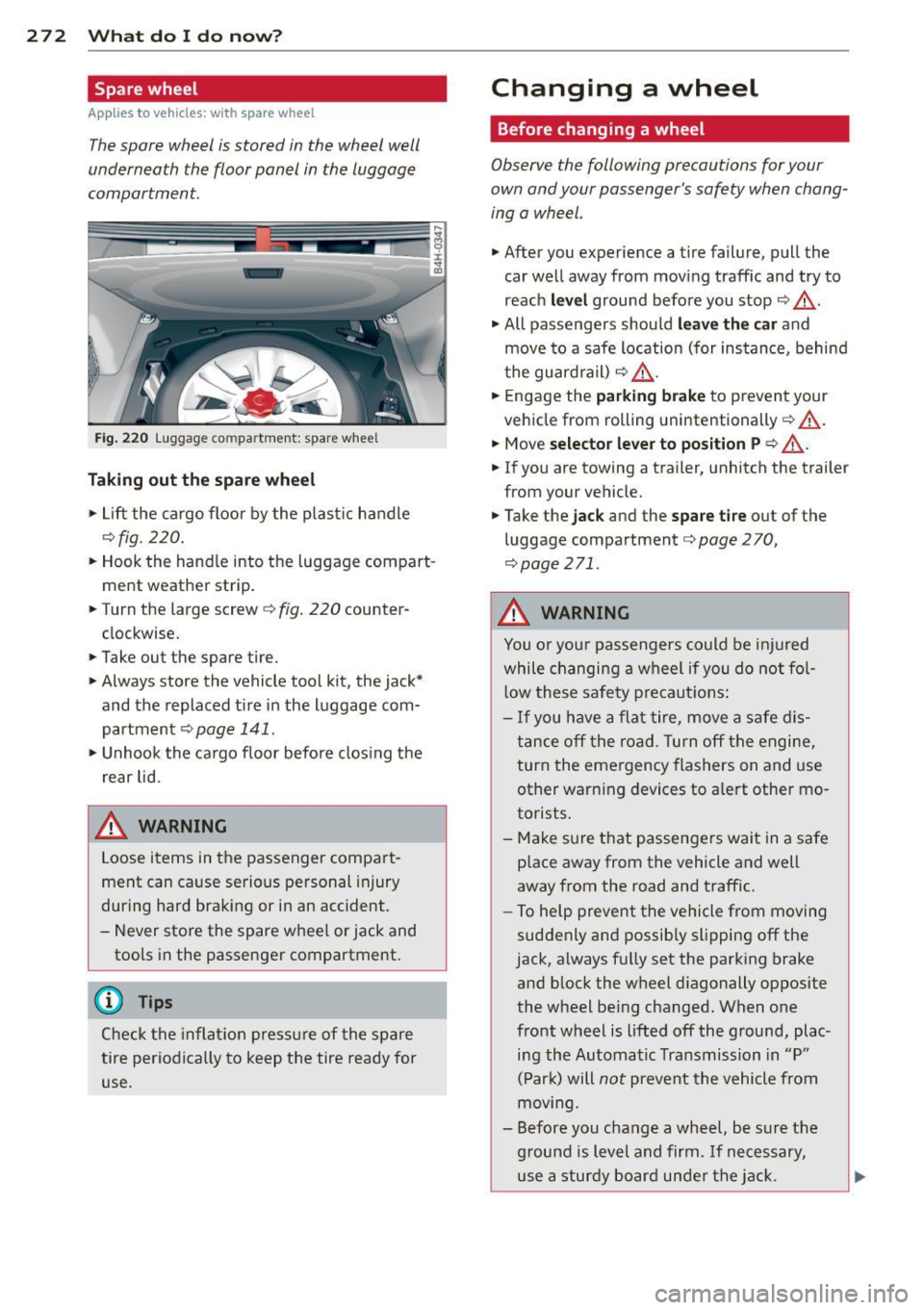
Spare wheel
App lies to vehicles: with spare wheel
The spare wheel is stored in the wheel well
underneath the floor panel in the luggage
compartment.
Fig. 220 L uggage compartment: spare wheel
Taking out the spare wheel
.,. Lift the cargo floor by the plastic handle
¢fig. 220.
.. Hook the hand le into the luggage compart
ment weather strip .
.. Turn the large screw¢
fig. 220 counter
clockwise.
.. Take out the spare tire.
.. Always store the vehicle tool kit, the jack*
and the replaced tire in the luggage com
partment ¢
page 141.
.,. Unhook the cargo floor before closing the
rear lid.
&_ WARNING
-
Loose items in the passenger compart
ment can cause serious personal injury
during hard braking or in an accident.
- Never store the spare wheel or jack and
tools in the passenger compartment.
(D Tips
Check the inflat ion pressure of the spare
tire periodically to keep the tire ready for
use.
Changing a wheel
Before changing a wheel
Observe the following precautions for your
own and your passenger's safety when chang
ing a wheel.
.. After you experience a tire failure, pull the
car well away from moving traffic and try to
reach
level ground before you stop ¢ .&_ .
.. All passengers should leave the car and
move to a safe location (for instance, behind
the guardra il)¢ .&_ .
.. Engage the
parking brake to prevent your
vehicle from rolling unintentionally¢ .&_.
.. Move
selector lever to position P ¢ A .
.. If you are towing a trailer, unhitch the trailer
from your vehicle .
.,. Take the
jack and the spare tire out of the
luggage compartment¢
page 270,
¢page 271.
&_ WARNING
You or you r passengers could be injured
while changing a wheel if you do not fol
l ow these safety precautions:
-If you have a flat tire, move a safe dis
tance off the road. Turn off the engine,
turn the emergency flashers on and use
other warning devices to alert other mo
torists .
- Make sure that passengers wait in a safe
p lace away from the vehicle and well
away from the road and traffic.
- To help prevent the vehicle from moving
suddenly and possib ly slipping off the
jack, always fully set the parking brake
and block the wheel d iagonally opposite
the wheel be ing changed. When one
front wheel is lifted off the ground, plac ing the Automatic Transmission in "P"
(Par k) will
not prevent the vehicle from
mov ing.
- Before you change a wheel, be sure the
g rou nd is level and firm. If necessary,
use a sturdy board under the jack.
-
Page 281 of 314
Fuse pa nel @ (brown )
No . Equipment
1 Headlight contro
l switch
2 Emergency
start coil (key
i dentification)
3 Rear door
control module
(driver's side)
5 Horn
6 Interior
lights (headliner)
Steer ing column leve r, mul-
8
tifunction steering wheel
controls, steering wheel
heating
10 E
lectric steering column
l ock
11 Driver door
control module
12 D
iagnostic connector, light/
rain sensor
14 Powe
r steering column ad-
justment
15 Power steering, A/C com-
presser
16 Brake booster
Fu se p anel © (black )
No. Equipment
1 Front seat heating
2 Windshield
wiper
3 Front exte rior lighting
4 Sun roof
5 D river power window
6 Driver
seat (pneumatic)
7 Pano ramic sunroof
8 Dynamic
steering
9 Front exterior lighting
10 W
indshield/headlight wash-
er system
11 Rear power
window (driver's
side)
12 Panoramic sunroof
Amp s
5
5
7,5 15
7,5
10/5
5
7,5
10
25
20 15
Amp s
30
30 30
20
30
7,5 20
35
30
35
30
40
Fu ses and bulb s 2 79
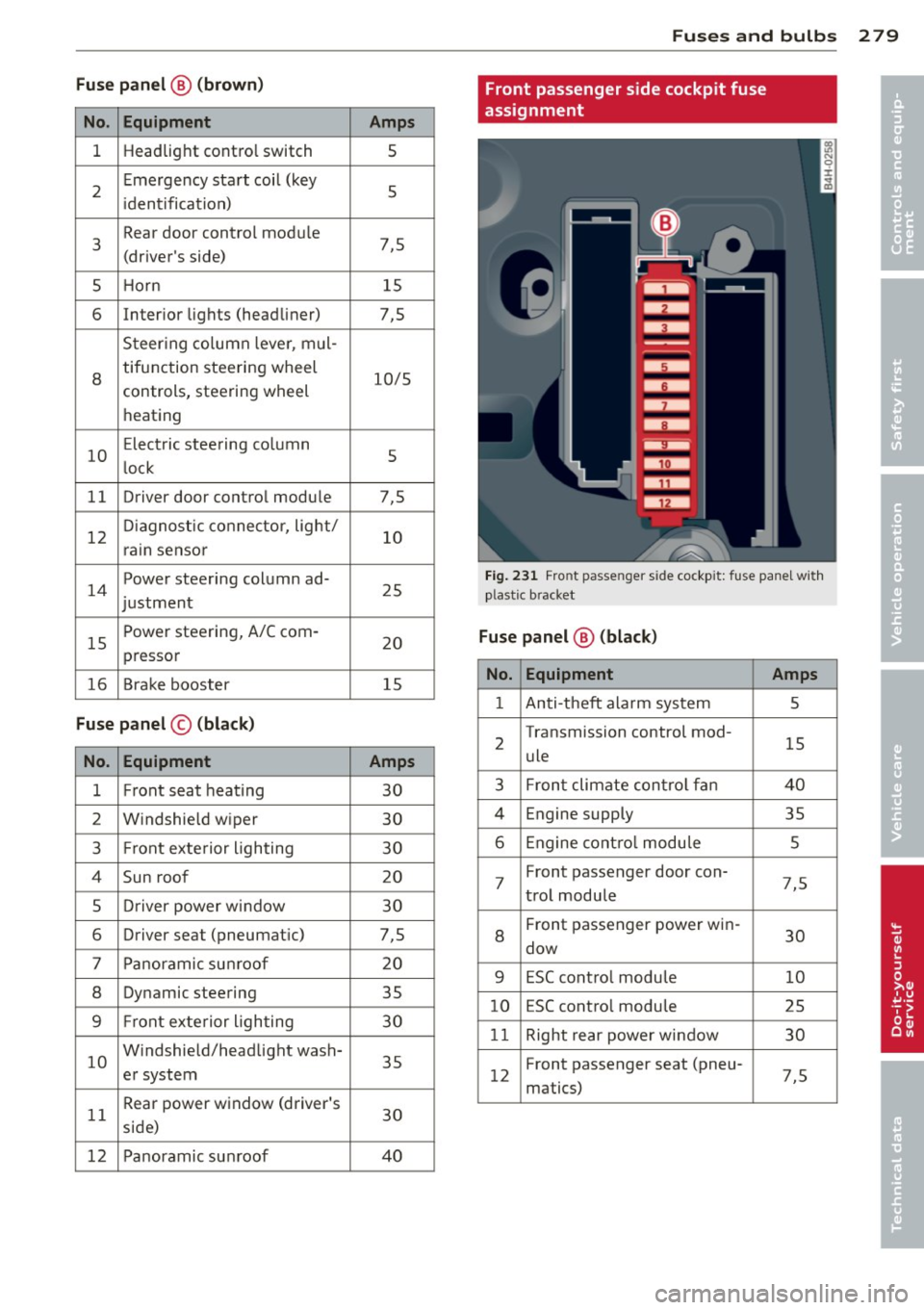
Front passenger side cockpit fuse
assignment
Fig . 231 Front passenger side cockpit: f use pane l with
plast ic bracket
Fu se panel @ (bl ac k)
No. Equipment Amps
1 Anti-theft alarm system 5
2 Transmission control
mod-
15
ule
3 Front climate control fan
40
4 Engine supply 35
6 Engine cont ro l modu le 5
7 Front
passenger door con-
7,5
trol module
8
Front passenger power win-
30
dow
9 E5C contro l module 10
10 ESC
contro l modu le
25
1 1 Right rear power window 30
1 2 Front
passenger seat (pneu-
7,5
matics)
•
•
Page 286 of 314
284 Emergency situations
@ Tips
-The discharged battery must be properly
connected to the vehicle's electrical sys
tem. When jump starting or charging the
battery, never connect the negative
ground cable to the battery negative
post because the battery manager sys
tem must be able to detect the battery's
state of charge . Always connect the neg
ative ground cable to the negative
ground post of the battery manager con
trol unit.
Use of jumper cables
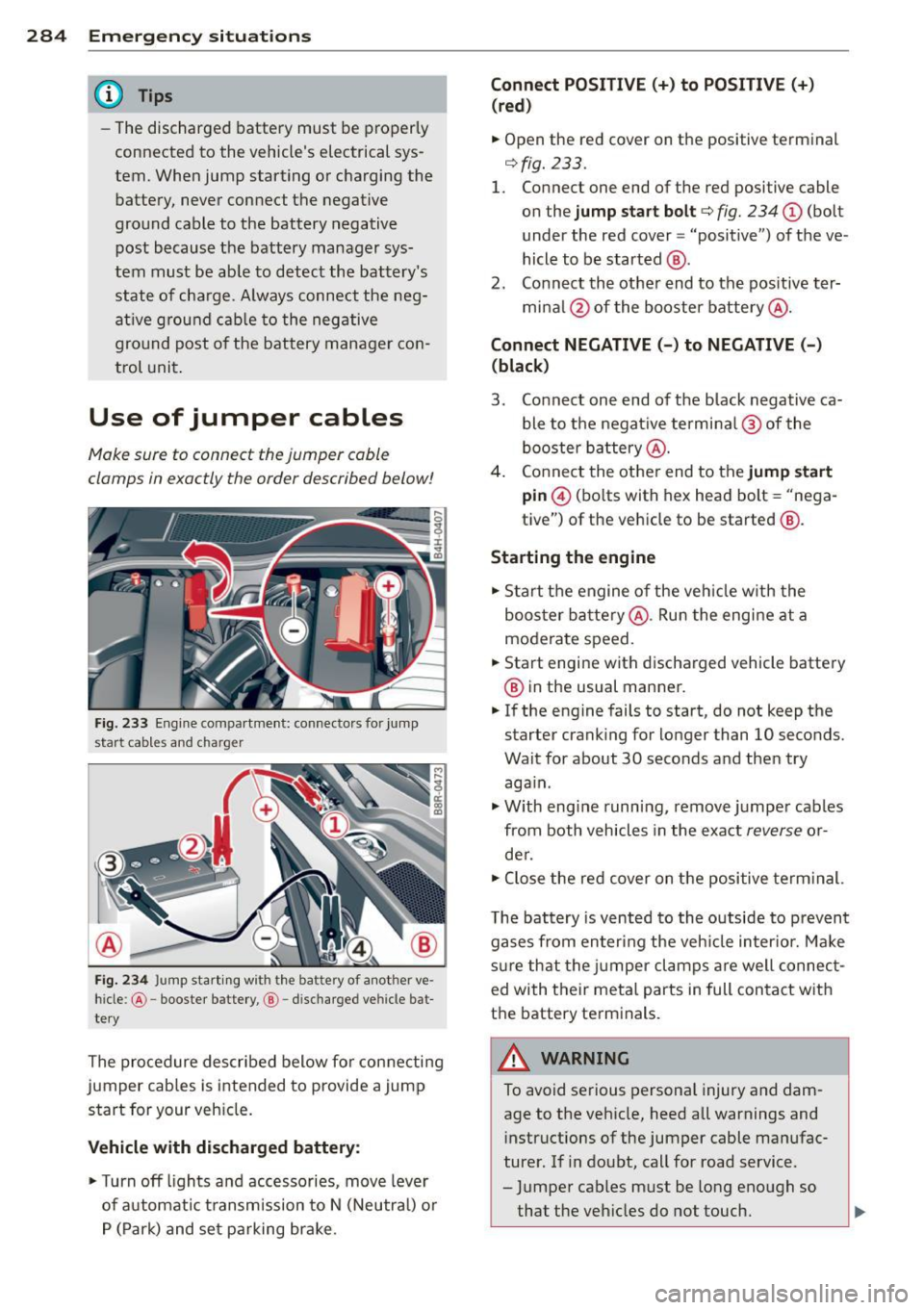
Make sure to connect the jumper coble
clomps in exactly the order described below!
Fig . 233 Engine co mpartment: connecto rs fo r jump
star t cab les and c harg er
Fig. 234 Ju m p sta rt in g w it h the ba ttery of anot her ve
h icle :@ - booster battery, @-discharge d ve hicle bat
tery
The procedure described below for connecting
jumper cables is intended to provide a jump
start for your vehicle.
Vehicle with discharged battery:
•Turnoff lights and accessories, move lever
of automatic transmission to N (Neutral) or
P (Park) and set parking brake.
Connect POSITIVE(+) to POSITIVE(+)
(red)
• Open the red cover on the pos itive terminal
¢ fig. 233 .
1. Connect one end of the red positive cable
on the
jump start bolt c::;, fig. 234 @ (bolt
under the red cover = "positive ") of the ve
hicle to be started @.
2. Connect the other end to the positive ter-
mina l@ of the booster battery@.
Connect NEGATIVE (-) to NEGATIVE (-)
(black)
3. Connect one end of the black negative ca
ble to the negat ive terminal @ of the
booster battery @.
4. Connect the other end to the
jump start
pin © (bolts with hex head bolt= "nega
tive") of the vehicle to be started @.
Starting the engine
• Start the engine of the veh icle w ith the
booster battery@. Run the engine at a
moderate speed.
• Start engine with discharged vehicle battery
@ in the usual manner.
• If the engine fails to start, do not keep the
starter cranking for longer than 10 seconds.
Wait for about 30 second s and then try
aga in.
• With engine running, remove jumper cables
from both vehicles in the exact
reverse o r
de r.
• Close the red cover on the positive term inal.
T he battery is vented to the outside to prevent
gases from entering the veh icle inter ior. Make
sure that the jumper clamps are well connect
ed with their metal parts in full contact with
the battery terminals.
_& WARNING
To avoid serious personal injury and dam
age to the vehicle, heed all warnings and
instructions of the jumper cable manufac
turer. If in doubt, call for road service.
- Jumper cables must be long enough so
that the veh icles do not touch.
-
Page 289 of 314
@ Tips
Check carefully to make sure the hook-up
is secure before moving the car up the flat
bed truck ramp .
Vehicle transport
Whenever you hov e your vehicle transported,
be sure to note the following :
(D Note
Mount the tie-down chains/cables over the
running surface (circumference) of the
tires. Never secure the vehicle by the axle,
the suspension struts or the front or rear
towline eye . For technical reasons, the
pressure in the suspension struts may
change du ring the transport and this will
adve rsely affect vehicle handling.
Lifting vehicle
Lifting with workshop hoist and with
floor jack
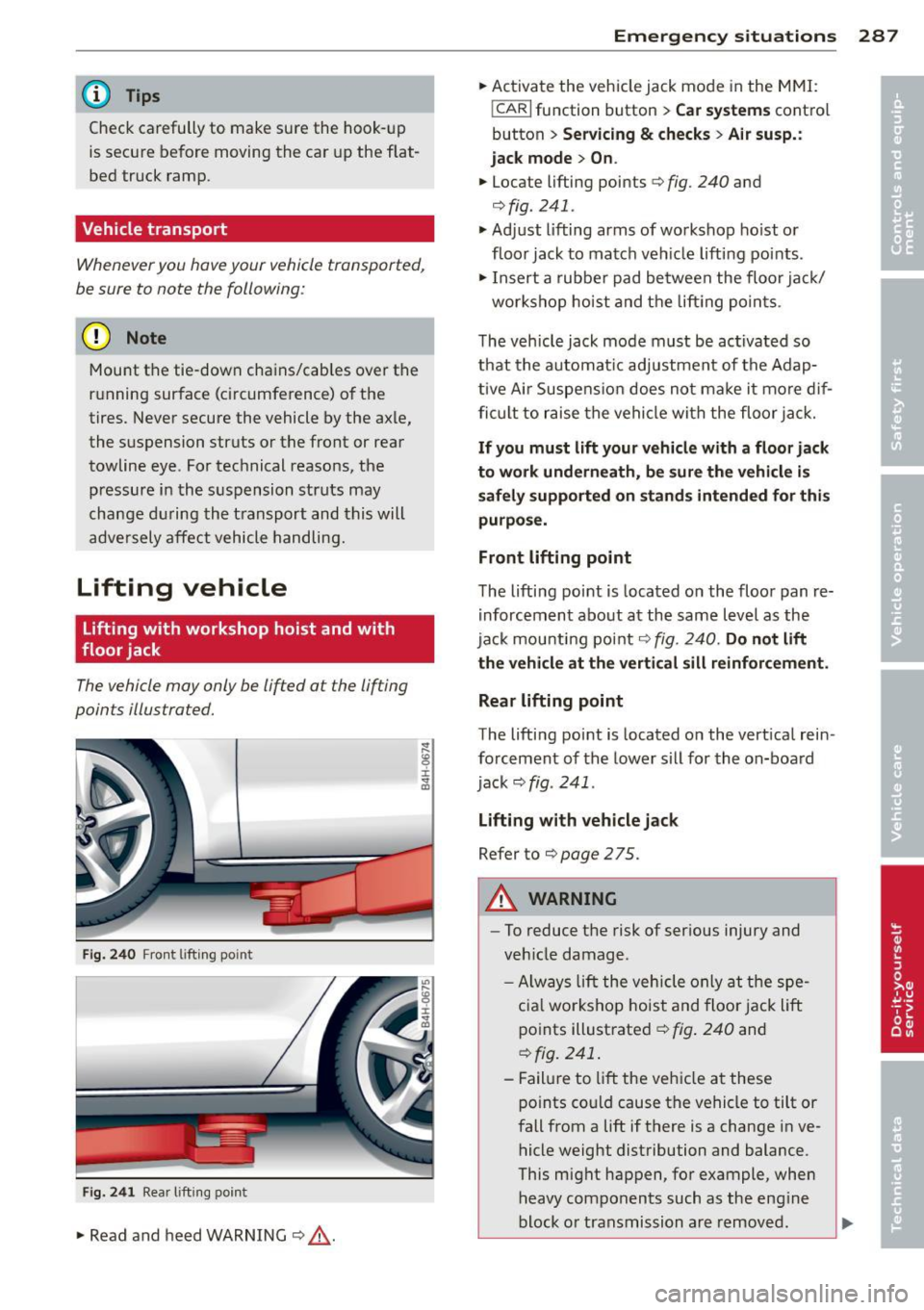
The vehicle may onl y be li~ed at the lif ting
points illu stra ted.
Fi g. 2 40 Front l ift ing po int
Fig. 2 41 Rea r lifti ng poin t
• Read and heed WARNING Q ,&. .
Emergenc y situ ation s 287
• Activate the vehicle jack mode in the MMI :
!CAR I function button > Ca r system s control
button>
Ser vici ng & ch ecks > Air su sp. :
jack mo de > On .
• Locate lifting poin ts Q fig . 240 and
¢ fig . 241 .
• Adjust lifting arms of wo rkshop hoist o r
floor jack to match veh icle lifting points.
• Insert a rubber pad be tween the floo r jack/
workshop hoist and the lift ing po ints .
The vehicle jack mode must be activated so
that the automat ic adjustment of the Adap
tive Ai r Suspens ion does not make it more dif
fic ult to raise the vehicle with the floor ja ck.
If you mu st l ift your vehicle with a fl oor jack
t o wo rk underneath , be sure the vehi cle i s
s af ely s upported on stand s intended for thi s
purpose.
Front lifting point
The lifting point is located on the floor pan re
i nforcement about at the same leve l as the
jac k mounting point
c:> fig . 240 . Do not lift
t h e v ehi cle at the verti cal sill reinf orcement .
Rear lifting point
The lifting point is located o n the vert ical rein
forcement of the lower sill for the on-board
jack ¢
fig. 241 .
Lifting with vehicle jack
Refer to ¢ page 275.
&_ WARNING ,-~
-To reduce the risk of serious injury and
vehicle damage .
- Always lift the vehicle only at the spe
c ia l workshop ho ist and floor jack lift
points illustrated
c:> fig . 240 and
c:> fig. 241 .
- Failure to lift the vehicle at these
po ints could cause the vehicle to tilt or
fall from a lift if there is a change in ve
hicle weight distribution and balance .
This might happen, for example, when h eavy components such as the eng ine
block or transmission are removed.